Non-Bloch band theory of boundary-controlled magnon edge modes in an antiferromagnetic chain
Pith reviewed 2026-06-27 15:29 UTC · model grok-4.3
The pith
A non-Bloch winding number on a generalized Brillouin zone predicts magnon edge modes in antiferromagnetic chains where standard invariants are trivial.
A machine-rendered reading of the paper's core claim, the machinery that carries it, and where it could break.
Core claim
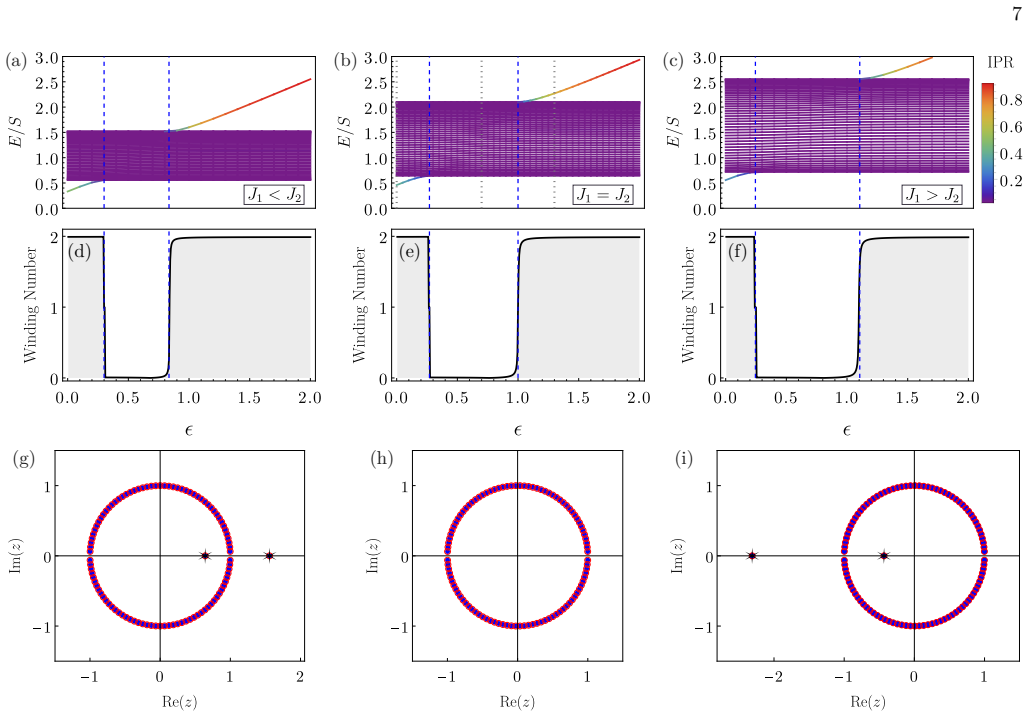
The central claim is that a winding number defined inside the non-Bloch band theory, evaluated on a generalized Brillouin zone for the non-Hermitian dynamic matrix, captures the emergence of magnon edge modes and accounts for their control by boundary perturbations, even though the Bloch winding number is trivial.
What carries the argument
The non-Bloch winding number evaluated over a generalized Brillouin zone contour of the non-Hermitian dynamic matrix from linear spin-wave theory.
If this is right
- Tuning the boundary potential drives the edge modes into or out of the bulk spectrum.
- The non-Bloch winding number correctly forecasts the appearance of these modes.
- Boundary-controlled topological transitions occur and remain experimentally reachable via local Zeeman fields or modified edge anisotropy.
- The framework resolves the mismatch between trivial Bloch invariants and observed boundary modes.
Where Pith is reading between the lines
- Similar non-Hermitian effective descriptions may produce hidden edge modes in other magnetic systems where linear approximations are used.
- The transition points predicted by the non-Bloch winding number could be tested directly by scanning edge potentials in van der Waals antiferromagnets.
- The same construction might apply to chains with different spin magnitudes or additional next-nearest-neighbor couplings without introducing new parameters.
Load-bearing premise
The non-Hermitian dynamic matrix obtained from linear spin-wave theory continues to describe the magnon spectrum accurately once boundary potentials are introduced, and the generalized Brillouin zone contour can be fixed without extra fitting.
What would settle it
Vary the boundary potential in a finite antiferromagnetic chain and check whether the edge modes enter or leave the bulk continuum exactly at the parameter values where the non-Bloch winding number jumps.
Figures

read the original abstract
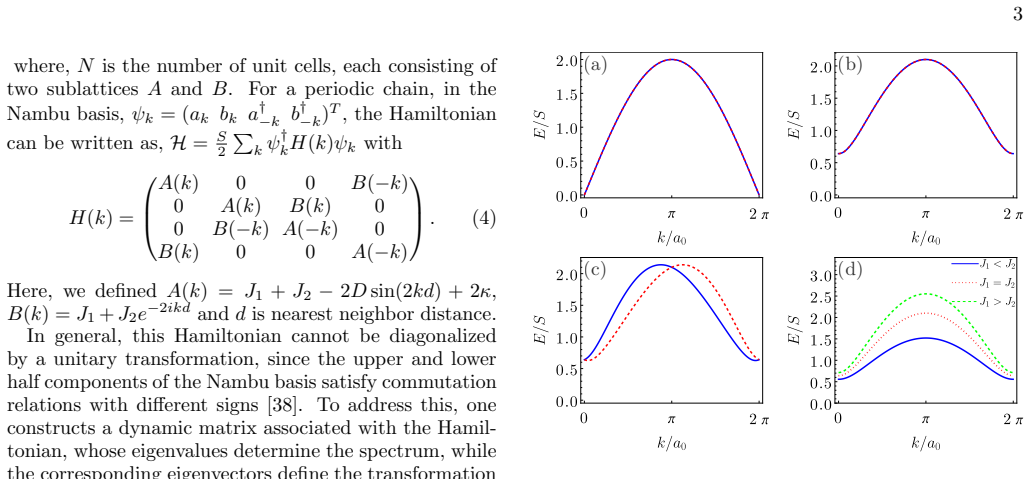
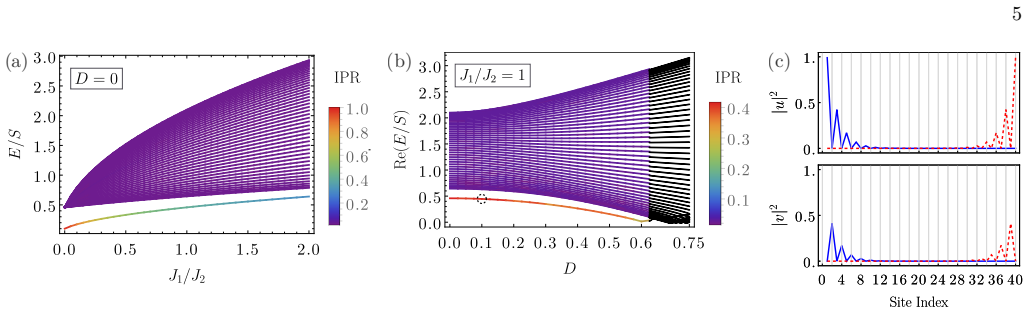
We define a winding number within the Non-Bloch band theory framework that captures the emergence of magnon edge modes in a one-dimensional antiferromagnetic spin chain, even when the conventional Bloch winding number is trivial. Within linear spin-wave theory, magnon excitations are governed by a non-Hermitian dynamic matrix, despite the underlying Hamiltonian being Hermitian. The symmetry classification of this matrix yields a trivial bulk invariant, however, finite systems exhibit boundary-localized modes, signaling a breakdown of the conventional bulk-boundary correspondence. We further show that these edge modes can be controlled via boundary perturbations. By tuning the boundary potential, the modes can be driven into or out of the bulk spectrum. To resolve the bulk-boundary mismatch, we develop a non-Bloch framework based on a generalized Brillouin zone and a winding number that correctly predicts the presence of edge states. Our results establish boundary-controlled topological transitions that are experimentally accessible through local Zeeman fields or modified edge anisotropy in antiferromagnetic van der Waals nanostructures.
Editorial analysis
A structured set of objections, weighed in public.
Referee Report
Summary. The manuscript develops a non-Bloch band theory for magnon excitations in a one-dimensional antiferromagnetic spin chain. Within linear spin-wave theory the dynamic matrix is non-Hermitian; the conventional Bloch winding number is trivial, yet open-boundary spectra contain edge-localized modes. The authors introduce a generalized Brillouin zone (GBZ) contour in the complex β-plane together with an associated winding number that is claimed to restore the bulk-boundary correspondence and to predict the presence or absence of these modes. They further show that local boundary potentials can drive the edge modes into or out of the bulk continuum.
Significance. A parameter-free, bulk-derived non-Bloch invariant that correctly counts magnon edge states would constitute a concrete advance for non-Hermitian topology in magnetic systems and would directly motivate experiments with local Zeeman fields or edge anisotropy in van der Waals antiferromagnets. The manuscript supplies no machine-checked proofs or open-source code, but the claim is in principle falsifiable once the GBZ radius and winding integral are stated explicitly.
major comments (2)
- [Non-Bloch framework / GBZ construction] The central claim that the GBZ contour is fixed solely by the bulk characteristic equation (without reference to open-boundary eigenvalues) is load-bearing for the non-Bloch prediction. The manuscript must demonstrate, with an explicit analytic expression or numerical procedure in the non-Bloch construction section, that the radius satisfying |β1|·|β2|=1 is obtained from the bulk dynamic-matrix entries alone and is not adjusted to match finite-chain spectra.
- [Winding-number definition] The winding-number integral itself must be written out (including the precise contour parametrization and the matrix whose determinant is taken) so that a reader can recompute it from the bulk parameters without any post-hoc fitting. Absence of this expression leaves open whether the reported agreement with edge-mode counts is a priori or calibrated.
minor comments (2)
- [Linear spin-wave theory section] The abstract states that the dynamic matrix is non-Hermitian despite a Hermitian Hamiltonian; a short paragraph in §2 or §3 should recall the explicit Bogoliubov-de Gennes structure that produces the non-Hermiticity.
- [Figure captions] Figure captions should state the precise boundary-potential values used and whether the GBZ radius was held fixed or re-optimized when the boundary term is added.
Simulated Author's Rebuttal
We thank the referee for the careful reading and the specific suggestions that strengthen the presentation of the non-Bloch framework. We address each major comment below and will incorporate the requested explicit constructions into the revised manuscript.
read point-by-point responses
-
Referee: [Non-Bloch framework / GBZ construction] The central claim that the GBZ contour is fixed solely by the bulk characteristic equation (without reference to open-boundary eigenvalues) is load-bearing for the non-Bloch prediction. The manuscript must demonstrate, with an explicit analytic expression or numerical procedure in the non-Bloch construction section, that the radius satisfying |β1|·|β2|=1 is obtained from the bulk dynamic-matrix entries alone and is not adjusted to match finite-chain spectra.
Authors: We agree that an explicit, self-contained derivation from the bulk matrix alone is required. In the revised non-Bloch construction section we will add the following analytic procedure: the dynamic matrix M(β) yields the characteristic polynomial det(M(β) − λI) = a2(λ)β² + a1(λ)β + a0(λ) = 0 whose coefficients depend only on the bulk exchange and anisotropy parameters. The GBZ radius r is then fixed by the condition |β1 β2| = 1, which reduces to r = sqrt(|a0/a2|) evaluated at the relevant λ; this expression is obtained directly from the bulk coefficients without reference to open-boundary spectra. A short numerical root-finding algorithm on the bulk polynomial will also be stated for completeness. revision: yes
-
Referee: [Winding-number definition] The winding-number integral itself must be written out (including the precise contour parametrization and the matrix whose determinant is taken) so that a reader can recompute it from the bulk parameters without any post-hoc fitting. Absence of this expression leaves open whether the reported agreement with edge-mode counts is a priori or calibrated.
Authors: We accept the point and will supply the explicit integral in the revised manuscript. The winding number is defined as W = (1/(2πi)) ∮_C (dβ/β) ∂_β log det[D(β)], where D(β) is the 2×2 non-Hermitian dynamic matrix and the contour C is the circle |β| = r with r obtained from the bulk characteristic equation as described above. The integral is evaluated by parametrizing β(θ) = r e^{iθ}, θ ∈ [0,2π], allowing direct numerical or analytic recomputation from the bulk matrix entries alone. revision: yes
Circularity Check
No significant circularity; non-Bloch winding number derived independently from bulk matrix
full rationale
The paper constructs a non-Bloch framework with generalized Brillouin zone and winding number from the non-Hermitian dynamic matrix obtained via linear spin-wave theory on the antiferromagnetic chain. The abstract and description present this as resolving the bulk-boundary mismatch where the conventional Bloch invariant is trivial, without any quoted equations showing the winding number defined via the edge modes it predicts, parameters fitted to finite-chain spectra, or load-bearing self-citations. The GBZ contour and winding are asserted to be determined from the bulk characteristic equation alone. No self-definitional steps, fitted-input predictions, or ansatz smuggling via citation are exhibited. The derivation chain remains self-contained against the stated inputs.
Axiom & Free-Parameter Ledger
axioms (2)
- domain assumption Linear spin-wave theory accurately describes small-amplitude magnon excitations around the antiferromagnetic ground state even in the presence of boundary perturbations.
- domain assumption A generalized Brillouin zone contour exists that restores bulk-boundary correspondence for the non-Hermitian magnon problem.
Reference graph
Works this paper leans on
-
[1]
N. D. Mermin and H. Wagner, Phys. Rev. Lett.17, 1133 (1966)
1966
-
[2]
P. C. Hohenberg, Phys. Rev.158, 383 (1967)
1967
-
[3]
Park, K.-X
J.-G. Park, K.-X. Zhang, H. Cheong, J. H. Kim, C. A. Belvin, D. Hsieh, H. Ning, and N. Gedik, Rev. Mod. Phys.98, 025003 (2026)
2026
-
[4]
Kumar and J.-G
R. Kumar and J.-G. Park, Journal of Magnetism and Magnetic Materials645, 173977 (2026)
2026
-
[5]
C. Gong, L. Li, Z. Li, H. Ji, A. Stern, Y. Xia, T. Cao, W. Bao, C. Wang, Y. Wang,et al., Nature546, 265 (2017)
2017
-
[6]
Huang, G
B. Huang, G. Clark, E. Navarro-Moratalla, D. R. Klein, R. Cheng, K. L. Seyler, D. Zhong, E. Schmidgall, M. A. McGuire, D. H. Cobden,et al., Nature546, 270 (2017)
2017
-
[7]
Q. H. Wang, A. Bedoya-Pinto, M. Blei, A. H. Dismukes, A. Hamo, S. Jenkins, M. Koperski, Y. Liu, Q.-C. Sun, E. J. Telford, H. H. Kim, M. Augustin, U. Vool, J.- X. Yin, L. H. Li, A. Falin, C. R. Dean, F. Casanova, R. F. L. Evans, M. Chshiev, A. Mishchenko, C. Petrovic, R. He, L. Zhao, A. W. Tsen, B. D. Gerardot, M. Brotons- Gisbert, Z. Guguchia, X. Roy, S. ...
2022
- [8]
-
[9]
M. A. McGuire, G. Clark, S. KC, W. M. Chance, G. E. Jellison, V. R. Cooper, X. Xu, and B. C. Sales, Phys. Rev. Mater.1, 014001 (2017)
2017
-
[10]
S. Yang, X. Xu, B. Han, P. Gu, R. Guzman, Y. Song, Z. Lin, P. Gao, W. Zhou, J. Yang, Z. Chen, and Y. Ye, J. Am. Chem. Soc.145, 28184 (2023)
2023
-
[11]
S. A. L´ opez-Paz, Z. Guguchia, V. Y. Pomjakushin, C. Witteveen, A. Cervellino, H. Luetkens, N. Casati, A. F. Morpurgo, and F. O. von Rohr, Nature Communi- cations13, 4745 (2022)
2022
-
[12]
J.-U. Lee, S. Lee, J. H. Ryoo, S. Kang, T. Y. Kim, 12 P. Kim, C.-H. Park, J.-G. Park, and H. Cheong, Nano Lett.16, 7433 (2016)
2016
-
[13]
K. Kim, S. Y. Lim, J.-U. Lee, S. Lee, T. Y. Kim, K. Park, G. S. Jeon, C.-H. Park, J.-G. Park, and H. Cheong, Nat. Commun.10, 345 (2019)
2019
-
[14]
K. S. Burch, D. Mandrus, and J.-G. Park, Nature563, 47 (2018)
2018
-
[15]
N. Stetzuhn, A. M. Kumar, S. Kovalchuk, D. Yagodkin, L. Simon, S. Ma˜ nas-Valero, E. Coronado, T. Taniguchi, K. Watanabe, D. Gill, S. Sharma, P. Brouwer, C. von Korff Schmising, S. Eisebitt, and K. I. Bolotin, Tun- able magnons in a dual-gated 2d antiferromagnet (2025), arXiv:2506.02185 [cond-mat.mes-hall]
-
[16]
Pizzochero and O
M. Pizzochero and O. V. Yazyev, The Journal of Physical Chemistry C124, 7585 (2020)
2020
-
[17]
Y. Xu, A. Ray, Y.-T. Shao, S. Jiang, K. Lee, D. We- ber, J. E. Goldberger, K. Watanabe, T. Taniguchi, D. A. Muller, K. F. Mak, and J. Shan, Nature Nanotechnology 17, 143 (2021)
2021
-
[18]
Jiang, L
S. Jiang, L. Li, Z. Wang, K. F. Mak, and J. Shan, Nature Nanotechnology13, 549 (2018)
2018
-
[19]
S. Badola, A. Pawbake, B. Wu, A. S¨ oll, Z. Sofer, R. Heid, and C. Faugeras, Nano Letters 10.1021/acs.nanolett.5c05146 (2026)
-
[20]
J. H. P. Colpa, Physica A93, 327 (1978)
1978
-
[21]
Shindou, R
R. Shindou, R. Matsumoto, S. Murakami, and J.-i. Ohe, Phys. Rev. B87, 174427 (2013)
2013
-
[22]
Peano and H
V. Peano and H. Schulz-Baldes, Journal of Mathematical Physics59, 031901 (2018)
2018
-
[23]
McDonald, T
A. McDonald, T. Pereg-Barnea, and A. A. Clerk, Phys. Rev. X8, 041031 (2018)
2018
-
[24]
Kondo, Y
H. Kondo, Y. Akagi, and H. Katsura, Prog. Theor. Exp. Phys.2020, 12A104 (2020)
2020
-
[25]
Kawabata, K
K. Kawabata, K. Shiozaki, M. Ueda, and M. Sato, Phys. Rev. X9, 041015 (2019)
2019
-
[26]
T. E. Lee, Phys. Rev. Lett.116, 133903 (2016)
2016
-
[27]
Yao and Z
S. Yao and Z. Wang, Phys. Rev. Lett.121, 086803 (2018)
2018
-
[28]
F. K. Kunst, E. Edvardsson, J. C. Budich, and E. J. Bergholtz, Phys. Rev. Lett.121, 026808 (2018)
2018
-
[29]
Okuma, K
N. Okuma, K. Kawabata, K. Shiozaki, and M. Sato, Phys. Rev. Lett.124, 086801 (2020)
2020
-
[30]
Yokomizo and S
K. Yokomizo and S. Murakami, Phys. Rev. Lett.123, 066404 (2019)
2019
-
[31]
Z. Yang, Non-perturbative breakdown of Bloch’s theo- rem and Hermitian skin effects (2020), arXiv:2012.03333 [cond-mat.mes-hall]
-
[32]
Yokomizo and S
K. Yokomizo and S. Murakami, Phys. Rev. B103, 165123 (2021)
2021
-
[33]
E. J. Bergholtz, J. C. Budich, and F. K. Kunst, Rev. Mod. Phys.93, 015005 (2021)
2021
-
[34]
Ashida, Z
Y. Ashida, Z. Gong, and M. Ueda, Advances in Physics 69, 249–435 (2020)
2020
-
[35]
J. J. Slim, C. C. Wanjura, M. Brunelli, J. del Pino, A. Nunnenkamp, and E. Verhagen, Nature627, 767 (2024)
2024
-
[36]
J. H. Busnaina, Z. Shi, A. McDonald, D. Dubyna, I. Nsanzineza, J. S. C. Hung, C. W. S. Chang, A. A. Clerk, and C. M. Wilson, Nat. Commun.15, 3065 (2024)
2024
-
[37]
Khomskii,Basic Aspects of the Quantum Theory of Solids: Order and Elementary Excitations(Cambridge University Press, 2010)
D. Khomskii,Basic Aspects of the Quantum Theory of Solids: Order and Elementary Excitations(Cambridge University Press, 2010)
2010
-
[38]
Theory of transformation for the diagonalization of quadratic Hamiltonians
M.-w. Xiao, Theory of transformation for the di- agonalization of quadratic Hamiltonians (2009), arXiv:0908.0787 [math-ph]
work page internal anchor Pith review Pith/arXiv arXiv 2009
-
[39]
Mukherjee, R
R. Mukherjee, R. Kundu, A. Singh, and A. Kundu, Phys. Rev. B107, 155122 (2023)
2023
-
[40]
Verma and M
S. Verma and M. J. Park, Phys. Rev. B110, 035424 (2024)
2024
-
[41]
J. K. Asb´ oth, L. Oroszl´ any, and A. P´ alyi,A Short Course on Topological Insulators, Lecture Notes in Physics, Vol. 919 (Springer, 2016)
2016
-
[42]
Ohashi, S
T. Ohashi, S. Kobayashi, and Y. Kawaguchi, Phys. Rev. A101, 013625 (2020)
2020
-
[43]
Z. Gong, Y. Ashida, K. Kawabata, K. Takasan, S. Hi- gashikawa, and M. Ueda, Phys. Rev. X8, 031079 (2018)
2018
-
[44]
Altland and M
A. Altland and M. R. Zirnbauer, Phys. Rev. B55, 1142 (1997)
1997
-
[45]
S. Ryu, A. P. Schnyder, A. Furusaki, and A. W. Ludwig, New Journal of Physics12, 065010 (2010)
2010
-
[46]
Guo, C.-H
C.-X. Guo, C.-H. Liu, X.-M. Zhao, Y. Liu, and S. Chen, Phys. Rev. Lett.127, 116801 (2021)
2021
-
[47]
Verma and M
S. Verma and M. J. Park, Communications Physics7, 21 (2024)
2024
-
[48]
Wei, J.-Y
P.-T. Wei, J.-Y. Ni, X.-M. Zheng, D.-Y. Liu, and L.-J. Zou, Journal of Physics: Condensed Matter34, 495801 (2022)
2022
-
[49]
Thiel, Z
L. Thiel, Z. Wang, M. A. Tschudin, D. Rohner, I. Guti´ errez-Lezama, N. Ubrig, M. Gibertini, E. Gian- nini, A. F. Morpurgo, and P. Maletinsky, Science364, 973 (2019)
2019
-
[50]
W. Xing, L. Qiu, X. Wang, Y. Yao, Y. Ma, R. Cai, S. Jia, X. C. Xie, and W. Han, Phys. Rev. X9, 011026 (2019)
2019
-
[51]
Mukherjee, S
R. Mukherjee, S. Verma, and A. Kundu, Phys. Rev. B 107, 245426 (2023)
2023
-
[52]
Varshney, R
H. Varshney, R. Mukherjee, A. Kundu, and A. Agarwal, Phys. Rev. B108, 165412 (2023)
2023
-
[53]
F. K. Kunst, G. van Miert, and E. J. Bergholtz, Phys. Rev. B97, 241405(R) (2018)
2018
discussion (0)
Sign in with ORCID, Apple, or X to comment. Anyone can read and Pith papers without signing in.