Fast Radio Bursts produced during collapse of macroscopic X-mode in magnetized pair plasma
Pith reviewed 2026-06-27 15:42 UTC · model grok-4.3
The pith
Wave collapse of long-wavelength X-modes in highly magnetized pair plasma generates the short bright pulses seen as Fast Radio Bursts.
A machine-rendered reading of the paper's core claim, the machinery that carries it, and where it could break.
Core claim
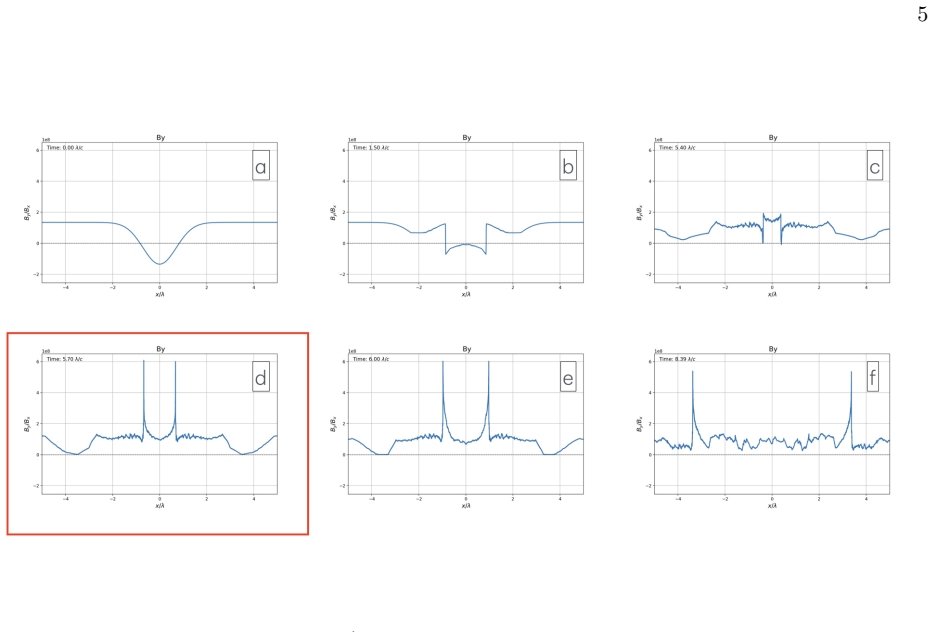
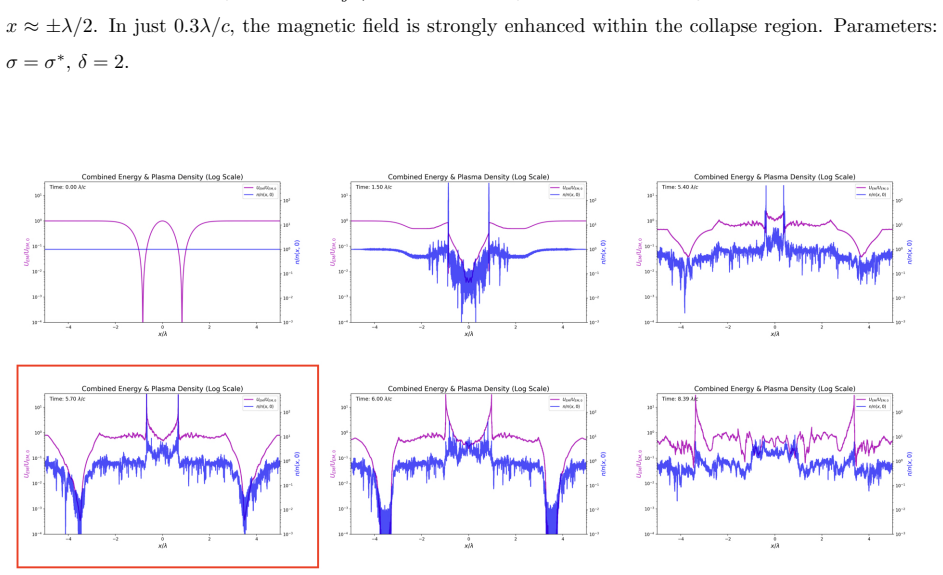
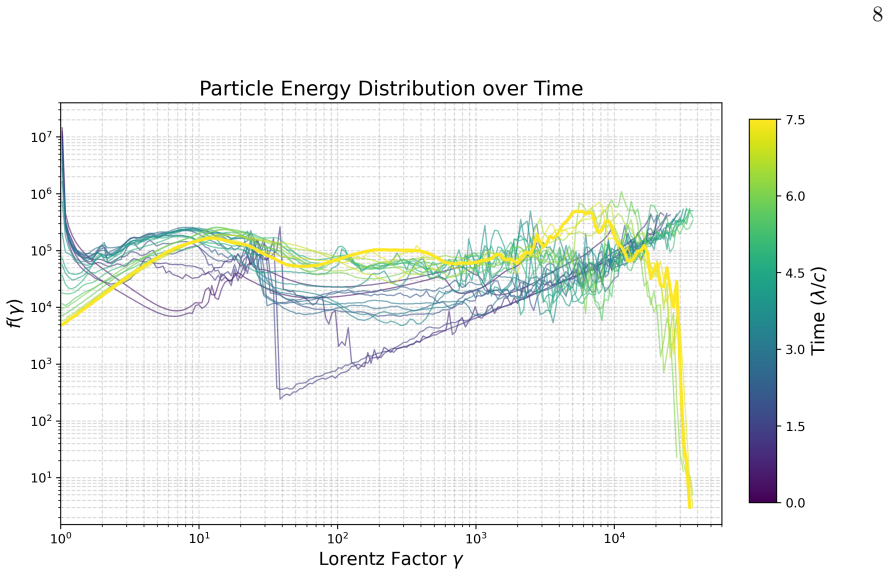
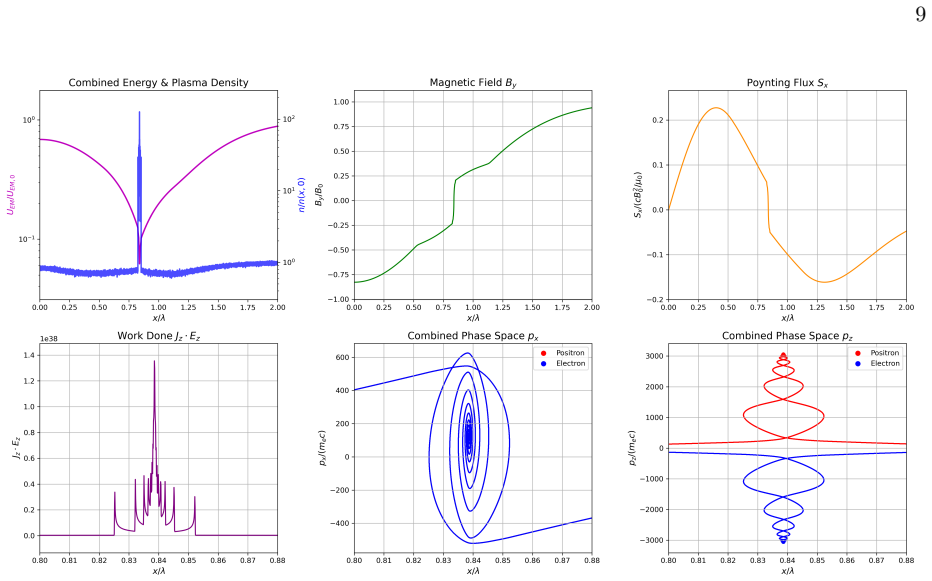
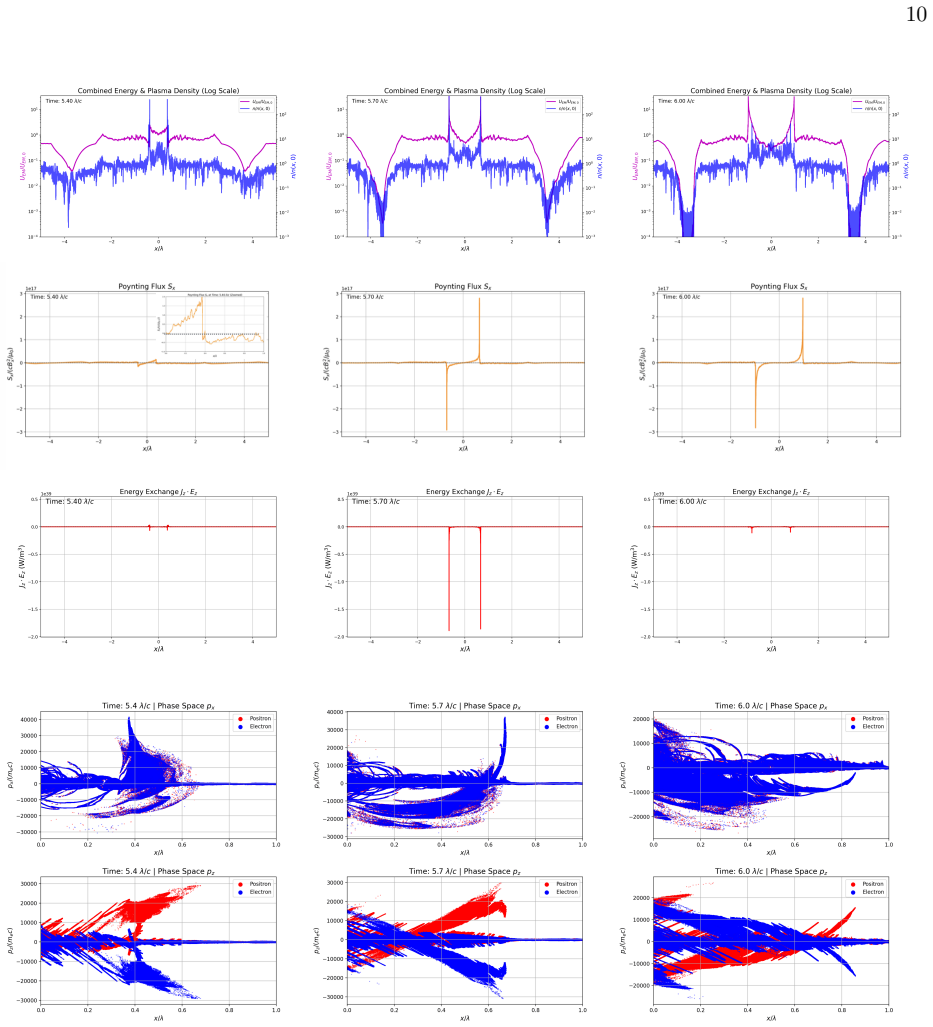
In highly magnetized pair plasma, nonlinear long-wavelength X-modes experience wave collapse/breaking driven by nonlinear modifications of the refractive index and strong ponderomotive forces. Breaking occurs when the fluctuating part of the magnetic field exceeds the guide field and plasma magnetization approaches the current-starvation regime. This squeezes initial electromagnetic energy into highly localized singular pulses whose electromagnetic spectrum follows E_k proportional to k to the minus two and whose particle spectrum is flat, f(gamma) proportional to gamma to the zero. The collapse produces short bright electromagnetic pulses identified as Fast Radio Bursts.
What carries the argument
Wave collapse/breaking of nonlinear X-modes, in which ponderomotive forces and refractive-index changes drive severe spatial steepening and generation of high-k modes.
If this is right
- Initial large-scale electromagnetic energy is rapidly concentrated into macroscopic yet short-wavelength singular pulses.
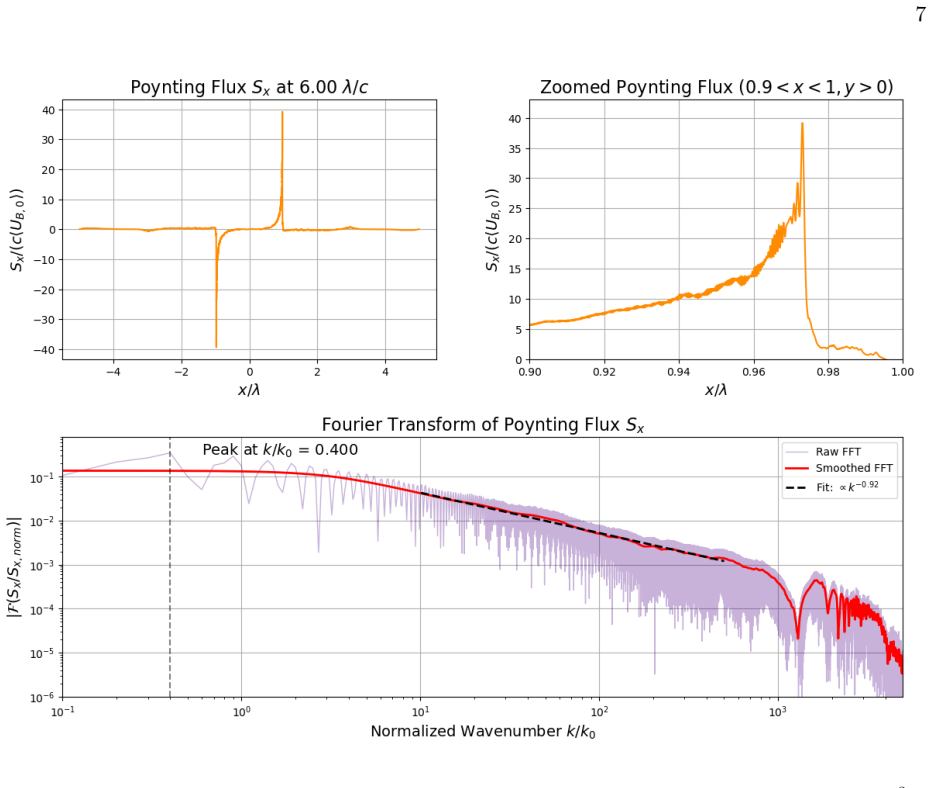
- The electromagnetic spectrum of the resulting foam is red with E_k proportional to k to the minus two.
- The particle energy distribution is exceptionally hard, f(gamma) proportional to gamma to the zero.
- The highest-energy particles produced in the collapse may generate accompanying short high-energy bursts.
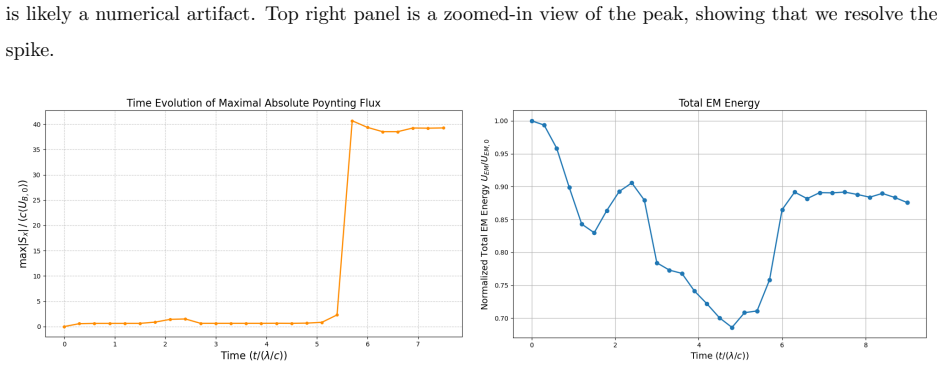
- The entire process completes on a timescale that is only a fraction of the dynamical time.
Where Pith is reading between the lines
- The same steepening process could operate in other compact objects where pair plasma reaches similar magnetization levels.
- The generated high-k modes may seed further instabilities not explored in the paper.
- Detection of a flat particle spectrum in association with an FRB would provide a direct test independent of the radio pulse itself.
Load-bearing premise
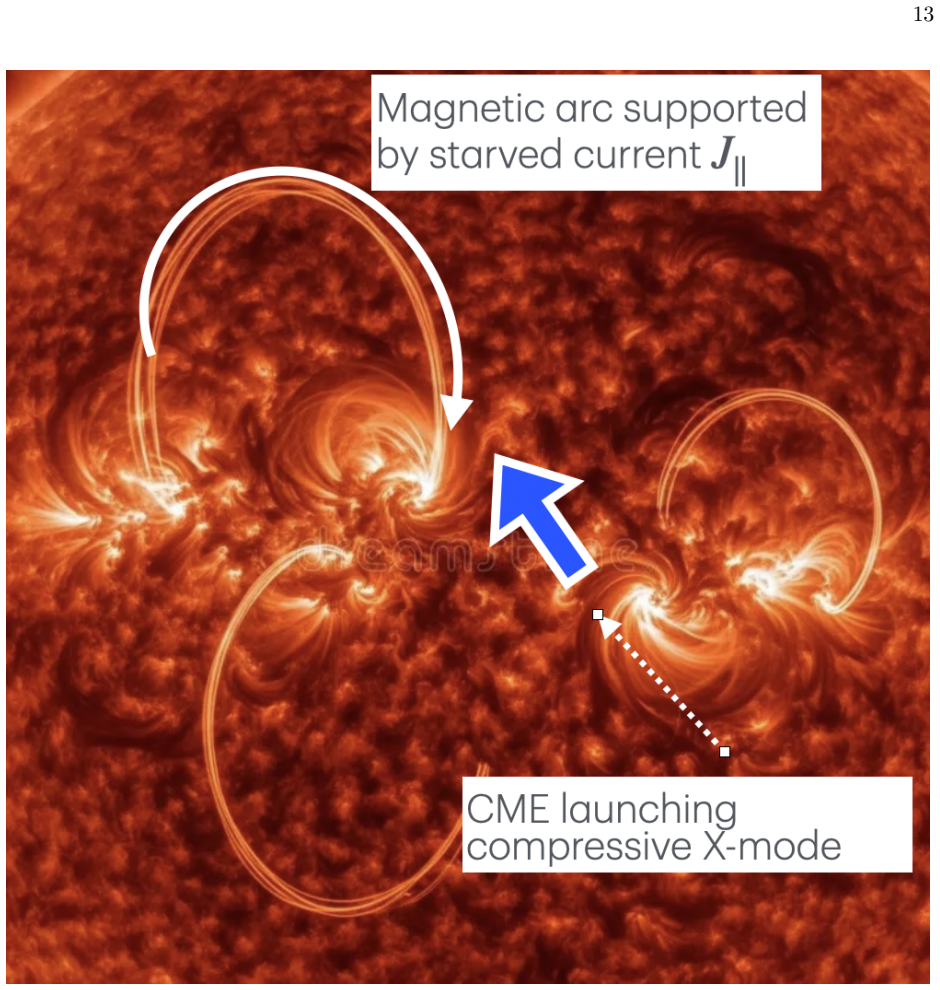
The collapse occurs only inside a narrow parameter window where fluctuating magnetic field exceeds the guide field and magnetization is near current starvation.
What would settle it
Absence of the predicted red electromagnetic spectrum (E_k proportional to k^{-2}) or the flat particle spectrum in any observed Fast Radio Burst source would falsify the mechanism.
Figures


read the original abstract
We demonstrate that in highly magnetized pair plasma nonlinear long-wavelength X-modes experience wave collapse/breaking, whereby the wave undergoes severe spatial steepening, driven by nonlinear modifications of the refractive index and strong ponderomotive forces. The collapse/wave breaking occurs in a narrow parameter regime, when the fluctuating part of the magnetic field exceed the guide field, and plasma magnetization is close to the current starvation regime. This regime is naturally achieved in highly magnetized neutron stars, magnetars. Breaking occurs on the time scale of a fraction of the dynamic time scale, and quickly generates high-k modes. The initial EM energy, spread over large spatial scales, is squeezed into these highly localized, short-wavelength (yet macroscopic) singular pulses. The corresponding electromagnetic ``foam'' spectrum is red, $E_k \propto k^{-2}$, while the particles' spectrum is exceptionally hard, $f(\gamma) \propto \gamma^0$ The wave collapse produces short bright EM pulses - astrophysical Fast Radio Bursts. The highest energy particles may produce short high energy bursts.
Editorial analysis
A structured set of objections, weighed in public.
Referee Report
Summary. The manuscript claims that nonlinear long-wavelength X-modes in highly magnetized pair plasma undergo wave collapse/breaking when the fluctuating magnetic field exceeds the guide field and the plasma is near the current-starvation regime (naturally realized in magnetars). This process occurs on a fraction of the dynamical timescale, steepens the wave via nonlinear refractive-index modifications and ponderomotive forces, generates high-k modes, and squeezes the initial EM energy into localized singular pulses with spectrum E_k ∝ k^{-2} and a hard particle spectrum f(γ) ∝ γ^0. The resulting short bright EM pulses are identified as astrophysical Fast Radio Bursts, with the highest-energy particles potentially producing high-energy bursts.
Significance. If the quantitative mapping from the post-collapse high-k pulses to observed FRB properties can be established, the work would supply a concrete plasma-physics channel for FRB generation inside magnetar magnetospheres, linking wave-breaking timescales directly to the observed millisecond durations and extreme brightness temperatures.
major comments (2)
- [Abstract] Abstract: the central identification of the singular high-k EM pulses with astrophysical FRBs requires an explicit calculation showing that the wavelengths after refractive-index steepening and ponderomotive squeezing fall inside the observed radio band (~100 MHz–10 GHz) and that the energy density matches observed fluences when evaluated at magnetar surface densities and B ~ 10^{14}–10^{15} G. No dispersion-relation evaluation or fluence estimate is supplied.
- [Abstract] Abstract: the statement that collapse occurs “in a narrow parameter regime” when the fluctuating field exceeds the guide field and magnetization is near current starvation is presented without the supporting dispersion relation, growth-rate calculation, or threshold condition that would define the boundaries of this regime.
Simulated Author's Rebuttal
We thank the referee for the careful reading of the manuscript and the constructive comments. We address each major comment below and agree that the paper would be strengthened by additional quantitative details.
read point-by-point responses
-
Referee: [Abstract] Abstract: the central identification of the singular high-k EM pulses with astrophysical FRBs requires an explicit calculation showing that the wavelengths after refractive-index steepening and ponderomotive squeezing fall inside the observed radio band (~100 MHz–10 GHz) and that the energy density matches observed fluences when evaluated at magnetar surface densities and B ~ 10^{14}–10^{15} G. No dispersion-relation evaluation or fluence estimate is supplied.
Authors: We agree that the manuscript does not contain explicit post-collapse wavelength or fluence calculations evaluated at magnetar surface densities and field strengths. The identification with FRBs rests on the demonstrated production of short, localized high-k pulses on sub-dynamical timescales together with the resulting spectra; quantitative mapping to the radio band and observed fluences is left implicit. We will add order-of-magnitude estimates of the compressed wavelengths and energy densities in the revised version. revision: yes
-
Referee: [Abstract] Abstract: the statement that collapse occurs “in a narrow parameter regime” when the fluctuating field exceeds the guide field and magnetization is near current starvation is presented without the supporting dispersion relation, growth-rate calculation, or threshold condition that would define the boundaries of this regime.
Authors: The manuscript states the regime conditions (fluctuating |B| exceeding the guide field and proximity to current starvation) and demonstrates collapse under those conditions. However, an explicit derivation of the dispersion relation, growth rate, or precise threshold boundaries is not supplied. We will include a supporting linear analysis defining the regime boundaries in the revision. revision: yes
Circularity Check
No significant circularity detected in derivation chain.
full rationale
The paper advances a first-principles plasma-physics argument that nonlinear X-mode evolution in a narrow magnetization regime produces wave collapse, high-k modes, and a red spectrum E_k ∝ k^{-2}. No quoted equations or steps reduce the target result to a fitted parameter, self-citation, or definitional tautology; the collapse timescale, ponderomotive squeezing, and particle spectrum are derived from the stated nonlinear refractive-index and force terms. The astrophysical identification with FRBs is an interpretive label rather than a load-bearing quantitative mapping that loops back to the inputs. The derivation therefore remains self-contained against external plasma benchmarks.
Axiom & Free-Parameter Ledger
Reference graph
Works this paper leans on
-
[1]
D. R. Lorimer, M. Bailes, M. A. McLaughlin, D. J. Narkevic, and F. Crawford, Science318, 777 (2007), arXiv:0709.4301
Pith/arXiv arXiv 2007
-
[2]
E. Petroff, J. W. T. Hessels, and D. R. Lorimer, Astron. Astrophys. Rev.27, 4 (2019), arXiv:1904.07947 [astro-ph.HE]
Pith/arXiv arXiv 2019
-
[3]
J. M. Cordes and S. Chatterjee, Annual Review of Astron. and Astrophys.57, 417 (2019), arXiv:1906.05878 [astro-ph.HE]
arXiv 2019
-
[4]
The CHIME/FRB Collaboration, :, B. C. Andersen, K. M. Band ura, M. Bhardwaj, A. Bij, M. M. Boyce, P. J. Boyle, C. Brar, T. Cassanelli, P. Chawla, T. Chen, J. F. Cliche, A. Cook, D. Cubranic, 15 A. P. Curtin, N. T. Denman, M. Dobbs, F. Q. Dong, M. Fandino, E. Fonseca, B. M. Gaensler, U. Giri, D. C. Good, M. Halpern, A. S. Hill, G. F. Hinshaw, C. H¨ ofer, A...
arXiv 2005
-
[5]
C. D. Bochenek, V. Ravi, K. V. Belov, G. Hallinan, J. Kocz, S. R. Kulkarni, and D. L. McKenna, arXiv e-prints , arXiv:2005.10828 (2020), arXiv:2005.10828 [astro-ph.HE]
arXiv 2005
-
[6]
S. Mereghetti, V. Savchenko, C. Ferrigno, D. G¨ otz, M. Rigoselli, A. Tiengo, A. Bazzano, E. Bozzo, A. Coleiro, T. J. L. Courvoisier, M. Doyle, A. Goldwurm, L. Hanlon, E. Jourdain, A. von Kienlin, A. Lutovinov, A. Martin-Carrillo, S. Molkov, L. Natalucci, F. Onori, F. Panessa, J. Rodi, J. Ro- driguez, C. S´ anchez-Fern´ andez, R. Sunyaev, and P. Ubertini,...
arXiv 2005
-
[7]
A. Ridnaia, D. Svinkin, D. Frederiks, A. Bykov, S. Popov, R. Aptekar, S. Golenetskii, A. Lysenko, A. Tsvetkova, M. Ulanov, and T. Cline, arXiv e-prints , arXiv:2005.11178 (2020), arXiv:2005.11178 [astro-ph.HE]
arXiv 2005
-
[8]
M. Tavani, C. Casentini, A. Ursi, F. Verrecchia, A. Addis, L. A. Antonelli, A. Argan, G. Barbiellini, L. Baroncelli, G. Bernardi, G. Bianchi, A. Bulgarelli, P. Caraveo, M. Cardillo, P. W. Cattaneo, A. W. Chen, E. Costa, E. Del Monte, G. Di Cocco, G. Di Persio, I. Donnarumma, Y. Evangelista, M. Feroci, A. Ferrari, V. Fioretti, F. Fuschino, M. Galli, F. Gia...
arXiv 2005
-
[9]
Lyutikov, ApJ Lett.580, L65 (2002), arXiv:astro-ph/0206439 [astro-ph]
M. Lyutikov, ApJ Lett.580, L65 (2002), arXiv:astro-ph/0206439 [astro-ph]
Pith/arXiv arXiv 2002
-
[10]
S. B. Popov and K. A. Postnov, arXiv e-prints , arXiv:1307.4924 (2013), arXiv:1307.4924 [astro-ph.HE]
Pith/arXiv arXiv 2013
-
[11]
M. Lyutikov and S. Popov, arXiv e-prints , arXiv:2005.05093 (2020), arXiv:2005.05093 [astro-ph.HE]
arXiv 2005
- [12]
-
[13]
M. V. Barkov, P. Sharma, K. N. Gourgouliatos, and M. Lyutikov, Astrophys. J.934, 140 (2022)
2022
-
[14]
M. Lyutikov and V. Gurarie, arXiv e-prints , arXiv:2509.20594 (2025), arXiv:2509.20594 [physics.plasm- ph]
arXiv 2025
-
[15]
Lyutikov, inAPS April Meeting Abstracts, APS Meeting Abstracts (2006) p
M. Lyutikov, inAPS April Meeting Abstracts, APS Meeting Abstracts (2006) p. X3.003. 16
2006
-
[16]
Goldreich and A
P. Goldreich and A. Reisenegger, Astrophys. J.395, 250 (1992)
1992
-
[17]
T. S. Wood, R. Hollerbach, and M. Lyutikov, Physics of Plasmas21, 052110 (2014), arXiv:1404.2145 [physics.plasm-ph]
Pith/arXiv arXiv 2014
-
[18]
K. N. Gourgouliatos, T. Kondi´ c, M. Lyutikov, and R. Hollerbach, MNRAS453, L93 (2015), arXiv:1507.07454 [astro-ph.HE]
Pith/arXiv arXiv 2015
-
[19]
Lyutikov, MNRAS346, 540 (2003), arXiv:astro-ph/0303384
M. Lyutikov, MNRAS346, 540 (2003), arXiv:astro-ph/0303384
Pith/arXiv arXiv 2003
-
[20]
Lyutikov, MNRAS447, 1407 (2015), arXiv:1407.5881 [astro-ph.HE]
M. Lyutikov, MNRAS447, 1407 (2015), arXiv:1407.5881 [astro-ph.HE]
Pith/arXiv arXiv 2015
-
[21]
M. P. Snelders, K. Nimmo, J. W. T. Hessels, Z. Bensellam, L. P. Zwaan, P. Chawla, O. S. Ould- Boukattine, F. Kirsten, J. T. Faber, and V. Gajjar, Nature Astronomy7, 1486 (2023), arXiv:2307.02303 [astro-ph.HE]
arXiv 2023
-
[22]
J. Braithwaite and H. C. Spruit, A&A450, 1097 (2006), arXiv:astro-ph/0510287 [astro-ph]
Pith/arXiv arXiv 2006
-
[23]
Braithwaite, MNRAS397, 763 (2009), arXiv:0810.1049 [astro-ph]
J. Braithwaite, MNRAS397, 763 (2009), arXiv:0810.1049 [astro-ph]
Pith/arXiv arXiv 2009
-
[24]
A. K. Harding and D. Lai, Reports on Progress in Physics69, 2631 (2006), arXiv:astro-ph/0606674 [astro-ph]
Pith/arXiv arXiv 2006
-
[25]
C. Thompson, M. Lyutikov, and S. R. Kulkarni, Astrophys. J.574, 332 (2002), astro-ph/0110677
Pith/arXiv arXiv 2002
-
[26]
S. B. Popov and K. A. Postnov, inEvolution of Cosmic Objects through their Physical Activity, edited by H. A. Harutyunian, A. M. Mickaelian, and Y. Terzian (2010) pp. 129–132, arXiv:0710.2006
Pith/arXiv arXiv 2010
-
[27]
M. Lyutikov, L. Burzawa, and S. B. Popov, MNRAS462, 941 (2016), arXiv:1603.02891 [astro-ph.HE]
Pith/arXiv arXiv 2016
-
[28]
A. M. Beloborodov, Astrophys. J.959, 34 (2023), arXiv:2210.13509 [astro-ph.HE]
arXiv 2023
-
[29]
Lyutikov, MNRAS529, 2180 (2024)
M. Lyutikov, MNRAS529, 2180 (2024)
2024
-
[30]
A. M. Beloborodov, Astrophys. J.1000, 157 (2026), arXiv:2503.16054 [astro-ph.HE]
arXiv 2026
-
[31]
Lyutikov, ApJ Lett.933, L6 (2022), arXiv:2206.01235 [astro-ph.HE]
M. Lyutikov, ApJ Lett.933, L6 (2022), arXiv:2206.01235 [astro-ph.HE]
arXiv 2022
-
[32]
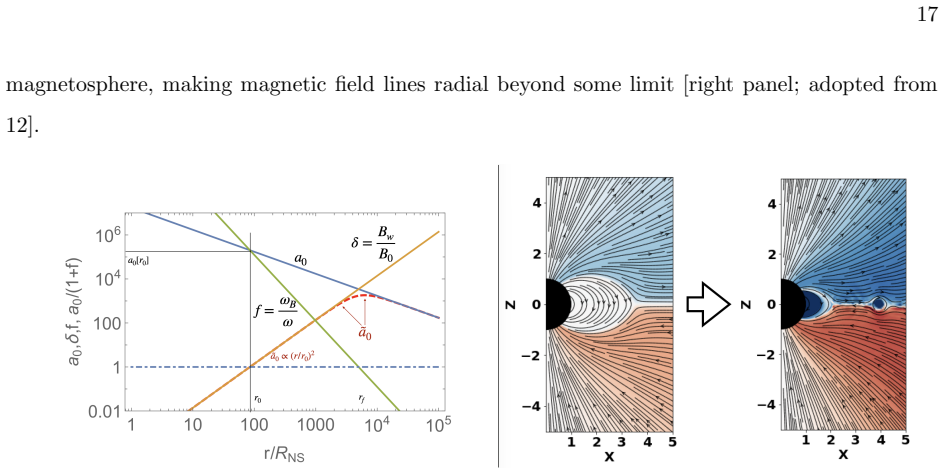
M. Lyutikov, Astrophys. J.962, 18 (2024), arXiv:2307.03212 [astro-ph.HE]. Appendix A: Escape of generated radiation from the magnetospheres: electromagnetic broom Concerns have been raised that in the framework of magnetospheric models of FRBs [9, 10, 26, 27], the high power nonlinear electromagnetic may not escape, suffering from nonlinear absorption [28...
arXiv 2024
discussion (0)
Sign in with ORCID, Apple, or X to comment. Anyone can read and Pith papers without signing in.