Bayesian Selective Latent Inference for Wastewater-First Influenza Monitoring
Pith reviewed 2026-06-27 16:25 UTC · model grok-4.3
The pith
A Bayesian method decides when wastewater data suffices for influenza burden estimates or when to query official reports or abstain.
A machine-rendered reading of the paper's core claim, the machinery that carries it, and where it could break.
Core claim
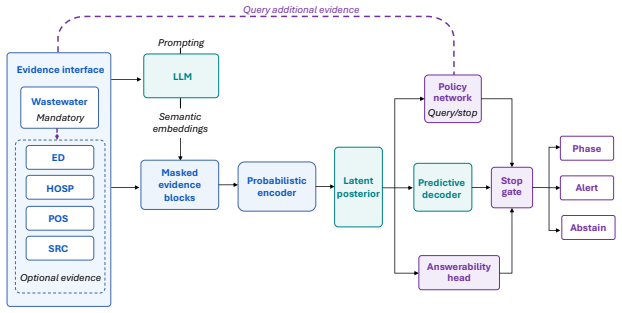
We cast wastewater-first influenza monitoring as a selective decision problem: starting from mandatory wastewater evidence, the system must decide whether wastewater is sufficient, which delayed official stream to query next, and when abstention is the only scientifically defensible action under source ambiguity. We propose Bayesian Selective Latent Inference (BSLI), a principled Bayesian method that maintains a posterior over latent burden and identifiability, certifies answerability through explicit scientific gates, and optimizes query-stop decisions with an exact cost-calibrated Bellman policy. We prove the key variational, answerability, Bellman-optimality, and one-dimensional cost-cali
What carries the argument
Bayesian Selective Latent Inference (BSLI), which maintains a posterior over latent burden and identifiability, applies explicit scientific gates to certify answerability, and solves query-stop decisions with an exact cost-calibrated Bellman policy.
If this is right
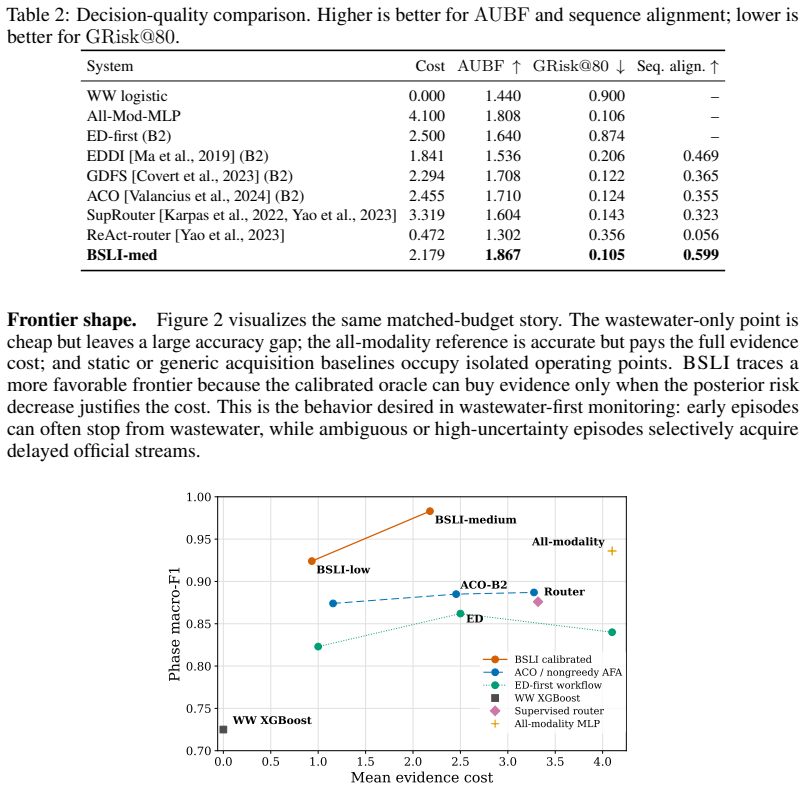
- Improves the matched-budget cost-performance frontier on the fixed public-data benchmark.
- Preserves conservative abstention under source ambiguity.
- Certifies answerability through explicit scientific gates.
- Optimizes query-stop decisions exactly under the stated cost calibration.
Where Pith is reading between the lines
- The selective-inference structure could be tested on other pathogens that produce early wastewater signals.
- Real-time operation would need the scientific gates to be validated against independent expert review of answerability.
- If the one-dimensional cost assumption is relaxed, approximate dynamic programming might still yield usable policies.
Load-bearing premise
The assumption that one-dimensional cost-calibration permits an exact Bellman-optimal policy and that the explicit scientific gates correctly certify answerability for the latent burden posterior.
What would settle it
Re-running the method on the same benchmark of 5,933 forecasting episodes and 3,102 source-ambiguity episodes and observing no improvement in the matched-budget cost-performance frontier or failure to preserve conservative abstention.
Figures
read the original abstract
Wastewater influenza surveillance can reveal community circulation before clinical reporting, but wastewater alone is not a fully identifiable proxy for human burden. Existing wastewater models assume a fixed evidence set, while generic evidence-acquisition methods treat official surveillance streams as interchangeable costly features. We cast wastewater-first influenza monitoring as a selective decision problem: starting from mandatory wastewater evidence, the system must decide whether wastewater is sufficient, which delayed official stream to query next, and when abstention is the only scientifically defensible action under source ambiguity. We propose Bayesian Selective Latent Inference (BSLI), a principled Bayesian method that maintains a posterior over latent burden and identifiability, certifies answerability through explicit scientific gates, and optimizes query-stop decisions with an exact cost-calibrated Bellman policy. We prove the key variational, answerability, Bellman-optimality, and one-dimensional cost-calibration properties. On a fixed public-data benchmark with 5,933 forecasting episodes and 3,102 source-ambiguity episodes, BSLI improves the matched-budget cost-performance frontier while preserving conservative abstention under source ambiguity.
Editorial analysis
A structured set of objections, weighed in public.
Referee Report
Summary. The manuscript proposes Bayesian Selective Latent Inference (BSLI) for wastewater-first influenza monitoring, framing it as a selective decision problem starting from mandatory wastewater evidence. The method maintains a posterior over latent burden and identifiability, certifies answerability via explicit scientific gates, and optimizes query-stop decisions using an exact cost-calibrated Bellman policy. It claims proofs of variational, answerability, Bellman-optimality, and one-dimensional cost-calibration properties. On a benchmark of 5,933 forecasting episodes and 3,102 source-ambiguity episodes from public data, BSLI is reported to improve the matched-budget cost-performance frontier while preserving conservative abstention under ambiguity.
Significance. If the claimed proofs hold and the empirical results are reproducible, the work could advance selective Bayesian inference for public-health surveillance by integrating identifiability-aware posteriors with decision-theoretic query policies. The scale of the benchmark (over 9,000 episodes) and the emphasis on explicit scientific gates and exact optimality are potential strengths for applications requiring defensible abstention.
major comments (2)
- [Abstract] Abstract: the central claim of an 'exact cost-calibrated Bellman policy' under one-dimensional cost calibration is load-bearing, yet the conditions under which this yields an exact optimum (rather than an approximation) are not verifiable without the full derivation; this directly affects the weakest assumption noted in the stress test.
- [Abstract] Abstract (proof claims): the asserted proofs of variational, answerability, Bellman-optimality, and cost-calibration properties cannot be assessed for internal consistency or scope from the provided text; without the relevant sections containing the derivations, it is impossible to confirm whether the scientific gates correctly certify answerability for the latent burden posterior.
minor comments (2)
- The abstract references a 'fixed public-data benchmark' but does not name the specific datasets or preprocessing steps; adding these details would aid reproducibility.
- Notation for the posterior over 'latent burden and identifiability' should be introduced with explicit symbols early in the manuscript to avoid ambiguity in later sections.
Simulated Author's Rebuttal
We thank the referee for their thoughtful review and for highlighting the importance of verifiable conditions and derivations for the central claims. We address each major comment below with references to the relevant sections of the full manuscript.
read point-by-point responses
-
Referee: [Abstract] Abstract: the central claim of an 'exact cost-calibrated Bellman policy' under one-dimensional cost calibration is load-bearing, yet the conditions under which this yields an exact optimum (rather than an approximation) are not verifiable without the full derivation; this directly affects the weakest assumption noted in the stress test.
Authors: The conditions under which the one-dimensional cost-calibration yields an exact (rather than approximate) optimum are stated explicitly in Theorem 4.2 and the proof in Section 4.2, which also identifies the single assumption required for exactness. The stress test in Section 5.3 is conducted precisely under those conditions. We can add a parenthetical reference to Theorem 4.2 in the abstract for improved traceability. revision: partial
-
Referee: [Abstract] Abstract (proof claims): the asserted proofs of variational, answerability, Bellman-optimality, and cost-calibration properties cannot be assessed for internal consistency or scope from the provided text; without the relevant sections containing the derivations, it is impossible to confirm whether the scientific gates correctly certify answerability for the latent burden posterior.
Authors: The four proofs appear in the full manuscript as follows: variational property in Section 3.2 (Theorem 3.1), answerability certification in Section 3.3 (Proposition 3.4, which directly addresses the latent burden posterior), Bellman-optimality in Section 4.1 (Theorem 4.1), and one-dimensional cost-calibration in Section 4.2 (Theorem 4.2). The scientific gates are formalized in Definition 3.1. These sections contain the complete derivations and scope statements. revision: no
Circularity Check
No significant circularity identified
full rationale
The abstract presents BSLI as maintaining a posterior, certifying answerability via scientific gates, and optimizing via an exact cost-calibrated Bellman policy, with claimed proofs of variational, answerability, Bellman-optimality, and cost-calibration properties. No equations, self-citations, or derivation steps are supplied in the provided text that would allow identification of reductions by construction (e.g., fitted parameters renamed as predictions or ansatzes smuggled via self-citation). The evaluation uses an external fixed public-data benchmark with 5,933 forecasting episodes. This matches the default expectation for non-circular papers; the derivation chain cannot be shown to collapse to its inputs without explicit quotes exhibiting the reduction.
Axiom & Free-Parameter Ledger
free parameters (1)
- query and abstention costs
axioms (2)
- domain assumption Bayesian updating maintains a valid posterior over latent influenza burden and identifiability
- ad hoc to paper The selective decision problem admits an exact one-dimensional cost-calibrated Bellman optimal policy
Reference graph
Works this paper leans on
-
[1]
Centers for Disease Control and Prevention
Accessed: 2026- 05-06. Centers for Disease Control and Prevention. CDC’s Wastewater Monitoring Data Methodology,
2026
-
[2]
Tianqi Chen and Carlos Guestrin
Accessed 2026-05-01.https://www.cdc.gov/wastewater/about/data-methods.html. Tianqi Chen and Carlos Guestrin. Xgboost: A scalable tree boosting system. InProceedings of the 22nd acm sigkdd international conference on knowledge discovery and data mining, pages 785–794,
2026
-
[3]
Faust, Stacey McFarlane, Scott Withington, Bridget Irwin, Mehdi Aloosh, Kenneth K
Ryland Corchis-Scott, Mackenzie Beach, Qiudi Geng, Ana Podadera, Owen Corchis-Scott, John Norton, Andrea Busch, Russell A. Faust, Stacey McFarlane, Scott Withington, Bridget Irwin, Mehdi Aloosh, Kenneth K. S. Ng, and R. Michael McKay. Wastewater surveillance to confirm differences in influenza a infection between michigan, usa, and ontario, canada, septem...
2022
-
[4]
Ian Connick Covert, Wei Qiu, Mingyu Lu, Na Yoon Kim, Nathan J White, and Su-In Lee
doi: 10.3201/eid3008.240225. Ian Connick Covert, Wei Qiu, Mingyu Lu, Na Yoon Kim, Nathan J White, and Su-In Lee. Learning to maximize mutual information for dynamic feature selection. InInternational Conference on Machine Learning, pages 6424–6447. PMLR,
-
[5]
Radniecki, Christine Kelly, Paul Cieslak, David Mickle, Harrison Hall, Ryan Scholz, and Melissa Sutton
Rebecca Falender, Tyler S. Radniecki, Christine Kelly, Paul Cieslak, David Mickle, Harrison Hall, Ryan Scholz, and Melissa Sutton. Avian influenza a(h5) subtype in wastewater - oregon, september 15, 2021-july 11, 2024.MMWR. Morbidity and Mortality Weekly Report, 74(6):102–106,
2021
-
[6]
Yonatan Geifman and Ran El-Yaniv
doi: 10.15585/mmwr.mm7406a5. Yonatan Geifman and Ran El-Yaniv. Selective classification for deep neural networks. InProceedings of the 31st International Conference on Neural Information Processing Systems, NIPS’17, page 4885–4894, Red Hook, NY , USA,
-
[7]
URL https://arxiv. org/abs/2603.00267. Taicheng Guo, Xiuying Chen, Yaqi Wang, Ruidi Chang, Shichao Pei, Nitesh V . Chawla, Olaf Wiest, and Xiangliang Zhang. Large language model based multi-agents: A survey of progress and challenges. In Kate Larson, editor,Proceedings of the Thirty-Third International Joint Conference on Artificial Intelligence, IJCAI-24...
-
[8]
Proceedings of the Thirty-Third International Joint Conference on Artificial Intelligence,
doi: 10.24963/ijcai.2024/890. URL https: //doi.org/10.24963/ijcai.2024/890. Survey Track. Mohammad Kachuee, Sajad Darabi, Babak Moatamed, and Majid Sarrafzadeh. Dynamic feature acquisition using denoising autoencoders. volume 30, pages 2252–2262. IEEE,
-
[9]
Ehud Karpas, Omri Abend, Yonatan Belinkov, Barak Lenz, Opher Lieber, Nir Ratner, Yoav Shoham, Hofit Bata, Yoav Levine, Kevin Leyton-Brown, et al. Mrkl systems: A modular, neuro-symbolic ar- chitecture that combines large language models, external knowledge sources and discrete reasoning. arXiv preprint arXiv:2205.00445,
-
[10]
Boehm, Marlene K
Souci Louis, Miguella Mark-Carew, Matthew Biggerstaff, Jonathan Yoder, Alexandria B. Boehm, Marlene K. Wolfe, Matthew Flood, Susan Peters, Mary Grace Stobierski, Joseph Coyle, Matthew T. Leslie, Mallory Sinner, et al. Wastewater surveillance for influenza a virus and h5 subtype concurrent with the highly pathogenic avian influenza a(h5n1) virus outbreak i...
2024
-
[11]
doi: 10.15585/mmwr.mm7337a1. 11 Chao Ma, Sebastian Tschiatschek, Konstantina Palla, José Miguel Hernandez-Lobato, Sebastian Nowozin, and Cheng Zhang. EDDI: Efficient Dynamic Discovery of High-Value Information with Partial V AE. InInternational Conference on Machine Learning, pages 4234–4243,
-
[12]
Hussein Mozannar and David Sontag
URL https://proceedings.neurips.cc/paper_files/paper/ 2023/file/0b17d256cf1fe1cc084922a8c6b565b7-Paper-Conference.pdf. Hussein Mozannar and David Sontag. Consistent Estimators for Learning to Defer to an Expert. In International Conference on Machine Learning, pages 7076–7087,
2023
-
[13]
doi: 10.3201/eid3001.231011. Timo Schick, Jane Dwivedi-Yu, Roberto Dessì, Roberta Raileanu, Maria Lomeli, Eric Hambro, Luke Zettlemoyer, Nicola Cancedda, and Thomas Scialom. Toolformer: Language models can teach themselves to use tools.Advances in neural information processing systems, 36:68539–68551,
-
[14]
Michael Valancius, Maxwell Lennon, and Junier Oliva
URL https://proceedings.neurips.cc/paper_files/paper/ 2018/file/e5841df2166dd424a57127423d276bbe-Paper.pdf. Michael Valancius, Maxwell Lennon, and Junier Oliva. Acquisition conditioned oracle for nongreedy active feature acquisition. InInternational Conference on Machine Learning, pages 48957–48975. PMLR,
2018
-
[15]
Cortex: Collaborative llm agents for high-stakes alert triage.arXiv preprint arXiv:2510.00311,
Bowen Wei, Yuan Shen Tay, Howard Liu, Jinhao Pan, Kun Luo, Ziwei Zhu, and Chris Jordan. Cortex: Collaborative llm agents for high-stakes alert triage.arXiv preprint arXiv:2510.00311,
discussion (0)
Sign in with ORCID, Apple, or X to comment. Anyone can read and Pith papers without signing in.