A 65-nm Privacy-Preserving Neuromorphic Encoder With 7.13-nJ Efficiency, 2.38-Mb/mm² Item-Memory Density, and Federated Learning Support
Pith reviewed 2026-06-27 20:14 UTC · model grok-4.3
The pith
A 65-nm neuromorphic encoder uses transistor process variation as entropy to create device-specific item memory for privacy-preserving hyperdimensional bio-signal encoding.
A machine-rendered reading of the paper's core claim, the machinery that carries it, and where it could break.
Core claim
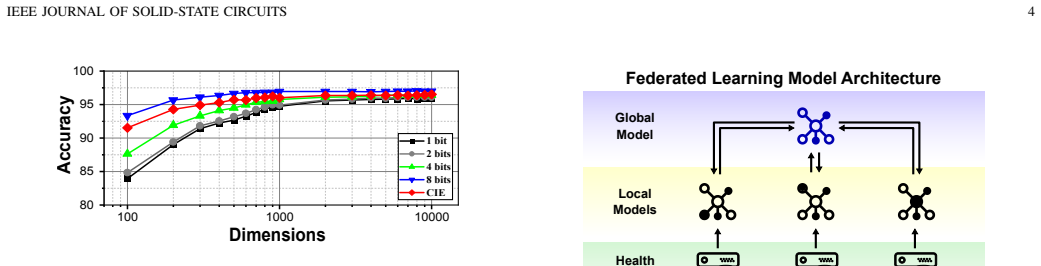
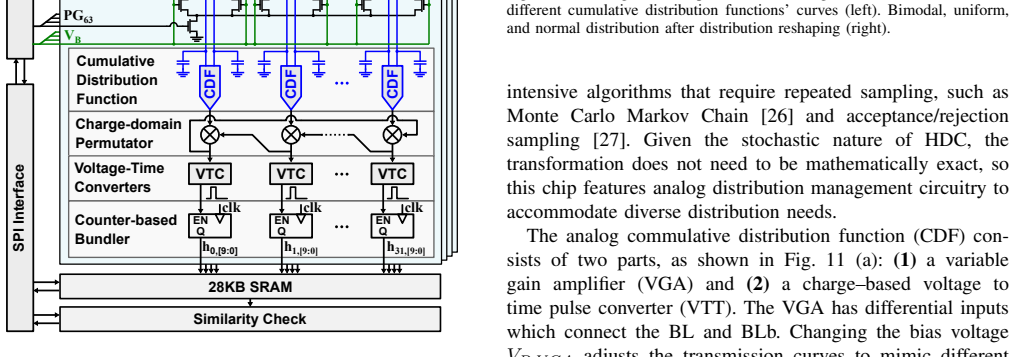
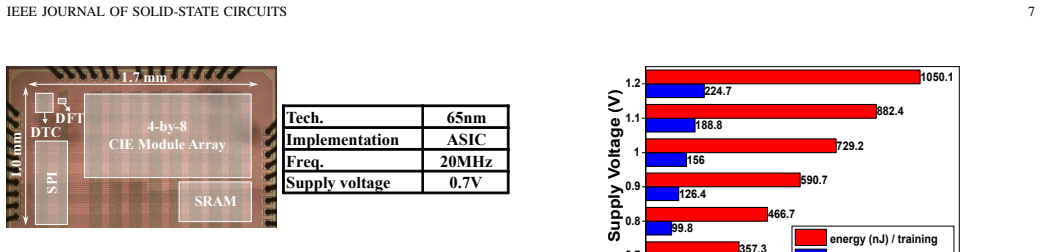
The fabricated prototype achieves 7.13 nJ per encoding, 2.38 Mb/mm² item-memory density, 76.44 nJ per prediction, and 357.32 nJ per training update. It also supports in-situ decision-making, continual learning, and federated learning for multi-user deployment and cold-start personalization. Evaluations across bio-signal datasets demonstrate 93.2% accuracy on EMG and 96.1% accuracy on UCI-HAR, while reducing hypervector dimensionality by 14.3x compared with binary hyperdimensional computing.
What carries the argument
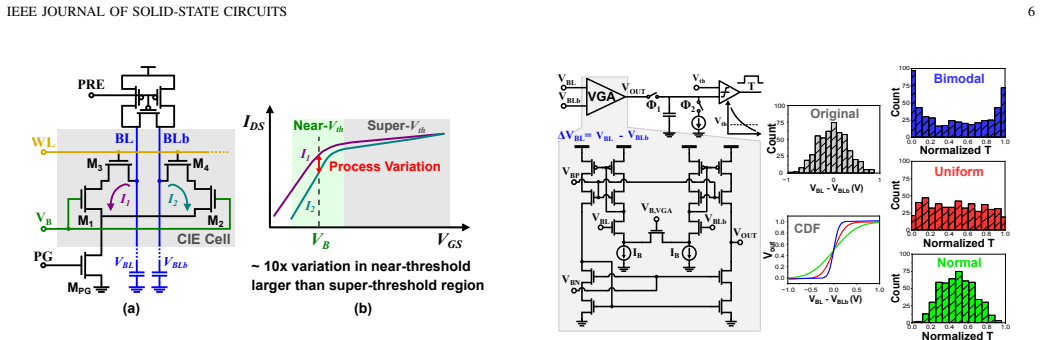
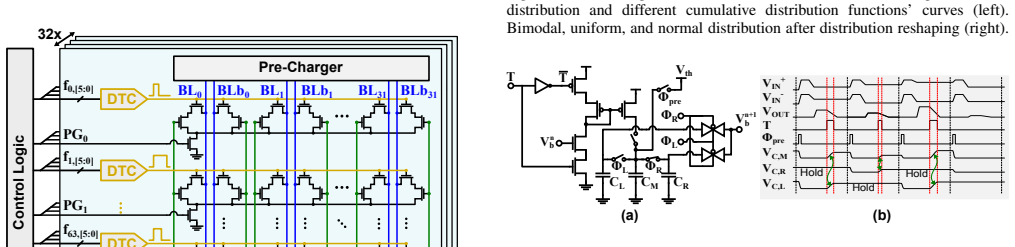
The 2T-2T entropy cell that extracts physically unclonable entropy from transistor-level process variation to form compact, device-specific, write-free item memory for hyperdimensional computing.
If this is right
- Encoding operations run at 7.13 nJ each with 2.38 Mb/mm² item-memory density.
- The hardware supports in-situ prediction at 76.44 nJ and training updates at 357.32 nJ.
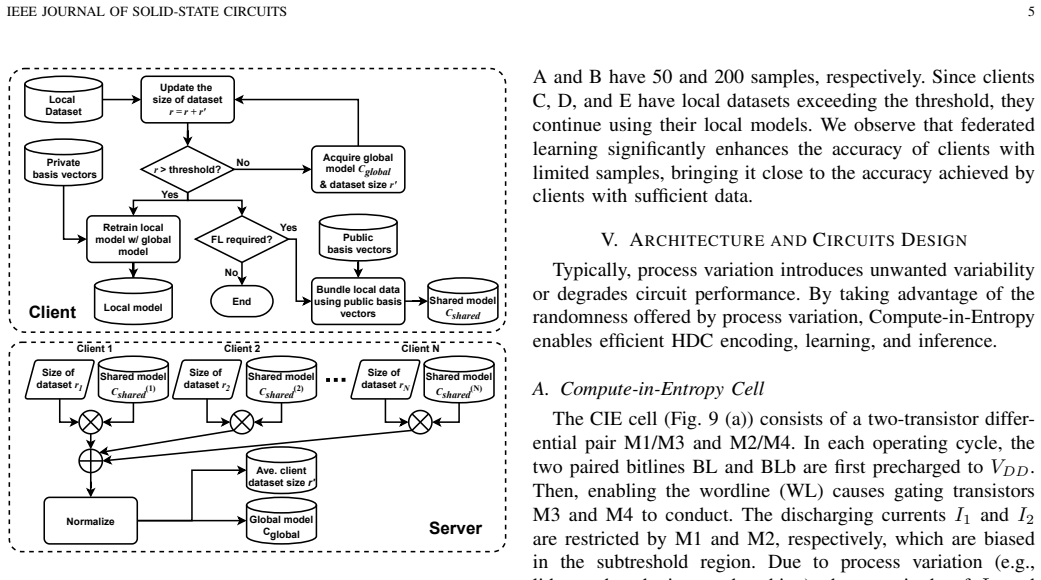
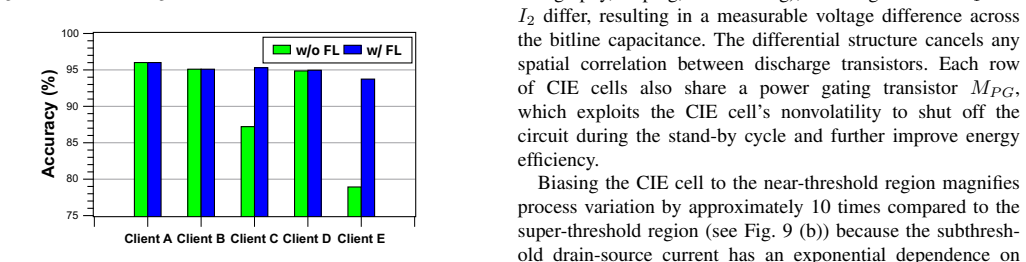
- Federated learning enables multi-user deployment and cold-start personalization without central data sharing.
- Accuracy reaches 93.2% on EMG signals and 96.1% on UCI-HAR activity data.
- Hypervector dimensionality drops 14.3x versus conventional binary hyperdimensional computing.
Where Pith is reading between the lines
- Edge devices could perform secure bio-signal analytics locally without transmitting raw personal data.
- The continual-learning support opens the possibility of wearables that adapt to individual users over time.
- Similar entropy extraction could be tested in other edge security applications that need unique per-device keys.
- Combining this encoder with existing sensor front-ends might reduce overall system power for always-on health monitoring.
Load-bearing premise
The assumption that transistor-level process variation in the 65-nm process supplies enough reliable and secure entropy in the 2T-2T cells to enable privacy-preserving encoding and the stated accuracies without calibration or post-processing.
What would settle it
Fabrication and measurement of multiple chips showing that encoding accuracy or entropy uniqueness varies enough across devices or over time to drop accuracy below 90% or allow reconstruction of basis vectors would falsify the privacy and reliability claims.
Figures



read the original abstract
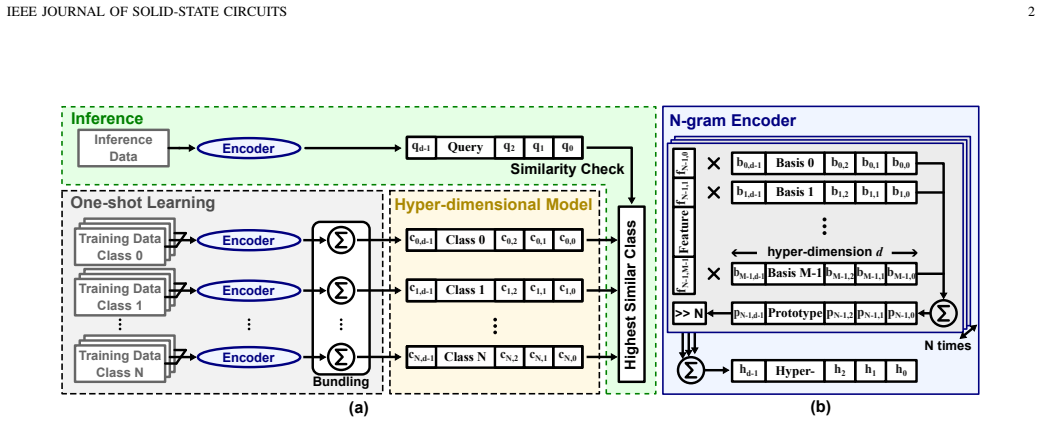
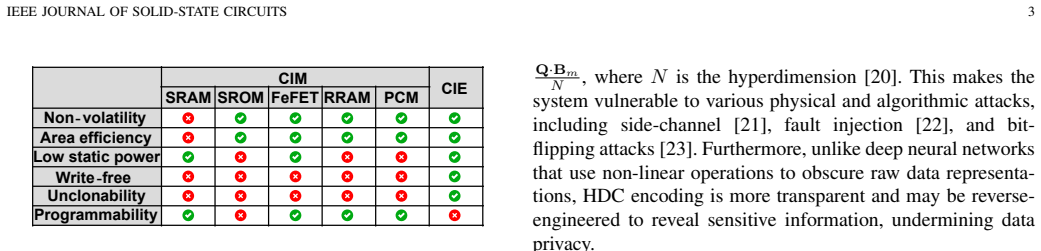
The increasing demand for privacy-preserving personal data analytics in smart assistants, wearable health monitors, and context-aware systems calls for hardware that is both energy-efficient and secure. This work presents a 65-nm privacy-preserving neuromorphic encoder that leverages transistor-level process variation as physically unclonable entropy for hyperdimensional computing. The proposed 2T-2T entropy cell enables compact, device-specific, and write-free item memory, allowing privacy-preserving bio-signal encoding without storing random basis vectors in conventional memory. The fabricated prototype achieves 7.13 nJ per encoding, 2.38 Mb/mm^2 item-memory density, 76.44 nJ per prediction, and 357.32 nJ per training update. It also supports in-situ decision-making, continual learning, and federated learning for multi-user deployment and cold-start personalization. Evaluations across bio-signal datasets demonstrate 93.2% accuracy on EMG and 96.1% accuracy on UCI-HAR, while reducing hypervector dimensionality by 14.3x compared with binary hyperdimensional computing. These results demonstrate an energy-efficient and privacy-preserving neuromorphic hardware platform for secure edge biomedical intelligence.
Editorial analysis
A structured set of objections, weighed in public.
Referee Report
Summary. The manuscript presents a 65-nm CMOS fabricated neuromorphic encoder for hyperdimensional computing that exploits transistor process variation in 2T-2T cells as a physically unclonable entropy source to generate device-specific item memories on-the-fly. This enables privacy-preserving bio-signal encoding without storing or transmitting random basis vectors. The prototype reports 7.13 nJ per encoding, 2.38 Mb/mm² item-memory density, 76.44 nJ per prediction, 357.32 nJ per training update, support for in-situ decision-making/continual/federated learning, 93.2% accuracy on EMG and 96.1% on UCI-HAR, and 14.3× dimensionality reduction versus binary HDC.
Significance. If the entropy source proves reliable and the reported numbers are validated with full experimental data, the work would offer a concrete hardware demonstration of compact, energy-efficient, calibration-free privacy-preserving edge computing for biomedical signals by tightly integrating PUF functionality with HDC.
major comments (2)
- [Abstract] Abstract: the central claim that the 2T-2T entropy cells supply sufficient, stable, and attack-resistant entropy from 65-nm process variation for privacy-preserving, write-free item memory (without calibration or post-processing) is load-bearing for both the privacy guarantee and the stated accuracies, yet no inter-device uniqueness, intra-device stability, or modeling-attack resistance data are provided.
- [Abstract] Abstract: the reported accuracies (93.2% EMG, 96.1% UCI-HAR) and energy figures are presented without error bars, trial counts, device-to-device variation statistics, or baseline comparisons at the reduced dimensionality, preventing assessment of whether the 14.3× reduction preserves performance as claimed.
minor comments (1)
- [Abstract] The abstract would benefit from explicit statement of the original hypervector dimensionality and the exact mechanism of the 14.3× reduction.
Simulated Author's Rebuttal
We thank the referee for the thorough and constructive review. We address each major comment below and will revise the manuscript to incorporate the requested clarifications and data.
read point-by-point responses
-
Referee: [Abstract] Abstract: the central claim that the 2T-2T entropy cells supply sufficient, stable, and attack-resistant entropy from 65-nm process variation for privacy-preserving, write-free item memory (without calibration or post-processing) is load-bearing for both the privacy guarantee and the stated accuracies, yet no inter-device uniqueness, intra-device stability, or modeling-attack resistance data are provided.
Authors: We agree that experimental characterization of inter-device uniqueness, intra-device stability, and modeling-attack resistance is necessary to fully support the privacy claims. The manuscript emphasizes system-level integration and measured performance of the neuromorphic encoder but does not present these PUF-specific metrics. In the revised version we will add measured results from multiple chips, including uniqueness (inter-device Hamming distance), stability (intra-device repeatability across time/temperature), and initial modeling-attack analysis. revision: yes
-
Referee: [Abstract] Abstract: the reported accuracies (93.2% EMG, 96.1% UCI-HAR) and energy figures are presented without error bars, trial counts, device-to-device variation statistics, or baseline comparisons at the reduced dimensionality, preventing assessment of whether the 14.3× reduction preserves performance as claimed.
Authors: We acknowledge the absence of error bars, trial counts, device-to-device variation statistics, and explicit baseline comparisons at the reduced dimensionality. These details are required to evaluate whether the 14.3× dimensionality reduction maintains performance. The revised manuscript will include standard deviations from repeated trials, the number of experimental runs, device-to-device statistics, and direct accuracy/energy comparisons against full-dimensionality binary HDC on the same datasets. revision: yes
Circularity Check
No circularity: empirical hardware measurements with no derivations or fitted predictions
full rationale
The paper reports measured results from a fabricated 65-nm prototype (energy per encoding, density, accuracies on EMG/UCI-HAR datasets) without any equations, parameter fitting, or predictions that reduce to inputs by construction. No self-definitional steps, fitted-input predictions, or load-bearing self-citations appear in the provided text. The central claims rest on physical fabrication and empirical evaluation, which are self-contained against external benchmarks and do not invoke uniqueness theorems or ansatzes from prior author work.
Axiom & Free-Parameter Ledger
Reference graph
Works this paper leans on
-
[1]
A 20 channel emg soc with an integrated 32b risc core for real-time wireless prosthetic control,
M. P. Sole, K. Badami, J. Deng, T. Mavrogordatos, E. Azarkhish, L. Zahnd, C. Cosentino, M. Augustyniak, Y . Zha, A. Bischof, L. Bergamini, P. Dallemagne, and S. Emery, “A 20 channel emg soc with an integrated 32b risc core for real-time wireless prosthetic control,” in ESSCIRC 2019 - IEEE 45th European Solid State Circuits Conference (ESSCIRC), 2019, pp. 73–76
2019
-
[2]
A 0.6v 785-nw multimodal sensor interface ic for ozone pollutant sensing and correlated cardiovascular disease monitoring,
R. Agarwala, P. Wang, H. L. Bishop, A. Dissanayake, and B. H. Calhoun, “A 0.6v 785-nw multimodal sensor interface ic for ozone pollutant sensing and correlated cardiovascular disease monitoring,”IEEE Journal of Solid-State Circuits, vol. 56, no. 4, pp. 1058–1070, 2021
2021
-
[3]
A 1.05-a/m minimum magnetic field strength single-chip, fully integrated biometric smart card soc achieving 792.5-ms transaction time with anti-spoofing fingerprint authentication,
J.-S. Chang, E. Jang, Y . Choi, M. Song, S. Lee, G.-J. Kang, J. Kim, U. Song, C.-Y . Cho, G. Ko, H. Hwang, J. Lee, H.-S. Lee, Y .-I. Kwon, K. Seo, T. Kim, H.-W. Lim, S. Song, J.-Y . Lee, and S. U. Kwak, “A 1.05-a/m minimum magnetic field strength single-chip, fully integrated biometric smart card soc achieving 792.5-ms transaction time with anti-spoofing ...
2023
-
[4]
FPGA-Based Hardware Accelerator of Homomorphic Encryption for Efficient Federated Learning,
Z. Yang, S. Hu, and K. Chen, “FPGA-Based Hardware Accelerator of Homomorphic Encryption for Efficient Federated Learning,” 2020, version Number: 1
2020
-
[5]
Differential Privacy Tech- niques for Cyber Physical Systems: A Survey,
M. U. Hassan, M. H. Rehmani, and J. Chen, “Differential Privacy Tech- niques for Cyber Physical Systems: A Survey,”IEEE Communications Surveys & Tutorials, vol. 22, no. 1, pp. 746–789, 2020
2020
-
[6]
Hyperdimensional Computing: An Introduction to Com- puting in Distributed Representation with High-Dimensional Random Vectors,
P. Kanerva, “Hyperdimensional Computing: An Introduction to Com- puting in Distributed Representation with High-Dimensional Random Vectors,”Cognitive Computation, vol. 1, no. 2, pp. 139–159, Jun. 2009
2009
-
[7]
Low- Power Sparse Hyperdimensional Encoder for Language Recognition,
M. Imani, J. Hwang, T. Rosing, A. Rahimi, and J. M. Rabaey, “Low- Power Sparse Hyperdimensional Encoder for Language Recognition,” IEEE Design & Test, vol. 34, no. 6, pp. 94–101, Dec. 2017
2017
-
[8]
In-memory hyperdimensional computing,
G. Karunaratne, M. Le Gallo, G. Cherubini, L. Benini, A. Rahimi, and A. Sebastian, “In-memory hyperdimensional computing,”Nature Electronics, vol. 3, no. 6, p. 327–337, Jun. 2020
2020
-
[9]
Achieving software- equivalent accuracy for hyperdimensional computing with ferroelectric- based in-memory computing,
A. Kazemi, F. M ¨uller, M. M. Sharifi, H. Errahmouni, G. Gerlach, T. K¨ampfe, M. Imani, X. S. Hu, and M. Niemier, “Achieving software- equivalent accuracy for hyperdimensional computing with ferroelectric- based in-memory computing,”Scientific Reports, vol. 12, no. 1, p. 19201, Nov. 2022
2022
-
[10]
Real-time Language Recognition using Hyperdimensional Computing on Phase-change Memory Array,
G. Karunaratne, A. Rahimi, M. L. Gallo, G. Cherubini, and A. Sebastian, “Real-time Language Recognition using Hyperdimensional Computing on Phase-change Memory Array,” in2021 IEEE 3rd International Conference on Artificial Intelligence Circuits and Systems (AICAS). Washington DC, DC, USA: IEEE, Jun. 2021, pp. 1–1
2021
-
[11]
A physically unclonable bio-signal encoder for privacy-preserving iomt applications,
J. Liu, B. Cheng, X. Zhao, S. Davis, Y . Wang, X. Dong, and N. Cao, “A physically unclonable bio-signal encoder for privacy-preserving iomt applications,”IEEE Internet of Things Journal, vol. 12, no. 16, pp. 32 904–32 915, 2025
2025
-
[12]
Vae- hdc: Efficient and secure hyper-dimensional encoder leveraging variation analog entropy,
B. Cheng, J. Liu, S. Davis, Z. M. Enciso, Y . Zhang, and N. Cao, “Vae- hdc: Efficient and secure hyper-dimensional encoder leveraging variation analog entropy,” inProceedings of the 61st ACM/IEEE Design Automa- tion Conference, ser. DAC ’24. New York, NY , USA: Association for Computing Machinery, 2024
2024
-
[14]
A Framework for Collaborative Learning in Secure High- Dimensional Space,
M. Imani, Y . Kim, S. Riazi, J. Messerly, P. Liu, F. Koushanfar, and T. Rosing, “A Framework for Collaborative Learning in Secure High- Dimensional Space,” in2019 IEEE 12th International Conference on Cloud Computing (CLOUD). Milan, Italy: IEEE, Jul. 2019, pp. 435– 446
2019
-
[15]
Latent semantic indexing: a probabilistic analysis,
C. H. Papadimitriou, H. Tamaki, P. Raghavan, and S. Vempala, “Latent semantic indexing: a probabilistic analysis,” inProceedings of the seventeenth ACM SIGACT-SIGMOD-SIGART symposium on Principles of database systems, ser. SIGMOD/PODS98. ACM, May 1998
1998
-
[16]
A theoretical perspective on hyperdimensional computing,
A. Thomas, S. Dasgupta, and T. Rosing, “A theoretical perspective on hyperdimensional computing,”Journal of Artificial Intelligence Re- search, vol. 72, p. 215–249, Oct. 2021
2021
-
[17]
Holographic Graph Neuron: a Bio-Inspired Architecture for Pattern Processing,
D. Kleyko, E. Osipov, A. Senior, A. I. Khan, and Y . A. S ¸ekercio ˘glu, “Holographic Graph Neuron: a Bio-Inspired Architecture for Pattern Processing,”IEEE Transactions on Neural Networks and Learning Systems, vol. 28, no. 6, pp. 1250–1262, Jun. 2017, arXiv:1501.03784 [cs]
arXiv 2017
-
[18]
Cafehd: A charge-domain fefet-based compute-in-memory hyperdimensional encoder with hypervector merging,
T. Li, H. Zhong, J. Wu, T. K ¨ampfe, K. Ni, V . Narayanan, H. Yang, and X. Li, “Cafehd: A charge-domain fefet-based compute-in-memory hyperdimensional encoder with hypervector merging,” in2024 Design, Automation and Test in Europe Conference and Exhibition (DATE), 2024, pp. 1–6
2024
-
[19]
Hyperdimensional computing exploiting carbon nanotube fets, resistive ram, and their monolithic 3d integration,
T. F. Wu, H. Li, P.-C. Huang, A. Rahimi, G. Hills, B. Hodson, W. Hwang, J. M. Rabaey, H.-S. P. Wong, M. M. Shulaker, and S. Mitra, “Hyperdimensional computing exploiting carbon nanotube fets, resistive ram, and their monolithic 3d integration,”IEEE Journal of Solid-State Circuits, vol. 53, no. 11, pp. 3183–3196, 2018
2018
-
[20]
In-situ privacy via mixed-signal perturbation and hardware-secure data reversibility,
S. Davis, J. Liu, B. Cheng, M. Chang, and N. Cao, “In-situ privacy via mixed-signal perturbation and hardware-secure data reversibility,”IEEE Transactions on Circuits and Systems I: Regular Papers, vol. 71, no. 6, pp. 2538–2549, 2024
2024
-
[21]
Cipuf: Towards on-chip learnable anomaly detection with compute-in-puf architecture,
J. Liu, B. Cheng, Z. M. Enciso, S. Davis, and N. Cao, “Cipuf: Towards on-chip learnable anomaly detection with compute-in-puf architecture,” inProceedings of the 29th ACM/IEEE International Symposium on Low Power Electronics and Design, ser. ISLPED ’24. New York, NY , USA: Association for Computing Machinery, 2024, p. 1–6
2024
-
[22]
Fault injection attacks on cryptographic devices: Theory, practice, and countermea- sures,
A. Barenghi, L. Breveglieri, I. Koren, and D. Naccache, “Fault injection attacks on cryptographic devices: Theory, practice, and countermea- sures,”Proceedings of the IEEE, vol. 100, no. 11, pp. 3056–3076, 2012
2012
-
[23]
Hyperattack: An efficient attack framework for hyperdimensional computing,
F. Liu, H. Li, Y . Chen, T. Yang, and L. Jiang, “Hyperattack: An efficient attack framework for hyperdimensional computing,” in2023 60th ACM/IEEE Design Automation Conference (DAC), 2023, pp. 1–6
2023
-
[24]
Towards uncertainty- quantifiable biomedical intelligence: Mixed-signal compute-in-entropy for bayesian neural networks,
L. Pei, Y . Qin, Z. M. Enciso, B. CHeng, J. Liu, S. Davis, Z. Jia, M. Niemier, Y . Shi, S. Hu, and N. Cao, “Towards uncertainty- quantifiable biomedical intelligence: Mixed-signal compute-in-entropy for bayesian neural networks,” inProceedings of the 43rd IEEE/ACM International Conference on Computer-Aided Design, ser. ICCAD ’24. New York, NY , USA: Assoc...
2025
-
[25]
Privacy-preserving blockchain-based federated learning for iot devices,
Y . Zhao, J. Zhao, L. Jiang, R. Tan, D. Niyato, Z. Li, L. Lyu, and Y . Liu, “Privacy-preserving blockchain-based federated learning for iot devices,” IEEE Internet of Things Journal, vol. 8, no. 3, pp. 1817–1829, 2021
2021
-
[26]
Practical Markov Chain Monte Carlo,
C. J. Geyer, “Practical Markov Chain Monte Carlo,”Statistical Science, vol. 7, no. 4, pp. 473–483, 1992, publisher: Institute of Mathematical Statistics
1992
-
[27]
Generalized accept-reject sampling schemes,
G. Casella, C. P. Robert, and M. T. Wells, “Generalized accept-reject sampling schemes,”Lecture Notes-Monograph Series, vol. 45, pp. 342– 347, 2004
2004
-
[28]
Online Learning and Classification of EMG-Based Gestures on a Par- allel Ultra-Low Power Platform Using Hyperdimensional Computing,
S. Benatti, F. Montagna, V . Kartsch, A. Rahimi, D. Rossi, and L. Benini, “Online Learning and Classification of EMG-Based Gestures on a Par- allel Ultra-Low Power Platform Using Hyperdimensional Computing,” IEEE Transactions on Biomedical Circuits and Systems, vol. 13, no. 3, pp. 516–528, Jun. 2019
2019
-
[29]
A wearable biosensing system with in- sensor adaptive machine learning for hand gesture recognition,
A. Moin, A. Zhou, A. Rahimi, A. Menon, S. Benatti, G. Alexandrov, S. Tamakloe, J. Ting, N. Yamamoto, Y . Khan, F. Burghardt, L. Benini, A. C. Arias, and J. M. Rabaey, “A wearable biosensing system with in- sensor adaptive machine learning for hand gesture recognition,”Nature Electronics, vol. 4, no. 1, pp. 54–63, Dec. 2020
2020
-
[30]
A 5µW Standard Cell Memory-Based Configurable Hyperdimensional Computing Accelerator for Always-on Smart Sensing,
M. Eggimann, A. Rahimi, and L. Benini, “A 5µW Standard Cell Memory-Based Configurable Hyperdimensional Computing Accelerator for Always-on Smart Sensing,”IEEE Transactions on Circuits and Systems I: Regular Papers, vol. 68, no. 10, pp. 4116–4128, Oct. 2021
2021
-
[31]
A Programmable Hyper-Dimensional Processor Architecture for Human- Centric IoT,
S. Datta, R. A. G. Antonio, A. R. S. Ison, and J. M. Rabaey, “A Programmable Hyper-Dimensional Processor Architecture for Human- Centric IoT,”IEEE Journal on Emerging and Selected Topics in Circuits and Systems, vol. 9, no. 3, pp. 439–452, Sep. 2019
2019
-
[32]
HDBinaryCore: A 28nm 2048-bit Hyper-Dimensional biosignal clas- sifier achieving 25 nJ/prediction for EMG hand-gesture recognition,
S. Datta, B. Richards, H. Liew, Y . Kim, D. Sun, and J. M. Rabaey, “HDBinaryCore: A 28nm 2048-bit Hyper-Dimensional biosignal clas- sifier achieving 25 nJ/prediction for EMG hand-gesture recognition,” in ESSCIRC 2023- IEEE 49th European Solid State Circuits Conference (ESSCIRC). Lisbon, Portugal: IEEE, Sep. 2023, pp. 229–232
2048
-
[33]
Hand gesture recognition with jointly calibrated Leap Motion and depth sensor,
G. Marin, F. Dominio, and P. Zanuttigh, “Hand gesture recognition with jointly calibrated Leap Motion and depth sensor,”Multimedia Tools and Applications, vol. 75, no. 22, pp. 14 991–15 015, Nov. 2016
2016
-
[34]
Human Activity Recognition Using Smart- phones,
D. A. Jorge Reyes-Ortiz, “Human Activity Recognition Using Smart- phones,” 2013
2013
-
[35]
R. Cole and M. Fanty, “ISOLET,” UCI Machine Learning Repository, 1991, DOI: https://doi.org/10.24432/C51G69
-
[36]
A Robust and Energy- Efficient Classifier Using Brain-Inspired Hyperdimensional Computing,
A. Rahimi, P. Kanerva, and J. M. Rabaey, “A Robust and Energy- Efficient Classifier Using Brain-Inspired Hyperdimensional Computing,” inProceedings of the 2016 International Symposium on Low Power Electronics and Design. San Francisco Airport CA USA: ACM, Aug. 2016, pp. 64–69
2016
-
[37]
MNIST handwritten digit database
Y . LeCun and C. Cortes, “MNIST handwritten digit database.” [Online]. Available: http://yann.lecun.com/exdb/mnist
discussion (0)
Sign in with ORCID, Apple, or X to comment. Anyone can read and Pith papers without signing in.