Free fermions in disguise without exponential degeneracies
Pith reviewed 2026-06-27 15:01 UTC · model grok-4.3
The pith
A perturbation of two Ising chains produces a free-fermion-in-disguise model without exponential degeneracies.
A machine-rendered reading of the paper's core claim, the machinery that carries it, and where it could break.
Core claim
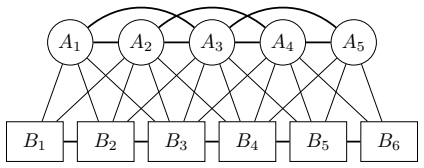
The paper establishes that there exists a family of Hamiltonians interpolating between a standard Jordan-Wigner chain and Fendley’s FFD model, or equivalently obtained by adding a particular perturbation to two decoupled Ising chains, for which the spectrum is obtained from free-fermion operators yet remains free of exponential degeneracies when the coupling constant is generic.
What carries the argument
The specific four-spin perturbation (or interpolation term) that couples the two Ising chains while preserving the hidden free-fermion algebra.
If this is right
- The spectrum remains free of volume-law degeneracies for almost all parameter values.
- The model remains solvable by diagonalizing a set of effective free-fermion modes.
- Degeneracies are at most polynomial in system size rather than exponential.
- Both the ground state and excited states are constructed explicitly without homogeneous degeneracies across the spectrum.
Where Pith is reading between the lines
- This opens the door to studying thermodynamic properties without complications from degenerate manifolds.
- Similar perturbations might remove unwanted degeneracies in other hidden-symmetry models.
- The result indicates that exponential degeneracies are not intrinsic to the free-fermion-in-disguise approach but depend on the form of the interaction.
Load-bearing premise
The chosen perturbation exactly preserves the hidden free-fermion structure for all system sizes and does not introduce or retain exponential degeneracies.
What would settle it
Exact diagonalization of the finite-size Hamiltonian at a generic coupling value showing either an exponential number of degenerate states or a mismatch with the free-fermion state counting.
Figures


read the original abstract
Recently, a number of spin chain models have been discovered that are solvable via hidden free-fermionic structures, going beyond the Jordan-Wigner paradigm. However, all examples in the literature displayed degeneracies that grow exponentially with the volume and that are homogeneous in the spectrum (identical degeneracies for all energy levels). In this note we present a model that can be solved by ``free fermions in disguise'' (FFD), such that the spectrum is free from exponential degeneracies for generic coupling constants. The model can be seen as a particular perturbation of two Ising chains. Alternatively, it can be realized as an interpolation between a standard Jordan-Wigner solvable chain and the original FFD model of Fendley. We used ChatGPT Pro 5.4 and 5.5 as a research assistant; in the Supplemental Material we provide details about the collaboration between the AI and the human author.
Editorial analysis
A structured set of objections, weighed in public.
Referee Report
Summary. The manuscript introduces a spin-chain model solvable via free fermions in disguise (FFD) that lacks the exponential (volume-law) degeneracies present in all prior FFD examples. The model is constructed either as a specific perturbation coupling two Ising chains or as an interpolation between a Jordan-Wigner solvable chain and Fendley's original FFD model; the authors assert that the spectrum remains free of exponential degeneracies for generic values of the coupling constants.
Significance. If the hidden FFD mapping is rigorously preserved under the chosen perturbation and the absence of degeneracies is demonstrated, the result would be significant: it supplies the first explicit FFD example without homogeneous exponential degeneracies, clarifying the structural conditions under which such hidden free-fermion structures can appear without the degeneracy issue that has accompanied every previous case.
major comments (2)
- [Abstract and model construction] The central claim that the FFD structure survives the two-chain perturbation (or interpolation) for generic couplings is asserted in the abstract and model definition but is not supported by an explicit disguise transformation, a set of conserved fermionic operators, or a degeneracy-counting argument showing why volume-law degeneracy is lifted. This is load-bearing for the result.
- [Abstract] No numerical verification or analytic proof is supplied that the spectrum remains non-degenerate once the chains are coupled; the abstract states the outcome for generic couplings without exhibiting the fermionic operators or the conserved quantities that would confirm the mapping remains intact.
minor comments (1)
- [Abstract] The note on the use of ChatGPT Pro as a research assistant belongs in the acknowledgments or supplemental material rather than the abstract.
Simulated Author's Rebuttal
We thank the referee for their detailed reading of the manuscript and for highlighting the need for stronger support of the central claims. We address each major comment below and will revise the manuscript to incorporate explicit constructions and verifications as outlined.
read point-by-point responses
-
Referee: [Abstract and model construction] The central claim that the FFD structure survives the two-chain perturbation (or interpolation) for generic couplings is asserted in the abstract and model definition but is not supported by an explicit disguise transformation, a set of conserved fermionic operators, or a degeneracy-counting argument showing why volume-law degeneracy is lifted. This is load-bearing for the result.
Authors: We agree that the load-bearing claim requires explicit support. In the revised manuscript we will add an explicit construction of the disguise transformation for the interpolated model, obtained by deforming the known fermionic operators of the Jordan-Wigner and Fendley limits. We will also include a degeneracy-counting argument that shows how the volume-law degeneracy is lifted for generic values of the coupling constants while remaining intact only on a measure-zero set of special points. revision: yes
-
Referee: [Abstract] No numerical verification or analytic proof is supplied that the spectrum remains non-degenerate once the chains are coupled; the abstract states the outcome for generic couplings without exhibiting the fermionic operators or the conserved quantities that would confirm the mapping remains intact.
Authors: We acknowledge the absence of such verification in the current version. The revised manuscript will contain both (i) an analytic outline demonstrating that the conserved quantities of the interpolated model remain fermionic and close under the algebra for generic couplings, and (ii) small-system exact-diagonalization data confirming the lifting of exponential degeneracies away from the special points. revision: yes
Circularity Check
No circularity: claim rests on explicit model construction without reduction to inputs
full rationale
The paper introduces a specific Hamiltonian as a perturbation of two Ising chains (or interpolation between JW and Fendley FFD models) and asserts that this choice preserves the hidden free-fermion mapping while eliminating volume-law degeneracies for generic couplings. No equations, fitted parameters, self-citations, or ansatzes are shown that would make the non-degeneracy result equivalent to the input by construction. The central claim is therefore a direct consequence of the chosen perturbation form rather than a tautological renaming or self-referential fit, rendering the derivation self-contained against external benchmarks.
Axiom & Free-Parameter Ledger
axioms (1)
- domain assumption The perturbed Hamiltonian remains integrable via a hidden free-fermion structure for generic couplings.
Reference graph
Works this paper leans on
-
[1]
Über das Paulische Äquivalenzverbot,
P. Jordan and E. Wigner, “Über das Paulische Äquivalenzverbot,”Z. Physik47(1928) 631–651
1928
-
[2]
Solvable Hamiltonians and Fermionization Transformations Obtained from Operators Satisfying Specific Commutation Relations,
K. Minami, “Solvable Hamiltonians and Fermionization Transformations Obtained from Operators Satisfying Specific Commutation Relations,”J. Phys. Soc. Japan85(2016) no. 2, 024003
2016
-
[3]
K. Minami, “Infinite number of solvable generalizations of XY-chain, with cluster state, and with central charge c = m/2,”Nucl. Phys. B925(2017) 144–160,arXiv:1710.01851 [cond-mat.stat-mech]
Pith/arXiv arXiv 2017
-
[4]
Exact solution of a cluster model with next-nearest-neighbor interaction,
Y. Yanagihara and K. Minami, “Exact solution of a cluster model with next-nearest-neighbor interaction,”Progr. of Theor. Exp. Phys.2020(2020) no. 11, 113A01,arXiv:2003.00962 [cond-mat.stat-mech]
arXiv 2020
-
[5]
Geometric criterion for solvability of lattice spin systems,
M. Ogura, Y. Imamura, N. Kameyama, K. Minami, and M. Sato, “Geometric criterion for solvability of lattice spin systems,”Phys. Rev. B102(2020) no. 24, 245118, arXiv:2003.13264 [cond-mat.stat-mech]
arXiv 2020
-
[6]
Characterization of solvable spin models via graph invariants,
A. Chapman and S. T. Flammia, “Characterization of solvable spin models via graph invariants,”Quantum4(2020) 278,arXiv:2003.05465 [quant-ph]
arXiv 2020
-
[7]
P. Fendley, “Free fermions in disguise,”J. Phys. A52(2019) no. 33, 335002, arXiv:1901.08078 [cond-mat.stat-mech]
arXiv 2019
-
[8]
Free fermions behind the disguise,
S. J. Elman, A. Chapman, and S. T. Flammia, “Free fermions behind the disguise,”Commun. Math. Phys.388(2021) 969–1003,arXiv:2012.07857 [quant-ph]
arXiv 2021
-
[9]
Solving models with generalized free fermions II: Path-product expansion and conserved charges,
K. Fukai, B. Pozsgay, and I. Vona, “Solving models with generalized free fermions II: Path-product expansion and conserved charges,”arXiv e-prints(2026) ,arXiv:2605.31453 [cond-mat.stat-mech]
Pith/arXiv arXiv 2026
-
[10]
The Hilbert-space structure of free fermions in disguise,
E. Vernier and L. Piroli, “The Hilbert-space structure of free fermions in disguise,”JSTAT 2026(2026) no. 1, 013101,arXiv:2507.15959 [cond-mat.stat-mech]
arXiv 2026
-
[11]
Solving models with generalized free fermions I: Algebras and eigenstates,
K. Fukai, B. Pozsgay, and I. Vona, “Solving models with generalized free fermions I: Algebras and eigenstates,”arXiv e-prints(2026) ,arXiv:2602.03431 [cond-mat.stat-mech]
arXiv 2026
-
[12]
Free fermions beyond Jordan and Wigner,
P. Fendley and B. Pozsgay, “Free fermions beyond Jordan and Wigner,”SciPost Physics16 (2024) no. 4, 102,arXiv:2310.19897 [cond-mat.stat-mech]
arXiv 2024
-
[13]
A free fermions in disguise model with claws,
K. Fukai, I. Vona, and B. Pozsgay, “A free fermions in disguise model with claws,”arXiv e-prints(2025) ,arXiv:2508.05789 [cond-mat.stat-mech]
arXiv 2025
-
[14]
A Unified Graph-Theoretic Framework for Free-Fermion Solvability,
A. Chapman, S. J. Elman, and R. L. Mann, “A Unified Graph-Theoretic Framework for Free-Fermion Solvability,”arXiv e-prints(2023) ,arXiv:2305.15625 [quant-ph]
arXiv 2023
-
[15]
T. Khovanova, “Clifford Algebras and Graphs,”GeombinatoricsXX (2)(2010) 56, arXiv:0810.3322 [math.CO]
Pith/arXiv arXiv 2010
-
[16]
Quantum circuits with free fermions in disguise,
K. Fukai and B. Pozsgay, “Quantum circuits with free fermions in disguise,”J. Phys. A58 (2025) no. 17, 175202,arXiv:2402.02984 [quant-ph]. 36
arXiv 2025
-
[17]
Graphs with 1-factors,
D. P. Sumner, “Graphs with 1-factors,”Proceedings of the American Mathematical Society42 (1974) no. 1, 8–12
1974
-
[18]
A note on matchings in graphs,
M. Las Vergnas, “A note on matchings in graphs,”Cahiers du Centre d’Études de Recherche Opérationnelle17(1975) no. 2–3–4, 257–260. Colloque sur la Théorie des Graphes, Paris, 1974. 37
1975
discussion (0)
Sign in with ORCID, Apple, or X to comment. Anyone can read and Pith papers without signing in.