Local Search on Vertex Coloring for Bipartite Graphs
Pith reviewed 2026-06-27 14:18 UTC · model grok-4.3
The pith
A gray-box local search mutation operator finds optimal vertex colorings on complete bipartite graphs in expected Θ(n log n) time.
A machine-rendered reading of the paper's core claim, the machinery that carries it, and where it could break.
Core claim
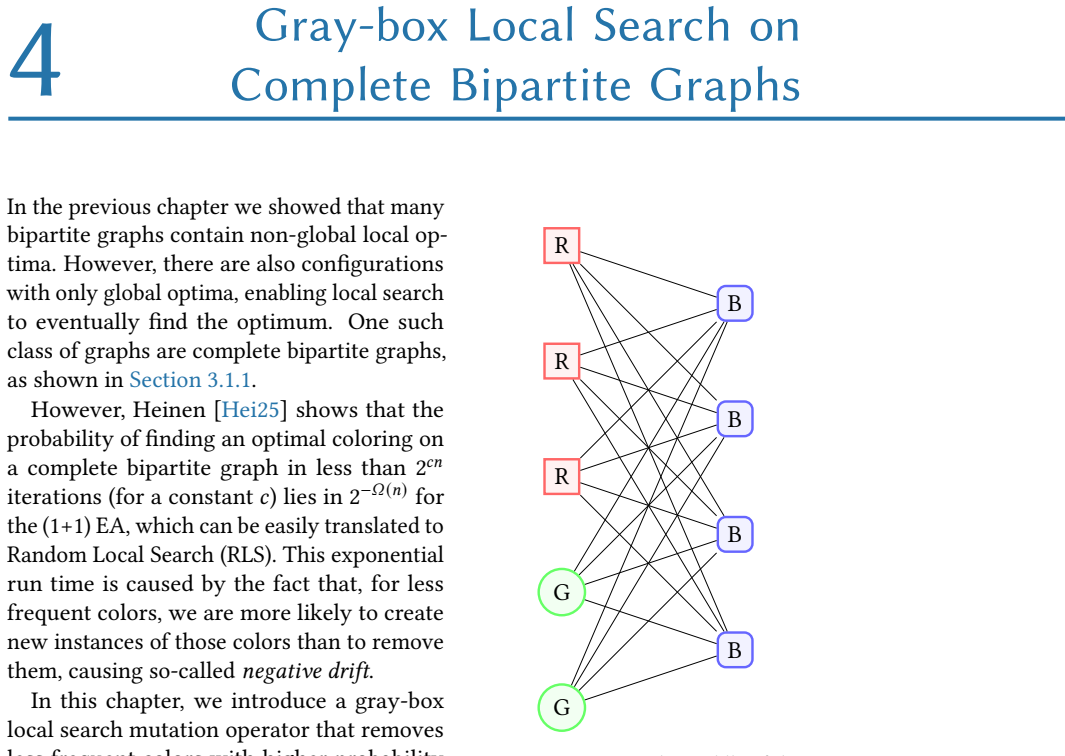
The paper proves that a gray-box local search mutation operator which removes less frequent colors with higher probability finds an optimal coloring on complete bipartite graphs in an expected runtime of Θ(n log n). This is established by analyzing the local search landscape on complete bipartite graphs and showing that the biased mutation drives the process to the global optimum at the stated rate.
What carries the argument
The gray-box local search mutation operator that removes less frequent colors with higher probability.
If this is right
- On complete bipartite graphs the gray-box operator reaches the global optimum while black-box random local search requires exponential time.
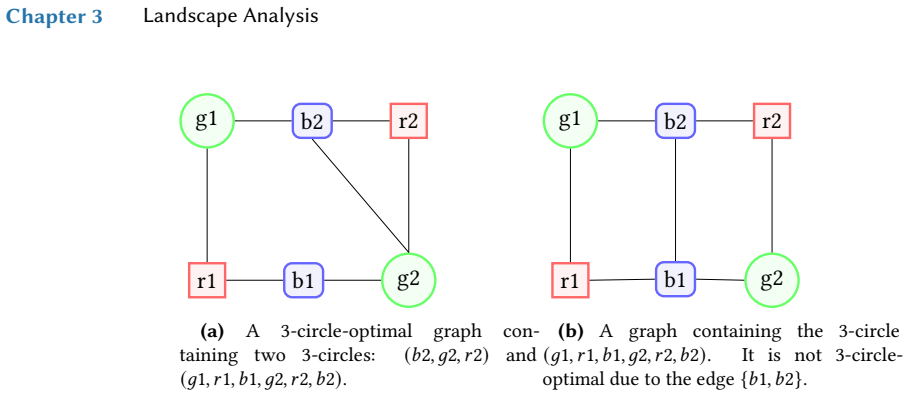
- General bipartite graphs admit local optima that use arbitrarily many colors beyond the chromatic number.
- Local search landscapes on bipartite graphs can contain only global optima or can contain non-global local optima depending on the graph structure.
- Gray-box information about color frequencies suffices to obtain a polynomial expected runtime on complete bipartite graphs.
Where Pith is reading between the lines
- The same frequency-biased mutation might be tested on other graph classes that admit efficient 2-colorings but contain local-search traps.
- The Θ(n log n) bound likely arises from a coupon-collector-like process over the color classes and could be verified by direct simulation on small complete bipartite graphs.
- If the bias toward rare colors is removed, the expected runtime on complete bipartite graphs reverts to the exponential black-box bound shown in the paper.
Load-bearing premise
The runtime bound and optimality guarantee are proven only for complete bipartite graphs.
What would settle it
An experiment on a complete bipartite graph K_{n,n} in which the gray-box local search fails to reach a proper 2-coloring with high probability after O(n log n) steps.
Figures


read the original abstract
Local search is a well-known heuristic method used in optimization. In this thesis, we explore its capabilities on the vertex coloring problem, an $NP$-hard problem with relevance in both theoretical analysis and practical application. To recognize limitations in the applicability of local search of the vertex coloring problem, we analyze local search landscapes on differently-structured bipartite graphs. We identify structures that ensure only global optima can exist as well as ones that enable the existence of non-global local optima, showing that on general bipartite graphs, it is possible for local search to return arbitrarily bad results. Further, we analyze the capabilities of local search on graphs where a local optimum can be found. To do so, we introduce a gray-box local search mutation operator that removes less frequent colors with higher probability and prove that it finds an optimal coloring on complete bipartite graphs in an expected run time of $\Theta(n \log n)$. This is a drastic improvement to the exponential tun time of the black-box Random Local Search, showing that gray-box mutation operators can improve the run time of local search.
Editorial analysis
A structured set of objections, weighed in public.
Referee Report
Summary. The manuscript examines local search for vertex coloring on bipartite graphs. It shows that general bipartite graphs can have non-global local optima that local search may reach, leading to arbitrarily bad colorings. It introduces a gray-box mutation operator that removes less frequent colors with higher probability and proves that on complete bipartite graphs, this operator achieves an optimal coloring in expected Θ(n log n) time, a significant improvement over the exponential time of black-box random local search.
Significance. If the proof is correct, the work is significant in demonstrating the potential of gray-box information in local search to achieve near-linear expected runtime on structured instances like complete bipartite graphs. It also provides insight into the local search landscape for bipartite graphs, distinguishing cases where local optima are only global from those with bad local optima.
major comments (1)
- Abstract: the central claim is a proof that the gray-box mutation operator yields expected runtime Θ(n log n) on complete bipartite graphs, but the derivation steps, probability calculations for the biased removal of less frequent colors, and handling of the mutation operator are not visible, preventing verification of the analysis.
minor comments (1)
- The abstract refers to 'this thesis,' suggesting the text may be excerpted from a larger document; ensure the manuscript is self-contained with consistent terminology and section numbering if submitted as a standalone paper.
Simulated Author's Rebuttal
We thank the referee for the detailed review and the recommendation for major revision. We address the single major comment below.
read point-by-point responses
-
Referee: Abstract: the central claim is a proof that the gray-box mutation operator yields expected runtime Θ(n log n) on complete bipartite graphs, but the derivation steps, probability calculations for the biased removal of less frequent colors, and handling of the mutation operator are not visible, preventing verification of the analysis.
Authors: We agree that the abstract, as a concise summary, cannot contain the full derivation. The manuscript body presents the proof of the Θ(n log n) bound, including the biased removal probabilities and mutation operator analysis. However, to address the verifiability concern, we will revise the manuscript by expanding the relevant section(s) with more explicit step-by-step derivations, clearer probability calculations, and improved structuring of the mutation operator handling. We will also slightly expand the abstract to better indicate the main analytical approach without exceeding length limits. revision: yes
Circularity Check
No significant circularity
full rationale
The paper introduces a gray-box mutation operator and proves a Θ(n log n) expected runtime bound specifically for complete bipartite graphs via standard expected-time analysis of the operator's bias toward less frequent colors. The derivation relies on the operator definition and graph structure rather than any fitted parameters, self-referential definitions, or load-bearing self-citations that reduce the result to its inputs by construction. The comparison to exponential runtime for black-box RLS is presented as a contrast, not as a derived quantity from the new result. No steps match the enumerated circularity patterns.
Axiom & Free-Parameter Ledger
axioms (1)
- standard math Standard properties of expected runtime analysis for randomized local search algorithms
invented entities (1)
-
Gray-box mutation operator
no independent evidence
Reference graph
Works this paper leans on
-
[1]
Musser, David R. , date =. Introspective. doi:10.1002/(SICI)1097-024X(199708)27:8<983::AID-SPE117>3.0.CO;2- langid =
-
[2]
Exponential
Heinen, Antonia , month = aug, year =. Exponential
-
[3]
Linear time self-stabilizing colorings , volume =. Information Processing Letters , author =. 2003 , keywords =. doi:10.1016/S0020-0190(03)00299-0 , abstract =
-
[4]
Chaitin, G. J. , month = jun, year =. Register allocation & spilling via graph coloring , isbn =. Proceedings of the 1982. doi:10.1145/800230.806984 , abstract =
-
[5]
2004 , note =
Periodica Polytechnica Electrical Engineering (Archives) , author =. 2004 , note =
2004
-
[6]
Selman, Bart and Gomes, Carla P , year =. Hill-climbing. Encyclopedia of. doi:10.1002/0470018860.s00015 , keywords =
-
[7]
Analyzing
Jansen, Thomas , month = jan, year =. Analyzing
-
[8]
Journal of the Operational Research Society , author =
Statistical. Journal of the Operational Research Society , author =. 2004 , keywords =. doi:10.1057/palgrave.jors.2601611 , abstract =
-
[9]
Variable
Hansen, Pierre and Mladenović, Nenad , editor =. Variable. Handbook of. 2018 , doi =
2018
-
[10]
Approximation
Korte, Bernhard and Vygen, Jens , editor =. Approximation. Combinatorial. 2018 , doi =
2018
-
[11]
Colouring , url =
Diestel, Reinhard , editor =. Colouring , url =. Graph. 2025 , doi =
2025
-
[12]
and Kolen, A
Crama, Y. and Kolen, A. W. J. and Pesch, E. J. , editor =. Local search in combinatorial optimization , url =. Artificial. 1995 , doi =
1995
-
[13]
Voß, Stefan , year =. Metaheuristics , url =. Encyclopedia of. doi:10.1007/978-0-387-74759-0_367 , pages =
-
[14]
and Rajabi, Amirhossein , editor =
Friedrich, Tobias and Kötzing, Timo and Krejca, Martin S. and Rajabi, Amirhossein , editor =. Escaping. Parallel. 2022 , doi =
2022
-
[15]
Journal of Heuristics , author =
Testing heuristics:. Journal of Heuristics , author =. 1995 , keywords =. doi:10.1007/BF02430364 , abstract =
-
[16]
Watson, Jean-Paul , editor =. An. Handbook of. 2010 , doi =
2010
-
[17]
and Ranganathan, K
Balakrishnan, R. and Ranganathan, K. , editor =. Graph. A. 2012 , doi =
2012
-
[18]
Crossover for. ACM Trans. Evol. Learn. Optim. , author =. 2023 , pages =. doi:10.1145/3603629 , abstract =
-
[19]
Analysis of a gray-box operator for vertex cover , isbn =
Baguley, Samuel and Friedrich, Tobias and Kötzing, Timo and Li, Xiaoyue and Pappik, Marcus and Zeif, Ziena , month = jul, year =. Analysis of a gray-box operator for vertex cover , url =. doi:10.1145/3512290.3528848 , abstract =
-
[20]
Analysis of an
Sudholt, Dirk and Zarges, Christine , editor =. Analysis of an. Algorithms and. 2010 , doi =
2010
-
[21]
Crossover is provably essential for the
Sudholt, Dirk , month = jun, year =. Crossover is provably essential for the. doi:10.1145/1068009.1068202 , abstract =
-
[22]
Whitley, Darrell , month = jul, year =. Mk. doi:10.1145/2739480.2754809 , abstract =
-
[23]
Time. Algorithmica , author =. 2021 , keywords =. doi:10.1007/s00453-021-00838-3 , abstract =
-
[24]
Doerr, Benjamin , year =. Probabilistic. doi:10.1007/978-3-030-29414-4_1 , note =
-
[25]
Theoretical Computer Science , author =
First-hitting times under drift , volume =. Theoretical Computer Science , author =. 2019 , keywords =. doi:10.1016/j.tcs.2019.08.021 , abstract =
-
[26]
Mixed. ICAPS , author =. 2019 , pages =. doi:10.1609/icaps.v29i1.3521 , abstract =
-
[27]
Kötzing, Timo , month = jun, year =. Theory of. doi:10.48550/arXiv.2406.14589 , abstract =
-
[28]
Multiplicative drift analysis , url =
Doerr, Benjamin and Johannsen, Daniel and Winzen, Carola , month = jul, year =. Multiplicative drift analysis , url =. doi:10.1145/1830483.1830748 , abstract =
-
[29]
Simplified. Algorithmica , author =. 2011 , keywords =. doi:10.1007/s00453-010-9387-z , abstract =
-
[30]
Erratum: Simplified Drift Analysis for Proving Lower Bounds in Evolutionary Computation
Oliveto, Pietro S. and Witt, Carsten , month = nov, year =. Erratum:. doi:10.48550/arXiv.1211.7184 , abstract =
work page internal anchor Pith review Pith/arXiv arXiv doi:10.48550/arxiv.1211.7184
-
[31]
Jensen, J. L. W. V. , month = nov, year =. Sur les fonctions convexes et les inégualités entre les valeurs. doi:10.1007/bf02418571 , abstract =
-
[32]
Back, T. and Khuri, S. , booktitle=. An evolutionary heuristic for the maximum independent set problem , year=. doi:10.1109/ICEC.1994.350004 , ISSN=
-
[33]
Randomized local search, evolutionary algorithms, and the minimum spanning tree problem , volume =
Randomized local search, evolutionary algorithms, and the minimum spanning tree problem , volume =. Theoretical Computer Science , author =. 2007 , keywords =. doi:10.1016/j.tcs.2006.11.002 , abstract =
-
[34]
Static and. Algorithmica , author =. 2018 , keywords =. doi:10.1007/s00453-017-0341-1 , abstract =
-
[35]
Branson, Luke and Sutton, Andrew M. , month = sep, year =. Focused jump-and-repair constraint handling for fixed-parameter tractable graph problems , url =. doi:10.1145/3450218.3477304 , abstract =
-
[36]
Systems, Man, and Cybernetics , author =
A. Systems, Man, and Cybernetics , author =. 2005 , file =. doi:10.1109/TSMCC.2004.841903 , abstract =
discussion (0)
Sign in with ORCID, Apple, or X to comment. Anyone can read and Pith papers without signing in.