When Types Intersect and Effects Get Handled
Pith reviewed 2026-06-27 14:44 UTC · model grok-4.3
The pith
A new intersection type system for lambda calculus with algebraic effects and handlers characterizes exactly the terminating terms and reduces reachability to type inference.
A machine-rendered reading of the paper's core claim, the machinery that carries it, and where it could break.
Core claim
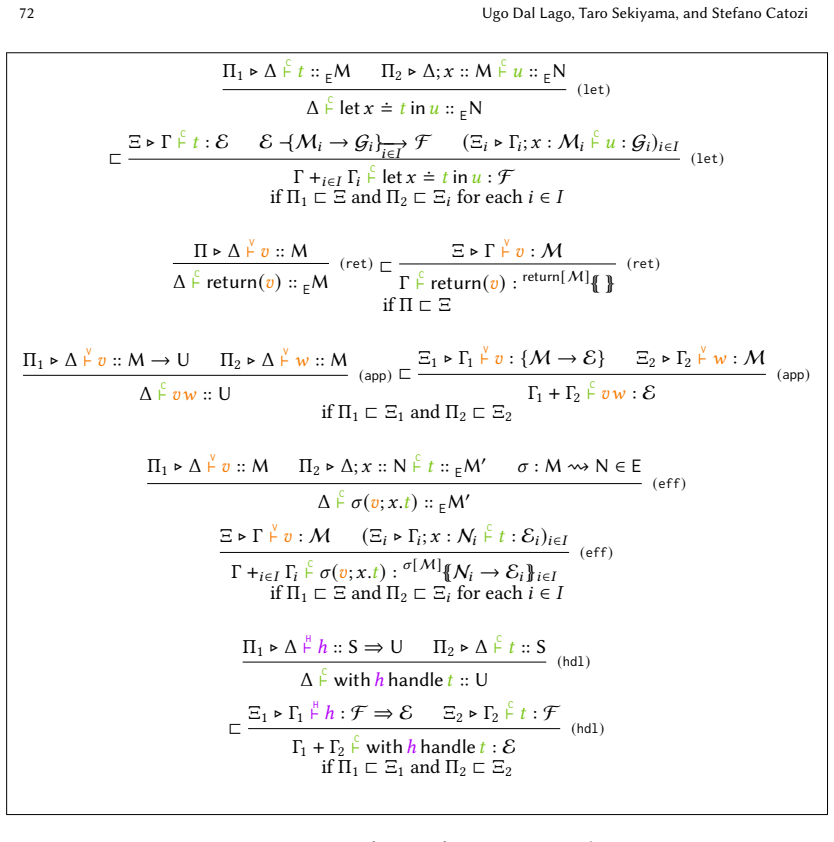
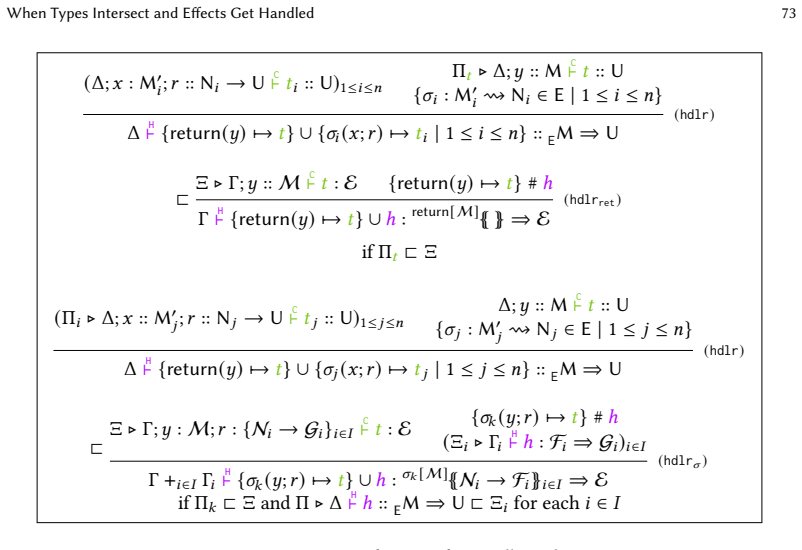
We introduce a novel intersection type system for a λ-calculus with algebraic effects and handlers. The system, inherently behavioral in nature, enjoys subject reduction and expansion. It thus characterizes the set of terms whose evaluation process terminates and allows reducing the reachability problem to type inference. This system induces a system of simple types which is type sound and admits a decidable HOMC problem.
What carries the argument
The intersection type system for the lambda calculus with algebraic effects and handlers, which assigns types that record both functional and effect-handling behavior.
If this is right
- Every terminating term receives an intersection type and every typed term terminates.
- Reachability of a given effect or handler configuration reduces directly to checking whether a type exists.
- The induced simple type system remains sound for the effectful calculus.
- The higher-order model-checking problem for the induced simple types is decidable.
Where Pith is reading between the lines
- Type-inference algorithms developed for this system could be used as decision procedures for termination in effectful programs.
- The reduction of reachability to typing suggests that existing type-inference engines might be repurposed for verifying handler safety.
- The contrast with earlier systems like HEPCF indicates that intersection types can restore decidability where simple types alone fail.
Load-bearing premise
That an intersection type system can be defined for this calculus so that it satisfies subject reduction, expansion, and exactly captures termination.
What would settle it
A concrete term whose evaluation terminates yet receives no type in the system, or a typed term whose evaluation diverges, or a reduction step that violates subject reduction.
Figures







read the original abstract
We introduce a novel intersection type system for a $\lambda$-calculus with algebraic effects and handlers. The system, inherently behavioral in nature, enjoys the classical properties of intersection type systems, in particular subject reduction and expansion. It thus characterizes the set of terms whose evaluation process terminates and, at the same time, allows reducing the reachability problem to type inference. This new system, the first with these features for a calculus with handlers, induces a system of simple types which, although not guaranteeing termination, is type sound and admits a decidable HOMC problem, unlike similar type systems like Dal Lago and Ghyselen's HEPCF.
Editorial analysis
A structured set of objections, weighed in public.
Referee Report
Summary. The paper introduces a novel intersection type system for a λ-calculus with algebraic effects and handlers. The system is behavioral, enjoys subject reduction and expansion, characterizes terminating terms, reduces reachability to type inference, and induces a sound simple type system with decidable HOMC (unlike HEPCF).
Significance. If the derivations hold, the result is significant as the first intersection type system with these classical properties for a calculus with handlers. It provides a behavioral characterization of termination and a reduction of reachability to type inference, while the induced simple types offer decidability advantages over prior systems like Dal Lago and Ghyselen's HEPCF. The manuscript supplies arguments for subject reduction/expansion and soundness.
minor comments (2)
- The abstract claims the system 'induces a system of simple types' with decidable HOMC; the manuscript should explicitly state the induction construction and the precise HOMC instance in a dedicated section or theorem.
- Notation for effect operations and handlers in the typing rules should be clarified with an example derivation to aid readability, especially for readers unfamiliar with algebraic effects.
Simulated Author's Rebuttal
We thank the referee for the positive summary of our manuscript and the recommendation of minor revision. The referee's description accurately captures the main results concerning the intersection type system for the lambda calculus with algebraic effects and handlers, including subject reduction/expansion, termination characterization, and the induced simple type system with decidable HOMC.
Circularity Check
No significant circularity detected
full rationale
The paper introduces a new intersection type system for the lambda-calculus with algebraic effects and handlers, then establishes subject reduction, expansion, termination characterization, and reachability reduction via direct arguments on the typing rules. These steps are presented as standard formal derivations without reduction to fitted parameters, self-definitional loops, or load-bearing self-citations. The induced simple type system and its soundness/HOMC decidability are shown separately. No quoted step equates a claimed result to its own input by construction.
Axiom & Free-Parameter Ledger
Reference graph
Works this paper leans on
-
[1]
Beniamino Accattoli, Ugo Dal Lago, and Gabriele Vanoni. 2021. The (in) efficiency of interaction.Proceedings of the ACM on Programming Languages5, POPL (2021), 1–33
2021
-
[2]
Sandra Alves, Delia Kesner, and Miguel Ramos. 2023. Quantitative global memory. InInternational Workshop on Logic, Language, Information, and Computation. Springer, 53–68
2023
-
[3]
Henk Barendregt, Mario Coppo, and Mariangiola Dezani-Ciancaglini. 1983. A filter lambda model and the completeness of type assignment1.The journal of symbolic logic48, 4 (1983), 931–940
1983
-
[4]
Andrej Bauer and Matija Pretnar. 2014. An Effect System for Algebraic Effects and Handlers.Logical Methods in Computer Science10, 4 (2014). doi:10.2168/LMCS-10(4:9)2014
-
[5]
Alexis Bernadet and Stéphane Lengrand. 2011. Filter Models: Non-idempotent Intersection Types, Orthogonality and Polymorphism. InComputer Science Logic - 25th International Workshop / 20th Annual Conference of the EACSL, CSL 2011, Bergen, Norway, September 12-15, 2011, Proceedings (LIPIcs, Vol. 12), Marc Bezem (Ed.). Schloss Dagstuhl - Leibniz-Zentrum für...
-
[6]
Gavin Bierman, Martín Abadi, and Mads Torgersen. 2014. Understanding typescript. InEuropean Conference on Object-Oriented Programming. Springer, 257–281. 28 Ugo Dal Lago, Taro Sekiyama, and Stefano Catozi
2014
-
[7]
Viviana Bono and Mariangiola Dezani-Ciancaglini. 2020. A tale of intersection types. InProceedings of the 35th Annual ACM/IEEE Symposium on Logic in Computer Science. 7–20
2020
-
[8]
Gilad Bracha, Martin Odersky, David Stoutamire, and Philip Wadler. 1998. Making the future safe for the past: Adding genericity to the Java programming language.Acm sigplan notices33, 10 (1998), 183–200
1998
-
[9]
Flavien Breuvart and Ugo Dal Lago. 2018. On intersection types and probabilistic lambda calculi. InProceedings of the 20th International Symposium on Principles and Practice of Declarative Programming. 1–13
2018
-
[10]
Pierre Clairambault, Charles Grellois, and Andrzej S Murawski. 2017. Linearity in higher-order recursion schemes. Proceedings of the ACM on Programming Languages2, POPL (2017), 1–29
2017
-
[11]
Mario Coppo and Mariangiola Dezani-Ciancaglini. 1978. A new type assignment for𝜆-terms.Archiv für mathematische Logik und Grundlagenforschung19, 1 (1978), 139–156
1978
-
[12]
Ugo Dal Lago, Claudia Faggian, and Simona Ronchi Della Rocca. 2021. Intersection types and (positive) almost-sure termination.Proceedings of the ACM on Programming Languages5, POPL (2021), 1–32
2021
-
[13]
Ugo Dal Lago and Alexis Ghyselen. 2024. On Model-Checking Higher-Order Effectful Programs.Proc. ACM Program. Lang.8, POPL (2024), 2610–2638. doi:10.1145/3632929
-
[14]
2007.Sémantiques de la logique linéaire et temps de calcul
Daniel De Carvalho. 2007.Sémantiques de la logique linéaire et temps de calcul. Ph. D. Dissertation. Aix-Marseille 2
2007
-
[15]
Ugo Deliguoro and Adolfo Piperno. 1995. Nondeterministic extensions of untyped 𝜆-calculus.Information and Computation122, 2 (1995), 149–177
1995
-
[16]
Andrej Dudenhefner and Daniele Pautasso. 2024. Mechanized Subject Expansion in Uniform Intersection Types for Perpetual Reductions. In9th International Conference on Formal Structures for Computation and Deduction (FSCD 2024). Schloss Dagstuhl–Leibniz-Zentrum für Informatik, 8–1
2024
-
[17]
Ryunosuke Endo and Tachio Terauchi. 2025. Reachability is Decidable for ATM-Typable Finitary PCF with Effect Handlers. InProgramming Languages and Systems - 23rd Asian Symposium, APLAS 2025, Bengaluru, India, October 27-30, 2025, Proceedings (Lecture Notes in Computer Science, Vol. 16201), Alex Potanin (Ed.). Springer, 67–87. doi:10.1007/978- 981-95-3585-9_4
-
[18]
Zeinab Galal, Francesco Gavazzo, Riccardo Treglia, and Gabriele Vanoni. 2025. Monadic Intersection Types, Relationally, and Ordered.ACM Transactions on Programming Languages and Systems47, 4 (2025), 1–51
2025
-
[19]
Francesco Gavazzo, Riccardo Treglia, and Gabriele Vanoni. 2024. Monadic intersection types, relationally. InEuropean Symposium on Programming. Springer, 22–51
2024
-
[20]
J. Y. Girard. 1972.Interprétation fonctionnelle et élimination des coupures de l’arithmétique d’ordre supérieur. Thèse de Doctorat d’État. Université Paris 7
1972
-
[21]
Colin S. Gordon. 2020. Lifting Sequential Effects to Control Operators. In34th European Conference on Object- Oriented Programming, ECOOP 2020 (LIPIcs, Vol. 166), Robert Hirschfeld and Tobias Pape (Eds.). Schloss Dagstuhl - Leibniz-Zentrum für Informatik, 23:1–23:30. doi:10.4230/LIPIcs.ECOOP.2020.23
-
[22]
Colin S. Gordon. 2021. Polymorphic Iterable Sequential Effect Systems.ACM Trans. Program. Lang. Syst.43, 1 (2021), 4:1–4:79. doi:10.1145/3450272
-
[23]
Charles Grellois and Paul-André Melliès. 2015. Relational Semantics of Linear Logic and Higher-order Model Checking. In24th EACSL Annual Conference on Computer Science Logic (CSL 2015) (Leibniz International Proceedings in Informatics (LIPIcs), Vol. 41), Stephan Kreutzer (Ed.). Schloss Dagstuhl – Leibniz-Zentrum für Informatik, Dagstuhl, Germany, 260–276....
-
[24]
Daniel Hillerström and Sam Lindley. 2016. Liberating effects with rows and handlers. InProceedings of the 1st International Workshop on Type-Driven Development, TyDe@ICFP 2016, Nara, Japan, September 18, 2016. 15–27. doi:10. 1145/2976022.2976033
arXiv 2016
-
[25]
Oleg Kiselyov and Hiromi Ishii. 2015. Freer monads, more extensible effects. InProceedings of the 8th ACM SIGPLAN Symposium on Haskell, Haskell 2015. 94–105. doi:10.1145/2804302.2804319
-
[27]
Teodor Knapik, Damian Niwinski, and Pawel Urzyczyn. 2002. Higher-Order Pushdown Trees Are Easy. InFoundations of Software Science and Computation Structures, 5th International Conference, FOSSACS 2002. Held as Part of the Joint European Conferences on Theory and Practice of Software, ETAPS 2002 Grenoble, France, April 8-12, 2002, Proceedings (Lecture Note...
work page doi:10.1007/3- 2002
-
[28]
Naoki Kobayashi. 2009. Types and higher-order recursion schemes for verification of higher-order programs. In Proceedings of the 36th annual ACM SIGPLAN-SIGACT Symposium on Principles of Programming Languages. 416–428
2009
-
[29]
Naoki Kobayashi. 2013. Model checking higher-order programs.Journal of the ACM (JACM)60, 3 (2013), 1–62. When Types Intersect and Effects Get Handled 29
2013
-
[30]
Naoki Kobayashi, Ugo Dal Lago, and Charles Grellois. 2019. On the Termination Problem for Probabilistic Higher-Order Recursive Programs. In34th Annual ACM/IEEE Symposium on Logic in Computer Science, LICS 2019, Vancouver, BC, Canada, June 24-27, 2019. IEEE, 1–14. doi:10.1109/LICS.2019.8785679
-
[31]
Naoki Kobayashi and Atsushi Igarashi. 2013. Model-Checking Higher-Order Programs with Recursive Types. In Programming Languages and Systems - 22nd European Symposium on Programming, ESOP 2013, Held as Part of the European Joint Conferences on Theory and Practice of Software, ETAPS 2013, Rome, Italy, March 16-24, 2013. Proceedings (Lecture Notes in Compute...
-
[32]
Naoki Kobayashi and C.-H. Luke Ong. 2009. A Type System Equivalent to the Modal Mu-Calculus Model Checking of Higher-Order Recursion Schemes. InProceedings of the 24th Annual IEEE Symposium on Logic in Computer Science, LICS 2009. IEEE Computer Society, 179–188. doi:10.1109/LICS.2009.29
-
[33]
Eric Koskinen and Tachio Terauchi. 2014. Local Temporal Reasoning. InJoint Meeting of the Twenty-Third EACSL Annual Conference on Computer Science Logic and the Twenty-Ninth Annual ACM/IEEE Symposium on Logic in Computer Science (CSL-LICS ’14), Thomas A. Henzinger and Dale Miller (Eds.). ACM, 59:1–59:10. doi:10.1145/2603088.2603138
-
[34]
Daan Leijen. 2017. Type directed compilation of row-typed algebraic effects. InProceedings of the 44th ACM SIGPLAN Symposium on Principles of Programming Languages, POPL 2017. 486–499. http://dl.acm.org/citation.cfm?id=3009872
2017
-
[35]
Eugenio Moggi. 1991. Notions of computation and monads.Information and computation93, 1 (1991), 55–92
1991
-
[36]
Yoji Nanjo, Hiroshi Unno, Eric Koskinen, and Tachio Terauchi. 2018. A Fixpoint Logic and Dependent Effects for Temporal Property Verification. InProceedings of the 33rd Annual ACM/IEEE Symposium on Logic in Computer Science (LICS ’18), Anuj Dawar and Erich Grädel (Eds.). ACM, 759–768. doi:10.1145/3209108.3209204
-
[37]
Martin Odersky, Philippe Altherr, Vincent Cremet, Burak Emir, Sebastian Maneth, Stéphane Micheloud, Nikolay Mihaylov, Michel Schinz, Erik Stenman, and Matthias Zenger. 2004. An overview of the Scala programming language. (2004)
2004
-
[38]
C.-H. Luke Ong. 2006. On Model-Checking Trees Generated by Higher-Order Recursion Schemes. In21th IEEE Symposium on Logic in Computer Science (LICS 2006), 12-15 August 2006, Seattle, W A, USA, Proceedings. IEEE Computer Society, 81–90. doi:10.1109/LICS.2006.38
-
[39]
Dominic Orchard and Nobuko Yoshida. 2016. Effects as sessions, sessions as effects.ACM SIGPLAN Notices51, 1 (2016), 568–581
2016
-
[40]
Gordon D. Plotkin and John Power. 2003. Algebraic Operations and Generic Effects.Applied Categorical Structures11, 1 (2003), 69–94. doi:10.1023/A:1023064908962
-
[41]
Gordon D. Plotkin and Matija Pretnar. 2009. Handlers of Algebraic Effects. InProgramming Languages and Systems, 18th European Symposium on Programming, ESOP 2009, Held as Part of the Joint European Conferences on Theory and Practice of Software, ETAPS 2009, Proceedings. 80–94. doi:10.1007/978-3-642-00590-9_7
-
[42]
Gordon D. Plotkin and Matija Pretnar. 2013. Handling Algebraic Effects.Logical Methods in Computer Science9, 4 (2013). doi:10.2168/LMCS-9(4:23)2013
-
[43]
Matija Pretnar. 2015. An Introduction to Algebraic Effects and Handlers. Invited tutorial paper. InThe 31st Conference on the Mathematical Foundations of Programming Semantics, MFPS 2015, Nijmegen, The Netherlands, June 22-25, 2015 (Electronic Notes in Theoretical Computer Science, Vol. 319), Dan R. Ghica (Ed.). Elsevier, 19–35. doi:10.1016/J.ENTCS. 2015.12.003
-
[44]
John C. Reynolds. 1974. Towards a theory of type structure. InProgramming Symposium, Proceedings Colloque sur la Programmation. 408–423. doi:10.1007/3-540-06859-7_148
-
[45]
Reynolds
John C. Reynolds. 1988.Preliminary Design of the Programming Language Forsythe. Technical Report CMU-CS-88-159. Carnegie Mellon University
1988
-
[46]
Tom Schrijvers, Maciej Piróg, Nicolas Wu, and Mauro Jaskelioff. 2019. Monad transformers and modular algebraic effects: what binds them together. InProceedings of the 12th ACM SIGPLAN International Symposium on Haskell, Haskell@ICFP 2019, Berlin, Germany, August 18-23, 2019, Richard A. Eisenberg (Ed.). ACM, 98–113. doi:10.1145/3331545. 3342595
-
[47]
Taro Sekiyama, Ugo Dal Lago, and Hiroshi Unno. 2025. On Higher-Order Model Checking of Effectful Answer-Type- Polymorphic Programs.Proc. ACM Program. Lang.9, OOPSLA2 (2025), 3726–3754. doi:10.1145/3763184
-
[48]
Taro Sekiyama and Hiroshi Unno. 2023. Temporal Verification with Answer-Effect Modification: Dependent Temporal Type-and-Effect System with Delimited Continuations.Proc. ACM Program. Lang.7, POPL, Article 71 (2023), 32 pages. doi:10.1145/3571264
-
[49]
Taro Sekiyama and Hiroshi Unno. 2024. Higher-Order Model Checking of Effect-Handling Programs with Answer-Type Modification.Proc. ACM Program. Lang.8, OOPSLA2 (2024), 2662–2691. doi:10.1145/3689805
-
[50]
Taro Sekiyama and Hiroshi Unno. 2025. Algebraic Temporal Effects: Temporal Verification of Recursively Typed Higher-Order Programs.Proc. ACM Program. Lang.9, POPL (2025), 2306–2336. doi:10.1145/3704914 30 Ugo Dal Lago, Taro Sekiyama, and Stefano Catozi
-
[51]
Christian Skalka and Scott F. Smith. 2004. History Effects and Verification. InProgramming Languages and Systems: Second Asian Symposium, APLAS 2004 (Lecture Notes in Computer Science, Vol. 3302), Wei-Ngan Chin (Ed.). Springer, 107–128. doi:10.1007/978-3-540-30477-7_8
-
[52]
Christian Skalka, Scott F. Smith, and David Van Horn. 2008. Types and trace effects of higher order programs.J. Funct. Program.18, 2 (2008), 179–249. doi:10.1017/S0956796807006466
-
[53]
2006.Lectures on the Curry-Howard isomorphism
Morten Heine Sørensen and Pawel Urzyczyn. 2006.Lectures on the Curry-Howard isomorphism. Vol. 149. Elsevier
2006
-
[54]
Nikhil Swamy, Joel Weinberger, Cole Schlesinger, Juan Chen, and Benjamin Livshits. 2013. Verifying higher-order programs with the dijkstra monad. InACM SIGPLAN Conference on Programming Language Design and Implementation, PLDI ’13, Seattle, W A, USA, June 16-19, 2013, Hans-Juergen Boehm and Cormac Flanagan (Eds.). ACM, 387–398. doi:10.1145/2491956.2491978
-
[55]
William W. Tait. 1967. Intensional Interpretations of Functionals of Finite Type I.J. Symb. Log.32, 2 (1967), 198–212. doi:10.2307/2271658
-
[56]
Wenhao Tang. 2024. Session-Typed Effect Handlers.POPL 2024 SRC(2024)
2024
-
[57]
Wenhao Tang and Sam Lindley. 2026. Rows and Capabilities as Modal Effects.Proc. ACM Program. Lang.10, POPL (2026), 923–950. doi:10.1145/3776674
-
[58]
Steffen van Bakel, Franco Barbanera, and Ugo de’Liguoro. 2018. Intersection Types for the lambda-mu Calculus.Log. Methods Comput. Sci.14, 1 (2018). doi:10.23638/LMCS-14(1:2)2018
-
[59]
Takuma Yoshioka, Taro Sekiyama, and Atsushi Igarashi. 2024. Abstracting Effect Systems for Algebraic Effect Handlers. Proc. ACM Program. Lang.8, ICFP (2024), 455–484. doi:10.1145/3674641 When Types Intersect and Effects Get Handled 31 A Proofs of Section 4 In this appendix, we provide detailed proofs of all the statements presented in the main text. The o...
discussion (0)
Sign in with ORCID, Apple, or X to comment. Anyone can read and Pith papers without signing in.