Reduced integration with scaled boundary parametrization for virtual elements at finite strains
Pith reviewed 2026-06-27 14:34 UTC · model grok-4.3
The pith
Scaled boundary parametrization with Taylor expansion enables one-point analytical integration to stabilize virtual elements at finite strains.
A machine-rendered reading of the paper's core claim, the machinery that carries it, and where it could break.
Core claim
The formulation applies a scaled boundary parametrization together with a Taylor series expansion of the constitutive quantities with respect to the sectional center; this reduces integration of the weak form to a single analytical point per section while preserving stability and accuracy for virtual elements undergoing finite strains, hyperelastic anisotropy, and elasto-plasticity.
What carries the argument
Scaled boundary parametrization combined with Taylor series expansion of constitutive quantities around the sectional center for analytical one-point integration of the weak form.
If this is right
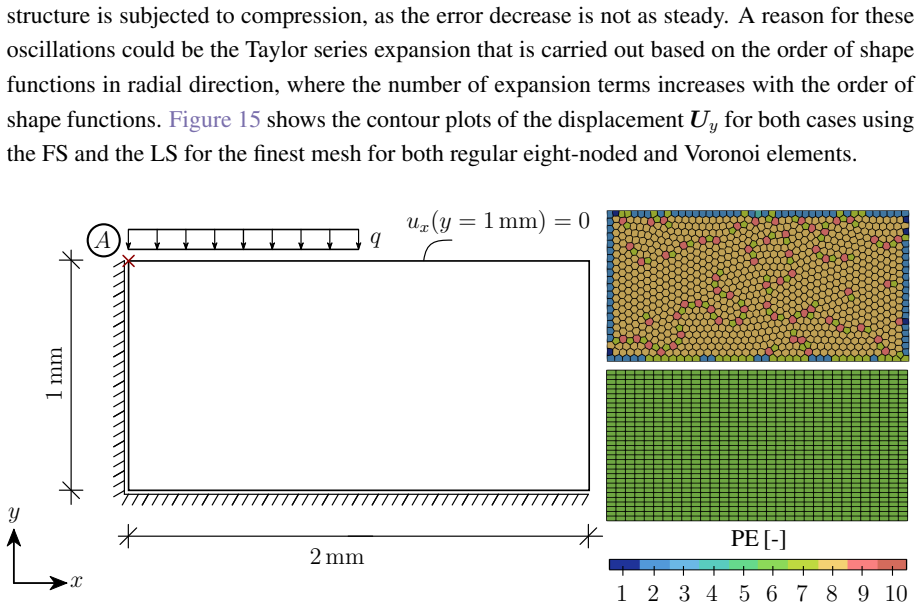
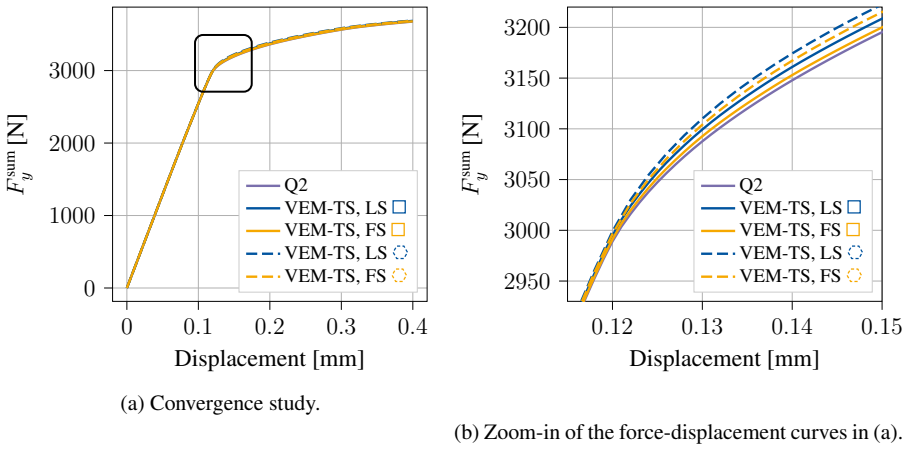
- The method yields accurate results for compression under large deformations.
- It handles hyperelastic anisotropy and elasto-plastic material behavior without loss of stability.
- Performance improves when the physical element geometry closely matches the pre-assigned parent element.
- Inelastic response is captured correctly in asymmetrically notched specimens.
Where Pith is reading between the lines
- The single-point scheme may lower computational cost relative to standard quadrature in repeated nonlinear solves.
- The approach could be tested on three-dimensional or higher-order virtual elements where integration expense grows rapidly.
- Accuracy on highly distorted meshes may still require additional checks beyond the parent-element resemblance condition.
Load-bearing premise
The Taylor series expansion of the constitutive quantities with respect to the sectional center remains sufficiently accurate to allow analytical integration of the weak form with only one integration point per section.
What would settle it
A nonlinear patch test or large-deformation compression example in which the single-point analytical integration produces visible deviation from the expected uniform stress or displacement field.
Figures







read the original abstract
This contribution presents an alternative stabilization technique for the virtual element method (VEM) based on reduced integration combined with a scaled boundary parametrization. To this end, a Taylor series expansion of the constitutive quantities with respect to the sectional center is carried out, enabling analytical integration of the weak form and reducing the need for integration points to only one per section. The accuracy of the proposed formulation is shown by several numerical examples, including a non-linear patch test. Different loading, e.g. compression under large deformations, and material conditions, such as hyperelastic anisotropy and elasto-plasticity, are considered. The biquadratic serendipity finite element formulation (Q2) and the low-order finite element formulation with hourglass stabilization (Q1STc+) are used for comparison. While the patch test was not fulfilled using higher order shape functions, the formulation led to good results and was able to capture the structure's response accurately. Furthermore, the formulation performed better when the physical element resembled the pre-assigned parent elements. The example of the asymmetrically notched specimen under elasto-plastic material behavior showed that the proposed formulation is able to capture inelasticities.
Editorial analysis
A structured set of objections, weighed in public.
Referee Report
Summary. The paper proposes an alternative stabilization for the virtual element method at finite strains based on reduced integration with scaled boundary parametrization. A Taylor series expansion of constitutive quantities about the sectional center enables analytical integration of the weak form, reducing quadrature to one point per section. Accuracy is demonstrated via numerical examples including a nonlinear patch test, large-deformation compression, hyperelastic anisotropy, and elasto-plasticity, with comparisons to Q2 and Q1STc+ finite elements; the method performs better when physical elements resemble parent elements.
Significance. If the truncation error remains controlled, the approach could supply an efficient, low-quadrature stabilization for VEM in nonlinear regimes, supported by the reported success on patch tests and inelastic examples. The numerical evidence of accurate structural response under finite strains and varied materials is a concrete strength.
major comments (2)
- [Formulation] Formulation (Taylor expansion step): the central claim that the expansion permits accurate single-point integration rests on the assumption that truncation of constitutive quantities about the sectional center remains sufficiently accurate at finite strains; no a priori error bound, consistency analysis, or dependence on expansion order is supplied, leaving the uncontrolled consistency error unquantified for nonlinear maps such as anisotropic hyperelasticity or elasto-plasticity.
- [Numerical examples] Numerical results (patch test paragraph): the abstract states the patch test 'was not fulfilled using higher order shape functions' yet 'the formulation led to good results'; this tension must be resolved by defining what constitutes fulfillment for the nonlinear case and by reporting the observed residual or convergence rate.
minor comments (1)
- [Abstract] Abstract: the phrase 'the formulation performed better when the physical element resembled the pre-assigned parent elements' is presented without quantitative support or discussion of its implications for general meshes.
Simulated Author's Rebuttal
We thank the referee for the constructive review and the positive overall assessment of the work. We address each major comment below and indicate the corresponding revisions.
read point-by-point responses
-
Referee: [Formulation] Formulation (Taylor expansion step): the central claim that the expansion permits accurate single-point integration rests on the assumption that truncation of constitutive quantities about the sectional center remains sufficiently accurate at finite strains; no a priori error bound, consistency analysis, or dependence on expansion order is supplied, leaving the uncontrolled consistency error unquantified for nonlinear maps such as anisotropic hyperelasticity or elasto-plasticity.
Authors: We agree that the manuscript does not supply an a priori error bound or a formal consistency analysis for the first-order Taylor truncation. The approach relies on the local character of the expansion within each scaled-boundary section together with numerical verification across the reported examples. In the revised version we will add a short paragraph in the formulation section that (i) recalls the local consistency of the expansion as the section diameter tends to zero and (ii) states the order of the truncation error for the first-order expansion employed. A full a priori bound for arbitrary nonlinear constitutive laws lies beyond the scope of the present contribution but can be pursued in follow-up work. revision: yes
-
Referee: [Numerical examples] Numerical results (patch test paragraph): the abstract states the patch test 'was not fulfilled using higher order shape functions' yet 'the formulation led to good results'; this tension must be resolved by defining what constitutes fulfillment for the nonlinear case and by reporting the observed residual or convergence rate.
Authors: The referee correctly identifies an imprecise formulation in the abstract. In the nonlinear patch test, 'fulfillment' is understood as recovery of the exact linear displacement field up to a small residual that vanishes under mesh refinement. With higher-order shape functions the stabilization introduces a small but non-zero residual at finite resolution. We will (i) revise the abstract to remove the ambiguous phrasing, (ii) add a precise definition of the nonlinear patch-test criterion, and (iii) report the observed L2 residual norm together with the convergence rate under successive refinement in the corresponding numerical section. revision: yes
Circularity Check
No circularity: derivation uses standard Taylor expansion on VEM weak form
full rationale
The paper derives reduced integration via Taylor expansion of constitutive quantities about the sectional center to enable one-point analytical integration per section. This is a direct application of series truncation to the weak form, independent of the target results. No self-definitional equations, fitted parameters renamed as predictions, or load-bearing self-citations appear in the provided text. The non-linear patch test and numerical examples are presented as validation, not as inputs that force the outcome by construction. The central claim remains an independent stabilization technique.
Axiom & Free-Parameter Ledger
Reference graph
Works this paper leans on
-
[7]
Mathematical Models and Methods in Applied Sciences , volume=
Basic principles of virtual element methods , author=. Mathematical Models and Methods in Applied Sciences , volume=. 2013 , publisher=
2013
-
[22]
Artioli, Edoardo , editor =. Current. 2022 , doi =
2022
-
[28]
Automation of Finite Element Methods , url =
Korelc, Joze and Wriggers, Peter , year=. Automation of Finite Element Methods , url =
-
[34]
Neper: a 3-D random polycrystal generator for the finite element method , author=
-
[37]
Metallurgia , volume=
A practical strain hardening function , author=. Metallurgia , volume=
-
[39]
2002 , publisher=
Nonlinear solid mechanics: a continuum approach for engineering science , author=. 2002 , publisher=
2002
-
[42]
Hourglass control in linear and nonlinear problems , url =
Belytschko, Ted and Ong, Jame Shau-Jen and Liu, Wing Kam and Kennedy, James M , journal=. Hourglass control in linear and nonlinear problems , url =. 1984 , publisher=
1984
-
[47]
The Scaled Boundary Finite Element Method: Introduction to Theory and Implementation , isbn =
Song, Chongmin , year=. The Scaled Boundary Finite Element Method: Introduction to Theory and Implementation , isbn =
-
[48]
Wolf, John P. , year=. The Scaled Boundary Finite Element Method , isbn =
-
[58]
Donatella , month = sep, year =
Prada, Daniele and Brezzi, Franco and Marini, L. Donatella , month = sep, year =. A. doi:10.48550/arXiv.2509.23005 , abstract =
-
[62]
, author=
A rational finite element basis. , author=
-
[81]
B. Ahmad, A. Alsaedi, F. Brezzi, L. D. Marini, and A. Russo. Equivalent projectors for virtual element methods. Computers & Mathematics with Applications, 66 0 (3): 0 376--391, Sept. 2013. ISSN 0898-1221. doi:10.1016/j.camwa.2013.05.015. URL https://www.sciencedirect.com/science/article/pii/S0898122113003179
-
[82]
F. Aldakheel, B. Hudobivnik, and P. Wriggers. VIRTUAL ELEMENT FORMULATION FOR PHASE - FIELD MODELING OF DUCTILE FRACTURE . International Journal for Multiscale Computational Engineering, 17 0 (2), 2019. ISSN 1543-1649, 1940-4352. doi:10.1615/IntJMultCompEng.2018026804. URL https://www.dl.begellhouse.com/journals/61fd1b191cf7e96f,1c64c2e535b20529,5f99ec5a4...
-
[83]
M. Ambati, R. Kruse, and L. De Lorenzis. A phase-field model for ductile fracture at finite strains and its experimental verification. Computational Mechanics, 57 0 (1): 0 149--167, 2016. ISSN 0178-7675, 1432-0924. doi:10.1007/s00466-015-1225-3. URL http://link.springer.com/10.1007/s00466-015-1225-3
-
[84]
P. F. Antonietti, L. B. da Veiga, S. Scacchi, and M. Verani. A \ C 1\ Virtual Element Method for the Cahn -- Hilliard Equation with Polygonal Meshes . SIAM Journal on Numerical Analysis, 54 0 (1): 0 34--56, Jan. 2016. ISSN 0036-1429. doi:10.1137/15M1008117. URL https://epubs.siam.org/doi/abs/10.1137/15M1008117. Publisher: Society for Industrial and Applie...
-
[85]
E. Artioli. VEM Approach for Homogenization of Fibre - Reinforced Composites with Curvilinear Inclusions . In F. Aldakheel, B. Hudobivnik, M. Soleimani, H. Wessels, C. Weißenfels, and M. Marino, editors, Current Trends and Open Problems in Computational Mechanics , pages 31--39. Springer International Publishing, Cham, 2022. ISBN 978-3-030-87312-7. doi:10...
-
[86]
E. Artioli, L. Beirão da Veiga, C. Lovadina, and E. Sacco. Arbitrary order 2D virtual elements for polygonal meshes: part I , elastic problem. Computational Mechanics, 60 0 (3): 0 355--377, Sept. 2017. ISSN 1432-0924. doi:10.1007/s00466-017-1404-5. URL https://doi.org/10.1007/s00466-017-1404-5
-
[87]
E. Artioli, L. Beirão da Veiga, and M. Verani. An adaptive curved virtual element method for the statistical homogenization of random fibre-reinforced composites. Finite Elements in Analysis and Design, 177: 0 103418, Sept. 2020. ISSN 0168-874X. doi:10.1016/j.finel.2020.103418. URL https://www.sciencedirect.com/science/article/pii/S0168874X20300986
-
[88]
O. Barfusz, T. Brepols, T. van der Velden, J. Frischkorn, and S. Reese. A single Gauss point continuum finite element formulation for gradient-extended damage at large deformations. Computer Methods in Applied Mechanics and Engineering, 373: 0 113440, Jan. 2021. ISSN 0045-7825. doi:10.1016/j.cma.2020.113440. URL https://www.sciencedirect.com/science/artic...
-
[89]
R. Behnke, M. Mundil, C. Birk, and M. Kaliske. A physically and geometrically nonlinear scaled-boundary-based finite element formulation for fracture in elastomers. International Journal for Numerical Methods in Engineering, 99 0 (13): 0 966--999, 2014. ISSN 1097-0207. doi:10.1002/nme.4714. URL https://onlinelibrary.wiley.com/doi/abs/10.1002/nme.4714. \_e...
-
[90]
Beir \ a o da Veiga, F
L. Beir \ a o da Veiga, F. Brezzi, A. Cangiani, G. Manzini, L. D. Marini, and A. Russo. Basic principles of virtual element methods. Mathematical Models and Methods in Applied Sciences, 23 0 (01): 0 199--214, 2013
2013
-
[91]
L. Beirão da Veiga, F. Brezzi, L. D. Marini, and A. Russo. The Hitchhiker 's Guide to the Virtual Element Method . Mathematical Models and Methods in Applied Sciences, 24 0 (08): 0 1541--1573, July 2014. ISSN 0218-2025. doi:10.1142/S021820251440003X. URL https://www.worldscientific.com/doi/abs/10.1142/S021820251440003X. Publisher: World Scientific Publishing Co
-
[92]
L. Beirão da Veiga, C. Lovadina, and D. Mora. A Virtual Element Method for elastic and inelastic problems on polytope meshes. Computer Methods in Applied Mechanics and Engineering, 295: 0 327--346, Oct. 2015. ISSN 0045-7825. doi:10.1016/j.cma.2015.07.013. URL https://www.sciencedirect.com/science/article/pii/S004578251500225X
-
[93]
L. Beirão da Veiga, F. Brezzi, L. D. Marini, and A. Russo. Polynomial preserving virtual elements with curved edges. Mathematical Models and Methods in Applied Sciences, 30 0 (08): 0 1555--1590, July 2020. ISSN 0218-2025. doi:10.1142/S0218202520500311. URL https://www.worldscientific.com/doi/abs/10.1142/S0218202520500311. Publisher: World Scientific Publishing Co
-
[94]
T. Belytschko, J. S.-J. Ong, W. K. Liu, and J. M. Kennedy. Hourglass control in linear and nonlinear problems. Computer methods in applied mechanics and engineering, 43 0 (3): 0 251--276, 1984. URL https://www.sciencedirect.com/science/article/pii/0045782584900677
arXiv 1984
-
[95]
S. Berrone, A. Borio, and F. Marcon. Lowest order stabilization free virtual element method for the 2D Poisson equation. Computers & Mathematics with Applications, 177: 0 78--99, Jan. 2025. ISSN 0898-1221. doi:10.1016/j.camwa.2024.11.017. URL https://www.sciencedirect.com/science/article/pii/S0898122124005145
-
[96]
S. Bieber, B. Oesterle, E. Ramm, and M. Bischoff. A variational method to avoid locking—independent of the discretization scheme. International Journal for Numerical Methods in Engineering, 114 0 (8): 0 801--827, 2018. ISSN 1097-0207. doi:10.1002/nme.5766. URL https://onlinelibrary.wiley.com/doi/abs/10.1002/nme.5766
-
[97]
F. Brezzi and L. D. Marini. Virtual Element Methods for plate bending problems. Computer Methods in Applied Mechanics and Engineering, 253: 0 455--462, Jan. 2013. ISSN 0045-7825. doi:10.1016/j.cma.2012.09.012. URL https://www.sciencedirect.com/science/article/pii/S0045782512002940
-
[98]
C. Böhm, B. Hudobivnik, M. Marino, and P. Wriggers. Electro-magneto-mechanically response of polycrystalline materials: Computational homogenization via the Virtual Element Method . Computer Methods in Applied Mechanics and Engineering, 380: 0 113775, July 2021. ISSN 0045-7825. doi:10.1016/j.cma.2021.113775. URL https://www.sciencedirect.com/science/artic...
-
[99]
A. Cangiani, G. Manzini, A. Russo, and N. Sukumar. Hourglass stabilization and the virtual element method. International Journal for Numerical Methods in Engineering, 102 0 (3-4): 0 404--436, 2015. ISSN 1097-0207. doi:10.1002/nme.4854. URL https://onlinelibrary.wiley.com/doi/abs/10.1002/nme.4854. \_eprint: https://onlinelibrary.wiley.com/doi/pdf/10.1002/nme.4854
-
[100]
M. Chasapi, L. Mester, B. Simeon, and S. Klinkel. Isogeometric analysis of 3D solids in boundary representation for problems in nonlinear solid mechanics and structural dynamics. International Journal for Numerical Methods in Engineering, 123 0 (22): 0 5695--5695, 2022. ISSN 1097-0207. doi:10.1002/nme.7098. URL https://onlinelibrary.wiley.com/doi/abs/10.1...
-
[101]
H. Chi, L. B. da Veiga, and G. H. Paulino. Some basic formulations of the virtual element method ( VEM ) for finite deformations. Computer Methods in Applied Mechanics and Engineering, 318: 0 148--192, May 2017. ISSN 0045-7825. doi:10.1016/j.cma.2016.12.020. URL https://www.sciencedirect.com/science/article/pii/S0045782516309094
-
[102]
H. Chi, A. Pereira, I. F. M. Menezes, and G. H. Paulino. Virtual element method ( VEM )-based topology optimization: an integrated framework. Structural and Multidisciplinary Optimization, 62 0 (3): 0 1089--1114, Sept. 2020. ISSN 1615-1488. doi:10.1007/s00158-019-02268-w. URL https://doi.org/10.1007/s00158-019-02268-w
-
[103]
L. B. Da Veiga, F. Brezzi, and L. D. Marini. Virtual Elements for linear elasticity problems. SIAM Journal on Numerical Analysis, 2013. doi:10.1137/120874746. URL https://boa.unimib.it/handle/10281/98715. Accepted: 2016-01-07T17:05:05Z
-
[104]
F. Dassi, C. Lovadina, and M. Visinoni. A three-dimensional Hellinger – Reissner virtual element method for linear elasticity problems. Computer Methods in Applied Mechanics and Engineering, 364: 0 112910, June 2020. ISSN 0045-7825. doi:10.1016/j.cma.2020.112910. URL https://www.sciencedirect.com/science/article/pii/S0045782520300931
-
[105]
F. Fahrendorf, L. De Lorenzis, and H. Gomez. Reduced integration at superconvergent points in isogeometric analysis. Computer Methods in Applied Mechanics and Engineering, 328: 0 390--410, Jan. 2018. ISSN 0045-7825. doi:10.1016/j.cma.2017.08.028. URL https://www.sciencedirect.com/science/article/pii/S0045782517303717
-
[106]
M. S. Floater. Mean value coordinates. Computer Aided Geometric Design, 20 0 (1): 0 19--27, Mar. 2003. ISSN 0167-8396. doi:10.1016/S0167-8396(03)00002-5. URL https://www.sciencedirect.com/science/article/pii/S0167839603000025
-
[107]
J. Frischkorn and S. Reese. A solid-beam finite element and non-linear constitutive modelling. Computer Methods in Applied Mechanics and Engineering, 265: 0 195--212, Oct. 2013. ISSN 0045-7825. doi:10.1016/j.cma.2013.06.009. URL https://www.sciencedirect.com/science/article/pii/S0045782513001618
-
[108]
A. L. Gain, C. Talischi, and G. H. Paulino. On the Virtual Element Method for three-dimensional linear elasticity problems on arbitrary polyhedral meshes. Computer Methods in Applied Mechanics and Engineering, 282: 0 132--160, Dec. 2014. ISSN 0045-7825. doi:10.1016/j.cma.2014.05.005. URL https://www.sciencedirect.com/science/article/pii/S0045782514001509
-
[109]
H. Gravenkamp, S. Natarajan, and W. Dornisch. On the use of NURBS -based discretizations in the scaled boundary finite element method for wave propagation problems. Computer Methods in Applied Mechanics and Engineering, 315: 0 867--880, Mar. 2017. ISSN 0045-7825. doi:10.1016/j.cma.2016.11.030. URL https://www.sciencedirect.com/science/article/pii/S0045782...
-
[110]
G. A. Holzapfel. Nonlinear solid mechanics: a continuum approach for engineering science, 2002
2002
-
[111]
T. J. R. Hughes. Equivalence of finite elements for nearly incompressible elasticity. Journal of Applied Mechanics, 44 0 (1): 0 181--183, 1977. ISSN 0021-8936, 1528-9036. doi:10.1115/1.3423994. URL https://asmedigitalcollection.asme.org/appliedmechanics/article/44/1/181/388644/Equivalence-of-Finite-Elements-for-Nearly
-
[112]
A. Hussein, F. Aldakheel, B. Hudobivnik, P. Wriggers, P.-A. Guidault, and O. Allix. A computational framework for brittle crack-propagation based on efficient virtual element method. Finite Elements in Analysis and Design, 159: 0 15--32, July 2019. ISSN 0168-874X. doi:10.1016/j.finel.2019.03.001. URL https://www.sciencedirect.com/science/article/pii/S0168...
-
[113]
S. Klinkel and R. Reichel. A finite element formulation in boundary representation for the analysis of nonlinear problems in solid mechanics. Computer Methods in Applied Mechanics and Engineering, 347: 0 295--315, Apr. 2019. ISSN 0045-7825. doi:10.1016/j.cma.2018.12.020. URL https://www.sciencedirect.com/science/article/pii/S0045782518306194
-
[114]
J. Korelc and P. Wriggers. Automation of Finite Element Methods. Springer, 2016. URL https://link.springer.com/content/pdf/10.1007/978-3-319-39005-5.pdf
-
[115]
L. Leonetti, F. S. Liguori, D. Magisano, J. Kiendl, A. Reali, and G. Garcea. A robust penalty coupling of non-matching isogeometric Kirchhoff – Love shell patches in large deformations. Computer Methods in Applied Mechanics and Engineering, 371: 0 113289, Nov. 2020. ISSN 0045-7825. doi:10.1016/j.cma.2020.113289. URL https://www.sciencedirect.com/science/a...
-
[116]
Z. Lin and S. Liao. The scaled boundary FEM for nonlinear problems. Communications in Nonlinear Science and Numerical Simulation, 16 0 (1): 0 63--75, 2011. ISSN 1007-5704. doi:10.1016/j.cnsns.2010.03.005. URL https://www.sciencedirect.com/science/article/pii/S1007570410001292
-
[117]
L. Liu, J. Zhang, C. Song, K. He, A. A. Saputra, and W. Gao. Automatic scaled boundary finite element method for three-dimensional elastoplastic analysis. International Journal of Mechanical Sciences, 171: 0 105374, Apr. 2020. ISSN 0020-7403. doi:10.1016/j.ijmecsci.2019.105374. URL https://www.sciencedirect.com/science/article/pii/S0020740319332965
-
[118]
S. Natarajan, J. Wang, C. Song, and C. Birk. Isogeometric analysis enhanced by the scaled boundary finite element method. Computer Methods in Applied Mechanics and Engineering, 283: 0 733--762, Jan. 2015. ISSN 0045-7825. doi:10.1016/j.cma.2014.09.003. URL https://www.sciencedirect.com/science/article/pii/S0045782514003120
-
[119]
H. Nguyen-Xuan. A polygonal finite element method for plate analysis. Computers & Structures, 188: 0 45--62, Aug. 2017. ISSN 0045-7949. doi:10.1016/j.compstruc.2017.04.002. URL https://www.sciencedirect.com/science/article/pii/S0045794916309828
-
[120]
E. T. Ooi, C. Song, F. Tin-Loi, and Z. Yang. Polygon scaled boundary finite elements for crack propagation modelling. International Journal for Numerical Methods in Engineering, 91 0 (3): 0 319--342, 2012. ISSN 1097-0207. doi:10.1002/nme.4284. URL https://onlinelibrary.wiley.com/doi/abs/10.1002/nme.4284. \_eprint: https://onlinelibrary.wiley.com/doi/pdf/1...
-
[121]
E. T. Ooi, H. Man, S. Natarajan, and C. Song. Adaptation of quadtree meshes in the scaled boundary finite element method for crack propagation modelling. Engineering Fracture Mechanics, 144: 0 101--117, Aug. 2015. ISSN 0013-7944. doi:10.1016/j.engfracmech.2015.06.083. URL https://www.sciencedirect.com/science/article/pii/S001379441500363X
-
[122]
E. T. Ooi, B. Sauren, S. Natarajan, and C. Song. An extensible set of parent elements to facilitate the isoparametric concept for polygons at finite strains: A scaled boundary finite element approach. Computer Methods in Applied Mechanics and Engineering, 437: 0 117803, Mar. 2025. ISSN 0045-7825. doi:10.1016/j.cma.2025.117803. URL https://www.sciencedirec...
-
[123]
N. Pacolli, A. Awad, J. Kehls, B. Sauren, S. Klinkel, S. Reese, and H. Holthusen. An enhanced single Gaussian point continuum finite element formulation using automatic differentiation. Finite Elements in Analysis and Design, 246: 0 104329, Apr. 2025 a . ISSN 0168-874X. doi:10.1016/j.finel.2025.104329. URL https://www.sciencedirect.com/science/article/pii...
-
[124]
N. Pacolli, J. Kehls, M. Sesa, S. Reese, and H. Holthusen. Reduced Integration - Based Stabilization for Virtual Elements . PAMM, 25 0 (4): 0 e70020, 2025 b . ISSN 1617-7061. doi:10.1002/pamm.70020. URL https://onlinelibrary.wiley.com/doi/abs/10.1002/pamm.70020. \_eprint: https://onlinelibrary.wiley.com/doi/pdf/10.1002/pamm.70020
-
[125]
A. K. Pasupuleti, M. Reichle, A. Hellers, N. Pacolli, S. Reese, H. Holthusen, S. Klinkel, and C. Birk. A Comparative Study of Polygonal Element Formulations for Linear Elasticity . PAMM, 25 0 (4): 0 e70021, Dec. 2025. ISSN 1617-7061, 1617-7061. doi:10.1002/pamm.70021. URL https://onlinelibrary.wiley.com/doi/10.1002/pamm.70021
-
[126]
R. Pfefferkorn and P. Betsch. Hourglassing- and locking-free mesh distortion insensitive petrov–galerkin EAS element for large deformation solid mechanics. International Journal for Numerical Methods in Engineering, 124 0 (6): 0 1307--1343, 2023. ISSN 1097-0207. doi:10.1002/nme.7166. URL https://onlinelibrary.wiley.com/doi/abs/10.1002/nme.7166
-
[127]
R. Pfefferkorn, S. Bieber, B. Oesterle, M. Bischoff, and P. Betsch. Improving efficiency and robustness of enhanced assumed strain elements for nonlinear problems. International Journal for Numerical Methods in Engineering, 122 0 (8): 0 1911--1939, 2021. ISSN 1097-0207. doi:10.1002/nme.6605. URL https://onlinelibrary.wiley.com/doi/abs/10.1002/nme.6605
- [128]
-
[129]
R. Quey. Neper: a 3-d random polycrystal generator for the finite element method, 2009
2009
-
[130]
R. Quey, P. R. Dawson, and F. Barbe. Large-scale 3D random polycrystals for the finite element method: Generation , meshing and remeshing. Computer Methods in Applied Mechanics and Engineering, 200 0 (17): 0 1729--1745, Apr. 2011. ISSN 0045-7825. doi:10.1016/j.cma.2011.01.002. URL https://www.sciencedirect.com/science/article/pii/S004578251100003X
-
[131]
A. Rajagopal, M. Kraus, and P. Steinmann. Hyperelastic analysis based on a polygonal finite element method. Mechanics of Advanced Materials and Structures, 25 0 (11): 0 930--942, Aug. 2018. ISSN 1537-6494. doi:10.1080/15376494.2017.1329463. URL https://doi.org/10.1080/15376494.2017.1329463. Publisher: Taylor & Francis \_eprint: https://doi.org/10.1080/153...
-
[132]
S. Reese. On a consistent hourglass stabilization technique to treat large inelastic deformations and thermo‐mechanical coupling in plane strain problems. International journal for numerical methods in engineering, 57 0 (8): 0 1095--1127, 2003. ISSN 0029-5981, 1097-0207. doi:10.1002/nme.719. URL https://onlinelibrary.wiley.com/doi/10.1002/nme.719
-
[133]
S. Reese. On a physically stabilized one point finite element formulation for three-dimensional finite elasto-plasticity. Computer Methods in Applied Mechanics and Engineering, 194 0 (45): 0 4685--4715, Nov. 2005. ISSN 0045-7825. doi:10.1016/j.cma.2004.12.012. URL https://www.sciencedirect.com/science/article/pii/S0045782504005596
-
[134]
S. Reese. A large deformation solid‐shell concept based on reduced integration with hourglass stabilization. International Journal for Numerical Methods in Engineering, 69 0 (8): 0 1671--1716, 2007. ISSN 0029-5981, 1097-0207. doi:10.1002/nme.1827. URL https://onlinelibrary.wiley.com/doi/10.1002/nme.1827
-
[135]
S. Reese and P. Wriggers. A stabilization technique to avoid hourglassing in finite elasticity. International Journal for Numerical Methods in Engineering, 48 0 (1): 0 79--109, 2000. ISSN 1097-0207. doi:10.1002/(SICI)1097-0207(20000510)48:1<79::AID-NME869>3.0.CO;2-D. URL https://onlinelibrary.wiley.com/doi/abs/10.1002/
-
[136]
A. Saputra, H. Talebi, D. Tran, C. Birk, and C. Song. Automatic image-based stress analysis by the scaled boundary finite element method. International Journal for Numerical Methods in Engineering, 109 0 (5): 0 697--738, 2017. ISSN 1097-0207. doi:10.1002/nme.5304. URL https://onlinelibrary.wiley.com/doi/abs/10.1002/nme.5304. \_eprint: https://onlinelibrar...
-
[137]
B. Sauren, S. Klarmann, L. Kobbelt, and S. Klinkel. A mixed polygonal finite element formulation for nearly-incompressible finite elasticity. Computer Methods in Applied Mechanics and Engineering, 403: 0 115656, Jan. 2023. ISSN 0045-7825. doi:10.1016/j.cma.2022.115656. URL https://www.sciencedirect.com/science/article/pii/S0045782522006119
-
[138]
K. Schmitz and A. Ricoeur. Configurational forces in the virtual element method with applications to cracks. Computer Methods in Applied Mechanics and Engineering, 455: 0 118877, June 2026. ISSN 0045-7825. doi:10.1016/j.cma.2026.118877. URL https://www.sciencedirect.com/science/article/pii/S0045782526001507
-
[139]
J. C. Schulz. Finite element hourglassing control. International Journal for Numerical Methods in Engineering, 21 0 (6): 0 1039--1048, 1985. ISSN 0029-5981, 1097-0207. doi:10.1002/nme.1620210606. URL https://onlinelibrary.wiley.com/doi/10.1002/nme.1620210606
-
[140]
M. Schwarze and S. Reese. A reduced integration solid-shell finite element based on the EAS and the ANS concept— Geometrically linear problems. International Journal for Numerical Methods in Engineering, 80 0 (10): 0 1322--1355, 2009. ISSN 1097-0207. doi:10.1002/nme.2653. URL https://onlinelibrary.wiley.com/doi/abs/10.1002/nme.2653. \_eprint: https://onli...
-
[141]
M. Schwarze and S. Reese. A reduced integration solid‐shell finite element based on the EAS and the ANS concept— Large deformation problems. International Journal for Numerical Methods in Engineering, 85 0 (3): 0 289--329, Jan. 2011. ISSN 0029-5981, 1097-0207. doi:10.1002/nme.2966. URL https://onlinelibrary.wiley.com/doi/10.1002/nme.2966
-
[142]
C. Song. The Scaled Boundary Finite Element Method: Introduction to Theory and Implementation. John Wiley & Sons, 2018. ISBN 978-1-119-38815-9
2018
-
[143]
N. Sukumar and E. A. Malsch. Recent advances in the construction of polygonal finite element interpolants. Archives of Computational Methods in Engineering, 13 0 (1): 0 129--163, Mar. 2006. ISSN 1886-1784. doi:10.1007/BF02905933. URL https://doi.org/10.1007/BF02905933
-
[144]
N. Sukumar and A. Tabarraei. Conforming polygonal finite elements. International Journal for Numerical Methods in Engineering, 61 0 (12): 0 2045--2066, 2004. ISSN 1097-0207. doi:10.1002/nme.1141. URL https://onlinelibrary.wiley.com/doi/abs/10.1002/nme.1141. \_eprint: https://onlinelibrary.wiley.com/doi/pdf/10.1002/nme.1141
-
[145]
A. Tabarraei and N. Sukumar. Application of polygonal finite elements in linear elasticity. International Journal of Computational Methods, 03 0 (04): 0 503--520, Dec. 2006. ISSN 0219-8762. doi:10.1142/S021987620600117X. URL https://www.worldscientific.com/doi/abs/10.1142/S021987620600117X. Publisher: World Scientific Publishing Co
-
[146]
D. van Huyssteen and B. D. Reddy. A virtual element method for isotropic hyperelasticity. Computer Methods in Applied Mechanics and Engineering, 367: 0 113134, Aug. 2020. ISSN 0045-7825. doi:10.1016/j.cma.2020.113134. URL https://www.sciencedirect.com/science/article/pii/S0045782520303194
-
[147]
L. B. d. Veiga, C. Lovadina, and G. Vacca. Divergence free virtual elements for the stokes problem on polygonal meshes. ESAIM: Mathematical Modelling and Numerical Analysis, 51 0 (2): 0 509--535, Mar. 2017. ISSN 0764-583X, 1290-3841. doi:10.1051/m2an/2016032. URL https://www.esaim-m2an.org/articles/m2an/abs/2017/02/m2an150187/m2an150187.html. Publisher: E...
-
[148]
I. N. Vladimirov and S. Reese. Anisotropic finite plasticity with combined hardening and application to sheet metal forming. International Journal of Material Forming, 1: 0 293--296, 2008. ISSN 1960-6206, 1960-6214. doi:10.1007/s12289-008-0346-z. URL http://link.springer.com/10.1007/s12289-008-0346-z
-
[149]
E. Voce. A practical strain hardening function. Metallurgia, 51: 0 219--226, 1955
1955
discussion (0)
Sign in with ORCID, Apple, or X to comment. Anyone can read and Pith papers without signing in.