Adversarial Attack and Disturbance Detection by Hadamard-Coded Output Representations for Object Detection and Semantic Segmentation
Pith reviewed 2026-06-27 16:54 UTC · model grok-4.3
The pith
Hadamard-coded outputs enable single-pass detection of adversarial attacks and disturbances in object detection and semantic segmentation.
A machine-rendered reading of the paper's core claim, the machinery that carries it, and where it could break.
Core claim
Hadamard codewords as output representations, decoded via projection onto the probability simplex, yield an inconsistency measure that detects adversarial attacks and input disturbances in a single pass for object detection and semantic segmentation models, while preserving clean-data performance.
What carries the argument
The inconsistency measure derived from projecting Hadamard codeword predictions onto the probability simplex.
If this is right
- Perturbation detection becomes available for object detection and semantic segmentation without auxiliary networks or multiple passes.
- Models retain reference-level accuracy on undisturbed data while gaining detection capability.
- The same framework applies to both semantic segmentation and object detection tasks.
Where Pith is reading between the lines
- The inconsistency signal could be thresholded in real time to trigger safety responses in deployed vision systems.
- Similar codeword redundancy might be tested in other dense prediction tasks such as depth estimation.
Load-bearing premise
The inconsistency score from the simplex projection separates adversarial or disturbed inputs from the normal range of clean inputs.
What would settle it
Finding that clean inputs with typical natural variations produce inconsistency scores overlapping those of attacked inputs would falsify the detection method.
Figures





read the original abstract
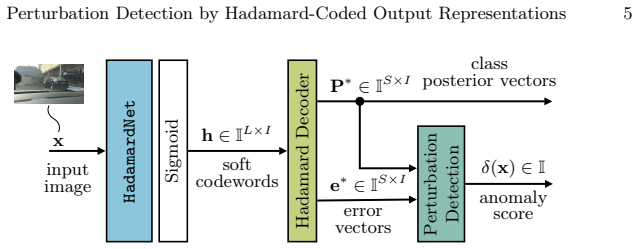
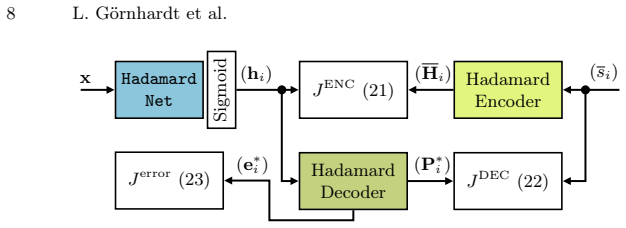
Conventional one-hot encodings often yield poorly calibrated models, being overconfident under attack, and letting entropy-based detection algorithms fail. Previous image classification works have demonstrated that Hadamard-coded output representations can improve adversarial robustness. However, attempts to integrate Hadamard codes into semantic segmentation fall far behind state-of-the-art models in mean intersection-over-union performance. Regarding object detection, such output encodings have not yet been investigated at all. Further, no prior art addressed intrinsic codeword inconsistencies or actually exploited intrinsic codeword redundancy. Accordingly, we first derive a novel decoding procedure for Hadamard codewords towards optimal class-wise probabilities, solving the underlying optimization problem by using the projection onto the probability simplex. Second, our optimization delivers a measure of prediction inconsistency. Third, we are the first to show how to exploit these inconsistencies for adversarial attack and disturbance detection. Fourth, we introduce HadamardNet, a framework employing Hadamard codes as output representations for semantic segmentation and object detection models and tasks. We conduct a comprehensive evaluation both on disturbances and adversarial attacks, achieving state-of-the-art perturbation detection performance for both tasks in only a single detection pass, while delivering equivalent or close-by reference performance on clean data.
Editorial analysis
A structured set of objections, weighed in public.
Referee Report
Summary. The paper introduces Hadamard-coded output representations for object detection and semantic segmentation via a new framework called HadamardNet. It derives a decoding step that projects onto the probability simplex to obtain class-wise probabilities, yielding both optimal probabilities and an inconsistency measure. This measure is then exploited to detect adversarial attacks and input disturbances in a single forward pass, with claims of state-of-the-art detection performance while preserving clean-data accuracy comparable to standard one-hot baselines.
Significance. If the simplex-projection decoder is shown to solve a well-posed optimization and the inconsistency signal proves robust under controlled baselines, the work would offer a practical, single-pass mechanism for perturbation detection in dense-prediction tasks that leverages code redundancy without requiring multiple inferences. The extension to object detection and the explicit use of intrinsic inconsistencies are novel relative to prior Hadamard work limited to classification.
major comments (2)
- [Abstract / Methods decoding section] Abstract and Methods (decoding derivation): the claim that simplex projection 'solves the underlying optimization problem' is not supported by an explicit statement of the objective function being minimized or a derivation showing that the projection is its solution. Without this, it is unclear whether the reported inconsistency metric is a theoretically justified quantity or merely a side-effect of an inexact decoder, which is load-bearing for the central exploitation argument and the SOTA detection claim.
- [Evaluation / detection experiments] Evaluation sections (adversarial and disturbance detection): no comparison is provided against alternative decoders (nearest-codeword, linear, or softmax) to isolate whether the inconsistency signal arises specifically from the Hadamard structure or from the projection step itself. This omission weakens the assertion that the method exploits 'intrinsic codeword inconsistencies' rather than decoder artifacts.
minor comments (2)
- [Methods] Notation for the Hadamard matrix and codeword length should be introduced with an explicit equation early in the methods section to avoid ambiguity when the inconsistency metric is later defined.
- [Tables reporting clean performance] The abstract states 'equivalent or close-by reference performance on clean data'; the corresponding tables should report both mIoU / mAP deltas and statistical significance tests against the one-hot baseline.
Simulated Author's Rebuttal
We thank the referee for the constructive feedback. We will revise the manuscript to provide an explicit optimization objective and derivation for the simplex projection decoder, as well as add the requested decoder ablations to strengthen the claims about the source of the inconsistency signal.
read point-by-point responses
-
Referee: [Abstract / Methods decoding section] Abstract and Methods (decoding derivation): the claim that simplex projection 'solves the underlying optimization problem' is not supported by an explicit statement of the objective function being minimized or a derivation showing that the projection is its solution. Without this, it is unclear whether the reported inconsistency metric is a theoretically justified quantity or merely a side-effect of an inexact decoder, which is load-bearing for the central exploitation argument and the SOTA detection claim.
Authors: We agree that the presentation would benefit from greater explicitness. The objective minimized by the decoder is the Euclidean distance between the (scaled) network output vector and a probability vector constrained to the simplex; the Euclidean projection onto the simplex is the unique closed-form solution to this convex program. In the revised manuscript we will state this objective function in the Methods section and include a short derivation confirming that the projection step solves it, thereby grounding the inconsistency measure theoretically rather than as a decoder artifact. revision: yes
-
Referee: [Evaluation / detection experiments] Evaluation sections (adversarial and disturbance detection): no comparison is provided against alternative decoders (nearest-codeword, linear, or softmax) to isolate whether the inconsistency signal arises specifically from the Hadamard structure or from the projection step itself. This omission weakens the assertion that the method exploits 'intrinsic codeword inconsistencies' rather than decoder artifacts.
Authors: We acknowledge that direct comparisons to other decoders would help isolate the contribution of the Hadamard code redundancy. In the revision we will add experiments that replace the simplex-projection decoder with nearest-codeword, linear, and softmax baselines while keeping the same Hadamard-trained networks, and report the resulting perturbation detection AUROC / AUPR on both the adversarial and disturbance benchmarks. This will allow readers to assess whether the inconsistency signal is tied to the code structure or to the choice of decoder. revision: yes
Circularity Check
No circularity; explicit mathematical projection used for decoding
full rationale
The paper's central derivation introduces a decoding step via projection onto the probability simplex to obtain class-wise probabilities and an inconsistency measure from Hadamard codewords. This is framed as solving an underlying optimization problem through a standard mathematical operation rather than any parameter fitting to evaluation data, self-referential definition, or load-bearing self-citation. The inconsistency signal is then applied to detection tasks, with performance claims evaluated separately on clean, disturbed, and adversarial inputs. No steps reduce by construction to the paper's own inputs or prior self-citations; the procedure remains independent of the target detection results.
Axiom & Free-Parameter Ledger
Reference graph
Works this paper leans on
-
[1]
In: Proc
Akata, Z., Perronnin, F., Harchaoui, Z., Schmid, C.: Label-Embedding for Attribute-Based Classification. In: Proc. of CVPR. pp. 819–826. Portland, OR, USA (Jun 2013)
2013
-
[2]
In: Proc
Carion, N., Massa, F., Synnaeve, G., Usunier, N., Kirillov, A., Zagoruyko, S.: End- to-End Object Detection with Transformers. In: Proc. of ECCV. pp. 213–229. Glasgow, United Kingdom (Nov 2020)
2020
-
[3]
Chen, K., Wang, J., Pang, J., Cao, Y., Xiong, Y., Li, X., Sun, S., Feng, W., Liu, Z., Xu, J., Zhang, Z., Cheng, D., Zhu, C., Cheng, T., Zhao, Q., Li, B., Lu, X., Zhu, R., Wu, Y., Dai, J., Wang, J., Shi, J., Ouyang, W., Loy, C.C., Lin, D.: MMDetection: OpenMMLabDetectionToolboxandBenchmark.arXivpreprintarXiv:1906.07155 (2019)
work page internal anchor Pith review Pith/arXiv arXiv 1906
-
[4]
In: Proc
Chen, L.C., Zhu, Y., Papandreou, G., Schroff, F., Adam, H.: Encoder-Decoder With Atrous Separable Convolution for Semantic Image Segmentation. In: Proc. of ECCV. pp. 801–818. Munich, Germany (Sep 2018)
2018
-
[5]
In: Proc
Chow, K.H., Liu, L., Loper, M., Bae, J., Gursoy, M.E., Truex, S., Wei, W., Wu, Y.: Adversarial Objectness Gradient Attacks in Real-time Object Detection Systems. In: Proc. of TPS-ISA. pp. 263–272. Atlanta, GA, USA (Oct 2020)
2020
-
[6]
Contributors, M.: MMSegmentation: Openmmlab semantic segmentation toolbox and benchmark.https://github.com/open-mmlab/mmsegmentation(2020)
2020
-
[7]
In: Proc
Cordts, M., Omran, M., Ramos, S., Rehfeld, T., Enzweiler, M., Benenson, R., Franke, U., Roth, S., Schiele, B.: The Cityscapes Dataset for Semantic Urban Scene Understanding. In: Proc. of CVPR. pp. 3213–3223. Las Vegas, NV, USA (Jun 2016)
2016
-
[8]
Dietterich, T.G., Bakiri, G.: Solving Multiclass Learning Problems via Error- Correcting Output Codes. J. Artif. Intell. Res.2(1), 263–286 (Jan 1995)
1995
-
[9]
International Journal of Com- puter Vision88(2), 303–338 (Sep 2010)
Everingham, M., Van Gool, L., Williams, C.K.I., Winn, J., Zisserman, A.: The PASCAL Visual Object Classes (VOC) Challenge. International Journal of Com- puter Vision88(2), 303–338 (Sep 2010)
2010
-
[10]
International Journal of Computer Vision (IJCV)111(1), 98–136 (Jan 2015)
Everingham, M., Van Gool, L., Williams, C.K.I., Winn, J., Zisserman, A.: The Pascal Visual Object Classes Challenge: A Retrospective. International Journal of Computer Vision (IJCV)111(1), 98–136 (Jan 2015)
2015
-
[11]
In: Proc
Frome, A., Corrado, G.S., Shlens, J., Bengio, S., Dean, J., Ranzato, M., Mikolov, T.: DeViSE: A Deep Visual-Semantic Embedding Model. In: Proc. of NeurIPS. pp. 2121–2129. Lake Tahoe, NV, USA (Dec 2013)
2013
-
[12]
In: Proc
Goodfellow, I., Shlens, J., Szegedy, C.: Explaining and Harnessing Adversarial Ex- amples. In: Proc. of ICLR. pp. 1–10. San Diego, CA, USA (May 2015)
2015
-
[13]
In: Proc
Hendrycks, D., Gimpel, K.: A Baseline for Detecting Misclassified and Out-of- Distribution Examples in Neural Networks. In: Proc. of ICLR. pp. 1–12. Toulon, France (Apr 2017) 16 L. Görnhardt et al
2017
-
[14]
In: Proc
Hoffer, E.,Hubara, I.,Soudry,D.: FixYourClassifier: TheMarginal Value ofTrain- ing the Last Weight Layer. In: Proc. of ICLR - Workshops. pp. 1–11. Vancouver, Canada (Apr 2018)
2018
-
[15]
IEEE Access12, 194367–194377 (2024)
Hoyos, A., Rivera, M.: Hadamard Layer for Improve Semantic Segmentation. IEEE Access12, 194367–194377 (2024)
2024
-
[16]
IEEE Access9, 118324–118333 (2021)
Hoyos, A., Ruiz, U., Chavez, E.: Hadamard’s Defense Against Adversarial Exam- ples. IEEE Access9, 118324–118333 (2021)
2021
-
[17]
In: Proc
Hsu, D.J., Kakade, S.M., Langford, J., Zhang, T.: Multi-Label Prediction via Com- pressed Sensing. In: Proc. of NeurIPS. pp. 772–780. Vancouver, BC, Canada (Dec 2009)
2009
-
[18]
In: Proc
Klingner, M., Bär, A., Fingscheidt, T.: Improved Noise and Attack Robustness for Semantic Segmentation by Using Multi-Task Training with Self-Supervised Depth Estimation. In: Proc. of CVPR - Workshops. pp. 1299–1309. Seattle, WA, USA (Jun 2020)
2020
-
[19]
In: Proc
Klingner, M., Kumar, V.R., Yogamani, S., Bär, A., Fingscheidt, T.: Detecting Adversarial Perturbations in Multi-Task Perception. In: Proc. of IROS. pp. 13050– 13057. Kyoto, Japan (Oct 2022)
2022
-
[20]
Econometrica46(1), 33–50 (1978)
Koenker, R., Bassett, G.: Regression Quantiles. Econometrica46(1), 33–50 (1978)
1978
-
[21]
In: Proc
Kong, E.B., Dietterich, T.G.: Error-Correcting Output Coding Corrects Bias and Variance. In: Proc. of ICML. pp. 313–321. Tahoe City, CA, USA (Jul 1995)
1995
-
[22]
In: Proc
Kurakin, A., Goodfellow, I., Bengio, S.: Adversarial Examples in the Physical World. In: Proc. of ICLR - Workshops. pp. 1–14. Toulon, France (Apr 2017)
2017
-
[23]
In: Proc
Li, S., Zhu, S., Paul, S., Roy-Chowdhury, A., Song, C., Krishnamurthy, S., Swami, A., Chan, K.S.: Connecting the Dots: Detecting Adversarial Perturbations Using Context Inconsistency. In: Proc. of ECCV. pp. 396–413. Glasgow, United Kingdom (Nov 2020)
2020
-
[24]
In: Proc
Lin, T.Y., Maire, M., Belongie, S., Hays, J., Perona, P., Ramanan, D., Dollár, P., Zitnick, C.L.: Microsoft COCO: Common Objects in Context. In: Proc. of ECCV. pp. 740–755. Zurich, Switzerland (Sep 2014)
2014
-
[25]
In: Proc
Liu, W., Wang, X., Owens, J., Li, Y.: Energy-based Out-of-Distribution and Ad- versarial Detection. In: Proc. of NeurIPS. pp. 21464–21475. virtual (Dec 2020)
2020
-
[26]
In: Proc
Loshchilov, I., Hutter, F.: Decoupled Weight Decay Regularization. In: Proc. of ICLR. pp. 1–18. New Orleans, LA, USA (May 2019)
2019
-
[27]
Maag, K., Resner, R., Fischer, A.: Detecting Adversarial Attacks in Semantic Seg- mentation via Uncertainty Estimation: A Deep Analysis. arXiv:2408.10021 (Aug 2024)
-
[28]
In: Proc
Madry, A., Makelov, A., Schmidt, L., Tsipras, D., Vladu, A.: Towards Deep Learn- ing Models Resistant to Adversarial Attacks. In: Proc. of ICLR. pp. 1–28. Vancou- ver, BC, Canada (Apr 2018)
2018
-
[29]
In: Proc
Metzen, J.H., Kumar, M.C., Brox, T., Fischer, V.: Universal Adversarial Pertur- bations Against Semantic Image Segmentation. In: Proc. of ICCV. pp. 2774–2783. Venice, Italy (Oct 2017)
2017
-
[30]
Journal of Optimization Theory and Applications50(1), 195–200 (1986)
Michelot, C.: A Finite Algorithm for Finding the Projection of a Point onto the Canonical Simplex ofαn. Journal of Optimization Theory and Applications50(1), 195–200 (1986)
1986
-
[31]
IEEE Trans- actions on Neural Networks and Learning Systems36(9), 15706–15722 (2025)
Nguyen, K.N.T., Zhang, W., Lu, K., Wu, Y.H., Zheng, X., Li Tan, H., Zhen, L.: A Survey and Evaluation of Adversarial Attacks in Object Detection. IEEE Trans- actions on Neural Networks and Learning Systems36(9), 15706–15722 (2025). https://doi.org/10.1109/TNNLS.2025.3561225
-
[32]
McGraw-Hill Book Company (1989) Perturbation Detection by Hadamard-Coded Output Representations 17
Proakis, J.G.: Digital Communications. McGraw-Hill Book Company (1989) Perturbation Detection by Hadamard-Coded Output Representations 17
1989
-
[33]
In: Proc
Ren, S., He, K., Girshick, R., Sun, J.: Faster R-CNN: Towards Real-Time Object Detection With Region Proposal Networks. In: Proc. of NIPS. pp. 91–99. Montréal, QC, Canada (Dec 2015)
2015
-
[34]
Image and Vision Computing75, 21–31 (2018)
Rodríguez, P., Bautista, M.A., Gonzàlez, J., Escalera, S.: Beyond One-Hot En- coding: Lower Dimensional Target Embedding. Image and Vision Computing75, 21–31 (2018)
2018
-
[35]
In: Proc
Ronneberger, O., Fischer, P., Brox, T.: U-Net: Convolutional Networks for Biomed- ical Image Segmentation. In: Proc. of MICCAI. pp. 234–241. Munich, Germany (Oct 2015)
2015
-
[36]
International Journal of Information Security23(1), 299–314 (Feb 2024)
Ryu, G., Choi, D.: Detection of Adversarial Attacks Based on Differences in Image Entropy. International Journal of Information Security23(1), 299–314 (Feb 2024)
2024
-
[37]
Understanding Measures of Uncertainty for Adversarial Example Detection
Smith, L., Gal, Y.: Understanding Measures of Uncertainty for Adversarial Exam- ple Detection. arXiv preprint:1803.08533 (Mar 2018)
work page internal anchor Pith review Pith/arXiv arXiv 2018
-
[38]
Sylvester, J.J.: LX. Thoughts on Inverse Orthogonal Matrices, Simultaneous Sign Successions, and Tessellated Pavements in Two or More Colours, With Applica- tions to Newton’s Rule, Ornamental Tile-Work, and the Theory of Numbers. The London, Edinburgh, and Dublin Philosophical Magazine and Journal of Science 34(232), 461–475 (1867)
-
[39]
Thunuguntla, A., Tadepalli, P., Raffa, G.: Defenses Against Adversarial Attacks on Object Detection: Methods and Future Directions. Information16(11) (2025). https://doi.org/10.3390/info16111003,https://www.mdpi.com/2078-2489/ 16/11/1003
-
[40]
Verma, G., Swami, A.: Error Correcting Output Codes Improve Probability Esti- mationandAdversarialRobustnessofDeepNeuralNetworks.In:Proc.ofNeurIPS. pp. 8646–8656. Vancouver, BC, Canada (Dec 2019)
2019
-
[41]
In: Proc
Wan, L., Alpcan, T., Viterbo, E., Kuijper, M.: Efficient Error-Correcting Output Codes for Adversarial Learning Robustness. In: Proc. of ICC. pp. 2345–2350. Seoul, South Korea (May 2022)
2022
-
[42]
Machine learning81(1), 21–35 (2010)
Weston, J., Bengio, S., Usunier, N.: Large Scale Image Annotation: Learning to Rank with Joint Word-Image Embeddings. Machine learning81(1), 21–35 (2010)
2010
-
[44]
In: Proc
Xie, E., Wang, W., Yu, Z., Anandkumar, A., Alvarez, J.M., Luo, P.: SegFormer: Simple and Efficient Design for Semantic Segmentation with Transformers. In: Proc. of NeurIPS. pp. 12077–12090. virtual (Dec 2021)
2021
-
[45]
In: Proc
Xu, W., Evans, D., Qi, Y.: Feature Squeezing: Detecting Adversarial Examples in Deep Neural Networks. In: Proc. of Network and Distributed Systems Security Symposium. San Diego, CA, USA (Feb 2018)
2018
-
[46]
In: Proc
Yang, S., Luo, P., Loy, C.C., Shum, K.W., Tang, X.: Deep Representation Learning with Target Coding. In: Proc. of AAAI. pp. 3848–3854. Austin, TX, USA (Jan 2015)
2015
-
[47]
In: Proc
Yin,M.,Li,S.,Cai,Z.,Song,C.,Asif,M.S.,Roy-Chowdhury,A.K.,Krishnamurthy, S.V.: Exploiting Multi-Object Relationships for Detecting Adversarial Attacks in Complex Scenes. In: Proc. of ICCV. pp. 7858–7867. Montréal, QC, Canada (Oct 2021)
2021
-
[48]
In: Proc
Yu, F., Chen, H., Wang, X., Xian, W., Chen, Y., Liu, F., Madhavan, V., Darrell, T.: BDD100K: A Diverse Driving Dataset for Heterogeneous Multitask Learning. In: Proc. of CVPR. pp. 1–14. Seattle, WA, USA (Jun 2020) 18 L. Görnhardt et al
2020
-
[49]
In: Proc
Zhou, B., Zhao, H., Puig, X., Fidler, S., Barriuso, A., Torralba, A.: Scene Parsing through ADE20K Dataset. In: Proc. of CVPR. pp. 633–641. Honolulu, HI, USA (Jul 2017) Perturbation Detection by Hadamard-Coded Output Representations 19 A Hadamard Code Construction and Example Hadamard codes are generated using Sylvester’s construction [38] of the bipolar ...
2017
-
[50]
(46) Using (45) and (46), and exploiting that both ˜Pi and ˇhi are constant w.r.t. minimization overP i, we find arg min Pi∈P ∥ei∥2 2 = arg min Pi∈P (∥Pi∥2 2 −2P T i ˜Pi +∥ ˜Pi∥2 2) = arg min Pi∈P (∥Pi∥2 2 −2P T i ˜Pi + 1 L ˇhT i ˇhi) = arg min Pi∈P ( L 4 ∥Pi∥2 2 − L 2 PT i ˜Pi + 1 4 ˇhT i ˇhi) = arg min Pi∈P ∥ˇei∥2 2 (47) Accordingly, minimizing||ei||2 2...
2000
-
[51]
We report the perturbation detection accuracy measured by AuROC (%) and global AuROC (%) as well as global TPR5% (%) per perturbation across all strengths
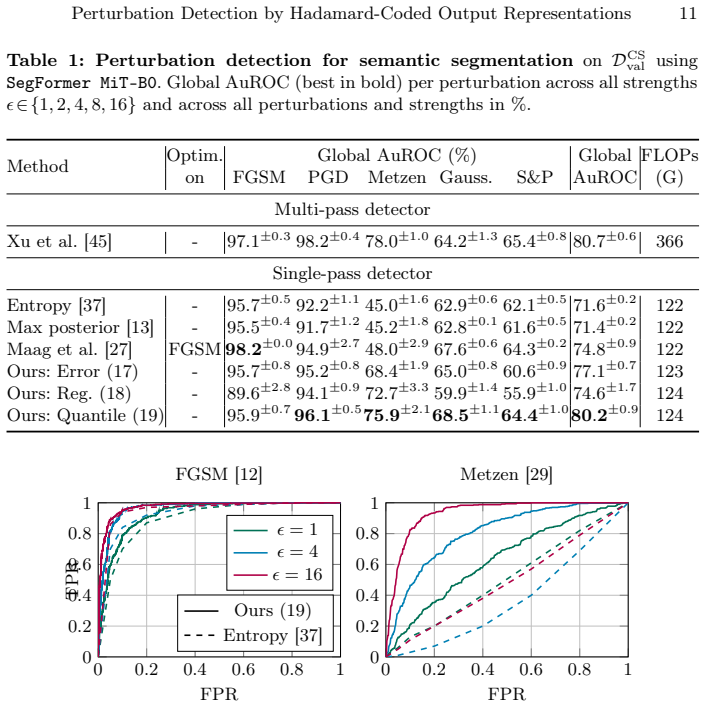
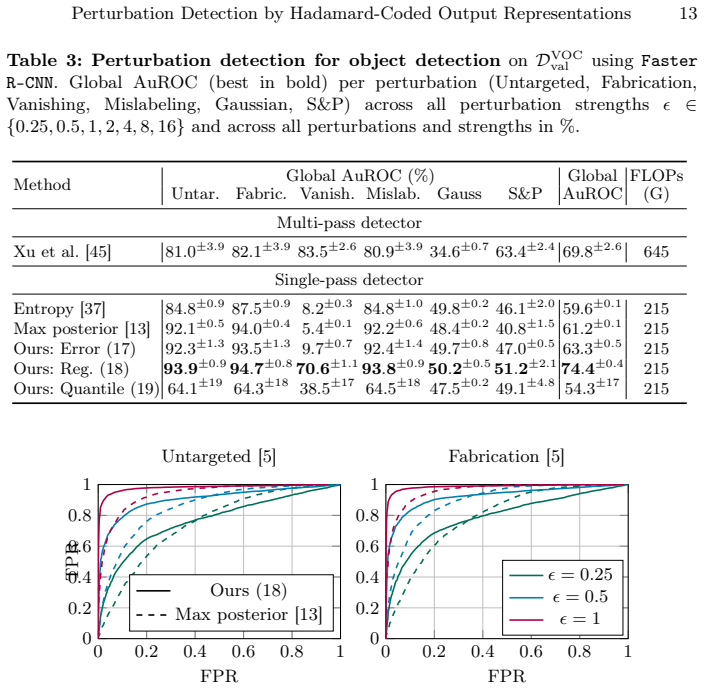
trained onD BDD,Seg train and evaluated on perturbed samples fromDBDD,Seg val . We report the perturbation detection accuracy measured by AuROC (%) and global AuROC (%) as well as global TPR5% (%) per perturbation across all strengths. FGSM and PGD, which also cause the strongest mIoU degradation, achieve the highest detection performance and the AuROC in...
discussion (0)
Sign in with ORCID, Apple, or X to comment. Anyone can read and Pith papers without signing in.