Apparent Transverse Motion of Light Bridges Coupled to Coronal Loop Dynamics
Pith reviewed 2026-06-27 15:01 UTC · model grok-4.3
The pith
Light bridge transverse motions in sunspots are apparent projections of umbral core dynamics coupled to coronal loops.
A machine-rendered reading of the paper's core claim, the machinery that carries it, and where it could break.
Core claim
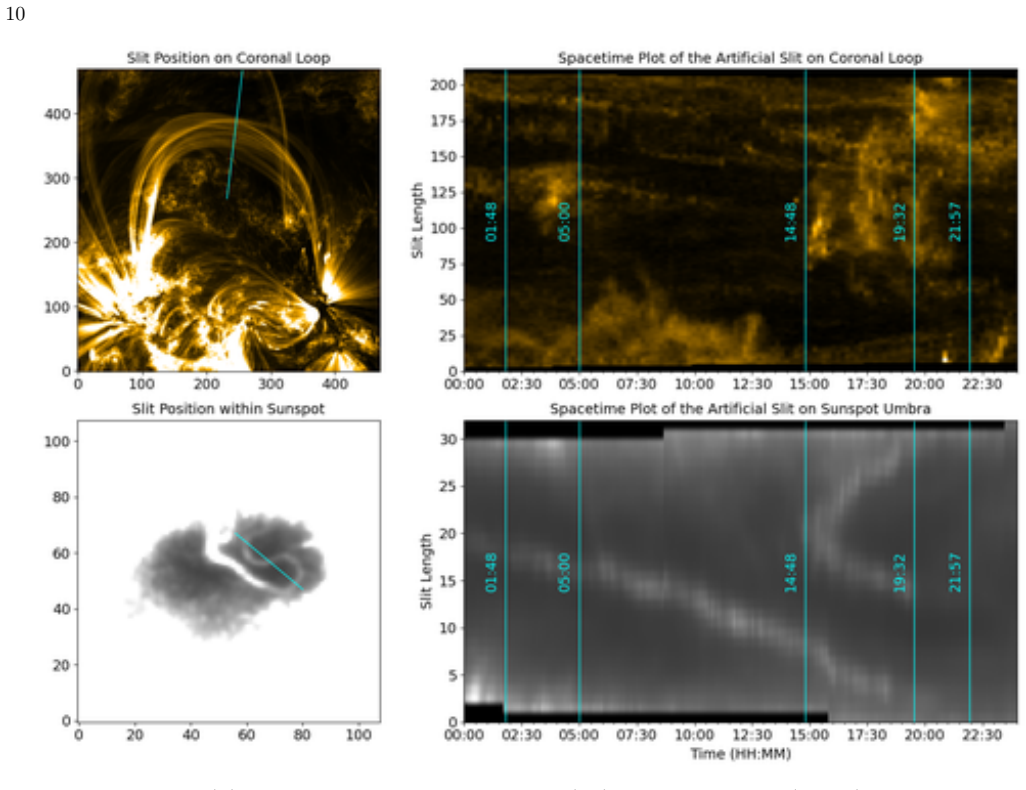
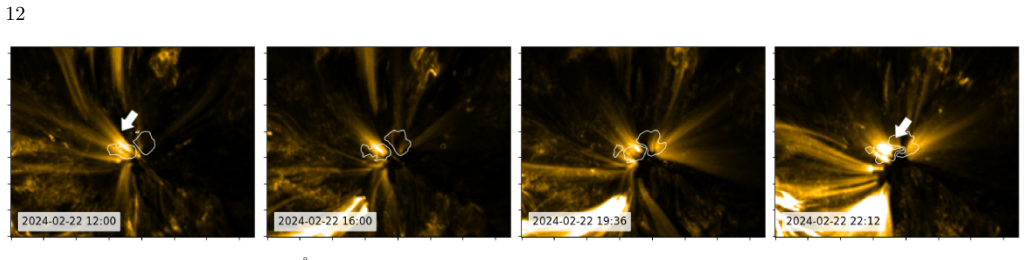
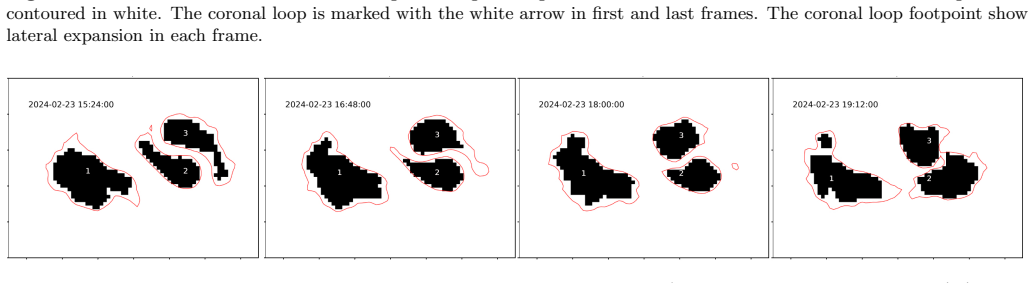
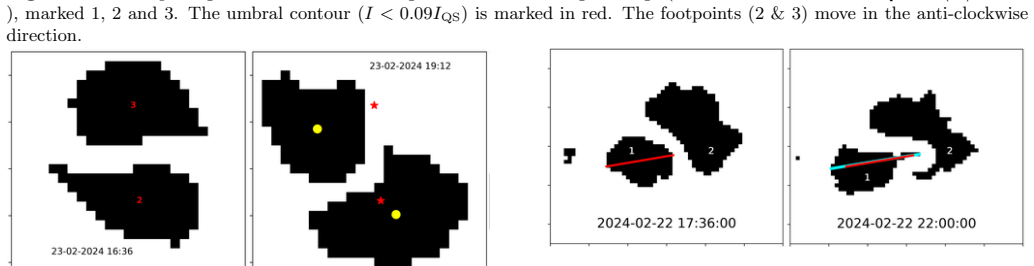
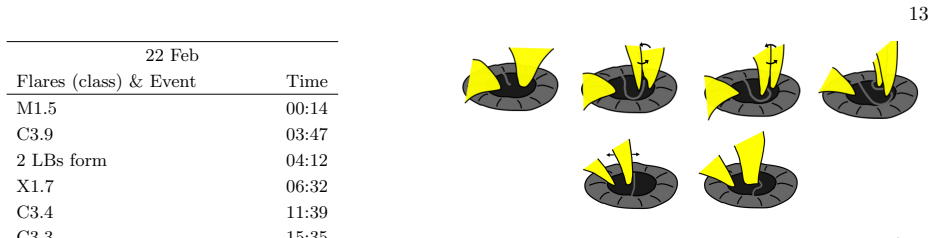
The unique movements of the light bridges in the observed sunspot and earlier studies could be an apparent view of the umbral core dynamics. Investigation into these dynamics through signatures in the higher atmosphere reveals a clear coupling to coronal loops and their dynamics.
What carries the argument
Apparent transverse motion of light bridges, treated as a line-of-sight projection of umbral core evolution whose signatures propagate upward to drive or follow coronal loop changes.
If this is right
- Light bridge observations can serve as indirect indicators of umbral core evolution.
- Coronal loop dynamics are dynamically linked to photospheric umbral processes through the light bridge region.
- Earlier reports of light bridge motion in other sunspots may also reflect apparent rather than intrinsic bridge displacement.
- Signatures in the chromosphere and corona can be used to monitor umbral core changes when photospheric resolution is limited.
Where Pith is reading between the lines
- The same projection effect may explain light bridge behavior across multiple active regions, allowing a single mechanism to account for diverse reported motions.
- Routine coronal imaging could become a practical tool for tracking internal sunspot restructuring on timescales shorter than those accessible from the photosphere alone.
- Magnetoconvective models of sunspots would need to include upward coupling channels from the umbra through light bridges to the corona.
Load-bearing premise
The observed sideways shifts of light bridges are projections caused by deeper umbral core motion rather than actual physical displacement of the light bridge material.
What would settle it
High-resolution vector magnetograms or Doppler maps showing light bridge material undergoing genuine lateral displacement with no corresponding change in the umbral core or in the connected coronal loops.
Figures
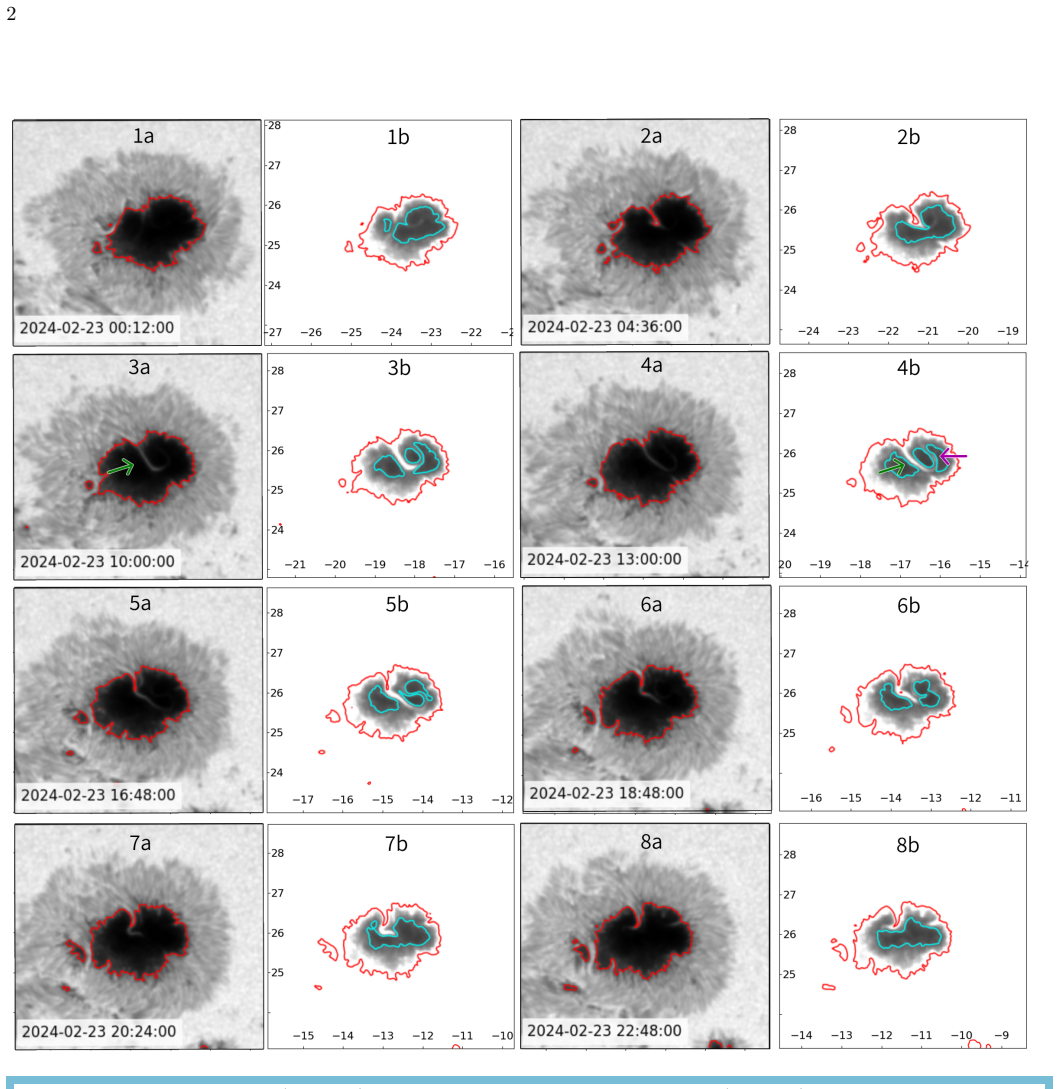
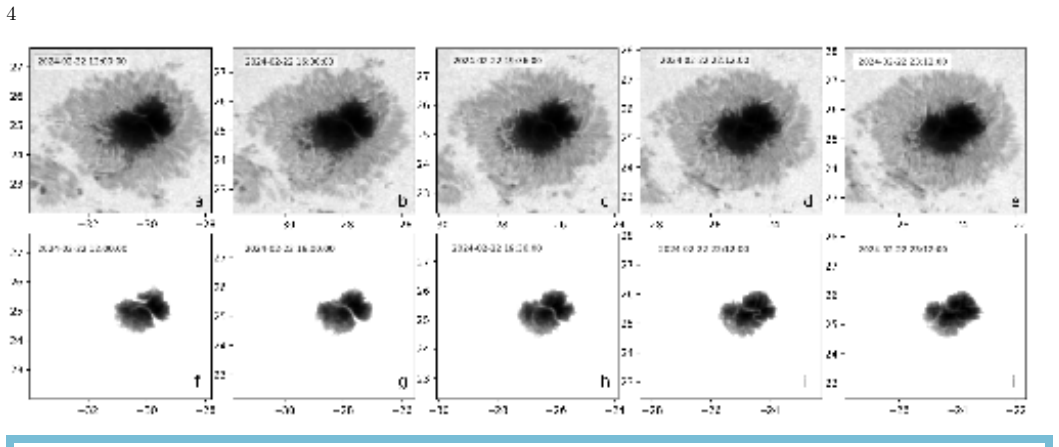
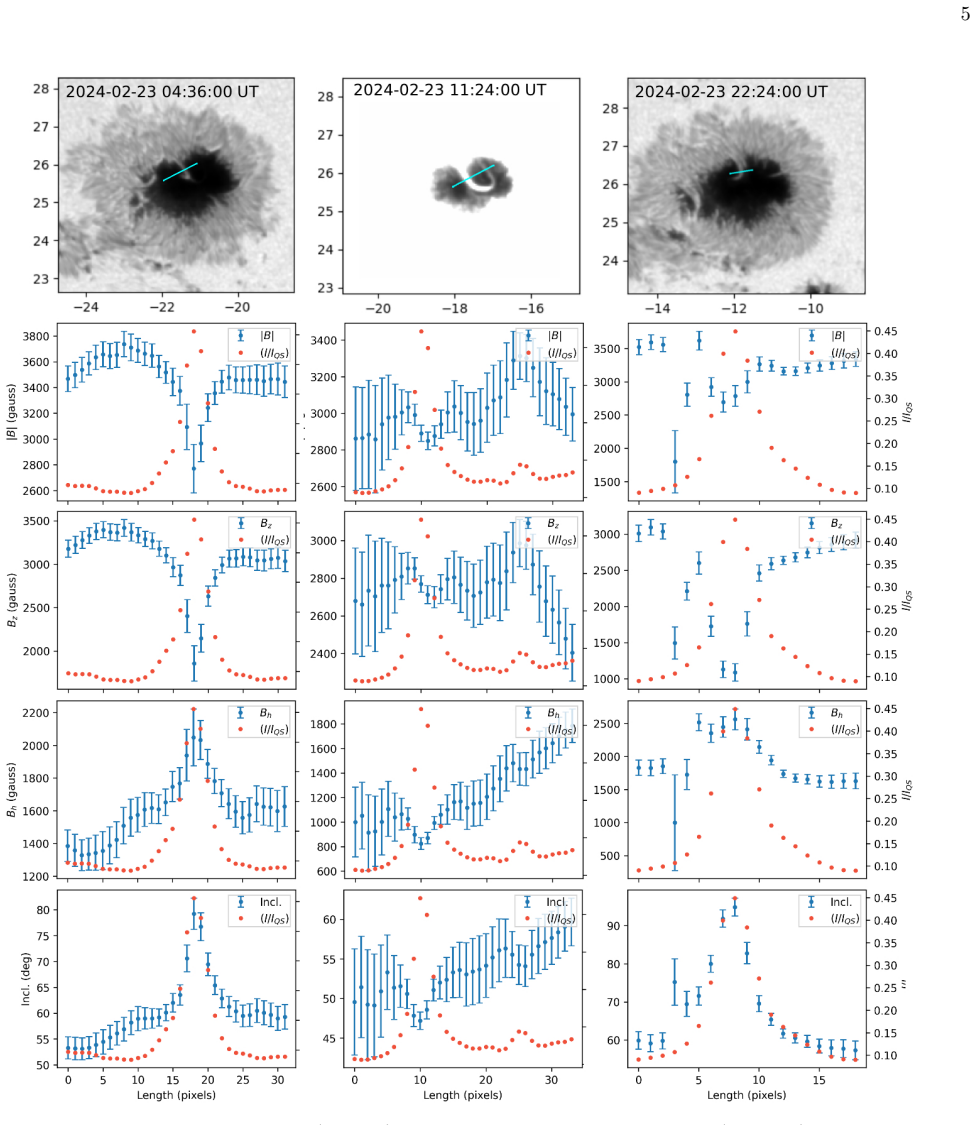
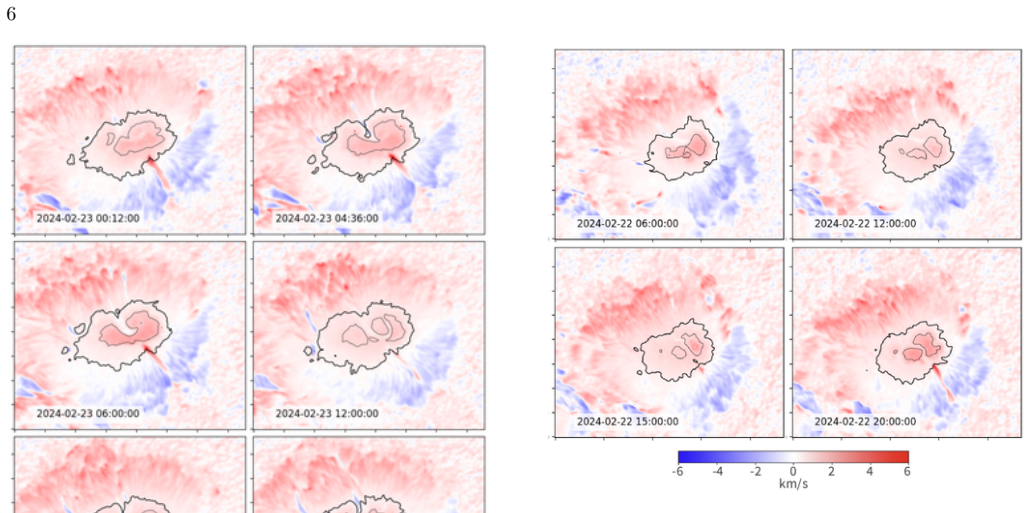

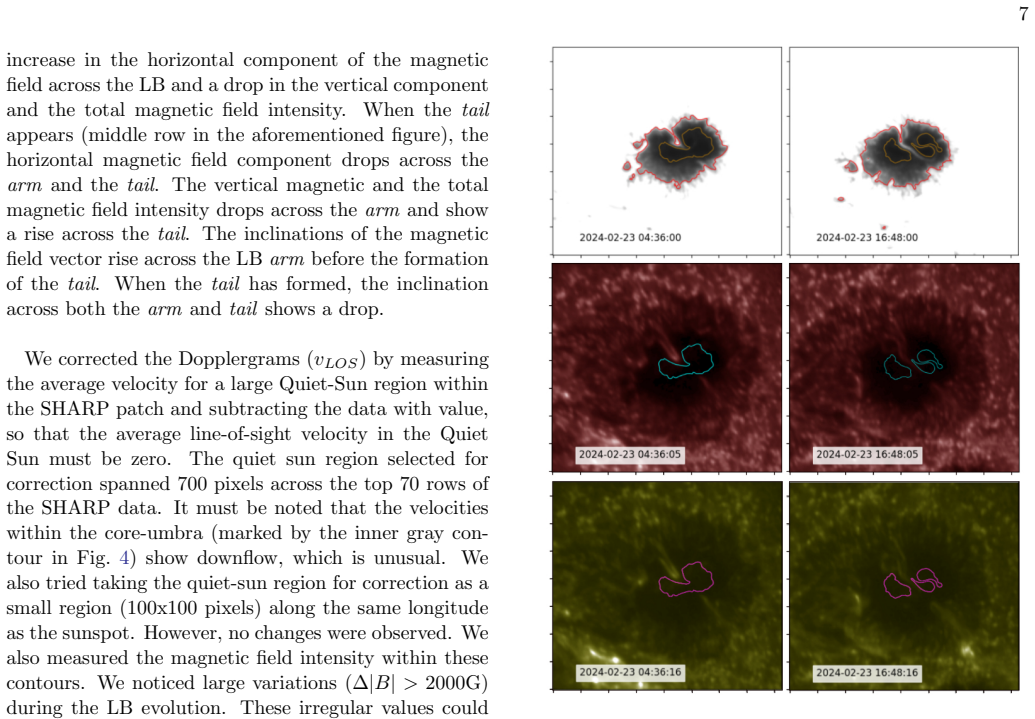
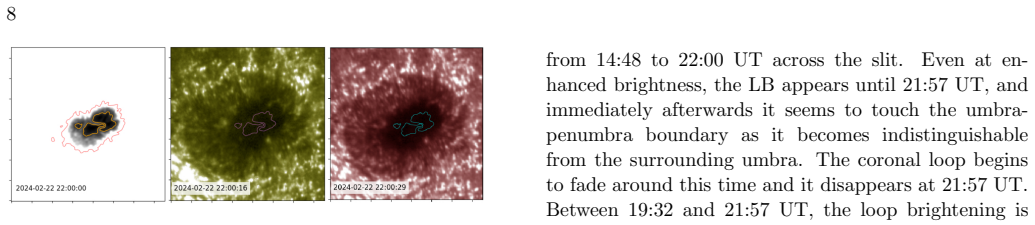
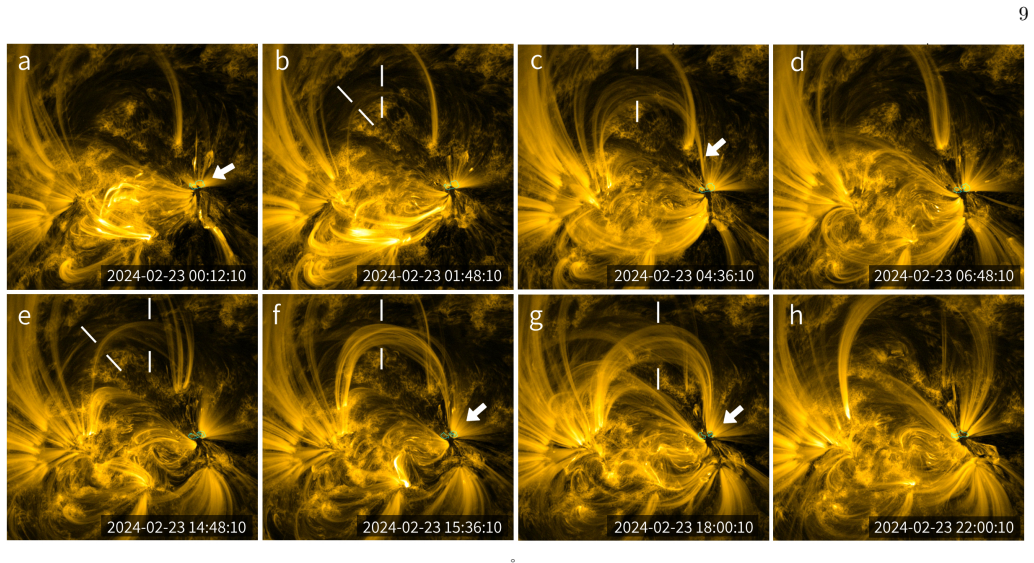
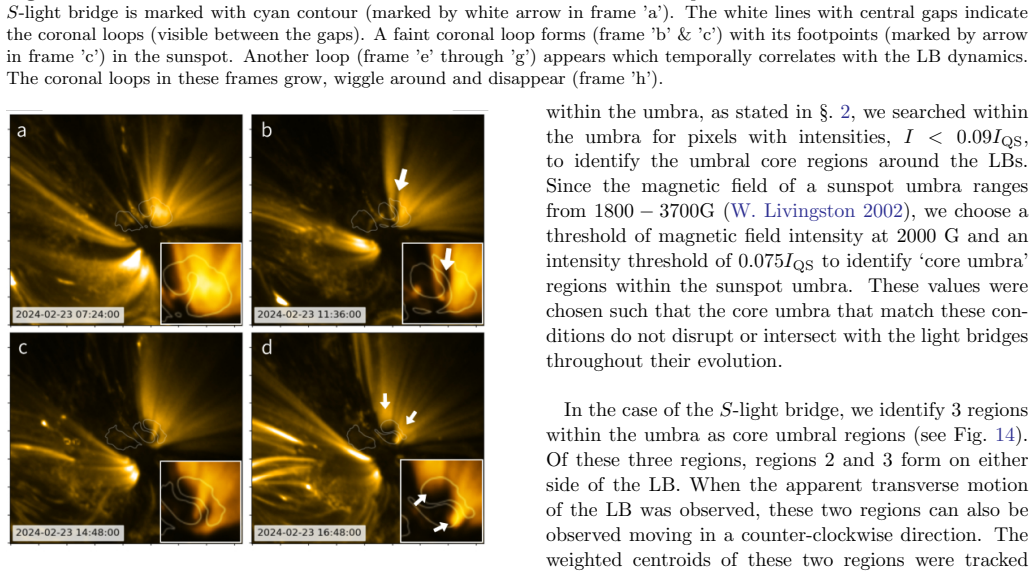


read the original abstract
Light bridges are commonly observed in active regions and are interpreted as signatures of magnetoconvective processes in sunspots. Several studies have attempted to classify them in the past based on their morphological characteristics. Recent observations have revealed new dynamical properties of light bridges, including their signatures in the upper solar atmosphere, particularly in the chromosphere, and their coupling with coronal features. In this study, we observed two cases of rare and unusual dynamics as light bridges evolve. Using data from the Solar Dynamics Observatory, the evolution of the light bridges is analysed, and the results are reported here. Based on our findings, we propose that the unique movements of the light bridges in the observed sunspot and earlier studies could be an apparent view of the umbral core dynamics. Investigation into these dynamics through signatures in the higher atmosphere reveals a clear coupling to coronal loops and their dynamics.
Editorial analysis
A structured set of objections, weighed in public.
Referee Report
Summary. The manuscript reports observations of two cases of unusual transverse motions in light bridges within sunspots, analyzed using Solar Dynamics Observatory (SDO) data. The authors propose that these movements represent an apparent projection of umbral core dynamics coupled to coronal loop dynamics, as revealed through signatures in the higher atmosphere.
Significance. If the interpretation holds and is supported by the underlying data, the work could provide a new perspective on the coupling between photospheric magnetoconvective features and coronal structures. The paper is purely observational with no equations, derivations, fitted parameters, or machine-checked elements; its value rests entirely on the quality and presentation of the two cases.
major comments (1)
- [Abstract] Abstract: the central interpretive proposal (that light-bridge motions are apparent projections of umbral-core dynamics) rests on unspecified analysis of two cases, yet the abstract provides no data, figures, error analysis, or methods. This prevents evaluation of whether the claim is supported by evidence and is load-bearing for the manuscript's main conclusion.
Simulated Author's Rebuttal
We thank the referee for their review and constructive comment. We address the point below and will revise the manuscript accordingly.
read point-by-point responses
-
Referee: [Abstract] Abstract: the central interpretive proposal (that light-bridge motions are apparent projections of umbral-core dynamics) rests on unspecified analysis of two cases, yet the abstract provides no data, figures, error analysis, or methods. This prevents evaluation of whether the claim is supported by evidence and is load-bearing for the manuscript's main conclusion.
Authors: We agree that the abstract as written is too terse and does not sufficiently indicate the observational basis for the central claim. The manuscript presents two specific cases drawn from SDO/AIA and HMI data, with the interpretation arising from the apparent transverse motions in the light bridges being consistent with projected umbral-core dynamics and their coupling to overlying coronal loops. In revision we will expand the abstract to state the data sources, note the two observed cases, and briefly characterize the key signatures (transverse motions aligned with coronal-loop evolution) that support the projection interpretation, while keeping the abstract concise. Detailed measurements, time series, and comparison with earlier studies remain in the body of the paper. revision: yes
Circularity Check
No significant circularity
full rationale
The paper is a purely observational report analyzing SDO data on light-bridge evolution in sunspots. It presents no equations, derivations, fitted parameters, or mathematical predictions. The central claim is an interpretive proposal linking observed motions to umbral-core dynamics and coronal loops, explicitly flagged as 'apparent' in the title and abstract. No self-citation chains, ansatzes, or reductions of outputs to inputs by construction are present. The derivation chain is absent, so no circularity can be exhibited.
Axiom & Free-Parameter Ledger
Reference graph
Works this paper leans on
-
[1]
Asai, A., Ishii, T. T., & Kurokawa, H. 2001, ApJ, 555, L65, doi: 10.1086/321738
-
[2]
1999, ApJ, 520, 880, doi: 10.1086/307502 Astropy Collaboration, Robitaille, T
Alexander, D. 1999, ApJ, 520, 880, doi: 10.1086/307502 Astropy Collaboration, Robitaille, T. P., Tollerud, E. J., et al. 2013, A&A, 558, A33, doi: 10.1051/0004-6361/201322068
-
[3]
Beckers, J. M., & Tallant, P. E. 1969, Solar Physics, 7, 351, doi: 10.1007/BF00146140
-
[4]
2015, MNRAS, 452, L16, doi: 10.1093/mnrasl/slv071
Bharti, L. 2015, MNRAS, 452, L16, doi: 10.1093/mnrasl/slv071
-
[5]
Smartt, R. N. 2007, MNRAS, 376, 1291, doi: 10.1111/j.1365-2966.2007.11525.x
-
[6]
1964, Sunspots (London: BChapman and Hall) Castellanos Dur´ an, J
Bray, R., & Loughead, R. 1964, Sunspots (London: BChapman and Hall) Castellanos Dur´ an, J. S., Lagg, A., & Solanki, S. K. 2021, Astronomy & Astrophysics, 651, L1, doi: 10.1051/0004-6361/202141159
-
[7]
Feng, S., Miao, Y., Yuan, D., Qu, Z., & Nakariakov, V. M. 2020, ApJL, 893, L2, doi: 10.3847/2041-8213/ab7dc4 Garcia de La Rosa, J. I. 1987, SoPh, 112, 49, doi: 10.1007/BF00148486
-
[8]
Ballester, J. L. 2009, A&A, 503, 213, doi: 10.1051/0004-6361/200912399
-
[9]
L., Romano, P., & Zuccarello, F
Guglielmino, S. L., Romano, P., & Zuccarello, F. 2017, ApJL, 846, L16, doi: 10.3847/2041-8213/aa835c
-
[10]
Harris, C. R., Millman, K. J., van der Walt, S. J., et al. 2020, Nature, 585, 357, doi: 10.1038/s41586-020-2649-2
-
[11]
T., Liu, Y., Hayashi, K., et al
Hoeksema, J. T., Liu, Y., Hayashi, K., et al. 2014, SoPh, 289, 3483, doi: 10.1007/s11207-014-0516-8 15
-
[12]
Hofmeister, S., Hahn, M., & Savin, D. W. 2021, in American Astronomical Society Meeting Abstracts, Vol. 238, American Astronomical Society Meeting Abstracts, 313.13
2021
-
[13]
Hunter, J. D. 2007, Computing in Science & Engineering, 9, 90, doi: 10.1109/MCSE.2007.55
-
[14]
Katsukawa, Y., Yokoyama, T., Berger, T. E., et al. 2007, PASJ, 59, S577, doi: 10.1093/pasj/59.sp3.S577
-
[15]
2013, The Astrophysical Journal, 770, 74, doi: 10.1088/0004-637X/770/1/74
Kleint, L., & Sainz Dalda, A. 2013, The Astrophysical Journal, 770, 74, doi: 10.1088/0004-637X/770/1/74
-
[16]
Korobova, Z. B. 1966, Astronomicheskii Zhurnal, 43, 480
1966
-
[17]
K., van Noort, M., & Danilovic, S
Lagg, A., Solanki, S. K., van Noort, M., & Danilovic, S. 2014, A&A, 568, A60, doi: 10.1051/0004-6361/201424071
-
[18]
Leka, K. D. 1997, The Astrophysical Journal, 484, 900, doi: 10.1086/304363
-
[19]
Lemen, J. R., Title, A. M., Akin, D. J., et al. 2012, SoPh, 275, 17, doi: 10.1007/s11207-011-9776-8
-
[20]
Lites, B. W., Bida, T. A., Johannesson, A., & Scharmer, G. B. 1991, ApJ, 373, 683, doi: 10.1086/170089
-
[21]
1991, Nature, 350, 45, doi: 10.1038/350045a0
Livingston, W. 1991, Nature, 350, 45, doi: 10.1038/350045a0
-
[22]
2002, SoPh, 207, 41, doi: 10.1023/A:1015555000456
Livingston, W. 2002, SoPh, 207, 41, doi: 10.1023/A:1015555000456
-
[23]
2008, SoPh, 252, 43, doi: 10.1007/s11207-008-9247-z
Venkatakrishnan, P. 2008, SoPh, 252, 43, doi: 10.1007/s11207-008-9247-z
-
[24]
Louis, R. E., Beck, C., Mathew, S. K., & Venkatakrishnan, P. 2014, A&A, 570, A92, doi: 10.1051/0004-6361/201424112
-
[25]
2021, MNRAS, 506, L35, doi: 10.1093/mnrasl/slab071
Miao, Y., Fu, L., Du, X., et al. 2021, MNRAS, 506, L35, doi: 10.1093/mnrasl/slab071
-
[26]
1979, SoPh, 61, 297, doi: 10.1007/BF00150414
Muller, R. 1979, SoPh, 61, 297, doi: 10.1007/BF00150414
-
[27]
Parker, E. N. 1979, ApJ, 234, 333, doi: 10.1086/157501
-
[28]
Pesnell, W. D., Thompson, B. J., & Chamberlin, P. C. 2012, SoPh, 275, 3, doi: 10.1007/s11207-011-9841-3
-
[29]
2008, ApJ, 672, 684, doi: 10.1086/523702
Rimmele, T. 2008, ApJ, 672, 684, doi: 10.1086/523702
-
[30]
Scherrer, P. H., Schou, J., Bush, R. I., et al. 2012, SoPh, 275, 207, doi: 10.1007/s11207-011-9834-2
-
[31]
2016, A&A, 596, A7, doi: 10.1051/0004-6361/201628561
Schlichenmaier, R., von der L¨ uhe, O., Hoch, S., et al. 2016, A&A, 596, A7, doi: 10.1051/0004-6361/201628561
-
[32]
Schou, J., Scherrer, P. H., Bush, R. I., et al. 2012, SoPh, 275, 229, doi: 10.1007/s11207-011-9842-2
-
[33]
2009, ApJL, 696, L66, doi: 10.1088/0004-637X/696/1/L66
Shimizu, T., Katsukawa, Y., Kubo, M., et al. 2009, ApJL, 696, L66, doi: 10.1088/0004-637X/696/1/L66
-
[34]
L., Rempel, M., Lagg, A., & Solanki, S
Siu-Tapia, A. L., Rempel, M., Lagg, A., & Solanki, S. K. 2018, ApJ, 852, 66, doi: 10.3847/1538-4357/aaa007
-
[35]
1997, in Astronomical Society of the Pacific Conference Series, Vol
Sobotka, M. 1997, in Astronomical Society of the Pacific Conference Series, Vol. 118, 1st Advances in Solar Physics Euroconference. Advances in Physics of Sunspots, ed. B. Schmieder, J. C. del Toro Iniesta, & M. Vazquez, 155
1997
-
[36]
Solanki, S. K. 2003, A&A Rv, 11, 153, doi: 10.1007/s00159-003-0018-4
-
[37]
Thaler, I., & Borrero, J. M. 2023, A&A, 673, A163, doi: 10.1051/0004-6361/202245701
-
[38]
Toriumi, S., Katsukawa, Y., & Cheung, M. C. M. 2015, ApJ, 811, 137, doi: 10.1088/0004-637X/811/2/137
-
[39]
1973, SoPh, 31, 377, doi: 10.1007/BF00152814
Vazquez, M. 1973, SoPh, 31, 377, doi: 10.1007/BF00152814
-
[40]
Virtanen, P., Gommers, R., Oliphant, T. E., et al. 2020, Nature Methods, 17, 261, doi: 10.1038/s41592-019-0686-2
-
[41]
2024, A&A, 682, A3, doi: 10.1051/0004-6361/202347053
Xing, C., Aulanier, G., Schmieder, B., Cheng, X., & Ding, M. 2024, A&A, 682, A3, doi: 10.1051/0004-6361/202347053
discussion (0)
Sign in with ORCID, Apple, or X to comment. Anyone can read and Pith papers without signing in.