Self-Explainability in Self-Adaptive and Self-Organising Systems: Status and Research Directions
Pith reviewed 2026-06-27 16:48 UTC · model grok-4.3
The pith
Self-explainability approaches in self-adaptive systems remain mostly conceptual with no established evaluation standards.
A machine-rendered reading of the paper's core claim, the machinery that carries it, and where it could break.
Core claim
Through a systematic literature review, the paper shows that self-explainability approaches in self-adaptive and self-organising systems are predominantly conceptual, with few practical implementations, and that no standard exists for evaluating them. It introduces a unified definition and taxonomy of self-explainability along with Levels of Self-Explainability to structure the field and serve as a roadmap for future research.
What carries the argument
Systematic literature review that synthesizes existing approaches into a taxonomy and Levels of Self-Explainability framework.
Load-bearing premise
The literature search and inclusion criteria captured a representative sample of all relevant work on self-explainability.
What would settle it
Identification of multiple fully implemented self-explainability systems that use agreed-upon evaluation metrics would challenge the review's main findings on conceptual dominance and lack of standards.
Figures



read the original abstract
The growing complexity of self-adaptive and self-organising systems, fuelled by advances in Artificial Intelligence (AI), has made them increasingly difficult to understand and trust. While Explainable AI aims to provide insight into AI decision-making, a more advanced goal is for systems to explain themselves - an ability referred to as Self-Explainability (SX). This article presents a systematic literature review on SX, analysing existing approaches, including their domains, targets, and evaluation methods. The review develops a unified definition and taxonomy of SX and introduces Levels of Self-Explainability, providing a framework for positioning current and future research. Our results show that most SX approaches remain conceptual, with few practical implementations. Moreover, there is currently no formal or de facto standard for evaluating SX, highlighting a major research gap. This work thus establishes a foundation and roadmap for advancing Self-Explainability in complex systems.
Editorial analysis
A structured set of objections, weighed in public.
Referee Report
Summary. The paper conducts a systematic literature review on Self-Explainability (SX) in self-adaptive and self-organising systems. It examines existing approaches by domain, target, and evaluation method; proposes a unified definition and taxonomy of SX; introduces Levels of Self-Explainability as a positioning framework; and reports that most SX approaches remain conceptual with few practical implementations and that no formal or de facto standard exists for evaluating SX.
Significance. If the review's sampling is representative, the taxonomy, levels framework, and identified gaps in practical implementations and evaluation standards would provide a useful foundation and research roadmap for SX in complex adaptive systems, consolidating observations from the literature and directing attention to under-explored areas.
major comments (1)
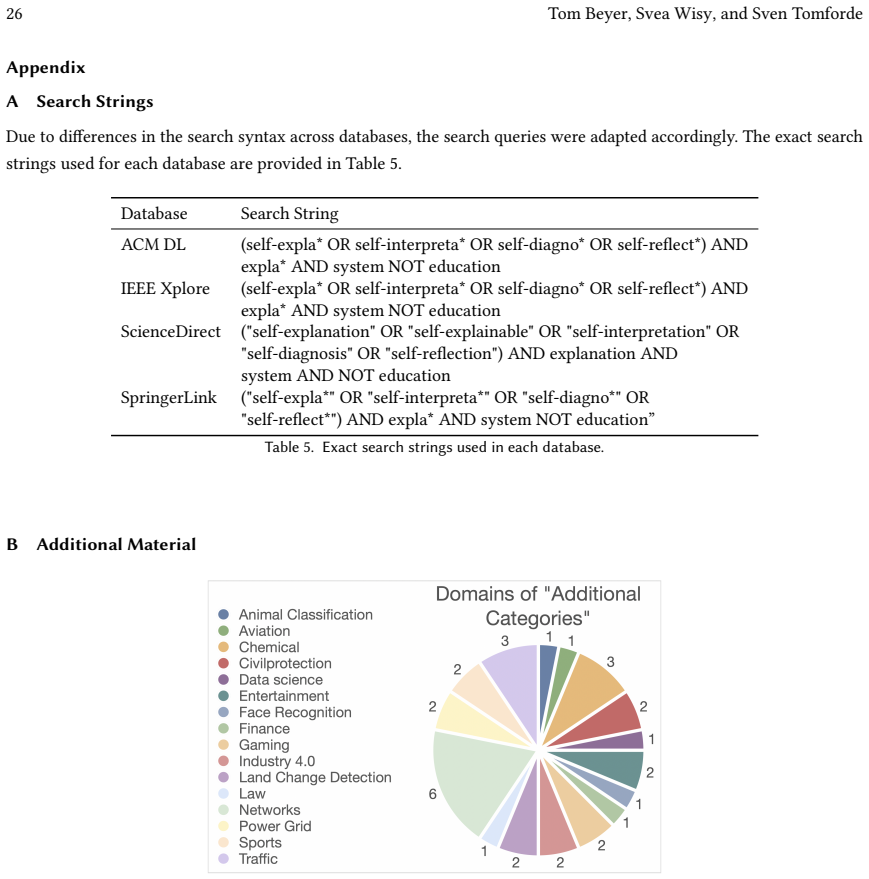
- [Methodology / Systematic Review Process] The methodology section does not report the literature search protocol (databases, exact query strings, date ranges, inclusion/exclusion criteria, screening process, or PRISMA-style flow). This directly affects the reliability of the central claims that 'most SX approaches remain conceptual, with few practical implementations' and 'there is currently no formal or de facto standard for evaluating SX', because representativeness of the sampled papers cannot be verified.
minor comments (2)
- [Introduction / Scope] Clarify whether the scope is limited to self-adaptive/self-organising systems or also includes broader XAI work; the current framing leaves the boundary ambiguous.
- [Taxonomy and Levels of Self-Explainability] Ensure all cited works in the taxonomy and levels sections are explicitly linked back to the reviewed corpus so readers can trace which papers support each category.
Simulated Author's Rebuttal
We thank the referee for the detailed review and constructive feedback on our systematic literature review. We address the major comment below.
read point-by-point responses
-
Referee: The methodology section does not report the literature search protocol (databases, exact query strings, date ranges, inclusion/exclusion criteria, screening process, or PRISMA-style flow). This directly affects the reliability of the central claims that 'most SX approaches remain conceptual, with few practical implementations' and 'there is currently no formal or de facto standard for evaluating SX', because representativeness of the sampled papers cannot be verified.
Authors: We agree that the methodology section lacks the required level of detail on the search protocol. In the revised manuscript we will add a complete description of the literature search protocol, including the databases queried, exact search strings, date ranges, inclusion/exclusion criteria, the multi-stage screening process, and a PRISMA flow diagram. This addition will directly support the reliability of the reported findings on the prevalence of conceptual approaches and the absence of evaluation standards. revision: yes
Circularity Check
No circularity: literature review with no derivations or self-referential predictions
full rationale
This is a systematic literature review paper whose central claims (most SX approaches conceptual; no standard for evaluating SX) are observational summaries drawn from external reviewed works. No equations, fitted parameters, predictions, or derivation chains exist that could reduce to inputs by construction. Self-citations, if present, are not load-bearing for any result; the taxonomy and levels framework are presented as syntheses, not forced by prior author work. The paper is self-contained against external benchmarks in the sense that its status claims rest on the (unverifiable here) sampled literature rather than internal tautologies.
Axiom & Free-Parameter Ledger
axioms (1)
- domain assumption The literature search strategy and inclusion criteria capture a representative sample of relevant SX work.
Reference graph
Works this paper leans on
-
[1]
Amina Adadi and Mohammed Berrada. 2018. Peeking Inside the Black-Box: A Survey on Explainable Artificial Intelligence (XAI).IEEE Access6 (2018), 52138–52160. doi:10.1109/ACCESS.2018.2870052
-
[2]
Khlood Ahmad, Mohamed Abdelrazek, Chetan Arora, Muneera Bano, and John Grundy. 2023. Requirements engineering for artificial intelligence systems: A systematic mapping study.Information and Software Technology158 (2023), 107176. doi:10.1016/j.infsof.2023.107176
-
[3]
Samed Al and Seref Sagiroglu. 2025. Explainable artificial intelligence models in intrusion detection systems.Engineering Applications of Artificial Intelligence144 (2025), 110145. doi:10.1016/j.engappai.2025.110145
-
[4]
Ghassan Al-Falouji, Lukas Haschke, Dirk Nowotka, and Sven Tomforde. 2023. Self-Explanation as a Basis for Self-Integration - The Autonomous Passenger Ferry Scenario. In2023 IEEE International Conference on Autonomic Computing and Self-Organizing Systems Companion (ACSOS-C). 65–70. doi:10.1109/ACSOS-C58168.2023.00038
-
[5]
Alonso, Pietro Ducange, Riccardo Pecori, and Raúl Vilas
Jose M. Alonso, Pietro Ducange, Riccardo Pecori, and Raúl Vilas. 2020. Building Explanations for Fuzzy Decision Trees with the ExpliClas Software. In2020 IEEE International Conference on Fuzzy Systems (FUZZ-IEEE). 1–8. doi:10.1109/FUZZ48607.2020.9177725 ISSN: 1558-4739
-
[6]
Thanasis Antamis, Anastasis Drosou, Thanasis Vafeiadis, Alexandros Nizamis, Dimosthenis Ioannidis, and Dimitrios Tzovaras. 2024. Interpretability of deep neural networks: A review of methods, classification and hardware.Neurocomputing601 (2024), 128204. doi:10.1016/j.neucom.2024.128204
-
[7]
Pasquale Antonante, Heath G. Nilsen, and Luca Carlone. 2023. Monitoring of perception systems: Deterministic, probabilistic, and learning-based fault detection and identification.Artificial Intelligence325 (2023), 103998. doi:10.1016/j.artint.2023.103998
-
[8]
Association for Computing Machinery. [n. d.]. ACM Digital Library. https://dl.acm.org/. Accessed: 2025-08-28
2025
-
[9]
Serge Autexier and Rolf Drechsler. 2018. Towards Self-explaining Intelligent Environments. In2018 7th International Conference on Reliability, Infocom Technologies and Optimization (Trends and Future Directions) (ICRITO). 1–6. doi:10.1109/ICRITO.2018.8748460
-
[10]
Baptista, Kai Goebel, and Elsa M
Marcia L. Baptista, Kai Goebel, and Elsa M. P. Henriques. 2022. Relation between prognostics predictor evaluation metrics and local interpretability SHAP values.Artificial Intelligence306 (2022), 103667. doi:10.1016/j.artint.2022.103667
-
[11]
Alejandro Barredo Arrieta, Natalia Díaz-Rodríguez, Javier Del Ser, Adrien Bennetot, Siham Tabik, Alberto Barbado, Salvador Garcia, Sergio Gil-Lopez, Daniel Molina, Richard Benjamins, Raja Chatila, and Francisco Herrera. 2020. Explainable Artificial Intelligence (XAI): Concepts, taxonomies, opportunities and challenges toward responsible AI.Inf. Fusion58, ...
-
[12]
Matthieu Bellucci, Nicolas Delestre, Nicolas Malandain, and Cecilia Zanni-Merk. 2022. Combining an explainable model based on ontologies with an explanation interface to classify images.Procedia Computer Science207 (2022), 2395–2403. doi:10.1016/j.procs.2022.09.298
-
[13]
Nelly Bencomo. 2017. The Role of models@run.time in Autonomic Systems: Keynote. In2017 IEEE International Conference on Autonomic Computing (ICAC). 293–294. doi:10.1109/ICAC.2017.55 ISSN: 2474-0756
-
[14]
Nelly Bencomo, Kris Welsh, Pete Sawyer, and Jon Whittle. 2012. Self-Explanation in Adaptive Systems. In2012 IEEE 17th International Conference on Engineering of Complex Computer Systems. 157–166. doi:10.1109/ICECCS20050.2012.6299211
-
[15]
Adrien Bennetot, Gianni Franchi, Javier Del Ser, Raja Chatila, and Natalia Díaz-Rodríguez. 2022. Greybox XAI: A Neural-Symbolic learning framework to produce interpretable predictions for image classification.Knowledge-Based Systems258 (2022), 109947. doi:10.1016/j.knosys.2022. 109947
-
[16]
Tom Beyer. 2026. Open the Black Box: Self-Explainability of AI in Autonomous Marine Systems. InArchitecture of Computing Systems, Sven Tomforde, Christian Krupitzer, Stéphane Vialle, Estela Suarez, and Thilo Pionteck (Eds.). Springer Nature Switzerland, Cham, 449–458
2026
-
[17]
Mathias Blumreiter, Joel Greenyer, Francisco Javier Chiyah Garcia, Verena Klös, Maike Schwammberger, Christoph Sommer, Andreas Vogelsang, and Andreas Wortmann. 2019. Towards Self-Explainable Cyber-Physical Systems. In2019 ACM/IEEE 22nd International Conference on Model Driven Engineering Languages and Systems Companion (MODELS-C). 543–548. doi:10.1109/MOD...
-
[18]
L. Borodulkin, H. Ruser, and H.-R. Trankler. 2002. 3D virtual "smart home" user interface. In2002 IEEE International Symposium on Virtual and Intelligent Measurement Systems (IEEE Cat. No.02EX545). 111–115. doi:10.1109/VIMS.2002.1009367
-
[19]
Daniel Burmeister, Nicolai Petter, and Andreas Schrader. 2017. Dynamic and Constraint-based building of Ambient Applications with Self-Reflective Smart Objects.Procedia Computer Science109 (2017), 458–465. doi:10.1016/j.procs.2017.05.306
-
[20]
Radu Calinescu, Raffaela Mirandola, Diego Perez-Palacin, and Danny Weyns. 2020. Understanding Uncertainty in Self-adaptive Systems. In2020 IEEE International Conference on Autonomic Computing and Self-Organizing Systems (ACSOS). 242–251. doi:10.1109/ACSOS49614.2020.00047
-
[21]
Eugenio Cesario, Salvatore Giampá, Enrico Baglione, Louise Cordrie, Jacopo Selva, and Domenico Talia. 2024. Machine Learning for Tsunami Waves Forecasting Using Regression Trees.Big Data Research36 (2024), 100452. doi:10.1016/j.bdr.2024.100452
-
[22]
Long Chen, Yuchen Li, Chao Huang, Yang Xing, Daxin Tian, Li Li, Zhongxu Hu, Siyu Teng, Chen Lv, Jinjun Wang, Dongpu Cao, Nanning Zheng, and Fei-Yue Wang. 2023. Milestones in Autonomous Driving and Intelligent Vehicles—Part I: Control, Computing System Design, Communication, HD Map, Testing, and Human Behaviors.IEEE Transactions on Systems, Man, and Cybern...
-
[23]
Michał Choraś, Marek Pawlicki, Damian Puchalski, and Rafał Kozik. 2020. Machine Learning – The Results Are Not the only Thing that Matters! What About Security, Explainability and Fairness?. InComputational Science – ICCS 2020, Valeria V. Krzhizhanovskaya, Gábor Závodszky, Michael H. Lees, Jack J. Dongarra, Peter M. A. Sloot, Sérgio Brissos, and João Teix...
2020
-
[24]
Yu-Liang Chou, Catarina Moreira, Peter Bruza, Chun Ouyang, and Joaquim Jorge. 2022. Counterfactuals and causability in explainable artificial intelligence: Theory, algorithms, and applications.Information Fusion81 (2022), 59–83. doi:10.1016/j.inffus.2021.11.003 30 Tom Beyer, Svea Wisy, and Sven Tomforde
-
[25]
M. Cilínio, M. Pereira, D. Duarte, L. Mata, and P. Vieira. 2024. Unraveling the root causes of faults in mobile communications: A comparative analysis of different model explainability techniques.AEU - International Journal of Electronics and Communications181 (2024), 155339. doi:10. 1016/j.aeue.2024.155339
arXiv 2024
-
[26]
Clark, James Egger, and Vincent G
Heidi B. Clark, James Egger, and Vincent G. Duffy. 2024. AI in Healthcare and Medicine: A Systematic Literature Review and Reappraisal. In Digital Human Modeling and Applications in Health, Safety, Ergonomics and Risk Management, Vincent G. Duffy (Ed.). Springer Nature Switzerland, Cham, 251–270
2024
-
[27]
Yiming Cui, Ting Liu, Wanxiang Che, Zhigang Chen, and Shijin Wang. 2022. Teaching Machines to Read, Answer and Explain.IEEE/ACM Transactions on Audio, Speech, and Language Processing30 (2022), 1483–1492. doi:10.1109/TASLP.2022.3156789
-
[28]
Enyan Dai and Suhang Wang. 2025. Towards Prototype-Based Self-Explainable Graph Neural Network.ACM Trans. Knowl. Discov. Data19, 2 (Feb. 2025). doi:10.1145/3689647 Place: New York, NY, USA Publisher: Association for Computing Machinery
-
[29]
Yuchen Dai, Wei Xu, Minghui Yan, Feng Xue, and Jianfeng Zhao. 2025. Deep reinforcement learning explanation-assisted integer variable reduction method for security-constrained unit commitment.Engineering Applications of Artificial Intelligence144 (2025), 110139. doi:10.1016/j.engappai. 2025.110139
-
[30]
Belur V. Dasarathy. 2000. Elucidative fusion systems – an exposition.Information Fusion1, 1 (2000), 5–15. doi:10.1016/S1566-2535(00)00006-3
-
[31]
Suarez Saiz, Kenney Ng, Daby Sow, Kush R
Sanjoy Dey, Prithwish Chakraborty, Bum Chul Kwon, Amit Dhurandhar, Mohamed Ghalwash, Fernando J. Suarez Saiz, Kenney Ng, Daby Sow, Kush R. Varshney, and Pablo Meyer. 2022. Human-centered explainability for life sciences, healthcare, and medical informatics.Patterns3, 5 (2022), 100493. doi:10.1016/j.patter.2022.100493
-
[33]
Rolf Drechsler. 2018. Keynotes: Towards Self-Explaining Digital Systems: A Design Methodology for the Next Generation. In2018 IEEE 3rd International Verification and Security Workshop (IVSW). i–iii. doi:10.1109/IVSW.2018.8494895
-
[34]
Rolf Drechsler, Christoph Lüth, Goerschwin Fey, and Tim Güneysu. 2018. Towards Self-Explaining Digital Systems: A Design Methodology for the Next Generation. In2018 IEEE 3rd International Verification and Security Workshop (IVSW). 1–6. doi:10.1109/IVSW.2018.8494900
-
[35]
Yu Du, Sylvie Ranwez, Nicolas Sutton-Charani, and Vincent Ranwez. 2022. Post-hoc recommendation explanations through an efficient exploitation of the DBpedia category hierarchy.Knowledge-Based Systems245 (2022), 108560. doi:10.1016/j.knosys.2022.108560
-
[36]
Joy Dutta and Deepak Puthal. 2023. Human-Centered Explainable AI at the Edge for eHealth. In2023 IEEE International Conference on Edge Computing and Communications (EDGE). 227–232. doi:10.1109/EDGE60047.2023.00044 ISSN: 2767-9918
-
[37]
Amine Echraibi, Joachim Flocon-Cholet, Stéphane Gosselin, and Sandrine Vaton. 2020. An Infinite Multivariate Categorical Mixture Model for Self-Diagnosis of Telecommunication Networks. In2020 23rd Conference on Innovation in Clouds, Internet and Networks and Workshops (ICIN). 258–265. doi:10.1109/ICIN48450.2020.9059491 ISSN: 2472-8144
-
[38]
Adam Eck, Leen-Kiat Soh, Sam Devlin, and Daniel Kudenko. 2016. Potential-based reward shaping for finite horizon online POMDP planning. Autonomous Agents and Multi-Agent Systems30, 3 (May 2016), 403–445. doi:10.1007/s10458-015-9292-6
-
[40]
Elsevier. [n. d.]. ScienceDirect. https://www.sciencedirect.com/. Accessed: 2025-08-28
2025
-
[41]
Goerschwin Fey and Rolf Drechsler. 2019. Self-Explaining Digital Systems - Some Technical Steps. InMBMV 2019; 22nd Workshop - Methods and Description Languages for Modelling and Verification of Circuits and Systems. 1–8
2019
-
[42]
Goerschwin Fey, Martin Fränzle, and Rolf Drechsler. 2022. Self-Explanation in Systems of Systems. In2022 IEEE 30th International Requirements Engineering Conference Workshops (REW). 85–91. doi:10.1109/REW56159.2022.00023 ISSN: 2770-6834
-
[43]
Gabriel Filios, Ioannis Katsidimas, Vassilis Kostopoulos, Thanasis Kotzakolios, Sotiris Nikoletseas, George Sotiriadis, and Ioannis Tsenempis
-
[44]
In2019 15th International Conference on Distributed Computing in Sensor Systems (DCOSS)
An Encapsulated Energy Harvesting Platform for On-road Low Power Sensing Systems. In2019 15th International Conference on Distributed Computing in Sensor Systems (DCOSS). 725–732. doi:10.1109/DCOSS.2019.00128 ISSN: 2325-2944
-
[45]
Akinobu Fujii, Minoru Tanaka, Hidenori Yabushita, Takemitsu Mori, and Tadashi Odashima. 2015. Detection of localization failure using logistic regression. In2015 IEEE/RSJ International Conference on Intelligent Robots and Systems (IROS). 4313–4318. doi:10.1109/IROS.2015.7353988
-
[46]
Patro, Wadhah Zai El Amri, and Wolfgang Nejdl
Niloy Ganguly, Dren Fazlija, Maryam Badar, Marco Fisichella, Sandipan Sikdar, Johanna Schrader, Jonas Wallat, Koustav Rudra, Manolis Koubarakis, Gourab K. Patro, Wadhah Zai El Amri, and Wolfgang Nejdl. 2023. A Review of the Role of Causality in Developing Trustworthy AI Systems. arXiv:2302.06975 [cs.AI]
arXiv 2023
-
[47]
Antonio Garcia Dominguez, Nelly Bencomo, Juan Marcelo Parra Ullauri, and Luis Hernan Garcia Paucar. 2019. Towards History-Aware Self- Adaptation with Explanation Capabilities. In2019 IEEE 4th International Workshops on Foundations and Applications of Self* Systems (FAS*W). 18–23. doi:10.1109/FAS-W.2019.00018
-
[48]
Alfonso García Frey. 2010. Self-explanatory user interfaces by model-driven engineering. InProceedings of the 2nd ACM SIGCHI Symposium on Engineering Interactive Computing Systems (EICS ’10). Association for Computing Machinery, New York, NY, USA, 341–344. doi:10.1145/1822018. 1822076 event-place: Berlin, Germany
-
[49]
Alfonso García Frey, Gaëlle Calvary, and Sophie Dupuy-Chessa. 2010. Xplain: an editor for building self-explanatory user interfaces by model-driven engineering. InProceedings of the 2nd ACM SIGCHI Symposium on Engineering Interactive Computing Systems (EICS ’10). Association for Computing Self-Explainability in Self-Adaptive Systems 31 Machinery, New York...
-
[50]
Silvia García-Méndez, Fátima Leal, Benedita Malheiro, and Juan Carlos Burguillo-Rial. 2023. Interpretable Classification of Wiki-Review Streams. IEEE Access11 (2023), 141137–141151. doi:10.1109/ACCESS.2023.3342472
-
[51]
Divya Garikapati and Sneha Sudhir Shetiya. 2024. Autonomous Vehicles: Evolution of Artificial Intelligence and the Current Industry Landscape. Big Data and Cognitive Computing8, 4 (2024). doi:10.3390/bdcc8040042
-
[52]
Höhne, Stine Hansen, Robert Jenssen, and Michael Kampffmeyer
Srishti Gautam, Marina M.-C. Höhne, Stine Hansen, Robert Jenssen, and Michael Kampffmeyer. 2023. This looks More Like that: Enhancing Self-Explaining Models by Prototypical Relevance Propagation.Pattern Recognition136 (2023), 109172. doi:10.1016/j.patcog.2022.109172
-
[53]
Ilias Gerostathopoulos, Tomas Bures, Petr Hnetynka, Jaroslav Keznikl, Michal Kit, Frantisek Plasil, and Noël Plouzeau. 2016. Self-adaptation in software-intensive cyber–physical systems: From system goals to architecture configurations.Journal of Systems and Software122 (2016), 378–397. doi:10.1016/j.jss.2016.02.028
-
[54]
Shajib Ghosh, Mukhil Azhagan Mallaiyan Sathiaseelan, and Navid Asadizanjani. 2021. Deep Learning-Based Approaches for Text Recognition in PCB Optical Inspection: A Survey. In2021 IEEE Physical Assurance and Inspection of Electronics (PAINE). 1–8. doi:10.1109/PAINE54418.2021.9707712
-
[55]
Leilani H. Gilpin, David Bau, Ben Z. Yuan, Ayesha Bajwa, Michael Specter, and Lalana Kagal. 2018. Explaining Explanations: An Overview of Interpretability of Machine Learning. In2018 IEEE 5th International Conference on Data Science and Advanced Analytics (DSAA). 80–89. doi:10.1109/DSAA.2018.00018
-
[56]
Rokas Gipiškis, Chun-Wei Tsai, and Olga Kurasova. 2024. Explainable AI (XAI) in image segmentation in medicine, industry, and beyond: A survey. ICT Express10, 6 (2024), 1331–1354. doi:10.1016/j.icte.2024.09.008
-
[57]
Maria Gkemou, Ioannis Gkragkopoulos, Evangelos Bekiaris, Andrea Steccanella, and Dionysios Kehagias. 2019. Implementation and Validation Approach of the C-ITS Novel Solution Proposed by SAFE STRIP for Self-Explanatory and forgiving Infrastructures. In2019 15th International Conference on Distributed Computing in Sensor Systems (DCOSS). 717–724. doi:10.110...
-
[58]
Martin Goller and Sven Tomforde. 2022. Identifying Adaptation Changes in Collections of Self-Adaptive Systems. In2022 IEEE International Conference on Autonomic Computing and Self-Organizing Systems Companion (ACSOS-C). 101–106. doi:10.1109/ACSOSC56246.2022.00041
-
[59]
Dominik Grundt, Astrid Rakow, Philipp Borchers, and Eike Möhlmann. 2025. What does AI need to know to drive: Testing relevance of knowledge. Science of Computer Programming244 (2025), 103297. doi:10.1016/j.scico.2025.103297
-
[60]
Shaurya Gupta, Neil Gautam, and Anurag Malyala. 2024. ATAC-NET: Zoomed View Works Better for Anomaly Detection. In2024 IEEE International Conference on Image Processing (ICIP). 249–255. doi:10.1109/ICIP51287.2024.10647702 ISSN: 2381-8549
-
[61]
Akram Hakiri, Aniruddha Gokhale, Sadok Ben Yahia, and Nedra Mellouli. 2024. A comprehensive survey on digital twin for future networks and emerging Internet of Things industry.Computer Networks244 (2024), 110350. doi:10.1016/j.comnet.2024.110350
-
[62]
Henry Han, Wentian Li, Jiacun Wang, Guimin Qin, and Xianya Qin. 2022. Enhance explainability of manifold learning.Neurocomputing500 (2022), 877–895. doi:10.1016/j.neucom.2022.05.119
-
[63]
Peng Han, Wei He, You Cao, YingMei Li, QuanQi Mu, and YuHe Wang. 2023. Lithium-ion battery health assessment method based on belief rule base with interpretability.Applied Soft Computing138 (2023), 110160. doi:10.1016/j.asoc.2023.110160
-
[64]
Ashot Harutyunyan, Arnak Poghosyan, Tigran Bunarjyan, Naira Grigoryan, Artur Grigoryan, Vahan Tadevosyan, and Nelson Baloian. 2024. Discovery of Cloud Incidents through Streaming Consolidation of Events across Timeline and Topology Hierarchy. InNOMS 2024-2024 IEEE Network Operations and Management Symposium. 1–7. doi:10.1109/NOMS59830.2024.10575213
-
[65]
Michael Heider, Helena Stegherr, Richard Nordsieck, and Jörg Hähner. 2023. Assessing Model Requirements for Explainable AI: A Template and Exemplary Case Study.Artificial Life29, 4 (Nov. 2023), 468–486. doi:10.1162/artl_a_00414
-
[66]
Teun Hendriks and Piërre van de Laar. 2013. METIS: Dependable Cooperative Systems for Public Safety.Procedia Computer Science16 (2013), 542–551. doi:10.1016/j.procs.2013.01.057
-
[67]
T. Hirotomi and N.N. Mirenkov. 2002. Multimedia communication environment for children, handicapped, and elderly people. InProceedings 22nd International Conference on Distributed Computing Systems Workshops. 122–127. doi:10.1109/ICDCSW.2002.1030758
-
[68]
Thi-Ngoc-Phuc Ho, Thuy-Linh Nguyen, Xuan-Ha Nguyen, and Kim-Hung Le. 2022. Enhancing Explainability of Machine Learning-based Intrusion Detection Systems. In2022 RIVF International Conference on Computing and Communication Technologies (RIVF). 606–611. doi:10.1109/RIVF55975. 2022.10013844 ISSN: 2162-786X
-
[69]
Mueller, Gary Klein, and William J
Robert Hoffman, Tim Miller, Shane T. Mueller, Gary Klein, and William J. Clancey. 2018. Explaining Explanation, Part 4: A Deep Dive on Deep Nets.IEEE Intelligent Systems33, 3 (May 2018), 87–95. doi:10.1109/MIS.2018.033001421
-
[70]
Debra Hogue, Timothy Sharp, Joseph Karch, Geoffrey Dolinger, Alexander Stringer, Lacey Schley, Adam Bowersox, Chris Weaver, and Dean Hougen. 2023. Using Informative AI to Understand Camouflaged Object Detection and Segmentation. In2023 IEEE/AIAA 42nd Digital A vionics Systems Conference (DASC). 1–9. doi:10.1109/DASC58513.2023.10311193 ISSN: 2155-7209
-
[71]
Carole Hounkonnou and Eric Fabre. 2012. Empowering self-diagnosis with self-modeling. InProceedings of the 8th International Conference on Network and Service Management (CNSM ’12). International Federation for Information Processing, Laxenburg, AUT, 364–370. event-place: Las Vegas, Nevada
2012
-
[72]
Etienne Houze, Ada Diaconescu, Jean-Louis Dessalles, and David Menga. 2022. A generic and modular reference architecture for self-explainable smart homes. In2022 IEEE International Conference on Autonomic Computing and Self-Organizing Systems (ACSOS). IEEE, CA, USA, 101–110. doi:10.1109/ACSOS55765.2022.00028 32 Tom Beyer, Svea Wisy, and Sven Tomforde
-
[73]
Shengzhi Huang, Yong Huang, Yinpeng Liu, Zhuoran Luo, and Wei Lu. 2025. Are large language models qualified reviewers in originality evaluation?Information Processing & Management62, 3 (2025), 103973. doi:10.1016/j.ipm.2024.103973
-
[74]
Bas Huijbrechts, Marina Velikova, Steffen Michels, and Roeland Scheepens. 2015. Metis1: An Integrated Reference Architecture for Addressing Uncertainty in Decision-support Systems.Procedia Computer Science44 (2015), 476–485. doi:10.1016/j.procs.2015.03.007
-
[75]
IEEE. [n. d.]. IEEE Xplore. https://ieeexplore.ieee.org/Xplore/home.jsp. Accessed: 2025-08-28
2025
-
[76]
Mohammad N. S. Jahromi, Satya M. Muddamsetty, Asta Sofie Stage Jarlner, Anna Murphy Høgenhaug, Thomas Gammeltoft-Hansen, and Thomas B. Moeslund. 2024. SIDU-TXT: An XAI algorithm for NLP with a holistic assessment approach.Natural Language Processing Journal7 (2024), 100078. doi:10.1016/j.nlp.2024.100078
-
[77]
Changjian Jiang, Jie Zhang, Wenbin Tang, Guanhua Gao, and Yukan Hou. 2024. Attention-SP-LSTM-FIG: An explainable neural network model for productivity prediction in aircraft final assembly lines.Advanced Engineering Informatics60 (2024), 102389. doi:10.1016/j.aei.2024.102389
-
[78]
Joshua K. Jones and Ashok K. Goel. 2012. Perceptually grounded self-diagnosis and self-repair of domain knowledge.Knowledge-Based Systems27 (2012), 281–301. doi:10.1016/j.knosys.2011.09.012
-
[79]
Xu Kang, Jie Guo, Bin Song, Binghuang Cai, Hongyu Sun, and Zhebin Zhang. 2023. Interpretability for reliable, efficient, and self-cognitive DNNs: From theories to applications.Neurocomputing545 (2023), 126267. doi:10.1016/j.neucom.2023.126267
-
[80]
Frank Kaptein, Joost Broekens, Koen Hindriks, and Mark Neerincx. 2017. Personalised self-explanation by robots: The role of goals versus beliefs in robot-action explanation for children and adults. In2017 26th IEEE International Symposium on Robot and Human Interactive Communication (RO-MAN). 676–682. doi:10.1109/ROMAN.2017.8172376 ISSN: 1944-9437
-
[81]
Frank Kaptein, Joost Broekens, Koen Hindriks, and Mark Neerincx. 2017. The role of emotion in self-explanations by cognitive agents. In2017 Seventh International Conference on Affective Computing and Intelligent Interaction Workshops and Demos (ACIIW). 88–93. doi:10.1109/ACIIW.2017.8272595
-
[82]
Rasha Karakchi and Ryan Karbowniczak. 2024. Developing a Self-Explanatory Transformer. In2024 IEEE/ACM Symposium on Edge Computing (SEC). 523–525. doi:10.1109/SEC62691.2024.00066 ISSN: 2837-4827
discussion (0)
Sign in with ORCID, Apple, or X to comment. Anyone can read and Pith papers without signing in.