A differentiable forward model for weakly perturbed stellar streams: substructure forecasts from density and kinematics spectra
Pith reviewed 2026-06-27 15:57 UTC · model grok-4.3
The pith
A differentiable forward model shows that density plus full kinematics from one GD-1-like stream constrains the dark matter free-streaming cutoff to 0.25 dex precision.
A machine-rendered reading of the paper's core claim, the machinery that carries it, and where it could break.
Core claim
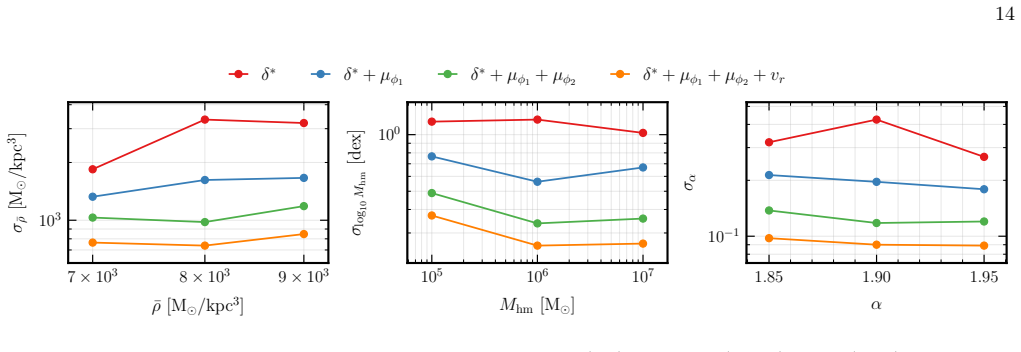
The authors construct a differentiable forward model for stellar streams in the diffusion regime, where the stream is heated by many small velocity kicks. Because the substructure population is represented solely by its power spectrum, the model remains computationally cheap and can be evaluated for any dark-matter or baryonic power spectrum. After validation against analytic expectations, the model is applied to forecast the information content of a GD-1-like stream; the inclusion of proper-motion and radial-velocity data improves the precision on the free-streaming cutoff scale from approximately 1.2 dex (density only) to 0.25 dex.
What carries the argument
The differentiable forward model in the diffusion regime, which encodes all substructure effects through a single input power spectrum.
If this is right
- Kinematic information tightens constraints by a factor of approximately 3-5 relative to density alone.
- Precision on the dark-matter free-streaming cutoff improves to 0.25 dex at a fiducial half-mode mass of 10^6 solar masses.
- A single well-measured stream yields limits competitive with strong lensing and satellite counts.
- The computational cost remains independent of the number of individual perturbers.
- Alternative dark-matter models are explored simply by swapping the input power spectrum.
Where Pith is reading between the lines
- The same forward model could be applied to additional streams observed by upcoming surveys to combine independent power-spectrum measurements.
- Differentiability opens the possibility of joint inference with other probes that also constrain the substructure power spectrum.
- If the diffusion assumption holds, the method provides a direct route to testing warm or fuzzy dark-matter scenarios without enumerating individual perturbers.
Load-bearing premise
The stream perturbations occur in the diffusion regime, where heating comes from many small velocity kicks rather than strong encounters.
What would settle it
A stream whose observed density and velocity structure matches the predictions of a few strong encounters rather than the statistical diffusion model would falsify the central modeling assumption.
Figures



read the original abstract
Stellar streams are a promising way to gravitationally detect low-mass substructure, since their low dynamical temperature makes them retain the imprint of weak gravitational perturbations. We develop a fast, differentiable forward model for perturbed stellar streams in the diffusion regime, where the stream is heated by many small velocity kicks rather than by a few strong encounters. The substructure population enters only through its power spectrum, so the computational cost is insensitive to the number of perturbers, and alternative dark matter models and/or baryonic perturbers can be explored by changing this single input. We validate the simulations against analytical predictions, then forecast the sensitivity of a GD-1-like stream to the substructure power spectrum, adding to the stream density the full kinematics, both proper motions and the radial velocity. Kinematic information tightens the constraints by a factor of $\sim 3$-$5$ relative to density alone, improving the precision on the dark matter free-streaming cutoff scale from $\sim 1.2$ dex to $\sim 0.25$ dex at a fiducial value of $M_{\rm hm} = 10^6 M_\odot$ for a $5$ Gyr stream. A single well-measured stream could thus constrain dark matter competitively with current limits from strong lensing and satellite counts.
Editorial analysis
A structured set of objections, weighed in public.
Referee Report
Summary. The paper develops a fast, differentiable forward model for stellar streams in the diffusion regime, where perturbations from substructure are modeled solely via the substructure power spectrum (rather than individual encounters). The model is validated against analytical predictions for density and kinematic spectra. For a GD-1-like stream over 5 Gyr, the authors forecast that adding full kinematics (proper motions and radial velocity) to density measurements tightens the constraint on the dark-matter free-streaming cutoff scale M_hm from ~1.2 dex (density alone) to ~0.25 dex, making a single well-measured stream competitive with strong-lensing and satellite-count limits.
Significance. If the diffusion-regime assumption holds for the relevant subhalo masses, the differentiable power-spectrum approach offers an efficient route to forecasting and fitting stream perturbations under alternative dark-matter or baryonic models. The quantitative forecast that kinematics improves precision by a factor of 3-5 is a concrete, falsifiable prediction that could guide observational strategies.
major comments (2)
- [§3 (diffusion regime and validation)] The central forecast (kinematics tightening the M_hm constraint to 0.25 dex) rests on the diffusion-regime assumption that heating arises from many weak velocity kicks, allowing substructure to enter only through its power spectrum. While the model is validated against analytical predictions within this regime, the manuscript does not demonstrate that individual encounters with ~10^6 M_⊙ perturbers remain in the weak-kick limit for a 5 Gyr GD-1-like stream; a direct comparison to N-body realizations of strong encounters would be required to confirm the power-spectrum-only statistics are sufficient.
- [§5 (forecast results)] The quantitative improvement from kinematics (factor ~3-5, reducing uncertainty from 1.2 dex to 0.25 dex) is presented as a forecast result, but the precise mapping from the density/kinematic spectra to the reported dex values is not shown in sufficient detail to allow independent reproduction; an explicit equation or table linking the power-spectrum amplitude to the posterior width on M_hm would strengthen the claim.
minor comments (2)
- [§2] Notation for the power spectrum P(k) and the stream response functions should be defined once in a dedicated subsection to avoid repeated re-introduction across sections.
- [Figure 2] Figure captions for the validation plots should explicitly state the analytical formula being compared (e.g., the expected variance in the diffusion limit) rather than referring only to 'analytical predictions'.
Simulated Author's Rebuttal
We thank the referee for their constructive and detailed report. We respond to each major comment below.
read point-by-point responses
-
Referee: [§3 (diffusion regime and validation)] The central forecast (kinematics tightening the M_hm constraint to 0.25 dex) rests on the diffusion-regime assumption that heating arises from many weak velocity kicks, allowing substructure to enter only through its power spectrum. While the model is validated against analytical predictions within this regime, the manuscript does not demonstrate that individual encounters with ~10^6 M_⊙ perturbers remain in the weak-kick limit for a 5 Gyr GD-1-like stream; a direct comparison to N-body realizations of strong encounters would be required to confirm the power-spectrum-only statistics are sufficient.
Authors: Our model is formulated and validated strictly within the diffusion regime, where the substructure power spectrum fully captures the effect of many weak velocity kicks; the analytical comparisons in the manuscript are performed under this assumption. We agree that an explicit verification for encounters at ~10^6 M_⊙ would strengthen the presentation. In revision we will add a short calculation in §3 estimating the typical velocity kick amplitude from a 10^6 M_⊙ perturber on a 5 Gyr GD-1-like stream and confirming that the kick remains small compared with the stream's velocity dispersion. A full N-body comparison to strong individual encounters lies outside the scope of the present work, which centers on the differentiable power-spectrum formalism. revision: partial
-
Referee: [§5 (forecast results)] The quantitative improvement from kinematics (factor ~3-5, reducing uncertainty from 1.2 dex to 0.25 dex) is presented as a forecast result, but the precise mapping from the density/kinematic spectra to the reported dex values is not shown in sufficient detail to allow independent reproduction; an explicit equation or table linking the power-spectrum amplitude to the posterior width on M_hm would strengthen the claim.
Authors: We agree that greater transparency on the mapping from spectra to posterior widths would aid reproducibility. In the revised manuscript we will insert an explicit expression for the Fisher information contributed by the density and kinematic power spectra and add a table that decomposes the resulting uncertainty on log M_hm into contributions from each observable. revision: yes
Circularity Check
No circularity: forward model validated against external analytics
full rationale
The paper constructs a differentiable forward model for stream perturbations in the diffusion regime, where substructure enters solely via its power spectrum. It explicitly validates this model against independent analytical predictions before using it for forecasts on GD-1-like streams. No step reduces a claimed prediction or result to a fitted parameter, self-citation, or input by construction; the derivation chain remains self-contained with external benchmarks.
Axiom & Free-Parameter Ledger
Reference graph
Works this paper leans on
-
[1]
At each ofN k discrete kick times, we sample a realisation of the substructure density field, compute the resulting veloc- ity kick field in Fourier space via Eq
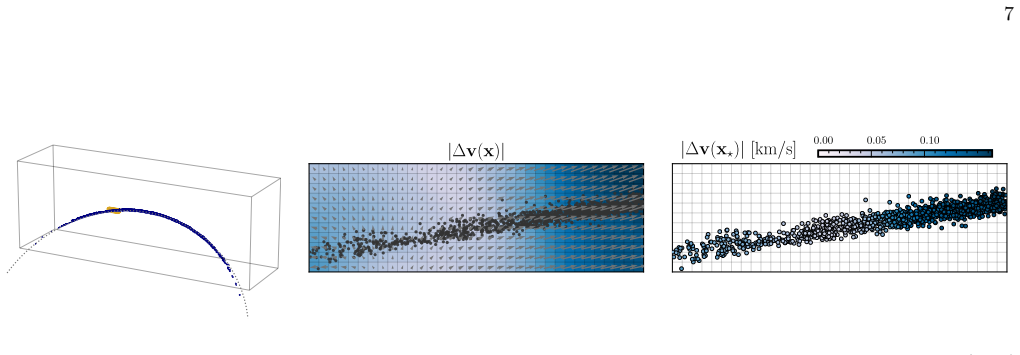
Velocity kicks implementation Having specified the substructure model, we now de- scribe how velocity kicks due to the substructures are computed and applied to the stream particles. At each ofN k discrete kick times, we sample a realisation of the substructure density field, compute the resulting veloc- ity kick field in Fourier space via Eq. (2), and ev...
-
[2]
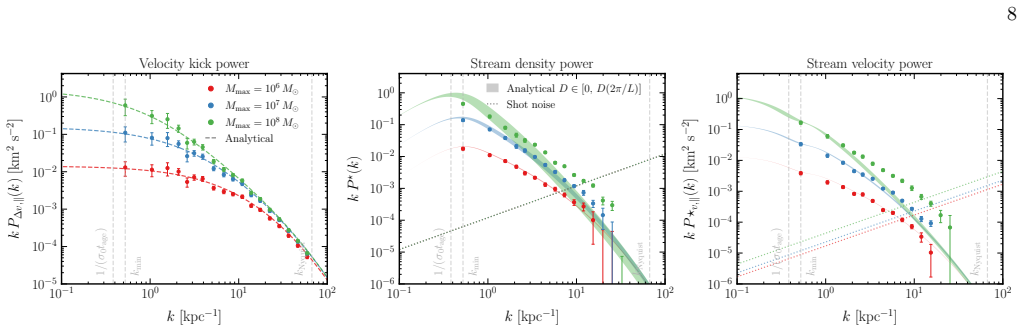
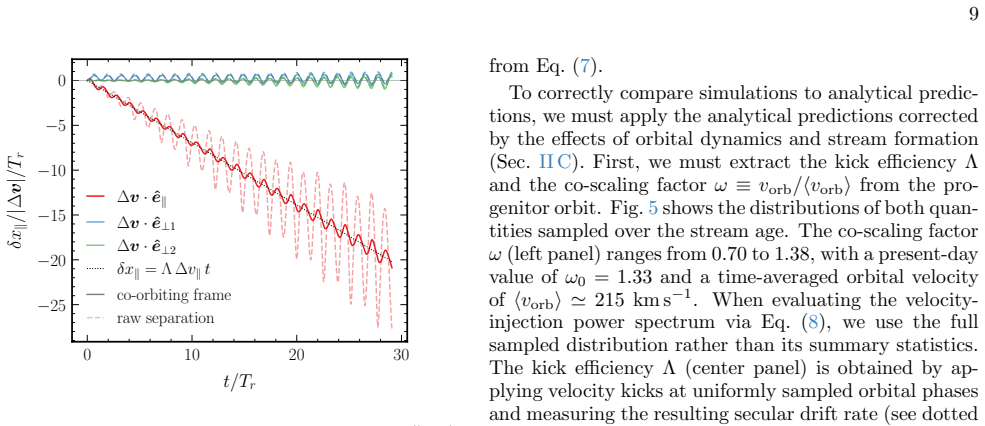
Idealized simulations The stream is initialized as a uniform line ofN ∗ = 105 stars spanningL= 12 kpc, with initial velocity dis- persionσ p = 0.365 km s −1 and zero stream velocity 8 10−1 100 101 102 k [kpc−1] 10−5 10−4 10−3 10−2 10−1 100 k P∆v,∥(k) [km 2 s−2] kNyquist kmin 1/(σ0tage) Velocity kick power Mmax = 10 6 M⊙ Mmax = 10 7 M⊙ Mmax = 10 8 M⊙ Analy...
-
[3]
We adopt a similar physical setup as in Ref
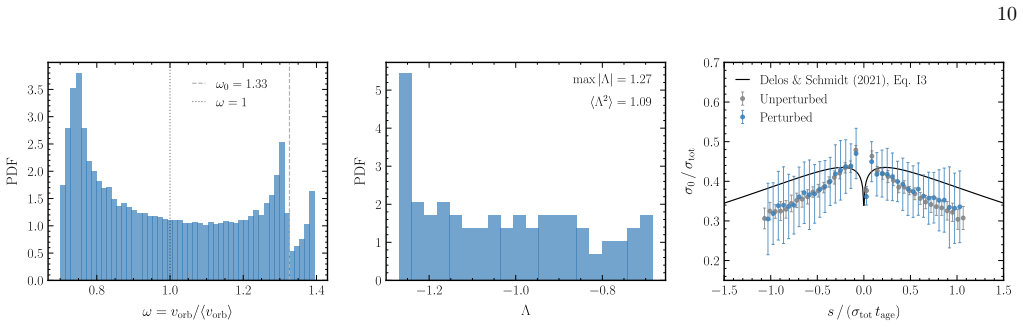
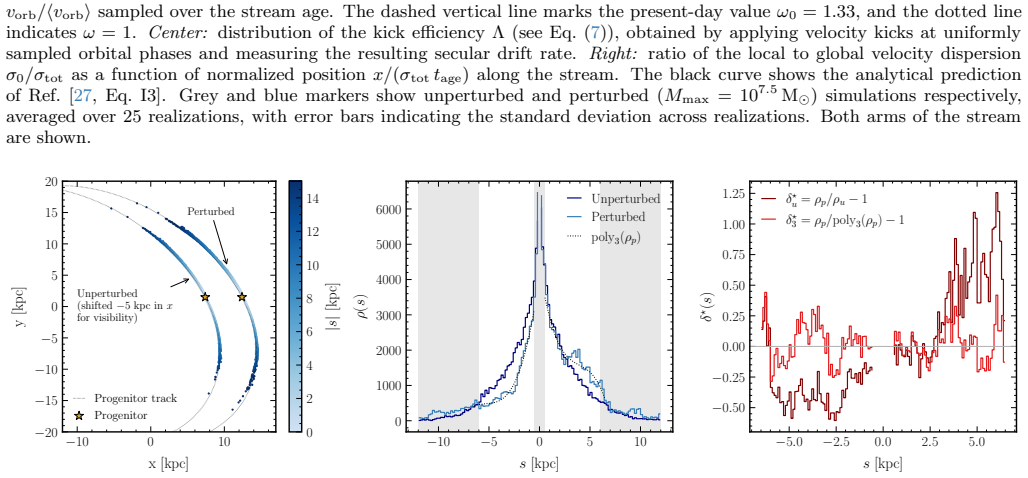
Realistic simulations Having validated the velocity injection implementa- tion in the idealized setting, we now turn to full realis- tic simulations that include orbital dynamics and stream formation. We adopt a similar physical setup as in Ref. [21] and Ref. [27] for a GD-1-like stream. The host potential is a flattened logarithmic potential with circula...
2000
-
[4]
Each data point shows the median power across simulations at 11 logarithmically spaced wavenumber bins, with error bars spanning the 16th–84th percentiles
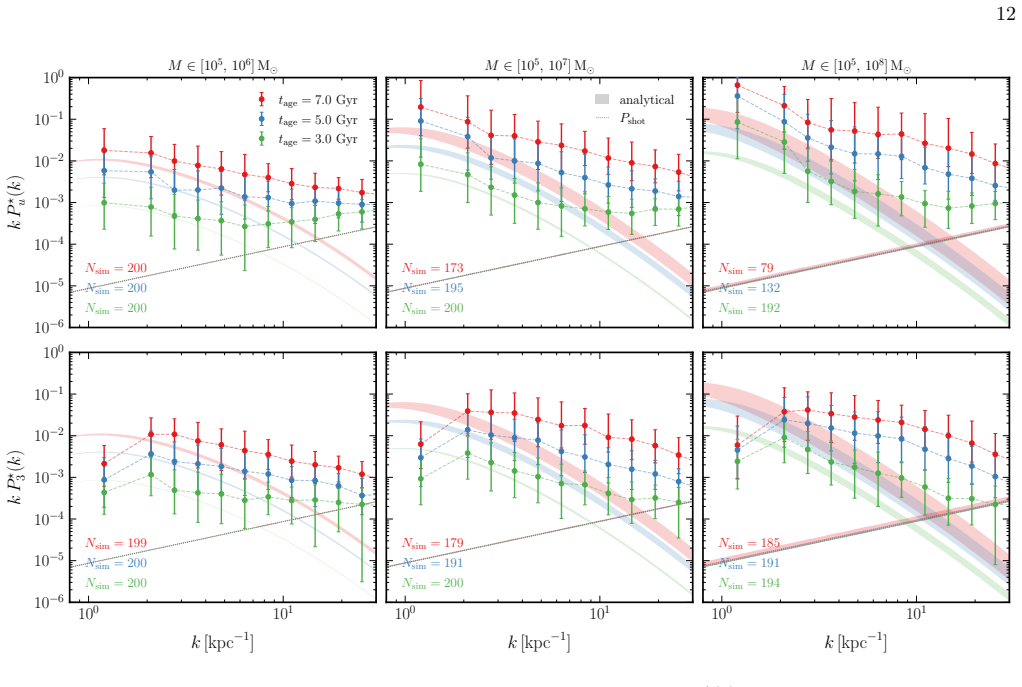
Columns correspond to mass rangesM∈[10 5,10 6], [105,10 7], and [105,10 8] M⊙ from left to right, and colors indicate stream agest age = 7, 5, and 3 Gyr. Each data point shows the median power across simulations at 11 logarithmically spaced wavenumber bins, with error bars spanning the 16th–84th percentiles. The analytical bands bracket the predictions co...
-
[5]
Points show the median power acrossN sim retained realizations at 11 logarithmically spaced wavenumber bins, with error bars spanning the 16th–84th percentiles. Shaded bands bracket the analytical predictions computed withD=D(2π/L) usingσ 0 −σ 0,std and D= 0 usingσ 0 +σ 0,std, whereσ 0,std is the standard deviation of the local velocity dispersion across ...
-
[6]
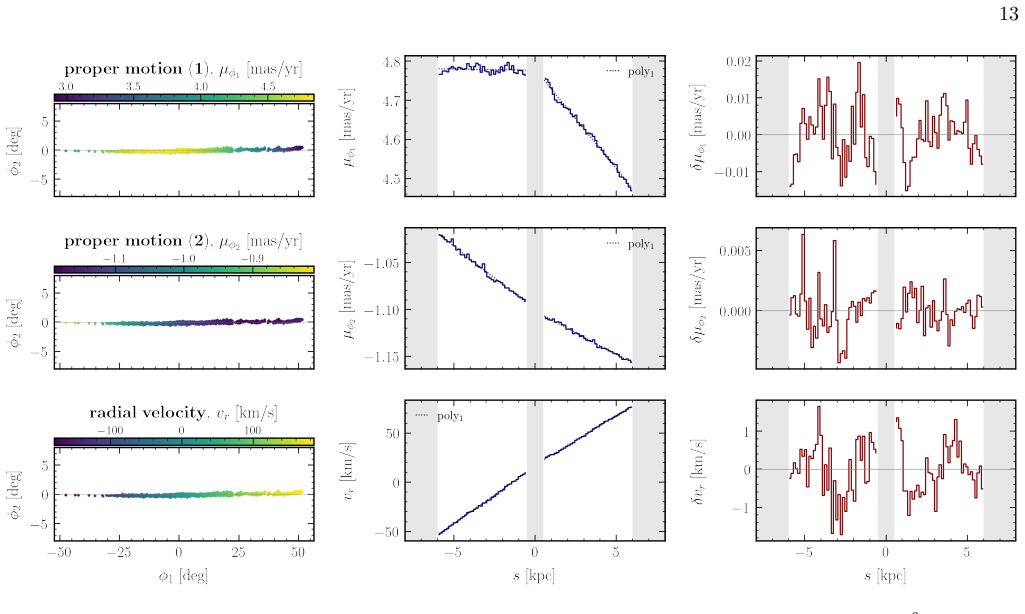
galactocentric defaults. Each star is then projected onto a local stream frame, defined by a right-handed orthonormal triad ( ˆeϕ1 , ˆeϕ2 , ˆn) computed at each point along the progenitor orbit, where ˆeϕ1 is the along-stream tangent on the heliocentric unit sphere, ˆeϕ2 the cross- stream direction, and ˆnthe line-of-sight. This yields three kinematic obs...
-
[7]
For the kinematic fields, large-scale trends are removed by fit- ting and subtracting a first-order polynomial baseline, δµϕ1 =µ ϕ1 −poly 1(µϕ1), and similarly forµ ϕ2 andv r, in analogy with the polynomial-based density estimator δ∗
-
[8]
8, similarly to Fig
Fig. 8, similarly to Fig. 6, illustrates this procedure for a single stream realization, showing each kinematic observable on the sky, its binned profile along arc-length, and the resulting contrast field. Each contrast field is multiplied by a Hann window to suppress spectral leakage before computing the one- 14 7 × 10³ 8 × 10³ 9 × 10³ ¯ρ [M⊙/kpc3] 103 σ...
2022
-
[9]
P. J. E. Peebles, Large-scale background temperature and mass fluctuations due to scale-invariant primeval per- turbations, The Astrophysical Journal Letters263, L1 (1982)
1982
-
[10]
C. J. Hogan and J. J. Dalcanton, New dark matter physics: Clues from halo structure, Physical Review D 62, 10.1103/physrevd.62.063511 (2000)
-
[11]
D. N. Spergel and P. J. Steinhardt, Observational evi- dence for self-interacting cold dark matter, Physical Re- view Letters84, 3760–3763 (2000)
2000
-
[12]
E. G. M. Ferreira, Ultra-light dark matter, The Astron- omy and Astrophysics Review29, 10.1007/s00159-021- 00135-6 (2021)
-
[13]
I. de Martino, S. S. Chakrabarty, V. Cesare, A. Gallo, L. Ostorero, and A. Diaferio, Dark matters on the scale of galaxies, Universe6, 107 (2020), arXiv:2007.15539 [astro- ph.CO]
arXiv 2020
-
[14]
Belokurov, Galactic archaeology: The dwarfs that sur- vived and perished, New Astronomy Reviews57, 100–121 (2013)
V. Belokurov, Galactic archaeology: The dwarfs that sur- vived and perished, New Astronomy Reviews57, 100–121 (2013)
2013
-
[15]
Fitts, M
A. Fitts, M. Boylan-Kolchin, O. D. Elbert, J. S. Bullock, P. F. Hopkins, J. O˜ norbe, A. Wetzel, C. Wheeler, C.- A. Faucher-Gigu` ere, D. Kereˇ s, E. D. Skillman, and D. R. Weisz, fire in the field: simulating the threshold of galaxy formation, Monthly Notices of the Royal Astronomical Society471, 3547–3562 (2017)
2017
-
[16]
K. V. Johnston, D. N. Spergel, and C. Haydn, How lumpy is the milky way’s dark matter halo?, The Astrophysical Journal570, 656–664 (2002)
2002
-
[17]
R. A. Ibata, G. F. Lewis, M. J. Irwin, and T. Quinn, Un- covering cold dark matter halo substructure with tidal streams, Monthly Notices of the Royal Astronomical So- ciety332, 915–920 (2002)
2002
-
[18]
A. Bonaca and A. M. Price-Whelan, Stellar streams in the Gaia era, New Astron. Rev.100, 101713 (2025), arXiv:2405.19410 [astro-ph.GA]
arXiv 2025
-
[19]
J. M. Siegal-Gaskins and M. Valluri, Signatures of ΛCDM Substructure in Tidal Debris, Astrophys. J.681, 40 (2008), arXiv:0710.0385 [astro-ph]
Pith/arXiv arXiv 2008
-
[20]
R. G. Carlberg, Star stream folding by dark galactic sub- halos, The Astrophysical Journal705, L223–L226 (2009)
2009
-
[21]
J. H. Yoon, K. V. Johnston, and D. W. Hogg, Clumpy streams from clumpy halos: Detecting missing satellites with cold stellar structures, The Astrophysical Journal 731, 58 (2011)
2011
-
[22]
Erkal and V
D. Erkal and V. Belokurov, Forensics of subhalo–stream encounters: the three phases of gap growth, Monthly No- tices of the Royal Astronomical Society450, 1136–1149 (2015)
2015
-
[23]
Erkal and V
D. Erkal and V. Belokurov, Properties of dark subhaloes from gaps in tidal streams, Monthly Notices of the Royal Astronomical Society454, 3542–3558 (2015)
2015
-
[24]
Bonaca, D
A. Bonaca, D. W. Hogg, A. M. Price-Whelan, and C. Conroy, The spur and the gap in gd-1: Dynamical evidence for a dark substructure in the milky way halo, The Astrophysical Journal880, 38 (2019)
2019
-
[25]
T. Nguyen, R. Pei, Z. Li, N. Shipp, S. Dodelson, D. Erkal, P. S. Ferguson, T. K. Starkenburg, M. M. Rau, A. H. 19 Riley, A. J. Zhou, and the LSST Dark Energy Sci- ence Collaboration, Forecasting Dark Matter Subhalo Constraints from Stellar Streams using Implicit Likeli- hood Inference, arXiv e-prints , arXiv:2512.07960 (2025), arXiv:2512.07960 [astro-ph.GA]
arXiv 2025
-
[26]
R. G. Carlberg, The dynamics of star stream gaps, The Astrophysical Journal775, 90 (2013)
2013
-
[27]
Erkal, V
D. Erkal, V. Belokurov, J. Bovy, and J. L. Sanders, The number and size of subhalo-induced gaps in stel- lar streams, Monthly Notices of the Royal Astronomical Society463, 102–119 (2016)
2016
-
[28]
Erkal, S
D. Erkal, S. E. Koposov, and V. Belokurov, A sharper view of pal 5’s tails: discovery of stream perturbations with a novel non-parametric technique, Monthly Notices of the Royal Astronomical Society470, 60–84 (2017)
2017
-
[29]
J. Bovy, D. Erkal, and J. L. Sanders, Linear perturbation theory for tidal streams and the small-scale cdm power spectrum, Monthly Notices of the Royal Astronomical Society466, 628–668 (2016)
2016
-
[30]
Banik and J
N. Banik and J. Bovy, Effects of baryonic and dark mat- ter substructure on the pal 5 stream, Monthly Notices of the Royal Astronomical Society484, 2009–2020 (2019)
2009
-
[31]
Banik, J
N. Banik, J. Bovy, G. Bertone, D. Erkal, and T. J. L. de Boer, Evidence of a population of dark subhaloes from gaia and pan-starrs observations of the gd-1 stream, Monthly Notices of the Royal Astronomical Society502, 2364–2380 (2021)
2021
-
[32]
Banik, J
N. Banik, J. Bovy, G. Bertone, D. Erkal, and T. de Boer, Novel constraints on the particle nature of dark matter from stellar streams, Journal of Cosmology and Astropar- ticle Physics2021(10), 043
-
[33]
J. Nibauer, A. Bonaca, D. N. Spergel, A. M. Price- Whelan, J. E. Greene, N. Starkman, and K. V. John- ston, StreamSculptor: Hamiltonian Perturbation The- ory for Stellar Streams in Flexible Potentials with Dif- ferentiable Simulations, Astrophys. J.983, 68 (2025), arXiv:2410.21174 [astro-ph.GA]
arXiv 2025
-
[34]
Nibauer, A
J. Nibauer, A. Bonaca, A. M. Price-Whelan, D. N. Spergel, and J. E. Greene, Measurement of substructure from the kinematics of the gd-1 stellar stream, The As- trophysical Journal1004, 62 (2026)
2026
-
[35]
M. S. Delos and F. Schmidt, Stellar streams and dark substructure: the diffusion regime, Monthly Notices of the Royal Astronomical Society513, 3682–3708 (2022)
2022
-
[36]
Tavangar and A
K. Tavangar and A. M. Price-Whelan, Inferring the den- sity and membership of stellar streams with flexible mod- els: The gd-1 stream in gaia data release 3, The Astro- physical Journal988, 45 (2025)
2025
-
[37]
E. Jarvis, T. S. Li, S. E. Koposov, R. G. Carlberg, M. Val- luri, N. Mohammed, J. Aguilar, S. Ahlen, C. A. Prieto, L. B. e Silva, D. Bianchi, D. Brooks, A. Bystr¨ om, T. Clay- baugh, A. P. Cooper, A. Cuceu, A. de la Macorra, A. Dey, B. Dey, P. Doel, J. E. Forero-Romero, E. Gazta˜ naga, O. Y. Gnedin, S. G. A. Gontcho, G. Gutierrez, K. Hon- scheid, R. Joyce...
Pith/arXiv arXiv 2026
-
[38]
The Via Project,https://via-project.org
-
[39]
W. Enzi, R. Murgia, O. Newton, S. Vegetti, C. Frenk, M. Viel, M. Cautun, C. D. Fassnacht, M. Auger, G. Despali, J. McKean, L. V. E. Koopmans, and M. Lovell, Joint constraints on thermal relic dark mat- ter from strong gravitational lensing, the lyαforest, and milky way satellites, Monthly Notices of the Royal As- tronomical Society506, 5848–5862 (2021)
2021
-
[40]
E. O. Nadler, S. Birrer, D. Gilman, R. H. Wechsler, X. Du, A. Benson, A. M. Nierenberg, and T. Treu, Dark matter constraints from a unified analysis of strong grav- itational lenses and milky way satellite galaxies, The As- trophysical Journal917, 7 (2021)
2021
-
[41]
A. H. W. K¨ upper, P. Kroupa, H. Baumgardt, and D. C. Heggie, Tidal tails of star clusters, Monthly Notices of the Royal Astronomical Society401, 105–120 (2010)
2010
-
[42]
A. H. W. K¨ upper, R. R. Lane, and D. C. Heggie, More on the structure of tidal tails, Monthly Notices of the Royal Astronomical Society420, 2700–2714 (2012)
2012
-
[43]
Bradbury, R
J. Bradbury, R. Frostig, P. Hawkins, M. J. Johnson, C. Leary, D. Maclaurin, G. Necula, A. Paszke, J. Van- derPlas, S. Wanderman-Milne, and Q. Zhang, JAX: com- posable transformations of Python+NumPy programs (2018)
2018
- [44]
-
[45]
Starkman, A
N. Starkman, A. Price-Whelan, and J. Nibauer, Galac- ticdynamics/galax: v0.0.2 (2024)
2024
-
[46]
Kidger,On Neural Differential Equations, Ph.D
P. Kidger,On Neural Differential Equations, Ph.D. the- sis, University of Oxford (2021)
2021
-
[47]
Bowden, V
A. Bowden, V. Belokurov, and N. W. Evans, Dipping our toes in the water: first models of gd-1 as a stream, Monthly Notices of the Royal Astronomical Society449, 1391–1400 (2015)
2015
-
[48]
M. A. Fardal, S. Huang, and M. D. Weinberg, Genera- tion of mock tidal streams, Monthly Notices of the Royal Astronomical Society452, 301–319 (2015)
2015
-
[49]
Y. Chen, M. Valluri, O. Y. Gnedin, and N. Ash, Im- proved particle spray algorithm for modeling globular cluster streams, The Astrophysical Journal Supplement Series276, 32 (2025)
2025
-
[50]
R. J. Scherrer and E. Bertschinger, Statistics of Primor- dial Density Perturbations from Discrete Seed Masses, Astrophys. J.381, 349 (1991)
1991
-
[51]
Y.-Y. Mao, L. E. Strigari, R. H. Wechsler, H.-Y. Wu, and O. Hahn, Halo-to-halo similarity and scatter in the velocity distribution of dark matter, The Astrophysical Journal764, 35 (2013)
2013
- [52]
-
[53]
Bovy, Dynamical modeling of tidal streams, The As- trophysical Journal795, 95 (2014)
J. Bovy, Dynamical modeling of tidal streams, The As- trophysical Journal795, 95 (2014)
2014
-
[54]
T. J. L. de Boer, D. Erkal, and M. Gieles, A closer look at the spur, blob, wiggle, and gaps in gd-1, Monthly No- tices of the Royal Astronomical Society494, 5315–5332 (2020)
2020
-
[55]
Cooray and R
A. Cooray and R. Sheth, Halo models of large scale struc- ture, Physics Reports372, 1–129 (2002)
2002
-
[56]
P. J. McMillan, The mass distribution and gravitational potential of the milky way, Monthly Notices of the Royal 20 Astronomical Society465, 76–94 (2016)
2016
-
[57]
V. Springel, J. Wang, M. Vogelsberger, A. Ludlow, A. Jenkins, A. Helmi, J. F. Navarro, C. S. Frenk, and S. D. M. White, The Aquarius Project: the subhaloes of galactic haloes, Monthly Notices of the Royal Astronomi- cal Society391, 1685 (2008), arXiv:0809.0898 [astro-ph]
Pith/arXiv arXiv 2008
-
[58]
Schneider, R
A. Schneider, R. E. Smith, A. V. Macci` o, and B. Moore, Non-linear evolution of cosmological structures in warm dark matter models: Non-linear structure formation in wdm models, Monthly Notices of the Royal Astronomical Society424, 684–698 (2012)
2012
-
[59]
Astropy Collaboration, A. M. Price-Whelan, P. L. Lim, N. Earl, N. Starkman, L. Bradley, D. L. Shupe, A. A. Patil, L. Corrales, C. E. Brasseur, M. N¨ othe, A. Do- nath, E. Tollerud, B. M. Morris, A. Ginsburg, E. Va- her, B. A. Weaver, J. Tocknell, W. Jamieson, M. H. van Kerkwijk, T. P. Robitaille, B. Merry, M. Bachetti, H. M. G¨ unther, T. L. Aldcroft, J. ...
Pith/arXiv arXiv 2022
-
[60]
D. Gilman, A. M. Nierenberg, T. Treu, K. N. Abaza- jian, T. Anguita, V. N. Bennert, A. J. Benson, S. Bir- rer, S. G. Djorgovski, X. Du, C. Gannon, S. F. Hoenig, R. E. Keeley, A. Kusenko, H. R. Larsson, M. Malkan, T. Morishita, V. Motta, L. A. Moustakas, P. Mozumdar, H. Paugnat, W. Sheu, D. Sluse, D. Stern, M. Stiavelli, D. Williams, and K. C. Wong, The fr...
Pith/arXiv arXiv 2026
-
[61]
Hsueh, W
J.-W. Hsueh, W. Enzi, S. Vegetti, M. W. Auger, C. D. Fassnacht, G. Despali, L. V. E. Koopmans, and J. P. McKean, Sharp – vii. new constraints on the dark matter free-streaming properties and substructure abundance from gravitationally lensed quasars, Monthly Notices of 0 25 50 75 100 125 150 Nk 0 20 40 60 80 100 120 140 Wall time [s] Nsub = 32 Nsub = 64 N...
2019
-
[62]
Gilman, S
D. Gilman, S. Birrer, A. Nierenberg, T. Treu, X. Du, and A. Benson, Warm dark matter chills out: constraints on the halo mass function and the free-streaming length of dark matter with eight quadruple-image strong gravita- tional lenses, Monthly Notices of the Royal Astronomical Society491, 6077–6101 (2019)
2019
-
[63]
R. E. Keeleyet al., JWST lensed quasar dark matter sur- vey – II. Strongest gravitational lensing limit on the dark matter free streaming length to date, Mon. Not. Roy. Astron. Soc.535, 1652 (2024), arXiv:2405.01620 [astro- ph.CO]
arXiv 2024
-
[64]
Starkman, A
N. Starkman, A. M. Price-Whelan, and J. Nibauer, unxt: A python package for unit-aware computing with jax, Journal of Open Source Software10, 7771 (2025)
2025
-
[65]
Y. hsuan Shih, G. Wright, J. And´ en, J. Blaschke, and A. H. Barnett, cufinufft: a load-balanced gpu library for general-purpose nonuniform ffts (2021), arXiv:2102.08463 [cs.DC]. Appendix A: Runtime comparison Fig. 11 shows the wall-clock time of our simulator as a function of the number of kick timesN k, measured on a single NVIDIA A100 GPU with 40GB of ...
arXiv 2021
discussion (0)
Sign in with ORCID, Apple, or X to comment. Anyone can read and Pith papers without signing in.