Throughput Analysis for Near-Field Mobile Communications: Beamfocusing or Caustic Beamforming?
Pith reviewed 2026-06-27 15:32 UTC · model grok-4.3
The pith
Caustic beamforming delivers speed-independent throughput and becomes preferable to beamfocusing for high-mobility THz links because its overhead threshold vanishes at high frequencies.
A machine-rendered reading of the paper's core claim, the machinery that carries it, and where it could break.
Core claim
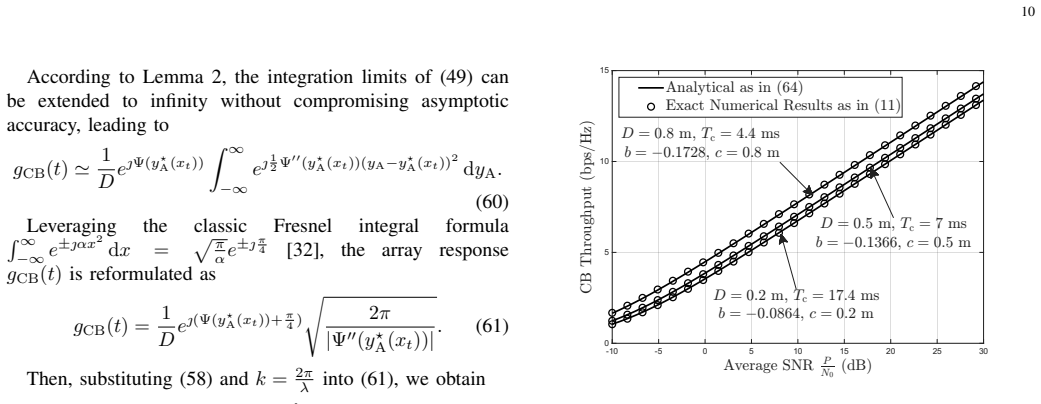
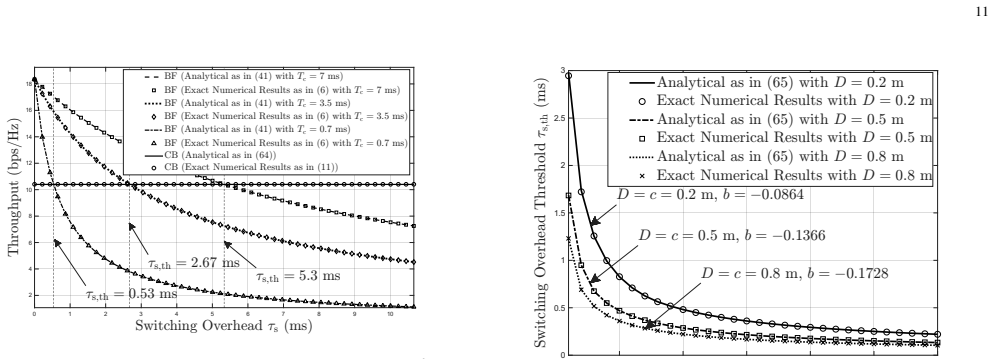
Closed-form throughput expressions are derived for beamfocusing and caustic beamforming; the latter depends solely on SNR and trajectory geometry and is invariant to user speed, while an analytically obtained switching-overhead threshold for paradigm selection asymptotically vanishes at extremely high frequencies.
What carries the argument
Airy beam model used to obtain closed-form throughput expressions and the performance boundary that separates the two beamforming regimes.
If this is right
- An optimal finite beam dwell time exists that maximizes beamfocusing throughput under continuous user motion.
- Caustic beamforming throughput is determined by SNR and trajectory geometry alone.
- A closed-form threshold on switching overhead separates the two regimes.
- The threshold value approaches zero at THz frequencies, favoring caustic beamforming for high-mobility links.
Where Pith is reading between the lines
- Systems could reduce beam management complexity by switching to continuous caustic beams once carrier frequency exceeds a few hundred GHz.
- Trajectory planning at the network level becomes a direct lever for rate in caustic beamforming deployments.
- Hardware that can synthesize stable curved wavefronts may relax the need for ultra-fast beam switching circuits in future THz arrays.
Load-bearing premise
The Airy beam accurately represents caustic beamforming and caustic beamforming throughput depends only on SNR and trajectory geometry while remaining completely independent of user speed.
What would settle it
A measurement at THz frequencies in which caustic beamforming throughput changes measurably when user speed varies while SNR and trajectory are held fixed.
Figures
read the original abstract
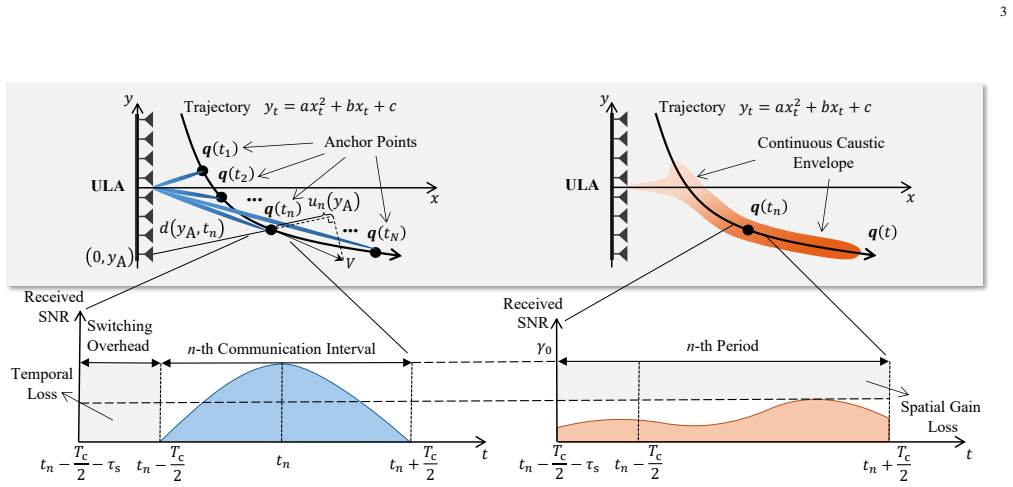
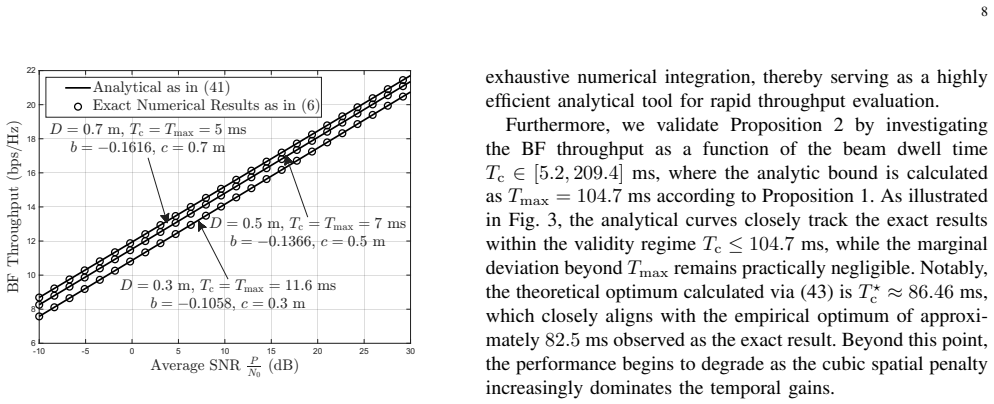
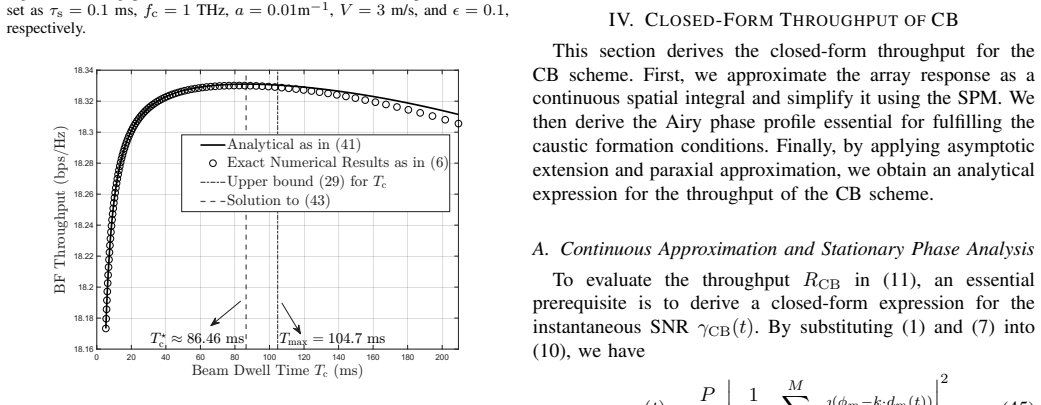
The migration to the Terahertz (THz) band and the deployment of extremely large antenna arrays (ELAAs) are transitioning wireless communications into the radiative near-field regime, fundamentally evolving conventional angular beam steering to beamfocusing (BF). However, the combination of the extremely narrow beamwidth and the mobility of the users necessitates frequent beamfocusing reconfigurations, incurring a significant switching overhead that degrades the system achievable throughput. In this regard, caustic beamforming (CB) is a promising alternative based on the synthesis of a continuous curved beam, which eliminates the need for beam tracking at the expense of a distributed beamforming gain. By leveraging the Airy beam as a canonical model, this paper develops an analytical framework to compare the throughputs achieved by CB and BF. Our main results include closed-form throughput expressions for both beamforming strategies and a performance boundary for paradigm selection. First, we derive the BF throughput by modeling a defocusing penalty induced by continuous user movement. The optimal beam dwell time that maximizes the throughput is analytically determined, and the impact of user speed and switching overhead on the throughput is quantified. For the CB scheme, we demonstrate that its throughput is determined by the signal-to-noise ratio (SNR) and the geometry of the trajectory of the user, yet invariant to the user speed. Finally, we analytically establish a threshold for the switching overhead to define the crossover point of the achievable throughput of both beamformers. Crucially, this threshold asymptotically vanishes at extremely high frequencies, positioning the continuous CB scheme as the preferred beam design paradigm for high-mobility THz communications.
Editorial analysis
A structured set of objections, weighed in public.
Referee Report
Summary. The manuscript develops an analytical framework to compare achievable throughputs of beamfocusing (BF) and caustic beamforming (CB) in near-field THz mobile communications with ELAA. Leveraging the Airy beam as a canonical model for CB, it derives closed-form throughput expressions for both schemes, determines the optimal beam dwell time for BF under a movement-induced defocusing penalty, shows that CB throughput depends only on SNR and user trajectory geometry while remaining invariant to speed, and analytically establishes a switching-overhead threshold whose asymptotic vanishing at high frequencies favors the continuous CB scheme for high-mobility THz systems.
Significance. If the closed-form derivations and the frequency-asymptotic threshold hold, the work supplies a concrete, analytically grounded criterion for selecting between BF and CB paradigms in future THz systems. The explicit invariance result for CB and the parameter-free boundary constitute notable strengths that could directly inform beam-design choices under mobility.
major comments (2)
- [§4] §4 (CB throughput derivation): the invariance of CB throughput to user speed is asserted to follow from the Airy-beam model and geometry-only dependence; however, the derivation does not appear to quantify residual losses from finite beam synthesis accuracy or small trajectory perturbations, which could affect the claimed invariance and therefore the location of the crossover threshold.
- [§5] §5, Eq. (threshold expression): the asymptotic vanishing of the overhead threshold at high frequencies is obtained by taking the limit of the ratio of the two closed-form throughputs; it is not shown whether the Airy-beam focal parameters themselves introduce additional frequency-dependent scaling that would alter the limit.
minor comments (3)
- [§2] The system model section would benefit from an explicit statement of the far-field vs. near-field boundary used to justify the transition to beamfocusing.
- [Figs. 4-5] Figure captions for the throughput curves should include the analytical threshold expression so readers can directly verify the crossover point.
- [§3] A short remark on how the Airy-beam model relates to other caustic-beam synthesis techniques would help readers assess generality.
Simulated Author's Rebuttal
We thank the referee for the constructive comments and positive recommendation. We address the two major comments point by point below.
read point-by-point responses
-
Referee: [§4] §4 (CB throughput derivation): the invariance of CB throughput to user speed is asserted to follow from the Airy-beam model and geometry-only dependence; however, the derivation does not appear to quantify residual losses from finite beam synthesis accuracy or small trajectory perturbations, which could affect the claimed invariance and therefore the location of the crossover threshold.
Authors: The invariance result is derived under the canonical ideal Airy-beam model, which assumes perfect synthesis and exact trajectory matching with no perturbations. Under these assumptions the throughput depends only on SNR and geometry. We agree that finite synthesis accuracy or trajectory perturbations could introduce speed-dependent residual losses in practice and thereby shift the exact location of the crossover threshold. We will revise §4 to explicitly state these modeling assumptions and add a short paragraph discussing their implications for real-world applicability, without altering the closed-form expressions. revision: partial
-
Referee: [§5] §5, Eq. (threshold expression): the asymptotic vanishing of the overhead threshold at high frequencies is obtained by taking the limit of the ratio of the two closed-form throughputs; it is not shown whether the Airy-beam focal parameters themselves introduce additional frequency-dependent scaling that would alter the limit.
Authors: The Airy-beam focal parameters are fixed by the trajectory curvature and carrier frequency to align the caustic with the user path. In the high-frequency asymptotic analysis these parameters produce scaling factors that cancel in the throughput ratio, leaving the overhead threshold to vanish. However, this cancellation was not shown explicitly. We will add a brief derivation (either in the main text or a short appendix) demonstrating that the frequency dependence of the focal parameters does not change the vanishing limit. revision: yes
Circularity Check
No significant circularity identified
full rationale
The paper derives closed-form throughput expressions for BF (via defocusing penalty and optimal dwell time) and CB (via Airy canonical model yielding SNR/geometry dependence invariant to speed), then analytically obtains a switching-overhead threshold whose high-frequency asymptotic vanishing is presented as following from those expressions. No quoted equations reduce a claimed prediction to a fitted parameter by construction, no self-citation chain is load-bearing for the central result, and the Airy model is adopted as an external canonical form rather than defined circularly from the throughput itself. The derivation chain is therefore self-contained against the stated modeling assumptions.
Axiom & Free-Parameter Ledger
axioms (1)
- domain assumption Airy beam serves as canonical model for caustic beamforming
Forward citations
Cited by 1 Pith paper
-
Bending the Rules of Propagation: Caustic Beamforming for Next-Generation Wireless Systems
Caustic beamforming is proposed as a new wireless beam control paradigm leveraging self-bending, self-healing, and near-field non-diffracting properties for 6G applications including physical layer security and blocka...
Reference graph
Works this paper leans on
-
[1]
On the road to 6G: Visions, requirements, key technologies, and testbeds,
C.-X. Wanget al., “On the road to 6G: Visions, requirements, key technologies, and testbeds,”IEEE Commun. Surveys Tuts., vol. 25, no. 2, pp. 905–974, secondquarter 2023
2023
-
[2]
Terahertz communications for 6G and beyond wireless networks: Challenges, key advancements, and opportunities,
A. Shafie, N. Yang, C. Han, J. M. Jornet, M. Juntti, and T. K ¨urner, “Terahertz communications for 6G and beyond wireless networks: Challenges, key advancements, and opportunities,”IEEE Netw., vol. 37, no. 3, pp. 162–169, May/Jun. 2023
2023
-
[3]
Terahertz communications and sensing for 6G and be- yond: A comprehensive review,
W. Jianget al., “Terahertz communications and sensing for 6G and be- yond: A comprehensive review,”IEEE Commun. Surveys Tuts., vol. 26, no. 4, pp. 2326–2381, fourthquarter 2024
2024
-
[4]
A tutorial on extremely large-scale MIMO for 6G: Fundamentals, signal processing, and applications,
Z. Wanget al., “A tutorial on extremely large-scale MIMO for 6G: Fundamentals, signal processing, and applications,”IEEE Commun. Surveys Tuts., vol. 26, no. 3, pp. 1560–1605, thirdquarter 2024
2024
-
[5]
6G wire- less communication systems: Applications, requirements, technologies, challenges, and research directions,
M. Z. Chowdhury, M. Shahjalal, S. Ahmed, and Y . M. Jang, “6G wire- less communication systems: Applications, requirements, technologies, challenges, and research directions,”IEEE Open J. Commun. Soc., vol. 1, pp. 957–975, Jul. 2020
2020
-
[6]
Alternating minimization algorithms for hybrid precoding in millimeter wave MIMO systems,
X. Yu, J.-C. Shen, J. Zhang, and K. B. Letaief, “Alternating minimization algorithms for hybrid precoding in millimeter wave MIMO systems,” IEEE J. Sel. Topics Signal Process., vol. 10, no. 3, pp. 485–500, Apr. 2016
2016
-
[7]
Ultramassive MIMO systems at Terahertz bands: Prospects and challenges,
A. Faisal, H. Sarieddeen, H. Dahrouj, T. Y . Al-Naffouri, and M.-S. Alouini, “Ultramassive MIMO systems at Terahertz bands: Prospects and challenges,”IEEE Veh. Technol. Mag., vol. 15, no. 4, pp. 33–42, Dec. 2020
2020
-
[8]
Beamforming technologies for ultra-massive MIMO in Terahertz communications,
B. Ninget al., “Beamforming technologies for ultra-massive MIMO in Terahertz communications,”IEEE Open J. Commun. Soc., vol. 4, pp. 614–658, 2023
2023
-
[9]
A tutorial on near-field XL-MIMO communications toward 6G,
H. Luet al., “A tutorial on near-field XL-MIMO communications toward 6G,”IEEE Commun. Surveys Tuts., vol. 26, no. 4, pp. 2213–2257, fourthquarter 2024
2024
-
[10]
Near- field communications: A tutorial review,
Y . Liu, Z. Wang, J. Xu, C. Ouyang, X. Mu, and R. Schober, “Near- field communications: A tutorial review,”IEEE Open J. Commun. Soc., vol. 4, pp. 1999–2049, Aug. 2023
1999
-
[11]
Near-field MIMO communications for 6G: Fundamentals, challenges, potentials, and future directions,
M. Cui, Z. Wu, Y . Lu, X. Wei, and L. Dai, “Near-field MIMO communications for 6G: Fundamentals, challenges, potentials, and future directions,”IEEE Commun. Mag., vol. 61, no. 1, pp. 40–46, Sep. 2023
2023
-
[12]
Channel estimation for extremely large-scale MIMO: Far-field or near-field?
M. Cui and L. Dai, “Channel estimation for extremely large-scale MIMO: Far-field or near-field?”IEEE Trans. Commun., vol. 70, no. 4, pp. 2663–2677, Apr. 2022
2022
-
[13]
Near-field velocity sensing and predictive beamforming,
Z. Wang, X. Mu, and Y . Liu, “Near-field velocity sensing and predictive beamforming,”IEEE Trans. Veh. Technol., vol. 74, no. 1, pp. 1806–1810, Sep. 2025
2025
-
[14]
Near-field integrated sensing and communication: Opportunities and challenges,
J. Conget al., “Near-field integrated sensing and communication: Opportunities and challenges,”IEEE Wireless Commun., vol. 31, no. 6, pp. 162–169, Dec. 2024
2024
-
[15]
Near-field tracking with large antenna arrays: Fundamental limits and practical algorithms,
A. Guerra, F. Guidi, D. Dardari, and P. M. Djuri ´c, “Near-field tracking with large antenna arrays: Fundamental limits and practical algorithms,” IEEE Trans. Signal Process., vol. 69, pp. 5723–5738, Aug. 2021
2021
-
[16]
Terahertz band communication: An old problem revisited and research directions for the next decade,
I. F. Akyildiz, C. Han, Z. Hu, S. Nie, and J. M. Jornet, “Terahertz band communication: An old problem revisited and research directions for the next decade,”IEEE Trans. Commun., vol. 70, no. 6, pp. 4250–4285, May 2022
2022
-
[17]
A survey of beam management for mmWave and THz communications towards 6G,
Q. Xueet al., “A survey of beam management for mmWave and THz communications towards 6G,”IEEE Commun. Surveys Tuts., vol. 26, no. 3, pp. 1520–1559, thirdquarter 2024
2024
-
[18]
Airy beams and accelerating waves: An overview of recent advances,
N. K. Efremidis, Z. Chen, M. Segev, and D. N. Christodoulides, “Airy beams and accelerating waves: An overview of recent advances,”Optica, vol. 6, no. 5, pp. 686–701, 2019
2019
-
[19]
Airy beams for near- field communications: Fundamentals, potentials, and limitations,
D. Darsena, F. Verde, M. Di Renzo, and V . Galdi, “Airy beams for near- field communications: Fundamentals, potentials, and limitations,”arXiv preprint arXiv:2508.13714, 2025
Pith/arXiv arXiv 2025
-
[20]
Bending beams for 6G near-field communications,
S. Droulias, G. Stratidakis, and A. Alexiou, “Bending beams for 6G near-field communications,”IEEE Trans. Wireless Commun., vol. 24, no. 2, pp. 1467–1480, Dec. 2025
2025
-
[21]
Curving THz wireless data links around obstacles,
H. Guerboukha, B. Zhao, Z. Fang, E. Knightly, and D. M. Mittleman, “Curving THz wireless data links around obstacles,”Communications Engineering, vol. 3, no. 1, p. 58, Mar. 2024
2024
-
[22]
Robust and secure near-field communi- cation via curved caustic beams,
S. Liu, X. Yu, and R. Schober, “Robust and secure near-field communi- cation via curved caustic beams,”IEEE Wireless Commun. Lett., vol. 15, pp. 3069–3073, 2026
2026
-
[23]
Terahertz wireless data center: Gaussian beam or Airy beam?
W. Zhao, S. Abadal, G. Song, J. Jiang, and C. Han, “Terahertz wireless data center: Gaussian beam or Airy beam?”IEEE Trans. Wireless Commun., vol. 25, pp. 7922–7938, 2026
2026
-
[24]
A physics-informed Airy beam learning framework for blockage avoidance in sub-terahertz wire- less networks,
H. Chen, A. Kludze, and Y . Ghasempour, “A physics-informed Airy beam learning framework for blockage avoidance in sub-terahertz wire- less networks,”Nat. Commun., vol. 16, no. 1, p. 7387, Aug. 2025
2025
-
[25]
Learning- based blockage-resilient beam training in near-field Terahertz commu- nications,
C. Weng, Y . Guo, B. Zhao, Y . Wang, W. Chen, and Z. Li, “Learning- based blockage-resilient beam training in near-field Terahertz commu- nications,”arXiv preprint arXiv:2510.25433, 2025
arXiv 2025
-
[26]
Radar-assisted predictive beamforming for vehicular links: Communication served by sensing,
F. Liu, W. Yuan, C. Masouros, and J. Yuan, “Radar-assisted predictive beamforming for vehicular links: Communication served by sensing,” IEEE Trans. Wireless Commun., vol. 19, no. 11, pp. 7704–7719, Nov. 2020
2020
-
[27]
Learning-based predictive beamforming for integrated sensing and communication in vehicular networks,
C. Liuet al., “Learning-based predictive beamforming for integrated sensing and communication in vehicular networks,”IEEE J. Sel. Areas Commun., vol. 40, no. 8, pp. 2317–2334, Aug. 2022
2022
-
[28]
Tse and P
D. Tse and P. Viswanath,Fundamentals of Wireless Communication. Cambridge, U.K.: Cambridge Univ. Press, 2005
2005
-
[29]
Curved apertures for customized wave trajectories: Beyond flat aperture limitations,
J. M. Canals, F. Devoti, V . Sciancalepore, M. Di Renzo, and X. Costa- P´erez, “Curved apertures for customized wave trajectories: Beyond flat aperture limitations,”IEEE Wireless Commun. Lett., vol. 14, no. 12, pp. 4037–4041, Dec. 2025
2025
-
[30]
C. M. Bender and S. A. Orszag,Advanced Mathematical Methods for Scientists and Engineers I: Asymptotic Methods and Perturbation Theory. New York, NY , USA: Springer, 1999, vol. 1
1999
-
[31]
Sensing- enhanced channel estimation for near-field XL-MIMO systems,
S. Liu, X. Yu, Z. Gao, J. Xu, D. W. K. Ng, and S. Cui, “Sensing- enhanced channel estimation for near-field XL-MIMO systems,”IEEE J. Sel. Areas Commun., vol. 43, no. 3, pp. 628–643, Jan. 2025
2025
-
[32]
I. S. Gradshteyn and I. M. Ryzhik,Table of Integrals, Series, and Products, 7th ed. New York, NY , USA: Academic, 2007
2007
-
[33]
Properties of focused apertures in the fresnel region,
J. Sherman, “Properties of focused apertures in the fresnel region,”IRE Trans. Antennas Propagat., vol. 10, no. 4, pp. 399–408, Jul. 1962
1962
-
[34]
Ob- servation of accelerating Airy beams,
G. A. Siviloglou, J. Broky, A. Dogariu, and D. Christodoulides, “Ob- servation of accelerating Airy beams,”Phys. Rev. Lett., vol. 99, no. 21, p. 213901, 2007
2007
-
[35]
A tutorial on beam management for 3GPP NR at mmWave frequencies,
M. Giordani, M. Polese, A. Roy, D. Castor, and M. Zorzi, “A tutorial on beam management for 3GPP NR at mmWave frequencies,”IEEE Commun. Surv. Tutor., vol. 21, no. 1, pp. 173–196, firstquarter 2019
2019
-
[36]
H. H. Sohrab,Basic Real Analysis. Cambridge, MA, USA: Birkh ¨auser, 2003, vol. 231
2003
discussion (0)
Sign in with ORCID, Apple, or X to comment. Anyone can read and Pith papers without signing in.