A space-time sparse-grid method for the wave equation
Pith reviewed 2026-06-27 15:44 UTC · model grok-4.3
The pith
The sparse-grid combination technique on coercive space-time discretizations solves the linear wave equation with full-grid accuracy at reduced cost.
A machine-rendered reading of the paper's core claim, the machinery that carries it, and where it could break.
Core claim
The authors show that the sparse-grid combination technique applied to a coercive space-time discretization of the linear wave equation produces an approximation whose error converges at the same rate as the underlying full tensor-product scheme, while the total computational complexity grows at a lower rate in the number of space-time dimensions; the proof proceeds by bounding the combination error in terms of the individual grid errors and by counting the degrees of freedom across the selected anisotropic grids.
What carries the argument
The sparse-grid combination technique, which forms a linear combination of solutions computed on a collection of anisotropic tensor-product grids chosen so that the leading error terms cancel.
If this is right
- The error of the combined solution equals the error of the full-grid solution up to a constant factor independent of the mesh size.
- The total number of degrees of freedom scales like the surface measure rather than the volume in space-time.
- Each individual grid solve can be performed independently, enabling straightforward parallel implementation.
- The same convergence and complexity statements hold for any coercive discretization that admits a tensor-product structure.
Where Pith is reading between the lines
- The same combination framework could be applied to other linear hyperbolic systems once a coercive space-time formulation is available.
- Adaptive selection of the anisotropic grids might further reduce cost for solutions with localized features.
- The method supplies a concrete test case for studying whether coercivity is preserved under common time-stepping schemes for the wave equation.
Load-bearing premise
The chosen space-time discretization must be coercive so that the combination of the individual solutions retains the convergence rate of the finest grid.
What would settle it
A set of numerical experiments in which the observed convergence rate of the combined solution is strictly lower than the rate proved for the underlying full-grid discretization would falsify the claim.
Figures


read the original abstract
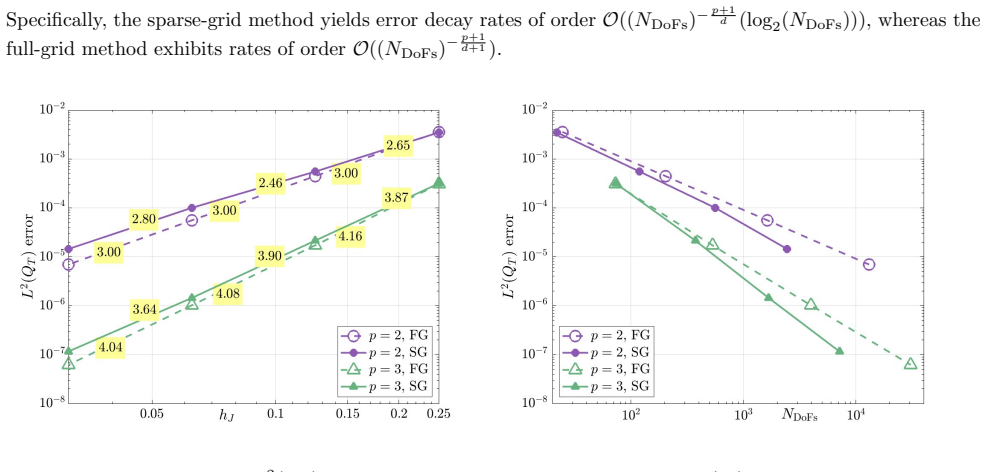
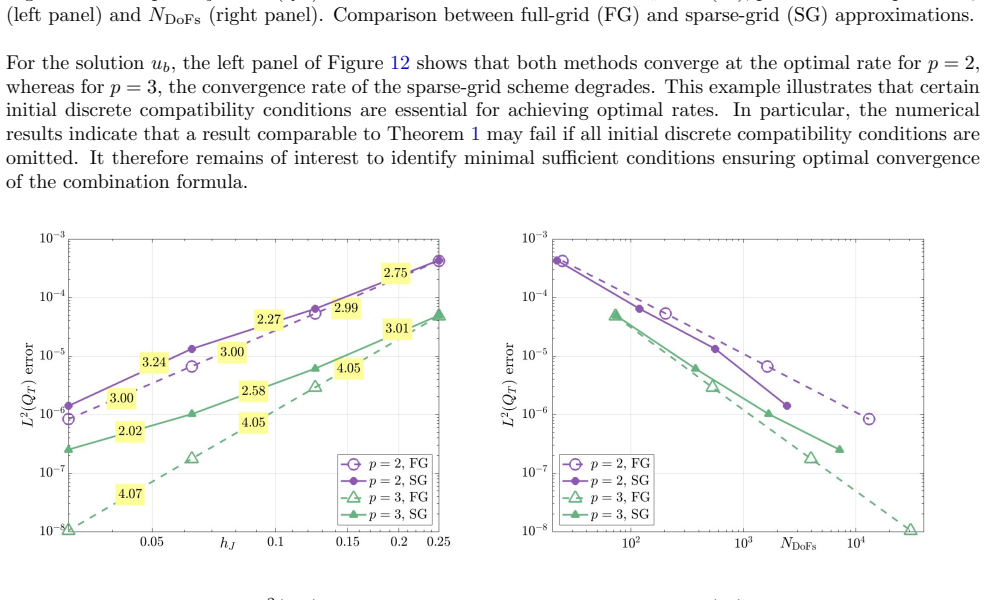
We develop a fast space-time numerical scheme for approximating solutions to the linear wave equation. The approach is based on the sparse-grid combination technique applied to a coercive space-time discretization. Designed for tensor-product space-time discretizations, the method enables efficient parallelization of the resulting solver. We provide a rigorous theoretical analysis establishing convergence rates and computational complexity estimates. Numerical experiments validate the theoretical estimates and demonstrate the efficiency of the proposed method.
Editorial analysis
A structured set of objections, weighed in public.
Referee Report
Summary. The paper develops a fast space-time numerical scheme for the linear wave equation by applying the sparse-grid combination technique to a coercive space-time discretization. It claims rigorous theoretical analysis establishing convergence rates and computational complexity estimates, along with numerical experiments validating the estimates and demonstrating efficiency and parallelization potential.
Significance. If the coercivity of the chosen space-time formulation holds uniformly and the combination technique preserves the rates without additional restrictions, the work would provide a theoretically grounded approach to efficient high-dimensional space-time discretizations for hyperbolic problems, with explicit complexity benefits from sparse grids and parallelization.
major comments (2)
- [Abstract, §2 (discretization), and §3 (analysis)] The central claim depends on the existence of a coercive space-time variational formulation to which the combination technique applies while retaining convergence rates. The manuscript must explicitly identify the bilinear form, the norm, and the proof of coercivity (including uniformity with respect to mesh size, polynomial degree, and time-interval length), as standard space-time Galerkin forms for the second-order wave equation are typically non-coercive.
- [§4] §4 (theoretical results): the stated convergence rates and complexity estimates are derived under the coercivity assumption; if coercivity requires restrictive conditions (e.g., on T or stabilization parameters), the transfer of these estimates to the sparse-grid setting must be re-examined and the restrictions stated explicitly.
minor comments (2)
- [§2] Notation for the space-time tensor-product spaces and the combination technique parameters should be introduced with a single consistent table or diagram for clarity.
- [§5] Numerical experiments section should include a direct comparison of wall-clock times or flop counts against a standard space-time solver on the same hardware to quantify the parallelization benefit.
Simulated Author's Rebuttal
We thank the referee for the careful reading and constructive comments on our manuscript. The emphasis on making the coercivity assumption fully explicit is appreciated, and we address each major comment below. We will revise the manuscript to improve clarity on these points.
read point-by-point responses
-
Referee: [Abstract, §2 (discretization), and §3 (analysis)] The central claim depends on the existence of a coercive space-time variational formulation to which the combination technique applies while retaining convergence rates. The manuscript must explicitly identify the bilinear form, the norm, and the proof of coercivity (including uniformity with respect to mesh size, polynomial degree, and time-interval length), as standard space-time Galerkin forms for the second-order wave equation are typically non-coercive.
Authors: We agree that the coercivity property must be stated with full precision. Section 2 of the manuscript defines the specific coercive space-time variational formulation (a stabilized bilinear form that is coercive in a suitable space-time norm), and Section 3 contains the proof of coercivity (Theorem 3.1) together with the uniformity statement with respect to mesh size, polynomial degree, and time-interval length T. The combination technique is shown to preserve the rates under these conditions. To make the identification more prominent and address the referee's concern directly, we will revise §2 to include a dedicated paragraph that isolates the bilinear form, the norm, and the uniformity result. revision: yes
-
Referee: [§4] §4 (theoretical results): the stated convergence rates and complexity estimates are derived under the coercivity assumption; if coercivity requires restrictive conditions (e.g., on T or stabilization parameters), the transfer of these estimates to the sparse-grid setting must be re-examined and the restrictions stated explicitly.
Authors: The coercivity result in §3 holds uniformly and imposes no restrictions on the final time T or on the stabilization parameters. The constants appearing in the coercivity and continuity estimates are independent of these quantities. Consequently, the convergence rates and complexity bounds derived in §4 transfer directly to the sparse-grid setting without additional conditions. We will add a short clarifying remark in the revised §4 that explicitly records this uniformity. revision: partial
Circularity Check
No significant circularity; derivation self-contained
full rationale
The paper develops a numerical scheme via the sparse-grid combination technique applied to a coercive space-time discretization of the wave equation, followed by convergence analysis and complexity estimates. No quoted steps reduce a claimed result to a fitted parameter, self-definition, or load-bearing self-citation chain. The central claims rest on the stated coercivity assumption and tensor-product structure, which are external to the combination technique itself and do not exhibit the enumerated circular patterns. This is the expected outcome for a theoretical discretization paper whose analysis is independent of its own outputs.
Axiom & Free-Parameter Ledger
Reference graph
Works this paper leans on
-
[1]
Aubin.Applied Functional Analysis
J.-P. Aubin.Applied Functional Analysis. John Wiley & Sons, New York, 1979
1979
-
[2]
Banjai, J
L. Banjai, J. M. Melenk, R. H. Nochetto, E. Ot´ arola, A. J. Salgado, and C. Schwab. Tensor FEM for spectral fractional diffusion.Found. Comput. Math., 19(4):901–962, 2019
2019
-
[3]
Bansal, A
P. Bansal, A. Moiola, I. Perugia, and C. Schwab. Space–time discontinuous Galerkin approximation of acoustic waves with point singularities.IMA J. Numer. Anal., 41(3):1996–2033, 2021
1996
-
[4]
J. Beck, G. Sangalli, and L. Tamellini. A sparse-grid isogeometric solver.Comput. Methods Appl. Mech. Engrg., 335:128–151, 2018
2018
-
[5]
Brezis.Functional Analysis, Sobolev Spaces and Partial Differential Equations
H. Brezis.Functional Analysis, Sobolev Spaces and Partial Differential Equations. Universitext. Springer New York, 2010
2010
-
[6]
Bungartz and M
H.-J. Bungartz and M. Griebel. Sparse grids.Acta Numer., 13:147–269, 2004
2004
-
[7]
Z. Dong, L. Mascotto, and Z. Wang. A priori and a posteriori error estimates of aC 0-in-time method for the wave equation in second order formulation. arXiv.2411.03264, 2026
Pith/arXiv arXiv 2026
-
[8]
Ern and J.-L
A. Ern and J.-L. Guermond.Finite Elements I, volume 72 ofTexts in Applied Mathematics. Springer Cham, 2021
2021
-
[9]
L. C. Evans.Partial differential equations, volume 19. American mathematical society, 1998
1998
-
[10]
Ferrari, S
M. Ferrari, S. Fraschini, G. Loli, and I. Perugia. Unconditionally stable space–time isogeometric discretiza- tion for the wave equation in Hamiltonian formulation.ESAIM: Math. Model. Numer. Anal., 59(5):2447– 2490, 2025
2025
-
[11]
Ferrari and I
M. Ferrari and I. Perugia. Intrinsic unconditional stability in space–time isogeometric approximation of the acoustic wave equation in second-order formulation.Math. Models Methods Appl. Sci., 36(3):561–599, 2026
2026
-
[12]
Ferrari, I
M. Ferrari, I. Perugia, and E. Zampa. Inf-sup stable space–time discretization of the wave equation based on a first-order-in-time variational formulation.J. Sci. Comput., 107:89, 2026
2026
-
[13]
S. G´ omez. Galerkin-type time discretizations for parabolic and hyperbolic problems: stability anda priori error analysis. arXiv:2601.19828, 2026. 28
arXiv 2026
-
[14]
Griebel and H
M. Griebel and H. Harbrecht. On the construction of sparse tensor product spaces.Math. Comp., 82(282):975–994, 2013
2013
-
[15]
Griebel and H
M. Griebel and H. Harbrecht. On the convergence of the combination technique. InSparse Grids and Applications-Munich 2012, pages 55–74. Springer, 2014
2012
-
[16]
Griebel, M
M. Griebel, M. Schneider, and C. Zenger. A combination technique for the solution of sparse grid problems. In R. Beauwens and P. de Groen, editors,Iterative Methods in Linear Algebra, pages 263–281, Amsterdam,
-
[17]
Elsevier North-Holland
-
[18]
Harbrecht, M
H. Harbrecht, M. Peters, and M. Siebenmorgen. Combination technique basedk-th moment analysis of elliptic problems with random diffusion.J. Comput. Phys., 252:128–141, 2013
2013
-
[19]
Harbrecht, C
H. Harbrecht, C. Schwab, and M. Zank. Wavelet compressed, modified Hilbert transform in the space-time discretization of the heat equation.IMA J. Numer. Anal., 45(3):1641–1675, 2025
2025
-
[20]
T. J. R. Hughes and G. M. Hulbert. Space-time finite element methods for elastodynamics: formulations and error estimates.Comput. Methods Appl. Mech. Engrg., 66(3):339–363, 1988
1988
-
[21]
Loli and G
G. Loli and G. Sangalli. Space–time isogeometric analysis: a review with application to wave propagation. SeMA Journal, 82:633–644, 2025
2025
-
[22]
L¨ oscher, O
R. L¨ oscher, O. Steinbach, and M. Zank. Numerical results for an unconditionally stable space-time finite element method for the wave equation. InDomain Decomposition Methods in Science and Engineering XXVI, volume 145 ofLect. Notes Comput. Sci. Eng., pages 625–632. Springer, 2022
2022
-
[23]
R. E. Lynch, J. R. Rice, and D. H. Thomas. Direct solution of partial difference equations by tensor product methods.Numer. Math., 6(1):185–199, 1964
1964
-
[24]
W. C. H. McLean.Strongly elliptic systems and boundary integral equations. Cambridge university press, 2000
2000
-
[25]
Monk and G
P. Monk and G. R. Richter. A discontinuous Galerkin method for linear symmetric hyperbolic systems in inhomogeneous media.J. Sci. Comput., 22/23:443–477, 2005
2005
-
[26]
Reed and B
M. Reed and B. Simon.Methods of Modern Mathematical Physics I: Functional Analysis. Academic Press, San Diego, 1980
1980
-
[27]
Thom´ ee.Galerkin Finite Element Methods for Parabolic Problems, volume 25 ofSpringer Series in Computational Mathematics
V. Thom´ ee.Galerkin Finite Element Methods for Parabolic Problems, volume 25 ofSpringer Series in Computational Mathematics. Springer-Verlag, Berlin, Heidelberg, second edition, 2006
2006
-
[28]
N. J. Walkington. Combined DG–CG time stepping for wave equations.SIAM J. Numer. Anal., 52(3):1398– 1417, 2014
2014
-
[29]
M. Zank. Efficient direct space-time finite element solvers for the wave equation in second-order formulation. J. Sci. Comput., 105(1), 2025. 29
2025
discussion (0)
Sign in with ORCID, Apple, or X to comment. Anyone can read and Pith papers without signing in.