Partial Pressure Contributions of Hadron Families to the QCD Equation of State
Pith reviewed 2026-06-27 15:52 UTC · model grok-4.3
The pith
Linear combinations of up to fourth-order susceptibilities isolate the pressure contributions of hadrons grouped by baryon number, charge and strangeness.
A machine-rendered reading of the paper's core claim, the machinery that carries it, and where it could break.
Core claim
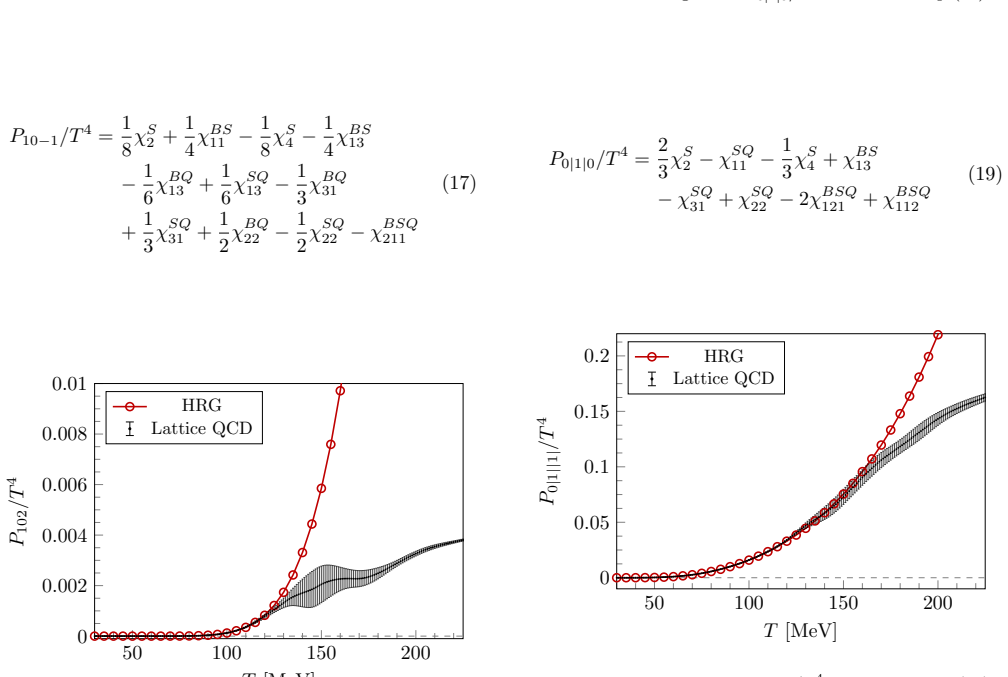
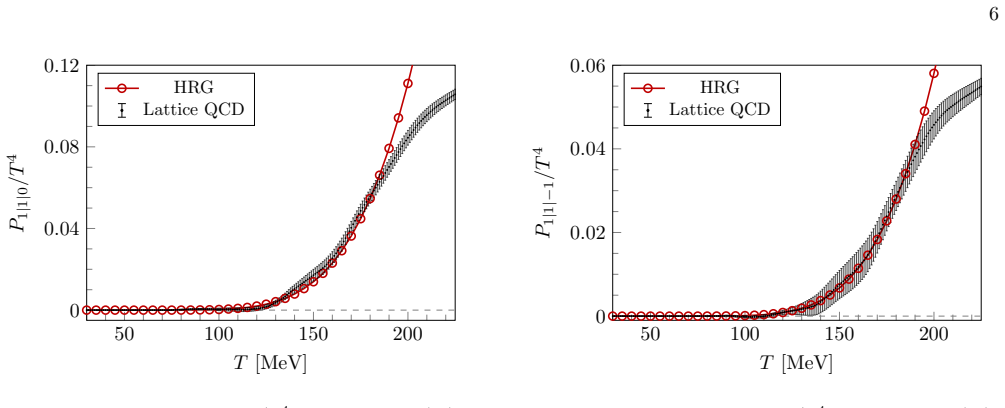
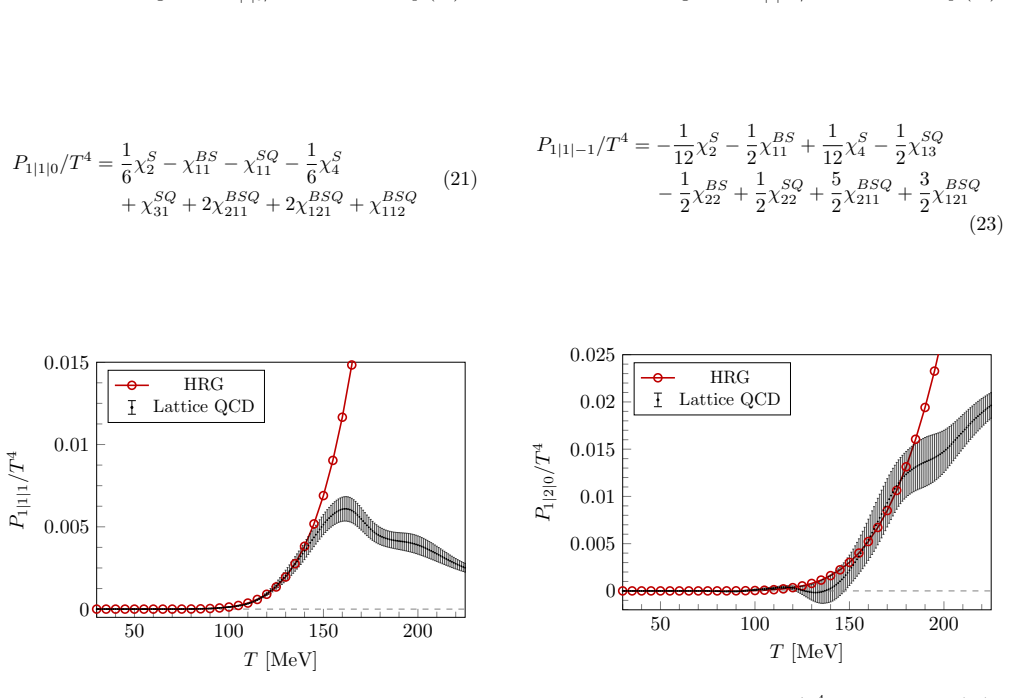
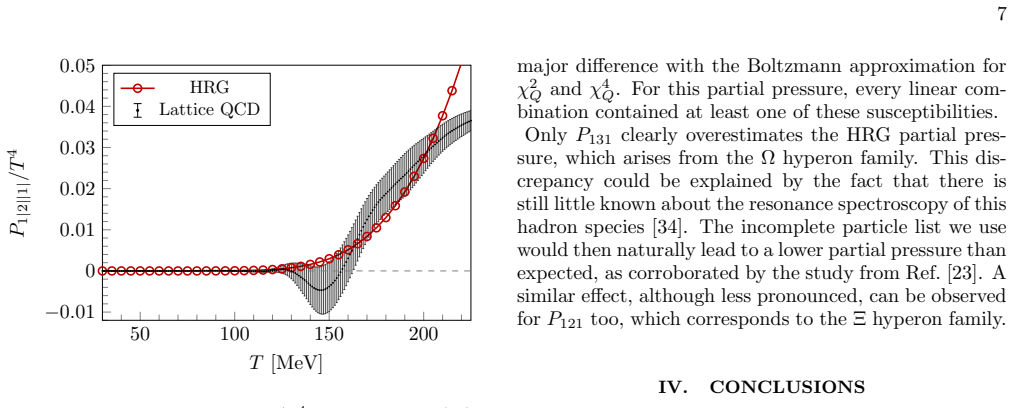
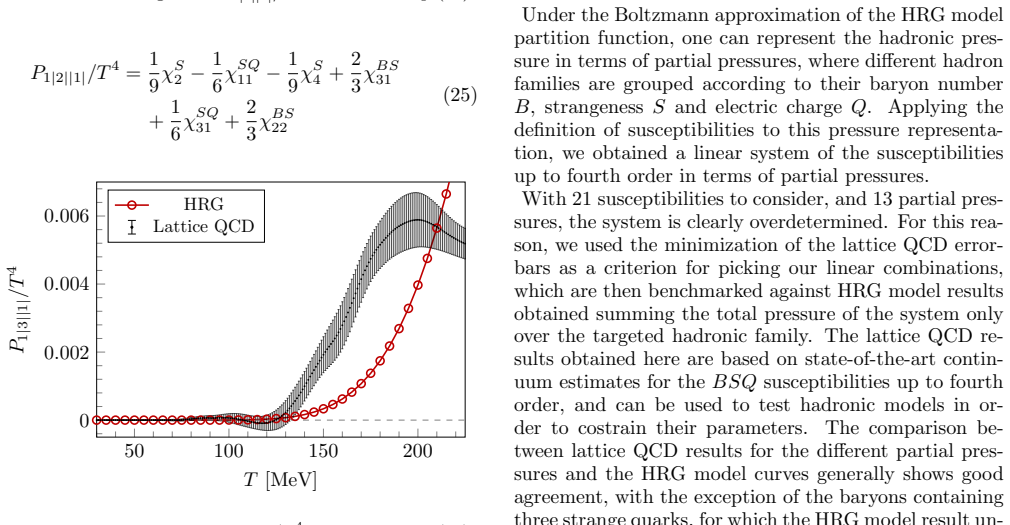
We find linear combinations of up to fourth order susceptibilities which isolate the contribution of hadrons to the QCD pressure according to their baryon number B, electric charge Q and strangeness S content. These combinations are valid, provided that the thermodynamics of a strongly-interacting gas in the low-temperature regime can be modeled as a gas of non-interacting hadrons and their resonances. Finally, we test the validity of these linear combinations in the Hadron Resonance Gas model and compare them to available lattice QCD results, using continuum-estimated susceptibilities.
What carries the argument
Linear combinations of susceptibilities (derivatives of pressure with respect to chemical potentials) that project onto fixed (B, Q, S) sectors of the hadron spectrum.
If this is right
- The total QCD pressure below the transition temperature decomposes into additive contributions from distinct hadron families.
- Each family’s pressure can be extracted directly from lattice susceptibilities without additional modeling beyond the stated assumption.
- The method supplies a quantitative test of whether the Hadron Resonance Gas description matches lattice results family by family.
- Fourth-order susceptibilities suffice to isolate all combinations of B, Q and S that occur for known hadrons.
- The combinations remain valid at finite but moderate baryon chemical potential as long as the non-interacting resonance gas assumption holds.
Where Pith is reading between the lines
- The same combinations could be used to track how the relative weight of different families changes as temperature approaches the crossover from below.
- If lattice data at higher orders become available, the method could isolate finer groupings or test the assumption at larger chemical potentials.
- The decomposition might help interpret fluctuations measured in heavy-ion collisions by linking them to specific quantum-number sectors.
- Extensions that include repulsive interactions or excluded-volume corrections could be tested by seeing whether the combinations still recover the input partial pressures inside modified HRG implementations.
Load-bearing premise
The low-temperature regime of QCD can be described as a non-interacting gas of hadrons and resonances.
What would settle it
If the same linear combinations, when evaluated on lattice susceptibilities, fail to reproduce the partial pressures predicted by the Hadron Resonance Gas model for the corresponding (B, Q, S) groups, the isolation method does not hold.
Figures
read the original abstract
Lattice simulations provide the thermodynamics of quantum chromodynamics (QCD) as a function of the temperature, at zero-to-moderate values of the baryonic chemical potential. However, the contribution of single hadronic species cannot be directly isolated from lattice calculations. In this work, we find linear combinations of up to fourth order susceptibilities which isolate the contribution of hadrons to the QCD pressure according to their baryon number $B$, electric charge $Q$ and strangeness $S$ content. These combinations are valid, provided that the thermodynamics of a strongly-interacting gas in the low-temperature regime can be modeled as a gas of non-interacting hadrons and their resonances. Finally, we test the validity of these linear combinations in the Hadron Resonance Gas (HRG) model and compare them to available lattice QCD results, using continuum-estimated susceptibilities.
Editorial analysis
A structured set of objections, weighed in public.
Referee Report
Summary. The paper derives linear combinations of up to fourth-order susceptibilities in baryon number B, electric charge Q and strangeness S that isolate the partial pressure contributions of specific hadron families (classified by their (B,Q,S) content) to the QCD equation of state. These combinations are obtained algebraically from the definitions of the susceptibilities and are stated to be valid under the assumption that low-temperature QCD thermodynamics is described by a non-interacting Hadron Resonance Gas (HRG). The combinations are tested inside the HRG model and compared to continuum-estimated lattice QCD susceptibilities.
Significance. If the derivations hold, the result supplies a parameter-free algebraic tool to extract family-specific pressure contributions directly from lattice susceptibilities, without additional fitting. This is useful for quantifying the hadronic content of the QCD pressure in the confined phase and for testing the range of validity of the HRG description against first-principles data. The absence of free parameters and the direct use of moment relations among susceptibilities are explicit strengths.
major comments (2)
- [§2] §2 (Derivation of the linear combinations): the manuscript states that the combinations are found from the susceptibility definitions but does not display the explicit system of equations or the algebraic steps (e.g., matrix inversion or successive elimination) used to obtain the coefficients for any of the (B,Q,S) families. This step is load-bearing for the central claim that the combinations isolate the partial pressures.
- [§4, Fig. 3] §4 and Fig. 3: the comparison between the HRG-evaluated combinations and lattice susceptibilities reports qualitative agreement but does not quantify the size of deviations (e.g., relative difference or χ² per degree of freedom) as a function of temperature, which is needed to assess the temperature range where the HRG assumption remains reliable.
minor comments (3)
- [Abstract, §1] The abstract and §1 use the phrase “hadron families” without an explicit definition or table listing which species belong to each (B,Q,S) bin; a short table would improve clarity.
- [§2] Notation for the susceptibilities (e.g., χ_{BQS}^{ijk}) is introduced without a dedicated paragraph recalling the standard definition χ_{ijk} = ∂^{i+j+k} (P/T^4) / (∂(μ_B/T)^i ∂(μ_Q/T)^j ∂(μ_S/T)^k); a one-sentence reminder would help readers.
- [Table 1] Table 1 lists the numerical coefficients but does not indicate the source of the rounding (exact fractions or floating-point); stating whether the coefficients are exact would remove ambiguity.
Simulated Author's Rebuttal
We thank the referee for the positive assessment of our work and for the constructive major comments. We address each point below and will revise the manuscript accordingly to improve clarity and rigor.
read point-by-point responses
-
Referee: [§2] §2 (Derivation of the linear combinations): the manuscript states that the combinations are found from the susceptibility definitions but does not display the explicit system of equations or the algebraic steps (e.g., matrix inversion or successive elimination) used to obtain the coefficients for any of the (B,Q,S) families. This step is load-bearing for the central claim that the combinations isolate the partial pressures.
Authors: We agree that including the explicit algebraic derivation would enhance the transparency of the central result. In the revised manuscript, we will expand Section 2 to present the full system of equations relating the susceptibilities to the partial pressures for each (B,Q,S) family, along with the steps for solving the linear system (via successive elimination or matrix inversion as appropriate). This will directly demonstrate how the coefficients are obtained from the definitions. revision: yes
-
Referee: [§4, Fig. 3] §4 and Fig. 3: the comparison between the HRG-evaluated combinations and lattice susceptibilities reports qualitative agreement but does not quantify the size of deviations (e.g., relative difference or χ² per degree of freedom) as a function of temperature, which is needed to assess the temperature range where the HRG assumption remains reliable.
Authors: We concur that a quantitative assessment of the deviations is important for determining the validity range of the HRG model. In the revised version, we will augment Section 4 and Figure 3 (or add a new figure) with quantitative measures, such as the relative difference between the HRG combinations and lattice data as a function of temperature, and possibly a χ² analysis where appropriate. This will provide a clearer indication of the temperature range over which the agreement holds. revision: yes
Circularity Check
No significant circularity identified
full rationale
The paper derives linear combinations of susceptibilities (up to fourth order) algebraically from their definitions as derivatives of the pressure with respect to chemical potentials (B, Q, S). These combinations isolate partial pressures for hadron families under the explicit non-interacting HRG assumption, which is stated as a condition rather than derived or fitted. Validation consists of direct computation inside the HRG model plus comparison to independent lattice QCD data; no parameter fitting, self-referential prediction, or load-bearing self-citation chain is present. The central result is a direct consequence of the moment relations in the assumed model and does not reduce to its own inputs by construction.
Axiom & Free-Parameter Ledger
axioms (1)
- domain assumption thermodynamics of a strongly-interacting gas in the low-temperature regime can be modeled as a gas of non-interacting hadrons and their resonances
Forward citations
Cited by 1 Pith paper
-
Studying the QCD Matter produced in Heavy-Ion Collisions using the MUSES Calculation Engine
The MUSES Calliope engine computes multi-dimensional QCD equations of state, merges them consistently, and feeds them into viscous hydrodynamic simulations of heavy-ion collisions with movable critical points and crit...
Reference graph
Works this paper leans on
-
[1]
Ratti, Prog
C. Ratti, Prog. Part. Nucl. Phys.129, 104007 (2023)
2023
-
[2]
Lattice QCD and heavy ion collisions: a review of recent progress
C. Ratti, Rept. Prog. Phys.81, 084301 (2018), arXiv:1804.07810 [hep-lat]
work page internal anchor Pith review Pith/arXiv arXiv 2018
- [3]
- [4]
-
[5]
A. Sorensen et al., Prog. Part. Nucl. Phys.134, 104080 (2024), arXiv:2301.13253 [nucl-th]
-
[6]
M. M. Aggarwal et al. (STAR), (2010), arXiv:1007.2613 [nucl-ex]
work page internal anchor Pith review Pith/arXiv arXiv 2010
-
[7]
S. Acharya et al. (ALICE), Eur. Phys. J. C84, 813 (2024), arXiv:2211.04384 [nucl-ex]
-
[8]
B. P. Abbott et al. (LIGO Scientific, Virgo), Phys. Rev. Lett.121, 161101 (2018), arXiv:1805.11581 [gr-qc]
work page internal anchor Pith review Pith/arXiv arXiv 2018
- [9]
-
[10]
Gravitational-wave constraints on the neutron-star-matter Equation of State
E. Annala, T. Gorda, A. Kurkela, and A. Vuorinen, Phys. Rev. Lett.120, 172703 (2018), arXiv:1711.02644 [astro-ph.HE]
work page internal anchor Pith review Pith/arXiv arXiv 2018
-
[11]
Y. Aoki, G. Endrodi, Z. Fodor, S. D. Katz, and K. K. Szabo, Nature443, 675 (2006), arXiv:hep-lat/0611014
work page internal anchor Pith review Pith/arXiv arXiv 2006
-
[12]
C. S. Fischer, Phys. Rev. Lett.103, 052003 (2009), arXiv:0904.2700 [hep-ph]
work page internal anchor Pith review Pith/arXiv arXiv 2009
-
[13]
K. G. Wilson, Phys. Rev. D10, 2445 (1974)
1974
-
[14]
J. B. Kogut and L. Susskind, Phys. Rev. D11, 395 (1975)
1975
-
[15]
Susskind, Phys
L. Susskind, Phys. Rev. D16, 3031 (1977)
1977
-
[16]
Hagedorn, Nuovo Cim
R. Hagedorn, Nuovo Cim. Suppl.3, 147 (1965)
1965
-
[17]
J. I. Kapusta and K. A. Olive, Nucl. Phys. A408, 478 (1983)
1983
-
[18]
M. I. Gorenstein, V. K. Petrov, and G. M. Zinovev, Phys. Lett. B106, 327 (1981)
1981
-
[19]
F. Karsch, Lect. Notes Phys.583, 209 (2002), arXiv:hep- lat/0106019
-
[20]
The QCD phase diagram for small densities from imaginary chemical potential
P. de Forcrand and O. Philipsen, Nucl. Phys. B642, 290 (2002), arXiv:hep-lat/0205016
work page internal anchor Pith review Pith/arXiv arXiv 2002
-
[21]
Finite density QCD via imaginary chemical potential
M. D’Elia and M.-P. Lombardo, Phys. Rev. D67, 014505 (2003), arXiv:hep-lat/0209146
work page internal anchor Pith review Pith/arXiv arXiv 2003
-
[22]
Strangeness at high temperatures: from hadrons to quarks
A. Bazavov et al., Phys. Rev. Lett.111, 082301 (2013), arXiv:1304.7220 [hep-lat]
work page internal anchor Pith review Pith/arXiv arXiv 2013
-
[23]
Constraining the hadronic spectrum through QCD thermodynamics on the lattice
P. Alba et al., Phys. Rev. D96, 034517 (2017), arXiv:1702.01113 [hep-lat]
work page internal anchor Pith review Pith/arXiv arXiv 2017
- [24]
-
[25]
Continuum-estimated lattice susceptibilites of order 2 and 4,
J. Jahan and P. Parotto, “Continuum-estimated lattice susceptibilites of order 2 and 4,” (2025)
2025
-
[26]
Partial pressures module,
J. Jahan, J. Gonzalez, and A. R. Nava Acu˜ na, “Partial pressures module,” (2026)
2026
-
[27]
MUSES Calculation Engine,
T. A. Manning, “MUSES Calculation Engine,” (2025)
2025
-
[28]
Cabibbo and G
N. Cabibbo and G. Parisi, Physics Letters B59, 67 (1975)
1975
-
[29]
Navas et al
S. Navas et al. (Particle Data Group), Phys. Rev. D110, 030001 (2024)
2024
-
[30]
Hadron Resonance Gas Equation of State from Lattice QCD
V. Vovchenko, D. V. Anchishkin, and M. I. Gorenstein, Phys. Rev. C91, 024905 (2015), arXiv:1412.5478 [nucl- th]
work page internal anchor Pith review Pith/arXiv arXiv 2015
-
[31]
Kaon fluctuations from lattice QCD
J. Noronha-Hostler, R. Bellwied, J. Gunther, P. Parotto, A. Pasztor, I. Portillo Vazquez, and C. Ratti, (arXiv:1607.02527, 2016), arXiv:1607.02527 [hep-ph]
work page internal anchor Pith review Pith/arXiv arXiv 2016
-
[32]
Fluctuations and correlations in high temperature QCD
R. Bellwied, S. Borsanyi, Z. Fodor, S. D. Katz, A. Pasz- tor, C. Ratti, and K. K. Szabo, Phys. Rev. D92, 114505 (2015), arXiv:1507.04627 [hep-lat]
work page internal anchor Pith review Pith/arXiv arXiv 2015
- [33]
-
[34]
V. Crede and J. Yelton, Rept. Prog. Phys.87, 106301 (2024), arXiv:2502.08815 [hep-ex]
discussion (0)
Sign in with ORCID, Apple, or X to comment. Anyone can read and Pith papers without signing in.