Topological Neural Operators
Pith reviewed 2026-06-27 17:15 UTC · model grok-4.3
The pith
Topological Neural Operators lift neural operators to cell complexes by using fixed Discrete Exterior Calculus to control cross-dimensional flows while learning only the transformations.
A machine-rendered reading of the paper's core claim, the machinery that carries it, and where it could break.
Core claim
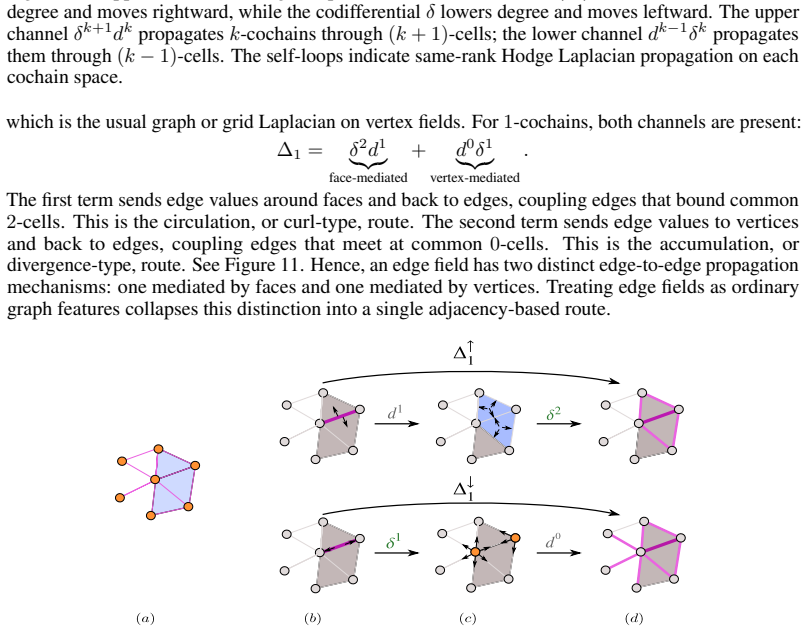
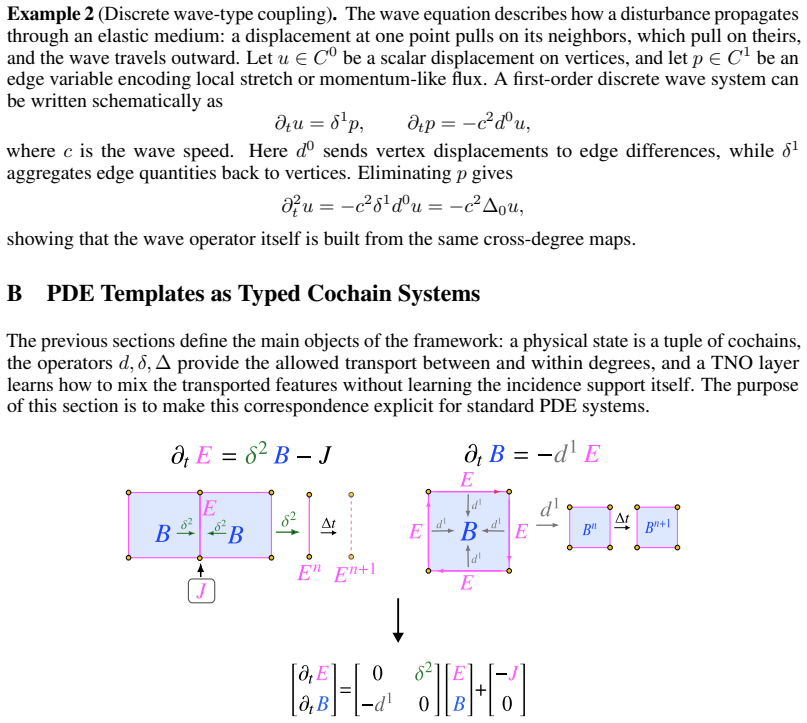
TNOs represent data as features defined on cells of varying dimension and model their interactions through Discrete Exterior Calculus, enabling explicit cross-dimensional coupling via gradient-, curl-, and divergence-type operators. The key design principle is to decouple where information flows, as governed by fixed topological operators, from how it is transformed, which is learned, yielding models that respect the geometric support of physical quantities and expose conservation and compatibility structure. HTNOs incorporate learned coarse complexes to propagate long-range and topology-dependent information.
What carries the argument
Discrete Exterior Calculus operators on cell complexes that fix the locations and directions of information flow between dimensions while separate learned modules handle the actual transformations.
If this is right
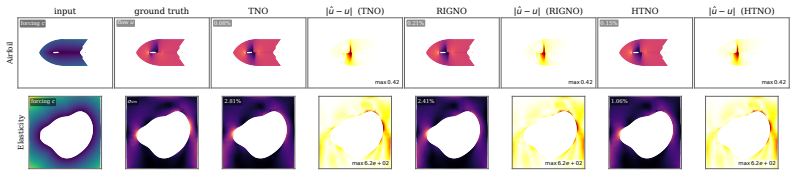
- TNOs and HTNOs improve accuracy over prior neural operators on PDE benchmarks that include irregular-geometry flows.
- Existing neural operators appear as special cases inside the TNO framework.
- The models make conservation and compatibility relations visible through the fixed topological operators.
- Hierarchical coarse complexes allow propagation of long-range topological information without changing the base discretization.
Where Pith is reading between the lines
- The same decoupling of fixed topology from learned maps could be tested on other structured data such as simplicial meshes or higher-order graphs.
- If the fixed operators preserve key invariants, TNOs may reduce the need for explicit physics-informed loss terms on conservation problems.
- Learned coarse complexes in HTNOs suggest a route to multi-scale operator learning that adapts topology rather than only resolution.
Load-bearing premise
Fixed Discrete Exterior Calculus operators on cell complexes can govern information flow without needing learned adjustments to the topology or losing critical domain-specific interactions.
What would settle it
A controlled ablation on an irregular-geometry flow benchmark in which a version of TNO that replaces the fixed topological operators with fully learned adjacency or message-passing edges outperforms the original TNO on conservation-sensitive metrics would falsify the central design claim.
Figures









read the original abstract
We introduce Topological Neural Operators (TNOs), a principled framework for operator learning on cell complexes that lifts neural operators (NOs) from functions on points and/or edges to topological domains. TNOs represent data as features defined on cells of varying dimension and model their interactions through Discrete Exterior Calculus, enabling explicit cross-dimensional coupling via gradient-, curl-, and divergence-type operators. The key design principle is to decouple where information flows, as governed by fixed topological operators, from how it is transformed (which is learned), yielding models that respect the geometric support of physical quantities and expose conservation and compatibility structure. We further propose Hierarchical TNOs (HTNOs), which incorporate learned coarse complexes to propagate long-range and topology-dependent information. Our framework subsumes existing NOs as a special case, providing a unified perspective on operator learning across discretizations. Across a range of PDE benchmarks, including irregular-geometry flow problems, TNOs and HTNOs improve accuracy; controlled studies further isolate the benefits of native higher-rank and topological structure. Project page: https://circle-group.github.io/research/TNO
Editorial analysis
A structured set of objections, weighed in public.
Referee Report
Summary. The paper introduces Topological Neural Operators (TNOs) as a framework for operator learning on cell complexes, representing data as features on cells of varying dimension and modeling interactions via fixed Discrete Exterior Calculus operators (gradient, curl, divergence) to enable explicit cross-dimensional coupling. It further proposes Hierarchical TNOs (HTNOs) incorporating learned coarse complexes for long-range propagation. The central claims are that this decouples flow location (fixed topology) from learned transformations, subsumes existing neural operators as a special case, and yields accuracy improvements on PDE benchmarks including irregular-geometry flows, with controlled studies isolating benefits of higher-rank and topological structure.
Significance. If the results and subsumption hold, the work provides a principled unification of neural operator methods under topological and geometric structure, with potential to improve physical fidelity through explicit conservation and compatibility properties. The design principle and controlled studies isolating topological contributions are notable strengths that could influence architecture design in operator learning.
major comments (2)
- [Abstract] Abstract: the subsumption claim that TNOs provide a unified perspective by reducing existing NOs to special cases is load-bearing for the unified-view contribution, yet the abstract provides no explicit conditions, restriction, or proposition showing how (for example) standard graph or Fourier neural operators emerge when restricted to 0- or 1-cells; this requires a dedicated statement or theorem in the main text.
- [Abstract] Abstract (key design principle paragraph): the assertion that fixed DEC operators on cell complexes govern information flow without learned topology adjustments is central to the accuracy claims on irregular geometries, but the manuscript must specify how cell complexes are constructed and validated to preserve domain-specific couplings across the tested discretizations; without this, gains could stem from implementation details rather than the decoupling.
minor comments (2)
- The abstract is information-dense; splitting the description of the design principle and the subsumption claim into separate sentences would improve readability.
- Project page is referenced but no details on code or data availability are given in the abstract; the manuscript should include a reproducibility statement.
Simulated Author's Rebuttal
We thank the referee for their thoughtful and constructive comments, which help clarify the presentation of our contributions. We address each major comment below and commit to revisions that strengthen the manuscript without altering its core claims.
read point-by-point responses
-
Referee: [Abstract] Abstract: the subsumption claim that TNOs provide a unified perspective by reducing existing NOs to special cases is load-bearing for the unified-view contribution, yet the abstract provides no explicit conditions, restriction, or proposition showing how (for example) standard graph or Fourier neural operators emerge when restricted to 0- or 1-cells; this requires a dedicated statement or theorem in the main text.
Authors: We agree that the subsumption claim requires explicit support to be load-bearing. The current manuscript states the claim in the abstract and introduction but does not include a formal proposition. In the revision we will add a dedicated theorem (or proposition) in the main text (likely in Section 3 or 4) that specifies the precise restrictions on the cell complex, feature spaces, and DEC operators under which standard graph neural operators (0-cells only) and Fourier neural operators emerge as special cases. This will include the necessary conditions on the topology and the reduction of the cross-dimensional coupling terms. revision: yes
-
Referee: [Abstract] Abstract (key design principle paragraph): the assertion that fixed DEC operators on cell complexes govern information flow without learned topology adjustments is central to the accuracy claims on irregular geometries, but the manuscript must specify how cell complexes are constructed and validated to preserve domain-specific couplings across the tested discretizations; without this, gains could stem from implementation details rather than the decoupling.
Authors: We acknowledge the need for greater transparency on cell-complex construction. The manuscript already describes the use of fixed DEC operators, but the construction details for each benchmark are distributed across the experimental section. In the revision we will consolidate and expand a dedicated subsection (e.g., in Section 5 or an appendix) that explicitly states, for every PDE benchmark, (i) how the cell complex is generated from the given geometry, (ii) the validation steps performed to confirm that the discrete operators preserve the expected couplings (e.g., discrete Stokes theorem checks, conservation of divergence-free fields), and (iii) that these steps are identical across compared models. This will make clear that the reported gains arise from the topological decoupling rather than ad-hoc implementation choices. revision: yes
Circularity Check
No significant circularity in claimed derivation
full rationale
The provided abstract and description present TNOs/HTNOs as a modeling framework that applies fixed DEC operators on cell complexes to decouple flow location from learned transformations, with the claim that this subsumes prior neural operators as a special case. No equations, fitted parameters, or self-citations are quoted that reduce any central prediction or uniqueness result to the inputs by construction. The design choices are stated as principles rather than derived outputs, and the accuracy improvements are positioned as empirical outcomes on benchmarks. This qualifies as a self-contained proposal without load-bearing circular steps.
Axiom & Free-Parameter Ledger
axioms (1)
- domain assumption Data on cell complexes can be represented as features on cells of varying dimension whose interactions are governed by fixed topological operators from Discrete Exterior Calculus.
invented entities (2)
-
Topological Neural Operators (TNOs)
no independent evidence
-
Hierarchical TNOs (HTNOs)
no independent evidence
Forward citations
Cited by 1 Pith paper
-
Collapsed Effective Operators for Higher-order Structures
Collapsed Effective Operators use Schur complement on graded Laplacians to create vertex-level operators that encode higher-order topology, preserve PSD, and improve spectral clustering and smoothing.
Reference graph
Works this paper leans on
-
[1]
Universal physics transformers: A framework for efficiently scaling neural operators
Benedikt Alkin, Andreas Fürst, Simon Schmid, Lukas Gruber, Markus Holzleitner, and Johannes Brandstetter. Universal physics transformers: A framework for efficiently scaling neural operators. InAdv. Neural Inform. Process. Syst., 2024
2024
-
[2]
Benedikt Alkin, Maurits Bleeker, Richard Kurle, Tobias Kronlachner, Reinhard Sonnleitner, Matthias Dorfer, and Johannes Brandstetter. AB-UPT: Scaling neural CFD surrogates for high-fidelity automotive aerodynamics simulations via anchored-branched universal physics transformers.Trans. Mach. Lear. Resea., 2025. arXiv:2502.09692
arXiv 2025
-
[3]
Douglas N. Arnold.Finite Element Exterior Calculus, volume 93 ofCBMS-NSF Regional Conference Series in Applied Mathematics. Society for Industrial and Applied Mathematics, Philadelphia, PA, 2018. doi: 10.1137/1.9781611975543. 10
-
[4]
Arnold, Richard S
Douglas N. Arnold, Richard S. Falk, and Ragnar Winther. Multigrid in H(div) and H(curl). Numerische Mathematik, 85(2):197–217, 2000
2000
-
[5]
Arnold, Richard S
Douglas N. Arnold, Richard S. Falk, and Ragnar Winther. Finite element exterior calculus, homological techniques, and applications.Acta Numerica, 15:1–155, 2006
2006
-
[6]
Arnold, Richard S
Douglas N. Arnold, Richard S. Falk, and Ragnar Winther. Finite element exterior calculus: from Hodge theory to numerical stability.Bulletin of the American Mathematical Society, 47 (2):281–354, 2010
2010
-
[7]
Michael Aschbacher. Combinatorial cell complexes. InProgress in Algebraic Combinatorics, volume 24 ofAdvanced Studies in Pure Mathematics, pages 1–80. Mathematical Society of Japan, 1996. doi: 10.2969/aspm/02410001
-
[8]
Neural operators for accelerating scientific simulations and design
Kamyar Azizzadenesheli, Nikola Kovachki, Zongyi Li, Miguel Liu-Schiaffini, Jean Kossaifi, and Anima Anandkumar. Neural operators for accelerating scientific simulations and design. Nature Reviews Physics, 6(5):320–328, 2024
2024
-
[9]
Baratta, Joseph P
Igor A. Baratta, Joseph P. Dean, Jørgen S. Dokken, Michal Habera, Jack S. Hale, Chris N. Richardson, Marie E. Rognes, Matthew W. Scroggs, Nathan Sime, and Garth N. Wells. DOLFINx: The next generation FEniCS problem solving environment. Zenodo, 2023
2023
-
[10]
Combinatorial cell complexes and poincaré duality.Geometriae Dedicata, 147(1):357–387, 2010
Tathagata Basak. Combinatorial cell complexes and poincaré duality.Geometriae Dedicata, 147(1):357–387, 2010
2010
-
[11]
Nathan Bell and Anil N. Hirani. PyDEC: Software and algorithms for discretization of exterior calculus.ACM Transactions on Mathematical Software, 39(1):3:1–3:41, 2012. doi: 10.1145/ 2382585.2382588
arXiv 2012
-
[12]
Model reduction and neural networks for parametric PDEs.The SMAI Journal of Computational Mathematics, 7:121–157, 2021
Kaushik Bhattacharya, Bamdad Hosseini, Nikola B Kovachki, and Andrew M Stuart. Model reduction and neural networks for parametric PDEs.The SMAI Journal of Computational Mathematics, 7:121–157, 2021
2021
-
[13]
The topological Dirac equation of networks and simplicial complexes
Ginestra Bianconi. The topological Dirac equation of networks and simplicial complexes. Journal of Physics: Complexity, 2(3):035022, 2021
2021
-
[14]
Weisfeiler and lehman go cellular: CW networks
Cristian Bodnar, Fabrizio Frasca, Nina Otter, Yuguang Wang, Pietro Liò, Guido Montúfar, and Michael Bronstein. Weisfeiler and lehman go cellular: CW networks. InAdv. Neural Inform. Process. Syst., 2021
2021
-
[15]
Weisfeiler and lehman go topological: Message passing simplicial networks
Cristian Bodnar, Fabrizio Frasca, Yuguang Wang, Nina Otter, Guido Montúfar, Pietro Liò, and Michael Bronstein. Weisfeiler and lehman go topological: Message passing simplicial networks. InInt. Conf. Mach. Lear., 2021
2021
-
[16]
Neural sheaf diffusion: A topological perspective on heterophily and oversmoothing in gnns.Advances in Neural Information Processing Systems, 35:18527–18541, 2022
Cristian Bodnar, Francesco Di Giovanni, Benjamin Chamberlain, Pietro Lio, and Michael Bronstein. Neural sheaf diffusion: A topological perspective on heterophily and oversmoothing in gnns.Advances in Neural Information Processing Systems, 35:18527–18541, 2022
2022
-
[17]
Alain Bossavit. Whitney forms: A class of finite elements for three-dimensional computations in electromagnetism.IEE Proceedings A (Physical Science, Measurement and Instrumentation, Management and Education, Reviews), 135(8):493–500, 1988
1988
-
[18]
Academic Press, 1998
Alain Bossavit.Computational Electromagnetism: Variational Formulations, Complementarity, Edge Elements. Academic Press, 1998
1998
-
[19]
A mathematical guide to operator learning
Nicolas Boullé and Alex Townsend. A mathematical guide to operator learning. InHandbook of Numerical Analysis, volume 25, pages 83–125. Elsevier, 2024
2024
-
[20]
JAX: composable transformations of Python+NumPy programs, 2018
James Bradbury, Roy Frostig, Peter Hawkins, Matthew James Johnson, Chris Leary, Dougal Maclaurin, George Necula, Adam Paszke, Jake VanderPlas, Skye Wanderman-Milne, and Qiao Zhang. JAX: composable transformations of Python+NumPy programs, 2018. URL http://github.com/jax-ml/jax. 11
2018
-
[21]
Bramble, Joseph E
James H. Bramble, Joseph E. Pasciak, and Jinchao Xu. The analysis of multigrid algorithms with nonnested spaces or noninherited quadratic forms.Mathematics of Computation, 56(193): 1–34, 1991
1991
-
[22]
Briggs, Van Emden Henson, and Steve F
William L. Briggs, Van Emden Henson, and Steve F. McCormick.A Multigrid Tutorial. SIAM, Philadelphia, second edition, 2000. doi: 10.1137/1.9780898719505
-
[23]
Hamlet: Graph transformer neural operator for partial differential equations
Andrey Bryutkin, Jiahao Huang, Zhongying Deng, Guang Yang, Carola-Bibiane Schönlieb, and Angelica I Aviles-Rivero. Hamlet: Graph transformer neural operator for partial differential equations. InInternational Conference on Machine Learning, pages 4624–4641. PMLR, 2024
2024
-
[24]
WiFi Sensing for Outdoor Surveillance,
Lucille Calmon, Michael T. Schaub, and Ginestra Bianconi. Higher-order signal processing with the Dirac operator. In56th Asilomar Conference on Signals, Systems, and Computers, pages 925–929. IEEE, 2022. doi: 10.1109/IEEECONF56349.2022.10052062
-
[25]
Continuum attention for neural operators.Journal of Machine Learning Research, 26(300):1–52, 2025
Edoardo Calvello, Nikola B Kovachki, Matthew E Levine, and Andrew M Stuart. Continuum attention for neural operators.Journal of Machine Learning Research, 26(300):1–52, 2025
2025
-
[26]
Learning neural operators on riemannian manifolds.National Science Open, 3(6):20240001, 2024
Gengxiang Chen, Xu Liu, Qinglu Meng, Lu Chen, Changqing Liu, and Yingguang Li. Learning neural operators on riemannian manifolds.National Science Open, 3(6):20240001, 2024
2024
-
[27]
Equivariant neural operator learning with graphon convolution
Chaoran Cheng and Jian Peng. Equivariant neural operator learning with graphon convolution. InProceedings of the 37th International Conference on Neural Information Processing Systems, pages 61960–61984, 2023
2023
-
[28]
Pengcheng Cheng. Gauge-equivariant intrinsic neural operators for geometry-consistent learning of elliptic pde maps.arXiv preprint arXiv:2603.14734, 2026
arXiv 2026
-
[29]
Jae Choi, Yuzhou Chen, Huikyo Lee, Hyun Kim, and Yulia R. Gel. SNN-PDE: Learning dynamic PDEs from data with simplicial neural networks. InAAAI, pages 11561–11569, 2024
2024
-
[30]
Discrete differential geometry: An applied introduction
Keenan Crane. Discrete differential geometry: An applied introduction. https://www.cs. cmu.edu/~kmcrane/Projects/DDG/paper.pdf, 2018. Lecture notes, Carnegie Mellon University
2018
-
[31]
Digital geometry processing with discrete exterior calculus
Keenan Crane, Fernando de Goes, Mathieu Desbrun, and Peter Schröder. Digital geometry processing with discrete exterior calculus. InACM SIGGRAPH 2013 Courses, pages 1–126. 2013
2013
-
[32]
Discrete exterior calculus.arXiv preprint math/0508341, 2005
Mathieu Desbrun, Anil N Hirani, Melvin Leok, and Jerrold E Marsden. Discrete exterior calculus.arXiv preprint math/0508341, 2005
Pith/arXiv arXiv 2005
-
[33]
Discrete differential forms for computational modeling
Mathieu Desbrun, Eva Kanso, and Yiying Tong. Discrete differential forms for computational modeling. InACM SIGGRAPH 2006 Courses, pages 39–54. 2006
2006
-
[34]
Stable, circulation- preserving, simplicial fluids.ACM Transactions on Graphics, 26(1):4, 2007
Sharif Elcott, Yiying Tong, Eva Kanso, Peter Schröder, and Mathieu Desbrun. Stable, circulation- preserving, simplicial fluids.ACM Transactions on Graphics, 26(1):4, 2007. doi: 10.1145/ 1189762.1189766
arXiv 2007
-
[35]
Physics-informed deep neural operator networks
Somdatta Goswami, Aniruddha Bora, Yue Yu, and George Em Karniadakis. Physics-informed deep neural operator networks. InMachine learning in modeling and simulation: methods and applications, pages 219–254. Springer, 2023
2023
-
[36]
Mustafa Hajij, Ghada Zamzmi, Theodore Papamarkou, Aldo Guzmán-Sáenz, Tolga Birdal, and Michael T. Schaub. Combinatorial complexes: bridging the gap between cell complexes and hypergraphs. InAsilomar Conference on Signals, Systems, and Computers, pages 799–803. IEEE, 2023
2023
-
[37]
Dey, Soham Mukherjee, Shreyas N
Mustafa Hajij, Ghada Zamzmi, Theodore Papamarkou, Nina Miolane, Aldo Guzmán-Sáenz, Karthikeyan Natesan Ramamurthy, Tolga Birdal, Tamal K. Dey, Soham Mukherjee, Shreyas N. Samaga, Neal Livesay, Robin Walters, Paul Rosen, and Michael T. Schaub. Topological deep learning: Going beyond graph data.arXiv preprint arXiv:2206.00606, 2023. 12
arXiv 2023
-
[38]
Copresheaf topological neural networks: A general- ized deep learning framework
Mustafa Hajij, Lennart Bastian, Sarah Osentoski, Hardik Kabaria, John L Davenport, Sheik Dawood, Balaji Cherukuri, Joseph G Kocheemoolayil, Nastaran Shahmansouri, Adrian Lew, Theodore Papamarkou, and Tolga Birdal. Copresheaf topological neural networks: A general- ized deep learning framework. InAdv. Neural Inform. Process. Syst., 2025
2025
-
[39]
Jakob Hansen and Thomas Gebhart. Sheaf neural networks. InNeurIPS 2020 Workshop on Topological Data Analysis and Beyond, 2020. arXiv:2012.06333
arXiv 2020
-
[40]
Gnot: A general neural operator transformer for operator learning
Zhongkai Hao, Zhengyi Wang, Hang Su, Chengyang Ying, Yinpeng Dong, Songming Liu, Ze Cheng, Jian Song, and Jun Zhu. Gnot: A general neural operator transformer for operator learning. InInternational conference on machine learning, pages 12556–12569. PMLR, 2023
2023
-
[41]
Poseidon: Efficient foundation models for PDEs
Maximilian Herde, Bogdan Raoni ´c, Tobias Rohner, Roger Käppeli, Roberto Molinaro, Em- manuel de Bézenac, and Siddhartha Mishra. Poseidon: Efficient foundation models for PDEs. Advances in Neural Information Processing Systems, 37:72525–72624, 2024
2024
-
[42]
Multigrid method for Maxwell’s equations.SIAM Journal on Numerical Analysis, 36(1):204–225, 1998
Ralf Hiptmair. Multigrid method for Maxwell’s equations.SIAM Journal on Numerical Analysis, 36(1):204–225, 1998
1998
-
[43]
Finite elements in computational electromagnetism.Acta Numerica, 11:237–339, 2002
Ralf Hiptmair. Finite elements in computational electromagnetism.Acta Numerica, 11:237–339, 2002
2002
-
[44]
Nodal auxiliary space preconditioning in H(curl) and H(div) spaces.SIAM Journal on Numerical Analysis, 45(6):2483–2509, 2007
Ralf Hiptmair and Jinchao Xu. Nodal auxiliary space preconditioning in H(curl) and H(div) spaces.SIAM Journal on Numerical Analysis, 45(6):2483–2509, 2007
2007
-
[45]
PhD thesis, California Institute of Technology, 2003
Anil Nirmal Hirani.Discrete Exterior Calculus. PhD thesis, California Institute of Technology, 2003
2003
-
[46]
The numerical solution of diffusion problems in strongly heterogeneous non-isotropic materials.Journal of Computational Physics, 132(1):130–148, 1997
James M Hyman, Mikhail Shashkov, and Stanly Steinberg. The numerical solution of diffusion problems in strongly heterogeneous non-isotropic materials.Journal of Computational Physics, 132(1):130–148, 1997
1997
-
[47]
One-shot learning for solution operators of partial differential equations.Nature Communications, 16(1):8386, 2025
Anran Jiao, Haiyang He, Rishikesh Ranade, Jay Pathak, and Lu Lu. One-shot learning for solution operators of partial differential equations.Nature Communications, 16(1):8386, 2025
2025
-
[48]
Operator learning: Algorithms and analysis.Handbook of Numerical Analysis, 25:419–467, 2024
Nikola B Kovachki, Samuel Lanthaler, and Andrew M Stuart. Operator learning: Algorithms and analysis.Handbook of Numerical Analysis, 25:419–467, 2024
2024
-
[49]
Neural operator: Learning maps between function spaces with applications to PDEs.J
Nikolas Kovachki, Zongyi Li, Burigede Liu, Kamyar Azizzadenesheli, Kaushik Bhattacharya, Andrew Stuart, and Anima Anandkumar. Neural operator: Learning maps between function spaces with applications to PDEs.J. Mach. Learn. Res., 24(89):1–97, 2023
2023
-
[50]
Modeling hierarchical topological structure in scientific images with graph neural networks
Samuel Leventhal, Attila Gyulassy, Valerio Pascucci, and Mark Heimann. Modeling hierarchical topological structure in scientific images with graph neural networks. In2023 IEEE International Conference on Image Processing (ICIP), pages 2995–2999. IEEE, 2023
2023
-
[51]
Transformer for partial differential equations’ operator learning.Transactions on Machine Learning Research, 2023
Zijie Li, Kazem Meidani, and Amir Barati Farimani. Transformer for partial differential equations’ operator learning.Transactions on Machine Learning Research, 2023
2023
-
[52]
Neural operator: Graph kernel network for partial differential equations
Zongyi Li, Nikola Kovachki, Kamyar Azizzadenesheli, Burigede Liu, Kaushik Bhattacharya, Andrew Stuart, and Anima Anandkumar. Neural operator: Graph kernel network for partial differential equations. InICLR 2020 Workshop on Integration of Deep Neural Models and Differential Equations, 2020. arXiv:2003.03485
Pith/arXiv arXiv 2020
-
[53]
Fourier neural operator for parametric partial differen- tial equations
Zongyi Li, Nikolas Kovachki, Kamyar Azizzadenesheli, Burigede Liu, Kaushik Bhattacharya, Andrew Stuart, and Anima Anandkumar. Fourier neural operator for parametric partial differen- tial equations. InICLR, 2021
2021
-
[54]
Fourier neural operator with learned deformations for PDEs on general geometries.J
Zongyi Li, Daniel Zhengyu Huang, Burigede Liu, and Anima Anandkumar. Fourier neural operator with learned deformations for PDEs on general geometries.J. Mach. Learn. Res., 24 (388):1–26, 2023. 13
2023
-
[55]
Geometry-informed neural operator for large-scale 3D PDEs
Zongyi Li, Nikola Kovachki, Chris Choy, Boyi Li, Jean Kossaifi, Shourya Otta, Moham- mad Amin Nabian, Maximilian Stadler, Christian Hundt, Kamyar Azizzadenesheli, and Anima Anandkumar. Geometry-informed neural operator for large-scale 3D PDEs. InAdv. Neural Inform. Process. Syst., 2023
2023
-
[56]
Physics-informed neural operator for learning partial differential equations.ACM/IMS Journal of Data Science, 1(3):1–27, 2024
Zongyi Li, Hongkai Zheng, Nikola Kovachki, David Jin, Haoxuan Chen, Burigede Liu, Kamyar Azizzadenesheli, and Anima Anandkumar. Physics-informed neural operator for learning partial differential equations.ACM/IMS Journal of Data Science, 1(3):1–27, 2024
2024
-
[57]
Boundary-value PDEs meet higher-order differential topology-aware GNNs
Yunfeng Liao, Yangxin Wu, and Xiucheng Li. Boundary-value PDEs meet higher-order differential topology-aware GNNs. InAdvances in Neural Information Processing Systems, 2025
2025
-
[58]
Hodge laplacians on graphs.SIAM Review, 62(3):685–715, 2020
Lek-Heng Lim. Hodge laplacians on graphs.SIAM Review, 62(3):685–715, 2020
2020
-
[59]
Lingsch, Mike Yan Michelis, Emmanuel De Bezenac, Sirani M
Levi E. Lingsch, Mike Yan Michelis, Emmanuel De Bezenac, Sirani M. Perera, Robert K. Katzschmann, and Siddhartha Mishra. Beyond regular grids: Fourier-based neural operators on arbitrary domains. InInt. Conf. Mach. Lear., 2024
2024
-
[60]
Mimetic finite difference method.Journal of Computational Physics, 257:1163–1227, 2014
Konstantin Lipnikov, Gianmarco Manzini, and Mikhail Shashkov. Mimetic finite difference method.Journal of Computational Physics, 257:1163–1227, 2014
2014
-
[61]
Domain agnostic fourier neural operators.Advances in neural information processing systems, 36:47438–47450, 2023
Ning Liu, Siavash Jafarzadeh, and Yue Yu. Domain agnostic fourier neural operators.Advances in neural information processing systems, 36:47438–47450, 2023
2023
-
[62]
Learning nonlinear operators via deeponet based on the universal approximation theorem of operators
Lu Lu, Pengzhan Jin, Guofei Pang, Zhongqiang Zhang, and George Em Karniadakis. Learning nonlinear operators via deeponet based on the universal approximation theorem of operators. Nature machine intelligence, 3(3):218–229, 2021
2021
-
[63]
Discrete differential-geometry operators for triangulated 2-manifolds
Mark Meyer, Mathieu Desbrun, Peter Schröder, and Alan H Barr. Discrete differential-geometry operators for triangulated 2-manifolds. InVisualization and mathematics III, pages 35–57. Springer, 2003
2003
-
[64]
Mamdouh S. Mohamed, Anil N. Hirani, and Ravi Samtaney. Discrete exterior calculus dis- cretization of incompressible Navier–Stokes equations over surface simplicial meshes.Journal of Computational Physics, 312:175–191, 2016. doi: 10.1016/j.jcp.2016.02.028
-
[65]
A finite element method for approximating the time-harmonic Maxwell equations
Peter Monk. A finite element method for approximating the time-harmonic Maxwell equations. Numerische Mathematik, 63(2):243–262, 1992. doi: 10.1007/BF01385860
-
[66]
Oxford University Press, Oxford, 2003
Peter Monk.Finite Element Methods for Maxwell’s Equations. Oxford University Press, Oxford, 2003
2003
-
[67]
Rigno: A graph-based framework for robust and accurate operator learning for pdes on arbitrary domains
Sepehr Mousavi, Shizheng Wen, Levi Lingsch, Maximilian Herde, Bogdan Raonic, and Sid- dhartha Mishra. Rigno: A graph-based framework for robust and accurate operator learning for pdes on arbitrary domains. InAdv. Neural Inform. Process. Syst., 2025
2025
-
[68]
Mixed finite elements in R3.Numerische Mathematik, 35(3):315–341, 1980
Jean-Claude Nédélec. Mixed finite elements in R3.Numerische Mathematik, 35(3):315–341, 1980
1980
-
[69]
Going with the speed of sound: Pushing neural surrogates into highly-turbulent transonic regimes
Fabian Paischer, Leo Cotteleer, Yann Dreze, Richard Kurle, Dylan Rubini, Maurits Bleeker, Tobias Kronlachner, and Johannes Brandstetter. Going with the speed of sound: Pushing neural surrogates into highly-turbulent transonic regimes. InNeurIPS 2025 Workshop on Machine Learning and the Physical Sciences, 2025. arXiv:2511.21474
arXiv 2025
-
[70]
Bronstein, Gunnar E
Theodore Papamarkou, Tolga Birdal, Michael M. Bronstein, Gunnar E. Carlsson, Justin Curry, Yue Gao, Mustafa Hajij, Roland Kwitt, Pietro Liò, Paolo Di Lorenzo, Vasileios Maroulas, Nina Miolane, Farzana Nasrin, Karthikeyan Natesan Ramamurthy, Bastian Rieck, Simone Scardapane, Michael T. Schaub, Petar Veliˇckovi´c, Bei Wang, Yusu Wang, Guowei Wei, and Ghada ...
2024
-
[71]
Pytorch: An imperative style, high-performance deep learning library.Advances in neural information processing systems, 32, 2019
Adam Paszke, Sam Gross, Francisco Massa, Adam Lerer, James Bradbury, Gregory Chanan, Trevor Killeen, Zeming Lin, Natalia Gimelshein, Luca Antiga, et al. Pytorch: An imperative style, high-performance deep learning library.Advances in neural information processing systems, 32, 2019
2019
-
[72]
Battaglia
Tobias Pfaff, Meire Fortunato, Alvaro Sanchez-Gonzalez, and Peter W. Battaglia. Learning mesh-based simulation with graph networks. InICLR, 2021
2021
-
[73]
A simple and complete discrete exterior calculus on general polygonal meshes.Computer Aided Geometric Design, 88:102002, 2021
Lenka Ptáˇcková and Luiz Velho. A simple and complete discrete exterior calculus on general polygonal meshes.Computer Aided Geometric Design, 88:102002, 2021
2021
-
[74]
PointNet: Deep learning on point sets for 3D classification and segmentation
Charles R Qi, Hao Su, Kaichun Mo, and Leonidas J Guibas. PointNet: Deep learning on point sets for 3D classification and segmentation. InCVPR, 2017
2017
-
[75]
Geometric neural operators (gnps) for data-driven deep learning in non-euclidean settings.Machine Learning: Science and Technology, 5(4): 045033, 2024
Blaine Quackenbush and Paul J Atzberger. Geometric neural operators (gnps) for data-driven deep learning in non-euclidean settings.Machine Learning: Science and Technology, 5(4): 045033, 2024
2024
-
[76]
Convolutional neural operators for robust and accurate learning of PDEs
Bogdan Raonic, Roberto Molinaro, Tim De Ryck, Tobias Rohner, Francesca Bartolucci, Rima Alaifari, Siddhartha Mishra, and Emmanuel de Bézenac. Convolutional neural operators for robust and accurate learning of PDEs. InAdv. Neural Inform. Process. Syst., 2023
2023
-
[77]
Society for Industrial and Applied Mathematics, Philadelphia, 2 edition, 2003
Yousef Saad.Iterative Methods for Sparse Linear Systems. Society for Industrial and Applied Mathematics, Philadelphia, 2 edition, 2003
2003
-
[78]
Combinatorial cell complexes: Duality, reconstruction and causal cobordisms
Maxime Savoy. Combinatorial cell complexes: Duality, reconstruction and causal cobordisms. arXiv preprint arXiv:2201.12846, 2022
arXiv 2022
-
[79]
Random walks on simplicial complexes and the normalized hodge 1-laplacian.SIAM Review, 62(2): 353–391, 2020
Michael T Schaub, Austin R Benson, Paul Horn, Gabor Lippner, and Ali Jadbabaie. Random walks on simplicial complexes and the normalized hodge 1-laplacian.SIAM Review, 62(2): 353–391, 2020
2020
-
[80]
HodgeNet: Learning spectral geometry on triangle meshes.ACM Transactions on Graphics (SIGGRAPH), 40(4), 2021
Dmitriy Smirnov and Justin Solomon. HodgeNet: Learning spectral geometry on triangle meshes.ACM Transactions on Graphics (SIGGRAPH), 40(4), 2021
2021
discussion (0)
Sign in with ORCID, Apple, or X to comment. Anyone can read and Pith papers without signing in.