Quantum resources in non-stoquastic quantum annealing
Pith reviewed 2026-06-27 16:05 UTC · model grok-4.3
The pith
Non-stoquastic terms in quantum annealing maintain or increase the quantum resources that hinder classical simulation.
A machine-rendered reading of the paper's core claim, the machinery that carries it, and where it could break.
Core claim
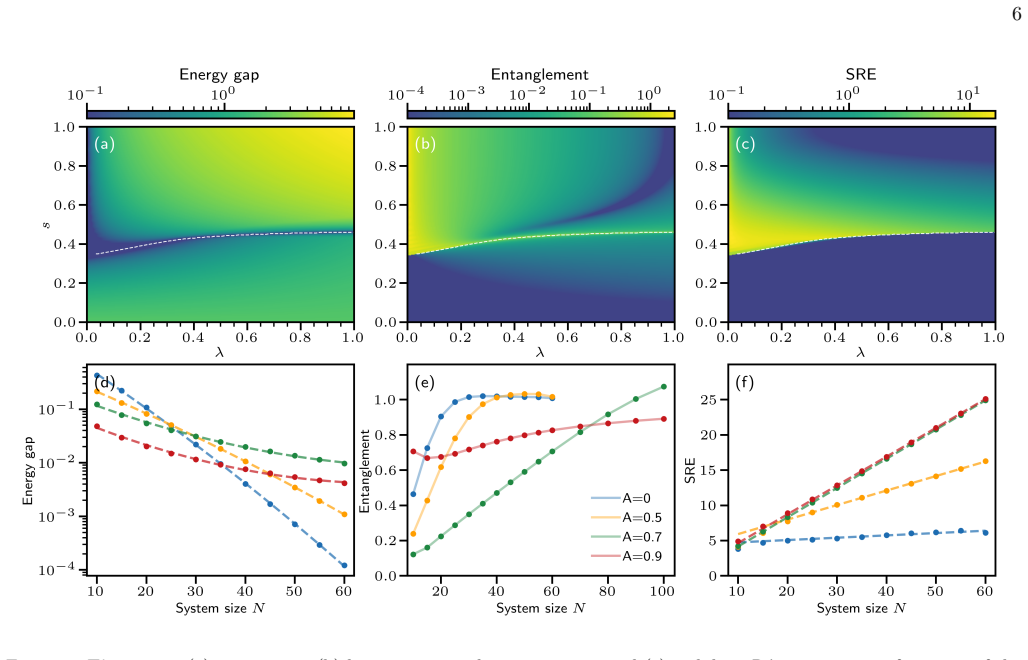
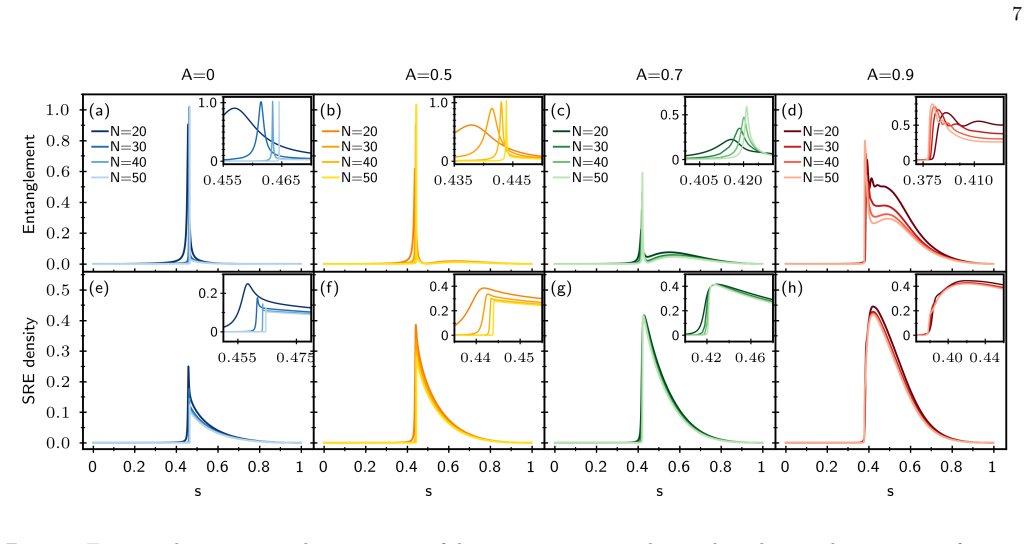
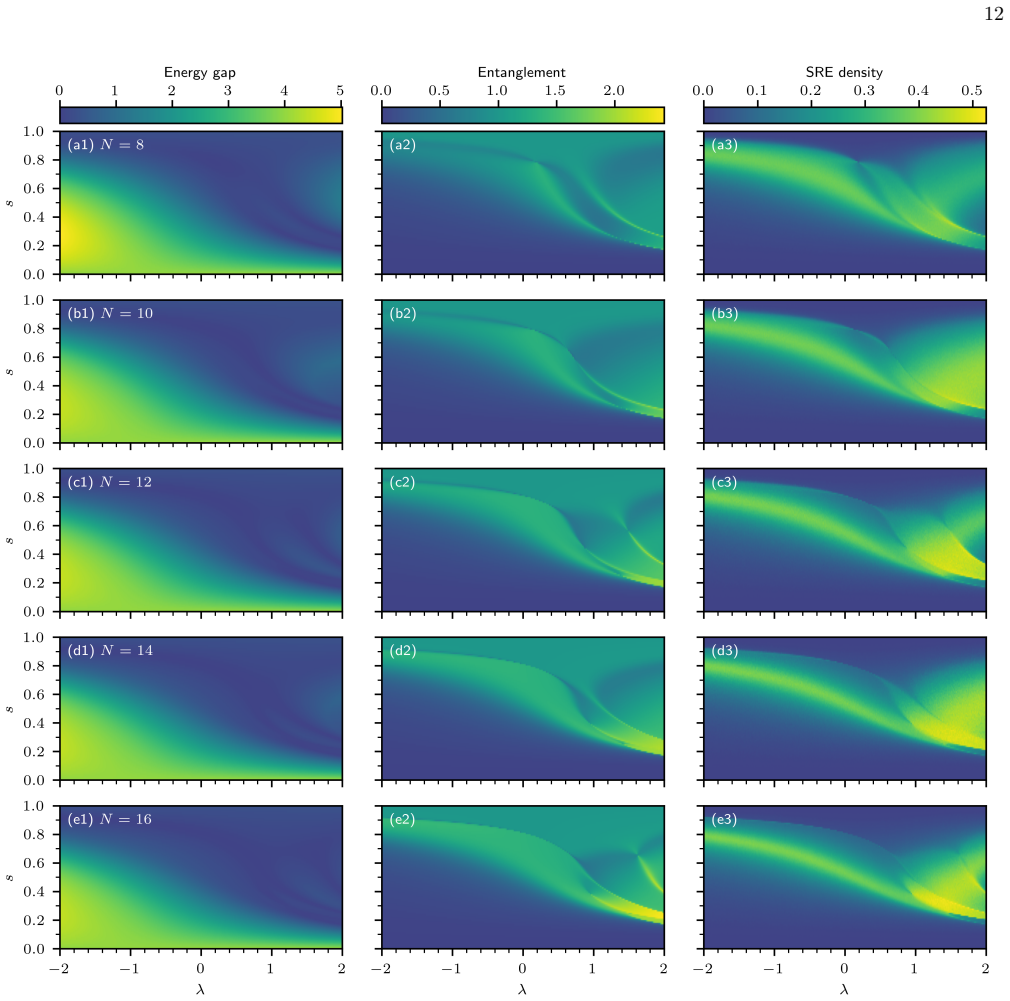
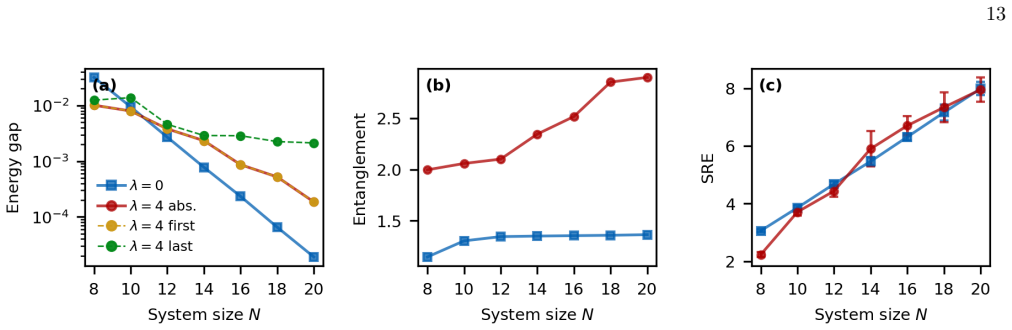
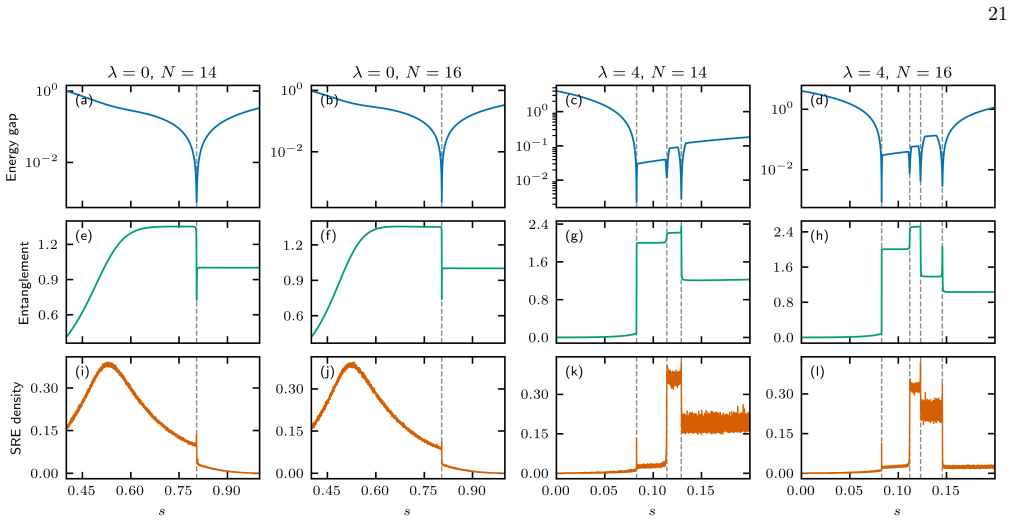
We address this question by computing quantum resources -- entanglement entropy and stabilizer Rényi entropy -- whose presence makes classical computations based on tensor networks and stabilizer-tableau methods exponentially hard. We compare these with the spectral gap along the annealing path for two paradigmatic benchmark models, the fully connected p-spin model and a geometrically local Ising model. While the exact behavior shows a subtle dependency on the underlying model and the annealing path, our numerics suggest consistently that the scaling of entanglement and non-stabilizerness is at least maintained in the deeply non-stoquastic regime and in some cases even significantly enhanced
What carries the argument
Entanglement entropy and stabilizer Rényi entropy, computed along the annealing path and compared to the spectral gap to quantify resources that render tensor-network and stabilizer methods hard.
If this is right
- Tensor-network simulations of the annealing dynamics remain exponentially costly once non-stoquastic terms dominate.
- Stabilizer-tableau methods encounter comparable exponential overhead from the elevated non-stabilizerness.
- The performance advantage gained by converting first-order to second-order transitions is accompanied by sustained or larger quantum resources.
- Classical methods that ignore these resources will continue to fail even when the gap is enlarged by the catalyst.
Where Pith is reading between the lines
- The observed correlation could be used to screen candidate catalyst Hamiltonians by checking whether they also increase the chosen resource measures.
- If the pattern holds for other geometrically local problems, non-stoquastic annealing would systematically separate quantum and classical simulability.
- One could test whether deliberately suppressing the resource measures while retaining non-stoquasticity erases the gap improvement.
- The same resource diagnostics might apply to other protocols that introduce sign-problem-inducing terms to obtain quantum advantage.
Load-bearing premise
The scaling behavior observed for the fully connected p-spin model and the geometrically local Ising model under the chosen annealing paths is representative of the broader class of problems where non-stoquastic catalysts convert first-order to second-order transitions.
What would settle it
A concrete counter-example would be any non-stoquastic path or model in which the gap improves markedly yet both entanglement entropy and stabilizer Rényi entropy fall below their stoquastic counterparts at corresponding points along the schedule.
Figures

read the original abstract
Quantum annealing promises to solve combinatorial optimization problems by preparing the ground state of a target Hamiltonian. Standard annealing protocols are, however, stoquastic and can thus be simulated by sign-problem-free quantum Monte-Carlo methods. To obtain a true quantum advantage, it has been proposed to use non-stoquastic catalyst Hamiltonians. Active only at intermediate stages of the protocol, these can, for certain problems, convert first-order into second-order quantum phase transitions and thus permit an exponential speedup over the stoquastic protocol. At the same time, the non-stoquastic catalyst renders quantum Monte-Carlo methods inefficient. It remains, however, an open question how other classical computation methods are affected by the non-stoquastic terms. We address this question by computing quantum resources -- entanglement entropy and stabilizer R\'enyi entropy -- whose presence makes classical computations based on tensor networks and stabilizer-tableau methods exponentially hard. We compare these with the spectral gap along the annealing path for two paradigmatic benchmark models, the fully connected $p$-spin model and a geometrically local Ising model. While the exact behavior shows a subtle dependency on the underlying model and the annealing path, our numerics suggest consistently that the scaling of entanglement and non-stabilizerness is at least maintained in the deeply non-stoquastic regime and in some cases even significantly enhanced. Our results thus suggest that improvements of quantum performance in non-stoquastic annealing coincide with significant presence of quantum computational resources.
Editorial analysis
A structured set of objections, weighed in public.
Referee Report
Summary. The manuscript computes entanglement entropy and stabilizer Rényi entropy along non-stoquastic annealing paths for the fully connected p-spin model and a geometrically local Ising model, comparing their scaling to the spectral gap. The central claim is that these quantum resources are at least maintained (and sometimes enhanced) in the deeply non-stoquastic regime, suggesting that performance gains from converting first- to second-order transitions coincide with resources that render tensor-network and stabilizer-based classical methods exponentially costly. The abstract explicitly notes a model- and path-dependent subtlety in the observed behavior.
Significance. If the reported scaling holds beyond the two benchmarks, the work supplies concrete numerical evidence that non-stoquastic catalysis introduces quantum resources whose presence is directly tied to classical hardness, thereby supporting the prospect of genuine quantum advantage. The choice of entanglement entropy and stabilizer Rényi entropy is well-motivated, as both quantities have established links to the complexity of specific classical simulation techniques.
major comments (2)
- [Abstract / benchmark-models paragraph] Abstract and the paragraph introducing the benchmark models: the suggestion that resource scaling 'coincides with' performance improvement is load-bearing for the central claim, yet the numerics are confined to two specific models under chosen paths; the abstract itself flags a 'subtle dependency on model and annealing path,' so the representativeness for the broader class of first-to-second-order conversion problems is not established by the presented evidence.
- [Numerical results] Numerical-results section (comparison of scaling exponents): without reported system sizes, error bars, or explicit finite-size scaling analysis for the entropy quantities, it is difficult to assess whether the claimed 'maintenance or enhancement' of scaling is robust or an artifact of the accessible sizes.
minor comments (2)
- [Methods / definitions] Notation for the stabilizer Rényi entropy should be defined explicitly on first use, including the precise definition of the stabilizer group and the order of the Rényi entropy employed.
- [Figures] Figure captions should state the annealing schedule parameter values and the range of system sizes shown, to allow immediate assessment of the plotted data.
Simulated Author's Rebuttal
We thank the referee for the constructive comments. We address each major point below, providing the strongest honest defense of the manuscript's scope and claims while noting where revisions will strengthen the presentation.
read point-by-point responses
-
Referee: [Abstract / benchmark-models paragraph] Abstract and the paragraph introducing the benchmark models: the suggestion that resource scaling 'coincides with' performance improvement is load-bearing for the central claim, yet the numerics are confined to two specific models under chosen paths; the abstract itself flags a 'subtle dependency on model and annealing path,' so the representativeness for the broader class of first-to-second-order conversion problems is not established by the presented evidence.
Authors: The manuscript explicitly frames its contribution around two paradigmatic benchmark models (the fully connected p-spin model and a geometrically local Ising model) chosen because they exhibit the known first-to-second-order transition conversion under non-stoquastic terms. This choice enables a direct, controlled comparison between the scaling of quantum resources and the spectral gap. The abstract already states that 'the exact behavior shows a subtle dependency on the underlying model and the annealing path' and qualifies the conclusion as what 'our numerics suggest.' The central claim is therefore limited to the observation that, within these benchmarks, resource maintenance or enhancement coincides with the performance gains; no broader universality is asserted. We view the acknowledged limitations as already sufficient to bound the scope. revision: no
-
Referee: [Numerical results] Numerical-results section (comparison of scaling exponents): without reported system sizes, error bars, or explicit finite-size scaling analysis for the entropy quantities, it is difficult to assess whether the claimed 'maintenance or enhancement' of scaling is robust or an artifact of the accessible sizes.
Authors: We agree that explicit reporting of these details will improve clarity. In the revised manuscript we will state the system sizes used for each model and path, include error bars (from sampling or ensemble averaging where relevant), and add a finite-size scaling discussion for both entanglement entropy and stabilizer Rényi entropy to demonstrate that the reported trends are not artifacts of the accessible sizes. revision: yes
Circularity Check
No significant circularity; quantities computed directly from Hamiltonians
full rationale
The paper computes entanglement entropy and stabilizer Rényi entropy directly along the annealing paths of two explicit benchmark Hamiltonians and compares their scaling to the spectral gap. These resource measures are obtained from the eigenstates or density matrices of the given models without being defined in terms of the performance improvement or fitted to produce the claimed coincidence. No self-definitional reduction, fitted-input prediction, or load-bearing self-citation chain appears in the derivation; the numerics constitute independent evidence for the suggested correlation. The representativeness concern raised by the skeptic is a question of external validity, not circularity.
Axiom & Free-Parameter Ledger
axioms (2)
- standard math Standard definitions of entanglement entropy and stabilizer Rényi entropy in quantum many-body systems
- domain assumption The two chosen models (p-spin and local Ising) are paradigmatic for studying non-stoquastic catalysis
Forward citations
Cited by 1 Pith paper
-
Unitary Designs from Doped Matchgate Circuits
Doped matchgate circuits achieve approximate parity-preserving 2-designs in polylogarithmic depth using a sparse number of non-Gaussian gates, with the design formation mapped exactly to a birth-death Markov chain.
Reference graph
Works this paper leans on
-
[1]
G. E. Santoro, R. Martoňák, E. Tosatti, and R. Car, Science295, 2427 (2002)
2002
-
[2]
Martoňák, G
R. Martoňák, G. E. Santoro, and E. Tosatti, Physical Review E70, 057701 (2004)
2004
-
[3]
Albash and D
T. Albash and D. A. Lidar, Reviews of Modern Physics 90, 015002 (2018)
2018
-
[4]
Hauke, H
P. Hauke, H. G. Katzgraber, W. Lechner, H. Nishimori, and W. D. Oliver, Reports on Progress in Physics83, 054401 (2020)
2020
-
[5]
A. Rajak, S. Suzuki, A. Dutta, and B. K. Chakrabarti, Philosophical Transactions of the Royal Society A: Mathematical, Physical and Engineering Sciences381, 10.1098/rsta.2021.0417 (2022)
-
[6]
Nagies, K
S. Nagies, K. T. Geier, J. Akram, D. Bantounas, M. Jo- hanning, and P. Hauke, Quantum Science and Technol- ogy10, 035008 (2025)
2025
-
[7]
Nagies, C
S. Nagies, C. Capecci, M. S. Benkner, J. Akram, S. Rub- bert, D. Bantounas, M. Moeller, M. Johanning, and P. Hauke, Phys. Rev. A113, 012621 (2026)
2026
-
[8]
Jansen, M.-B
S. Jansen, M.-B. Ruskai, and R. Seiler, Journal of Math- ematical Physics48, 102111 (2007)
2007
-
[9]
D. A. Lidar, A. T. Rezakhani, and A. Hamma, Journal of Mathematical Physics50, 10.1063/1.3236685 (2009)
-
[10]
M. H. S. Amin, Physical Review Letters102, 220401 (2009)
2009
-
[11]
Cheung, P
D. Cheung, P. Høyer, and N. Wiebe, Journal of Physics A: Mathematical and Theoretical44, 415302 (2011)
2011
-
[12]
S. Bravyi, D. P. DiVincenzo, R. I. Oliveira, and B. M. Terhal, arXiv preprint 10.48550/ARXIV.QUANT- PH/0606140 (2006)
-
[13]
Troyer and U.-J
M. Troyer and U.-J. Wiese, Physical Review Letters94, 170201 (2005)
2005
-
[14]
S. V. Isakov, G. Mazzola, V. N. Smelyanskiy, Z. Jiang, S. Boixo, H. Neven, and M. Troyer, Physical Review Let- ters117, 180402 (2016)
2016
-
[15]
V. S. Denchev, S. Boixo, S. V. Isakov, N. Ding, R. Bab- bush, V. Smelyanskiy, J. Martinis, and H. Neven, Physi- cal Review X6, 031015 (2016)
2016
-
[16]
Jiang, V
Z. Jiang, V. N. Smelyanskiy, S. V. Isakov, S. Boixo, G. Mazzola, M. Troyer, and H. Neven, Physical Review A95, 012322 (2017)
2017
-
[17]
Hormozi, E
L. Hormozi, E. W. Brown, G. Carleo, and M. Troyer, Physical Review B95, 184416 (2017)
2017
-
[18]
A. Y. Kitaev, A. H. Shen, and M. N. Vyalyi,Classical and Quantum Computation, Graduate Studies in Mathemat- ics, Vol. 47 (American Mathematical Society, Providence, RI, 2002)
2002
-
[19]
Kempe, A
J. Kempe, A. Kitaev, and O. Regev, SIAM Journal on Computing35, 1070 (2006)
2006
-
[20]
S. Bravyi and B. M. Terhal, SIAM Journal on Computing 39, 1462 (2010), arXiv:0806.1746 [quant-ph]
Pith/arXiv arXiv 2010
-
[21]
Farhi, J
E. Farhi, J. Goldstone, S. Gutmann, and M. Sipser, Quantum computation by adiabatic evolution (2000)
2000
-
[22]
H. Nishimori and K. Takada, Frontiers in ICT4, 10.3389/fict.2017.00002 (2017)
-
[23]
Albash, Physical Review A99, 042334 (2019)
T. Albash, Physical Review A99, 042334 (2019)
2019
-
[24]
Seki and H
Y. Seki and H. Nishimori, Physical Review E85, 051112 (2012)
2012
-
[25]
N. N. Hegade, X. Chen, and E. Solano, Physical Review Research4, l042030 (2022)
2022
-
[26]
Suzuki,Quantum Monte Carlo Methods in Condensed Matter Physics(WORLD SCIENTIFIC, 1993)
M. Suzuki,Quantum Monte Carlo Methods in Condensed Matter Physics(WORLD SCIENTIFIC, 1993)
1993
-
[27]
Becca and S
F. Becca and S. Sorella,Quantum Monte Carlo Ap- proaches for Correlated Systems(Cambridge University Press, 2017)
2017
-
[28]
Schollwöck, Annals of Physics326, 96 (2011)
U. Schollwöck, Annals of Physics326, 96 (2011)
2011
-
[29]
Orús, Annals of Physics349, 117 (2014)
R. Orús, Annals of Physics349, 117 (2014)
2014
-
[30]
Montangero,Introduction to Tensor Network Meth- ods: Numerical Simulations of Low-dimensional Many- body Quantum Systems(Springer)
S. Montangero,Introduction to Tensor Network Meth- ods: Numerical Simulations of Low-dimensional Many- body Quantum Systems(Springer)
-
[31]
Gottesman, arXiv preprint quant-ph/9807006 (1998)
D. Gottesman, arXiv preprint quant-ph/9807006 (1998)
Pith/arXiv arXiv 1998
-
[32]
Aaronson and D
S. Aaronson and D. Gottesman, Physical Review A—Atomic, Molecular, and Optical Physics70, 052328 (2004)
2004
-
[33]
P. Hauke, L. Bonnes, M. Heyl, and W. Lechner, Frontiers in Physics3, 10.3389/fphy.2015.00021 (2015)
-
[34]
Dupont, N
M. Dupont, N. Didier, M. J. Hodson, J. E. Moore, and M. J. Reagor, Phys. Rev. A106, 022423 (2022)
2022
-
[35]
Y. Chen, L. Zhu, N. J. Mayhall, E. Barnes, and S. E. Economou, Quantum 2.0 Conference and Exhibition , QM4A.2 (2022)
2022
-
[36]
G. C. Santra, S. S. Roy, D. J. Egger, and P. Hauke, Phys- ical Review A111, 022434 (2025)
2025
-
[37]
Capecci, G
C. Capecci, G. C. Santra, A. Bottarelli, E. Tirrito, and P. Hauke, Role of nonstabilizerness in quantum optimiza- tion (2025)
2025
-
[38]
Amico, R
L. Amico, R. Fazio, A. Osterloh, and V. Vedral, Reviews of modern physics80, 517 (2008)
2008
-
[39]
Horodecki, P
R. Horodecki, P. Horodecki, M. Horodecki, and K. Horodecki, Rev. Mod. Phys.81, 865 (2009). 15
2009
-
[40]
Contreras-Tejada, C
P. Contreras-Tejada, C. Palazuelos, and J. I. De Vicente, Physical review letters122, 120503 (2019)
2019
-
[41]
S. Bäuml, S. Das, X. Wang, and M. M. Wilde, arXiv preprint arXiv:1907.04181 (2019)
Pith/arXiv arXiv 1907
-
[42]
Gottesman, arXiv: quant-ph/9705052 (1997)
D. Gottesman, arXiv: quant-ph/9705052 (1997)
Pith/arXiv arXiv 1997
-
[43]
H. J. Briegel, D. E. Browne, W. Dür, R. Raussendorf, and M. V. den Nest, Nature Physics5, 19 (2009)
2009
-
[44]
Veitch, S
V. Veitch, S. H. Mousavian, D. Gottesman, and J. Emer- son, New Journal of Physics16, 013009 (2014)
2014
-
[45]
E. T. Campbell, B. M. Terhal, and C. Vuillot, Nature 549, 172 (2017)
2017
-
[46]
Leone and L
L. Leone and L. Bittel, Physical Review A110, L040403 (2024)
2024
-
[47]
T. Jörg, F. Krzakala, J. Kurchan, A. C. Maggs, and J. Pujos, EPL (Europhysics Letters)89, 40004 (2010)
2010
-
[48]
Bapst and G
V. Bapst and G. Semerjian, Journal of Statistical Me- chanics: Theory and Experiment2012, P06007 (2012)
2012
-
[49]
M. M. Wauters, R. Fazio, H. Nishimori, and G. E. San- toro, Phys. Rev. A96, 022326 (2017)
2017
-
[50]
M. M. Wauters, G. B. Mbeng, and G. E. Santoro, Phys. Rev. A102, 062404 (2020)
2020
-
[51]
B. Heim, T. F. Rønnow, S. V. Isakov, and M. Troyer, Science348, 215 (2015)
2015
-
[52]
M. Marvian, D. A. Lidar, and I. Hen, Nature Communi- cations10, 10.1038/s41467-019-09501-6 (2019)
-
[53]
Klassen, M
J. Klassen, M. Marvian, S. Piddock, M. Ioannou, I. Hen, and B. M. Terhal, SIAM Journal on Computing49, 1332 (2020)
2020
-
[54]
Barahona, Journal of Physics A: Mathematical and General15, 3241 (1982)
F. Barahona, Journal of Physics A: Mathematical and General15, 3241 (1982)
1982
- [55]
-
[56]
J. D. Biamonte and P. J. Love, Phys. Rev. A78, 012352 (2008)
2008
-
[57]
Seki and H
Y. Seki and H. Nishimori, Journal of Physics A: Mathe- matical and Theoretical48, 335301 (2015)
2015
-
[58]
Feinstein, I
N. Feinstein, I. Shalashilin, S. Bose, and P. A. Warbur- ton,QuantumScienceandTechnology10,025011(2025)
2025
-
[59]
Bose, Physical Review Research8, 10.1103/hnzj- j7kt (2026)
R.Ghosh, L.A.Nutricati, N.Feinstein, P.A.Warburton, and S. Bose, Physical Review Research8, 10.1103/hnzj- j7kt (2026)
-
[60]
Bravyi and A
S. Bravyi and A. Kitaev, Phys. Rev. A71, 022316 (2005)
2005
-
[61]
Leone, S
L. Leone, S. F. E. Oliviero, and A. Hamma, Physical Review Letters128, 050402 (2022)
2022
-
[62]
Bittel and L
L. Bittel and L. Leone, Quantum10, 2069 (2026)
2069
-
[63]
P. Sierant and X. Turkeshi, Theory of magic phase transitions in encoding-decoding circuits (2026), arXiv:2603.00235 [quant-ph]
arXiv 2026
-
[64]
Spagnoli, A
L. Spagnoli, A. Roggero, and N. Wiebe, Quantum10, 1968 (2026)
1968
-
[65]
Bravyi and D
S. Bravyi and D. Gosset, Physical Review Letters116, 250501 (2016)
2016
-
[66]
Leone, S
L. Leone, S. F. E. Oliviero, Y. Zhou, and A. Hamma, Quantum5, 453 (2021)
2021
-
[67]
G. C. Santra, A. Windey, S. Bandyopadhyay, A. Legra- mandi, and P. Hauke, Complexity transitions in chaotic quantum systems: Nonstabilizerness, entanglement, and fractal dimension in syk and random matrix models (2025), arXiv:2505.09707 [quant-ph]
arXiv 2025
-
[68]
Magni and X
B. Magni and X. Turkeshi, Quantum9, 1956 (2025)
1956
-
[69]
H. Lóio, G. Lami, L. Leone, M. McGinley, X. Turkeshi, and J. De Nardis, arXiv preprint arXiv:2510.13950 (2025)
arXiv 2025
-
[70]
B. Magni, M. Heinrich, L. Leone, and X. Turkeshi, arXiv preprint arXiv:2512.15880 (2025)
Pith/arXiv arXiv 2025
-
[71]
N. D. Varikuti, S. Bandyopadhyay, and P. Hauke, arXiv preprint arXiv:2512.09999 (2025)
arXiv 2025
-
[72]
N. D. Varikuti, S. Bandyopadhyay, and P. Hauke, Quan- tum10, 2017 (2026)
2017
-
[73]
Lipkin, N
H. Lipkin, N. Meshkov, and A. Glick, Nuclear Physics 62, 188 (1965)
1965
-
[74]
Meshkov, A
N. Meshkov, A. Glick, and H. Lipkin, Nuclear Physics 62, 199 (1965)
1965
-
[75]
Glick, H
A. Glick, H. Lipkin, and N. Meshkov, Nuclear Physics 62, 211 (1965)
1965
-
[76]
L. K. Grover, Phys. Rev. Lett.79, 325 (1997)
1997
-
[77]
Popkov and M
V. Popkov and M. Salerno, International Journal of Mod- ern Physics B26, 1243009 (2012)
2012
-
[78]
J. K. Stockton, J. M. Geremia, A. C. Doherty, and H. Mabuchi, Phys. Rev. A67, 022112 (2003)
2003
-
[79]
Passarelli, R
G. Passarelli, R. Fazio, and P. Lucignano, Phys. Rev. A 110, 022436 (2024)
2024
-
[80]
Lami,Pushing the Boundaries of Matrix Product States in Quantum Many-Body Physics and Computing, Phd thesis, University of Insubria, Como, Italy (2023)
G. Lami,Pushing the Boundaries of Matrix Product States in Quantum Many-Body Physics and Computing, Phd thesis, University of Insubria, Como, Italy (2023)
2023
discussion (0)
Sign in with ORCID, Apple, or X to comment. Anyone can read and Pith papers without signing in.