Constraints and Projections for Millicharged Dark Matter in the Sun with Water Cherenkov Neutrino Detectors
Pith reviewed 2026-06-27 15:38 UTC · model grok-4.3
The pith
Super-Kamiokande and Hyper-Kamiokande can constrain millicharged dark matter at 5-28 GeV masses down to fractional abundances of 5×10^{-6}.
A machine-rendered reading of the paper's core claim, the machinery that carries it, and where it could break.
Core claim
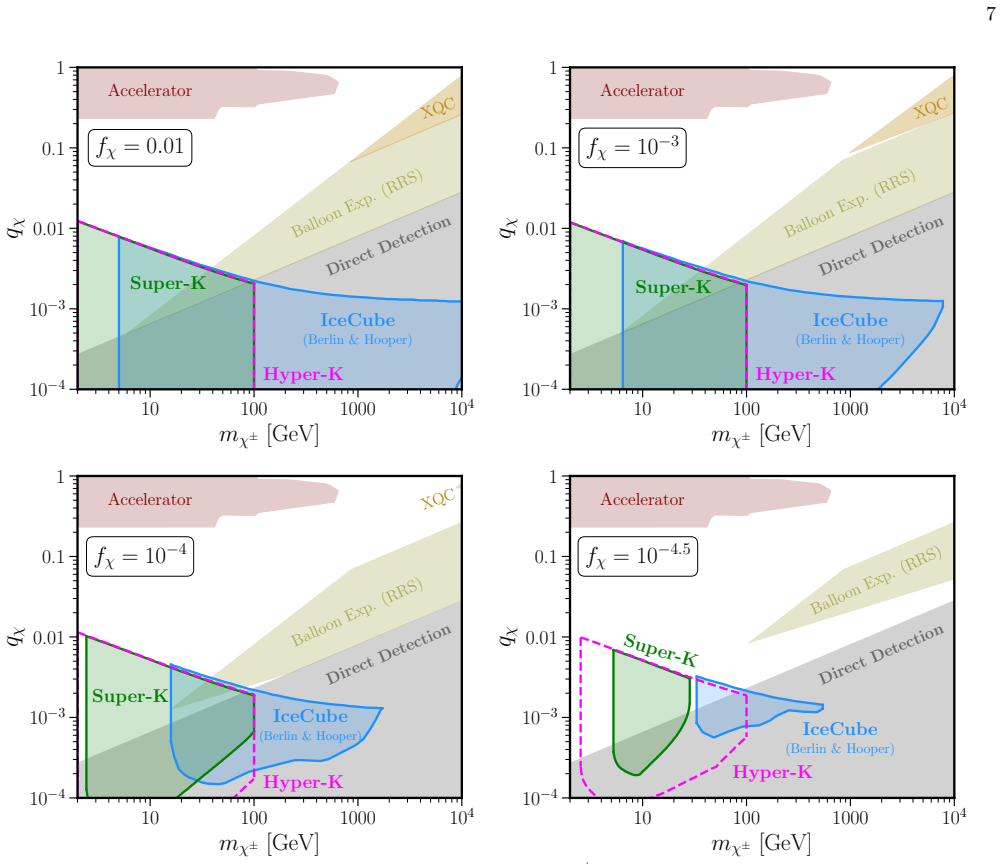
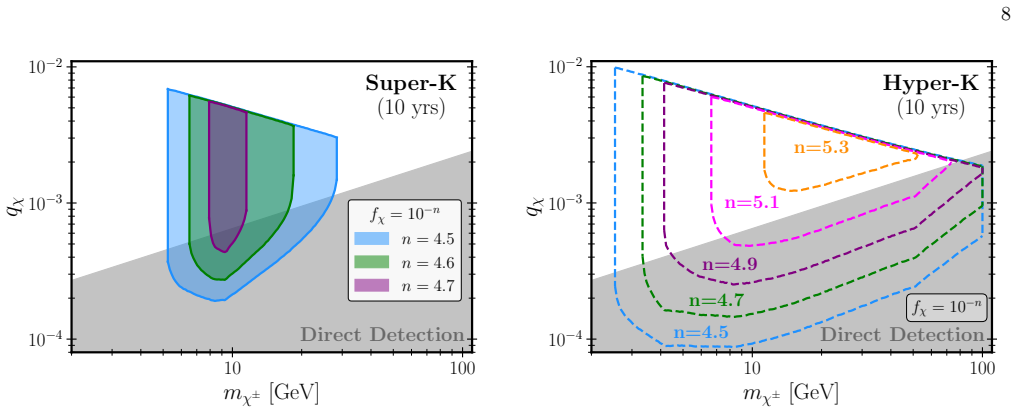
The paper establishes that the lower energy threshold of water Cherenkov detectors makes Super-Kamiokande and Hyper-Kamiokande sensitive to neutrinos from the annihilation of lighter millicharged dark matter in the Sun, allowing Super-Kamiokande to constrain new parameter space at m_χ=5-28 GeV for f_χ=10^{-4.5} while Hyper-Kamiokande reaches f_χ≃5×10^{-6}.
What carries the argument
Neutrino signals from solar capture and annihilation of millicharged dark matter, detected via the lower energy threshold of water Cherenkov detectors.
If this is right
- Super-Kamiokande can set new limits on millicharged dark matter in a mass range inaccessible to IceCube.
- Hyper-Kamiokande extends sensitivity to fractional abundances nearly an order of magnitude below current IceCube limits.
- The approach complements high-mass constraints from IceCube with reach to lower masses.
- Millicharged dark matter can be tested at small abundances where terrestrial experiments lose sensitivity.
Where Pith is reading between the lines
- Combining data across IceCube, Super-Kamiokande, and Hyper-Kamiokande could cover a continuous mass range for millicharged dark matter.
- The same solar-capture method might apply to other hidden-sector particles that produce neutrinos upon annihilation.
- Future refinements in solar capture modeling could push the reachable fractional abundances even lower.
Load-bearing premise
Neutrino event rates and backgrounds in Super-Kamiokande and Hyper-Kamiokande are assumed to allow the stated sensitivity to the annihilation signals.
What would settle it
A detailed calculation or measurement showing that the solar capture rate for millicharged particles or the detector response yields fewer events than required for the projected sensitivity would falsify the constraints.
Figures
read the original abstract
Millicharged particles are well-motivated dark matter candidates that have been extensively investigated in terrestrial experiments. Recent studies proposed using the IceCube Neutrino Observatory to search for high-energy neutrinos produced by the capture and annihilation of millicharged dark matter in the Sun, deriving new constraints in the strong interaction regime where the millicharge is $q_\chi \sim 10^{-3}$-$10^{-2}$, which extend to small fractional abundances where all existing constraints lose sensitivity. In this work, I point out that the lower energy threshold of water Cherenkov detectors makes Super-Kamiokande and the future Hyper-Kamiokande sensitive to neutrinos from the annihilation of lighter millicharged dark matter, complementing the high-mass reach of IceCube. I find that Super-Kamiokande can constrain previously unexplored parameter space at $m_{\chi}=5$-28 GeV for dark matter fraction of $f_{\chi}=10^{-4.5}$, while Hyper-Kamiokande can improve these constraints and will be sensitive to fractional abundances as small as $f_{\chi}\simeq 5\times 10^{-6}$, nearly an order of magnitude below current IceCube limits.
Editorial analysis
A structured set of objections, weighed in public.
Referee Report
Summary. The manuscript claims that the lower energy thresholds of water Cherenkov detectors allow Super-Kamiokande and Hyper-Kamiokande to constrain millicharged dark matter (m_χ = 5-28 GeV) via solar capture and annihilation neutrinos at fractional abundances f_χ = 10^{-4.5} (SK) and down to ≃5×10^{-6} (HK), extending beyond IceCube's high-mass reach and filling gaps left by terrestrial experiments.
Significance. If the central projections hold after validation of the capture-annihilation equilibrium, the work would provide a concrete, falsifiable extension of neutrino-telescope constraints into the sub-30 GeV millicharged regime at small f_χ, where direct-detection and collider bounds weaken. It correctly exploits the complementarity between IceCube and lower-threshold detectors and employs standard solar-capture formalism.
major comments (1)
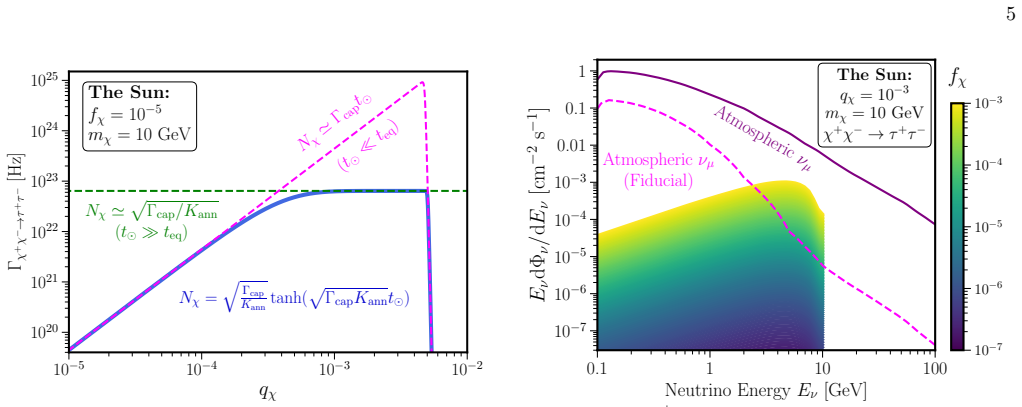
- [§3 and §4] §3 (Capture and Annihilation Rates) and the sensitivity projections in §4: the quoted limits assume the neutrino flux equals C/2, which requires equilibrium (τ_ann ≪ 4.5 Gyr). For q_χ ∼ 10^{-3} the electromagnetic ⟨σv⟩ ∝ q_χ^4 α^2 / m_χ^2 yields ⟨σv⟩ ≲ 10^{-40} cm³ s^{-1}, placing the system far from equilibrium and suppressing the rate by an extra factor ∝ ⟨σv⟩. No explicit check or additional annihilation channel is shown to restore equilibrium at the benchmark points.
minor comments (2)
- [Figure 2 and §4] Figure 2 caption and §4 text: the energy threshold values used for SK and HK event selection should be stated explicitly with references to the detector papers.
- [Abstract] The abstract states the f_χ reach but does not mention the equilibrium assumption or the annihilation cross-section scaling; a one-sentence qualifier would improve clarity.
Simulated Author's Rebuttal
We thank the referee for their thorough review and for highlighting the important issue of capture-annihilation equilibrium. We address this concern directly below and will revise the manuscript accordingly to strengthen the analysis.
read point-by-point responses
-
Referee: [§3 and §4] §3 (Capture and Annihilation Rates) and the sensitivity projections in §4: the quoted limits assume the neutrino flux equals C/2, which requires equilibrium (τ_ann ≪ 4.5 Gyr). For q_χ ∼ 10^{-3} the electromagnetic ⟨σv⟩ ∝ q_χ^4 α^2 / m_χ^2 yields ⟨σv⟩ ≲ 10^{-40} cm³ s^{-1}, placing the system far from equilibrium and suppressing the rate by an extra factor ∝ ⟨σv⟩. No explicit check or additional annihilation channel is shown to restore equilibrium at the benchmark points.
Authors: We agree that the equilibrium assumption requires explicit verification and that the purely electromagnetic annihilation cross section for q_χ ∼ 10^{-3} is too small to reach equilibrium within the solar lifetime. The original manuscript adopted the standard C/2 flux assumption common to solar DM neutrino searches without performing this check for the millicharged case. In the revised manuscript we will add an explicit calculation of τ_ann at the benchmark points (m_χ = 5–28 GeV, q_χ = 10^{-3}–10^{-2}, f_χ = 10^{-4.5}–5×10^{-6}). We will also discuss possible additional annihilation channels (e.g., via a kinetically mixed dark photon or other portals) that could increase ⟨σv⟩ and restore equilibrium; if such channels are not assumed, we will instead quote the suppressed flux ∝ C × (⟨σv⟩ t_⊙). This revision will make the projections conditional on the annihilation mechanism and improve the paper’s rigor. revision: yes
Circularity Check
No circularity; standard forward calculation from capture/annihilation models
full rationale
The abstract and provided context describe a forward projection of neutrino signals from solar capture and annihilation of millicharged DM, using established capture rate formulas and detector thresholds. No load-bearing step reduces by construction to a fitted input from the same dataset, no self-citation chain justifies a uniqueness claim, and no ansatz is smuggled via prior work by the same author. The sensitivity claims (f_χ = 10^{-4.5} for SK, 5×10^{-6} for HK) follow from applying standard DM solar physics to new detector energy ranges, without re-deriving or renaming the input quantities. This matches the default expectation of a non-circular paper.
Axiom & Free-Parameter Ledger
Reference graph
Works this paper leans on
-
[1]
G. Bertone and D. Hooper, Rev. Mod. Phys.90, 045002 (2018), arXiv:1605.04909 [astro-ph.CO]
Pith/arXiv arXiv 2018
-
[2]
G. Bertone, D. Hooper, and J. Silk, Phys. Rept.405, 279 (2005), arXiv:hep-ph/0404175
Pith/arXiv arXiv 2005
-
[3]
G. Bertone and T. Tait, M. P., Nature562, 51 (2018), arXiv:1810.01668 [astro-ph.CO]
Pith/arXiv arXiv 2018
-
[4]
M. Cirelli, A. Strumia, and J. Zupan, (2024), arXiv:2406.01705 [hep-ph]
Pith/arXiv arXiv 2024
- [5]
-
[6]
Goldberg and L
H. Goldberg and L. J. Hall, Phys. Lett. B174, 151 (1986)
1986
-
[7]
J. L. Feng, M. Kaplinghat, H. Tu, and H.-B. Yu, JCAP 07, 004 (2009), arXiv:0905.3039 [hep-ph]
Pith/arXiv arXiv 2009
-
[8]
De Rujula, S
A. De Rujula, S. L. Glashow, and U. Sarid, Nucl. Phys. B333, 173 (1990)
1990
-
[9]
A. Haas, C. S. Hill, E. Izaguirre, and I. Yavin, Phys. Lett. B746, 117 (2015), arXiv:1410.6816 [hep-ph]
Pith/arXiv arXiv 2015
-
[10]
E. Izaguirre and I. Yavin, Phys. Rev. D92, 035014 (2015), arXiv:1506.04760 [hep-ph]
Pith/arXiv arXiv 2015
- [11]
-
[12]
K. J. Kelly and Y.-D. Tsai, Phys. Rev. D100, 015043 (2019), arXiv:1812.03998 [hep-ph]
arXiv 2019
-
[13]
Acciarriet al.(ArgoNeuT), Phys
R. Acciarriet al.(ArgoNeuT), Phys. Rev. Lett.124, 10 131801 (2020), arXiv:1911.07996 [hep-ex]
arXiv 2020
- [14]
-
[15]
Perezet al.(Oscura), JHEP02, 072 (2024), arXiv:2304.08625 [hep-ex]
S. Perezet al.(Oscura), JHEP02, 072 (2024), arXiv:2304.08625 [hep-ex]
arXiv 2024
-
[16]
R. Plestid, V. Takhistov, Y.-D. Tsai, T. Bringmann, A. Kusenko, and M. Pospelov, Phys. Rev. D102, 115032 (2020), arXiv:2002.11732 [hep-ph]
arXiv 2020
-
[17]
I. M. Bloch, A. Caputo, R. Essig, D. Redigolo, M. Shola- purkar, and T. Volansky, JHEP01, 178 (2021), arXiv:2006.14521 [hep-ph]
arXiv 2021
-
[18]
S. Foroughi-Abari, F. Kling, and Y.-D. Tsai, Phys. Rev. D104, 035014 (2021), arXiv:2010.07941 [hep-ph]
arXiv 2021
- [19]
-
[20]
G. Marocco and S. Sarkar, SciPost Phys.10, 043 (2021), arXiv:2011.08153 [hep-ph]
arXiv 2021
- [21]
-
[22]
C.-R. Chen, B. H. Nhung, and C. S. Nugroho, Phys. Lett. B839, 137764 (2023), arXiv:2212.13017 [hep-ph]
arXiv 2023
- [23]
-
[24]
C. A. Arg¨ uelles Delgado, K. J. Kelly, and V. Mu˜ noz Al- bornoz, JHEP11, 099 (2021), arXiv:2104.13924 [hep- ph]
arXiv 2021
-
[25]
G. Afek, F. Monteiro, J. Wang, B. Siegel, S. Ghosh, and D. C. Moore, Phys. Rev. D104, 012004 (2021), arXiv:2012.08169 [hep-ex]
arXiv 2021
- [26]
- [27]
- [28]
- [29]
-
[30]
A. Berlin and K. Schutz, Phys. Rev. D105, 095012 (2022), arXiv:2111.01796 [hep-ph]
arXiv 2022
-
[31]
A. Berlin and A. Hook, Phys. Rev. D102, 035010 (2020), arXiv:2001.02679 [hep-ph]
arXiv 2020
-
[32]
A. Prabhu and C. Blanco, Phys. Rev. D108, 035035 (2023), arXiv:2211.05787 [hep-ph]
arXiv 2023
-
[33]
P. Du, R. Essig, B. J. Rauscher, and H. Xu, Phys. Rev. Lett.135, 051002 (2025), arXiv:2412.13131 [astro- ph.CO]
arXiv 2025
- [34]
-
[35]
E. D. Kovetz, V. Poulin, V. Gluscevic, K. K. Boddy, R. Barkana, and M. Kamionkowski, Phys. Rev. D98, 103529 (2018), arXiv:1807.11482 [astro-ph.CO]
Pith/arXiv arXiv 2018
-
[36]
R. de Putter, O. Dor´ e, J. Gleyzes, D. Green, and J. Meyers, Phys. Rev. Lett.122, 041301 (2019), arXiv:1805.11616 [astro-ph.CO]
Pith/arXiv arXiv 2019
-
[37]
J. B. Mu˜ noz and A. Loeb, Nature557, 684 (2018), arXiv:1802.10094 [astro-ph.CO]
Pith/arXiv arXiv 2018
-
[38]
C. Creque-Sarbinowski, L. Ji, E. D. Kovetz, and M. Kamionkowski, Phys. Rev. D100, 023528 (2019), arXiv:1903.09154 [astro-ph.CO]
Pith/arXiv arXiv 2019
-
[39]
A. Stebbins and G. Krnjaic, JCAP12, 003 (2019), arXiv:1908.05275 [astro-ph.CO]
arXiv 2019
-
[40]
J. Rich, R. Rocchia, and M. Spiro, Phys. Lett. B194, 173 (1987)
1987
-
[41]
A. L. Erickcek, P. J. Steinhardt, D. McCammon, and P. C. McGuire, Phys. Rev. D76, 042007 (2007), arXiv:0704.0794 [astro-ph]
Pith/arXiv arXiv 2007
- [42]
-
[43]
S. Chatrchyanet al.(CMS), Phys. Rev. D87, 092008 (2013), [Erratum: Phys.Rev.D 106, 099903 (2022)], arXiv:1210.2311 [hep-ex]
Pith/arXiv arXiv 2013
-
[44]
S. Davidson, S. Hannestad, and G. Raffelt, JHEP05, 003 (2000), arXiv:hep-ph/0001179
Pith/arXiv arXiv 2000
-
[45]
S. Chatrchyanet al.(CMS), JHEP07, 122 (2013), [Er- ratum: JHEP 11, 149 (2022)], arXiv:1305.0491 [hep-ex]
Pith/arXiv arXiv 2013
-
[46]
A. Hayrapetyanet al.(CMS), Phys. Rev. Lett.134, 131802 (2025), arXiv:2402.09932 [hep-ex]
arXiv 2025
-
[47]
A. Berlin and D. Hooper, Phys. Rev. D110, 075018 (2024), arXiv:2407.04768 [hep-ph]
arXiv 2024
-
[48]
R. Abbasiet al.(IceCube), Phys. Rev. D105, 062004 (2022), arXiv:2111.09970 [astro-ph.HE]
arXiv 2022
-
[49]
M. Fabbrichesi, E. Gabrielli, and G. Lanfranchi, (2020), 10.1007/978-3-030-62519-1, arXiv:2005.01515 [hep-ph]
work page internal anchor Pith review Pith/arXiv arXiv doi:10.1007/978-3-030-62519-1 2020
-
[50]
Fayet, Nucl
P. Fayet, Nucl. Phys. B187, 184 (1981)
1981
-
[51]
Holdom, Phys
B. Holdom, Phys. Lett. B166, 196 (1986)
1986
-
[52]
T. Cohen, D. J. Phalen, A. Pierce, and K. M. Zurek, Phys. Rev. D82, 056001 (2010), arXiv:1005.1655 [hep- ph]
Pith/arXiv arXiv 2010
-
[53]
M. Baumgart, C. Cheung, J. T. Ruderman, L.-T. Wang, and I. Yavin, JHEP04, 014 (2009), arXiv:0901.0283 [hep-ph]
Pith/arXiv arXiv 2009
-
[54]
S. L. Dubovsky, D. S. Gorbunov, and G. I. Rubtsov, JETP Lett.79, 1 (2004), arXiv:hep-ph/0311189
Pith/arXiv arXiv 2004
-
[55]
E. D. Kovetz, I. Cholis, and D. E. Kaplan, Phys. Rev. D99, 123511 (2019), arXiv:1809.01139 [astro-ph.CO]
Pith/arXiv arXiv 2019
-
[56]
M. A. Buen-Abad, R. Essig, D. McKeen, and Y.-M. Zhong, Phys. Rept.961, 1 (2022), arXiv:2107.12377 [astro-ph.CO]
arXiv 2022
-
[57]
Griest and M
K. Griest and M. Kamionkowski, Phys. Rev. Lett.64, 615 (1990)
1990
-
[58]
M. S. Mahdawi and G. R. Farrar, JCAP10, 007 (2018), arXiv:1804.03073 [hep-ph]
Pith/arXiv arXiv 2018
- [59]
-
[60]
W. H. Press and D. N. Spergel, Astrophys. J.296, 679 (1985)
1985
-
[61]
Faulkner and R
J. Faulkner and R. L. Gilliland, Astrophys. J.299, 994 (1985)
1985
-
[62]
J. Silk, K. A. Olive, and M. Srednicki, Phys. Rev. Lett. 55, 257 (1985)
1985
-
[63]
Srednicki, K
M. Srednicki, K. A. Olive, and J. Silk, Nucl. Phys. B 279, 804 (1987)
1987
-
[64]
T. K. Gaisser, G. Steigman, and S. Tilav, Phys. Rev. D34, 2206 (1986)
1986
-
[65]
Abbasiet al.(IceCube), (2025), arXiv:2507.08457 [hep-ex]
R. Abbasiet al.(IceCube), (2025), arXiv:2507.08457 [hep-ex]
arXiv 2025
-
[66]
D. Hooper and F. Vassallo, Phys. Rev. D112, 035014 (2025), arXiv:2505.06734 [hep-ph]
arXiv 2025
-
[67]
Adri´ an-Mart´ ınezet al.(ANTARES), JCAP05, 016 (2016), arXiv:1602.07000 [hep-ex]
S. Adri´ an-Mart´ ınezet al.(ANTARES), JCAP05, 016 (2016), arXiv:1602.07000 [hep-ex]
Pith/arXiv arXiv 2016
-
[68]
Widmark, JCAP05, 046 (2017), arXiv:1703.06878 [hep-ph]
A. Widmark, JCAP05, 046 (2017), arXiv:1703.06878 [hep-ph]
Pith/arXiv arXiv 2017
-
[69]
R. Catena and A. Widmark, JCAP12, 016 (2016), 11 arXiv:1609.04825 [astro-ph.CO]
Pith/arXiv arXiv 2016
-
[70]
M. G. Aartsenet al.(IceCube), JCAP04, 022 (2016), arXiv:1601.00653 [hep-ph]
Pith/arXiv arXiv 2016
-
[71]
J. F. Acevedo, J. Bramante, A. Goodman, J. Kopp, and T. Opferkuch, JCAP04, 026 (2021), arXiv:2012.09176 [hep-ph]
arXiv 2021
-
[72]
K.-W. Ng, K. A. Olive, and M. Srednicki, Phys. Lett. B188, 138 (1987)
1987
-
[73]
D. Krishna, R. Sherpa, A. K. Saha, T. N. Maity, R. Laha, and N. Raj, (2025), arXiv:2503.07713 [hep- ph]
arXiv 2025
-
[74]
T. N. Maity, A. K. Saha, S. Mondal, and R. Laha, Phys. Rev. D112, 023025 (2025), arXiv:2308.12336 [hep-ph]
arXiv 2025
-
[75]
N. F. Bell, M. J. Dolan, and S. Robles, JCAP11, 004 (2021), arXiv:2107.04216 [hep-ph]
arXiv 2021
-
[76]
N. F. Bell and K. Petraki, JCAP04, 003 (2011), arXiv:1102.2958 [hep-ph]
Pith/arXiv arXiv 2011
-
[77]
N. F. Bell, A. J. Brennan, and T. D. Jacques, JCAP 10, 045 (2012), arXiv:1206.2977 [hep-ph]
Pith/arXiv arXiv 2012
-
[78]
J. Kopp, V. Niro, T. Schwetz, and J. Zupan, Phys. Rev. D80, 083502 (2009), arXiv:0907.3159 [hep-ph]
Pith/arXiv arXiv 2009
-
[79]
Choiet al.(Super-Kamiokande), Phys
K. Choiet al.(Super-Kamiokande), Phys. Rev. Lett. 114, 141301 (2015), arXiv:1503.04858 [hep-ex]
Pith/arXiv arXiv 2015
-
[80]
R. K. Leane, K. C. Y. Ng, and J. F. Beacom, Phys. Rev. D95, 123016 (2017), arXiv:1703.04629 [astro-ph.HE]
Pith/arXiv arXiv 2017
discussion (0)
Sign in with ORCID, Apple, or X to comment. Anyone can read and Pith papers without signing in.