An algorithm for dynamical quantum optimal transport with applications to quantum chemistry
Pith reviewed 2026-06-27 15:22 UTC · model grok-4.3
The pith
A regularized dynamical formulation of quantum optimal transport yields computable geodesics between density matrices that approximate certain quantum chemistry problems when parameters are tuned.
A machine-rendered reading of the paper's core claim, the machinery that carries it, and where it could break.
Core claim
The interior-point regularized dynamical quantum optimal transport formulation computes geodesics between positive semidefinite matrices; with suitable parameter tuning these geodesics furnish approximations to selected quantum chemistry problems, as shown by visualizations in integral kernels and densities together with numerical convergence studies as matrix size increases.
What carries the argument
The interior-point regularized dynamical formulation inspired by the Benamou-Brenier approach, which computes geodesics between positive semidefinite matrices.
If this is right
- Geodesics between positive semidefinite matrices become numerically accessible via the regularized dynamical formulation.
- These geodesics admit visualization as integral kernels and densities suited to quantum chemistry contexts.
- Dynamical QOT distances can approximate selected quantum chemistry problems once parameters are tuned appropriately.
- Numerical properties of the distances and their convergence with growing matrix size can be quantified.
Where Pith is reading between the lines
- The method might extend to other quantum information tasks if the same regularization strategy preserves interpretability outside chemistry.
- Alternative regularization choices could be compared directly on the same matrix examples to isolate the effect of the interior-point approach.
- Scaling studies on matrices larger than those tested would reveal whether the observed convergence persists in regimes relevant to realistic molecular systems.
Load-bearing premise
The interior-point regularized dynamical formulation produces geodesics that remain meaningful and convergent for the chosen quantum chemistry examples once regularization and other parameters are selected, without the tuning process itself introducing uncontrolled bias.
What would settle it
A direct comparison in which the tuned dynamical QOT distances deviate substantially from known reference values or ground-truth solutions on the quantum chemistry examples studied in the paper.
Figures



read the original abstract
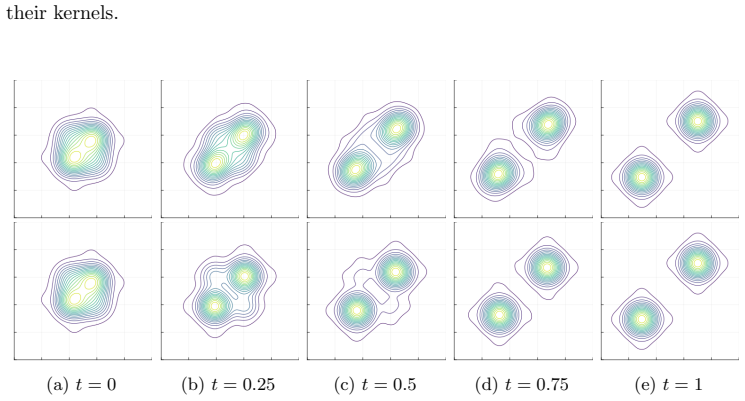
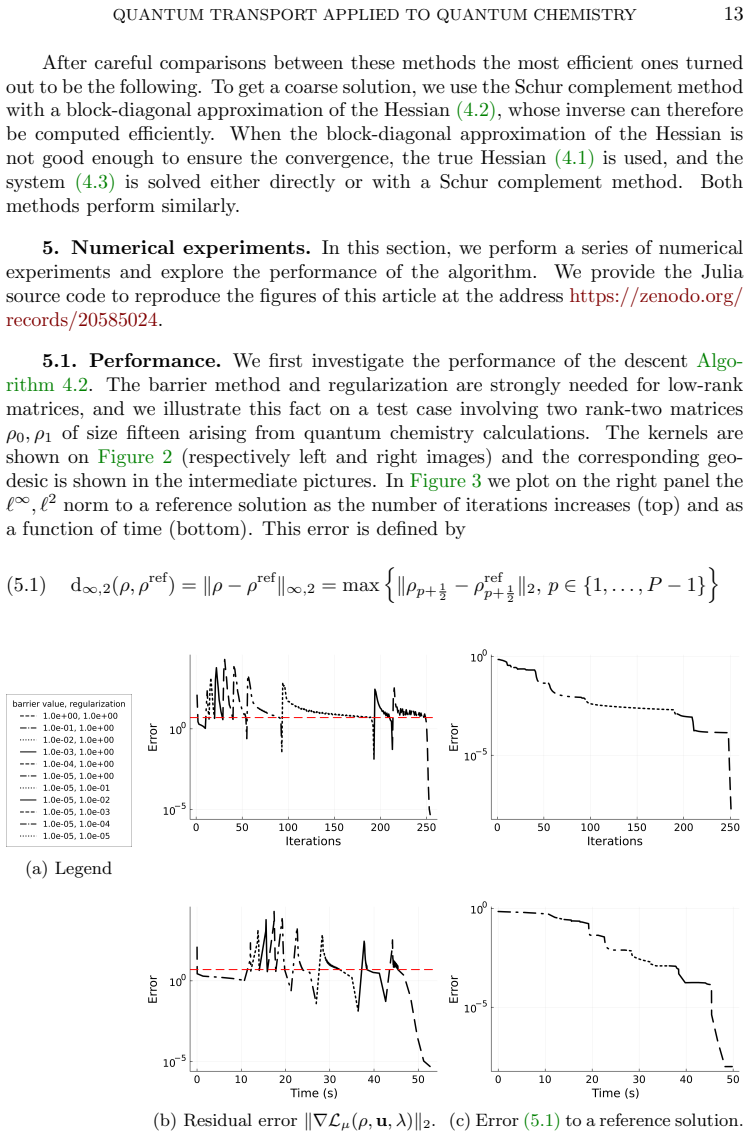
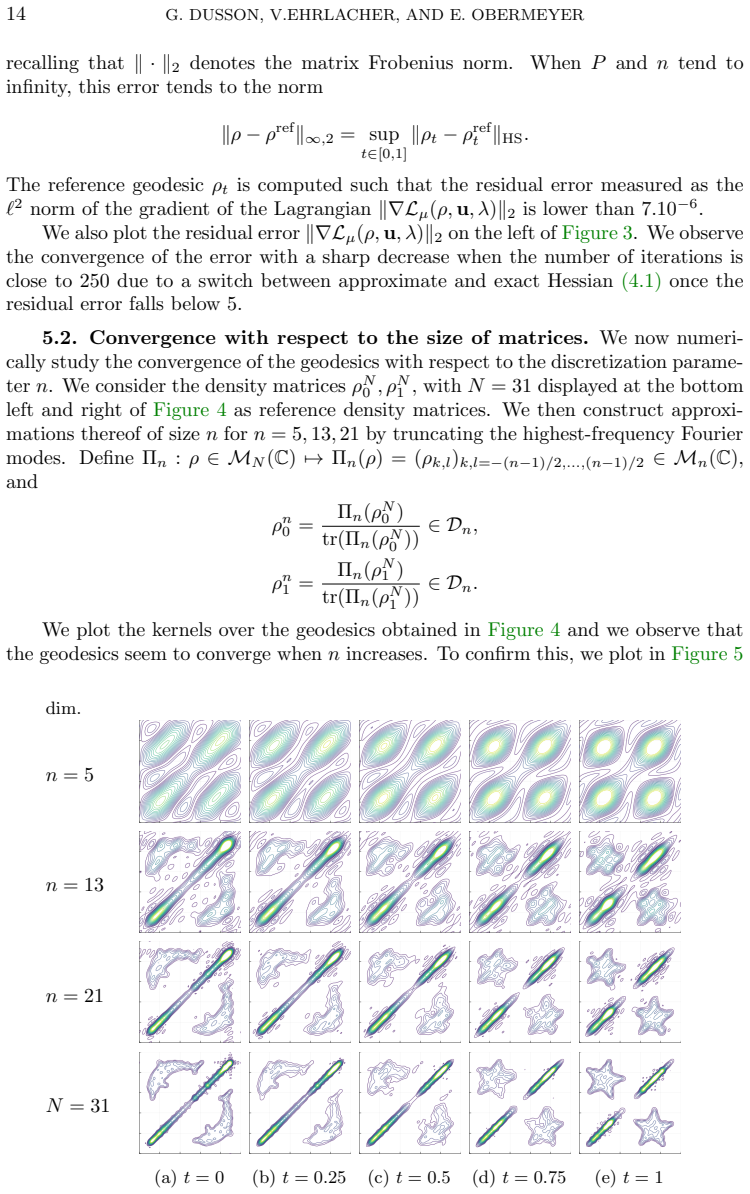
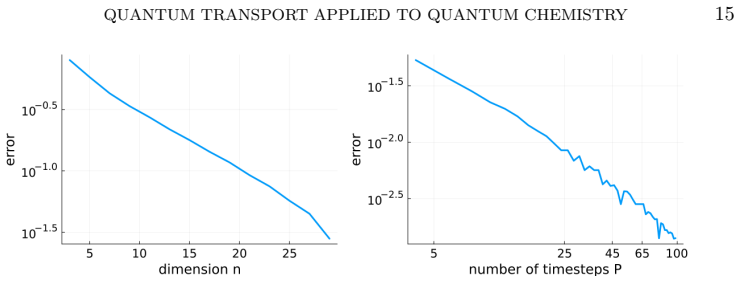
Quantum optimal transport (QOT) is a rapidly developing field. Among the many formulations of this adaptation of classical optimal transport (OT) to spaces of density matrices, we numerically study a family of distances based on a dynamical formulation inspired by the Benamou-Brenier OT formulation. We introduce an interior-point regularized method to compute geodesics between positive semidefinite matrices and visualize the results in terms of integral kernels and densities, inspired by quantum chemistry applications. We show that dynamical QOT may provide a good approximation to certain problems in quantum chemistry with appropriate parameter tuning. We also study the numerical properties of the distances at hand, and the convergence of the objects when the size of the matrices increases.
Editorial analysis
A structured set of objections, weighed in public.
Referee Report
Summary. The manuscript introduces an interior-point regularized dynamical formulation of quantum optimal transport (QOT) inspired by the Benamou-Brenier approach to compute geodesics between positive semidefinite matrices. It visualizes results via integral kernels and densities for quantum-chemistry-inspired applications, claims that dynamical QOT may approximate certain quantum chemistry problems with appropriate parameter tuning, and examines numerical properties together with convergence as matrix size increases.
Significance. The numerical study of convergence with increasing matrix dimension is a concrete strength that supports claims of practical scalability. If the approximation claim to quantum chemistry can be placed on a footing independent of post-hoc tuning (via error bounds or hold-out validation), the method could supply a new computational primitive for density-matrix problems; at present the conditional nature of the central claim limits its immediate significance.
major comments (2)
- [Abstract] Abstract: the assertion that dynamical QOT 'may provide a good approximation to certain problems in quantum chemistry with appropriate parameter tuning' supplies no a-priori error bounds relating the interior-point regularized geodesic to its unregularized counterpart, nor any validation protocol or hold-out procedure that separates parameter selection from reported approximation quality.
- [Abstract] Abstract and numerical-experiments section: the manuscript provides no quantitative error metrics, comparison against established quantum-chemistry benchmarks, or sensitivity analysis with respect to the regularization strength, step size, and other free parameters listed in the free_parameters ledger, so the practical utility of the visualized kernels and densities remains unquantified.
minor comments (1)
- [Throughout] Notation for the regularized versus unregularized dynamical formulations should be introduced explicitly at first use to avoid ambiguity when discussing convergence.
Simulated Author's Rebuttal
We thank the referee for the careful review and for recognizing the value of the convergence study with matrix dimension. We address each major comment below.
read point-by-point responses
-
Referee: [Abstract] Abstract: the assertion that dynamical QOT 'may provide a good approximation to certain problems in quantum chemistry with appropriate parameter tuning' supplies no a-priori error bounds relating the interior-point regularized geodesic to its unregularized counterpart, nor any validation protocol or hold-out procedure that separates parameter selection from reported approximation quality.
Authors: We agree that the claim is stated without supporting error bounds or an independent validation protocol. The statement is intended as an empirical observation from the visualizations rather than a substantiated result. In revision we will remove the claim from the abstract and replace it with a more qualified statement in the introduction and conclusion that frames the quantum-chemistry visualizations as illustrative only. revision: yes
-
Referee: [Abstract] Abstract and numerical-experiments section: the manuscript provides no quantitative error metrics, comparison against established quantum-chemistry benchmarks, or sensitivity analysis with respect to the regularization strength, step size, and other free parameters listed in the free_parameters ledger, so the practical utility of the visualized kernels and densities remains unquantified.
Authors: The numerical section is deliberately focused on qualitative visualization of the geodesics and on the observed convergence rate as matrix size grows. Direct quantitative comparisons to quantum-chemistry codes or benchmarks are outside the scope of the present work, which introduces a new dynamical QOT solver rather than evaluating it as a drop-in replacement. We will add a sensitivity study with respect to the regularization parameter and the step-size parameter in the revised numerical-experiments section; we will also include an explicit limitations paragraph noting the absence of benchmark comparisons. revision: partial
- Supplying a-priori error bounds that relate the interior-point regularized geodesic to its unregularized counterpart or to specific quantum-chemistry quantities; such bounds would require new theoretical analysis not contained in the current numerical study.
Circularity Check
Central claim of approximation to quantum chemistry rests on post-hoc parameter tuning whose effect is not bounded
specific steps
-
fitted input called prediction
[Abstract]
"We show that dynamical QOT may provide a good approximation to certain problems in quantum chemistry with appropriate parameter tuning."
The demonstration of approximation quality is achieved by selecting regularization strength, step size and other parameters; the reported match is therefore a consequence of that fitting step rather than an independent property of the unregularized dynamical formulation.
full rationale
The paper's algorithm for dynamical QOT is the core contribution and appears self-contained. However, the load-bearing claim that it 'may provide a good approximation to certain problems in quantum chemistry' is explicitly conditioned on 'appropriate parameter tuning' (regularization, step size, etc.). This matches the fitted-input-called-prediction pattern: the reported agreement is obtained by choosing parameters to produce the match, with no a-priori bounds or hold-out separation shown between tuning and evaluation. No other circular patterns (self-definition, self-citation chains, ansatz smuggling) are exhibited in the abstract or described derivation.
Axiom & Free-Parameter Ledger
free parameters (1)
- regularization and tuning parameters
Reference graph
Works this paper leans on
-
[1]
Barycenters in the Wasserstein space
Agueh, Martial and Carlier, Guillaume , year = 2011, month = jan, journal =. Barycenters in the. doi:10.1137/100805741 , urldate =
-
[2]
Nonlinear reduced basis using mixture Wasserstein barycenters: Application to an eigenvalue problem inspired from quantum chemistry
Dalery, Maxime and Dusson, Geneviève and Ehrlacher, Virginie and Lozinski, Alexei. Nonlinear reduced basis using mixture Wasserstein barycenters: Application to an eigenvalue problem inspired from quantum chemistry. Constr. Approx
-
[3]
Wasserstein Distances on Quantum Structures: an Overview
Beatty, Emily , year = 2025, month = jun, number =. Wasserstein. doi:10.48550/arXiv.2506.09794 , urldate =. arXiv , keywords =:2506.09794 , primaryclass =
work page internal anchor Pith review Pith/arXiv arXiv doi:10.48550/arxiv.2506.09794 2025
-
[4]
Numerische Mathematik , author =
Benamou, Jean-David and Brenier, Yann , year = 2000, month = jan, journal =. A Computational Fluid Mechanics Solution to the. doi:10.1007/s002110050002 , urldate =
-
[5]
SIAM Journal on Scientific Computing , author =
Benamou, Jean-David and Carlier, Guillaume and Cuturi, Marco and Nenna, Luca and Peyr. Iterative. SIAM Journal on Scientific Computing , volume =. doi:10.1137/141000439 , urldate =
-
[6]
Numerical Solution of Saddle Point Problems , author =. Acta Numerica , volume =. doi:10.1017/S0962492904000212 , urldate =
-
[7]
Benzi, Michele and Wathen, Andrew J. , editor =. Some. Model. doi:10.1007/978-3-540-78841-6_10 , urldate =
-
[8]
Bonnans, J. Fr. Numerical Optimization: Theoretical and Practical Aspects , shorttitle =
-
[9]
Caglioti, Emanuele and Golse, Fran. Towards. doi:10.48550/arXiv.2101.03256 , urldate =. arXiv , keywords =:2101.03256 , primaryclass =
-
[10]
M\'ethodes Math\'ematiques En Chimie Quantique
Canc. M\'ethodes Math\'ematiques En Chimie Quantique. doi:10.1007/3-540-37661-5 , urldate =
-
[11]
Journal of Statistical Physics , volume =
Non-Commutative Calculus, Optimal Transport and Functional Inequalities in Dissipative Quantum Systems , author =. Journal of Statistical Physics , volume =. doi:10.1007/s10955-019-02434-w , urldate =. arXiv , keywords =:1811.04572 , primaryclass =
-
[12]
Matrix Optimal Mass Transport: A Quantum Mechanical Approach
Chen, Yongxin and Georgiou, Tryphon T. and Tannenbaum, Allen , year = 2016, month = oct, number =. Matrix. doi:10.48550/arXiv.1610.03041 , urldate =. arXiv , keywords =:1610.03041 , primaryclass =
work page internal anchor Pith review Pith/arXiv arXiv doi:10.48550/arxiv.1610.03041 2016
-
[13]
An Efficient Algorithm for Matrix-Valued and Vector-Valued Optimal Mass Transport
Chen, Yongxin and Haber, Eldad and Yamamoto, Kaoru and Georgiou, Tryphon T. and Tannenbaum, Allen , year = 2017, month = jun, number =. An. doi:10.48550/arXiv.1706.08841 , urldate =. arXiv , keywords =:1706.08841 , primaryclass =
work page internal anchor Pith review Pith/arXiv arXiv doi:10.48550/arxiv.1706.08841 2017
-
[14]
On the Matrix Monge-Kantorovich Problem
Chen, Yongxin and Gangbo, Wilfrid and Georgiou, Tryphon T. and Tannenbaum, Allen , year = 2017, month = oct, number =. On the. doi:10.48550/arXiv.1701.02826 , urldate =. arXiv , keywords =:1701.02826 , primaryclass =
work page internal anchor Pith review Pith/arXiv arXiv doi:10.48550/arxiv.1701.02826 2017
-
[15]
and Tannenbaum, Allen , year = 2018, journal =
Chen, Yongxin and Georgiou, Tryphon T. and Tannenbaum, Allen , year = 2018, journal =. Vector-. 45093529 , pages =
2018
-
[16]
Cole, Sam and Eckstein, Micha. Quantum. Mathematical Physics, Analysis and Geometry , volume =. doi:10.1007/s11040-023-09456-7 , urldate =. arXiv , langid =:2105.06922 , primaryclass =
-
[17]
Wasserstein Barycenter Model Ensembling
Dognin, Pierre and Melnyk, Igor and Mroueh, Youssef and Ross, Jerret and Santos, Cicero Dos and Sercu, Tom , year = 2019, month = feb, number =. Wasserstein. doi:10.48550/arXiv.1902.04999 , urldate =. arXiv , keywords =:1902.04999 , primaryclass =
work page internal anchor Pith review Pith/arXiv arXiv doi:10.48550/arxiv.1902.04999 2019
-
[18]
Duvenhage, Rocco , year = 2022, month = nov, number =. Quadratic. doi:10.48550/arXiv.2012.03564 , urldate =. arXiv , keywords =:2012.03564 , primaryclass =
-
[19]
doi:10.48550/arXiv.2209.00315 , urldate =
Efficient Preconditioners for Solving Dynamical Optimal Transport via Interior Point Methods , author =. doi:10.48550/arXiv.2209.00315 , urldate =. arXiv , keywords =:2209.00315 , primaryclass =
-
[20]
Journal of Machine Learning Research , publisher =
Flamary, R. Journal of Machine Learning Research , publisher =
-
[21]
Forsgren, Anders and Gill, Philip E. and Wright, Margaret H. , year = 2002, month = jan, journal =. Interior. doi:10.1137/S0036144502414942 , urldate =
-
[22]
Haber, Eldad and Horesh, Raya , year = 2015, month = feb, journal =. A. doi:10.4208/nmtma.2015.w02si , urldate =
-
[23]
Meyer, Paul-Andr. Quantum. doi:10.1007/BFb0084701 , urldate =
-
[24]
Memoire Sur La Theorie Des Deblais et Des Remblais , author =. Mem. Math. Phys. Acad. Royale Sci. , pages =
-
[25]
ESAIM: Mathematical Modelling and Numerical Analysis , volume =
Computation of Optimal Transport with Finite Volumes , author =. ESAIM: Mathematical Modelling and Numerical Analysis , volume =. doi:10.1051/m2an/2021041 , urldate =
-
[26]
Nesterov, Yurii and Nemirovskii, Arkadii , year = 1994, month = jan, publisher =. Interior-. doi:10.1137/1.9781611970791 , urldate =
-
[27]
Otto, Felix , year = 2001, month = jan, journal =. The. doi:10.1081/PDE-100002243 , urldate =
-
[28]
Papadakis, Nicolas and Peyr. Optimal. SIAM Journal on Imaging Sciences , volume =. doi:10.1137/130920058 , urldate =
-
[29]
Peyr. Computational. doi:10.48550/arXiv.1803.00567 , urldate =. arXiv , keywords =:1803.00567 , primaryclass =
-
[30]
An ‘empirical interpolation’method: application to efficient reduced-basis discretization of partial differential equations
Barrault, Maxime and Maday, Yvon and Nguyen, Ngoc Cuong and Patera, Anthony T. An ‘empirical interpolation’method: application to efficient reduced-basis discretization of partial differential equations. C. R. Math
-
[31]
Certified Reduced Basis Methods for Parametrized Partial Differential Equations
Hesthaven, Jan S and Rozza, Gianluigi and Stamm, Benjamin. Certified Reduced Basis Methods for Parametrized Partial Differential Equations
-
[32]
Quan, Xue and Chen, Huajie , year = 2023, month = sep, journal =. A. doi:10.1016/j.jcp.2023.112251 , urldate =. arXiv , keywords =:2208.07526 , primaryclass =
-
[33]
A Wasserstein-Type Distance in the Space of Gaussian Mixture Models
Delon, Julie and Desolneux, Agnès. A Wasserstein-Type Distance in the Space of Gaussian Mixture Models. SIAM J. Imaging Sci
-
[34]
Gromov–Wasserstein distances and the metric approach to object matching
Mémoli, Facundo. Gromov–Wasserstein distances and the metric approach to object matching. Found. Comput. Math
-
[35]
Data-driven regularization of Wasserstein barycenters with an application to multivariate density registration
Bigot, Jérémie and Cazelles, Elsa and Papadakis, Nicolas. Data-driven regularization of Wasserstein barycenters with an application to multivariate density registration. arXiv [stat.ME]
-
[36]
Sparse Wasserstein barycenters and application to reduced order modeling
Do, Minh-Hieu and Feydy, Jean and Mula, Olga. Sparse Wasserstein barycenters and application to reduced order modeling. J. Sci. Comput
-
[37]
Fast Computation of Wasserstein Barycenters
Cuturi, Marco and Doucet, Arnaud. Fast Computation of Wasserstein Barycenters. arXiv [stat.ML]
-
[38]
Wasserstein Barycenter Model Ensembling
Dognin, Pierre and Melnyk, Igor and Mroueh, Youssef and Ross, Jerret and Dos Santos, Cicero and Sercu, Tom. Wasserstein Barycenter Model Ensembling. arXiv [cs.LG]
-
[39]
Wasserstein barycentric coordinates: histogram regression using optimal transport
Bonneel, Nicolas and Peyré, Gabriel and Cuturi, Marco. Wasserstein barycentric coordinates: histogram regression using optimal transport. ACM Trans. Graph
-
[40]
Rabin, Julien and Peyr. Wasserstein. Scale. doi:10.1007/978-3-642-24785-9_37 , urldate =
-
[41]
Methods of
Reed, Michael and Simon, Barry , year = 1980, month = dec, volume =. Methods of
1980
-
[42]
S. Unbalanced. doi:10.48550/arXiv.2211.08775 , urldate =. arXiv , keywords =:2211.08775 , primaryclass =
discussion (0)
Sign in with ORCID, Apple, or X to comment. Anyone can read and Pith papers without signing in.