Nonflow Subtraction Beyond Two-Particle Correlations
Pith reviewed 2026-06-27 14:20 UTC · model grok-4.3
The pith
A framework subtracts nonflow from m-particle cumulants using 1/N^{m-1} scaling and v1 estimators.
A machine-rendered reading of the paper's core claim, the machinery that carries it, and where it could break.
Core claim
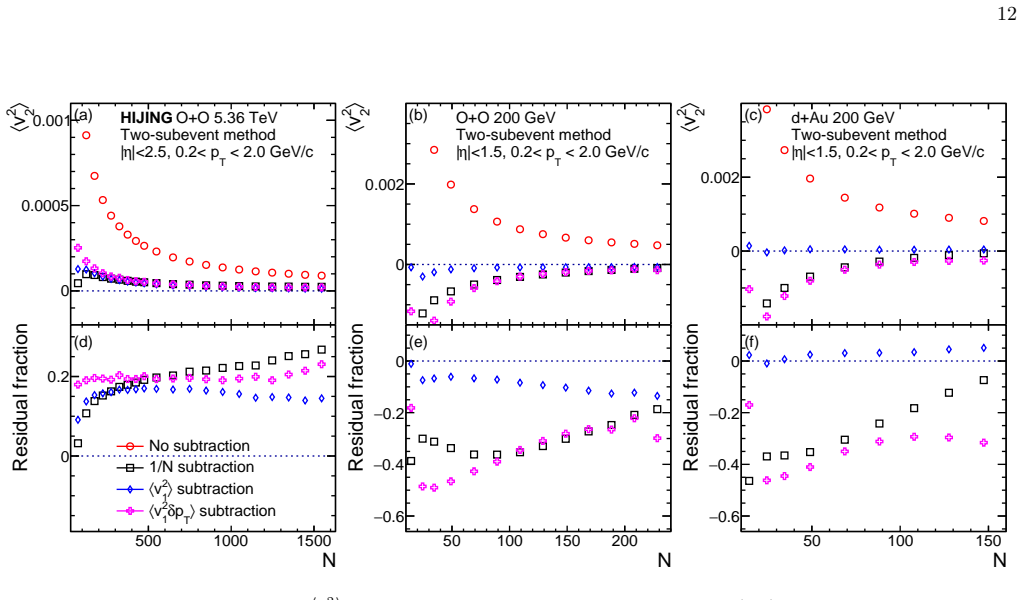
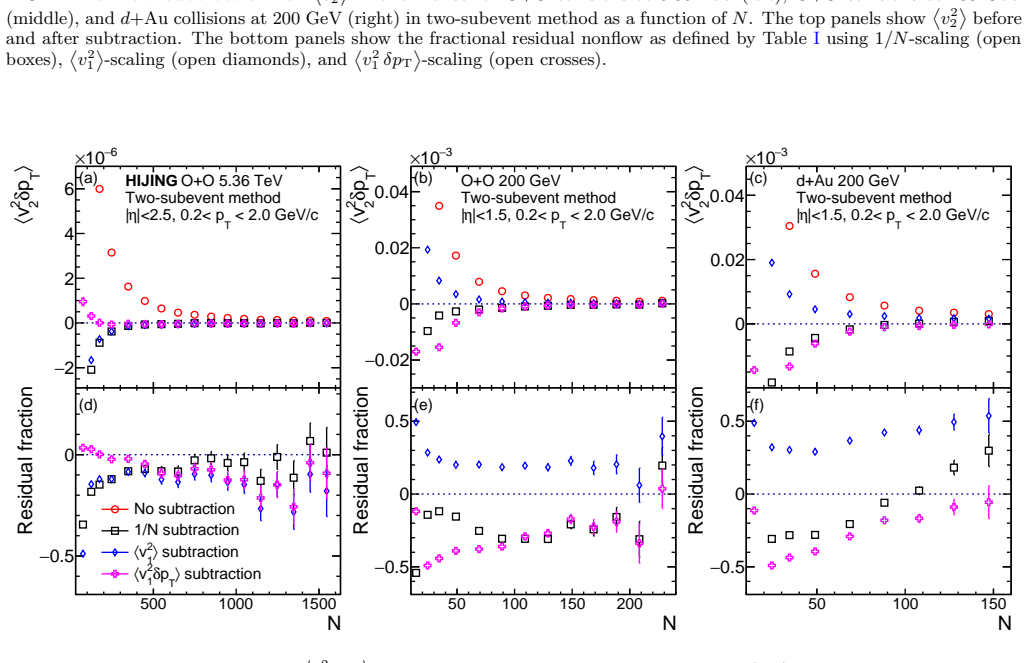
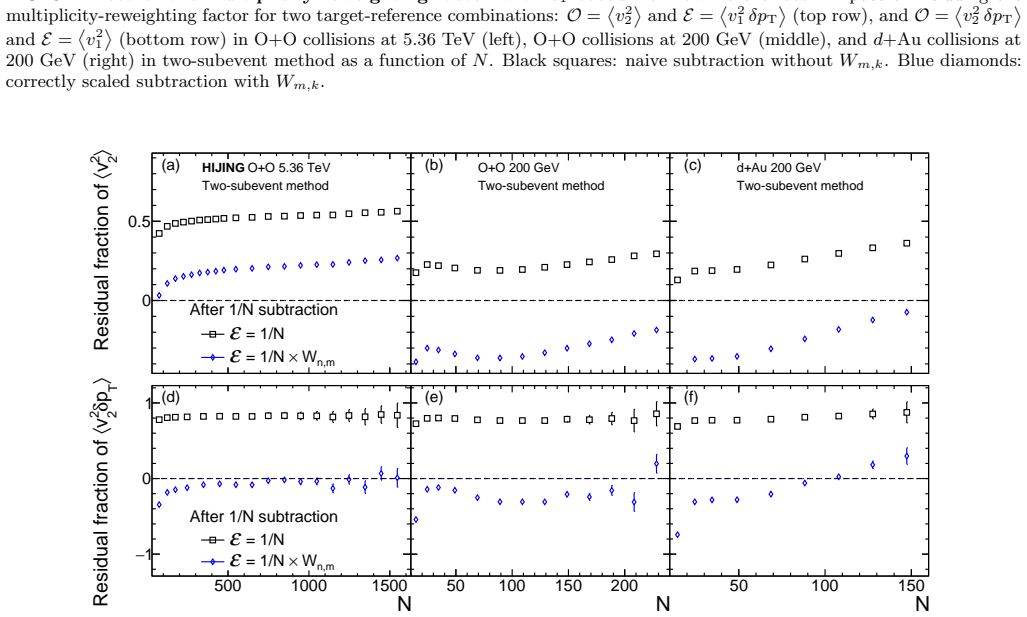
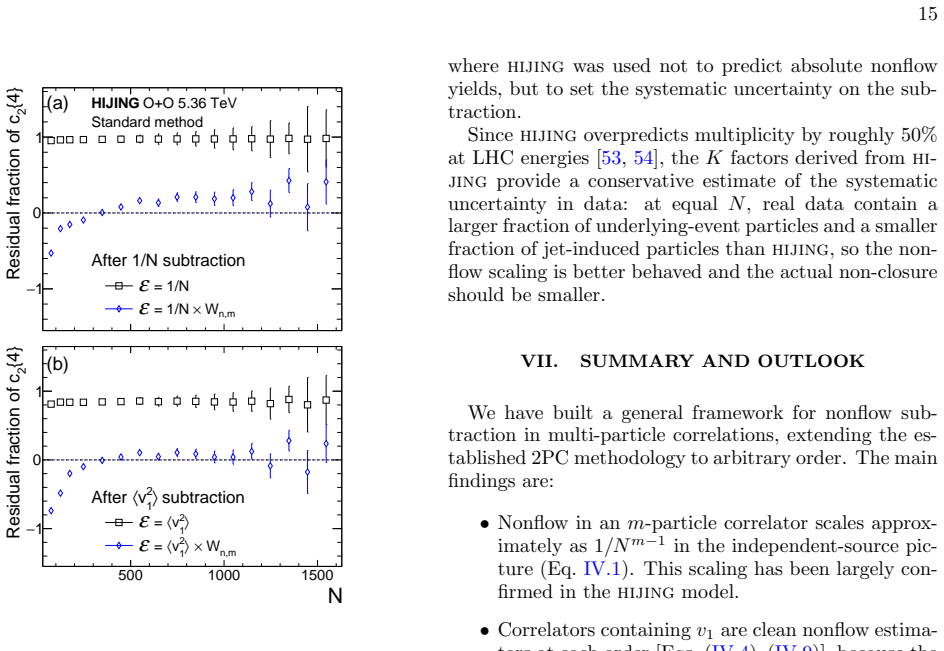
The framework gives a systematic route to nonflow subtraction beyond two-particle correlations, broadening the class of multi-particle observables accessible to the small-system flow program. Using the approximate 1/N^{m-1} scaling of nonflow and v1-containing correlators as clean estimators, the method removes most nonflow from target observables such as <v2^2>, <v2^2 δpT>, and c2{4} in HIJING simulations of O+O and d+Au collisions, leaving residual fractions typically within 20-30 percent at the two-particle level. It also identifies a multiplicity-reweighting correction whose impact increases as a power of the correlator order.
What carries the argument
m-particle nonflow subtraction framework based on the approximate 1/N^{m-1} scaling of nonflow in the independent-source picture, with v1-containing correlators serving as estimators.
If this is right
- Most nonflow is removed from three target observables in O+O and d+Au collisions at LHC and RHIC energies.
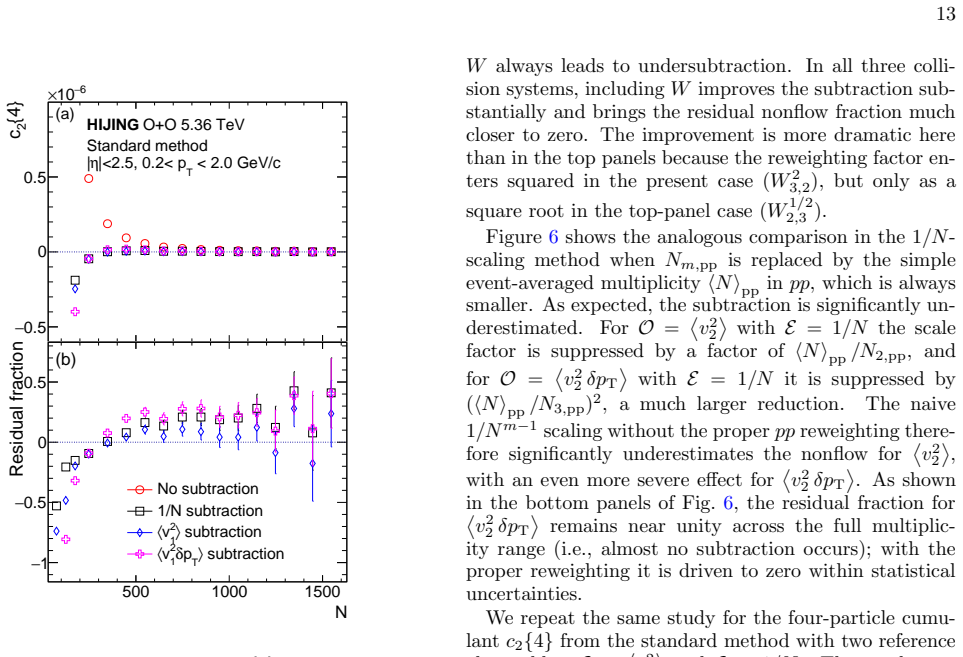
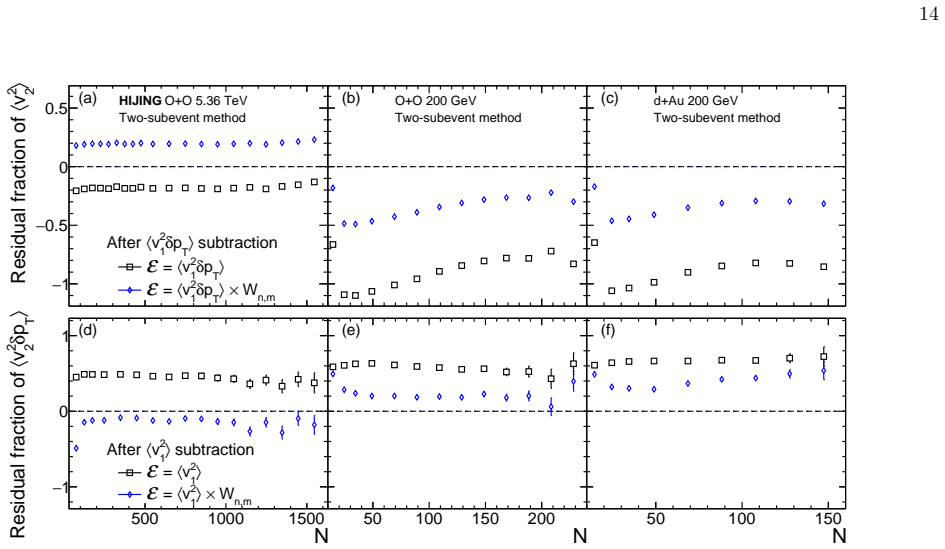
- A multiplicity-reweighting correction must be included; its size grows with the order of the cumulant.
- Residual nonflow after subtraction is typically 20-30 percent when expressed at the two-particle level.
- The same procedure can be applied to additional multi-particle observables once the scaling assumption holds.
Where Pith is reading between the lines
- The method could push multi-particle flow measurements to still lower multiplicities than currently possible.
- Similar estimators might be constructed for other harmonics if their integrated flow also vanishes.
- The framework's performance should be cross-checked in models that include both flow and nonflow to test robustness of the residuals.
Load-bearing premise
Nonflow obeys an approximate 1/N^{m-1} scaling in the independent-source picture, and pT-integrated dipolar flow nearly vanishes.
What would settle it
Apply the subtraction to a controlled simulation containing only nonflow (no flow) and check whether the corrected multi-particle signals fall to zero within the quoted residual fractions.
Figures

read the original abstract
Establishing collective flow in small collision systems is crucial for pinning down the minimum conditions for quark-gluon plasma (QGP) formation. In two-particle correlations, nonflow has been subtracted with good control, pushing the reach of flow measurements down to very small particle multiplicities $N$. However, the multi-particle nature of collectivity has not been established in the same $N$ regime, because the residual nonflow surviving the subevent procedure in multi-particle cumulants has never been quantified. We develop a general nonflow subtraction framework for $m$-particle cumulants, built around the approximate $1/N^{m-1}$ scaling of nonflow in the independent-source picture. Correlators containing $v_1$ serve as clean nonflow estimators, since the $p_{\rm T}$-integrated dipolar flow nearly vanishes. Using \HIJING{} as a controlled nonflow-only environment, we test the subtraction for three target observables ($\langle v_2^2\rangle$, $\langle v_2^2\delta p_{\rm T}\rangle$, and $c_2\{4\}$) in O+O and $d$+Au at $\sqrt{s_{\rm NN}} = 5.36$ TeV and 200 GeV. Most of the nonflow is removed, with residual fractions typically within 20--30% when converted to the two-particle level, though the best estimator differs across the three targets. We identify a multiplicity-reweighting correction, previously overlooked in two-particle correlations, that explains the long-standing undersubtraction of the naive $1/N$-scaling method; its impact grows as a power of the correlator order. The framework gives a systematic route to nonflow subtraction beyond two-particle correlations, broadening the class of multi-particle observables accessible to the small-system flow program.
Editorial analysis
A structured set of objections, weighed in public.
Referee Report
Summary. The paper develops a general nonflow subtraction framework for m-particle cumulants in small systems, based on the approximate 1/N^{m-1} scaling of nonflow in the independent-source picture and the use of v1-containing correlators as clean estimators (since pT-integrated dipolar flow nearly vanishes). It identifies a previously overlooked multiplicity-reweighting correction that explains undersubtraction in the naive 1/N method. The framework is tested in HIJING (nonflow-only) for O+O and d+Au at 5.36 TeV and 200 GeV on three observables—<v2^2>, <v2^2 δpT>, and c2{4}—reporting that most nonflow is removed with typical residuals of 20-30% when converted to the two-particle level, with the best estimator varying by target. The work aims to extend reliable multi-particle flow measurements to lower multiplicities.
Significance. If the central assumptions hold under realistic conditions, the result would be significant for the small-system flow program by providing a systematic route to nonflow subtraction in higher-order cumulants, thereby broadening the class of accessible multi-particle observables. A clear strength is the identification and explanation of the multiplicity-reweighting correction, which resolves a long-standing issue in two-particle methods and grows with correlator order. The controlled HIJING tests supply a reproducible validation benchmark for the scaling approach.
major comments (3)
- [HIJING validation section] HIJING validation section (abstract and corresponding results): The subtraction performance is demonstrated exclusively in a nonflow-only HIJING environment. The central claim—that the framework enables multi-particle observables for the small-system flow program—requires that v1 estimators remain clean and that the 1/N^{m-1} scaling continues to hold without biasing the underlying flow signal when collective flow is simultaneously present; no hybrid flow+nonflow tests are described, leaving this load-bearing assumption untested.
- [Framework construction] Framework construction (abstract): The method is built around the approximate 1/N^{m-1} scaling and the assumption that pT-integrated v1 nearly vanishes. No quantitative assessment of deviations from the scaling (e.g., via error propagation or robustness checks) is provided, nor is the impact of finite v1 quantified, both of which are required to establish the precision of the subtracted cumulants for the three target observables.
- [Residual quantification] Residual quantification (abstract): Residual fractions are reported as 'typically within 20--30% when converted to the two-particle level,' but the conversion procedure, its uncertainties, and how residuals propagate to the final flow observables are not detailed; this affects evaluation of whether the method achieves the claimed control for c2{4} and the pT-differential observables.
minor comments (2)
- The abstract would benefit from a brief statement of the derivation steps for the multiplicity-reweighting correction and the explicit form of the m-particle estimators.
- Notation for the target observables (<v2^2>, <v2^2 δpT>, c2{4}) should be defined at first use to improve readability for readers outside the immediate subfield.
Simulated Author's Rebuttal
We thank the referee for the careful reading and constructive comments. We address each major comment below. We agree that additional details and discussion will strengthen the manuscript and will revise accordingly.
read point-by-point responses
-
Referee: [HIJING validation section] HIJING validation section (abstract and corresponding results): The subtraction performance is demonstrated exclusively in a nonflow-only HIJING environment. The central claim—that the framework enables multi-particle observables for the small-system flow program—requires that v1 estimators remain clean and that the 1/N^{m-1} scaling continues to hold without biasing the underlying flow signal when collective flow is simultaneously present; no hybrid flow+nonflow tests are described, leaving this load-bearing assumption untested.
Authors: The manuscript states that HIJING serves as a controlled nonflow-only environment to isolate and quantify nonflow subtraction. The framework is derived from the independent-source picture, under which nonflow contributions are additive and independent of any collective flow; the 1/N^{m-1} scaling and v1 estimator properties therefore apply when flow is present. We acknowledge that explicit hybrid tests are absent. We will add a dedicated paragraph in the discussion section explaining why the independent-source assumption implies the subtraction remains unbiased by flow, while noting that full hybrid validation is left for future work. revision: partial
-
Referee: [Framework construction] Framework construction (abstract): The method is built around the approximate 1/N^{m-1} scaling and the assumption that pT-integrated v1 nearly vanishes. No quantitative assessment of deviations from the scaling (e.g., via error propagation or robustness checks) is provided, nor is the impact of finite v1 quantified, both of which are required to establish the precision of the subtracted cumulants for the three target observables.
Authors: We will revise the manuscript to include quantitative robustness checks: we will vary multiplicity binning, compute the observed deviation from exact 1/N^{m-1} scaling, and propagate the resulting uncertainty to the subtracted cumulants. For finite v1, we will add an estimate of its residual contribution using the documented smallness of pT-integrated v1 in small systems and show its effect on the precision of the three target observables. revision: yes
-
Referee: [Residual quantification] Residual quantification (abstract): Residual fractions are reported as 'typically within 20--30% when converted to the two-particle level,' but the conversion procedure, its uncertainties, and how residuals propagate to the final flow observables are not detailed; this affects evaluation of whether the method achieves the claimed control for c2{4} and the pT-differential observables.
Authors: We agree that the conversion and propagation details are insufficiently explicit. In the revised manuscript we will provide the explicit conversion formulas used to translate higher-order residuals to the two-particle level, state the associated uncertainties, and describe how these residuals propagate into the final values of c2{4} and the pT-differential observables. revision: yes
Circularity Check
No circularity; framework uses external HIJING validation on independent-source scaling assumption
full rationale
The paper constructs its m-particle nonflow subtraction around the approximate 1/N^{m-1} scaling from the independent-source picture and v1 correlators as estimators, then tests the method directly in HIJING (a controlled nonflow-only Monte Carlo) for observables like <v2^2>, <v2^2 δpT>, and c2{4}. No steps reduce by construction to fitted inputs, self-citations, or renamed known results; the scaling is an explicit modeling assumption whose performance is checked against external simulation output rather than being tautological. The derivation chain remains self-contained against the benchmark.
Axiom & Free-Parameter Ledger
axioms (1)
- domain assumption Nonflow scales approximately as 1/N^{m-1} in the independent-source picture
Reference graph
Works this paper leans on
-
[1]
Method 1:c 0 scaling 9
-
[2]
Method 2a: native estimator 9
-
[3]
Method 2b: pseudo-native estimator 9
-
[4]
Method 2c: mixed-order estimator 9
-
[5]
Considerations in subtraction strategy 9 V. Analysis setup 9 VI. Results 10 A. Nonflow scaling behavior 10 B. Subtraction performance 11 C. Importance of the multiplicity-weighting 13 D. Non-closure correction in data 13 VII. Summary and outlook 15 A. The effective multiplet multiplicityN m 16 B. The alternative effective multiplicityM m 16 References 17 ...
Pith/arXiv arXiv 2026
-
[6]
(IV.10) takes the form v2 n = v2 n obs −N 2,pp/N2 v2 n obs pp , v2 n δpT = v2 n δpT obs −(N 3,pp/N3)2 v2 n δpT obs pp , cn{4}=c n{4}obs −(N 4,pp/N4)3 cn{4}obs pp .(IV.16)
Method 1:c 0 scaling WhenE{k}= 1/N k−1 (pure multiplicity scaling) is used, Eq. (IV.10) takes the form v2 n = v2 n obs −N 2,pp/N2 v2 n obs pp , v2 n δpT = v2 n δpT obs −(N 3,pp/N3)2 v2 n δpT obs pp , cn{4}=c n{4}obs −(N 4,pp/N4)3 cn{4}obs pp .(IV.16)
-
[7]
Method 2a: native estimator Use av 1-containing reference observable in Eq. (IV.10) matched at the same order as the target, e.g.m=k: v2 n = v2 n obs − v2 1 obs ⟨v2 1⟩obs pp v2 n obs pp , v2 n δpT = v2 n δpT obs − v2 1 δpT obs ⟨v2 1 δpT⟩obs pp v2 n δpT obs pp , cn{4}=c n{4}obs − c1{4}obs c1{4}obspp cn{4}obs pp . sc(n, m) = sc(n, m)obs − sc(1, n)obs sc(1, ...
-
[8]
For example V 2 2 V ∗ 4 = V 2 2 V ∗ 4 obs − V 2 1 V ∗ 2 obs ⟨V 2 1 V ∗ 2 ⟩obs pp V 2 2 V ∗ 4 obs pp , (IV.18) or alternatively using⟨V 1V2V ∗ 3 ⟩as the estimator
Method 2b: pseudo-native estimator For mixed-harmonic targets such as V 2 2 V ∗ 4 or ⟨V2V3V ∗ 5 ⟩, one may use a pseudo-native estimator with m=kbut containing harmonics of different order. For example V 2 2 V ∗ 4 = V 2 2 V ∗ 4 obs − V 2 1 V ∗ 2 obs ⟨V 2 1 V ∗ 2 ⟩obs pp V 2 2 V ∗ 4 obs pp , (IV.18) or alternatively using⟨V 1V2V ∗ 3 ⟩as the estimator
-
[9]
It is not clear a priori which ones are good, and need to be carefully validated in model studies
Method 2c: mixed-order estimator Estimate the nonflow using a reference of different or- der, e.g.k̸=m; for example: v2 n = v2 n obs − v2 1 δpT obs ⟨v2 1 δpT⟩obs pp !1/2 N2,pp N3,pp N3 N2 v2 n obs pp , v2 n δpT = v2 n δpT obs − v2 1 obs ⟨v2 1⟩obs pp N3,pp N2,pp N2 N3 !2 v2 n δpT obs pp , cn{4}=c n{4}obs − v2 1 obs ⟨v2 1⟩obs pp N4,pp N2,pp N2 N4 !3 cn{4}ob...
-
[10]
IV A applies to multi-particle cumulants rather than to multi-particle moments; the two have fundamentally different scaling behavior
Considerations in subtraction strategy The nonflow scaling argument in Sec. IV A applies to multi-particle cumulants rather than to multi-particle moments; the two have fundamentally different scaling behavior. For example, the nonflow contribution to the four-particle moment v4 n scales as 1/N 2, whereas that for the cumulantc n{4}scales as 1/N 3. Nonflo...
-
[11]
Khachatryanet al.(CMS), JHEP09, 091 (2010), arXiv:1009.4122 [hep-ex]
V. Khachatryanet al.(CMS), JHEP09, 091 (2010), arXiv:1009.4122 [hep-ex]
Pith/arXiv arXiv 2010
-
[12]
S. Chatrchyanet al.(CMS), Phys. Lett. B718, 795 (2013), arXiv:1210.5482 [nucl-ex]
Pith/arXiv arXiv 2013
-
[13]
G. Aadet al.(ATLAS), Phys. Rev. Lett.110, 182302 (2013), arXiv:1212.5198 [hep-ex]
Pith/arXiv arXiv 2013
-
[14]
B. Abelevet al.(ALICE), Phys. Lett. B719, 29 (2013), arXiv:1212.2001 [nucl-ex]
Pith/arXiv arXiv 2013
-
[15]
A. Adareet al.(PHENIX), Phys. Rev. Lett.111, 212301 (2013), arXiv:1303.1794 [nucl-ex]
arXiv 2013
-
[16]
G. Aadet al.(ATLAS), Phys. Rev. C90, 044906 (2014), arXiv:1409.1792 [hep-ex]
Pith/arXiv arXiv 2014
-
[17]
V. Khachatryanet al.(CMS), Phys. Rev. Lett.115, 012301 (2015), arXiv:1502.05382 [nucl-ex]
Pith/arXiv arXiv 2015
-
[18]
M. Aaboudet al.(ATLAS), Phys. Rev. C97, 024904 (2018), arXiv:1708.03559 [hep-ex]
Pith/arXiv arXiv 2018
-
[19]
G. Aadet al.(ATLAS), Eur. Phys. J. C80, 73 (2020), arXiv:1910.13978 [nucl-ex]
arXiv 2020
-
[20]
G. Aadet al.(ATLAS), Phys. Rev. C104, 014903 (2021), arXiv:2101.10771 [nucl-ex]
arXiv 2021
-
[21]
Acharyaet al.(ALICE), Nature Commun.17, 2585 (2026), arXiv:2411.09323 [nucl-ex]
S. Acharyaet al.(ALICE), Nature Commun.17, 2585 (2026), arXiv:2411.09323 [nucl-ex]
arXiv 2026
-
[22]
K. Dusling, W. Li, and B. Schenke, Int. J. Mod. Phys. E25, 1630002 (2016), arXiv:1509.07939 [nucl-ex]
Pith/arXiv arXiv 2016
-
[23]
J. L. Nagle and W. A. Zajc, Ann. Rev. Nucl. Part. Sci. 68, 211 (2018), arXiv:1801.03477 [nucl-ex]
Pith/arXiv arXiv 2018
-
[24]
W. Busza, K. Rajagopal, and W. van der Schee, Ann. Rev. Nucl. Part. Sci.68, 339 (2018), arXiv:1802.04801 [hep-ph]
Pith/arXiv arXiv 2018
- [25]
-
[26]
G. Aadet al.(ATLAS), Phys. Rev. Lett.116, 172301 (2016), arXiv:1509.04776 [hep-ex]
Pith/arXiv arXiv 2016
-
[27]
S. Chatrchyanet al.(CMS), Phys. Lett. B724, 213 (2013), arXiv:1305.0609 [nucl-ex]
Pith/arXiv arXiv 2013
-
[28]
M. I. Abdulhamidet al.(STAR), Phys. Rev. Lett.130, 242301 (2023), arXiv:2210.11352 [nucl-ex]
arXiv 2023
-
[29]
N. Borghini, P. M. Dinh, and J.-Y. Ollitrault, Phys. Rev. C64, 054901 (2001), arXiv:nucl-th/0105040
Pith/arXiv arXiv 2001
-
[30]
M. Aaboudet al.(ATLAS), Phys. Lett. B789, 444 (2019), arXiv:1807.02012 [nucl-ex]
Pith/arXiv arXiv 2019
-
[31]
A. Adareet al.(PHENIX), Phys. Rev. C98, 014912 (2018), arXiv:1711.09003 [hep-ex]
arXiv 2018
-
[32]
J. Jia, M. Zhou, and A. Trzupek, Phys. Rev. C96, 034906 (2017), arXiv:1701.03830 [nucl-th]
Pith/arXiv arXiv 2017
-
[33]
P. Bozek and W. Broniowski, Phys. Lett. B752, 206 (2016), arXiv:1506.02817 [nucl-th]
Pith/arXiv arXiv 2016
-
[34]
J. Jia and P. Huo, Phys. Rev. C90, 034905 (2014), arXiv:1402.6680 [nucl-th]
Pith/arXiv arXiv 2014
-
[35]
A. Mazeliauskas and D. Teaney, Phys. Rev. C91, 044902 (2015), arXiv:1501.03138 [nucl-th]
Pith/arXiv arXiv 2015
-
[36]
A. M. Sirunyanet al.(CMS), Phys. Rev. C103, 014902 (2021), arXiv:1905.09935 [hep-ex]
arXiv 2021
-
[37]
S. Acharyaet al.(ALICE), Phys. Rev. Lett.123, 142301 (2019), arXiv:1903.01790 [nucl-ex]
arXiv 2019
-
[38]
A. M. Sirunyanet al.(CMS), Phys. Rev. Lett.120, 092301 (2018), arXiv:1709.09189 [nucl-ex]
Pith/arXiv arXiv 2018
-
[39]
G. Aadet al.(ATLAS), Phys. Rev. C107, 054910 (2023), arXiv:2205.00039 [nucl-ex]
arXiv 2023
-
[40]
Tumasyanet al.(CMS), (2024), arXiv:2410.04578 18 [nucl-ex]
A. Tumasyanet al.(CMS), (2024), arXiv:2410.04578 18 [nucl-ex]
arXiv 2024
-
[41]
I. J. Abualrobet al.(ALICE), (2026), arXiv:2603.13217 [nucl-ex]
arXiv 2026
-
[42]
A. Bilandzic, R. Snellings, and S. Voloshin, Phys. Rev. C83, 044913 (2011), arXiv:1010.0233 [nucl-ex]
Pith/arXiv arXiv 2011
-
[43]
A. Bilandzic, C. H. Christensen, K. Gulbrandsen, A. Hansen, and Y. Zhou, Phys. Rev. C89, 064904 (2014), arXiv:1312.3572 [nucl-ex]
Pith/arXiv arXiv 2014
-
[44]
P. Bozek, Phys. Rev. C93, 044908 (2016), arXiv:1601.04513 [nucl-th]
Pith/arXiv arXiv 2016
-
[45]
K. Welsh, J. Singer, and U. W. Heinz, Phys. Rev. C94, 024919 (2016), arXiv:1605.09418 [nucl-th]
Pith/arXiv arXiv 2016
-
[46]
B. Schenke, C. Shen, and P. Tribedy, Phys. Rev. C102, 044905 (2020), arXiv:2005.14682 [nucl-th]
arXiv 2020
-
[47]
W. Zhao, S. Ryu, C. Shen, and B. Schenke, Phys. Rev. C107, 014904 (2023), arXiv:2211.16376 [nucl-th]
arXiv 2023
-
[48]
G. Giacalone, J. Jia, and C. Zhang, Phys. Rev. Lett. 127, 242301 (2021), arXiv:2105.01638 [nucl-th]
arXiv 2021
- [49]
-
[50]
G. Aadet al.(ATLAS), Phys. Rev. C113, 045205 (2026), arXiv:2509.05171 [nucl-ex]
Pith/arXiv arXiv 2026
-
[51]
I. J. Abualrobet al.(ALICE), (2025), arXiv:2509.06428 [nucl-ex]
arXiv 2025
-
[52]
Hayrapetyanet al.(CMS), (2025), arXiv:2510.02580 [nucl-ex]
A. Hayrapetyanet al.(CMS), (2025), arXiv:2510.02580 [nucl-ex]
arXiv 2025
-
[53]
(2025), arXiv:2510.19645 [nucl-ex]
arXiv 2025
-
[54]
J. Chenet al., Chin. Phys. Lett.43, 030102 (2026), arXiv:2601.12977 [nucl-ex]
arXiv 2026
- [55]
-
[56]
N. Borghini, P. M. Dinh, J.-Y. Ollitrault, A. M. Poskanzer, and S. A. Voloshin, Phys. Rev. C66, 014901 (2002), arXiv:nucl-th/0202013
Pith/arXiv arXiv 2002
-
[57]
M. Luzum and J.-Y. Ollitrault, Phys. Rev. Lett.106, 102301 (2011), arXiv:1011.6361 [nucl-ex]
Pith/arXiv arXiv 2011
-
[58]
D. Teaney and L. Yan, Phys. Rev. C83, 064904 (2011), arXiv:1010.1876 [nucl-th]
Pith/arXiv arXiv 2011
-
[59]
J. Jia, S. K. Radhakrishnan, and S. Mohapatra, J. Phys. G40, 105108 (2013), arXiv:1203.3410 [nucl-th]
Pith/arXiv arXiv 2013
-
[60]
S. H. Lim, Q. Hu, R. Belmont, K. K. Hill, J. L. Nagle, and D. V. Perepelitsa, Phys. Rev. C100, 024908 (2019), arXiv:1902.11290 [nucl-th]
arXiv 2019
-
[61]
J. F. Grosse-Oetringhaus and U. A. Wiedemann, (2024), arXiv:2407.07484 [hep-ex]
arXiv 2024
-
[62]
M. Gyulassy and X.-N. Wang, Comput. Phys. Commun. 83, 307 (1994), arXiv:nucl-th/9502021
Pith/arXiv arXiv 1994
-
[63]
S. Acharyaet al.(ALICE), Eur. Phys. J. C81, 1012 (2021), arXiv:2105.05745 [nucl-ex]
arXiv 2021
-
[64]
S. Acharyaet al.(ALICE), Eur. Phys. J. C85, 919 (2025), arXiv:2502.18081 [nucl-ex]
arXiv 2025
-
[65]
M. I. Abdulhamidet al.(STAR), Phys. Rev. C110, 064902 (2024), arXiv:2312.07464 [nucl-ex]
arXiv 2024
-
[66]
B. Schenke, C. Shen, and D. Teaney, Phys. Rev. C102, 034905 (2020), arXiv:2004.00690 [nucl-th]
arXiv 2020
- [67]
-
[68]
U. Heinz and R. Snellings, Ann. Rev. Nucl. Part. Sci.63, 123 (2013), arXiv:1301.2826 [nucl-th]
Pith/arXiv arXiv 2013
-
[69]
C. Gale, S. Jeon, and B. Schenke, Int. J. Mod. Phys. A 28, 1340011 (2013), arXiv:1301.5893 [nucl-th]
Pith/arXiv arXiv 2013
-
[70]
M. Luzum and H. Petersen, J. Phys. G41, 063102 (2014), arXiv:1312.5503 [nucl-th]
Pith/arXiv arXiv 2014
-
[71]
Z. Yang, T. Luo, W. Chen, L.-G. Pang, and X.-N. Wang, Phys. Rev. Lett.130, 052301 (2023), arXiv:2203.03683 [hep-ph]
arXiv 2023
-
[72]
M. Gyulassy, I. Vitev, and X. N. Wang, Phys. Rev. Lett. 86, 2537 (2001), arXiv:nucl-th/0012092
Pith/arXiv arXiv 2001
-
[73]
J.-Y. Ollitrault, A. M. Poskanzer, and S. A. Voloshin, Phys. Rev. C80, 014904 (2009), arXiv:0904.2315 [nucl- ex]
Pith/arXiv arXiv 2009
-
[74]
A. Mazeliauskas and D. Teaney, Phys. Rev. C93, 024913 (2016), arXiv:1509.07492 [nucl-th]
Pith/arXiv arXiv 2016
-
[75]
L. Adamczyket al.(STAR), Phys. Lett. B747, 265 (2015), arXiv:1502.07652 [nucl-ex]
Pith/arXiv arXiv 2015
-
[76]
G. Aadet al.(ATLAS), Phys. Rev. Lett.124, 082301 (2020), arXiv:1909.01650 [nucl-ex]
arXiv 2020
-
[77]
Chenet al.(Electron-Positron Alliance), Phys
Y.-C. Chenet al.(Electron-Positron Alliance), Phys. Lett. B856, 138957 (2024), arXiv:2312.05084 [hep-ex]
arXiv 2024
-
[78]
A. Hayrapetyanet al.(CMS), Phys. Rev. Lett.133, 142301 (2024), arXiv:2312.17103 [hep-ex]
arXiv 2024
-
[79]
R. S. Bhalerao, M. Luzum, and J.-Y. Ollitrault, Phys. Rev. C84, 034910 (2011), arXiv:1104.4740 [nucl-th]
Pith/arXiv arXiv 2011
-
[80]
J. Jia, J. Phys. G41, 124003 (2014), arXiv:1407.6057 [nucl-ex]
Pith/arXiv arXiv 2014
discussion (0)
Sign in with ORCID, Apple, or X to comment. Anyone can read and Pith papers without signing in.