Turbulent Diffusion of Magnetic Field Lines in the Heliosphere
Pith reviewed 2026-06-27 11:59 UTC · model grok-4.3
The pith
Turbulence turns Parker spirals stochastic, yielding a Gaussian angular spread of about 25 degrees at 1 AU.
A machine-rendered reading of the paper's core claim, the machinery that carries it, and where it could break.
Core claim
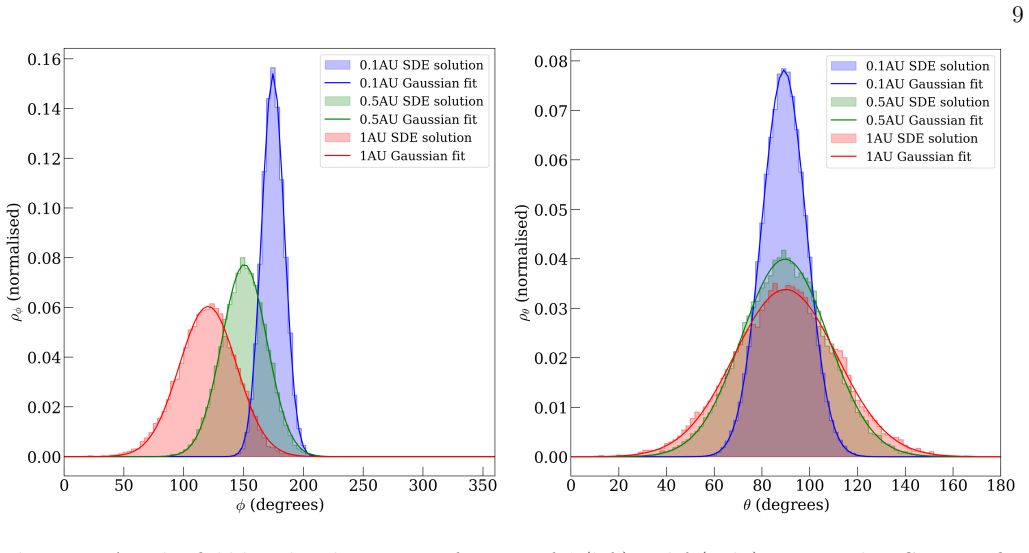
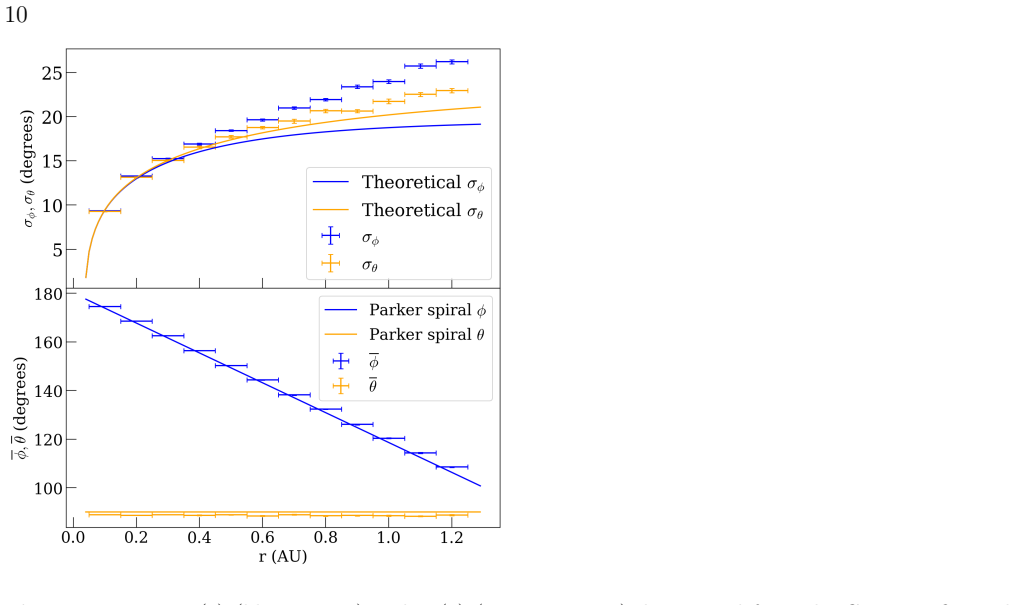
The central claim is that the three-dimensional convection-diffusion equation for the field line density distribution, after transformation into stochastic differential equations incorporating radial turbulence evolution, yields an angular distribution at 1 AU that is well fitted by a two-dimensional Gaussian with standard deviation close to 25 degrees, with magnetic field lines underwound on average for strong turbulence, and with angular uncertainty reduced to approximately 4 degrees when field lines are traced backward to the solar wind source surface at 0.25 AU.
What carries the argument
Stochastic differential equations obtained by transforming the convection-diffusion equation for magnetic field line density, accounting for radial evolution of turbulence, and solved numerically in both forward and backward directions.
Load-bearing premise
The specific form of the radial dependence of the turbulence is assumed when transforming the convection-diffusion equation into stochastic differential equations.
What would settle it
Observations showing that the angular spread of magnetic field lines at 1 AU deviates substantially from a Gaussian distribution with 25 degree standard deviation, or that back-tracing to 0.25 AU does not reduce the uncertainty to around 4 degrees.
Figures





read the original abstract
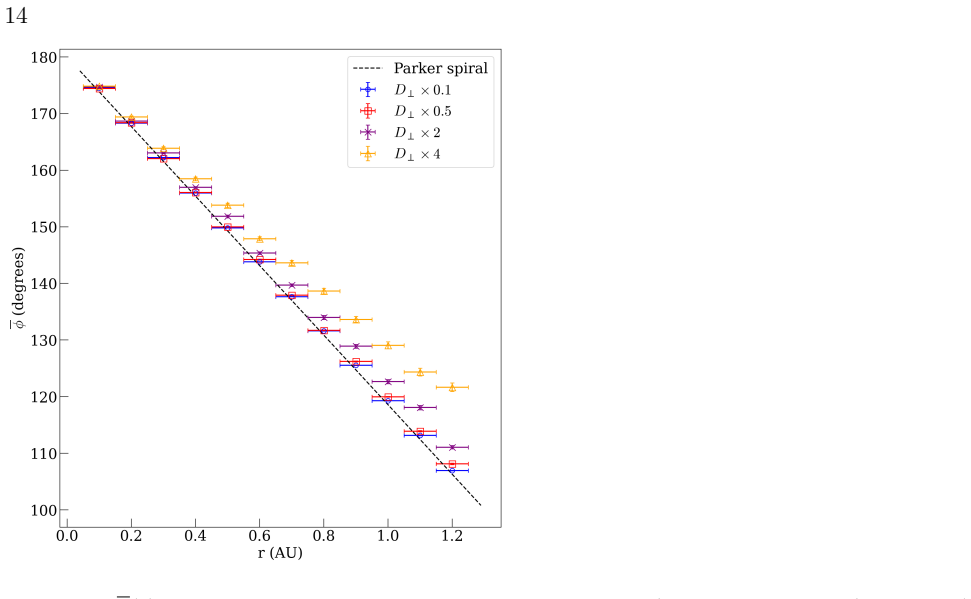
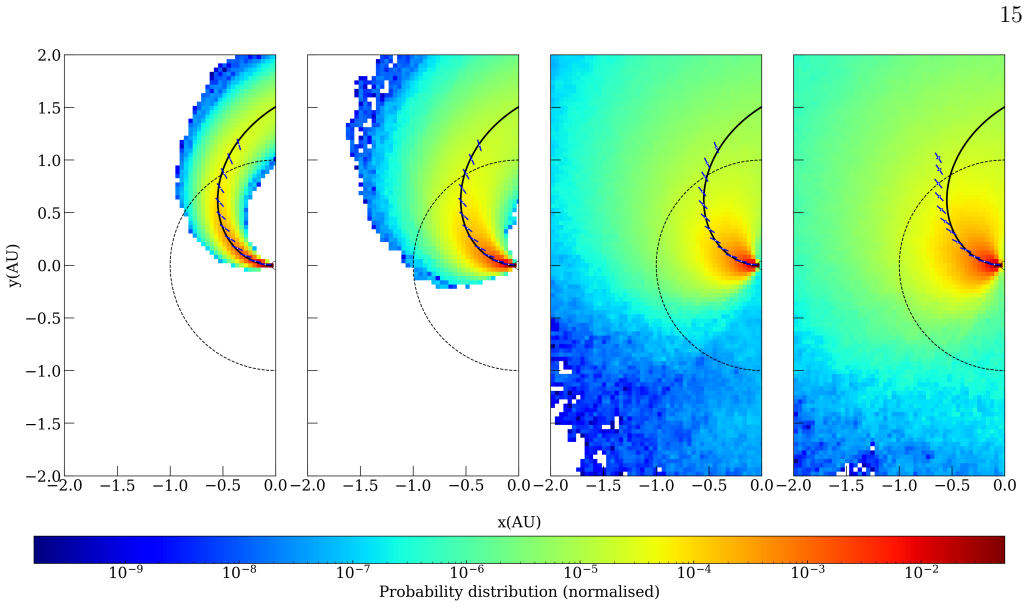
Due to solar wind turbulence, Parker spirals are stochastic. The dispersion of magnetic field lines is described by a convection-diffusion equation for the field line density distribution which is a function of the two heliographic angles in addition to the radial distance. Taking into account the radial evolution of the turbulence, the three-dimensional convection-diffusion equation is transformed into a set {of} stochastic differential equations which is solved numerically using both a forward and backward formulation. By tracing a large number of stochastic Parker spirals, the field line density distribution is constructed at any point in the heliosphere. It is shown that the angular part of the distribution function can be well-fitted by a two-dimensional Gaussian with standard deviation close to $ 25^{\circ}$ at 1 AU. The simulations also confirm that the magnetic field lines are underwound, on average, for strong enough turbulence intensity. Applying the backward approach, magnetic field lines are traced from an observer at 1 AU back to the Sun, quantifying the probability of magnetic connection when interplanetary turbulence is accounted for. It is shown that the angular uncertainty of $\sim 25^{\circ}$ is sharply reduced to $\sim 4^{\circ}$ when the field lines are traced back to the solar wind source surface from 0.25 AU.
Editorial analysis
A structured set of objections, weighed in public.
Referee Report
Summary. The manuscript claims that transforming the 3D convection-diffusion equation for magnetic field line density (accounting for radial turbulence evolution) into stochastic differential equations, solved numerically in both forward and backward formulations, yields an angular distribution well-fitted by a 2D Gaussian with standard deviation ~25° at 1 AU. Backward tracing from 1 AU to the source surface at 0.25 AU reduces the angular uncertainty to ~4°, and the simulations indicate that field lines are underwound on average for strong turbulence.
Significance. If the numerical results hold, the work supplies a quantitative tool for modeling turbulent diffusion of Parker spirals and magnetic connectivity in the heliosphere, relevant to solar energetic particles and space weather forecasting. The dual forward-backward SDE approach is a methodological strength, as it permits construction of the distribution function at arbitrary heliospheric locations without requiring full 3D grids.
major comments (2)
- [Abstract] Abstract: the reported Gaussian widths (~25° at 1 AU and reduction to ~4° on backward tracing) rest directly on the adopted radial evolution of turbulence parameters in the SDE transformation; no sensitivity tests, observational constraints, or alternative radial scalings are presented, yet a different functional form would alter the integrated diffusion and the fitted angular spreads.
- [Abstract] Abstract and numerical methods: central claims are generated by SDE integrations, but no validation details, error bars on the 25° and 4° values, or convergence tests (e.g., particle number, time-step independence) are supplied; this is load-bearing because the specific numerical outputs constitute the primary results.
minor comments (1)
- [Abstract] Abstract contains a formatting artifact: 'set {of} stochastic differential equations' should read 'set of stochastic differential equations'.
Simulated Author's Rebuttal
We thank the referee for their careful reading of the manuscript and for providing constructive comments that will improve the presentation of our results. We address each of the major comments below.
read point-by-point responses
-
Referee: [Abstract] Abstract: the reported Gaussian widths (~25° at 1 AU and reduction to ~4° on backward tracing) rest directly on the adopted radial evolution of turbulence parameters in the SDE transformation; no sensitivity tests, observational constraints, or alternative radial scalings are presented, yet a different functional form would alter the integrated diffusion and the fitted angular spreads.
Authors: The referee is correct that the reported angular spreads depend on the specific radial evolution model adopted for the turbulence parameters. Our choice follows established radial scaling laws from the literature on solar wind turbulence. However, we recognize the value of sensitivity analysis. In the revised manuscript, we will include tests with alternative functional forms for the radial dependence and discuss observational constraints, thereby quantifying the impact on the Gaussian widths. revision: yes
-
Referee: [Abstract] Abstract and numerical methods: central claims are generated by SDE integrations, but no validation details, error bars on the 25° and 4° values, or convergence tests (e.g., particle number, time-step independence) are supplied; this is load-bearing because the specific numerical outputs constitute the primary results.
Authors: We agree that validation of the numerical integrations is essential given that the angular spreads are the key quantitative results. The original manuscript focused on the methodology and outcomes but omitted detailed convergence and error analysis. We will add this information in the revised version, including convergence tests with respect to particle number and time step, as well as error bars on the fitted standard deviations derived from the simulations. revision: yes
Circularity Check
No circularity; numerical integration of SDEs yields distribution independent of input fitting
full rationale
The derivation consists of converting the convection-diffusion equation to SDEs (with radial turbulence evolution stated as an input), then performing forward and backward numerical integration to construct the field-line density. The reported ~25° Gaussian width and its reduction to ~4° upon backward tracing are direct outputs of that integration, not quantities fitted to data or forced by redefinition. No equation equates a prediction to a fitted parameter by construction, and no load-bearing premise reduces to a self-citation. The result is therefore self-contained against the stated model assumptions.
Axiom & Free-Parameter Ledger
axioms (1)
- domain assumption Dispersion of magnetic field lines is described by a convection-diffusion equation in heliographic angles and radial distance
Reference graph
Works this paper leans on
-
[1]
Adhikari, L., Zank, G. P., & Zhao, L. 2021, Fluids, 6, 368, doi: 10.3390/fluids6100368
-
[2]
Bian, N. H., & Li, G. 2021, The Astrophysical Journal, 908, 45, doi: 10.3847/1538-4357/abd39a
-
[3]
Bian, N. H., Strauss, R. D., Li, G., & Engelbrecht, N. E. 2024, The Astrophysical Journal, 962, 186, doi: 10.3847/1538-4357/ad19dd
-
[4]
Bieber, J. W., Matthaeus, W. H., Smith, C. W., et al. 1994, Astrophys. J., 420, 294, doi: 10.1086/173559
-
[5]
W., Wanner, W., & Matthaeus, W
Bieber, J. W., Wanner, W., & Matthaeus, W. H. 1996, J. Geophys. Res., 101, 2511, doi: 10.1029/95JA02588
-
[6]
Breech, B., Matthaeus, W. H., Minnie, J., et al. 2008, Journal of Geophysical Research: Space Physics, 113, 2007JA012711, doi: 10.1029/2007JA012711
-
[7]
Burger, R. A., & McKee, S. R. 2023, Advances in Space Research, 71, 4916, doi: 10.1016/j.asr.2023.01.033
-
[8]
Burger, R. A., Nel, A. E., & Engelbrecht, N. E. 2022, Astrophys. J., 926, 128, doi: 10.3847/1538-4357/ac4741
-
[9]
2022, ApJ, 939, 33, doi: 10.3847/1538-4357/ac9386
Chhiber, R. 2022, ApJ, 939, 33, doi: 10.3847/1538-4357/ac9386
-
[10]
Chhiber, R., Ruffolo, D., Matthaeus, W. H., et al. 2021a, ApJ, 908, 174, doi: 10.3847/1538-4357/abd7f0
-
[11]
Chhiber, R., Matthaeus, W. H., Cohen, C. M. S., et al. 2021b, A&A, 650, A26, doi: 10.1051/0004-6361/202039816
-
[12]
Chian, A. C.-L., Borotto, F. A., Hada, T., et al. 2022, Reviews of Modern Plasma Physics, 6, 34, doi: 10.1007/s41614-022-00095-z
-
[13]
2007, The Astrophysical Journal, 659, 1761, doi: 10.1086/511811
Meechai, J. 2007, The Astrophysical Journal, 659, 1761, doi: 10.1086/511811
-
[14]
E., Chhiber, R., Roy, S., et al
Cuesta, M. E., Chhiber, R., Roy, S., et al. 2022, The Astrophysical Journal Letters, 932, L11, doi: 10.3847/2041-8213/ac73fd da Silva, D. E., Wallace, S., Arge, C. N., & Jones, S. 2023, Space Weather, 21, e2023SW003554, doi: 10.1029/2023SW003554
-
[15]
Engelbrecht, N. E. 2019a, Astrophys. J., 872, 124, doi: 10.3847/1538-4357/aafe7f
-
[16]
Engelbrecht, N. E. 2019b, ApJ, 880, 60, doi: 10.3847/1538-4357/ab2871
-
[17]
Engelbrecht, N. E., & Burger, R. A. 2013, Astrophys. J., 772, 46, doi: 10.1088/0004-637X/772/1/46
-
[18]
Engelbrecht, N. E., & Burger, R. A. 2015, The Astrophysical Journal, 814, 152, doi: 10.1088/0004-637X/814/2/152
-
[19]
Engelbrecht, N. E., & Strauss, R. D. 2018, Astrophys. J., 856, 159, doi: 10.3847/1538-4357/aab495
-
[20]
E., Effenberger, F., Florinski, V., et al
Engelbrecht, N. E., Effenberger, F., Florinski, V., et al. 2022, SSRv, 218, 33, doi: 10.1007/s11214-022-00896-1
-
[21]
Smith, E. J. 1996, Geophys. Res. Lett., 23, 595, doi: 10.1029/96GL00416 28
-
[22]
Gardiner, C. W. 1985, Handbook of stochastic methods: for physics, chemistry, and the natural sciences, 2nd edn. (Berlin: Springer-Verlag)
1985
-
[23]
Hussain, A. K. M. F. 1986, Journal of Fluid Mechanics, 173, 303, doi: 10.1017/S0022112086001192
-
[24]
Jokipii, J. R. 1966, The Astrophysical Journal, 146, 480, doi: 10.1086/148912
-
[25]
E., & Platen, E
Kloeden, P. E., & Platen, E. 1999, Numerical solution of stochastic differential equations, corr. 3rd print edn., Applications of mathematics; 23 (Berlin: Springer)
1999
-
[26]
2019, The Astrophysical Journal, 887, 222, doi: 10.3847/1538-4357/ab54c7
Laitinen, T., & Dalla, S. 2019, The Astrophysical Journal, 887, 222, doi: 10.3847/1538-4357/ab54c7
-
[27]
2023, The Astrophysical Journal, 943, 108, doi: 10.3847/1538-4357/aca892
Hutchinson, A. 2023, The Astrophysical Journal, 943, 108, doi: 10.3847/1538-4357/aca892
-
[28]
2018, Journal of Space Weather and Space Climate, 8, A13, doi: 10.1051/swsc/2018001
Laitinen, T., Effenberger, F., Kopp, A., & Dalla, S. 2018, Journal of Space Weather and Space Climate, 8, A13, doi: 10.1051/swsc/2018001
-
[29]
Lemons, D. S. 2002, An introduction to stochastic processes in physics (Baltimore: Johns Hopkins University Press)
2002
-
[30]
Lotz, S., Nel, A. E., Wicks, R. T., et al. 2023, ApJ, 942, 93, doi: 10.3847/1538-4357/aca903
-
[31]
2007, The Astrophysical Journal, 667, 956, doi: 10.1086/520924
Chuychai, P., & Minnie, J. 2007, The Astrophysical Journal, 667, 956, doi: 10.1086/520924
-
[32]
H., Breech, B., Dmitruk, P., et al
Matthaeus, W. H., Breech, B., Dmitruk, P., et al. 2007, ApJL, 657, L121, doi: 10.1086/513075
-
[33]
Matthaeus, W. H., Goldstein, M. L., & Roberts, D. A. 1990, Journal of Geophysical Research, 95, 20673, doi: 10.1029/JA095iA12p20673
-
[34]
Matthaeus, W. H., Gray, P. C., Pontius, Jr., D. H., & Bieber, J. W. 1995, Physical Review Letters, 75, 2136, doi: 10.1103/PhysRevLett.75.2136 Øksendal, B. K. 2000, Stochastic differential equations : an introduction with applications, 5th edn. (Verlag: Springer-Verlag)
-
[35]
Breech, B., & Isenberg, P. A. 2011, J. Geophys. Res., 116, doi: 10.1029/2010JA016365
-
[36]
Osman, K. T. 2015, Philosophical Transactions of the Royal Society A: Mathematical, Physical and Engineering Sciences, 373, 20140152, doi: 10.1098/rsta.2014.0152
-
[37]
Parker, E. N. 1958, The Astrophysical Journal, 128, 664, doi: 10.1086/146579
-
[38]
2013, Planetary and Space Science, 89, 127, doi: 10.1016/j.pss.2013.09.013
Posner, A., Odstrˆ cil, D., MacNeice, P., et al. 2013, Planetary and Space Science, 89, 127, doi: 10.1016/j.pss.2013.09.013
-
[39]
Pradata, R. A., Roy, S., Matthaeus, W. H., et al. 2025, ApJL, 984, L23, doi: 10.3847/2041-8213/adc9b2
-
[40]
Ruffolo, D., Matthaeus, W. H., & Chuychai, P. 2003, ApJL, 597, L169, doi: 10.1086/379847
-
[41]
Ruffolo, D., Matthaeus, W. H., & Chuychai, P. 2004, The Astrophysical Journal, 614, 420, doi: 10.1086/423412 29
-
[42]
2019, Advances in Space Research, 64, 2426, doi: 10.1016/j.asr.2019.03.005
Shalchi, A. 2019, Advances in Space Research, 64, 2426, doi: 10.1016/j.asr.2019.03.005
-
[43]
1971, The Astrophysical Journal, 170, 265, doi: 10.1086/151210
Skilling, J. 1971, The Astrophysical Journal, 170, 265, doi: 10.1086/151210
-
[44]
Leamon, R. J. 2006, The Astrophysical Journal, 645, L85, doi: 10.1086/506151
-
[45]
Smith, C. W., Matthaeus, W. H., Zank, G. P., et al. 2001, Journal of Geophysical Research: Space Physics, 106, 8253, doi: 10.1029/2000JA000366
-
[46]
Steyn, P. J., Johnson, D., Botha, G. J. J., & R´ egnier, S. 2024, ApJ, 966, 77, doi: 10.3847/1538-4357/ad3356
-
[47]
Strauss, R. D. T., Dresing, N., & Engelbrecht, N. E. 2017, ApJ, 837, 43, doi: 10.3847/1538-4357/aa5df5
-
[48]
Strauss, R. D. T., & Effenberger, F. 2017, Space Science Reviews, 212, 151, doi: 10.1007/s11214-017-0351-y van Kampen, N. G. 2007, Stochastic processes in physics and chemistry, 3rd edn., North-Holland personal library (Amsterdam: Elsevier). http://site.ebrary.com/id/10172768 Van Der Merwe, F. H., & Engelbrecht, N. E. 2025, Solar Physics, 300, 80, doi: 10...
-
[49]
Wang, J., Matthaeus, W. H., Chhiber, R., et al. 2024, SoPh, 299, 169, doi: 10.1007/s11207-024-02401-z
-
[50]
Matthaeus, W. H. 2025, arXiv e-prints, arXiv:2507.16053, doi: 10.48550/arXiv.2507.16053
-
[51]
Kivelson, M. G. 2011, Journal of Geophysical Research: Space Physics, 116, doi: 10.1029/2011JA016621
-
[52]
Zank, G. P., Matthaeus, W. H., & Smith, C. W. 1996, Journal of Geophysical Research: Space Physics, 101, 17093, doi: 10.1029/96JA01275
-
[53]
2006, Journal of Geophysical Research (Space Physics), 111, A04208, doi: 10.1029/2005JA011323
Zhang, M. 2006, Journal of Geophysical Research (Space Physics), 111, A04208, doi: 10.1029/2005JA011323
-
[54]
Feng, X. S. 2018, Astrophys. J., 856, 94, doi: 10.3847/1538-4357/aab362
discussion (0)
Sign in with ORCID, Apple, or X to comment. Anyone can read and Pith papers without signing in.