Molecular Gas Structure and Star Formation Diversity in Stephan's Quintet Revealed by ACA CO(1-0) Mapping
Pith reviewed 2026-06-27 12:40 UTC · model grok-4.3
The pith
Molecular gas velocity dispersion anticorrelates with star formation efficiency across Stephan's Quintet, suggesting turbulence regulates star formation during galaxy interactions.
A machine-rendered reading of the paper's core claim, the machinery that carries it, and where it could break.
Core claim
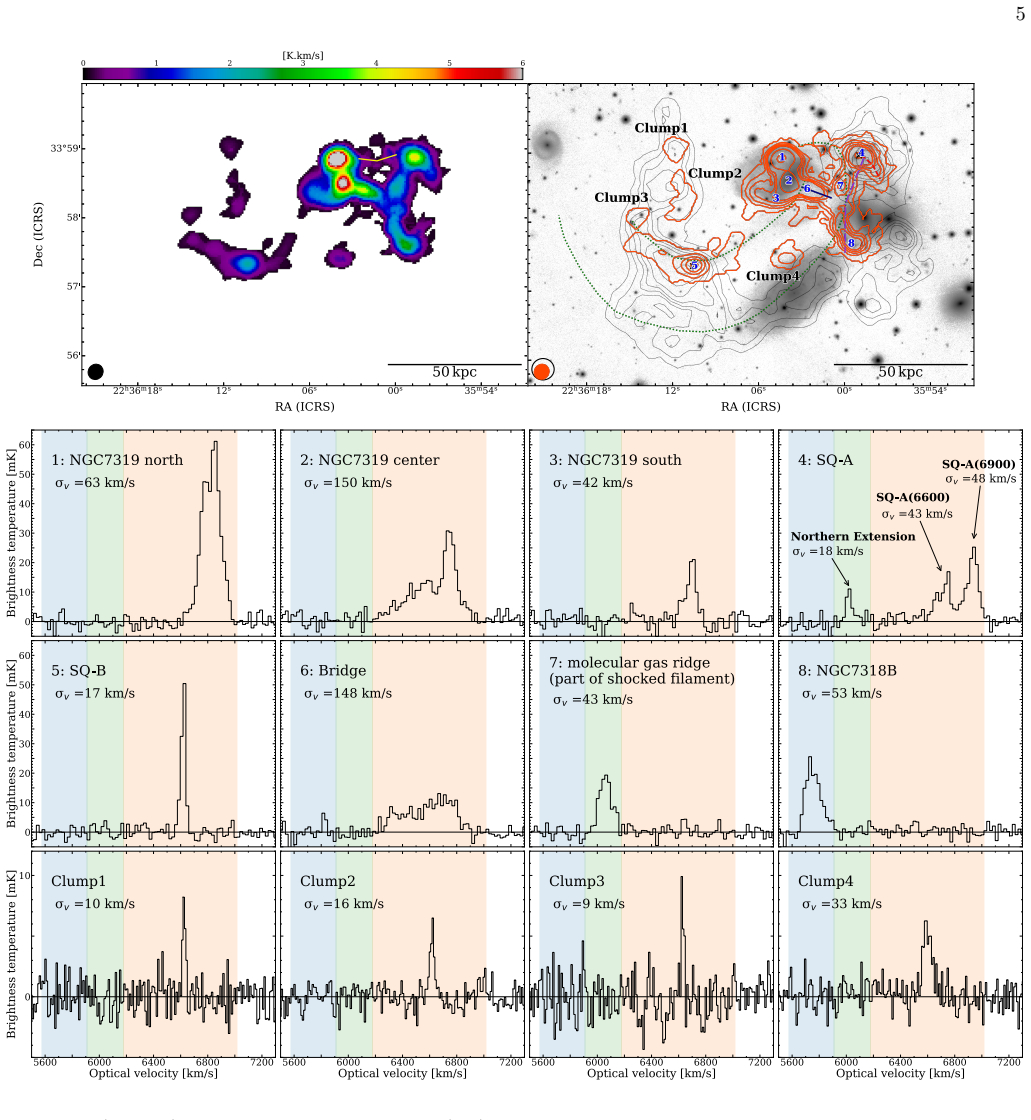
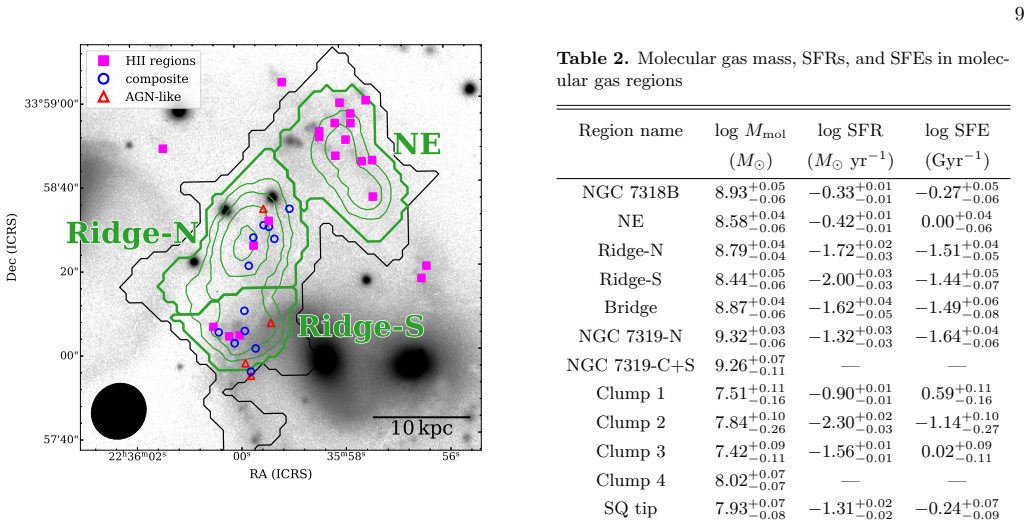
The observations reveal molecular gas concentrated in the disk of NGC 7319, along the shocked filament, and in a tidal tail with four discrete clumps of 10^7-10^8 solar masses. Star formation efficiencies derived from Hα luminosities of H II regions span from 0.02 to 4 Gyr^{-1} and show a negative correlation with CO velocity dispersion. This leads to the conclusion that turbulence plays a significant role in regulating star formation in interacting systems.
What carries the argument
The negative correlation between star formation efficiency (from Hα) and CO(1-0) velocity dispersion, treated as a proxy for turbulence affecting molecular gas.
If this is right
- Star formation is strongly suppressed in high-dispersion regions around the shocked filament compared to normal disk galaxies.
- Three of the four CO clumps in the tidal tail overlap with HI, while one lacks any optical, infrared, or HI counterpart.
- Efficiencies in low-dispersion regions remain comparable to those measured in nearby isolated disk galaxies.
- The map covers the full 137 kpc by 119 kpc extent of the group at roughly 5.5 kpc resolution.
Where Pith is reading between the lines
- The same turbulence-driven suppression could appear in other compact groups where shocks and tidal forces stir the gas.
- Higher-resolution follow-up could test whether the dispersion traces large-scale flows or internal cloud motions.
- If dust obscuration biases the Hα rates, the apparent correlation might weaken when cross-checked with dust-corrected indicators.
Load-bearing premise
That Hα luminosities provide unbiased star formation rates and that the observed CO velocity dispersion directly measures the turbulence level influencing molecular cloud collapse.
What would settle it
Measuring star formation rates with an independent tracer such as infrared luminosity and finding that the anticorrelation with velocity dispersion vanishes, or mapping a similar system and seeing no suppression in high-dispersion zones.
Figures



read the original abstract
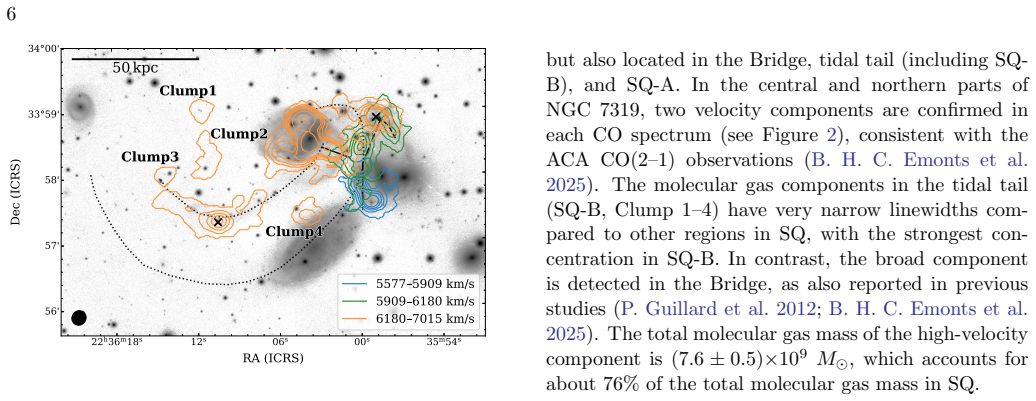
We present $^{12}$CO(1-0) mapping across the entire system of Stephan's Quintet, a well-known compact galaxy group, observed by Atacama Compact Array (7\,m array + Total Power) of the Atacama Large Millimeter/submillimeter Array. These observations provide the first large-scale ($137\,\mathrm{kpc}\times119\,\mathrm{kpc}$), spatially resolved ($\sim$5.5\,$\mathrm{kpc}$) molecular gas map of a compact group. Our CO map revealed that most of the molecular gas resides in the disk of the member galaxy NGC~7319 and in the intergalactic regions, including components along the shocked filament and the optically identified tidal tail extending from NGC~7319. Along the tidal tail and its surroundings, we found not only an extended molecular gas component but also four discrete CO clumps, with velocity dispersions of $\sim$10-30 $\mathrm{km\,s^{-1}}$ and molecular gas masses of order $10^7$-$10^8\,M_\odot$. Three of these clumps spatially overlap with H\,{\sc i}, whereas the remaining clump shows no associated H\,{\sc i} or counterparts at optical and infrared wavelengths. Using star formation rates derived from H$\alpha$ luminosities of H\,{\sc ii} regions, we found that star formation efficiencies (SFEs) span $\sim$2.2\,dex ($\sim$0.02--4\,Gyr$^{-1}$) and negatively correlate with CO velocity dispersion. While regions with small velocity dispersion exhibit SFEs comparable to those of nearby disk galaxies, those with large velocity dispersion ($\sim$50-150$\,\mathrm{km\,s^{-1}}$) around the shocked filament show strongly suppressed star formation. These results suggest that turbulence plays a significant role in regulating star formation in interacting systems.
Editorial analysis
A structured set of objections, weighed in public.
Referee Report
Summary. The paper presents the first large-scale (137 kpc × 119 kpc), spatially resolved (~5.5 kpc) ACA CO(1-0) map of Stephan's Quintet. It maps molecular gas primarily in the NGC 7319 disk and intergalactic regions including the shocked filament and tidal tail, identifies four discrete CO clumps along the tail (σ_v ~10-30 km/s, M_H2 ~10^7-10^8 M_⊙), and reports that star formation efficiencies derived from Hα luminosities of H II regions span ~2.2 dex (~0.02-4 Gyr^{-1}) and show a negative correlation with CO velocity dispersion. Regions with high dispersion (~50-150 km/s) near the filament exhibit strongly suppressed SFE, leading to the conclusion that turbulence regulates star formation in interacting systems.
Significance. If the reported correlation is robust to tracer biases, the result would provide spatially resolved observational support for turbulence (traced by CO velocity dispersion) as a regulator of star formation efficiency in the high-dispersion, shock-dominated environments of compact galaxy groups, extending disk-galaxy relations to interacting systems and offering a concrete test case for theoretical models of turbulence-regulated collapse.
major comments (1)
- [Abstract] Abstract and results on SFE–velocity dispersion correlation: The central claim attributes suppressed SFE in the high-dispersion filament regions to turbulence, but relies on Hα luminosities as unbiased SFR tracers. In Stephan's Quintet the filament is known to contain shock-heated gas; shock ionization can contribute to Hα without corresponding young stars, which would systematically overestimate SFR (and thus SFE) precisely where σ_v is largest (~50-150 km/s). This could artificially strengthen the reported negative correlation. No mention is made of ionization diagnostics (e.g., [N II]/Hα ratios) or cross-checks with other SFR indicators (IR, UV, radio) to rule out this bias.
Simulated Author's Rebuttal
We thank the referee for their insightful comments on our manuscript. We address the major comment regarding the SFE-velocity dispersion correlation and potential biases in the SFR tracer below.
read point-by-point responses
-
Referee: [Abstract] Abstract and results on SFE–velocity dispersion correlation: The central claim attributes suppressed SFE in the high-dispersion filament regions to turbulence, but relies on Hα luminosities as unbiased SFR tracers. In Stephan's Quintet the filament is known to contain shock-heated gas; shock ionization can contribute to Hα without corresponding young stars, which would systematically overestimate SFR (and thus SFE) precisely where σ_v is largest (~50-150 km/s). This could artificially strengthen the reported negative correlation. No mention is made of ionization diagnostics (e.g., [N II]/Hα ratios) or cross-checks with other SFR indicators (IR, UV, radio) to rule out this bias.
Authors: We appreciate the referee pointing out this potential issue with the SFR tracer. We note that the H II regions in our analysis are identified as such based on their optical spectra, which are typically used to distinguish photoionized regions from shock-excited gas. The potential bias from shock contribution would overestimate the SFR in the high-dispersion regions, which would actually weaken the observed negative correlation (making the suppression appear less severe than it is). The fact that the correlation is still clearly seen suggests it is robust. However, to fully address the concern, we will revise the manuscript to include a dedicated discussion on the choice of SFR indicator, potential biases, and any available cross-checks with other wavelengths from the literature on Stephan's Quintet. revision: yes
Circularity Check
No circularity: purely observational correlation from independent measurements
full rationale
The paper reports ACA CO(1-0) mapping, direct measurements of velocity dispersion in clumps and filaments, Hα-derived SFRs for H II regions, and an empirical negative correlation between SFE and σ_v. No equations, fitted parameters renamed as predictions, self-definitional steps, or load-bearing self-citations appear in the derivation chain. The central claim is a data-driven finding with no reduction to its own inputs by construction.
Axiom & Free-Parameter Ledger
free parameters (1)
- CO-to-H2 conversion factor
axioms (2)
- domain assumption Hα luminosity traces recent star formation rate
- domain assumption CO line velocity dispersion traces turbulence in molecular gas
Reference graph
Works this paper leans on
-
[1]
Alatalo, K., Appleton, P. N., Lisenfeld, U., et al. 2015, ApJ, 812, 117, doi: 10.1088/0004-637X/812/2/117
-
[2]
1996, AJ, 111, 140, doi: 10.1086/117767
Aoki, K., Ohtani, H., Yoshida, M., & Kosugi, G. 1996, AJ, 111, 140, doi: 10.1086/117767
-
[3]
arXiv , author =:2301.02928 , journal =
Appleton, P. N., Guillard, P., Emonts, B., et al. 2023, ApJ, 951, 104, doi: 10.3847/1538-4357/accc2a
-
[4]
Aromal, P., Gallagher, S. C., Fedotov, K., et al. 2025, ApJ, 994, 90, doi: 10.3847/1538-4357/ae0cb4 Astropy Collaboration, Price-Whelan, A. M., Sip˝ ocz, B. M., et al. 2018, AJ, 156, 123, doi: 10.3847/1538-3881/aabc4f
-
[5]
Barton, E. J., Geller, M. J., & Kenyon, S. J. 2000, ApJ, 530, 660, doi: 10.1086/308392
-
[6]
The CO-to-H2 Conversion Factor
Bolatto, A. D., Wolfire, M., & Leroy, A. K. 2013, ARA&A, 51, 207, doi: 10.1146/annurev-astro-082812-140944
work page internal anchor Pith review doi:10.1146/annurev-astro-082812-140944 2013
-
[7]
2011, A&A, 533, A19, doi: 10.1051/0004-6361/201117004
Boquien, M., Lisenfeld, U., Duc, P.-A., et al. 2011, A&A, 533, A19, doi: 10.1051/0004-6361/201117004
-
[8]
2006, A&A, 456, 481, doi: 10.1051/0004-6361:20065248
Bournaud, F., & Duc, P.-A. 2006, A&A, 456, 481, doi: 10.1051/0004-6361:20065248
-
[9]
Bournaud, F., Jog, C. J., & Combes, F. 2007, A&A, 476, 1179, doi: 10.1051/0004-6361:20078010
-
[10]
2001, A&A, 378, 51, doi: 10.1051/0004-6361:20011109
Braine, J., Duc, P.-A., Lisenfeld, U., et al. 2001, A&A, 378, 51, doi: 10.1051/0004-6361:20011109
-
[11]
2003, in Galaxies and Chaos, ed
Burkert, A., & Naab, T. 2003, in Galaxies and Chaos, ed. G. Contopoulos & N. Voglis, Vol. 626, 327–339, doi: 10.1007/978-3-540-45040-5 27 CASA Team, Bean, B., Bhatnagar, S., et al. 2022, PASP, 134, 114501, doi: 10.1088/1538-3873/ac9642
-
[12]
Cluver, M. E., Appleton, P. N., Boulanger, F., et al. 2010, ApJ, 710, 248, doi: 10.1088/0004-637X/710/1/248
-
[13]
Cornwell, T. J. 2008, IEEE Journal of Selected Topics in Signal Processing, 2, 793, doi: 10.1109/JSTSP.2008.2006388
-
[14]
Davies, L. J. M., Robotham, A. S. G., Driver, S. P., et al. 2015, MNRAS, 452, 616, doi: 10.1093/mnras/stv1241 Di Matteo, P., Bournaud, F., Martig, M., et al. 2008, A&A, 492, 31, doi: 10.1051/0004-6361:200809480
-
[15]
2010, MNRAS, 401, 2343, doi: 10.1111/j.1365-2966.2009.15859.x
Dobbs, C. L., Theis, C., Pringle, J. E., & Bate, M. R. 2010, MNRAS, 403, 625, doi: 10.1111/j.1365-2966.2009.16161.x Duarte Puertas, S., Iglesias-P´ aramo, J., Vilchez, J. M., et al. 2019, A&A, 629, A102, doi: 10.1051/0004-6361/201935686 Duarte Puertas, S., Vilchez, J. M., Iglesias-P´ aramo, J., et al. 2021, A&A, 645, A57, doi: 10.1051/0004-6361/202038734
-
[16]
2007, A&A, 475, 187, doi: 10.1051/0004-6361:20078335
Duc, P.-A., Braine, J., Lisenfeld, U., Brinks, E., & Boquien, M. 2007, A&A, 475, 187, doi: 10.1051/0004-6361:20078335
-
[17]
Emonts, B. H. C., Appleton, P. N., Lisenfeld, U., et al. 2025, ApJ, 978, 111, doi: 10.3847/1538-4357/ad957c
-
[18]
Fedotov, K., Gallagher, S. C., Durrell, P. R., et al. 2015, MNRAS, 449, 2937, doi: 10.1093/mnras/stv349
-
[19]
Fedotov, K., Gallagher, S. C., Konstantopoulos, I. S., et al. 2011, AJ, 142, 42, doi: 10.1088/0004-6256/142/2/42
-
[20]
Fujimoto, Y., Tasker, E. J., & Habe, A. 2014, MNRAS, 445, L65, doi: 10.1093/mnrasl/slu138
-
[21]
Zaritsky, D., & Whitmore, B. C. 2001, AJ, 122, 163, doi: 10.1086/321111
-
[22]
2000, ApJL, 542, L83, doi: 10.1086/312940
Gao, Y., & Xu, C. 2000, ApJL, 542, L83, doi: 10.1086/312940
-
[23]
1990, A&A, 230, 37
Gerin, M., Combes, F., & Athanassoula, E. 1990, A&A, 230, 37
1990
-
[24]
Appleton, P. N. 2009, A&A, 502, 515, doi: 10.1051/0004-6361/200811263
-
[25]
Guillard, P., Boulanger, F., Pineau des Forˆ ets, G., et al. 2012, ApJ, 749, 158, doi: 10.1088/0004-637X/749/2/158
-
[26]
Hunter, T. R., Indebetouw, R., Brogan, C. L., et al. 2023, PASP, 135, 074501, doi: 10.1088/1538-3873/ace216
-
[27]
G., Verdes-Montenegro, L., Moldon, J., et al
Jones, M. G., Verdes-Montenegro, L., Moldon, J., et al. 2023, A&A, 670, A21, doi: 10.1051/0004-6361/202244622
-
[28]
Kepley, A. A., Tsutsumi, T., Brogan, C. L., et al. 2020, PASP, 132, 024505, doi: 10.1088/1538-3873/ab5e14
-
[29]
Nakatsugawa, H. 2022, ApJ, 930, 76, doi: 10.3847/1538-4357/ac5a54
-
[30]
Konstantopoulos, I. S., Appleton, P. N., Guillard, P., et al. 2014, ApJ, 784, 1, doi: 10.1088/0004-637X/784/1/1
-
[31]
Larson, R. B., & Tinsley, B. M. 1978, ApJ, 219, 46, doi: 10.1086/155753
-
[32]
K., Walter, F., Brinks, E., et al
Leroy, A. K., Walter, F., Brinks, E., et al. 2008, AJ, 136, 2782, doi: 10.1088/0004-6256/136/6/2782
-
[33]
Lisenfeld, U., Braine, J., Duc, P. A., et al. 2004, A&A, 426, 471, doi: 10.1051/0004-6361:20041330
-
[34]
Lisenfeld, U., Braine, J., Duc, P. A., et al. 2002, A&A, 394, 823, doi: 10.1051/0004-6361:20021232 Lokas, E. L., Athanassoula, E., Debattista, V. P., et al. 2014, MNRAS, 445, 1339, doi: 10.1093/mnras/stu1846 16
-
[35]
2023, ApJ, 943, 7, doi: 10.3847/1538-4357/aca664
Maeda, F., Egusa, F., Ohta, K., Fujimoto, Y., & Habe, A. 2023, ApJ, 943, 7, doi: 10.3847/1538-4357/aca664
-
[36]
2025a, ApJ, 981, 156, doi: 10.3847/1538-4357/adb41e
Maeda, F., Ohta, K., Egusa, F., et al. 2025a, ApJ, 981, 156, doi: 10.3847/1538-4357/adb41e
-
[37]
2020a, MNRAS, 493, 5045, doi: 10.1093/mnras/staa556
Maeda, F., Ohta, K., Fujimoto, Y., & Habe, A. 2020a, MNRAS, 493, 5045, doi: 10.1093/mnras/staa556
-
[38]
2020b, MNRAS, 495, 3840, doi: 10.1093/mnras/staa1296
Maeda, F., Ohta, K., Fujimoto, Y., Habe, A., & Ushio, K. 2020b, MNRAS, 495, 3840, doi: 10.1093/mnras/staa1296
-
[39]
2024, ApJ, 962, 4, doi: 10.3847/1538-4357/ad1932
Maeda, F., Egusa, F., Tsujita, A., et al. 2024, ApJ, 962, 4, doi: 10.3847/1538-4357/ad1932
-
[40]
2025b, ApJ, 990, 221, doi: 10.3847/1538-4357/adfc56 Mendes de Oliveira, C., Cypriano, E
Maeda, F., Komugi, S., Muraoka, K., et al. 2025b, ApJ, 990, 221, doi: 10.3847/1538-4357/adfc56 Mendes de Oliveira, C., Cypriano, E. S., Sodr´ e, L., &
-
[41]
2004, in IAU Colloquium 195: Outskirts of Galaxy Clusters: Intense Life in the Suburbs, ed
Balkowski, C. 2004, in IAU Colloquium 195: Outskirts of Galaxy Clusters: Intense Life in the Suburbs, ed. A. Diaferio, 450–452, doi: 10.1017/S1743921304000973
-
[42]
2019, PASJ, 71, S15, doi: 10.1093/pasj/psz015
Muraoka, K., Sorai, K., Miyamoto, Y., et al. 2019, PASJ, 71, S15, doi: 10.1093/pasj/psz015
-
[43]
Natale, G., Tuffs, R. J., Xu, C. K., et al. 2010, ApJ, 725, 955, doi: 10.1088/0004-637X/725/1/955
-
[44]
Tidal deformation of a disc galaxy stabilized by massive halo
Noguchi, M. 1987, MNRAS, 228, 635, doi: 10.1093/mnras/228.3.635
-
[45]
2011, MNRAS, 411, 2439, doi: 10.1111/j.1365-2966.2010.17855.x 20
Patton, D. R., Ellison, S. L., Simard, L., McConnachie, A. W., & Mendel, J. T. 2011, MNRAS, 412, 591, doi: 10.1111/j.1365-2966.2010.17932.x
-
[46]
Petitpas, G. R., & Taylor, C. L. 2005, ApJ, 633, 138, doi: 10.1086/462403
-
[47]
Pettitt, A. R., & Wadsley, J. W. 2018, MNRAS, 474, 5645, doi: 10.1093/mnras/stx3129
-
[48]
The Astrophysical Journal , author =
Pontoppidan, K. M., Barrientes, J., Blome, C., et al. 2022, ApJL, 936, L14, doi: 10.3847/2041-8213/ac8a4e
-
[49]
The Astrophysical Journal , author =
Renaud, F., Boily, C. M., Naab, T., & Theis, C. 2009, ApJ, 706, 67, doi: 10.1088/0004-637X/706/1/67
-
[50]
2015, MNRAS, 446, 2038, doi: 10.1093/mnras/stu2208
Renaud, F., Bournaud, F., & Duc, P.-A. 2015, MNRAS, 446, 2038, doi: 10.1093/mnras/stu2208
-
[51]
2014, MNRAS, 442, L33, doi: 10.1093/mnrasl/slu050
Renaud, F., Bournaud, F., Kraljic, K., & Duc, P.-A. 2014, MNRAS, 442, L33, doi: 10.1093/mnrasl/slu050
-
[52]
2012, http://ascl.net/1208.017
Robitaille, T., & Bressert, E. 2012, http://ascl.net/1208.017
2012
-
[53]
Robotham, A. S. G., Liske, J., Driver, S. P., et al. 2013, MNRAS, 431, 167, doi: 10.1093/mnras/stt156
-
[54]
2013, MNRAS, 428, 370, doi: 10.1093/mnras/sts033
Serra, P., Koribalski, B., Duc, P.-A., et al. 2013, MNRAS, 428, 370, doi: 10.1093/mnras/sts033
-
[55]
Smith, B. J., & Struck, C. 2001, AJ, 121, 710, doi: 10.1086/318766
-
[56]
W., Rosado, M., Dultzin-Hacyan, D., et al
Sulentic, J. W., Rosado, M., Dultzin-Hacyan, D., et al. 2001, AJ, 122, 2993, doi: 10.1086/324455
-
[57]
, year = 1972, month = dec, volume =
Toomre, A., & Toomre, J. 1972, ApJ, 178, 623, doi: 10.1086/151823
-
[58]
Verdes-Montenegro, L., Yun, M. S., Williams, B. A., et al. 2001, A&A, 377, 812, doi: 10.1051/0004-6361:20011127
-
[59]
Williams, B. A., McMahon, P. M., & van Gorkom, J. H. 1991, AJ, 101, 1957, doi: 10.1086/115820
-
[60]
Williams, B. A., Yun, M. S., & Verdes-Montenegro, L. 2002, AJ, 123, 2417, doi: 10.1086/339839
-
[61]
Xu, C., Sulentic, J. W., & Tuffs, R. 1999, ApJ, 512, 178, doi: 10.1086/306771
-
[62]
Xu, C. K., Lu, N., Condon, J. J., Dopita, M., & Tuffs, R. J. 2003, ApJ, 595, 665, doi: 10.1086/377445
-
[63]
Xu, C. K., Cheng, C., Yun, M. S., et al. 2025, ApJ, 991, 197, doi: 10.3847/1538-4357/adfbf6
-
[64]
S., Verdes-Montenegro, L., del Olmo, A., & Perea, J
Yun, M. S., Verdes-Montenegro, L., del Olmo, A., & Perea, J. 1997, ApJL, 475, L21, doi: 10.1086/310458
discussion (0)
Sign in with ORCID, Apple, or X to comment. Anyone can read and Pith papers without signing in.