Discovery of EP J175257.3-351923 as a Candidate Black Hole Low-Mass X-ray Binary
Pith reviewed 2026-06-27 12:32 UTC · model grok-4.3
The pith
Timing, spectral and optical data identify EP J175257.3-351923 as a black hole low-mass X-ray binary candidate.
A machine-rendered reading of the paper's core claim, the machinery that carries it, and where it could break.
Core claim
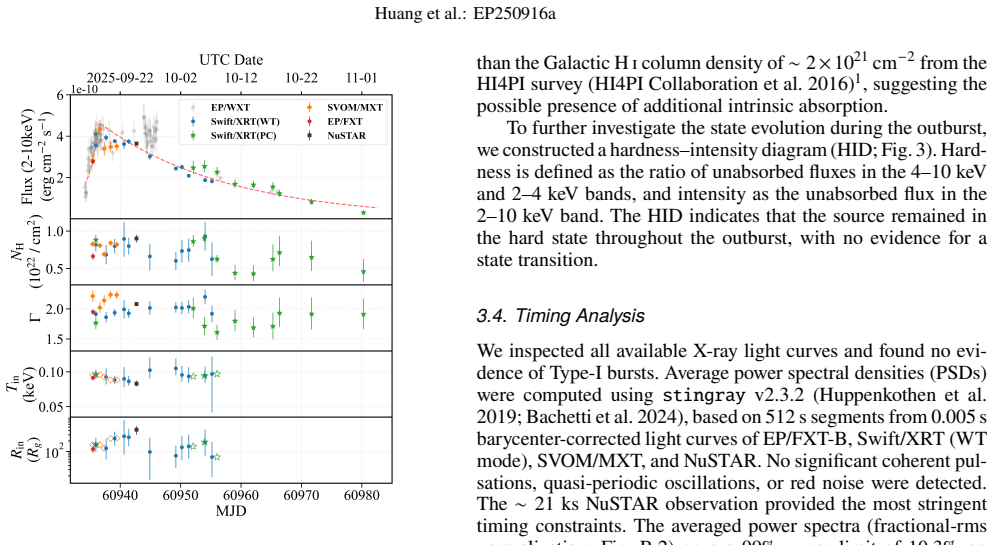
EP J175257.3-351923 is a newly discovered X-ray transient whose outburst reached a 2-10 keV peak flux of about 4 times 10 to the minus 10 erg cm squared s to the minus 1, maintained a hard spectral state for the entire duration with modest photon-index variation, showed no pulsations or strong aperiodic variability, and lacked any reliable optical counterpart inside the X-ray error circle, producing an X-ray-to-optical ratio consistent with a low-mass donor; the authors therefore present it as a black-hole low-mass X-ray binary candidate.
What carries the argument
The joint timing, spectral and optical evidence set consisting of persistent hard-state emission, absence of pulsations, and high X-ray-to-optical flux ratio that together distinguish the source from typical neutron-star systems.
If this is right
- The source accretes in the hard state without undergoing a state transition during the observed outburst.
- Absence of an optical counterpart combined with the measured flux ratio implies a low-mass companion star.
- The Einstein Probe is able to detect faint, previously unrecognized X-ray binaries close to the Galactic plane.
- Broadband spectral fits indicate a truncated inner disk and a high-energy cutoff near 217 keV in this system.
Where Pith is reading between the lines
- Repeated monitoring of similar transients could reveal how common persistent hard-state behavior is among black-hole candidates.
- Optical or infrared spectroscopy in quiescence could eventually yield a dynamical mass for the compact object.
- The source adds one more example to the still-small sample of black-hole low-mass X-ray binaries located near the plane.
Load-bearing premise
The combination of hard-state spectrum, missing pulsations and high X-ray-to-optical ratio can be taken to indicate a black hole rather than a neutron star without a direct mass measurement.
What would settle it
Detection of coherent X-ray pulsations or an unambiguous transition to a soft spectral state in a later outburst would indicate a neutron-star accretor instead.
Figures


read the original abstract
We report the discovery of a new X-ray transient, EP~J175257.3--351923 (EP250916a), by the \textit{Einstein Probe} (EP) near the Galactic plane. The outburst lasted for at least $\gtrsim 40$~days, reached a peak 2--10 keV flux of $\sim 4 \times 10^{-10}$~erg~cm$^{-2}$~s$^{-1}$, and exhibited a fast-rise, exponential-decay (FRED) profile typical of X-ray binary outbursts. The source remained in the hard state throughout the outburst, with only modest variations in the photon index ($\sim 1.6$--$2.2$) and no evidence for a spectral state transition. Broadband spectral modeling suggests a truncated disk, a weak reflection component, and a high-energy cutoff at $\sim 217$~keV, consistent with hard-state accretion in black-hole systems. No reliable optical counterpart is detected within the Swift/XRT error circle in SVOM/VT, Swift/UVOT and GROND observations, and the inferred X-ray-to-optical flux ratio, $\xi \gtrsim 21.75$, is consistent with a low-mass companion. No pulsations or significant aperiodic variability are detected. Although the compact object cannot yet be firmly identified, the timing, spectral, and optical evidence favors EP~J175257.3--351923 as a black-hole low-mass X-ray binary candidate, highlighting EP's potential to uncover a faint, previously hidden population of X-ray binaries.
Editorial analysis
A structured set of objections, weighed in public.
Referee Report
Summary. The paper presents the discovery of the X-ray transient EP J175257.3-351923 by the Einstein Probe, detailing its ~40-day outburst with FRED profile, peak flux of ~4×10^{-10} erg cm^{-2} s^{-1}, persistent hard state without transitions, spectral features including a ~217 keV cutoff, lack of optical counterpart with high X-ray-to-optical ratio ξ ≳ 21.75, and absence of pulsations or variability. It concludes that the evidence favors classification as a black hole low-mass X-ray binary candidate, while noting the compact object cannot be firmly identified.
Significance. Should the candidate classification hold, this work contributes to the known population of Galactic X-ray binaries and illustrates the Einstein Probe's capability for detecting faint transients. The analysis relies on standard multi-wavelength observations and spectral modeling techniques common in the field, offering a baseline for future studies of similar systems.
major comments (1)
- [Abstract] The claim that 'the timing, spectral, and optical evidence favors EP J175257.3-351923 as a black-hole low-mass X-ray binary candidate' lacks support, as the listed observables (no pulsations, hard state with Γ~1.6-2.2 and ~217 keV cutoff, ξ≳21.75) do not reliably distinguish black holes from neutron stars, being consistent with atoll sources. This is load-bearing for the paper's central claim and title, especially given the explicit statement that the compact object 'cannot yet be firmly identified'.
minor comments (2)
- [Abstract] The cutoff energy is reported as ~217 keV without associated uncertainties or details on the spectral fit.
- Consider providing quantitative upper limits on any undetected pulsations or variability to strengthen the timing analysis description.
Simulated Author's Rebuttal
We thank the referee for their detailed review and constructive criticism. We address the major comment below and agree that the abstract wording requires adjustment to better reflect the strength of the evidence.
read point-by-point responses
-
Referee: [Abstract] The claim that 'the timing, spectral, and optical evidence favors EP J175257.3-351923 as a black-hole low-mass X-ray binary candidate' lacks support, as the listed observables (no pulsations, hard state with Γ~1.6-2.2 and ~217 keV cutoff, ξ≳21.75) do not reliably distinguish black holes from neutron stars, being consistent with atoll sources. This is load-bearing for the paper's central claim and title, especially given the explicit statement that the compact object 'cannot yet be firmly identified'.
Authors: We acknowledge that the individual observables cited do not provide a definitive distinction and can overlap with properties seen in some neutron-star atoll sources. The manuscript already states explicitly that the compact object cannot be firmly identified. However, the combination of a FRED outburst profile, persistent hard state with no transitions over ~40 days, a high-energy cutoff at ~217 keV (higher than typical NS values), absence of pulsations or strong variability, and high X-ray-to-optical ratio is more commonly observed in black-hole systems. We therefore maintain that the evidence collectively favors a black-hole LMXB candidate interpretation, while remaining consistent with the paper's cautious stance. To address the referee's concern about overstatement in the abstract, we will revise the abstract and title wording to emphasize the candidate nature and the circumstantial nature of the evidence more clearly. This constitutes a partial revision focused on language rather than new analysis. revision: partial
Circularity Check
No circularity: purely observational report with external data
full rationale
The paper is an observational discovery announcement. It reports measured quantities (flux, photon index range, cutoff energy, absence of pulsations, X-ray-to-optical ratio) from EP, Swift, SVOM, and GROND, then offers an interpretation based on comparison to known properties of X-ray binaries. No derivation chain, fitted parameter, or equation reduces to itself by construction. No load-bearing self-citation is invoked to justify a uniqueness theorem or ansatz. The abstract's phrasing that evidence 'favors' a BH candidate while acknowledging the compact object 'cannot yet be firmly identified' is an interpretive judgment, not a self-referential loop. The derivation is self-contained against external telescope data.
Axiom & Free-Parameter Ledger
axioms (1)
- domain assumption Standard X-ray binary state classification based on spectral index and lack of state transition reliably indicates black-hole systems
Reference graph
Works this paper leans on
-
[1]
HI4PI: A full-sky HI survey based on EBHIS and GASS
HI4PI: A full-sky H I survey based on EBHIS and GASS. , keywords =. doi:10.1051/0004-6361/201629178 , archivePrefix =. 1610.06175 , primaryClass =
work page internal anchor Pith review Pith/arXiv arXiv doi:10.1051/0004-6361/201629178
-
[2]
2000, ApJ, 542, 914, doi: 10.1086/317016
On the Absorption of X-Rays in the Interstellar Medium. , keywords =. doi:10.1086/317016 , archivePrefix =. astro-ph/0008425 , primaryClass =
work page internal anchor Pith review Pith/arXiv arXiv doi:10.1086/317016
-
[3]
Tanaka, Y. and Shibazaki, N. X-RAY NOVAE. Annual Review of Astronomy and Astrophysics. 1996. doi:https://doi.org/10.1146/annurev.astro.34.1.607
-
[4]
The disc instability model of dwarf-novae and low-mass X-ray binary transients
The disc instability model of dwarf novae and low-mass X-ray binary transients. , keywords =. doi:10.1016/S1387-6473(01)00112-9 , archivePrefix =. astro-ph/0102072 , primaryClass =
work page internal anchor Pith review Pith/arXiv arXiv doi:10.1016/s1387-6473(01)00112-9
-
[5]
J.M. Hameury , keywords =. A review of the disc instability model for dwarf novae, soft X-ray transients and related objects , journal =. 2020 , note =. doi:https://doi.org/10.1016/j.asr.2019.10.022 , url =
-
[6]
2022, in Handbook of X-ray and Gamma-ray Astrophysics, ed
The Einstein Probe Mission. Handbook of X-ray and Gamma-ray Astrophysics , year = 2022, editor =. doi:10.1007/978-981-16-4544-0_151-1 , adsurl =
-
[7]
Society of Photo-Optical Instrumentation Engineers (SPIE) Conference Series , year = 2021, editor =
Status of the follow-up x-ray telescope onboard the Einstein Probe satellite. Society of Photo-Optical Instrumentation Engineers (SPIE) Conference Series , year = 2021, editor =. doi:10.1117/12.2562311 , adsurl =
-
[8]
Science China Physics, Mechanics, and Astronomy , keywords =
Science objectives of the Einstein Probe mission. Science China Physics, Mechanics, and Astronomy , keywords =. doi:10.1007/s11433-024-2600-3 , archivePrefix =. 2501.07362 , primaryClass =
-
[9]
GRB Coordinates Network , year = 2025, month = sep, volume =
EP250916a: Einstein Probe detection of an X-ray transient. GRB Coordinates Network , year = 2025, month = sep, volume =
2025
-
[10]
GRB Coordinates Network , year = 2025, month = sep, volume =
EP250916a: EP-FXT follow-up observation. GRB Coordinates Network , year = 2025, month = sep, volume =
2025
-
[11]
The Astronomer's Telegram , keywords =
SVOM follow-up of the X-ray transient EP250916a. The Astronomer's Telegram , keywords =
-
[12]
The Astronomer's Telegram , keywords =
EP250916a: Einstein Probe detection of an X-ray transient. The Astronomer's Telegram , keywords =
-
[13]
The Swift Gamma-Ray Burst Mission
The Swift Gamma-Ray Burst Mission. , keywords =. doi:10.1086/422091 , archivePrefix =. astro-ph/0405233 , primaryClass =
work page internal anchor Pith review Pith/arXiv arXiv doi:10.1086/422091
-
[14]
The Nuclear Spectroscopic Telescope Array (NuSTAR) Mission
The Nuclear Spectroscopic Telescope Array (NuSTAR) High-energy X-Ray Mission. , keywords =. doi:10.1088/0004-637X/770/2/103 , archivePrefix =. 1301.7307 , primaryClass =
work page internal anchor Pith review Pith/arXiv arXiv doi:10.1088/0004-637x/770/2/103
-
[15]
The Deep and Transient Universe in the SVOM Era: New Challenges and Opportunities - Scientific prospects of the SVOM mission. arXiv e-prints , keywords =. doi:10.48550/arXiv.1610.06892 , archivePrefix =. 1610.06892 , primaryClass =
work page internal anchor Pith review Pith/arXiv arXiv doi:10.48550/arxiv.1610.06892
-
[16]
Low-level accretion in neutron-star X-ray binaries
Low-level accretion in neutron star X-ray binaries. , keywords =. doi:10.1093/mnras/stv1974 , archivePrefix =. 1409.6265 , primaryClass =
work page internal anchor Pith review Pith/arXiv arXiv doi:10.1093/mnras/stv1974
-
[17]
Einstein Probe Discovery of EP J182730.0‑095633: A New Black Hole X-Ray Binary Candidate in Faint Outburst?. , keywords =. doi:10.3847/2041-8213/adf104 , archivePrefix =. 2507.12876 , primaryClass =
-
[18]
High-Energy Spectra of Black Hole and Neutron Star Low-Mass X-Ray Binaries. Universe , keywords =. doi:10.3390/universe10120446 , adsurl =
-
[19]
Soft X-ray prompt emission from the high-redshift gamma-ray burst EP240315a. Nature Astronomy , keywords =. doi:10.1038/s41550-024-02449-8 , archivePrefix =. 2404.16425 , primaryClass =
-
[20]
Science China Physics, Mechanics, and Astronomy , keywords =
Einstein Probe discovery of EP240408a: A peculiar X-ray transient with an intermediate timescale. Science China Physics, Mechanics, and Astronomy , keywords =. doi:10.1007/s11433-024-2524-4 , archivePrefix =. 2410.21617 , primaryClass =
-
[21]
WATCHDOG: A Comprehensive All-Sky Database of Galactic Black Hole X-ray Binaries
WATCHDOG: A Comprehensive All-sky Database of Galactic Black Hole X-ray Binaries. , keywords =. doi:10.3847/0067-0049/222/2/15 , archivePrefix =. 1512.00778 , primaryClass =
work page internal anchor Pith review Pith/arXiv arXiv doi:10.3847/0067-0049/222/2/15
-
[23]
X-ray outbursts of low-mass X-ray binary transients observed in the RXTE era
X-Ray Outbursts of Low-mass X-Ray Binary Transients Observed in the RXTE Era. , keywords =. doi:10.1088/0004-637X/805/2/87 , archivePrefix =. 1408.5146 , primaryClass =
work page internal anchor Pith review Pith/arXiv arXiv doi:10.1088/0004-637x/805/2/87
-
[24]
The Ariel V Sky Survey Instrument and new observations of the Milky Way. , keywords =. doi:10.1093/mnras/176.3.609 , adsurl =
-
[25]
Advances in Space Research , keywords =
The watch all-sky monitor for the granat project. Advances in Space Research , keywords =. doi:10.1016/0273-1177(90)90148-S , adsurl =
-
[26]
First Results from the All-Sky Monitor on the Rossi X-ray Timing Explorer
First Results from the All-Sky Monitor on the Rossi X-Ray Timing Explorer. , keywords =. doi:10.1086/310260 , archivePrefix =. astro-ph/9608109 , primaryClass =
work page internal anchor Pith review Pith/arXiv arXiv doi:10.1086/310260
-
[27]
The INTEGRAL mission. , keywords =. doi:10.1051/0004-6361:20031288 , adsurl =
-
[28]
The Burst Alert Telescope (BAT) on the Swift MIDEX Mission
The Burst Alert Telescope (BAT) on the SWIFT Midex Mission. , keywords =. doi:10.1007/s11214-005-5096-3 , archivePrefix =. astro-ph/0507410 , primaryClass =
work page internal anchor Pith review Pith/arXiv arXiv doi:10.1007/s11214-005-5096-3
-
[29]
The MAXI Mission on the ISS: Science and Instruments for Monitoring All Sky X-Ray Images
The MAXI Mission on the ISS: Science and Instruments for Monitoring All-Sky X-Ray Images. , keywords =. doi:10.1093/pasj/61.5.999 , archivePrefix =. 0906.0631 , primaryClass =
work page internal anchor Pith review Pith/arXiv arXiv doi:10.1093/pasj/61.5.999
-
[30]
Discovery of 146.8 s pulsations from EP J005146.9 - 730930, a new transient Be/X-ray binary in the SMC. , keywords =. doi:10.1093/mnras/staf1224 , archivePrefix =. 2507.17380 , primaryClass =
-
[31]
The Astronomer's Telegram , keywords =
EP-WXT detection of an X-ray transient EP240809a and Swift follow-up observation. The Astronomer's Telegram , keywords =
-
[32]
The Astronomer's Telegram , keywords =
Einstein Probe detection of an X-ray transient EP250315b. The Astronomer's Telegram , keywords =
-
[33]
Einstein Probe discovery of EP J171159.4-333253: an eclipsing neutron star low-mass X-ray binary with clocked bursts. arXiv e-prints , keywords =. doi:10.48550/arXiv.2601.11784 , archivePrefix =. 2601.11784 , primaryClass =
work page internal anchor Pith review Pith/arXiv arXiv doi:10.48550/arxiv.2601.11784
-
[34]
The Milky Way in X-rays for an outside observer. Log(N)-Log(S) and luminosity function of X-ray binaries from RXTE/ASM data. , keywords =. doi:10.1051/0004-6361:20020826 , archivePrefix =. astro-ph/0109239 , primaryClass =
work page internal anchor Pith review Pith/arXiv arXiv doi:10.1051/0004-6361:20020826
-
[35]
The Properties of X-Ray and Optical Light Curves of X-Ray Novae
The Properties of X-Ray and Optical Light Curves of X-Ray Novae. , keywords =. doi:10.1086/304921 , archivePrefix =. astro-ph/9707138 , primaryClass =
work page internal anchor Pith review Pith/arXiv arXiv doi:10.1086/304921
-
[36]
X-Ray Properties of Black-Hole Binaries. , keywords =. doi:10.1146/annurev.astro.44.051905.092532 , archivePrefix =. astro-ph/0606352 , primaryClass =
work page internal anchor Pith review Pith/arXiv arXiv doi:10.1146/annurev.astro.44.051905.092532
-
[37]
The XMM-Newton/Chandra monitoring campaign of the Galactic center region. Description of the program and preliminary results. , keywords =. doi:10.1051/0004-6361:20054129 , archivePrefix =. astro-ph/0508648 , primaryClass =
work page internal anchor Pith review Pith/arXiv arXiv doi:10.1051/0004-6361:20054129
-
[38]
Multiwavelength observations reveal a faint candidate black hole X-ray binary in IGR J17285-2922. , keywords =. doi:10.1093/mnras/stab2127 , adsurl =
-
[39]
The very faint X-ray binary IGR J17062-6143: a truncated disc, no pulsations, and a possible outflow. , keywords =. doi:10.1093/mnras/stx3224 , adsurl =
-
[40]
The 2013 outburst of a transient very faint X-ray binary, 23" from Sgr A*
The 2013 outburst of a transient very faint X-ray binary, 23 arcsec from Sgr A*. , keywords =. doi:10.1093/mnras/stu887 , archivePrefix =. 1405.0267 , primaryClass =
work page internal anchor Pith review Pith/arXiv arXiv doi:10.1093/mnras/stu887 2013
-
[41]
2022, International Journal of Modern Physics D, 31, 2230008, doi: 10.1142/S0218271822300087
The SVOM mission. International Journal of Modern Physics D , keywords =. doi:10.1142/S0218271822300087 , archivePrefix =. 2203.10962 , primaryClass =
-
[42]
1979, ApJ, 228, 939, doi: 10.1086/156922
Parameter estimation in astronomy through application of the likelihood ratio. , keywords =. doi:10.1086/156922 , adsurl =
-
[43]
Methods and results of an automatic analysis of a complete sample of Swift-XRT observations of GRBs. , keywords =. doi:10.1111/j.1365-2966.2009.14913.x , archivePrefix =. 0812.3662 , primaryClass =
-
[44]
Astronomical Data Analysis Software and Systems V , year = 1996, editor =
XSPEC: The First Ten Years. Astronomical Data Analysis Software and Systems V , year = 1996, editor =
1996
-
[45]
An All-sky 3D Dust Map Based on Gaia and LAMOST. , keywords =. doi:10.3847/1538-4365/adea39 , archivePrefix =. 2509.07640 , primaryClass =
-
[46]
Global optical/infrared-X-ray correlations in X-ray binaries: quantifying disc and jet contributions. , keywords =. doi:10.1111/j.1365-2966.2006.10756.x , archivePrefix =. astro-ph/0606721 , primaryClass =
-
[47]
Evidence for a jet contribution to the optical/infrared light of neutron star X-ray binaries. , keywords =. doi:10.1111/j.1365-2966.2007.12008.x , archivePrefix =. 0705.3611 , primaryClass =
-
[48]
Compact Optical Counterparts of Ultraluminous X-ray Sources
Compact Optical Counterparts of Ultraluminous X-Ray Sources. , keywords =. doi:10.1088/0004-637X/737/2/81 , archivePrefix =. 1106.0315 , primaryClass =
work page internal anchor Pith review Pith/arXiv arXiv doi:10.1088/0004-637x/737/2/81
-
[49]
X-ray Binaries , year = 1995, editor =
X-ray binaries. X-ray Binaries , year = 1995, editor =
1995
-
[50]
The Relationship between Infrared, Optical, and Ultraviolet Extinction. , keywords =. doi:10.1086/167900 , adsurl =
-
[51]
Summary of the content and survey properties
Gaia Data Release 3. Summary of the content and survey properties. , keywords =. doi:10.1051/0004-6361/202243940 , archivePrefix =. 2208.00211 , primaryClass =
-
[52]
Irradiation of an accretion disc by a jet: general properties and implications for spin measurements of black holes. , keywords =. doi:10.1093/mnras/sts710 , archivePrefix =. 1301.4922 , primaryClass =
work page internal anchor Pith review Pith/arXiv arXiv doi:10.1093/mnras/sts710
-
[53]
Improved Reflection Models of Black Hole Accretion Disks: Treating the Angular Distribution of X-Rays. , keywords =. doi:10.1088/0004-637X/782/2/76 , archivePrefix =. 1312.3231 , primaryClass =
work page internal anchor Pith review Pith/arXiv arXiv doi:10.1088/0004-637x/782/2/76
-
[54]
The Astronomer's Telegram , keywords =
Swift follow-up of the X-ray transient EP250916a. The Astronomer's Telegram , keywords =
-
[55]
PRESTO: PulsaR Exploration and Search TOolkit
-
[56]
A dichotomy between the hard state spectral properties of black hole and neutron star X-ray~binaries
A dichotomy between the hard state spectral properties of black hole and neutron star X-ray binaries. , keywords =. doi:10.1093/mnras/stw2514 , archivePrefix =. 1609.09511 , primaryClass =
work page internal anchor Pith review Pith/arXiv arXiv doi:10.1093/mnras/stw2514
-
[57]
Handbook of X-ray and Gamma-ray Astrophysics , year = 2022, editor =
Black Holes: Timing and Spectral Properties and Evolution. Handbook of X-ray and Gamma-ray Astrophysics , year = 2022, editor =. doi:10.1007/978-981-16-4544-0_100-1 , adsurl =
-
[58]
Handbook of X-ray and Gamma-ray Astrophysics , year = 2023, eid =
Low-Magnetic-Field Neutron Stars in X-ray Binaries. Handbook of X-ray and Gamma-ray Astrophysics , year = 2023, eid =. doi:10.1007/978-981-16-4544-0_103-1 , adsurl =
-
[59]
Catalog of Outbursts of Neutron Star Low-mass X-Ray Binaries. , keywords =. doi:10.3847/1538-4365/ade99a , archivePrefix =. 2407.18867 , primaryClass =
-
[60]
Outflows and spectral evolution in the eclipsing AMXP SWIFT J1749.4-2807 with NICER, XMM-Newton, and NuSTAR. , keywords =. doi:10.1093/mnras/stac2038 , archivePrefix =. 2207.08637 , primaryClass =
-
[61]
MAXI and NuSTAR Observations of the Faint X-Ray Transient MAXI J1848-015 in the GLIMPSE-C01 Cluster. , keywords =. doi:10.3847/1538-4357/ac5258 , archivePrefix =. 2202.02883 , primaryClass =
-
[62]
Handbook of X-ray and Gamma-ray Astrophysics , year = 2023, eid =
Black Holes: Accretion Processes in X-ray Binaries. Handbook of X-ray and Gamma-ray Astrophysics , year = 2023, eid =. doi:10.1007/978-981-16-4544-0_99-1 , adsurl =
-
[63]
Modelling the behaviour of accretion flows in X-ray binaries
Modelling the behaviour of accretion flows in X-ray binaries. Everything you always wanted to know about accretion but were afraid to ask. , keywords =. doi:10.1007/s00159-007-0006-1 , archivePrefix =. 0708.0148 , primaryClass =
work page internal anchor Pith review Pith/arXiv arXiv doi:10.1007/s00159-007-0006-1
-
[64]
Stingray: A Modern Python Library for Spectral Timing. , keywords =. doi:10.3847/1538-4357/ab258d , archivePrefix =. 1901.07681 , primaryClass =
-
[65]
Bachetti, Matteo and Huppenkothen, Daniela and Stevens, Abigail and Swinbank, John and Mastroserio, Guglielmo and Lucchini, Matteo and Lai, Eleonora Veronica and Buchner, Johannes and Desai, Amogh and Joshi, Gaurav and Pisanu, Francesco and Pisupati, Sri Guru Datta and Sharma, Swapnil and Tripathi, Mihir and Vats, Dhruv , title =. 2024 , publisher =. doi:...
-
[66]
VIRAC2: NIR astrometry and time series photometry for 500M+ stars from the VVV and VVVX surveys. , keywords =. doi:10.1093/mnras/stae2797 , archivePrefix =. 2501.06295 , primaryClass =
-
[67]
Experimental Astronomy , keywords =
Ground calibration result of the wide-field X-ray telescope (WXT) onboard the Einstein probe. Experimental Astronomy , keywords =. doi:10.1007/s10686-025-10025-9 , archivePrefix =. 2505.18939 , primaryClass =
-
[68]
GROND a 7-Channel Imager. , keywords =. doi:10.1086/587032 , archivePrefix =. 0801.4801 , primaryClass =
work page internal anchor Pith review Pith/arXiv arXiv doi:10.1086/587032
-
[69]
The Two Micron All Sky Survey (2MASS). , keywords =. doi:10.1086/498708 , adsurl =
-
[70]
The 2175 A dust feature in a Gamma Ray Burst afterglow at redshift 2.45
The 2175 A Dust Feature in a Gamma-Ray Burst Afterglow at Redshift 2.45. , keywords =. doi:10.1086/590240 , archivePrefix =. 0805.2824 , primaryClass =
work page internal anchor Pith review Pith/arXiv arXiv doi:10.1086/590240
-
[71]
Photometric content and validation
Gaia Early Data Release 3. Photometric content and validation. , keywords =. doi:10.1051/0004-6361/202039587 , archivePrefix =. 2012.01916 , primaryClass =
-
[72]
K-corrections and filter transformations in the ultraviolet, optical, and near infrared
K-Corrections and Filter Transformations in the Ultraviolet, Optical, and Near-Infrared. , keywords =. doi:10.1086/510127 , archivePrefix =. astro-ph/0606170 , primaryClass =
work page internal anchor Pith review Pith/arXiv arXiv doi:10.1086/510127
-
[73]
The nature of very faint X-ray binaries; hints from light curves
The nature of very faint X-ray binaries: hints from light curves. , keywords =. doi:10.1093/mnras/stu2652 , archivePrefix =. 1412.4097 , primaryClass =
work page internal anchor Pith review Pith/arXiv arXiv doi:10.1093/mnras/stu2652
-
[74]
Bahramian, Arash and Degenaar, Nathalie. Low-Mass X-ray Binaries. Handbook of X-ray and Gamma-ray Astrophysics. 2022. doi:10.1007/978-981-16-4544-0_94-1
discussion (0)
Sign in with ORCID, Apple, or X to comment. Anyone can read and Pith papers without signing in.