Disjointness of rescalings of smooth area preserving flows on surfaces
Pith reviewed 2026-06-27 11:50 UTC · model grok-4.3
The pith
Almost every locally Hamiltonian flow on a surface of genus at least two has any two distinct rational rescalings with different absolute values disjoint.
A machine-rendered reading of the paper's core claim, the machinery that carries it, and where it could break.
Core claim
For almost every locally Hamiltonian flow with 2g-2 non-degenerate simple saddles on a compact orientable surface of genus g ≥ 2, any two rational rescalings (φ_κt) and (φ_κ't) with κ = p/q and κ' = p'/q' of different absolute values are disjoint. The proof verifies a disjointness criterion by obtaining exponential tail decay estimates for the distribution of Birkhoff sums of a special representation. The key geometric step is the construction of a sequence of rigidity times that display bounded-type rigidity, obtained by degenerating a translation surface to a flat torus whose vertical flow has bounded-type rotation number.
What carries the argument
Bounded-type rigidity times, produced by degenerating a translation surface to a flat torus with bounded-type rotation number for the vertical flow, together with a criterion for disjointness based on exponential tail decay of Birkhoff sums in a special representation.
If this is right
- Distinct rational rescalings of the flow share no common positive-measure invariant sets other than null sets.
- The exponential tail decay of Birkhoff sums holds for the special representations arising from almost every such flow.
- The bounded-type rigidity sequence exists for almost every choice of the flow on genus g ≥ 2.
- Disjointness extends the genus-one case to all higher-genus surfaces with the stated saddle configuration.
Where Pith is reading between the lines
- The same degeneration technique might produce rigidity sequences useful for studying mixing rates or deviation estimates beyond disjointness.
- If the tail-decay estimates can be strengthened, the result could extend from rational to a dense set of irrational rescalings.
- The property may interact with the unique ergodicity or minimality of the underlying translation surface flows.
Load-bearing premise
There exists a sequence of rigidity times displaying bounded-type rigidity, produced by a particular degeneration of a translation surface to a flat torus for which the vertical flow has bounded-type rotation number.
What would settle it
A single explicit locally Hamiltonian flow on a genus-2 surface, equipped with 2g-2 = 2 simple saddles, for which two rational rescalings of different absolute values share a positive-measure set of points whose orbits remain within distance 1/q at all rigidity times q would falsify the claim.
Figures





read the original abstract
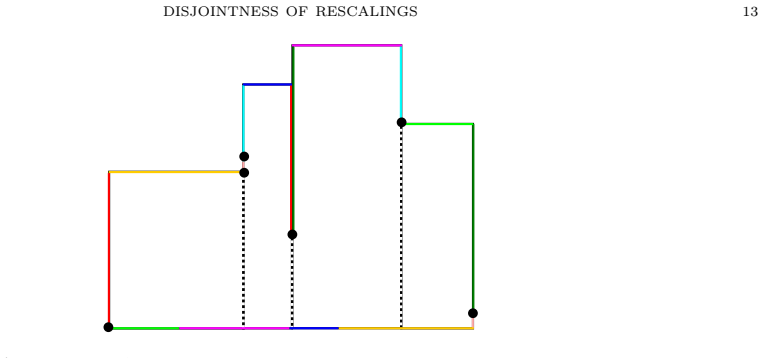
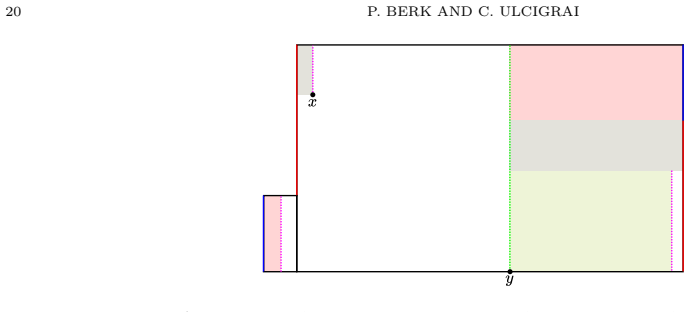
We consider the problem of \emph{disjointness of rescalings} $(\varphi_{\kappa t})_{t\in \mathbb{R}}$, $\kappa\in\mathbb{R}$ of a flow $(\varphi_{t})_{t\in \mathbb{R}}$ in the context of smooth flows preserving a smooth invariant measure, or, equivalently, locally Hamiltonian flows on compact orientable surfaces. We show that, when the genus of the surface is $g\ge 2$, almost every locally Hamiltonian flow with 2g-2 non-degenerate simple saddles is such that any distinct two rational rescalings $(\varphi_{\kappa t})_{t\in \mathbb{R}}$ and $(\varphi_{\kappa' t})_{t\in \mathbb{R}}$ with $\kappa=p/q$ and $\kappa'=p'/q'$ of different absolute values, are disjoint. Previous results on disjointness of rescalings were available only for rescalings for locally Hamiltonian flows and their special flow representations in genus one. The result is proved using a criterion for disjointness based on the study of the distribution of Birkhoff sums of a special representation and in particular estimates on their exponential tails decay. A key novel geometric ingredient in the proof is the existence of a sequence of rigidity times which display what we call bounded-type rigidity, so that a large set of points comes back in time $q$ with distance $O(1/q)$. To produce such bounded-type rigidity times we exploit a particular way of degeneration of a translation surface to a flat torus for which the vertical flow has bounded-type rotation number.
Editorial analysis
A structured set of objections, weighed in public.
Referee Report
Summary. The manuscript establishes a theorem stating that, for genus g ≥ 2, almost every locally Hamiltonian flow with 2g-2 non-degenerate simple saddles on a compact orientable surface has the property that distinct rational rescalings with different absolute values are disjoint. The proof strategy combines a disjointness criterion based on exponential tail decay of Birkhoff sums with a geometric construction of bounded-type rigidity times obtained through degeneration of translation surfaces to flat tori with bounded-type rotation numbers.
Significance. If correct, this extends previous results limited to genus one to higher genera, introducing a novel geometric ingredient in the form of bounded-type rigidity. This could impact the study of ergodic properties and disjointness in area-preserving flows on surfaces. The approach avoids free parameters and relies on measure-theoretic arguments for almost-everywhere statements.
major comments (2)
- [Abstract, final paragraph] The construction of the sequence of rigidity times t_n = q_n via a particular degeneration of the translation surface to a flat torus is central to obtaining the bounded-type rigidity needed for the Birkhoff sum tail estimates. However, the abstract provides no explicit verification that this degeneration remains within the stratum of 2g-2 non-degenerate simple saddles or supplies the measure estimates ensuring a large set returns within distance O(1/q_n); this step is load-bearing for the exponential tails and requires detailed justification in the main text.
- [Proof strategy (as sketched in abstract)] The reduction to the disjointness criterion on the distribution of Birkhoff sums assumes the existence of the rigidity times with the stated properties; if the degeneration construction only produces such times for a measure-zero set or fails to control the error terms, the almost-everywhere claim would not hold. The paper should include a dedicated section with quantitative estimates on the measure of the returning set.
minor comments (1)
- The abstract mentions 'special representation' without defining it in the summary; a brief clarification in the introduction would aid readability.
Simulated Author's Rebuttal
We thank the referee for the careful reading of the manuscript and the constructive comments. We address each major comment below. The concerns primarily concern the clarity and prominence of the geometric construction and its measure estimates; these can be addressed by reorganization and added exposition without altering the core arguments.
read point-by-point responses
-
Referee: [Abstract, final paragraph] The construction of the sequence of rigidity times t_n = q_n via a particular degeneration of the translation surface to a flat torus is central to obtaining the bounded-type rigidity needed for the Birkhoff sum tail estimates. However, the abstract provides no explicit verification that this degeneration remains within the stratum of 2g-2 non-degenerate simple saddles or supplies the measure estimates ensuring a large set returns within distance O(1/q_n); this step is load-bearing for the exponential tails and requires detailed justification in the main text.
Authors: The abstract is a concise overview and is not intended to contain the full technical verification. The degeneration construction is carried out in Section 3, where we explicitly show that the limiting flat torus arises from a path that stays inside the stratum of surfaces with exactly 2g-2 non-degenerate simple saddles (by keeping the saddle connections fixed and only collapsing a controlled subsurface). The quantitative measure estimate—that the set of points returning within distance O(1/q_n) has measure bounded below by a positive constant times 1/log q_n—is proved in Proposition 4.3 using the bounded-type condition on the rotation number of the limiting torus. To make this load-bearing step more visible, we will insert a short dedicated subsection (new Subsection 3.4) that collects the stratum-invariance argument and the measure lower bound before the application to Birkhoff sums. revision: partial
-
Referee: [Proof strategy (as sketched in abstract)] The reduction to the disjointness criterion on the distribution of Birkhoff sums assumes the existence of the rigidity times with the stated properties; if the degeneration construction only produces such times for a measure-zero set or fails to control the error terms, the almost-everywhere claim would not hold. The paper should include a dedicated section with quantitative estimates on the measure of the returning set.
Authors: The construction does not produce rigidity times only on a measure-zero set. The set of translation surfaces admitting a degeneration path to a bounded-type torus is shown to be of full measure in the stratum (by the density of bounded-type rotation numbers and the fact that the degeneration is a continuous operation on a positive-measure subset of the moduli space). The error terms in the return distance are controlled uniformly by the continued-fraction bound on the rotation number. While the estimates appear inline in the proofs of Theorems 2.1 and 5.1, we agree that a consolidated presentation would strengthen the manuscript. We will therefore add a new Section 4.5 titled “Quantitative measure estimates for bounded-type rigidity times” that gathers the lower bound on the measure of the returning set, the control on the O(1/q_n) error, and the verification that the construction is compatible with the almost-everywhere statement. revision: yes
Circularity Check
No circularity: external criterion plus independent geometric construction
full rationale
The paper reduces the disjointness statement to an external criterion on exponential tails of Birkhoff sums of a special representation, then supplies a geometric construction of bounded-type rigidity times via degeneration of a translation surface to a flat torus whose vertical flow has bounded rotation number. Neither step is self-definitional, nor does any fitted parameter get relabeled as a prediction, nor does the argument rest on a load-bearing self-citation whose content is unverified. Prior genus-one results are cited only as background. The derivation therefore remains self-contained against external benchmarks.
Axiom & Free-Parameter Ledger
axioms (1)
- domain assumption Almost every locally Hamiltonian flow with 2g-2 non-degenerate simple saddles admits a sequence of bounded-type rigidity times obtained by degeneration to a flat torus with bounded-type rotation number.
Reference graph
Works this paper leans on
-
[1]
266 (2014), 284-317
E.H.\ El Abdalaoui, M.\ Lema\'nczyk, T.\ de la Rue, On spectral disjointness of powers for rank-one transformations and M\"obius orthogonality, J.\ Funct.\ Anal. 266 (2014), 284-317
2014
-
[2]
I.\ Arnold, Topological and ergodic properties of closed 1 -forms with incommensurable periods, Funktsional.\ Anal.\ i Prilozhen
V. I.\ Arnold, Topological and ergodic properties of closed 1 -forms with incommensurable periods, Funktsional.\ Anal.\ i Prilozhen. 25 (1991), 1--12; translation in Funct.\ Anal.\ Appl. 25 (1991), 81--90
1991
-
[3]
Artigiani, L
M. Artigiani, L. Flaminio, D. Ravotti, On Rigidity Properties of Time-Changes of Unipotent Flows. Annali Scuola Normale Superiore - Classe di Scienze 2024, 46
2024
-
[4]
M. Auer, T. Schindler, Trimmed ergodic sums for non-integrable functions with power singularities over irrational rotations, preprint 2025, arXiv:2503.22242
arXiv 2025
-
[5]
ezel, J.-Ch.\ Yoccoz, Exponential mixing for the Teichm\
A.\ Avila, S.\ Gou\"ezel, J.-Ch.\ Yoccoz, Exponential mixing for the Teichm\"uller flow , Publ.\ Math.\ Inst.\ Hautes \'Etudes Sci. 104 (2006), 143--211
2006
-
[6]
H.\ El Abdalaoui, M.\ Lemaczyk, T.\ de la Rue, On spectral
E. H.\ El Abdalaoui, M.\ Lemaczyk, T.\ de la Rue, On spectral
-
[7]
A.\ Avila, G.\ Forni,
-
[8]
P.\ Berk, Backward Rauzy-Veech algorithm and horizontal saddle connections, Ann. Sc. Norm. Super. Pisa Cl. Sci. (5) 25 (2024), no. 3, 1383--1398
2024
-
[9]
35 (2015), 829-855
P.\ Berk, K.\ Fr a czek, On special flows that are not isomorphic to their inverses, Discrete\ Contin.\ Dyn.\ Syst. 35 (2015), 829-855
2015
-
[10]
103 (2021), 901--942
P.\ Berk, A.\ Kanigowski, Spectral disjointness of rescalings of some surface flows, J.\ Lond.\ Math.\ Soc. 103 (2021), 901--942
2021
-
[11]
P.\ Berk, K.\ Fr a czek, T.\ de la Rue, On typicality of translation flows which are disjoint with their inverse, published online in Journal of the Institute of Mathematics of Jussieu, arXiv:1703.09111
-
[12]
P.\ Berk, K.\ Fr a czek, F.\ Trujillo, On the ergodicity of anti-symmetric skew products with singularities and its applications, arXiv:2412.21067
-
[13]
P.\ Berk, F.\ Trujillo, C.\ Ulcigrai, Ergodicity of explicit logarithmic cocycles over IETs , Math. Ann. 393, 1195--1239 (2025)
2025
-
[14]
Math., vol
J.\ Bourgain, P.\ Sarnak, T.\ Ziegler, Disjointness of M \"o bius from horocycle flows , from Fourier analysis and number theory to Radon transforms and geometry, Dev. Math., vol. 28, Springer, New York, 2013, 67-83
2013
-
[15]
Chaika & A
J. Chaika & A. Eskin, M \"o bius disjointness for interval exchange transformations on three intervals, J.\ Mod.\ Dyn. 14 (2019), 55--86
2019
-
[16]
381 (2021), 1369-1407
J.\ Chaika, K.\ Fr a czek, A.\ Kanigowski, C.\ Ulcigrai, Singularity of the spectrum for smooth area-preserving flows in genus two and translation surfaces well approximated by cylinders, Commun.\ Math.\ Phys. 381 (2021), 1369-1407
2021
-
[17]
Fr a czek, Cocycles over interval exchange transformations and multivalued Hamiltonian flows, Adv.\ Math
J.-P.\ Conze, K. Fr a czek, Cocycles over interval exchange transformations and multivalued Hamiltonian flows, Adv.\ Math. 226 (2011), 4373--4428
2011
-
[18]
Cornfeld, S.V
I.P. Cornfeld, S.V. Fomin, Ya.G. Sinai. Ergodic Theory. Springer-Verlag, 1980
1980
-
[19]
J.\ Chaika, A.\ Eskin, Mobius disjointness for interval exchange transformations of three intervals, arXiv:1606.02357
-
[20]
A.I.\ Danilenko, V.V.\ Ryzhikov,
-
[21]
S.\ Ferenczi, J.\ Kulaga-Przymus, M.\ Lema \'n czyk, Sarnak's conjecture: what's new , UPDATE REF
-
[22]
C. Dong, A. Kanigowski, Rigidity of a class of smooth singular flows on T ^2 , J.\ Mod.\ Dyn. 16 (2020), 37--57
2020
-
[23]
C. Dong, A. Kanigowski, D. Wei, Rigidity of joinings for some measure preserving systems, Ergod.\ Th.\ Dynam.\ Sys. 42 (2022), 665--690
2022
-
[24]
Fayad, G
B. Fayad, G. Forni, A. Kanigowski, Lebesgue spectrum of countable multiplicity for conservative flows on the torus , J.\ Am.\ Math.\ Soc. 34 (2021), 747-813
2021
-
[25]
Fayad, A
B. Fayad, A. Kanigowski, Multiple mixing for a class of conservative surface flows, Invent.\ Math. 203 (2016), 555--614
2016
-
[26]
Ferenczi, J
S.\ Ferenczi, J.\ Ku aga-Przymus, M.\ Lema\'nczyk ,\\ Sarnak's conjecture: what's new , in: Ergodic Theory and Dynamical Systems in their Interactions with Arithmetics and Combinatorics, Editors: S. Ferenczi, J. Ku aga-Przymus, M. Lema\'nczyk,\\ Lecture Notes in Mathematics 2213, Springer International Publishing, pp. 418
-
[27]
146 (1997), 295-344
G.\ Forni, Solutions of the cohomological equation for area-preserving flows on compact surfaces of higher genus , Ann.\ of Math. 146 (1997), 295-344
1997
-
[28]
Forni, Asymptotic behaviour of ergodic integrals of renormalizable parabolic flows, in Proceedings of the International Congress of Mathematicians, Vol
G. Forni, Asymptotic behaviour of ergodic integrals of renormalizable parabolic flows, in Proceedings of the International Congress of Mathematicians, Vol. III (Beijing, 2002), Higher Education Press, Beijing (2002), 317--326
2002
-
[29]
Forni, A
G. Forni, A. Kanigowski, Multiple mixing and disjointness for time changes of bounded-type Heisenberg nilflows, J.\ \'Ec.\ Polytech., Math. 7 (2020), 63--91
2020
-
[30]
26 (2019), 16--23
L.\ Flaminio, G.\ Forni, Orthogonal powers and M\"obius conjecture for smooth time changes of horocycle flows, Electron.\ Res.\ Announc.\ Math.\ Sci. 26 (2019), 16--23
2019
-
[31]
K.\ Fr a czek, J.\ Kuaga-Przymus; M.\ Lemaczyk, On the self-similarity problem for Gaussian-Kronecker flows. Proc. Amer. Math. Soc. 141 (2013), no. 12, 42754291
2013
-
[32]
Ku aga-Przymus,\ M
K.\ Fr a czek,\ J. Ku aga-Przymus,\ M. Lema\'nczyk,
-
[33]
K.\ Fr a czek , A.\ Kanigowski, C.\ Ulcigrai , Singularity of the spectrum of typical minimal smooth area-preserving flows in any genus, preprint arXiv:2505.13193
-
[34]
Kim, Solving the cohomological equation for locally Hamiltonian flows, part I -- local obstructions, Adv
K.\ Fr a czek and M. Kim, Solving the cohomological equation for locally Hamiltonian flows, part I -- local obstructions, Adv. Math. 446 (2024), Paper No. 109668, 61 pp
2024
-
[35]
K.\ Fr a czek, M.\ Kim, Solving the cohomological equation for locally hamiltonian flows, part II - global obstructions , preprint https://arxiv.org/abs/2306.02340
-
[36]
807 (2024), 81-149
K.\ Fr a czek, M.\ Kim, New phenomena in deviation of Birkhoff integrals for locally Hamiltonian flows , J.\ Reine Angew.\ Math. 807 (2024), 81-149
2024
-
[37]
446 (2024), 109668
K.\ Fr a czek, M.\ Kim, Solving the cohomological equation for locally hamiltonian flows, part I - local obstructions , Adv.\ Math. 446 (2024), 109668
2024
-
[38]
K.\ Fr a czek, M.\ Lema\'nczyk, On symmetric logarithm and some old examples
-
[39]
K.\ Fr a czek, M.\ Lema\'nczyk, On disjointness properties of some smooth flows, Fund. Math. 185 (2005), No.2, 117--142
2005
-
[40]
180 (2003), 241--255
K.\ Fr a czek, M.\ Lema \'n czyk, On symmetric logarithm and some old examples in smooth ergodic theory, Fund.\ Math. 180 (2003), 241--255
2003
-
[41]
24 (2004), 1083--1095
K.\ Fr a czek, M.\ Lema \'n czyk, A class of special flows over irrational rotations which is disjoint from mixing flows , Ergodic Theory Dyn.\ Syst. 24 (2004), 1083--1095
2004
-
[42]
185 (2005), 117--142
K.\ Fr a czek, M.\ Lema \'n czyk, On disjointness properties of some smooth flows , Fund.\ Math. 185 (2005), 117--142
2005
-
[43]
156 (2009), 11-45
K.\ Fr a czek, M.\ Lema \'n czyk, Smooth singular flows in dimension 2 with the minimal self-joining property, Monatsh.\ Math. 156 (2009), 11-45
2009
-
[44]
K.\ Fr a czek, M.\ Lema\'nczyk, On the self-similarity problem for ergodic flows. Proc. Lond. Math. Soc. (3) 99 (2009), no. 3, 658696
2009
-
[45]
354 (2012), 1289--1367
K.\ Fr a czek, C.\ Ulcigrai, Ergodic properties of infinite extensions of area-preserving flows, Math.\ Ann. 354 (2012), 1289--1367
2012
-
[46]
Fedotov & F
A. Fedotov & F. Klopp, An exact renormalization formula for Gaussian exponential sums and applications, Amer. J. of Math. 134 (2012), 711--748
2012
-
[47]
K.\ Fr a czek, M.\ Lemaczyk, Smooth singular flows in dimension 2 with the minimal self-joining property, Monatsh. Math. 156 (2009), 11-45
2009
-
[48]
K.\ Fr a czek , C.\ Ulcigrai , Ergodic properties of infinite extension of area preserving flows, Math. Ann. 354 (2012) 1289--1367
2012
-
[49]
In: Silva, C.E., Danilenko, A.I
K.\ Fr a czek , C.\ Ulcigrai , Ergodic and Spectral Theory of Area-Preserving Flows on Surfaces. In: Silva, C.E., Danilenko, A.I. (eds) Ergodic Theory. Encyclopedia of Complexity and Systems Science Series. Springer, New York, NY, 2023
2023
-
[50]
99 (2024), 231-354
K.\ Fr a czek, C.\ Ulcigrai, On the asymptotic growth of Birkhoff integrals for locally Hamiltonian flows and ergodicity of their extensions , Comment.\ Math.\ Helv. 99 (2024), 231-354. \
2024
-
[51]
Furstenberg, Recurrence in Ergodic Theory and Combinatorial Number Theory, Princeton University Press , Princeton (1981)
H. Furstenberg, Recurrence in Ergodic Theory and Combinatorial Number Theory, Princeton University Press , Princeton (1981)
1981
-
[52]
Glasner Ergodic theory via joinings, Mathematical Surveys and Monographs, vol
E. Glasner Ergodic theory via joinings, Mathematical Surveys and Monographs, vol. 101, American Mathematical Society , Providence, RI, (2003)
2003
-
[53]
Kanigowski, M.\ Lema\'nczyk, C
A. Kanigowski, M.\ Lema\'nczyk, C. Ulcigrai, On disjointness properties of some parabolic flows, Invent.\ Math. 221 (2020), 1-111
2020
-
[54]
Analyse Math
J.\ King, Joining-rank and the structure of finite rank mixing transformations, J. Analyse Math. 51 (1988), 182-227
1988
-
[55]
Ergodic Theory Dynam
J.\ Kuaga-Przymus, On the self-similarity problem for smooth flows on orientable surfaces. Ergodic Theory Dynam. Systems 32 (2012), no. 5, 16151660
2012
-
[56]
195 (2007), 97-124
M.\ Lemaczyk, M.\ Wysokiska, On analytic flows on the torus which are disjoint from systems of probability origin, Fundamenta Math. 195 (2007), 97-124
2007
-
[57]
Ann.\ of Math.\ (2) 115 (1982), 169200
H.\ Masur, Interval exchange transformations and measured foliations. Ann.\ of Math.\ (2) 115 (1982), 169200
1982
-
[58]
G.\ Rauzy, \'Echanges d'intervalles et transformations induites,
-
[59]
Systems 28 (2008), no
Y.\ Sinai, C.\ Ulcigrai, Renewal-type Limit Theorem for the Gauss Map and Continued Fractions, Ergodic Theory Dynam. Systems 28 (2008), no. 2, 643655
2008
-
[60]
Chaika & A
J. Chaika & A. Eskin,
-
[61]
Kanigowski, J
A. Kanigowski, J. Kulaga-Przymus, C. Ulcigrai, Multiple mixing and parabolic divergence in smooth area-preserving flows on higher genus surfaces, J.\ Eur.\ Math.\ Soc. 21 (2019), 3797-3855
2019
-
[62]
B.\ Katok, Invariant measures of flows on orientable surfaces, (Russian) Dokl.\ Akad.\ Nauk SSSR 211 (1973), 775--778
A. B.\ Katok, Invariant measures of flows on orientable surfaces, (Russian) Dokl.\ Akad.\ Nauk SSSR 211 (1973), 775--778
1973
-
[63]
B.\ Katok, Interval exchange transformations and some special flows are not mixing
A. B.\ Katok, Interval exchange transformations and some special flows are not mixing. Israel J.\ Math. 35 (1980), 301--310
1980
-
[64]
A. B. Katok, J.-P. Thouvenot, Spectral Properties and Combinatorial Constructions in Ergodic Theory, in Handbook of dynamical systems, Vol. 1B, 649 743, Elsevier B.V., Amsterdam, 2006
2006
-
[65]
Keane, Interval Exchange Transformations, Math.\ Z
M. Keane, Interval Exchange Transformations, Math.\ Z. 141 (1975), 25--31
1975
-
[66]
5 (1985), 257--271
S.P.\ Kerckhoff, Simplicial systems for interval exchange maps and measured foliations , Ergodic Theory Dyn.\ Syst. 5 (1985), 257--271
1985
-
[67]
K. M. Khanin, Ya. G. Sinai, Mixing for some classes of special flows over rotations of the circle, Funktsional.\ Anal.\ i Prilozhen. 26 (1992), 1--21; translation in Funct.\ Anal.\ Appl. 26 (1992), 155--169
1992
-
[68]
Klari\'c, Z
S. Klari\'c, Z. Pavi\'c, S. Wu, Convex Combination Inequalities of the Line and Plane, Abstract and Applied Analysis, 1 (2014), 1--7
2014
-
[69]
A. V. Ko c ergin, The absence of mixing in special flows over a rotation of the circle and in flows on a two-dimensional torus, Dokl.\ Akad.\ Nauk SSSR 205 (1972), 512--518; translated in Soviet Math.\ Dokl. 13 (1972), 949--952
1972
-
[70]
A. V. Ko c ergin, Nondegenerate fixed points and mixing in flows on a two-dimensional torus, Mat.\ Sb. 194 (2003), 83--112; translation in Sb.\ Math. 194 (2003), 1195--1224
2003
-
[71]
A. V. Ko c ergin, Nondegenerate fixed points and mixing in flows on a two-dimensional torus. II, Mat.\ Sb. 195 (2004), 15--46; translation in Sb.\ Math. 195 (2004), 317--346
2004
-
[72]
A. V. Ko c ergin, Some generalizations of theorems on mixing flows with nondegenerate saddles on a two-dimensional torus, Mat.\ Sb. 195 (2004), 19--36; translation in Sb.\ Math. 195 (2004), 1253--1270
2004
-
[73]
A. V. Ko c ergin, Nondegenerate saddles and the absence of mixing in flows on surfaces, Proc.\ Steklov Inst.\ Math. 256, (2007), 238--252
2007
-
[74]
M.\ Lema\'nczyk, Spectral theory of dynamical systems, Mathematics of complexity and dynamical systems, Vols.\ 1-3, 1618--1638, Springer, New York, 2012
2012
-
[75]
A. G. Maier, Trajectories on closed orientable surfaces, Mat.\ Sb. 12(54) (1943), 71--84 (in R ussian)
1943
-
[76]
B. Marcus. Ergodic properties of horocycle flows on surfaces of negative curvature, Ann.\ of Math. 105 (1977), 81--105
1977
-
[77]
18 (2005), 823-872
S.\ Marmi, P.\ Moussa, J.-C.\ Yoccoz, Cohomological equation for Roth-type IETs , J.\ Am.\ Math.\ Soc. 18 (2005), 823-872
2005
-
[78]
Marmi, C
S. Marmi, C. Ulcigrai, and J.-C. Yoccoz, On Roth type conditions, duality and central Birkhoff sums for i.e.m., Astrisque, 416, :65--132, 2020
2020
-
[79]
Masur, Interval exchange transformations and measured foliations, Ann.\ of Math
H. Masur, Interval exchange transformations and measured foliations, Ann.\ of Math. 115 (1982), 169--200
1982
-
[80]
von Neumann, Zur Operatorenmethode in der klassischen Mechanik, Ann.\ of Math
J. von Neumann, Zur Operatorenmethode in der klassischen Mechanik, Ann.\ of Math. 33 (1932), 587--642
1932
discussion (0)
Sign in with ORCID, Apple, or X to comment. Anyone can read and Pith papers without signing in.