Analysis of the young disk around WRAY 15-1880: does it contain a primitive planetary system?
Pith reviewed 2026-06-27 11:54 UTC · model grok-4.3
The pith
High-contrast imaging detects a candidate 0.3-7.6 Jupiter-mass companion inside the gap of a 2.8-Myr-old pre-transitional disk.
A machine-rendered reading of the paper's core claim, the machinery that carries it, and where it could break.
Core claim
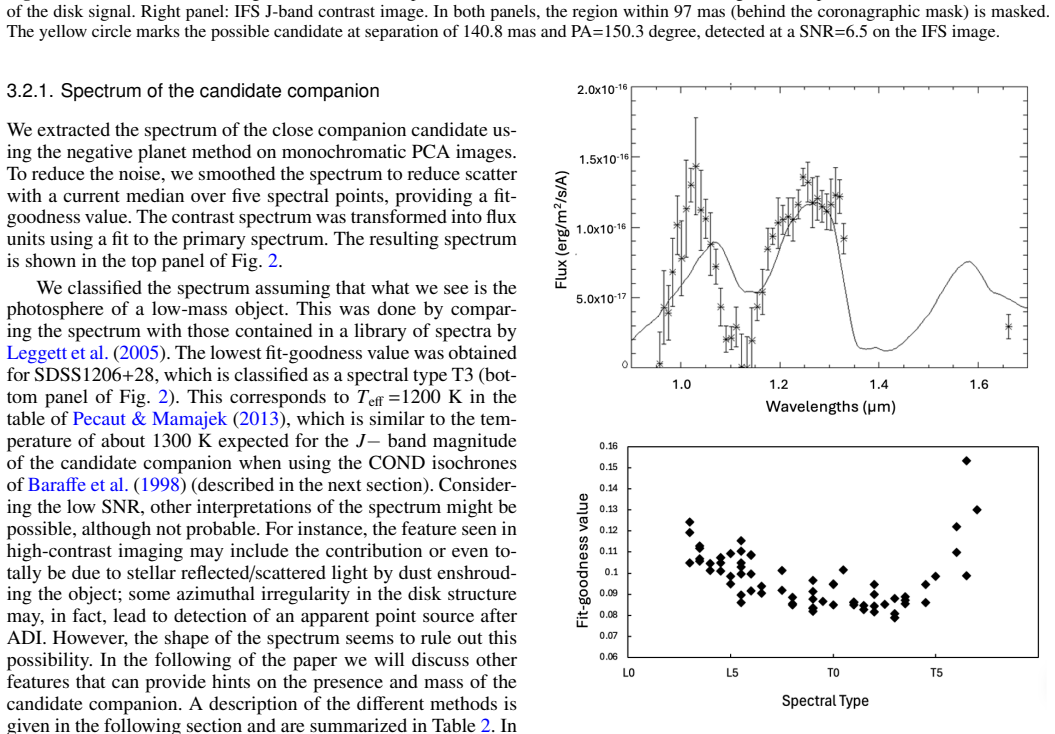
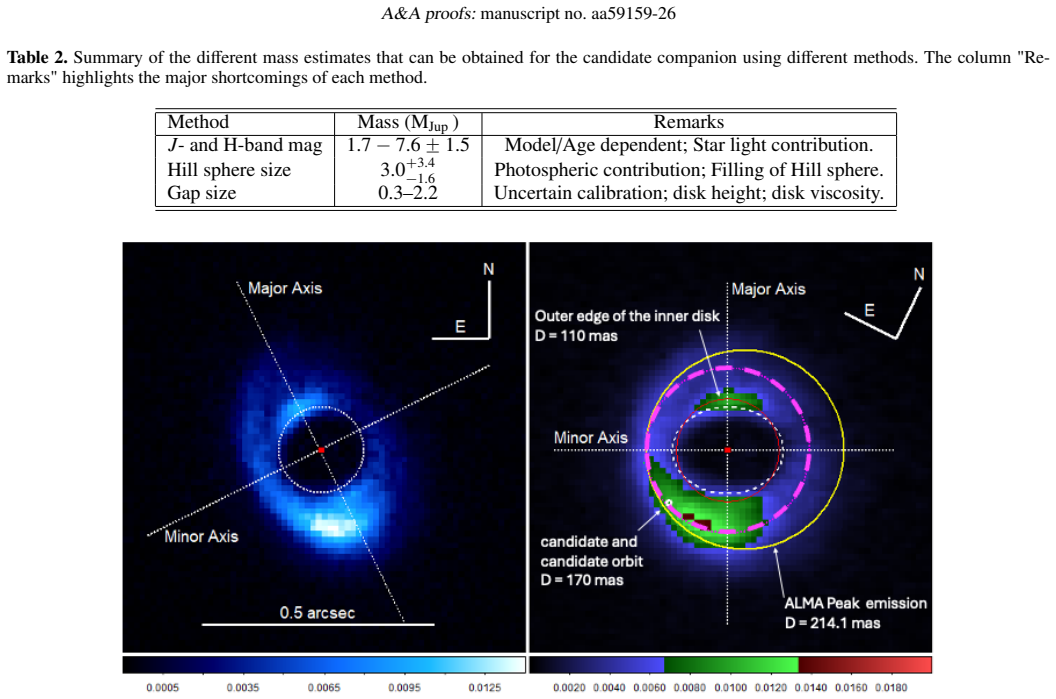
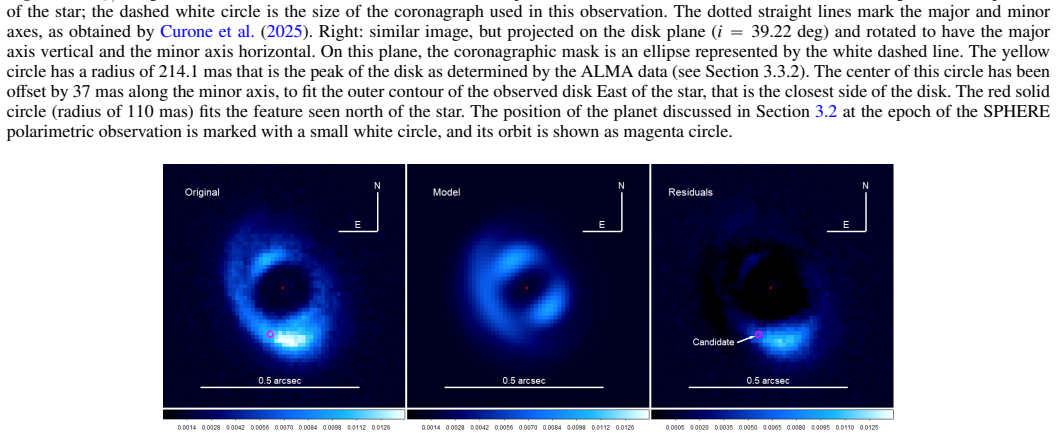
The central claim is the identification of a candidate Jupiter-like companion located within the disk gap of WRAY 15-1880, with mass 0.3-7.6 MJup and a spectrum consistent with T3 type. The authors further report an ALMA emission blob that rotates solidly with the candidate and can be interpreted as a vortex or dust trap at its m=1 Lindblad resonance, while noting the absence of detected accretion and the presence of a microjet.
What carries the argument
High-contrast imaging with VLT-SPHERE to locate the candidate companion, combined with ALMA continuum imaging to identify a co-rotating emission feature interpreted as a dynamical response to the companion.
If this is right
- The candidate companion would be actively shaping the disk gap through gravitational torques at an age of only 2.8 Myr.
- The lack of detected accretion could result from insufficient contrast or viewing geometry rather than absence of activity.
- The microjet indicates that outflow activity persists alongside any planet-disk interactions.
- Confirmation would provide a direct observational anchor for models of giant-planet formation and early disk evolution.
Where Pith is reading between the lines
- Long-term astrometric monitoring could test whether the candidate's orbit matches the expected period for the observed separation and ALMA feature.
- Similar searches combining high-contrast imaging with ALMA in other young disks could reveal how common such early companions are.
- If the resonance interpretation holds, it offers a new way to infer unseen planet masses from disk substructure alone.
Load-bearing premise
The ALMA emission blob is physically associated with the candidate companion and represents a vortex or dust trap at its Lindblad resonance rather than an unrelated disk feature or artifact.
What would settle it
Repeated high-resolution ALMA observations that track whether the emission blob maintains a fixed azimuthal offset from the companion consistent with the m=1 resonance over at least one orbital period.
Figures





read the original abstract
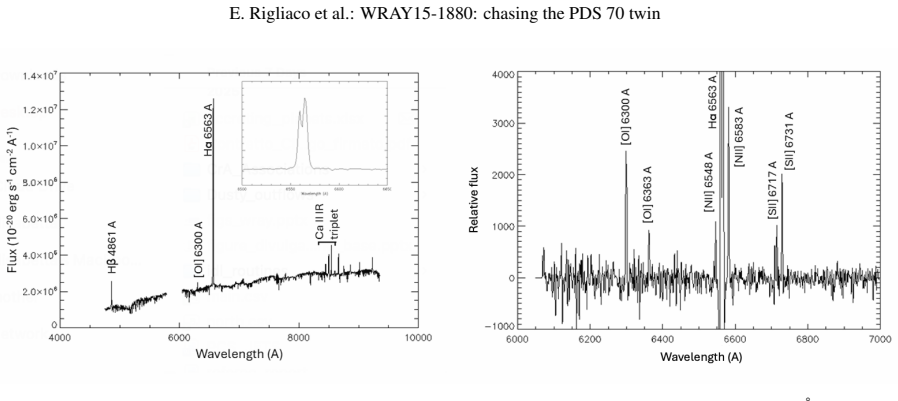
Observations of (giant) planets accreting material within their natal environment are crucial to constrain models for their formation. WRAY 15-1880 (aka RX J1842.9-3532) in the Corona Australis (CrA) complex has a prominent pre-transitional disk, and an age of ~2.8+-0.7 Myr, computed by comparison with isochrones using the accurate dynamical mass derived from disk kinematics. Hence, this star is in the late phases of disk evolution and might host accreting planets. We acquire new polarimetric imaging data with VLT-SPHERE and analyze archive observations taken with VLT-SPHERE, VLT-MUSE, and ALMA, finding a candidate Jupiter-like companion within the disk gap from high-contrast imaging. The mass estimates of the candidate companion, derived from various methods, are consistent with an object in the range of 0.3-7.6 MJup. The spectrum of the candidate companion is consistent with a T3 spectral type, in agreement with expectations of an object of a few Jupiter masses. We find an emission blob North-West of the star in the ALMA data rotating solidly with the candidate companion, that can be interpreted as a vortex/dust trap at the m=1 Lindblad resonance of the planet. Accretion on the candidate planet is not detected from the VLT-MUSE archival data. This may be due to insufficient contrast, an observational geometry that is unfavorable for viewing the planet's surface, or it could indicate that we are merely observing irregularities within the disk. Finally, we identify a microjet extending from the star perpendicular to the disk in these data.
Editorial analysis
A structured set of objections, weighed in public.
Referee Report
Summary. The paper reports new VLT/SPHERE polarimetric imaging and analysis of archival SPHERE, MUSE, and ALMA data for the ~2.8 Myr pre-transitional disk around WRAY 15-1880. It identifies a candidate companion in the disk gap with mass estimates spanning 0.3-7.6 MJup and a spectrum consistent with T3 type, an ALMA NW emission blob interpreted as a vortex/dust trap co-rotating at the m=1 Lindblad resonance of the candidate, no detected accretion, and a perpendicular microjet from the star.
Significance. If the candidate is confirmed as a bound planet and the ALMA feature is demonstrated to be physically associated at the expected resonance radius, the work would supply a rare observational example of a young giant planet still embedded in its natal disk at late evolutionary stages, with potential constraints on formation and disk-planet interaction models. The use of a dynamical mass to anchor the stellar age and the multi-facility dataset are positive features.
major comments (2)
- [ALMA analysis] Abstract and ALMA results section: the claim that the NW emission blob 'rotates solidly with the candidate companion' and 'can be interpreted as a vortex/dust trap at the m=1 Lindblad resonance' is presented without orbital elements, a resonance-radius calculation, or any test against Keplerian shear. A single-epoch ALMA archive observation cannot establish co-motion versus a static disk asymmetry or artifact; this association is load-bearing for the 'primitive planetary system' interpretation in the title and abstract.
- [Companion properties] Mass and spectral-type section: the reported mass range 0.3-7.6 MJup spans more than an order of magnitude and is derived from 'various methods' whose individual bounds and model dependencies are not tabulated or compared; this breadth weakens the 'Jupiter-like' classification and the claimed consistency with a T3 spectrum.
minor comments (1)
- [Introduction] The dynamical-mass-based age of 2.8±0.7 Myr is stated without reference to the specific isochrone set or fitting procedure used; a short methods paragraph would improve reproducibility.
Simulated Author's Rebuttal
We thank the referee for the constructive review. We address each major comment below, acknowledging limitations where data are insufficient, and have revised the manuscript to add calculations, a methods table, and tempered language on tentative interpretations.
read point-by-point responses
-
Referee: [ALMA analysis] Abstract and ALMA results section: the claim that the NW emission blob 'rotates solidly with the candidate companion' and 'can be interpreted as a vortex/dust trap at the m=1 Lindblad resonance' is presented without orbital elements, a resonance-radius calculation, or any test against Keplerian shear. A single-epoch ALMA archive observation cannot establish co-motion versus a static disk asymmetry or artifact; this association is load-bearing for the 'primitive planetary system' interpretation in the title and abstract.
Authors: We agree that a single-epoch observation cannot establish co-motion or exclude a static asymmetry. In revision we will add the m=1 Lindblad resonance radius calculation using the companion's estimated semi-major axis and the dynamical stellar mass, compare the blob position to the expected resonance location, and discuss consistency with (but not proof of) co-rotation versus Keplerian shear. Abstract and results text will be revised to describe the feature as 'positionally consistent with a vortex at the resonance' rather than 'rotates solidly.' Multi-epoch data to confirm motion are unavailable. revision: partial
-
Referee: [Companion properties] Mass and spectral-type section: the reported mass range 0.3-7.6 MJup spans more than an order of magnitude and is derived from 'various methods' whose individual bounds and model dependencies are not tabulated or compared; this breadth weakens the 'Jupiter-like' classification and the claimed consistency with a T3 spectrum.
Authors: We will add a table summarizing each mass method (evolutionary tracks, luminosity, spectral fitting, etc.), its model assumptions, input parameters, and derived mass bounds. This will clarify the sources of the broad range and show that the T3 classification aligns with the lower-mass end for a young object. The 'Jupiter-like' phrasing will be qualified as 'consistent with a few Jupiter masses within the reported range.' revision: yes
- Confirmation of physical association via co-motion of the ALMA blob requires multi-epoch observations that are not present in the archival dataset.
Circularity Check
No circularity: observational claims rest on direct data reduction
full rationale
The paper reports new VLT-SPHERE polarimetric imaging, archival MUSE and ALMA data, and a candidate companion detected in the disk gap. Mass range (0.3-7.6 MJup) and T3 type are obtained by applying standard evolutionary models and spectral templates to the observed photometry and spectrum; these are not predictions derived from a fit to the same data that would reduce by construction. The ALMA NW blob is described as co-rotating and possibly a vortex at the m=1 Lindblad resonance, but this is an interpretive suggestion from single-epoch positions rather than a self-derived equation that forces the conclusion. The stellar age (~2.8 Myr) is taken from isochrone comparison that uses an external dynamical mass from disk kinematics. No self-citation chain, ansatz smuggling, or uniqueness theorem imported from the authors' prior work is invoked to support the central imaging claim. The derivation chain is therefore self-contained against external benchmarks and receives the default non-finding.
Axiom & Free-Parameter Ledger
free parameters (1)
- age 2.8+-0.7 Myr
axioms (1)
- domain assumption Standard assumptions of high-contrast imaging (contrast curves, PSF subtraction) and spectral-type to mass relations hold for this object.
Reference graph
Works this paper leans on
-
[1]
Highly structured disk around the planet host PDS 70 revealed by high-angular resolution observations with ALMA. , keywords =. doi:10.1051/0004-6361/201935034 , archivePrefix =. 1902.07639 , primaryClass =
work page internal anchor Pith review Pith/arXiv arXiv doi:10.1051/0004-6361/201935034 1902
-
[2]
Discovery of a planetary-mass companion within the gap of the transition disk around PDS 70
Discovery of a planetary-mass companion within the gap of the transition disk around PDS 70. , keywords =. doi:10.1051/0004-6361/201832957 , archivePrefix =. 1806.11568 , primaryClass =
work page internal anchor Pith review Pith/arXiv arXiv doi:10.1051/0004-6361/201832957
-
[3]
Two accreting protoplanets around the young star PDS 70
Two accreting protoplanets around the young star PDS 70. Nature Astronomy , keywords =. doi:10.1038/s41550-019-0780-5 , archivePrefix =. 1906.01486 , primaryClass =
work page internal anchor Pith review Pith/arXiv arXiv doi:10.1038/s41550-019-0780-5 1906
-
[4]
Dust-depleted Inner Disks in a Large Sample of Transition Disks through Long-baseline ALMA Observations. , keywords =. doi:10.3847/1538-4357/ab7b63 , archivePrefix =. 2003.00079 , primaryClass =
-
[5]
exoALMA. I. Science Goals, Project Design, and Data Products. , keywords =. doi:10.3847/2041-8213/adc43b , archivePrefix =. 2504.18688 , primaryClass =
-
[6]
exoALMA. IV. Substructures, Asymmetries, and the Faint Outer Disk in Continuum Emission. , keywords =. doi:10.3847/2041-8213/adc438 , archivePrefix =. 2504.18725 , primaryClass =
-
[7]
The SEEDS High Contrast Imaging Survey of Exoplanets around Young Stellar Objects
The SEEDS High-Contrast Imaging Survey of Exoplanets Around Young Stellar Objects. , keywords =. doi:10.3847/1538-3881/153/3/106 , archivePrefix =. 1604.04697 , primaryClass =
work page internal anchor Pith review Pith/arXiv arXiv doi:10.3847/1538-3881/153/3/106
-
[8]
Search for substellar-mass companions and asymmetries in their parent discs
Sparse aperture masking interferometry survey of transitional discs. Search for substellar-mass companions and asymmetries in their parent discs. , keywords =. doi:10.1051/0004-6361/201628859 , archivePrefix =. 1608.03629 , primaryClass =
work page internal anchor Pith review Pith/arXiv arXiv doi:10.1051/0004-6361/201628859
-
[9]
SPHERE: the exoplanet imager for the Very Large Telescope. , keywords =. doi:10.1051/0004-6361/201935251 , archivePrefix =. 1902.04080 , primaryClass =
-
[10]
exoALMA. III. Line-intensity Modeling and System Property Extraction from Protoplanetary Disks. , keywords =. doi:10.3847/2041-8213/adc439 , archivePrefix =. 2504.19986 , primaryClass =
-
[11]
New evolutionary models for pre-main sequence and main sequence low-mass stars down to the hydrogen-burning limit. , keywords =. doi:10.1051/0004-6361/201425481 , archivePrefix =. 1503.04107 , primaryClass =
work page internal anchor Pith review Pith/arXiv arXiv doi:10.1051/0004-6361/201425481
-
[12]
Intrinsic Colors, Temperatures, and Bolometric Corrections of Pre-main-sequence Stars. , keywords =. doi:10.1088/0067-0049/208/1/9 , archivePrefix =. 1307.2657 , primaryClass =
work page internal anchor Pith review Pith/arXiv arXiv doi:10.1088/0067-0049/208/1/9
-
[13]
Spectral Classification Beyond M
Spectral classification beyond M. 13th Cambridge Workshop on Cool Stars, Stellar Systems and the Sun , year = 2005, editor =. doi:10.48550/arXiv.astro-ph/0409389 , archivePrefix =. astro-ph/0409389 , primaryClass =
work page internal anchor Pith review Pith/arXiv arXiv doi:10.48550/arxiv.astro-ph/0409389 2005
-
[14]
exoALMA. IX. Regularized Maximum Likelihood Imaging of Non-Keplerian Features. , keywords =. doi:10.3847/2041-8213/adc434 , archivePrefix =. 2504.19111 , primaryClass =
-
[15]
Structure and Composition of Two Transitional Circumstellar Disks in Corona Australis
Structure and Composition of Two Transitional Circumstellar Disks in Corona Australis. , keywords =. doi:10.1088/0004-6256/140/3/887 , archivePrefix =. 1007.3267 , primaryClass =
work page internal anchor Pith review Pith/arXiv arXiv doi:10.1088/0004-6256/140/3/887
-
[16]
Performance of the VLT Planet Finder SPHERE. II. Data analysis and results for IFS in laboratory. , keywords =. doi:10.1051/0004-6361/201423910 , archivePrefix =. 1503.02486 , primaryClass =
work page internal anchor Pith review Pith/arXiv arXiv doi:10.1051/0004-6361/201423910
-
[17]
Evolutionary models for solar metallicity low-mass stars: mass-magnitude relationships and color-magnitude diagrams. , keywords =. doi:10.48550/arXiv.astro-ph/9805009 , archivePrefix =. astro-ph/9805009 , primaryClass =
work page internal anchor Pith review Pith/arXiv arXiv doi:10.48550/arxiv.astro-ph/9805009
-
[18]
Evolutionary models for very-low-mass stars and brown dwarfs with dusty atmospheres
Evolutionary Models for Very Low-Mass Stars and Brown Dwarfs with Dusty Atmospheres. , keywords =. doi:10.1086/309513 , archivePrefix =. astro-ph/0005557 , primaryClass =
work page internal anchor Pith review Pith/arXiv arXiv doi:10.1086/309513
-
[19]
The SPHERE data center: a reference for high contrast imaging processing
The SPHERE Data Center: a reference for high contrast imaging processing. SF2A-2017: Proceedings of the Annual meeting of the French Society of Astronomy and Astrophysics , year = 2017, editor =. doi:10.48550/arXiv.1712.06948 , archivePrefix =. 1712.06948 , primaryClass =
work page internal anchor Pith review Pith/arXiv arXiv doi:10.48550/arxiv.1712.06948 2017
-
[20]
Astrometric and photometric accuracies in high contrast imaging: The SPHERE speckle calibration tool (SpeCal). , keywords =. doi:10.1051/0004-6361/201832973 , archivePrefix =. 1805.04854 , primaryClass =
-
[21]
SPHERE IRDIS and IFS astrometric strategy and calibration
SPHERE IRDIS and IFS astrometric strategy and calibration. Ground-based and Airborne Instrumentation for Astronomy VI , year = 2016, editor =. doi:10.1117/12.2233013 , archivePrefix =. 1609.06681 , primaryClass =
work page internal anchor Pith review Pith/arXiv arXiv doi:10.1117/12.2233013 2016
-
[22]
Polarimetric imaging mode of VLT/SPHERE/IRDIS. I. Description, data reduction, and observing strategy. , keywords =. doi:10.1051/0004-6361/201834989 , archivePrefix =. 1909.13107 , primaryClass =
-
[23]
Polarimetric imaging mode of VLT/SPHERE/IRDIS. II. Characterization and correction of instrumental polarization effects. , keywords =. doi:10.1051/0004-6361/201834996 , archivePrefix =. 1909.13108 , primaryClass =
-
[24]
Imaging Polarimetric Observations of a New Circumstellar Disk System
Imaging Polarimetric Observations of a New Circumstellar Disk System. , keywords =. doi:10.1086/320686 , archivePrefix =. astro-ph/0105239 , primaryClass =
work page internal anchor Pith review Pith/arXiv arXiv doi:10.1086/320686
-
[25]
Ground-based and Airborne Instrumentation for Astronomy II , year = 2008, editor =
The infra-red dual imaging and spectrograph for SPHERE: design and performance. Ground-based and Airborne Instrumentation for Astronomy II , year = 2008, editor =. doi:10.1117/12.789786 , adsurl =
-
[26]
Ground-based and Airborne Instrumentation for Astronomy II , year = 2008, editor =
SPHERE IFS: the spectro differential imager of the VLT for exoplanets search. Ground-based and Airborne Instrumentation for Astronomy II , year = 2008, editor =. doi:10.1117/12.788366 , adsurl =
-
[27]
Angular Differential Imaging: a Powerful High-Contrast Imaging Technique
Angular Differential Imaging: A Powerful High-Contrast Imaging Technique. , keywords =. doi:10.1086/500401 , archivePrefix =. astro-ph/0512335 , primaryClass =
work page internal anchor Pith review Pith/arXiv arXiv doi:10.1086/500401
-
[28]
Ground-based and Airborne Instrumentation for Astronomy III , year = 2010, editor =
The MUSE second-generation VLT instrument. Ground-based and Airborne Instrumentation for Astronomy III , year = 2010, editor =. doi:10.1117/12.856027 , archivePrefix =. 2211.16795 , primaryClass =
-
[29]
Adaptive Optics Systems III , year = 2012, editor =
GALACSI system design and analysis. Adaptive Optics Systems III , year = 2012, editor =. doi:10.1117/12.926110 , adsurl =
-
[30]
Adaptive Optics Systems , year = 2008, editor =
ESO adaptive optics facility. Adaptive Optics Systems , year = 2008, editor =. doi:10.1117/12.790359 , adsurl =
-
[31]
The data processing pipeline for the MUSE instrument. , keywords =. doi:10.1051/0004-6361/202037855 , archivePrefix =. 2006.08638 , primaryClass =
-
[32]
Astrophysics of gaseous nebulae and active galactic nuclei
-
[33]
Theoretical values for the [OIII] 5007/4959 line-intensity ratio and homologous cases. , keywords =. doi:10.1046/j.1365-8711.2000.03184.x , adsurl =
-
[34]
Astrophysical Letters and Communications , keywords =
The Critical Densities for Some Emission Lines. Astrophysical Letters and Communications , keywords =
-
[35]
Theoretical ISM Pressure and Electron Density Diagnostics for Local and High-redshift Galaxies. , keywords =. doi:10.3847/1538-4357/ab16ed , archivePrefix =. 1908.05504 , primaryClass =
-
[36]
On the gas content of transitional disks: a VLT/X-Shooter study of accretion and winds
Gas content of transitional disks: a VLT/X-Shooter study of accretion and winds. , keywords =. doi:10.1051/0004-6361/201323318 , archivePrefix =. 1406.1428 , primaryClass =
work page internal anchor Pith review Pith/arXiv arXiv doi:10.1051/0004-6361/201323318
-
[37]
Detection of [Ne II] Emission from Young Circumstellar Disks
Detection of [Ne II] Emission from Young Circumstellar Disks. , keywords =. doi:10.1086/518535 , archivePrefix =. astro-ph/0703616 , primaryClass =
work page internal anchor Pith review Pith/arXiv arXiv doi:10.1086/518535
-
[38]
A correlation between accretion and outflow rates for class II young stellar objects with full and transition disks. , keywords =. doi:10.1051/0004-6361/202554259 , archivePrefix =. 2505.16586 , primaryClass =
-
[39]
Recipes for stellar jets: results of combined optical/infrared diagnostics
Recipes for stellar jets: results of combined optical/infrared diagnostics. , keywords =. doi:10.1051/0004-6361:20054156 , archivePrefix =. astro-ph/0606280 , primaryClass =
work page internal anchor Pith review Pith/arXiv arXiv doi:10.1051/0004-6361:20054156
-
[40]
Kinematic Links and the Coevolution of MHD Winds, Jets, and Inner Disks from a High-resolution Optical [O I] Survey. , keywords =. doi:10.3847/1538-4357/aaf1aa , archivePrefix =. 1811.06544 , primaryClass =
work page internal anchor Pith review Pith/arXiv arXiv doi:10.3847/1538-4357/aaf1aa
-
[41]
The Evolution of Disk Winds from a Combined Study of Optical and Infrared Forbidden Lines. , keywords =. doi:10.3847/1538-4357/abba3c , archivePrefix =. 2009.09114 , primaryClass =
-
[42]
, keywords =
DG Tau: A shocking jet. , keywords =
-
[43]
Star and protoplanetary disk properties in Orion's suburbs
Star and protoplanetary disk properties in Orion's suburbs. , keywords =. doi:10.1051/0004-6361/200912468 , archivePrefix =. 0907.2380 , primaryClass =
work page internal anchor Pith review Pith/arXiv arXiv doi:10.1051/0004-6361/200912468
-
[44]
X-shooter spectroscopy of young stellar objects. I. Mass accretion rates of low-mass T Tauri stars in Orionis. , keywords =. doi:10.1051/0004-6361/201219832 , archivePrefix =. 1209.5799 , primaryClass =
work page internal anchor Pith review Pith/arXiv arXiv doi:10.1051/0004-6361/201219832
-
[45]
UV excess measures of accretion onto young very low-mass stars and brown dwarfs
UV Excess Measures of Accretion onto Young Very Low Mass Stars and Brown Dwarfs. , keywords =. doi:10.1086/586728 , archivePrefix =. 0801.3525 , primaryClass =
work page internal anchor Pith review Pith/arXiv arXiv doi:10.1086/586728
-
[46]
Forbidden emission lines in protostellar outflows and jets with MUSE. , keywords =. doi:10.1051/0004-6361/202141664 , archivePrefix =. 2301.02559 , primaryClass =
-
[47]
Diffuse radiation in the Galaxy. , year = 1941, month = jan, volume =. doi:10.1086/144246 , adsurl =
-
[48]
Dusty spirals triggered by shadows in transition discs
Dusty spirals triggered by shadows in transition discs. , keywords =. doi:10.1051/0004-6361/201731732 , archivePrefix =. 1811.08441 , primaryClass =
work page internal anchor Pith review Pith/arXiv arXiv doi:10.1051/0004-6361/201731732
-
[49]
The Structure of Spiral Shocks Excited by Planetary-mass Companions
The Structure of Spiral Shocks Excited by Planetary-mass Companions. , keywords =. doi:10.1088/0004-637X/813/2/88 , archivePrefix =. 1507.03599 , primaryClass =
work page internal anchor Pith review Pith/arXiv arXiv doi:10.1088/0004-637x/813/2/88
-
[50]
Direct detection of scattered light gaps in the transitional disk around HD 97048 with VLT/SPHERE
Direct detection of scattered light gaps in the transitional disk around HD 97048 with VLT/SPHERE. , keywords =. doi:10.1051/0004-6361/201629265 , archivePrefix =. 1609.04027 , primaryClass =
work page internal anchor Pith review Pith/arXiv arXiv doi:10.1051/0004-6361/201629265
-
[51]
Inferring Planet Mass from Spiral Structures in Protoplanetary Disks
Inferring Planet Mass from Spiral Structures in Protoplanetary Disks. , keywords =. doi:10.1088/2041-8205/815/2/L21 , archivePrefix =. 1511.01178 , primaryClass =
work page internal anchor Pith review Pith/arXiv arXiv doi:10.1088/2041-8205/815/2/l21 2041
-
[52]
exoALMA. XII. Weighing and Sizing exoALMA Disks with Rotation Curve Modelling. , keywords =. doi:10.3847/2041-8213/adc431 , archivePrefix =. 2504.18726 , primaryClass =
-
[53]
The Corona-Australis star-forming region: New insights on its formation history from detailed stellar and disk analysis. arXiv e-prints , keywords =. doi:10.48550/arXiv.2508.19757 , archivePrefix =. 2508.19757 , primaryClass =
-
[54]
Growth of Jupiter: Formation in disks of gas and solids and evolution to the present epoch. , keywords =. doi:10.1016/j.icarus.2020.114087 , archivePrefix =. 2009.05575 , primaryClass =
-
[55]
Proceedings of the National Academy of Science , keywords =
Age of Jupiter inferred from the distinct genetics and formation times of meteorites. Proceedings of the National Academy of Science , keywords =. doi:10.1073/pnas.1704461114 , adsurl =
-
[56]
The formation of Jupiter by hybrid pebble-planetesimal accretion
The formation of Jupiter by hybrid pebble-planetesimal accretion. Nature Astronomy , keywords =. doi:10.1038/s41550-018-0557-2 , archivePrefix =. 1809.05383 , primaryClass =
work page internal anchor Pith review Pith/arXiv arXiv doi:10.1038/s41550-018-0557-2
-
[57]
Radioactive Probes of the Supernova-contaminated Solar Nebula: Evidence that the Sun Was Born in a Cluster. , keywords =. doi:10.1086/508407 , archivePrefix =. astro-ph/0608411 , primaryClass =
work page internal anchor Pith review Pith/arXiv arXiv doi:10.1086/508407
-
[58]
Evidence from stable isotopes and Be-10 for solar system formation triggered by a low-mass supernova
Evidence from stable isotopes and ^ 10 Be for solar system formation triggered by a low-mass supernova. Nature Communications , keywords =. doi:10.1038/ncomms13639 , archivePrefix =. 1611.07162 , primaryClass =
work page internal anchor Pith review Pith/arXiv arXiv doi:10.1038/ncomms13639
-
[59]
Nucleosynthesis of an 11.8 M _ Supernova with 3D Simulation of the Inner Ejecta: Overall Yields and Implications for Short-lived Radionuclides in the Early Solar System. , keywords =. doi:10.3847/1538-4357/abc61b , archivePrefix =. 2008.12831 , primaryClass =
-
[60]
A Major Asymmetric Dust Trap in a Transition Disk
A Major Asymmetric Dust Trap in a Transition Disk. Science , keywords =. doi:10.1126/science.1236770 , archivePrefix =. 1306.1768 , primaryClass =
work page internal anchor Pith review Pith/arXiv arXiv doi:10.1126/science.1236770
-
[61]
Dust traps as planetary birthsites: basics and vortex formation
Dust traps as planetary birthsites: basics and vortex formation. , keywords =. doi:10.1093/mnras/stx302 , archivePrefix =. 1607.08250 , primaryClass =
work page internal anchor Pith review Pith/arXiv arXiv doi:10.1093/mnras/stx302
-
[62]
Ring shaped dust accumulation in transition disks
Ring shaped dust accumulation in transition disks. , keywords =. doi:10.1051/0004-6361/201219315 , archivePrefix =. 1207.6485 , primaryClass =
work page internal anchor Pith review Pith/arXiv arXiv doi:10.1051/0004-6361/201219315
-
[63]
Capture and evolution of dust in planetary mean-motion resonances: a fast, semi-analytic method for generating resonantly trapped disc images. , keywords =. doi:10.1093/mnras/stv045 , archivePrefix =. 1501.01631 , primaryClass =
work page internal anchor Pith review Pith/arXiv arXiv doi:10.1093/mnras/stv045
-
[64]
Mass constraint for a planet in a protoplanetary disk from the gap width
Mass constraint for a planet in a protoplanetary disk from the gap width. , keywords =. doi:10.1093/pasj/psw037 , archivePrefix =. 1603.03853 , primaryClass =
work page internal anchor Pith review Pith/arXiv arXiv doi:10.1093/pasj/psw037
-
[65]
VLT/MUSE Detection of the AB Aurigae b Protoplanet with H _ Spectroscopy. , keywords =. doi:10.3847/2041-8213/adf7a0 , archivePrefix =. 2508.18351 , primaryClass =
-
[66]
Disk Evolution Study Through Imaging of Nearby Young Stars (DESTINYS): Evidence of planet disk interaction in the 2MASSJ16120668-3010270 system. , keywords =. doi:10.1051/0004-6361/202451647 , archivePrefix =. 2506.05892 , primaryClass =
-
[67]
Wide Separation Planets in Time (WISPIT): Discovery of a Gap H Protoplanet WISPIT 2b with MagAO-X. , keywords =. doi:10.3847/2041-8213/adf7a5 , archivePrefix =. 2508.19046 , primaryClass =
-
[68]
WIde Separation Planets In Time (WISPIT): A Gap-clearing Planet in a Multi-ringed Disk around the Young Solar-type Star WISPIT 2. , keywords =. doi:10.3847/2041-8213/adf721 , archivePrefix =. 2508.19053 , primaryClass =
-
[69]
An Ionized Outflow from AB Aur, a Herbig Ae Star with a Transitional Disk
An Ionized Outflow from AB Aur, a Herbig Ae Star with a Transitional Disk. , keywords =. doi:10.1088/2041-8205/793/1/L21 , archivePrefix =. 1408.7068 , primaryClass =
work page internal anchor Pith review Pith/arXiv arXiv doi:10.1088/2041-8205/793/1/l21 2041
-
[70]
Blobs, spiral arms, and a possible planet around HD 169142
Blobs, spiral arms, and a possible planet around HD 169142. , keywords =. doi:10.1051/0004-6361/201834760 , archivePrefix =. 1901.06555 , primaryClass =
work page internal anchor Pith review Pith/arXiv arXiv doi:10.1051/0004-6361/201834760 1901
-
[71]
Confirmation and Keplerian motion of the gap-carving protoplanet HD 169142 b. , keywords =. doi:10.1093/mnrasl/slad027 , archivePrefix =. 2302.11302 , primaryClass =
-
[72]
Multi-band Spectral and Astrometric Characterization of the HIP 99770 b Planet with SCExAO/CHARIS and Gaia. arXiv e-prints , keywords =. doi:10.48550/arXiv.2509.02665 , archivePrefix =. 2509.02665 , primaryClass =
-
[73]
Theoretical Model of Hydrogen Line Emission from Accreting Gas Giants. , keywords =. doi:10.3847/1538-4357/aadc11 , archivePrefix =. 1808.06776 , primaryClass =
-
[74]
Constraining Planetary Gas Accretion Rate from H Line Width and Intensity: Case of PDS 70 b and c. , keywords =. doi:10.3847/2041-8213/ab5062 , archivePrefix =. 1909.08175 , primaryClass =
-
[75]
Growth of a Migrating Protoplanet. , keywords =. doi:10.1006/icar.1999.6107 , adsurl =
-
[76]
Three-Dimensional Interaction between a Planet and an Isothermal Gaseous Disk. I. Corotation and Lindblad Torques and Planet Migration. , keywords =. doi:10.1086/324713 , adsurl =
-
[77]
Forming the cores of giant planets from the radial pebble flux in protoplanetary discs
Forming the cores of giant planets from the radial pebble flux in protoplanetary discs. , keywords =. doi:10.1051/0004-6361/201424343 , archivePrefix =. 1408.6094 , primaryClass =
work page internal anchor Pith review Pith/arXiv arXiv doi:10.1051/0004-6361/201424343
-
[78]
Evolution of Migrating Planets Undergoing Gas Accretion
Evolution of Migrating Planets Undergoing Gas Accretion. , keywords =. doi:10.1086/590904 , archivePrefix =. 0806.1771 , primaryClass =
work page internal anchor Pith review Pith/arXiv arXiv doi:10.1086/590904
-
[79]
Migration of accreting planets in radiative discs from dynamical torques
Migration of accreting planets in radiative discs from dynamical torques. , keywords =. doi:10.1093/mnras/stw1904 , archivePrefix =. 1608.08756 , primaryClass =
work page internal anchor Pith review Pith/arXiv arXiv doi:10.1093/mnras/stw1904
-
[80]
M., 2011, @doi [ ] 10.1111/j.1365-2966.2010.17821.x , 411, 1917
Type III migration in a low-viscosity disc. , keywords =. doi:10.1111/j.1365-2966.2010.16560.x , archivePrefix =. 1002.3742 , primaryClass =
discussion (0)
Sign in with ORCID, Apple, or X to comment. Anyone can read and Pith papers without signing in.