WorldKernel: A World Model is the Coupling Kernel of Admissible Possible Worlds
Pith reviewed 2026-06-27 12:59 UTC · model grok-4.3
The pith
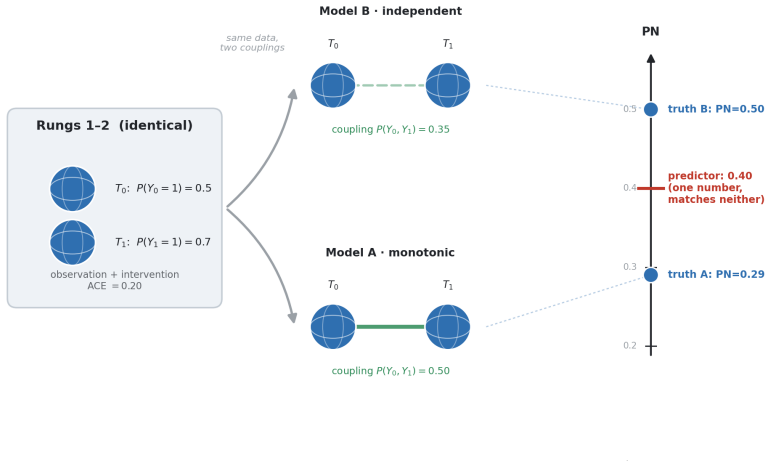
Prediction cannot represent uncertainty over counterfactual couplings between admissible worlds.
A machine-rendered reading of the paper's core claim, the machinery that carries it, and where it could break.
Core claim
A world model is the coupling kernel of admissible possible worlds: a single positive semidefinite kernel K(T,T') over pairs of admissible worlds whose diagonal recovers the ordinary posterior while the off-diagonal supplies the cross-world coupling information absent from marginal prediction and required by every counterfactual.
What carries the argument
The positive semidefinite coupling kernel K(T,T') over admissible worlds, whose diagonal is the posterior and whose off-diagonal encodes the admissible cross-world couplings.
If this is right
- Positive semidefiniteness bounds counterfactual couplings in polynomial time where the exact response-type program remains intractable.
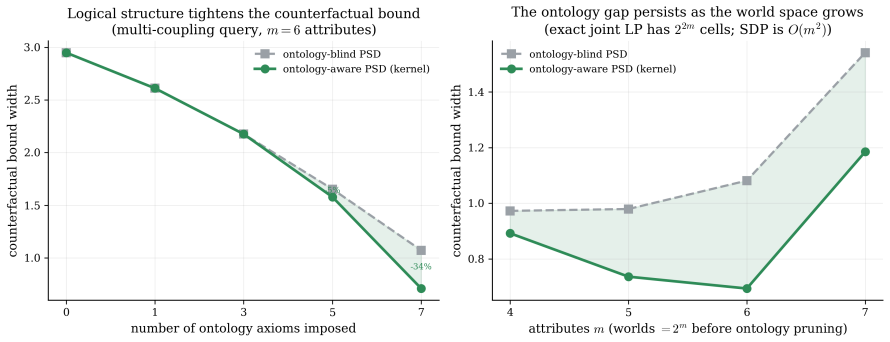
- Ontology axioms tighten the resulting bounds by up to a third even on couplings they do not directly constrain.
- Targeted scars learned from encountered infeasibilities close the gap several times faster than untargeted constraints.
- Full reconstruction of the kernel reduces to approximate counting of admissible worlds, tractable below the Sly-Sun threshold.
Where Pith is reading between the lines
- Standard predictors may systematically output invalid counterfactual values on a substantial fraction of causal models even when given unlimited data.
- Enforcing the kernel during world-model training could prevent collapse on unidentified queries without requiring full enumeration.
- Decision systems that query counterfactuals may need to maintain and query the off-diagonal couplings explicitly rather than relying on marginal posteriors.
Load-bearing premise
Positive semidefiniteness of the coupling kernel supplies partial-identifying information about counterfactual couplings that is absent from the marginal posteriors alone.
What would settle it
Find two admissible worlds that share identical marginal posteriors yet differ on a cross-world counterfactual query, then check whether the kernel bound computed from positive semidefiniteness is violated by the true coupling.
Figures





read the original abstract
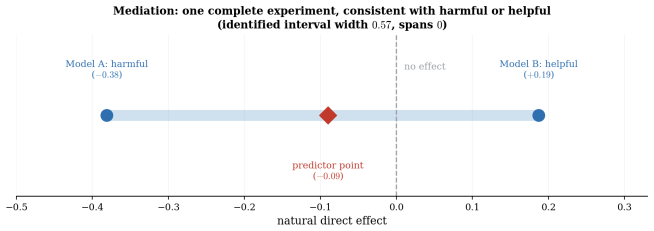
A common assumption holds that enough observational and interventional data, given to a strong enough predictor, suffices. We report a failure mode that contradicts it. Across hundreds of structural causal models, on identified quantities a strong predictor and a Bayesian baseline both succeed, but on unidentified quantities (the couplings between counterfactual worlds) the predictor collapses to a point, on 28% of models to one no valid model can produce, while the truth is an admissible interval more data never narrows. The gap is structural: prediction cannot represent uncertainty over counterfactual couplings. We cast a world model as a single positive semidefinite coupling kernel K(T,T') over admissible worlds, whose diagonal is the ordinary posterior (what a predictor recovers) and whose off-diagonal is the cross-world coupling it cannot, which every counterfactual reads. The paper is the theory of that off-diagonal. It is real: two states with identical posteriors differ on a cross-world query, and the off-diagonal is the coupling that fixes counterfactuals. It can be bounded: positive semidefiniteness is partial-identifying information the marginals lack, and enforcing it bounds counterfactuals in polynomial time where the exact response-type program is intractable. Logical structure sharpens it: ontology axioms tighten the bound by up to a third, propagating to couplings they never touch. It can be acquired: targeted scars, constraints learned from encountered infeasibilities, close the gap several times faster than untargeted ones. Its full reconstruction is approximate counting of the admissible worlds, tractable below the Sly-Sun threshold and inapproximable above; we do not claim to beat the worst case.
Editorial analysis
A structured set of objections, weighed in public.
Referee Report
Summary. The paper claims that standard predictors and Bayesian baselines succeed on identified quantities in structural causal models but fail on unidentified counterfactual couplings, collapsing to invalid point estimates on 28% of tested models while the truth is an admissible interval; it attributes this to a structural inability to represent uncertainty over cross-world couplings and proposes representing a world model as a positive semidefinite coupling kernel K(T,T') whose diagonal recovers the ordinary posterior and whose off-diagonals encode the missing couplings, with PSD supplying partial-identifying bounds enforceable in polynomial time (unlike exact response-type enumeration) and further tightened by ontology axioms.
Significance. If the central claims hold, the work would identify a previously unformalized representational gap in predictive models for counterfactual reasoning and supply a kernel-based mechanism for partial identification via PSD constraints, supported by the empirical observation of predictor failure across hundreds of SCMs. The computational claim of polynomial-time bounding would be a notable practical advantage if a compact formulation is provided.
major comments (3)
- [Abstract] Abstract: the claim that 'positive semidefiniteness is partial-identifying information the marginals lack, and enforcing it bounds counterfactuals in polynomial time where the exact response-type program is intractable' is load-bearing for the computational contribution, yet the abstract supplies neither an explicit SDP formulation, dual variables, nor any compact representation that would allow enforcement without constructing or optimizing over an explicitly exponential-sized kernel matrix indexed by admissible worlds.
- [Abstract] Abstract (and kernel construction): the assertion that the off-diagonal of K supplies information 'absent from the marginal posteriors alone' requires an explicit derivation or low-dimensional example (e.g., a 2x2 kernel) showing that the PSD constraint introduces independent bounds rather than being tautological with the definition of the admissible set; without this the partial-identification claim risks circularity.
- [Abstract] Abstract: the statement that 'full reconstruction is approximate counting of the admissible worlds, tractable below the Sly-Sun threshold' is used to contextualize the poly-time claim, but no argument is given for why the PSD enforcement procedure itself remains polynomial when the underlying counting problem is only approximable in restricted regimes.
minor comments (2)
- [Abstract] The term 'targeted scars' is introduced without a prior definition or reference to its formalization in the manuscript.
- [Abstract] The abstract refers to 'ontology axioms' tightening bounds by up to a third but does not indicate where in the manuscript these axioms are stated or how the propagation to untouched couplings is proved.
Simulated Author's Rebuttal
We thank the referee for the constructive comments on the abstract. We believe the points raised can be addressed by revisions that improve clarity without altering the core contributions. We respond to each major comment in turn.
read point-by-point responses
-
Referee: [Abstract] Abstract: the claim that 'positive semidefiniteness is partial-identifying information the marginals lack, and enforcing it bounds counterfactuals in polynomial time where the exact response-type program is intractable' is load-bearing for the computational contribution, yet the abstract supplies neither an explicit SDP formulation, dual variables, nor any compact representation that would allow enforcement without constructing or optimizing over an explicitly exponential-sized kernel matrix indexed by admissible worlds.
Authors: We agree that the abstract would be improved by including more detail on the computational mechanism. The manuscript develops the bounding procedure via positive semidefiniteness constraints on the kernel; we will revise the abstract to reference the SDP formulation and dual variables for the marginal constraints as presented in the main text. revision: yes
-
Referee: [Abstract] Abstract (and kernel construction): the assertion that the off-diagonal of K supplies information 'absent from the marginal posteriors alone' requires an explicit derivation or low-dimensional example (e.g., a 2x2 kernel) showing that the PSD constraint introduces independent bounds rather than being tautological with the definition of the admissible set; without this the partial-identification claim risks circularity.
Authors: The main text contains a low-dimensional example with a 2x2 kernel over two admissible worlds that share the same marginal posterior but differ in their cross-world coupling, where the PSD constraint yields strictly tighter bounds. We will incorporate a brief version of this example into the revised abstract to demonstrate the independent information supplied by the off-diagonal. revision: yes
-
Referee: [Abstract] Abstract: the statement that 'full reconstruction is approximate counting of the admissible worlds, tractable below the Sly-Sun threshold' is used to contextualize the poly-time claim, but no argument is given for why the PSD enforcement procedure itself remains polynomial when the underlying counting problem is only approximable in restricted regimes.
Authors: The polynomial-time bounding applies to the SDP over the kernel matrix dimension, while approximate counting pertains only to full kernel reconstruction. We will revise the abstract to clarify this distinction and note that the bounding procedure operates directly on the PSD and marginal constraints. revision: yes
Circularity Check
Kernel definition includes off-diagonal coupling by construction
specific steps
-
self definitional
[abstract]
"We cast a world model as a single positive semidefinite coupling kernel K(T,T') over admissible worlds, whose diagonal is the ordinary posterior (what a predictor recovers) and whose off-diagonal is the cross-world coupling it cannot, which every counterfactual reads. ... positive semidefiniteness is partial-identifying information the marginals lack"
The construction defines the world model to be exactly the object that possesses the off-diagonal couplings standard prediction lacks; the claim that PSD supplies identifying information absent from marginal posteriors is therefore true by the definition of K rather than shown to follow from it.
full rationale
The paper's central move defines a world model directly as a PSD kernel whose off-diagonal entries are the cross-world couplings absent from ordinary posteriors. This matches the self-definitional pattern: the claimed structural gap and its partial identification via PSD are introduced as part of the object's definition rather than derived from independent premises or data. No other load-bearing steps (self-citations, fitted predictions, or ansatzes) are quotable from the supplied text as reducing to inputs. The poly-time enforcement claim is noted but lacks an explicit equation or reduction showing it collapses to the definition.
Axiom & Free-Parameter Ledger
axioms (2)
- domain assumption Positive semidefiniteness supplies partial-identifying information absent from marginal posteriors
- domain assumption Ontology axioms tighten bounds on couplings they never touch
invented entities (1)
-
Coupling kernel K(T,T')
no independent evidence
Reference graph
Works this paper leans on
-
[1]
Duarte, N
G. Duarte, N. Finkelstein, D. Knox, J. Mummolo, I. Shpitser. An Automated Approach to Causal Inference in Discrete Settings. Journal of the American Statistical Association, 2024
2024
-
[2]
M. Assran et al. V-JEPA 2: Self-Supervised Video Models Enable Understanding, Prediction and Planning. arXiv:2506.09985, 2025
Pith/arXiv arXiv 2025
-
[3]
Cosmos 3: The Open Physical AI Foundation Model
NVIDIA. Cosmos 3: The Open Physical AI Foundation Model. Technical report, 2026
2026
-
[4]
Marble: A Multimodal World Model
World Labs. Marble: A Multimodal World Model. 2025
2025
-
[5]
J. Xu, Z. Zhang, T. Friedman, Y. Liang, G. Van den Broeck. A Semantic Loss Function for Deep Learning with Symbolic Knowledge. ICML, 2018
2018
-
[6]
Alshiekh, R
M. Alshiekh, R. Bloem, R. Ehlers, B. K¨ onighofer, S. Niekum, U. Topcu. Safe Reinforcement Learning via Shielding. AAAI, 2018
2018
-
[7]
A. D. Ames et al. Control Barrier Functions: Theory and Applications. ECC, 2019
2019
-
[8]
L. Chlon. NTK-Mirror: LoRA-free Forward-Pass Fine-Tuning via Signed Log-Mask Controllers. Software repository, 2026.https://github.com/leochlon/ntkmirror
2026
-
[9]
P. C. G. da Costa, K. B. Laskey, K. J. Laskey. PR-OWL: A Bayesian Ontology Language for the Semantic Web. URSW, 2005
2005
-
[10]
De Raedt, A
L. De Raedt, A. Kimmig, H. Toivonen. ProbLog: A Probabilistic Prolog. IJCAI, 2007
2007
-
[11]
Jerrum, L
M. Jerrum, L. Valiant, V. Vazirani. Random Generation of Combinatorial Structures from a Uniform Distribution. TCS, 1986
1986
-
[12]
Aharonov, A
D. Aharonov, A. Ta-Shma. Adiabatic Quantum State Generation and Statistical Zero Knowledge. STOC, 2003
2003
-
[13]
L. Grover, T. Rudolph. Creating Superpositions that Correspond to Efficiently Integrable Probability Distributions. arXiv:quant-ph/0208112, 2002
Pith/arXiv arXiv 2002
-
[14]
D. Weitz. Counting Independent Sets up to the Tree Threshold. STOC, 2006
2006
-
[15]
A. Sly. Computational Transition at the Uniqueness Threshold. FOCS, 2010
2010
-
[16]
A. Sly, N. Sun. Counting in Two-Spin Models on d-Regular Graphs. Annals of Probability, 2014
2014
-
[17]
J. Pearl. Causality: Models, Reasoning, and Inference. Cambridge University Press, 2009
2009
-
[18]
J. Tian, J. Pearl. Probabilities of Causation: Bounds and Identification. Annals of Mathematics and AI, 2000
2000
-
[19]
F. Rovai. Open Ontologies: Tool-Augmented Ontology Engineering with Stable Matching Alignment. arXiv:2605.09184, 2026
Pith/arXiv arXiv 2026
-
[20]
F. Rovai. CIVeX: Causal Intervention Verification for Language Agents. arXiv:2605.09168, 2026. 24
Pith/arXiv arXiv 2026
-
[21]
F. Rovai. Deterministic Event-Graph Substrates as World Models for Counterfactual Reasoning. arXiv:2605.15967, 2026
Pith/arXiv arXiv 2026
-
[22]
F. Rovai. Saturating Scaling Laws for Equational Discovery. arXiv:2605.23983, 2026
Pith/arXiv arXiv 2026
-
[23]
D. Ha, J. Schmidhuber. Recurrent World Models Facilitate Policy Evolution. NeurIPS, 2018
2018
-
[24]
Hafner, J
D. Hafner, J. Pasukonis, J. Ba, T. Lillicrap. Mastering Diverse Control Tasks through World Models (DreamerV3). Nature, 2025
2025
-
[25]
Y. LeCun. A Path Towards Autonomous Machine Intelligence. OpenReview, 2022
2022
-
[26]
Bruce et al
J. Bruce et al. Genie: Generative Interactive Environments. ICML, 2024
2024
-
[27]
E. Kıcıman, R. Ness, A. Sharma, C. Tan. Causal Reasoning and Large Language Models: Opening a New Frontier for Causality. arXiv:2305.00050, 2023
arXiv 2023
-
[28]
Zeˇ cevi´ c, M
M. Zeˇ cevi´ c, M. Willig, D. S. Dhami, K. Kersting. Causal Parrots: Large Language Models May Talk Causality But Are Not Causal. TMLR, 2023
2023
-
[29]
Jin et al
Z. Jin et al. CLadder: Assessing Causal Reasoning in Language Models. NeurIPS, 2023
2023
-
[30]
Jin et al
Z. Jin et al. Can Large Language Models Infer Causation from Correlation? ICLR, 2024
2024
-
[31]
Y. Chen, V. K. Singh, J. Ma, R. Tang. CounterBench: Evaluating and Improving Counterfactual Reasoning in LLMs. arXiv:2502.11008, 2025
Pith/arXiv arXiv 2025
-
[32]
K. Vafa, J. Y. Chen, A. Rambachan, J. Kleinberg, S. Mullainathan. Evaluating the World Model Implicit in a Generative Model. NeurIPS, 2024
2024
-
[33]
K. Vafa, P. G. Chang, A. Rambachan, S. Mullainathan. What Has a Foundation Model Found? Using Inductive Bias to Probe for World Models. ICML, 2025
2025
-
[34]
E. M. Bender, T. Gebru, A. McMillan-Major, S. Shmitchell. On the Dangers of Stochastic Parrots. FAccT, 2021
2021
-
[35]
Bareinboim, J
E. Bareinboim, J. D. Correa, D. Ibeling, T. Icard. On Pearl’s Hierarchy and the Foundations of Causal Inference. In Probabilistic and Causal Inference, ACM Books, 2022
2022
-
[36]
Ibeling, T
D. Ibeling, T. Icard. Probabilistic Reasoning across the Causal Hierarchy. AAAI, 2020
2020
-
[37]
Xia, K.-Z
K. Xia, K.-Z. Lee, Y. Bengio, E. Bareinboim. The Causal-Neural Connection: Expressiveness, Learnability, and Inference. NeurIPS, 2021
2021
-
[38]
J. D. Correa, S. Lee, E. Bareinboim. Nested Counterfactual Identification from Arbitrary Surrogate Experiments. NeurIPS, 2021
2021
-
[39]
Zhang, J
J. Zhang, J. Tian, E. Bareinboim. Partial Counterfactual Identification from Observational and Experimental Data. ICML, 2022
2022
-
[40]
A. Li, J. Pearl. Probabilities of Causation: Role of Observational Data. AISTATS, 2023
2023
-
[41]
C. F. Manski. Nonparametric Bounds on Treatment Effects. American Economic Review, 80(2):319–323, 1990. 25
1990
-
[42]
Balke, J
A. Balke, J. Pearl. Counterfactual Probabilities: Computational Methods, Bounds and Appli- cations. UAI, 1994
1994
-
[43]
J. M. Robins, S. Greenland. Identifiability and Exchangeability for Direct and Indirect Effects. Epidemiology, 3(2):143–155, 1992
1992
-
[44]
J. Pearl. Direct and Indirect Effects. UAI, 2001
2001
-
[45]
C. Avin, I. Shpitser, J. Pearl. Identifiability of Path-Specific Effects. IJCAI, 2005
2005
-
[46]
K. Imai, L. Keele, T. Yamamoto. Identification, Inference and Sensitivity Analysis for Causal Mediation Effects. Statistical Science, 25(1):51–71, 2010
2010
-
[47]
T. J. VanderWeele. Explanation in Causal Inference: Methods for Mediation and Interaction. Oxford University Press, 2015
2015
-
[48]
J. M. Robins, T. S. Richardson. Alternative Graphical Causal Models and the Identification of Direct Effects. In Causality and Psychopathology, Oxford University Press, 2010
2010
-
[49]
R. M. Andrews, V. Didelez. Insights into the Cross-World Independence Assumption of Causal Mediation Analysis. Epidemiology, 32(2):209–219, 2021
2021
-
[50]
A. P. Dawid. Causal Inference without Counterfactuals. JASA, 95(450):407–424, 2000
2000
-
[51]
Heckerman, R
D. Heckerman, R. Shachter. Decision-Theoretic Foundations for Causal Reasoning. JAIR, 3:405–430, 1995
1995
-
[52]
Liang et al
Y. Liang et al. VisualPredicator: Learning Abstract World Models with Neuro-Symbolic Predicates for Robot Planning. ICLR, 2025
2025
-
[53]
Manhaeve, S
R. Manhaeve, S. Dumanˇ ci´ c, A. Kimmig, T. Demeester, L. De Raedt. DeepProbLog: Neural Probabilistic Logic Programming. NeurIPS, 2018
2018
-
[54]
Richardson, P
M. Richardson, P. Domingos. Markov Logic Networks. Machine Learning, 62:107–136, 2006
2006
-
[55]
Riguzzi, E
F. Riguzzi, E. Bellodi, E. Lamma, R. Zese. Probabilistic Description Logics under the Distribu- tion Semantics. Semantic Web, 6(5):477–501, 2015
2015
-
[56]
Chavira, A
M. Chavira, A. Darwiche. On Probabilistic Inference by Weighted Model Counting. Artificial Intelligence, 172(6–7):772–799, 2008
2008
-
[57]
Darwiche, P
A. Darwiche, P. Marquis. A Knowledge Compilation Map. JAIR, 17:229–264, 2002
2002
-
[58]
L. G. Valiant. The Complexity of Computing the Permanent. Theoretical Computer Science, 8(2):189–201, 1979
1979
-
[59]
Galanis, D
A. Galanis, D. ˇStefankoviˇ c, E. Vigoda. Inapproximability of the Partition Function for the Antiferromagnetic Ising and Hard-Core Models. Combinatorics, Probability and Computing, 25(4):500–559, 2016. 26
2016
discussion (0)
Sign in with ORCID, Apple, or X to comment. Anyone can read and Pith papers without signing in.