Dimming and pulsation shock of the coalesced star V838 Monocerotis
Pith reviewed 2026-06-27 11:52 UTC · model grok-4.3
The pith
V838 Mon exhibits pulsation shocks twenty-four years after its stellar merger.
A machine-rendered reading of the paper's core claim, the machinery that carries it, and where it could break.
Core claim
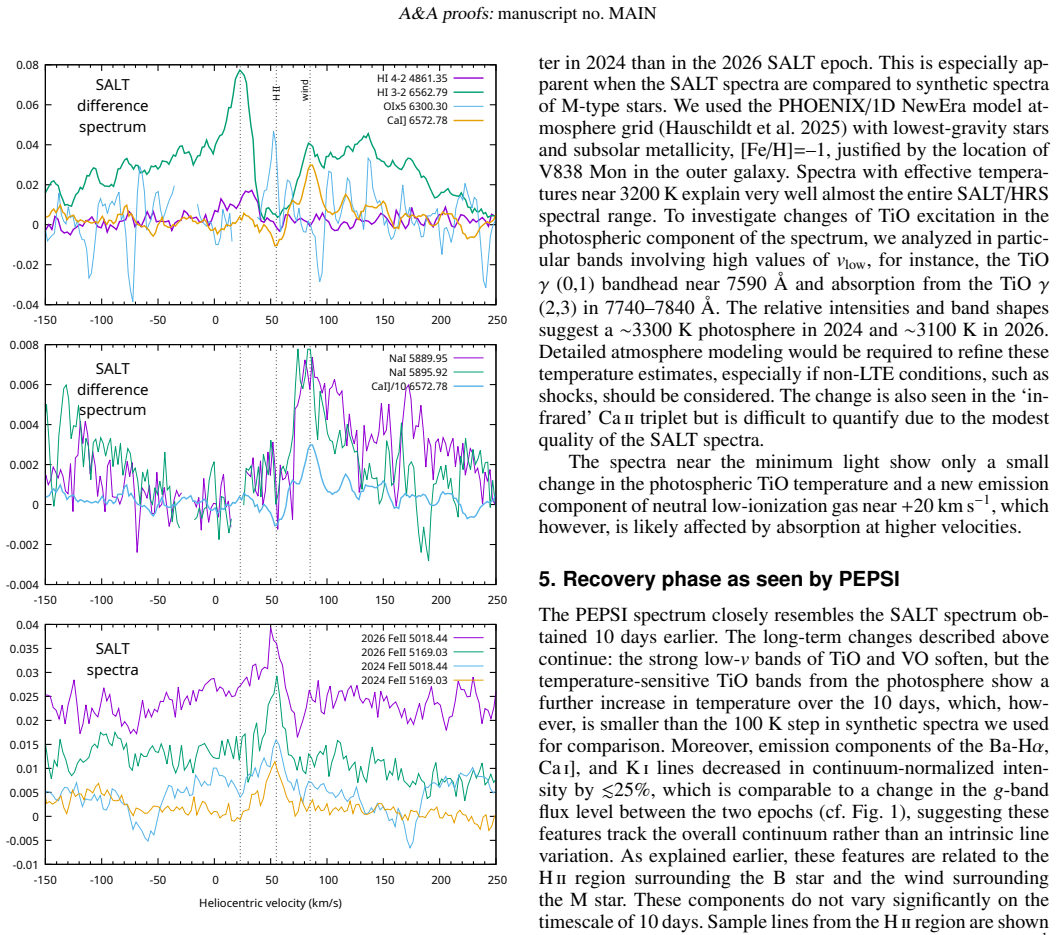
Twenty-four years after the 2002 merger, V838 Mon exhibits pulsation shocks qualitatively identical to those of red supergiants and Mira stars. The spectroscopic sequence during the recovery from the 2026 dimming shows H recombination lines with anomalous ratios and blueshifted metal lines at 90 km/s, interpreted as a sub-photospheric pulsation shock. This provides the first observational evidence for pulsations in a stellar merger remnant and confirms predictions of pulsational instability in post-merger objects. The 2026 dimming is linked to a preceding shock in 2025, with another dimming predicted for northern summer 2026.
What carries the argument
Sub-photospheric pulsation shock identified via anomalous H recombination line ratios matching Mira stars at maximum light and blueshifted low-ionization metal lines tracing shock-affected gas.
If this is right
- The 2026 dimming was triggered by a pulsation shock that occurred earlier in 2025.
- A further dimming event triggered by the observed shock is predicted to start in northern summer 2026.
- Post-merger objects undergo pulsational instability similar to that in red supergiants and Mira stars.
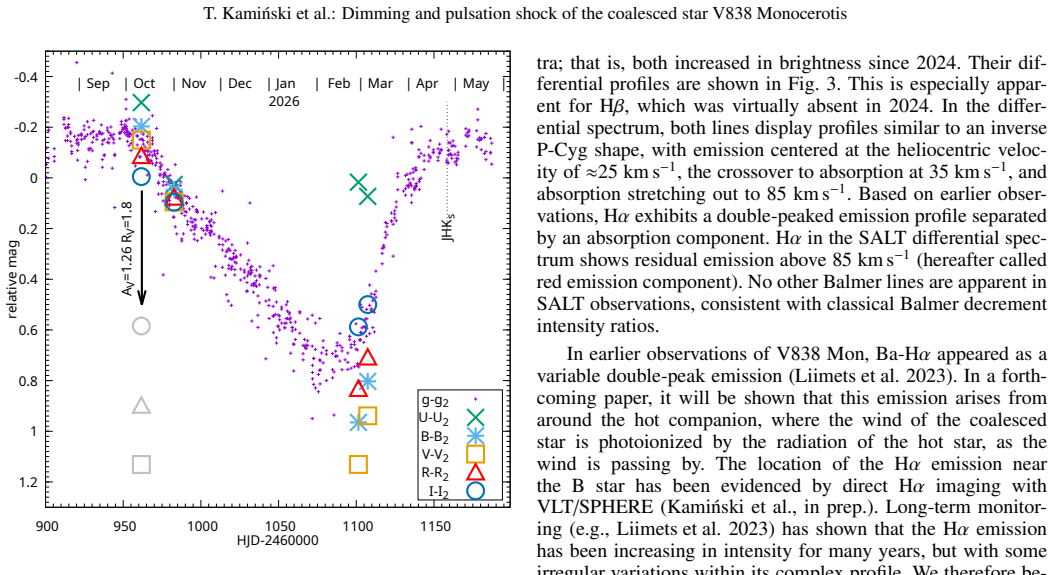
- The photospheric effective temperature changed by no more than about 200 K during the dimming, which is explained by dust extinction with A_V=1.26 mag and R_V=1.8.
Where Pith is reading between the lines
- This suggests that other known stellar merger remnants could exhibit similar pulsational behavior if monitored spectroscopically over long timescales.
- The connection between pulsation shocks and dust formation may be relevant to understanding dimming events in other classes of cool variable stars.
- Repeated spectroscopic observations could reveal whether the pulsations in V838 Mon have a regular period.
Load-bearing premise
The anomalous ratios of H recombination lines are produced by a sub-photospheric pulsation shock, and the analogy to Mira stars establishes the presence of pulsations.
What would settle it
Failure to observe the predicted further dimming event in northern summer 2026 would falsify the proposed connection between the observed shock and subsequent dust dimming events.
Figures




read the original abstract
V838 Mon is the remnant of a stellar merger that occurred in 2002. Twenty-four years after the merger, the remnant closely resembles a red supergiant, but its luminosity is sustained by core H burning and continued contraction toward hydrostatic equilibrium. In late 2025, the system entered the deepest dimming event observed since 2006. We characterize the 2026 dimming using multiband photometry and high-resolution spectroscopy spanning from the dimming minimum through the recovery phase. The photometric color evolution during the dimming can be well reproduced by dust extinction with $A_V=1.26$ mag and $R_V=1.8$, consistent with a transiting clump of freshly formed circumstellar dust composed of small silicate or alumina grains. The photospheric effective temperature changed by no more than ~200 K during the event. During the recovery phase, H recombination lines from the Balmer, Paschen, and Brackett series appeared in emission, with anomalous line ratios matching those of pulsating Mira stars near maximum light. These features are interpreted as arising from a sub-photospheric pulsation shock. Simultaneously, low-ionization metal lines appeared blueshifted by 90 km/s relative to the stellar rest frame, tracing shock-affected gas on the near side of the stellar disk. The spectroscopic sequence suggests that the 2026 dimming was itself triggered by a preceding pulsation shock that occurred earlier in 2025. We present the first observational evidence for pulsations in a stellar merger remnant. Twenty-four years after the coalescence, V838 Mon exhibits pulsation shocks qualitatively identical to those of red supergiants and Mira stars, confirming predictions of pulsational instability in post-merger objects. A further dimming event, triggered by the observed shock, is predicted to start in northern summer 2026.
Editorial analysis
A structured set of objections, weighed in public.
Referee Report
Summary. The manuscript reports multiband photometry and high-resolution spectroscopy of the stellar merger remnant V838 Mon during its 2025-2026 dimming event. Photometric colors are reproduced by a standard dust-extinction model with fitted parameters A_V=1.26 mag and R_V=1.8, indicating a transiting clump of small silicate or alumina grains and at most ~200 K change in effective temperature. During recovery, H recombination lines (Balmer, Paschen, Brackett series) appear in emission with anomalous ratios, accompanied by low-ionization metal lines blueshifted by 90 km/s; these are interpreted as arising from a sub-photospheric pulsation shock analogous to Mira stars near maximum light. The sequence is taken to indicate that a preceding pulsation shock triggered the dimming, constituting the first observational evidence for pulsations in a post-merger object and yielding a prediction of a further dimming event in summer 2026.
Significance. If the spectroscopic identification holds, the result would confirm theoretical predictions of pulsational instability in merger remnants and establish a direct observational link between such shocks and dust-driven dimming. The photometric analysis is a standard application of the extinction law using only two free parameters and is readily reproducible. The spectroscopic analogy to Mira stars, if quantified and tested against alternatives, would strengthen the case for pulsations in this class of objects.
major comments (2)
- [Spectroscopic observations and interpretation] The central claim that the observed H recombination line ratios are anomalous and match those of pulsating Mira stars near maximum light (and thereby establish a sub-photospheric pulsation shock) is load-bearing for the abstract's strongest statement, yet the manuscript provides neither the measured ratios (with uncertainties) for the Balmer/Paschen/Brackett series nor a quantitative side-by-side comparison to reference Mira spectra.
- [Discussion and conclusions] The attribution of the 2025-2026 dimming to a preceding pulsation shock (and the consequent prediction of a 2026 event) rests on the timing of the spectroscopic features and the Mira analogy, but no modeling excludes the possibility that the concurrent dust event itself could produce the observed line ratios and 90 km/s blueshift, nor is an alternative non-pulsational origin for the metal-line shift considered.
minor comments (2)
- The abstract states that the line ratios 'match' Mira stars but does not specify which particular ratios (e.g., Hα/Hβ or Paschen/Brackett decrements) are anomalous; adding the numerical values would improve clarity.
- No reference is given to the specific Mira-star spectra or line-ratio compilations used for the comparison; including these citations would allow readers to assess the strength of the analogy.
Simulated Author's Rebuttal
We thank the referee for their constructive comments on our manuscript. We address each major point below and have revised the manuscript to strengthen the spectroscopic analysis and discussion of alternative interpretations.
read point-by-point responses
-
Referee: [Spectroscopic observations and interpretation] The central claim that the observed H recombination line ratios are anomalous and match those of pulsating Mira stars near maximum light (and thereby establish a sub-photospheric pulsation shock) is load-bearing for the abstract's strongest statement, yet the manuscript provides neither the measured ratios (with uncertainties) for the Balmer/Paschen/Brackett series nor a quantitative side-by-side comparison to reference Mira spectra.
Authors: We agree that explicit measured line ratios with uncertainties and a quantitative comparison are needed to support the central claim. In the revised manuscript we have added Table 2 reporting the measured fluxes (with 1-sigma uncertainties from Gaussian fitting) and derived ratios for the strongest Balmer, Paschen and Brackett lines. We also include a direct numerical comparison to published Mira spectra near maximum light (e.g., from the references cited in the original text), confirming that the observed ratios fall within the range reported for shock-excited Mira atmospheres and are inconsistent with standard Case B recombination. These additions are now referenced in the abstract and results section. revision: yes
-
Referee: [Discussion and conclusions] The attribution of the 2025-2026 dimming to a preceding pulsation shock (and the consequent prediction of a 2026 event) rests on the timing of the spectroscopic features and the Mira analogy, but no modeling excludes the possibility that the concurrent dust event itself could produce the observed line ratios and 90 km/s blueshift, nor is an alternative non-pulsational origin for the metal-line shift considered.
Authors: We acknowledge that the manuscript does not contain radiative-transfer modeling that explicitly rules out dust-induced line formation. We have therefore expanded the discussion section to explain why dust extinction or scattering is unlikely to produce the observed emission-line spectrum and velocity shift: the lines appear only during the photometric recovery phase, exhibit ratios characteristic of shock excitation rather than photoionization, and the 90 km/s blueshift is seen exclusively in low-ionization species. We also briefly consider non-pulsational alternatives (e.g., episodic mass loss or binary interaction) and note that the timing relative to the dimming minimum and the close match to Mira shock signatures favor the pulsation interpretation. The 2026 prediction is framed as a testable hypothesis rather than a firm forecast. Full hydrodynamic modeling of the dust-shock interaction lies beyond the scope of the present observational paper. revision: partial
Circularity Check
No circularity: observational claims rest on photometry, spectroscopy, and external Mira analogies without reduction to fitted inputs or self-citation chains
full rationale
The paper's central claims derive from direct multiband photometry (dust extinction fit with A_V=1.26, R_V=1.8) and high-resolution spectroscopy (anomalous H recombination line ratios and 90 km/s blueshifted metal lines). These are interpreted via qualitative analogy to Mira stars at maximum light to infer a sub-photospheric pulsation shock, with the dimming linked interpretively to a prior shock. No equations, fitted parameters, or self-citations are invoked such that any prediction reduces by construction to the inputs; the pulsation evidence is presented as independent observational data confirming external predictions rather than deriving from the dust model or prior author work. The derivation chain is self-contained against external benchmarks.
Axiom & Free-Parameter Ledger
free parameters (2)
- A_V =
1.26 mag
- R_V =
1.8
axioms (2)
- domain assumption Photometric color changes during the dimming are produced by extinction from a transiting clump of freshly formed circumstellar dust composed of small silicate or alumina grains.
- domain assumption Anomalous H recombination line ratios and blueshifted metal lines arise from a sub-photospheric pulsation shock qualitatively identical to those in Mira stars near maximum light.
Reference graph
Works this paper leans on
-
[1]
R., Roettenbacher, R
Anugu, N., Gies, D. R., Roettenbacher, R. M., et al. 2024, ApJ, 973, L5
2024
-
[2]
M., Bychkov, K
Belova, O. M., Bychkov, K. V ., & Rudnitskii, G. M. 2014, Astronomy Reports, 58, 922
2014
-
[3]
A., Clayton, G
Cardelli, J. A., Clayton, G. C., & Mathis, J. S. 1989, ApJ, 345, 245
1989
-
[4]
W., Luttermoser, D
Castelaz, M. W., Luttermoser, D. G., Caton, D. B., & Piontek, R. A. 2000, AJ, 120, 2627
2000
-
[5]
Chiavassa, A., Kravchenko, K., & Goldberg, J. A. 2024, Living Reviews in Com- putational Astrophysics, 10, 2
2024
-
[6]
Cox, A. N. 2000, Allen’s astrophysical quantities
2000
-
[7]
A., Sharples, R
Crause, L. A., Sharples, R. M., Bramall, D. G., et al. 2014, in Society of Photo- Optical Instrumentation Engineers (SPIE) Conference Series, V ol. 9147, Ground-based and Airborne Instrumentation for Astronomy V , ed. S. K. Ram- say, I. S. McLean, & H. Takami, 91476T
2014
-
[8]
2005, PASJ, 57, L25
Deguchi, S., Matsunaga, N., & Fukushi, H. 2005, PASJ, 57, L25
2005
-
[9]
2000, in Society of Photo-Optical Instrumentation Engineers (SPIE) Conference Se- ries, V ol
Dekker, H., D’Odorico, S., Kaufer, A., Delabre, B., & Kotzlowski, H. 2000, in Society of Photo-Optical Instrumentation Engineers (SPIE) Conference Se- ries, V ol. 4008, Optical and IR Telescope Instrumentation and Detectors, ed. M. Iye & A. F. Moorwood, 534–545
2000
-
[10]
E., Mairs, S., Scicluna, P., et al
Dharmawardena, T. E., Mairs, S., Scicluna, P., et al. 2020, ApJ, 897, L9
2020
-
[11]
K., Strassmeier, K
Dupree, A. K., Strassmeier, K. G., Calderwood, T., et al. 2022, ApJ, 936, 18
2022
-
[12]
K., Strassmeier, K
Dupree, A. K., Strassmeier, K. G., Matthews, L. D., et al. 2020, ApJ, 899, 68
2020
-
[13]
2011, A&A, 535, A12
Fabas, N., Lèbre, A., & Gillet, D. 2011, A&A, 535, A12
2011
-
[14]
B., Massacrier, G., & Gillet, D
Fokin, A. B., Massacrier, G., & Gillet, D. 2004, A&A, 420, 1047
2004
-
[15]
2024, A&A, 692, A223 Article number, page 10 T
Freytag, B., Höfner, S., Aringer, B., & Chiavassa, A. 2024, A&A, 692, A223 Article number, page 10 T. Kami´nski et al.: Dimming and pulsation shock of the coalesced star V838 Monocerotis
2024
-
[16]
R., Kaminskiy, B
Geballe, T. R., Kaminskiy, B. M., Banerjee, D. P. K., et al. 2025, MNRAS, 541, 3331
2025
-
[17]
D., Marchetti, J., McMillan, S., et al
Gehrz, R. D., Marchetti, J., McMillan, S., et al. 2020, The Astronomer’s Tele- gram, 13518, 1
2020
-
[18]
1988, A&A, 192, 206
Gillet, D. 1988, A&A, 192, 206
1988
-
[19]
1983, A&A, 128, 384
Gillet, D., Maurice, E., & Baade, D. 1983, A&A, 128, 384
1983
-
[20]
P., Barsukova, E
Goranskij, V . P., Barsukova, E. A., Burenkov, A. N., et al. 2020, Astrophysical Bulletin, 75, 325
2020
-
[21]
P., Shugarov, S
Goranskij, V . P., Shugarov, S. Y ., Barsukova, E. A., et al. 2026, The Astronomer’s Telegram, 17702, 1
2026
-
[22]
M., Guinan, E
Harper, G. M., Guinan, E. F., Wasatonic, R., & Ryde, N. 2020, ApJ, 905, 34
2020
-
[23]
H., Barman, T., Baron, E., Aufdenberg, J
Hauschildt, P. H., Barman, T., Baron, E., Aufdenberg, J. P., & Schweitzer, A. 2025, The PHOENIX/1D NewEra model atmosphere grid: Access software & low resolution synthetic spectra, fixed download links in list...txt
2025
-
[24]
Henneco, J., Schneider, F. R. N., Heller, M., Hekker, S., & Aerts, C. 2025, A&A, 698, A49
2025
-
[25]
Ilyin, I. V . 2000, PhD thesis, University of Oulu, Division of Astronomy Jadlovský, D., Granzer, T., Weber, M., et al. 2024, A&A, 685, A124
2000
-
[26]
Z., Kochanek, C
Jayasinghe, T., Stanek, K. Z., Kochanek, C. S., et al. 2019, MNRAS, 486, 1907
2019
-
[27]
Joy, A. H. 1947, ApJ, 106, 288 Kami´nski, T. 2019, A&A, 627, A114
1947
-
[28]
Kaminski, T. & Blagorodnova, N. 2026, arXiv e-prints, arXiv:2605.17005 Kami´nski, T., Schmidt, M., Hajduk, M., et al. 2023, A&A, 672, A196 Kami´nski, T., Tylenda, R., Kiljan, A., et al. 2021, A&A, 655, A32
Pith/arXiv arXiv 2026
-
[29]
Y ., Gvaramadze, V
Kniazev, A. Y ., Gvaramadze, V . V ., & Berdnikov, L. N. 2017, in Astronomi- cal Society of the Pacific Conference Series, V ol. 510, Stars: From Collapse to Collapse, ed. Y . Y . Balega, D. O. Kudryavtsev, I. I. Romanyuk, & I. A. Yakunin, 480
2017
-
[30]
Levesque, E. M. & Massey, P. 2020, ApJ, 891, L37
2020
-
[31]
2023, A&A, 670, A13
Liimets, T., Kolka, I., Kraus, M., et al. 2023, A&A, 670, A13
2023
-
[32]
K., Richings, A
Liu, Y ., Theuns, T., Chan, T. K., Richings, A. J., & McLeod, A. F. 2026, MN- RAS, 547, stag429
2026
-
[33]
R., Wisniewski, J
Loebman, S. R., Wisniewski, J. P., Schmidt, S. J., et al. 2015, AJ, 149, 17 López Ariste, A., Tessore, B., Carlín, E. S., et al. 2019, A&A, 632, A30
2015
-
[34]
K., Rudy, R
Lynch, D. K., Rudy, R. J., Russell, R. W., et al. 2007, in Astronomical Society of the Pacific Conference Series, V ol. 363, The Nature of V838 Mon and its Light Echo, ed. R. L. M. Corradi & U. Munari, 39
2007
-
[35]
K., Rudy, R
Lynch, D. K., Rudy, R. J., Russell, R. W., et al. 2004, ApJ, 607, 460
2004
-
[36]
Mittag, M., Schröder, K.-P., Perdelwitz, V ., Jack, D., & Schmitt, J. H. M. M. 2023, A&A, 669, A9 Montargès, M., Cannon, E., Lagadec, E., et al. 2021, Nature, 594, 365
2023
-
[37]
Munari, U., Corradi, R. L. M., Henden, A., et al. 2007, A&A, 474, 585
2007
-
[38]
2002, A&A, 389, L51 Ortiz-León, G
Munari, U., Henden, A., Kiyota, S., et al. 2002, A&A, 389, L51 Ortiz-León, G. N., Menten, K. M., Kami´nski, T., et al. 2020, A&A, 638, A17
2002
-
[39]
Reid, M. J. & Goldston, J. E. 2002, ApJ, 568, 931
2002
-
[40]
& Wood, P
Richter, H. & Wood, P. R. 2001, A&A, 369, 1027
2001
-
[41]
R., Woitke, P., Bolick, U., & Sedlmayr, E
Richter, H., Wood, P. R., Woitke, P., Bolick, U., & Sedlmayr, E. 2003, A&A, 400, 319
2003
-
[42]
Rui, N. Z. & Fuller, J. 2021, MNRAS, 508, 1618
2021
-
[43]
L., & Graziani, M
Siviero, A., Munari, U., Righetti, G. L., & Graziani, M. 2016, Information Bul- letin on Variable Stars, 6183, 1
2016
-
[44]
2015, A&A, 576, A77
Smette, A., Sana, H., Noll, S., et al. 2015, A&A, 576, A77
2015
-
[45]
G., Ilyin, I., Järvinen, A., et al
Strassmeier, K. G., Ilyin, I., Järvinen, A., et al. 2015, Astronomische Nachrichten, 336, 324
2015
-
[46]
G., Ilyin, I., & Steffen, M
Strassmeier, K. G., Ilyin, I., & Steffen, M. 2018, A&A, 612, A44
2018
-
[47]
1986, in Society of Photo-Optical Instrumentation Engineers (SPIE) Conference Series, V ol
Tody, D. 1986, in Society of Photo-Optical Instrumentation Engineers (SPIE) Conference Series, V ol. 627, Instrumentation in astronomy VI, ed. D. L. Crawford, 733
1986
-
[48]
1993, in Astronomical Society of the Pacific Conference Series, V ol
Tody, D. 1993, in Astronomical Society of the Pacific Conference Series, V ol. 52, Astronomical Data Analysis Software and Systems II, ed. R. J. Hanisch, R. J. V . Brissenden, & J. Barnes, 173
1993
-
[49]
2005, A&A, 436, 1009
Tylenda, R. 2005, A&A, 436, 1009
2005
-
[50]
& Kami´nski, T
Tylenda, R. & Kami´nski, T. 2012, A&A, 548, A23
2012
-
[51]
2009, A&A, 503, 899
Tylenda, R., Kami´nski, T., & Schmidt, M. 2009, A&A, 503, 899
2009
-
[52]
2011, A&A, 532, A138
Tylenda, R., Kami ´nski, T., Schmidt, M., Kurtev, R., & Tomov, T. 2011, A&A, 532, A138
2011
-
[53]
& Soker, N
Tylenda, R. & Soker, N. 2006, A&A, 451, 223
2006
-
[54]
2005, A&A, 441, 1099
Tylenda, R., Soker, N., & Szczerba, R. 2005, A&A, 441, 1099
2005
-
[55]
2011, A&A, 536, A105
Vernet, J., Dekker, H., D’Odorico, S., et al. 2011, A&A, 536, A105
2011
-
[56]
2017, ApJS, 232, 16 Article number, page 11 A&A proofs:manuscript no
Yao, Y ., Liu, C., Deng, L., de Grijs, R., & Matsunaga, N. 2017, ApJS, 232, 16 Article number, page 11 A&A proofs:manuscript no. MAIN Table A.1: Sensitivities reached in our spectral observations. Date Instrument S/N S/N 4200 Å 7000 Å 15-11-2024 SALT/HRS 6 162 21-05-2026 SALT/HRS 4 179 13-03-2026 LBT/PEPSI 3 61 02-03-2024 VLT/Xshooter 78 460 10-04-2026 VL...
2017
discussion (0)
Sign in with ORCID, Apple, or X to comment. Anyone can read and Pith papers without signing in.