High-Resolution ALMA Imaging for a Gravitationally-lensed Quasar at z=6.5: Constraining the AGN Contribution to Galactic-Scale Dust Heating
Pith reviewed 2026-06-27 12:42 UTC · model grok-4.3
The pith
In a z=6.5 lensed quasar, AGN heating contributes only about 13% to the total sub-millimeter dust emission.
A machine-rendered reading of the paper's core claim, the machinery that carries it, and where it could break.
Core claim
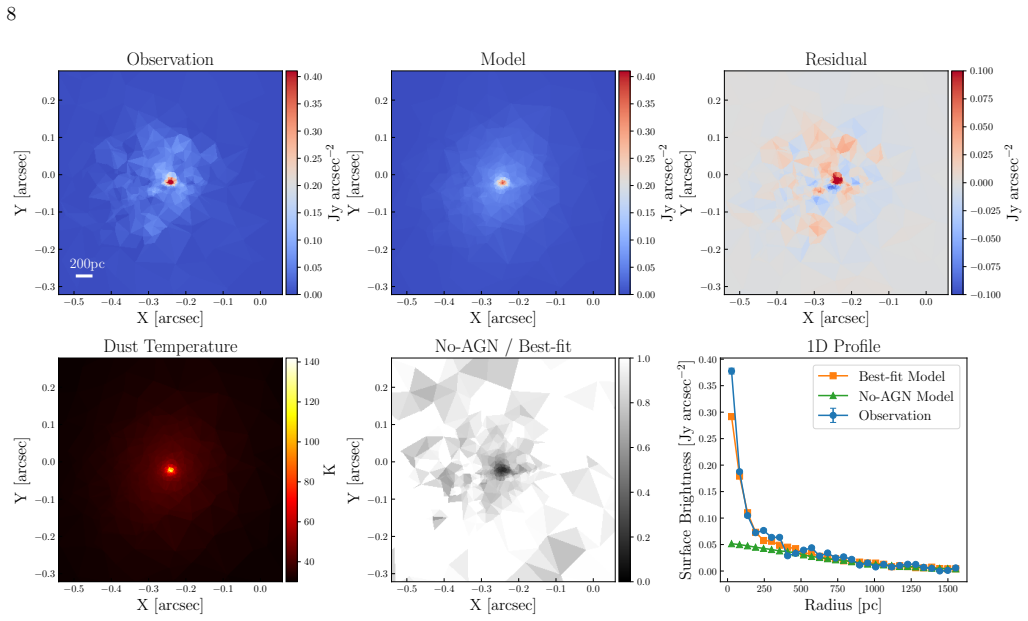
The reconstructed source-plane continuum shows a compact core of size less than or equal to 200 pc. The best-fit radiative transfer model indicates that heated dust from the active galactic nucleus dominates the sub-millimeter emission at radii less than or equal to 100 pc while star-heated dust dominates the outer region of the host galaxy. AGN heating therefore contributes approximately 13 percent to the observed sub-mm flux, implying that previous far-infrared-based star formation rate measurements for most high-redshift quasars are likely mildly overestimated.
What carries the argument
A radiative transfer model applied to the source-plane dust continuum map that partitions emission into AGN-heated and star-heated components based on assumed dust properties and geometry.
If this is right
- AGN-heated dust dominates sub-mm emission only within the inner 100 pc of the host galaxy.
- Star-heated dust dominates the outer region of the host galaxy.
- AGN heating contributes approximately 13 percent to the total observed sub-mm flux.
- Previous far-infrared-based star formation rate measurements for most high-redshift quasars are likely mildly overestimated.
Where Pith is reading between the lines
- The same modeling approach could be applied to other strongly lensed high-redshift quasars to test whether the 13 percent AGN fraction is typical.
- If the inner AGN dominance and outer stellar dominance hold generally, then AGN effects on dust heating remain spatially localized even at sub-millimeter wavelengths.
- Higher-resolution observations of additional targets could map the precise transition radius between the two heating regimes.
Load-bearing premise
The radiative transfer model correctly partitions the observed dust emission profile into AGN versus stellar heating components using the assumed dust properties, geometry, and heating sources.
What would settle it
An independent star formation rate measurement from a tracer such as radio synchrotron or CO line luminosity that, after subtracting a 13 percent AGN contribution, differs substantially from the far-infrared estimate.
Figures

read the original abstract
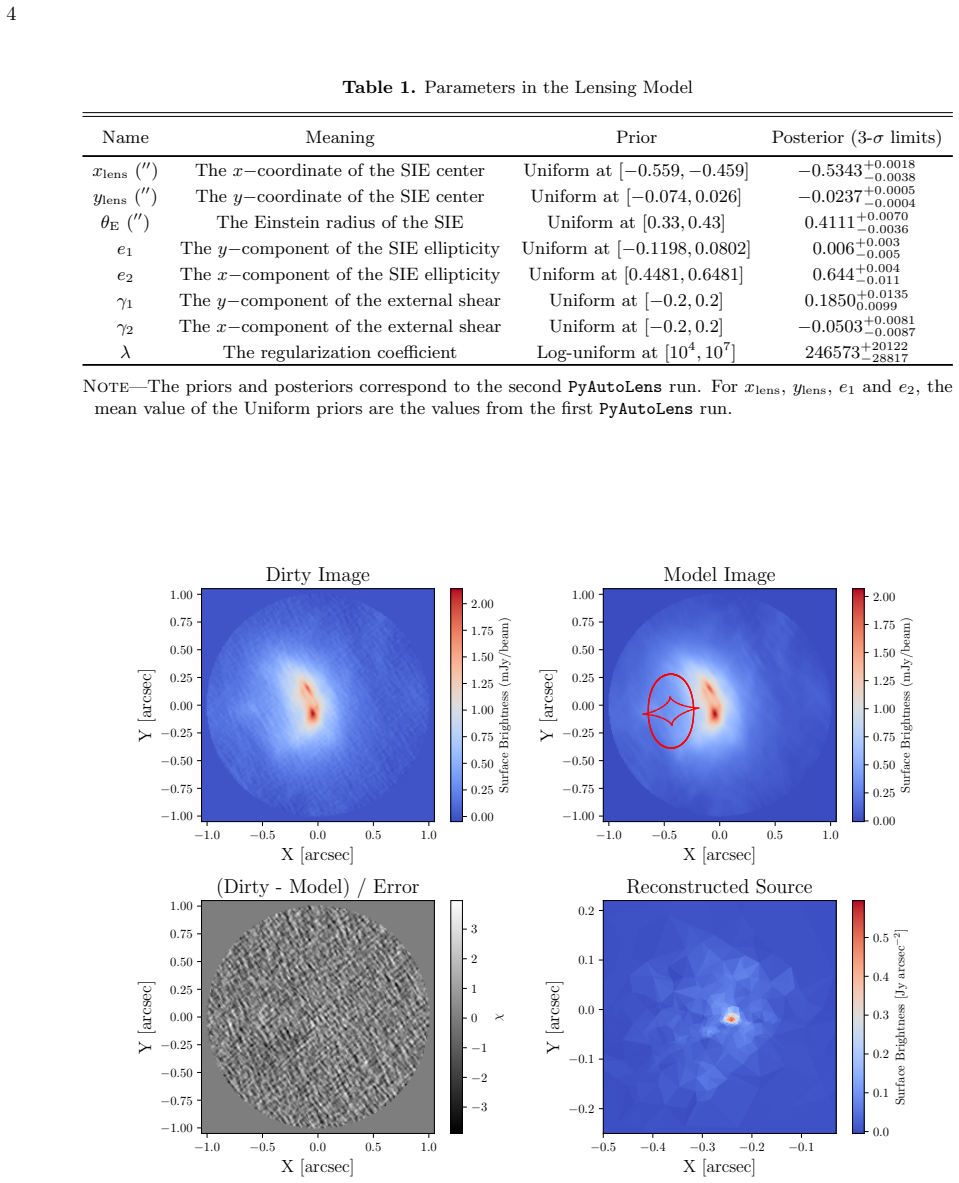
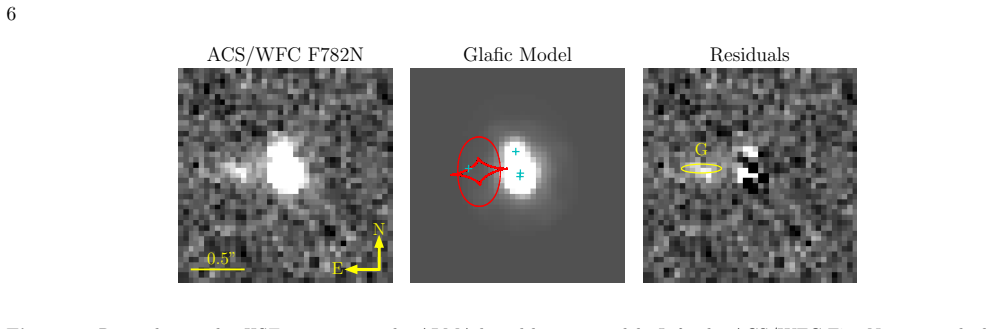
We present high-resolution (beam size $0\farcs076\times0\farcs040$) Atacama Large Millimeter/submillimeter Array (ALMA) observations of the far-infrared $(\lambda_\text{rest}=162.7\mu\rm{m})$ dust continuum of J0439+1634, a gravitationally lensed quasar at $z=6.52$. We perform pixelated lens modeling for the visibility data, finding that J0439+1634 is well-described by a singular isothermal ellipsoid plus an external shear lensing model. The best-fit lensing potential exhibits a naked-cusp configuration, confirming the finding in Fan et al. (2019). The reconstructed source plane continuum emission shows a compact bright core, with size $\lesssim200$ pc and peak brightness $\sim0.6 \text{ Jy arcsec}^{-2}$. The total continuum flux at 245 GHz is $3.36\pm0.02$ mJy. The flux magnification is {$4.63\pm0.03$}, indicating an average source-plane resolution of $0\farcs019$ (equivalent to 104 pc). The spatial resolution around the supermassive black hole reaches $\sim36$ pc. %Using the new lensing model, we re-fit the Hubble Space Telescope image for J0439+1634, and find that the position of the optical quasar is consistent with the brightest pixel in the dust continuum map. Leveraging the exceptional source-plane resolution, we build a radiative transfer model to describe the observed dust emission profile. The best-fit model indicates that heated dust from the active galactic nucleus (AGN) dominates the sub-millimeter emission at $r\lesssim100$ pc and that star-heated dust dominates the outer region of the host galaxy. AGN heating contributes {$\sim13\%$} to the observed sub-mm flux. Therefore, previous far-infrared-based star formation rate measurements for most high-redshift quasars are likely mildly overestimated.
Editorial analysis
A structured set of objections, weighed in public.
Referee Report
Summary. The manuscript presents high-resolution ALMA observations of the gravitationally lensed quasar J0439+1634 at z=6.52. Pixelated lens modeling of the visibility data yields a magnification of 4.63±0.03 and a reconstructed source-plane dust continuum with a compact core of size ≲200 pc. A radiative transfer model is then fitted to this profile, concluding that AGN-heated dust dominates within r≲100 pc while star-heated dust dominates at larger radii, with the AGN contributing approximately 13% to the total 245 GHz flux. The authors conclude that previous FIR-based SFR measurements for high-redshift quasars are likely mildly overestimated.
Significance. If the radiative transfer decomposition holds, the result provides a valuable empirical constraint on the relative contributions of AGN and stellar heating to the sub-millimeter emission in a z>6 quasar host galaxy. The ~36 pc resolution near the central black hole is particularly noteworthy and could inform models of AGN feedback and dust heating in the early universe. The work also demonstrates the power of strong lensing for achieving high physical resolution in high-redshift sources.
major comments (1)
- [radiative transfer model description] The section describing the radiative transfer model (following the lensing reconstruction): The manuscript provides no details on the radiative transfer fitting procedure, the specific dust parameters (opacity, grain size distribution, emissivity), the assumed geometry and luminosity for the central AGN point source versus the distributed stellar heating component, the free versus fixed parameters, or any goodness-of-fit metrics. The central claim that AGN heating contributes ~13% to the observed sub-mm flux and dominates at r≲100 pc rests entirely on the output of this model; without these elements the stability of the 13% fraction under plausible alternative assumptions cannot be assessed.
minor comments (1)
- [Abstract] The abstract contains LaTeX artifacts such as {$4.63\pm0.03$} and {\sim13\%}; these should be cleaned for the final version.
Simulated Author's Rebuttal
We thank the referee for their positive assessment of the significance of our work and for the constructive comment on the radiative transfer modeling section. We address the point below and will revise the manuscript to incorporate additional details.
read point-by-point responses
-
Referee: The section describing the radiative transfer model (following the lensing reconstruction): The manuscript provides no details on the radiative transfer fitting procedure, the specific dust parameters (opacity, grain size distribution, emissivity), the assumed geometry and luminosity for the central AGN point source versus the distributed stellar heating component, the free versus fixed parameters, or any goodness-of-fit metrics. The central claim that AGN heating contributes ~13% to the observed sub-mm flux and dominates at r≲100 pc rests entirely on the output of this model; without these elements the stability of the 13% fraction under plausible alternative assumptions cannot be assessed.
Authors: We agree that the original manuscript omitted key technical details on the radiative transfer model, which limits the ability to evaluate the robustness of the reported 13% AGN contribution. In the revised manuscript we will insert a new subsection immediately following the lensing reconstruction that fully specifies: (i) the radiative transfer code and fitting procedure (including whether a grid search or MCMC was employed); (ii) the adopted dust opacity law, grain size distribution, and emissivity index; (iii) the geometry and luminosity of the central AGN point source versus the spatially distributed stellar heating component; (iv) which parameters were allowed to vary and which were held fixed; and (v) quantitative goodness-of-fit statistics. These additions will enable readers to test the stability of the 13% fraction under alternative assumptions. revision: yes
Circularity Check
No circularity: AGN fraction from independent RT model fit to reconstructed profile
full rationale
The paper's central result (~13% AGN contribution) is produced by fitting a radiative transfer model to the source-plane brightness profile obtained from ALMA visibility modeling. This fit incorporates assumed dust properties, geometry, and heating sources but does not reduce by the paper's equations to a quantity defined solely in terms of a fitted normalization, self-citation, or input data. The lensing model confirms Fan et al. (2019) but is not load-bearing for the heating partition; the derivation remains self-contained against the observed continuum data.
Axiom & Free-Parameter Ledger
free parameters (1)
- radiative transfer model parameters for AGN and stellar heating
axioms (1)
- domain assumption The singular isothermal ellipsoid plus external shear model accurately reproduces the observed lensed morphology.
Reference graph
Works this paper leans on
-
[1]
Angl´ es-Alc´ azar, D., Quataert, E., Hopkins, P. F., et al. 2021, ApJ, 917, 53, doi: 10.3847/1538-4357/ac09e8 Astropy Collaboration, Robitaille, T. P., Tollerud, E. J., et al. 2013, A&A, 558, A33, doi: 10.1051/0004-6361/201322068 Astropy Collaboration, Price-Whelan, A. M., Sip˝ ocz, B. M., et al. 2018, AJ, 156, 123, doi: 10.3847/1538-3881/aabc4f Astropy ...
-
[2]
Astronomy and Computing , keywords =
Camps, P., & Baes, M. 2020, Astronomy and Computing, 31, 100381, doi: 10.1016/j.ascom.2020.100381 CASA Team, Bean, B., Bhatnagar, S., et al. 2022, PASP, 134, 114501, doi: 10.1088/1538-3873/ac9642
-
[3]
Decarli, R., Walter, F., Venemans, B. P., et al. 2018, ApJ, 854, 97, doi: 10.3847/1538-4357/aaa5aa Di Mascia, F., Carniani, S., Gallerani, S., et al. 2023, MNRAS, 518, 3667, doi: 10.1093/mnras/stac3306
-
[4]
Fan, X., Ba˜ nados, E., & Simcoe, R. A. 2023, ARA&A, 61, 373, doi: 10.1146/annurev-astro-052920-102455
-
[5]
2019, ApJL, 870, L11, doi: 10.3847/2041-8213/aaeffe
Fan, X., Wang, F., Yang, J., et al. 2019, ApJL, 870, L11, doi: 10.3847/2041-8213/aaeffe
-
[6]
Fraser-McKelvie, A., van de Sande, J., Gadotti, D. A., et al. 2025, A&A, 700, A237, doi: 10.1051/0004-6361/202452891 G¨ uver, T., &¨Ozel, F. 2009, MNRAS, 400, 2050, doi: 10.1111/j.1365-2966.2009.15598.x
-
[7]
Hezaveh, Y. D., Dalal, N., Marrone, D. P., et al. 2016, ApJ, 823, 37, doi: 10.3847/0004-637X/823/1/37
-
[8]
Izumi, T., Onoue, M., Matsuoka, Y., et al. 2019, PASJ, 71, 111, doi: 10.1093/pasj/psz096
-
[9]
Lange, J. U. 2023, Monthly Notices of the Royal Astronomical Society, 525, 3181, doi: 10.1093/mnras/stad2441
-
[10]
Litke, K. C., Marrone, D. P., Spilker, J. S., et al. 2019, ApJ, 870, 80, doi: 10.3847/1538-4357/aaf057
-
[11]
Extreme Galaxy-scale Outflows Are Frequent among Luminous Early Quasars
Liu, W., Fan, X., Li, H., et al. 2025, arXiv e-prints, arXiv:2509.08793, doi: 10.48550/arXiv.2509.08793
work page internal anchor Pith review Pith/arXiv arXiv doi:10.48550/arxiv.2509.08793 2025
-
[12]
2022, Universe, 8, 304, doi: 10.3390/universe8060304
Lyu, J., & Rieke, G. 2022, Universe, 8, 304, doi: 10.3390/universe8060304
-
[13]
Lyu, J., & Rieke, G. H. 2018, ApJ, 866, 92, doi: 10.3847/1538-4357/aae075
-
[14]
Lyu, J., & Rieke, G. H. 2021, ApJ, 912, 126, doi: 10.3847/1538-4357/abee14
-
[15]
2025, MNRAS, 537, 2708, doi: 10.1093/mnras/staf161
Maresca, J., & Dye, S. 2025, MNRAS, 537, 2708, doi: 10.1093/mnras/staf161
-
[16]
A., Yue, M., Eilers, A.-C., et al
Marshall, M. A., Yue, M., Eilers, A.-C., et al. 2025, A&A, 702, A50, doi: 10.1051/0004-6361/202452650
-
[17]
2019a, ApJ, 883, 183, doi: 10.3847/1538-4357/ab3c60
Matsuoka, Y., Iwasawa, K., Onoue, M., et al. 2019, ApJ, 883, 183, doi: 10.3847/1538-4357/ab3c60
-
[18]
2025, A&A, 694, A171, doi: 10.1051/0004-6361/202451290
Mazzucchelli, C., Decarli, R., Belladitta, S., et al. 2025, A&A, 694, A171, doi: 10.1051/0004-6361/202451290
-
[19]
A., Neeleman, M., Walter, F., & Venemans, B
Meyer, R. A., Neeleman, M., Walter, F., & Venemans, B. 2023, ApJ, 956, 127, doi: 10.3847/1538-4357/acf047
-
[20]
Neeleman, M., Novak, M., Venemans, B. P., et al. 2021, ApJ, 911, 141, doi: 10.3847/1538-4357/abe70f
-
[21]
Nightingale, J. W., & Dye, S. 2015, MNRAS, 452, 2940, doi: 10.1093/mnras/stv1455
-
[22]
Nightingale, J. W., Dye, S., & Massey, R. J. 2018, MNRAS, 478, 4738, doi: 10.1093/mnras/sty1264
-
[23]
Nightingale, J. W., Hayes, R. G., Kelly, A., et al. 2021, J. Open Source Softw., 6, 2825, doi: 10.21105/joss.02825
-
[24]
2010, glafic: Software Package for Analyzing Gravitational Lensing,, Astrophysics Source Code Library, record ascl:1010.012 http://ascl.net/1010.012
Oguri, M. 2010, glafic: Software Package for Analyzing Gravitational Lensing,, Astrophysics Source Code Library, record ascl:1010.012 http://ascl.net/1010.012
2010
-
[25]
D., et al.\ 2025, Nature Astronomy, 9, 1541
Onoue, M., Ding, X., Silverman, J. D., et al. 2025, Nature Astronomy, 9, 1541, doi: 10.1038/s41550-025-02628-1
-
[26]
2020, A&A, 637, A84, doi: 10.1051/0004-6361/201936634
Pensabene, A., Carniani, S., Perna, M., et al. 2020, A&A, 637, A84, doi: 10.1051/0004-6361/201936634
-
[27]
Powell, D., Vegetti, S., McKean, J. P., et al. 2021, MNRAS, 501, 515, doi: 10.1093/mnras/staa2740
-
[28]
D., Daddi, E., Tan, Q.-H., et al
Silverman, J. D., Daddi, E., Tan, Q.-H., et al. 2026, MNRAS, 546, stag167, doi: 10.1093/mnras/stag167 10
-
[29]
Suyu, S. H., Marshall, P. J., Hobson, M. P., & Blandford, R. D. 2006, MNRAS, 371, 983, doi: 10.1111/j.1365-2966.2006.10733.x
-
[30]
Tsukui, T., Wisnioski, E., Krumholz, M. R., & Battisti, A. 2023, MNRAS, 523, 4654, doi: 10.1093/mnras/stad1464
-
[31]
P., Neeleman, M., Walter, F., et al
Venemans, B. P., Neeleman, M., Walter, F., et al. 2019, ApJL, 874, L30, doi: 10.3847/2041-8213/ab11cc
-
[32]
P., Walter, F., Neeleman, M., et al
Venemans, B. P., Walter, F., Neeleman, M., et al. 2020, ApJ, 904, 130, doi: 10.3847/1538-4357/abc563
-
[33]
2009, Nature, 457, 699, doi: 10.1038/nature07681
Walter, F., Riechers, D., Cox, P., et al. 2009, Nature, 457, 699, doi: 10.1038/nature07681
-
[34]
2022, ApJ, 927, 21, doi: 10.3847/1538-4357/ac49e8
Walter, F., Neeleman, M., Decarli, R., et al. 2022, ApJ, 927, 21, doi: 10.3847/1538-4357/ac49e8
-
[35]
2019, ApJ, 884, 30, doi: 10.3847/1538-4357/ab2be5
Wang, F., Yang, J., Fan, X., et al. 2019, ApJ, 884, 30, doi: 10.3847/1538-4357/ab2be5
-
[36]
Wang, F., Yang, J., Fan, X., et al. 2021, ApJL, 907, L1, doi: 10.3847/2041-8213/abd8c6
-
[37]
2024, ApJ, 968, 9, doi: 10.3847/1538-4357/ad3fb4
Wang, F., Yang, J., Fan, X., et al. 2024, ApJ, 968, 9, doi: 10.3847/1538-4357/ad3fb4
-
[38]
Warren, S. J., & Dye, S. 2003, ApJ, 590, 673, doi: 10.1086/375132
-
[39]
2019, AJ, 157, 236, doi: 10.3847/1538-3881/ab1be1
Yang, J., Wang, F., Fan, X., et al. 2019a, AJ, 157, 236, doi: 10.3847/1538-3881/ab1be1
-
[40]
2019b, ApJ, 880, 153, doi: 10.3847/1538-4357/ab2a02
Yang, J., Venemans, B., Wang, F., et al. 2019b, ApJ, 880, 153, doi: 10.3847/1538-4357/ab2a02
-
[41]
2020, ApJL, 897, L14, doi: 10.3847/2041-8213/ab9c26
Yang, J., Wang, F., Fan, X., et al. 2020, ApJL, 897, L14, doi: 10.3847/2041-8213/ab9c26
-
[42]
2022, ApJL, 924, L25, doi: 10.3847/2041-8213/ac45f2
Yang, J., Fan, X., Wang, F., et al. 2022, ApJL, 924, L25, doi: 10.3847/2041-8213/ac45f2
-
[43]
2022a, ApJ, 925, 169, doi: 10.3847/1538-4357/ac409b
Yue, M., Fan, X., Yang, J., & Wang, F. 2022a, ApJ, 925, 169, doi: 10.3847/1538-4357/ac409b
-
[44]
2022b, AJ, 163, 139, doi: 10.3847/1538-3881/ac4cb0
Yue, M., Fan, X., Yang, J., & Wang, F. 2022b, AJ, 163, 139, doi: 10.3847/1538-3881/ac4cb0
-
[45]
2021, ApJ, 917, 99, doi: 10.3847/1538-4357/ac0af4
Yue, M., Yang, J., Fan, X., et al. 2021, ApJ, 917, 99, doi: 10.3847/1538-4357/ac0af4
-
[46]
Yue, M., Eilers, A.-C., Simcoe, R. A., et al. 2024, ApJ, 966, 176, doi: 10.3847/1538-4357/ad3914
-
[47]
Zhu, Y., Rieke, M. J., Ho, L. C., et al. 2025, arXiv e-prints, arXiv:2504.02305, doi: 10.48550/arXiv.2504.02305
discussion (0)
Sign in with ORCID, Apple, or X to comment. Anyone can read and Pith papers without signing in.