The Fuel Optimizer: A Data-Driven Numerical Framework for Formulation of Aviation Turbine Fuel
Pith reviewed 2026-06-27 12:13 UTC · model grok-4.3
The pith
A numerical framework uses surrogate models and genetic algorithms to design aviation fuel blends that reduce emissions while meeting property standards.
A machine-rendered reading of the paper's core claim, the machinery that carries it, and where it could break.
Core claim
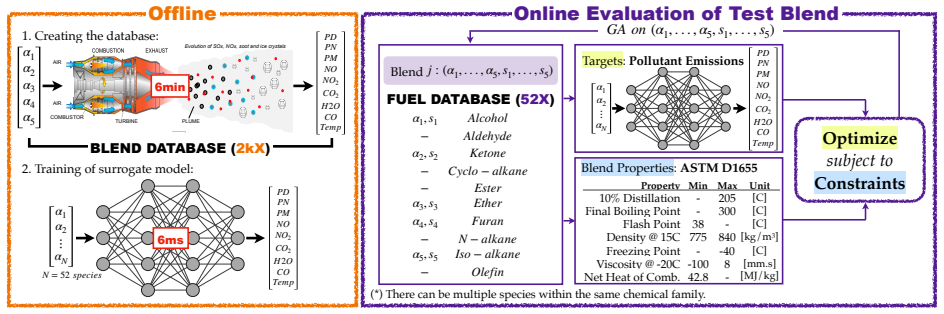
The Fuel Optimizer is an inverse design framework that starts from a user-defined merit function and identifies the optimal combination of chemical species or hydrocarbon families that optimize a combination of targets. As a case study, a database of fuel blends meeting selected property standards was simulated in a reactor model to obtain pollutant emissions at cruise conditions. A surrogate model was developed to reduce the computational cost of evaluating candidate blends, taking fuel composition as input and predicting emissions as output. A genetic algorithm was used to optimize fuel formulation according to two merit functions designed to break the nitrogen oxides - CO trade-off, and m
What carries the argument
Surrogate model trained on reactor simulation outputs, paired with genetic algorithm search under merit functions and property constraints.
If this is right
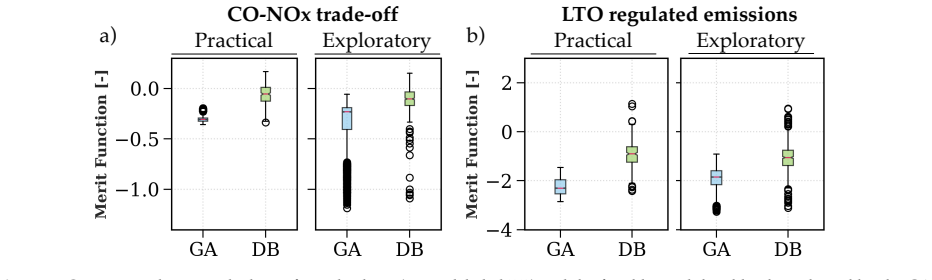
- Fuel candidates generated by the framework outperformed the training database across all merit functions.
- Optimal candidates were validated through additional reactor simulations confirming the predicted improvements.
- The framework supports different user-defined merit functions to address varied emission or performance targets.
- Property standards including seal swelling and composition limits are enforced as constraints during the search.
Where Pith is reading between the lines
- The method could speed up exploration of sustainable aviation fuel compositions that lie outside manually curated databases.
- It might be combined with additional reactor models or experimental validation loops to cover more flight conditions.
- Analogous inverse-design loops could be applied to optimize other fuel types or chemical mixtures in energy systems.
Load-bearing premise
The surrogate model trained on the initial database accurately predicts emissions for compositions outside that database, and the chosen merit functions plus property constraints correctly represent real operational and regulatory requirements.
What would settle it
Run the reactor simulations on the specific optimal fuel candidates produced by the framework and verify whether their emissions match the surrogate predictions while improving on the training database.
Figures

read the original abstract
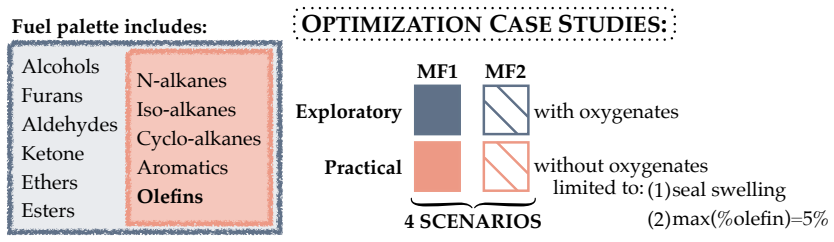
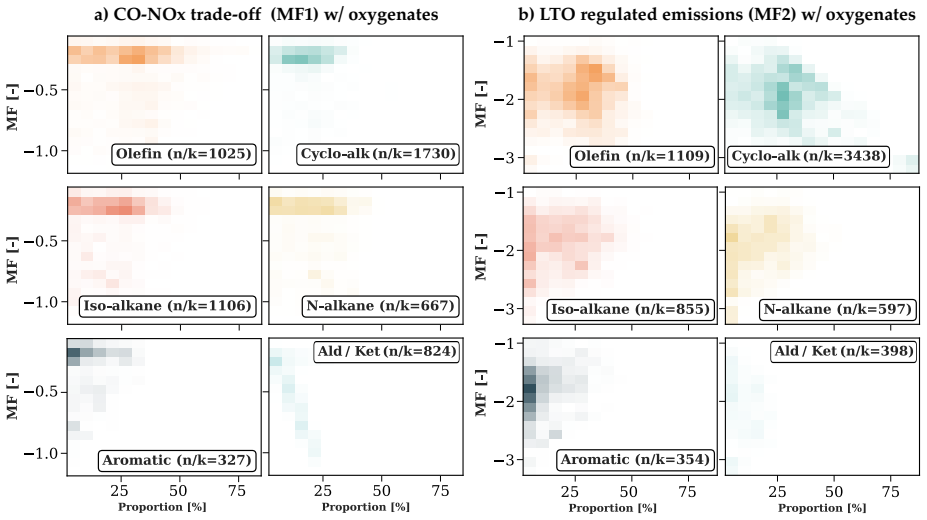
The Fuel Optimizer is an inverse design framework for sustainable aviation fuels that starts from a user-defined merit function and identifies the optimal combination of chemical species or hydrocarbon families that optimize a combination of targets. As a case study, a database of fuel blends meeting selected property standards was simulated in a reactor model to obtain pollutant emissions at cruise conditions. A surrogate model was developed to reduce the computational cost of evaluating candidate blends, taking fuel composition as input and predicting emissions as output. A genetic algorithm was used to optimize fuel formulation according to two merit functions designed to break the nitrogen oxides - CO trade-off, and minimize pollutant emissions over the landing-and-take-off cycle. Constraints included selected property standards (including seal swelling) and composition limits. Fuel candidates from the framework outperformed the training database across all merit functions, and the optimal candidates were validated through reactor simulations.
Editorial analysis
A structured set of objections, weighed in public.
Referee Report
Summary. The manuscript introduces the Fuel Optimizer, an inverse-design framework for aviation turbine fuels. Starting from a user-specified merit function, it builds a database of property-compliant blends, simulates them in a reactor model to obtain cruise emissions, trains a surrogate to map composition to emissions, and applies a genetic algorithm to optimize blends under property and composition constraints. Two merit functions are used to break the NOx-CO trade-off and minimize LTO-cycle emissions. The abstract states that the resulting candidates outperform the training database on all merit functions and that the optima were validated by reactor simulations.
Significance. If the surrogate generalizes reliably outside the training support and the merit functions faithfully capture operational requirements, the framework could provide a practical, data-driven route to low-emission sustainable aviation fuel formulations that would otherwise require prohibitive numbers of reactor evaluations.
major comments (2)
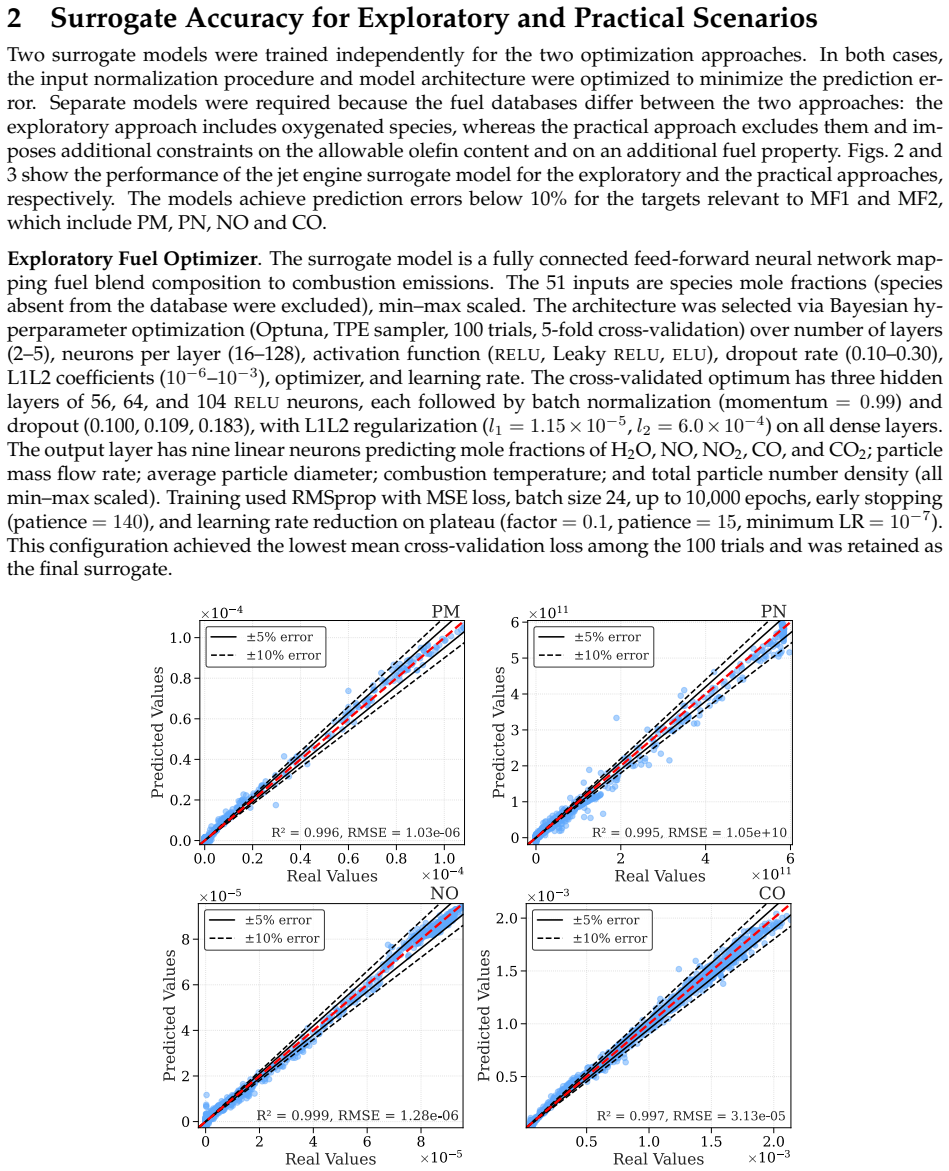
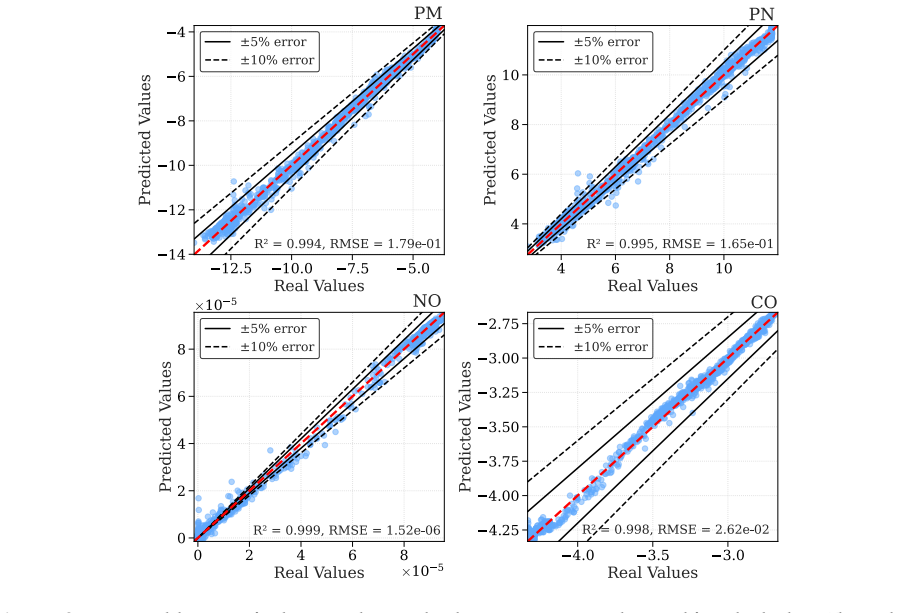
- The central claim—that GA-optimized compositions outperform the training database—rests on the surrogate accurately predicting emissions for points outside the initial database. The abstract provides no quantitative surrogate metrics (RMSE, R², cross-validation scores), no out-of-distribution test set, and no uncertainty quantification, so it is impossible to determine whether the reported outperformance is an artifact of surrogate error.
- No sensitivity analysis is reported for the chosen merit functions or the property constraints (including seal-swelling). If small changes in the weighting or constraint bounds alter the location of the optima, the superiority claim cannot be considered robust.
Simulated Author's Rebuttal
We thank the referee for their constructive comments. We provide point-by-point responses to the major comments below, indicating the revisions we will make to address them.
read point-by-point responses
-
Referee: The central claim—that GA-optimized compositions outperform the training database—rests on the surrogate accurately predicting emissions for points outside the initial database. The abstract provides no quantitative surrogate metrics (RMSE, R², cross-validation scores), no out-of-distribution test set, and no uncertainty quantification, so it is impossible to determine whether the reported outperformance is an artifact of surrogate error.
Authors: We appreciate this observation. The manuscript does report that the optimal candidates were validated through direct reactor simulations, which provides independent confirmation of their performance and mitigates concerns about surrogate error for the final claims. However, we agree that the abstract should include quantitative surrogate metrics to better support the framework description. In the revised manuscript, we will update the abstract to report key surrogate performance indicators such as RMSE, R², and cross-validation scores. We will also add details on any out-of-distribution testing and uncertainty quantification present in the full text or perform additional analysis if needed. revision: partial
-
Referee: No sensitivity analysis is reported for the chosen merit functions or the property constraints (including seal-swelling). If small changes in the weighting or constraint bounds alter the location of the optima, the superiority claim cannot be considered robust.
Authors: We concur that sensitivity analysis would enhance the robustness of our findings. We will incorporate a sensitivity analysis in the revised manuscript, examining the effects of variations in merit function weights and property constraint bounds, with particular attention to seal-swelling properties, to verify the stability of the optimized compositions. revision: yes
Circularity Check
No circularity; surrogate optimization followed by independent reactor validation
full rationale
The derivation chain uses a reactor model to generate training data, fits a surrogate, runs GA optimization under merit functions and constraints, then validates the resulting candidates with the original reactor model. This validation step is external to the surrogate fit and to the training database, so the claim that candidates outperform the database is not forced by construction. No self-citations, self-definitional equations, or fitted inputs renamed as predictions appear in the provided text. The process is a standard data-driven optimization pipeline with post-hoc verification.
Axiom & Free-Parameter Ledger
Reference graph
Works this paper leans on
-
[1]
C., Faulhaber, C., Borland, R., Boehm, J., Heyne, Measurements of Nitrile Rubber Absorption of Hydrocarbons: Trends for Sustainable Aviation Fuel Compatibility, Energy and Fuels 37 (2023) 9207–
2023
-
[2]
doi:10.1021/acs.energyfuels.3c00781
-
[3]
Low Lunar Orbit Design via Graphical Manipulation of Eccentricity Vector Evolution
J., Hamilton, B., Khandelwal, Effects of Aromatic Blends on Seal Swell Rates Using Novel Seals Compatibility Test Rig, AIAA SCITECH 2023 Forum, paper number 0596 (2023). doi:10.2514/6. 2023-0596
work page doi:10.2514/6 2023
-
[4]
URL:https://www.easa.europa.eu/en/ domains/environment/icao-aircraft-engine-emissions-databank
ICAO Aircraft Engine Emissions Databank | EASA. URL:https://www.easa.europa.eu/en/ domains/environment/icao-aircraft-engine-emissions-databank
-
[5]
Spatially Resolving Electron Spin Resonance ofπ-Radical in Single-Molecule Magnet
Lopez-Pintor, D., MacDonald, J., Ramirez-Correa, E., Garcia-Oliver, J. M., Payri, R., Marti Gomez- Aldaravi, P ., Leyland, P ., Fuel Effects on Aviation Engine Emissions: A Chemical Reactor Network Modeling Study, Energy & Fuels 40 (2026) 4777–4792. URL:https://doi.org/10.1021/acs. energyfuels.5c05727. doi:10.1021/acs.energyfuels.5c05727
work page doi:10.1021/acs 2026
-
[6]
URL:https://store.astm.org/d1655-25a
Standard Specification for Aviation Turbine Fuels. URL:https://store.astm.org/d1655-25a. html
-
[7]
URL: https://wtt-pro.nist.gov/wtt-pro/#default/B;869,179/A;0,0,705,755;help, about/
NIST/TRC Web Thermo Tables (WTT): Critically Evaluated Thermophysical Property Data. URL: https://wtt-pro.nist.gov/wtt-pro/#default/B;869,179/A;0,0,705,755;help, about/
-
[8]
P ., THE VISCOSITY OF LIQUIDS
Kendall, J., Monroe, K. P ., THE VISCOSITY OF LIQUIDS. II. THE VISCOSITY-COMPOSITION CURVE FOR IDEAL LIQUID MIXTURES.1, Journal of the American Chemical Society 39 (1917) 1787–
1917
-
[9]
URL:https://doi.org/10.1021/ja02254a001. doi:10.1021/ja02254a001
-
[10]
Lemmon, E.W., Bell, I.H., Huber, M.L., McLinden, M.O., NIST Standard Reference Database 23: Ref- erence Fluid Thermodynamic and Transport Properties-REFPROP , Version 10.0, National Institute of Standards and Technology, Standard Reference Data Program (2018). URL:https://doi.org/10. 18434/T4/1502528. doi:10.18434/T4/1502528
-
[11]
URL:https://arc.aiaa.org/ doi/10.2514/6.2022-2221
Coburn, A., Yang, Z., Boehm, R., Heyne, J., Determination of a Freeze Point Blend Prediction Model for Jet Fuel Range Hydrocarbons, in: AIAA SciTech Forum, 2022. URL:https://arc.aiaa.org/ doi/10.2514/6.2022-2221. doi:10.2514/6.2022-2221
-
[12]
O., Chittenden, D
Wickey, R. O., Chittenden, D. H., Flash points of blends correlated., Hydrocarb Process Pet Refin 42 (1963) 157–158. 8
1963
discussion (0)
Sign in with ORCID, Apple, or X to comment. Anyone can read and Pith papers without signing in.