Implementing Hamiltonian Renormalization Group Flow on Quantum Computers with VAPOR
Pith reviewed 2026-06-27 10:38 UTC · model grok-4.3
The pith
VAPOR identifies fixed points of naively discretized operators using a variational quantum algorithm
A machine-rendered reading of the paper's core claim, the machinery that carries it, and where it could break.
Core claim
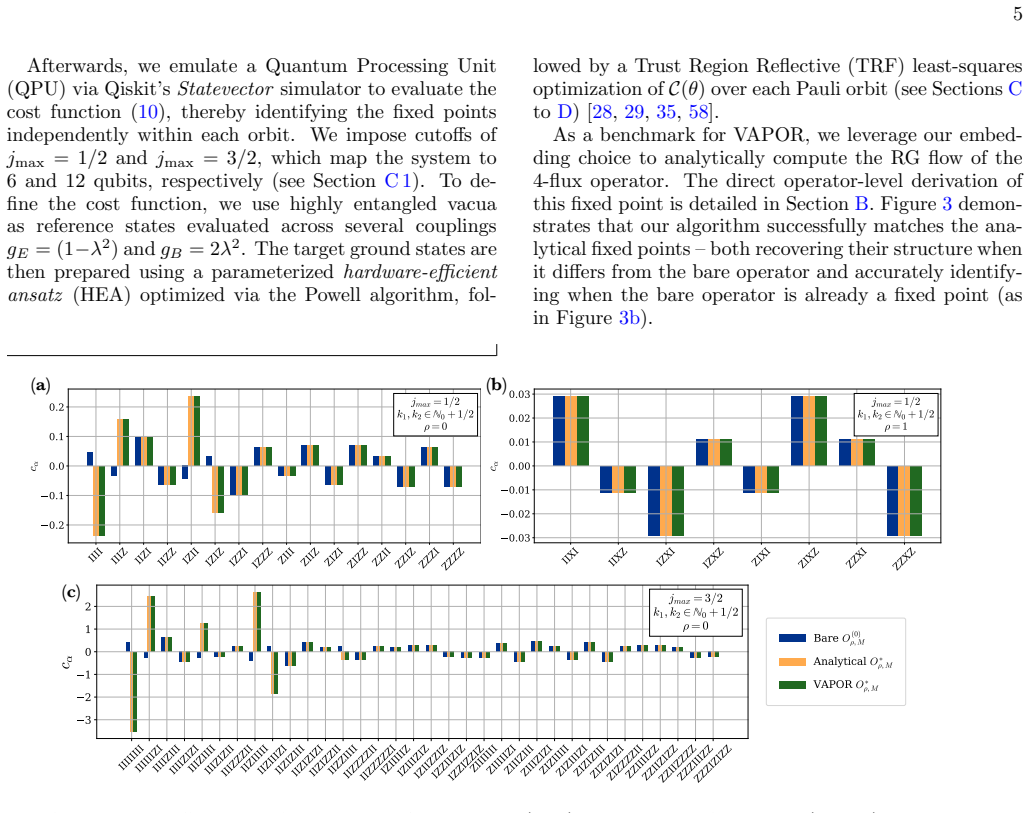
VAPOR decomposes operators into Pauli strings, identifies RG flow orbits, and determines fixed points of a naively discretized operator, as illustrated using a toy model of a kinematic operator in a symmetry-restricted SU(2) Yang-Mills theory.
What carries the argument
VAPOR, the variational quantum algorithm that decomposes operators into Pauli strings to identify RG flow orbits and fixed points of discretized operators.
If this is right
- The fixed points supply discretization-error-free operators for use in lattice gauge theory simulations.
- This method enables implementation of Hamiltonian RG flow directly on quantum computers.
- The decomposition into Pauli strings and orbit identification can be applied to other operators in the same symmetry-restricted theory.
Where Pith is reading between the lines
- If the method succeeds on the toy model it could be tested on dynamical operators beyond the kinematic case.
- The Pauli-string decomposition might reduce circuit depth requirements when scaling to larger symmetry-restricted models.
- Similar variational searches could be adapted to locate fixed points in other discretized gauge theories.
Load-bearing premise
The variational quantum algorithm can reliably locate the RG fixed points of the discretized operator in the presence of quantum hardware noise and without the fixed-point search itself introducing new discretization artifacts.
What would settle it
Executing VAPOR on the toy model and verifying that the identified fixed point reproduces the expected continuum limit of the kinematic operator without added errors from noise or the algorithm.
Figures



read the original abstract
While Hamiltonian Lattice Gauge Theory is gaining traction, today's limited numerical capacity leaves simulations affected by discretization errors. This motivates the implementation of renormalization group (RG) techniques to find discretization-error-free operators. To this end, we introduce VAPOR, a variational quantum algorithm that decomposes operators into Pauli strings, identifies RG flow orbits, and determines fixed points of a naively discretized operator. We illustrate this using a toy model of a kinematic operator in a symmetry-restricted SU(2) Yang-Mills theory.
Editorial analysis
A structured set of objections, weighed in public.
Referee Report
Summary. The manuscript introduces VAPOR, a variational quantum algorithm for implementing Hamiltonian renormalization group flow on quantum computers. VAPOR decomposes operators into Pauli strings, identifies RG flow orbits, and locates fixed points of naively discretized operators; the method is illustrated on a toy model of a kinematic operator in a symmetry-restricted SU(2) Yang-Mills theory.
Significance. If the variational procedure reliably recovers discretization-error-free fixed points, the approach could provide a practical route to mitigating cutoff effects in Hamiltonian lattice gauge theory simulations on near-term quantum hardware, where classical resources remain limited.
major comments (1)
- [VAPOR algorithm and toy-model illustration] The central claim that VAPOR determines fixed points free of O(a) discretization errors rests on the assumption that the variational optimizer converges to the exact RG fixed-point operator rather than a noise- or ansatz-shifted spurious minimum. No analysis or numerical evidence is provided that the cost-function minimum coincides with the true fixed point under realistic hardware noise or for the chosen ansatz in the SU(2) toy model.
Simulated Author's Rebuttal
We thank the referee for their careful reading of the manuscript and for highlighting an important point regarding the variational convergence. We address the major comment below.
read point-by-point responses
-
Referee: [VAPOR algorithm and toy-model illustration] The central claim that VAPOR determines fixed points free of O(a) discretization errors rests on the assumption that the variational optimizer converges to the exact RG fixed-point operator rather than a noise- or ansatz-shifted spurious minimum. No analysis or numerical evidence is provided that the cost-function minimum coincides with the true fixed point under realistic hardware noise or for the chosen ansatz in the SU(2) toy model.
Authors: We agree that the manuscript does not contain an explicit analysis or numerical evidence demonstrating that the variational optimizer converges to the exact RG fixed point (rather than a spurious minimum) under realistic hardware noise or for the specific ansatz employed in the SU(2) toy model. The current results are restricted to a classical simulation of the ideal, noise-free case, where the algorithm recovers the expected fixed point of the kinematic operator. We will revise the manuscript to include a dedicated discussion of the variational landscape in the ideal setting, the assumptions underlying convergence to the true fixed point, and explicit caveats concerning the effects of hardware noise and ansatz expressivity. The central claim will be tempered to reflect the scope of the present toy-model illustration. revision: yes
Circularity Check
No circularity: method introduces VAPOR as a new variational algorithm without equations reducing to fitted inputs or self-citations
full rationale
The abstract and description present VAPOR as a variational quantum algorithm that decomposes operators, identifies RG flow orbits, and locates fixed points of a discretized operator in a toy model. No equations, fitting procedures, or load-bearing self-citations are visible. The derivation chain is not shown to reduce any claimed prediction or fixed point to its own inputs by construction. The reader's assessment confirms absence of such reductions in the abstract, and the provided text contains no self-definitional steps, fitted-input predictions, or ansatz smuggling. This is a standard case of a self-contained proposal whose validity rests on external verification rather than internal redefinition.
Axiom & Free-Parameter Ledger
Reference graph
Works this paper leans on
-
[1]
or LGT vacua [61]). In the noise-dominated era, this minimizes systematic errors (e.g., constant biases), as the algorithm probes the operator over a sufficiently large set{|Ω I ⟩}without depending heavily on precise state preparation details. These features enable an efficient and scalable imple- mentation of the RG on near-term quantum hardware, providi...
-
[2]
Jaffe and E
A. Jaffe and E. Witten, Quantum yang–mills the- ory, The Millennium Prize Problems (2000), available athttps://www.claymath.org/millennium-problems/ yang-mills-and-mass-gap
2000
-
[3]
Haag, On quantum field theories, Kongelige Danske Videnskabernes Selskab, Matematisk-Fysiske Meddelelser29, 1 (1955)
R. Haag, On quantum field theories, Kongelige Danske Videnskabernes Selskab, Matematisk-Fysiske Meddelelser29, 1 (1955)
1955
-
[4]
R. F. Streater and A. S. Wightman, Pct, spin and statis- tics, and all that, Princeton University Press (2000). 7 Note that identifying orbits depends on the choice of embedding map and basis. The filling kernel and Pauli mapping used in our toy model provide just one choice benefiting from a feasible orbit decomposition
2000
-
[5]
K. G. Wilson, Confinement of quarks, Physical Review D10, 2445 (1974)
1974
-
[6]
A. Dapor and K. Liegener, Cosmological effective hamil- tonian from full loop quantum gravity dynamics, Physics Letters B785, 506 (2018), arXiv:1706.09833 [gr-qc]
Pith/arXiv arXiv 2018
-
[7]
A. Ashtekar, T. Pawlowski, and P. Singh, Quantum na- ture of the big bang, Physical Review Letters96, 141301 (2006), arXiv:gr-qc/0602086 [gr-qc]
Pith/arXiv arXiv 2006
-
[8]
Brower, N
R. Brower, N. Christ, C. DeTar, R. Edwards, and P. Mackenzie, Lattice qcd application development within the us doe exascale computing project, EPJ Web of Conferences175, 09010 (2018)
2018
-
[9]
E. Rico, T. Pichler, M. Dalmonte, P. Zoller, and S. Montangero, Tensor networks for lattice gauge the- ories and atomic quantum simulation, Phys. Rev. Lett. 112, 201601 (2014). 7
2014
-
[10]
Yang and et al., Observation of gauge invariance in a 71-site bose–hubbard quantum simulator, Nature587, 392–396 (2020)
B. Yang and et al., Observation of gauge invariance in a 71-site bose–hubbard quantum simulator, Nature587, 392–396 (2020)
2020
-
[11]
G. H. Low and I. L. Chuang, Optimal hamiltonian sim- ulation by quantum signal processing, Physical Review Letters118, 010501 (2017)
2017
-
[12]
J. C. Halimeh, M. Aidelsburger, F. Grusdt, P. Hauke, and B. Yang, Cold-atom quantum simulators of gauge theories, Nature Physics21, 25 (2025), arXiv:2310.12201 [quant-ph]
arXiv 2025
-
[13]
J. C. Halimeh, N. Mueller, J. Knolle, Z. Papi´ c, and Z. Davoudi, Quantum simulation of out-of- equilibrium dynamics in gauge theories, arXiv preprint arXiv:2509.03586 (2025), arXiv:2509.03586 [quant-ph]
Pith/arXiv arXiv 2025
-
[14]
K. G. Wilson, The renormalization group: Critical phe- nomena and the kondo problem, Reviews of Modern Physics47, 773 (1975)
1975
-
[15]
L. P. Kadanoff, Scaling laws for ising models neart c, Physics Physique Fizika2, 263 (1966)
1966
-
[16]
Janas, Inductive limit of operators and its applications, Studia Mathematica90, 87 (1988)
J. Janas, Inductive limit of operators and its applications, Studia Mathematica90, 87 (1988)
1988
-
[17]
R. V. Kadison and J. R. Ringrose, Fundamentals of the theory of operator algebras, volume ii: Advanced theory, American Mathematical Society (1997)
1997
-
[18]
Glimm and A
J. Glimm and A. Jaffe, Quantum physics: A functional integral point of view, Springer-Verlag (1987)
1987
-
[19]
H. D. Politzer, Reliable perturbative results for strong interactions?, Physical Review Letters30, 1346 (1973)
1973
-
[20]
K. G. Wilson and M. E. Fisher, Critical exponents in 3.99 dimensions, Physical Review Letters28, 240 (1972)
1972
-
[21]
Niemeijer and J
T. Niemeijer and J. M. J. van Leeuwen, Wilson theory for 2-dimensional ising spin systems, Physica71, 17 (1974)
1974
-
[22]
S. Rastgoo and M. Requardt, Emergent Space-Time via a Geometric Renormalization Method, Phys. Rev. D94, 124019 (2016), arXiv:1606.08073 [gr-qc]
Pith/arXiv arXiv 2016
-
[23]
M. Requardt and S. Rastgoo, The Structurally Dynamic Cellular Network and Quantum Graphity Approaches to Quantum Gravity and Quantum Geometry - A Re- view and Comparison, J. Cell. Automata10, 341 (2015), arXiv:1501.00391 [gr-qc]
Pith/arXiv arXiv 2015
-
[24]
P. Hasenfratz and F. Niedermayer, Perfect lattice action for asymptotically free theories, Nuclear Physics B414, 785 (1994), arXiv:hep-lat/9308004
Pith/arXiv arXiv 1994
-
[25]
Polchinski, Renormalization and effective lagrangians, Nuclear Physics B231, 269 (1984)
J. Polchinski, Renormalization and effective lagrangians, Nuclear Physics B231, 269 (1984)
1984
-
[26]
T. Lang, K. Liegener, and T. Thiemann, Hamilto- nian renormalisation i: derivation from osterwalder- schrader reconstruction, Classical and Quantum Gravity 35, 245011 (2018)
2018
-
[27]
Liegener and T
K. Liegener and T. Thiemann, Hamiltonian renormaliza- tion v: Free vector bosons, Front. Astron. Space Sci.7, 547550 (2021)
2021
-
[28]
Bahr and K
B. Bahr and K. Liegener, Towards exploring features of hamiltonian renormalisation relevant for quantum grav- ity, Classical and Quantum Gravity39, 075010 (2022)
2022
-
[29]
Peruzzo, J
A. Peruzzo, J. McClean, P. Shadbolt, M.-H. Yung, X.-Q. Zhou, P. J. Love, A. Aspuru-Guzik, and J. L. O’Brien, A variational eigenvalue solver on a photonic quantum processor, Nature Communications5, 4213 (2014)
2014
-
[30]
J. R. McClean, J. Romero, R. Babbush, and A. Aspuru- Guzik, The theory of variational hybrid quantum- classical algorithms, New Journal of Physics18, 023023 (2016)
2016
-
[31]
Bharti, A
K. Bharti, A. Cervera-Lierta, T. H. Kyaw, T. Haug, S. Alperin-Lea, A. Anand, M. Degroote, H. Heimonen, J. S. Kottmann, T. Menke, W.-K. Mok, S. Sim, L.-C. Kwek, and A. Aspuru-Guzik, Noisy intermediate-scale quantum algorithms, Reviews of Modern Physics94, 015004 (2022)
2022
-
[32]
Balaban, Propagators and renormalization transfor- mations for lattice gauge theories
T. Balaban, Propagators and renormalization transfor- mations for lattice gauge theories. i, Communications in Mathematical Physics95, 17 (1984)
1984
-
[33]
Balaban, Propagators and renormalization transfor- mations for lattice gauge theories
T. Balaban, Propagators and renormalization transfor- mations for lattice gauge theories. ii, Communications in Mathematical Physics96, 223 (1984)
1984
-
[34]
Aizenman, Proof of the triviality ofϕ 4 d field theory and some mean-field features of ising models ford >4, Physical Review Letters47, 1 (1981)
M. Aizenman, Proof of the triviality ofϕ 4 d field theory and some mean-field features of ising models ford >4, Physical Review Letters47, 1 (1981)
1981
-
[35]
L. D. Landau, A. A. Abrikosov, and I. M. Khalatnikov, On the removal of infinities in quantum electrodynamics, Doklady Akademii Nauk SSSR95, 497 (1954)
1954
-
[36]
Cerezo et al., Variational quantum algorithms, Nature Rev
M. Cerezo et al., Variational quantum algorithms, Nature Rev. Phys.3, 625 (2021), arXiv:2012.09265 [quant-ph]
arXiv 2021
-
[37]
Cochran and et al., Visualizing dynamics of charges and strings in (2+1)d lattice gauge theories, Nature642, 315 (2025)
T. Cochran and et al., Visualizing dynamics of charges and strings in (2+1)d lattice gauge theories, Nature642, 315 (2025)
2025
-
[38]
R. Joshi, Y. Tian, K. Hemery, N. S. Srivatsa, J. J. Os- borne, H. Dreyer, E. Rinaldi, and J. C. Halimeh, Ob- servation of genuine 2 + 1d string dynamics in a u(1) lattice gauge theory with a tunable plaquette term on a trapped-ion quantum computer (2026), arXiv:2604.07436 [quant-ph]
Pith/arXiv arXiv 2026
-
[39]
K. Xu, U. Borla, K. Hemery, R. Joshi, H. Dreyer, E. Ri- naldi, and J. C. Halimeh, Observation of glueball ex- citations and string breaking in a 2 + 1dZ 2 lattice gauge theory on a trapped-ion quantum computer (2026), arXiv:2604.07435 [hep-lat]
Pith/arXiv arXiv 2026
-
[40]
Kogut and L
J. Kogut and L. Susskind, Hamiltonian formulation of wilson’s lattice gauge theories, Phys. Rev. D11, 395 (1975)
1975
-
[41]
H. J. Rothe, Lattice Gauge Theories : An Introduction (Fourth Edition), World Scientific Publishing Company (2012)
2012
-
[42]
Bonzom, M
V. Bonzom, M. Dupuis, F. Girelli, and Q. Pan, Local observables in su q(2) lattice gauge theory, Phys. Rev. D 107, 026014 (2023)
2023
-
[43]
A. N. Krylov, On the numerical solution of the equation by which in technical questions frequencies of small os- cillations of material systems are determined, Izvestiya Akademii Nauk SSSR (1931)
1931
-
[44]
SIAM, 2011.doi:10.1137/1.9781611970739
Y. Saad, Numerical methods for large eigenvalue prob- lems, SIAM 10.1137/1.9781611970739 (2011)
-
[45]
B. T. Gard, L. Zhu, G. S. Barron, N. J. Mayhall, S. E. Economou, and E. Barnes, Efficient symmetry- preserving state preparation circuits for the variational quantum eigensolver algorithm, npj Quantum Informa- tion6(2019)
2019
-
[46]
C. N. Yang and R. L. Mills, Conservation of isotopic spin and isotopic gauge invariance, Phys. Rev.96, 191 (1954)
1954
-
[47]
Ashtekar and E
A. Ashtekar and E. Bianchi, A short review of loop quan- tum gravity, Reports on Progress in Physics84, 042001 (2021)
2021
-
[48]
Gambini and J
R. Gambini and J. Pullin, Loops, Knots, Gauge Theories (Cambridge University Press, 2000)
2000
-
[49]
Rovelli, Quantum gravity, Cambridge University Press (2004)
C. Rovelli, Quantum gravity, Cambridge University Press (2004). 8
2004
-
[50]
D’Andrea, C
I. D’Andrea, C. W. Bauer, D. M. Grabowska, and M. Freytsis, New basis for hamiltonian su(2) simulations, Phys. Rev. D109, 074501 (2024)
2024
-
[51]
Zohar, A
E. Zohar, A. Farace, B. Reznik, and J. I. Cirac, Digital quantum simulation ofz 2 lattice gauge theories with dy- namical fermionic matter, Phys. Rev. Lett.118, 070501 (2017)
2017
-
[52]
Fontana, M
P. Fontana, M. Miranda-Riaza, and A. Celi, Efficient finite-resource formulation of non-abelian lattice gauge theories beyond one dimension, Phys. Rev. X15, 031065 (2025)
2025
-
[53]
Ashtekar and J
A. Ashtekar and J. Lewandowski, Background indepen- dent quantum gravity: a status report, Classical and Quantum Gravity21, R53?R152 (2004)
2004
-
[54]
Kami´ nski and K
W. Kami´ nski and K. Liegener, Symmetry restriction and its application to gravity, Classical and Quantum Gravity 38, 065013 (2021)
2021
-
[55]
K. Liegener, S. Rastgoo, and J. Roberts, Spherically sym- metric gravity on a graph i: Theoretical foundations (2026), arXiv:2602.23308 [gr-qc]
arXiv 2026
-
[56]
D. A. Varshalovich, A. N. Moskalev, and V. K. Kherson- skii, Quantum Theory of Angular Momentum (World Scientific, Singapore, 1988)
1988
-
[57]
Brink and G
D. Brink and G. Satchler, Angular Momentum (2023)
2023
-
[58]
E. Balcar and S. Lovesey, Introduction to the Graphical Theory of Angular Momentum: Case Studies, Springer Tracts in Modern Physics 10.1007/978-3-642-03118-2 (2009)
-
[59]
A. Kandala, A. Mezzacapo, K. Temme, M. Takita, M. Brink, J. M. Chow, and J. M. Gambetta, Hardware- efficient variational quantum eigensolver for small molecules and quantum magnets, Nature549, 242 (2017), arXiv:1704.05018 [quant-ph]
Pith/arXiv arXiv 2017
-
[60]
J. R. McClean, S. Boixo, V. N. Smelyanskiy, R. Bab- bush, and H. Neven, Barren plateaus in quantum neural network training landscapes, Nature Communications9, 4812 (2018)
2018
-
[61]
J. H. Romeiro, Scalable single-step generation of w states in 2d superconducting qubit lattices, arXiv preprint arXiv:2605.18962 (2026), arXiv:2605.18962 [quant-ph]
Pith/arXiv arXiv 2026
-
[62]
K. Liegener, D. Mattern, A. Korobov, L. Kr¨ uger, M. Geiger, M. Singh, L. Huang, C. Schneider, F. Roy, and S. Filipp, Enhancing Variational Quantum Eigen- solvers for SU(2) Lattice Gauge Theory via Systematic State Preparation, (2026), arXiv:2603.03799 [quant-ph]
arXiv 2026
-
[63]
A. Gily´ en, Y. Su, G. H. Low, and N. Wiebe, Quantum singular value transformation and beyond: Exponen- tial improvements for quantum matrix arithmetics, arXiv preprint arXiv:1806.01838 (2018), arXiv:1806.01838 [quant-ph]
arXiv 2018
-
[64]
M. E. Peskin and D. V. Schroeder, An Introduction to quantum field theory, Addison-Wesley (1995)
1995
-
[65]
Bojowald, Canonical gravity and applications: Cos- mology, black holes, and quantum gravity, Cambridge University Press (2010)
M. Bojowald, Canonical gravity and applications: Cos- mology, black holes, and quantum gravity, Cambridge University Press (2010)
2010
-
[66]
Thiemann, Modern canonical quantum general rela- tivity, Cambridge University Press (2007)
T. Thiemann, Modern canonical quantum general rela- tivity, Cambridge University Press (2007)
2007
-
[67]
Thiemann, Quantum spin dynamics (qsd): Vii
T. Thiemann, Quantum spin dynamics (qsd): Vii. sym- plectic structures and continuum lattice formulations of gauge field theories, Classical and Quantum Gravity18, 3293?3338 (2001)
2001
-
[68]
F. Peter and H. Weyl, Die Vollst¨ andigkeit der primitiven Darstellungen einer geschlosse- nen kontinuierlichen Gruppe, Math. Ann. 97 https://doi.org/10.1007/BF01447892 (1927)
-
[69]
E. P. Wigner, On the matrices which reduce the kro- necker products of representations of s. r. groups, in Quantum Theory of Angular Momentum, edited by L. C. Biedenharn and H. Van Dam (Academic Press, New York, 1965) pp. 87–133
1965
-
[70]
Bambi, L
C. Bambi, L. Modesto, and I. Shapiro, Handbook of Quantum Gravity, Springer (2024)
2024
-
[71]
A. Ashtekar and J. Lewandowski, Differential geometry on the space of connections via graphs and projective limits, Journal of Geometry and Physics17, 191 (1995), arXiv:hep-th/9412073
Pith/arXiv arXiv 1995
-
[72]
M. A. Nielsen and I. L. Chuang, Quantum computation and quantum information, Cambridge University Press (2010)
2010
-
[73]
W. E. ARNOLDI, The principle of minimized iterations in the solution of the matrix eigenvalue problem, Quar- terly of Applied Mathematics9, 17 (1951)
1951
-
[74]
D. A. Fedorov, B. Peng, N. Govind, and Y. Alexeev, VQE method: a short survey and recent developments, Mater. Theor.6, 2 (2022), arXiv:2103.08505 [quant-ph]
arXiv 2022
-
[75]
T. Bian, D. Murphy, R. Xia, A. Daskin, and S. Kais, Quantum computing methods for electronic states of the water molecule, Molecular Physics117, 2069 (2019)
2069
-
[76]
I. G. Ryabinkin, T.-C. Yen, S. N. Genin, and A. F. Iz- maylov, Qubit coupled cluster method: A systematic ap- proach to quantum chemistry on a quantum computer., Journal of chemical theory and computation14 12, 6317 (2018)
2018
-
[77]
A. G. Taube and R. J. Bartlett, New perspectives on unitary coupled-cluster theory, International Journal of Quantum Chemistry106, 3393 (2006)
2006
-
[78]
E. Farhi, J. Goldstone, and S. Gutmann, A Quan- tum Approximate Optimization Algorithm, (2014), arXiv:1411.4028 [quant-ph]. Appendix A: The Lattice Gauge Theory Framework
Pith/arXiv arXiv 2014
-
[79]
Hamiltonian Formulation and Spin-Network Basis To construct a quantum simulation, we rely on the Hamiltonian formulation of LGT, originally introduced by Kogut and Susskind [39]. We consider a non-Abelian SU(2) gauge theory, which is distinguished by the non- commutativity of its local symmetry generators [63], [τ I , τ J] =if IJ Kτ K (A1) withI, J, Kinte...
-
[80]
To this end, letγ M denote a 2D cubic lattice with periodic vertex setZ M ×Z M
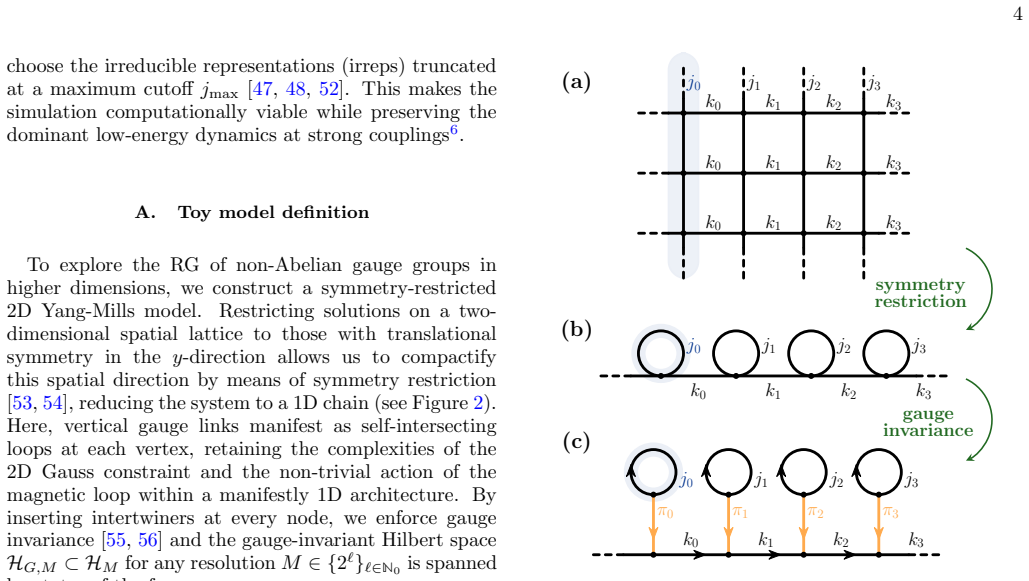
Toy model To construct a computationally tractable model for quantum simulation while retaining the core SU(2) dy- namics, we reduce the general formalism to a simplified geometry exhibiting homogeneity along one spatial di- rection. To this end, letγ M denote a 2D cubic lattice with periodic vertex setZ M ×Z M. At the classical level, discretizing an SU(...
discussion (0)
Sign in with ORCID, Apple, or X to comment. Anyone can read and Pith papers without signing in.