Direct Detection of Millicharged Particles from Supernovae
Pith reviewed 2026-06-27 12:23 UTC · model grok-4.3
The pith
Millicharged particles produced in supernovae can reach Earth and produce detectable electron recoils after the neutrino signal.
A machine-rendered reading of the paper's core claim, the machinery that carries it, and where it could break.
Core claim
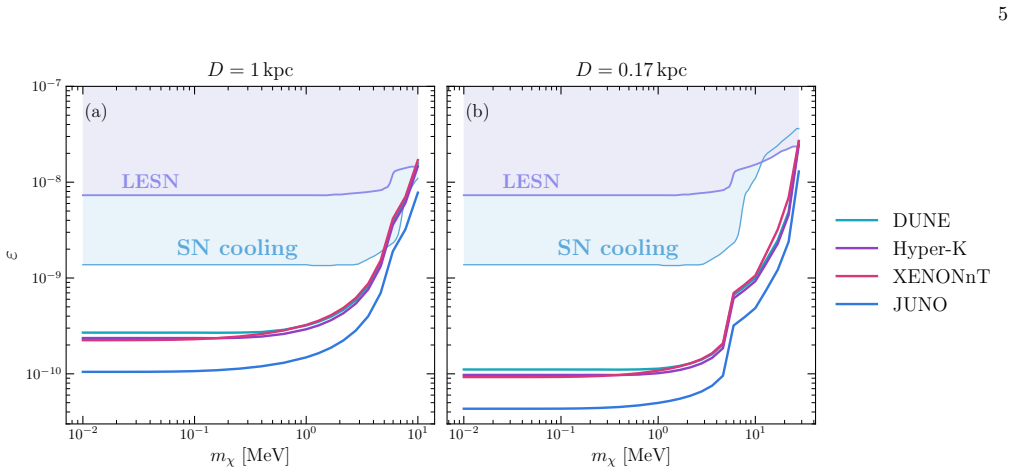
Millicharged particles with charge fraction ε = 10^{-9} and masses between sub-MeV and MeV can be copiously produced in supernovae, escape, and induce more than 10 electron-recoil events per year at detectors including XENONnT, JUNO, DUNE, and Hyper-Kamiokande, with the signal separated by time-of-flight delay from the neutrino burst, thereby improving the supernova cooling bound on ε by up to an order of magnitude.
What carries the argument
Time-of-flight delay of millicharged particles relative to the supernova neutrino burst, which opens a clean temporal search window for electron-recoil signals.
If this is right
- More than 10 events per year detectable at XENONnT, JUNO, DUNE, and Hyper-Kamiokande for the benchmark parameters.
- The search improves the existing supernova cooling bound on the millicharge ε by up to an order of magnitude.
- The method applies to sub-MeV to MeV-scale masses of the millicharged particles.
- Distinct signals arise from electron recoils induced by the particles reaching terrestrial detectors.
Where Pith is reading between the lines
- This approach could be combined with other direct detection methods to cross-check bounds on millicharged particles.
- Non-observation in upcoming supernova events would constrain supernova production models for these particles.
- Similar time-delay techniques might apply to searches for other feebly interacting particles from astrophysical sources.
Load-bearing premise
A sufficient number of millicharged particles are produced in the supernova core and escape the star to reach Earth without significant absorption.
What would settle it
Observing fewer than 10 events or no delayed signals in a year of data from a nearby supernova at one of the listed detectors for ε = 10^{-9} would indicate the production or escape fraction is lower than calculated.
Figures


read the original abstract
This work proposes a new terrestrial probe for millicharged particles (mCPs) and demonstrates promising discovery prospects. mCPs can be copiously produced in core-collapse supernovae (SNe), and a fraction may escape, travel to Earth and yield distinct signals. The mCP mass induces a time-of-flight (ToF) delay relative to the SN neutrino burst, opening a clean search window after the neutrino signal has passed. We compute the mCP-induced electron-recoil signals at XENONnT, JUNO, DUNE, and Hyper-Kamiokande for benchmark SN scenarios, and find that for $\varepsilon = 10^{-9}$ and sub-MeV to MeV-scale masses, more than 10 events per year can be detected. This search can improve upon existing SN cooling bound on $\varepsilon$ by up to an order of magnitude.
Editorial analysis
A structured set of objections, weighed in public.
Referee Report
Summary. The manuscript proposes using time-of-flight delayed electron-recoil signals from millicharged particles (mCPs) produced in core-collapse supernovae as a direct detection channel. For the benchmark millicharge ε = 10^{-9} and sub-MeV to MeV masses, the authors compute event rates exceeding 10 per year at XENONnT, JUNO, DUNE, and Hyper-Kamiokande. This is claimed to improve existing supernova cooling bounds on ε by up to an order of magnitude by exploiting the delay relative to the neutrino burst.
Significance. If the central rate calculations hold after uncertainty quantification, the work identifies a novel, clean search strategy for mCPs that leverages existing and near-future neutrino and dark-matter detectors. The time-of-flight separation from the neutrino signal is a concrete experimental advantage. The benchmark results suggest that current facilities could already probe parameter space beyond indirect cooling limits, providing a falsifiable prediction that could be tested with archival or upcoming data.
major comments (1)
- [Abstract and associated production/escape calculations] The headline claim of >10 events/year at ε=10^{-9} (Abstract) rests on mCP production (plasmon decay/bremsstrahlung) and escape fractions integrated over a single benchmark supernova core temperature/density profile. No variations over alternative SN simulations or ±20% shifts in core temperature are presented; a factor-of-3 reduction in escaping flux would drop the predicted counts below the stated threshold and remove the claimed order-of-magnitude improvement over the cooling bound. This uncertainty must be quantified for the central claim to be robust.
minor comments (1)
- [Abstract] The abstract refers to 'benchmark SN scenarios' without naming the specific temperature/density profile or reference simulation used; adding this citation would improve reproducibility.
Simulated Author's Rebuttal
We thank the referee for their thoughtful review and for highlighting the need to assess robustness against supernova model variations. We address the single major comment below and will revise the manuscript accordingly.
read point-by-point responses
-
Referee: [Abstract and associated production/escape calculations] The headline claim of >10 events/year at ε=10^{-9} (Abstract) rests on mCP production (plasmon decay/bremsstrahlung) and escape fractions integrated over a single benchmark supernova core temperature/density profile. No variations over alternative SN simulations or ±20% shifts in core temperature are presented; a factor-of-3 reduction in escaping flux would drop the predicted counts below the stated threshold and remove the claimed order-of-magnitude improvement over the cooling bound. This uncertainty must be quantified for the central claim to be robust.
Authors: We agree that the central claim relies on a single benchmark supernova profile and that explicit quantification of sensitivity to core temperature and alternative simulations is required for robustness. The manuscript employs a standard benchmark profile drawn from the supernova neutrino literature, chosen for consistency with existing cooling-bound calculations. In the revised version we will add new calculations varying the core temperature by ±20% around the benchmark value and results from one alternative supernova simulation. These will be presented in an expanded Section on production/escape and in a supplementary figure showing the resulting range of event rates at the detectors. The abstract will be updated to report the benchmark result together with the range obtained under these variations, with appropriate caveats on the improvement over cooling bounds. This addresses the concern directly. revision: yes
Circularity Check
No circularity; event-rate calculations are explicit outputs from benchmark SN models and standard production cross-sections
full rationale
The paper computes mCP production via plasmon decay and bremsstrahlung, escape fractions, and detector event rates for chosen benchmark values of ε and mass using standard SN core profiles and particle-physics formulas. No equation reduces by construction to a fitted parameter renamed as a prediction, no self-citation supplies a load-bearing uniqueness theorem, and no ansatz is smuggled in. The >10 events/yr claim is an output of the integration over the chosen profiles, not a tautology. SN-model uncertainties affect the numerical result but do not create circularity under the stated criteria.
Axiom & Free-Parameter Ledger
free parameters (1)
- benchmark millicharge ε
axioms (2)
- domain assumption Core-collapse supernovae produce millicharged particles at appreciable rates
- domain assumption A non-negligible fraction of produced mCPs escape the supernova
Reference graph
Works this paper leans on
-
[1]
P. A. M. Dirac, Proc. Roy. Soc. Lond. A133, 60 (1931)
1931
-
[2]
J. C. Pati and A. Salam, Phys. Rev.D8, 1240 (1973)
1973
-
[3]
Holdom, Phys
B. Holdom, Phys. Lett. B166, 196 (1986)
1986
-
[4]
Holdom, Phys
B. Holdom, Phys. Lett. B178, 65 (1986)
1986
-
[5]
K. Cheung and T.-C. Yuan, JHEP03, 120 (2007), arXiv:hep-ph/0701107
Pith/arXiv arXiv 2007
-
[6]
D. Feldman, Z. Liu, and P. Nath, Phys. Rev. D75, 115001 (2007), arXiv:hep-ph/0702123
Pith/arXiv arXiv 2007
-
[7]
Wen and E
X.-G. Wen and E. Witten, Nucl. Phys. B261, 651 (1985)
1985
-
[8]
Essiget al., (2013), arXiv:1311.0029 [hep-ph]
R. Essiget al., (2013), arXiv:1311.0029 [hep-ph]
Pith/arXiv arXiv 2013
-
[9]
Battaglieriet al., (2017), arXiv:1707.04591 [hep-ph]
M. Battaglieriet al., (2017), arXiv:1707.04591 [hep-ph]
Pith/arXiv arXiv 2017
-
[10]
Goriet al., (2022), arXiv:2209.04671 [hep-ph]
S. Goriet al., (2022), arXiv:2209.04671 [hep-ph]
arXiv 2022
-
[11]
J. Lee, F. Takahashi, and Y.-D. Tsai, (2026), arXiv:2603.12320 [hep-ph]
arXiv 2026
-
[12]
The coupling toZis suppressed and the effect can be neglected for the processes we consider
-
[13]
M. Ahlers, H. Gies, J. Jaeckel, J. Redondo, and A. Ring- wald, Phys. Rev. D77, 095001 (2008), arXiv:0711.4991 [hep-ph]
Pith/arXiv arXiv 2008
-
[14]
F. Della Valle, E. Milotti, A. Ejlli, G. Messineo, L. Piemontese, G. Zavattini, U. Gastaldi, R. Pengo, and G. Ruoso, Phys. Rev. D90, 092003 (2014), arXiv:1406.6518 [quant-ph]
Pith/arXiv arXiv 2014
- [15]
- [16]
-
[17]
K. J. Kelly and Y.-D. Tsai, Phys. Rev. D100, 015043 (2019), arXiv:1812.03998 [hep-ph]
arXiv 2019
-
[18]
S. Foroughi-Abari, F. Kling, and Y.-D. Tsai, Phys. Rev. D104, 035014 (2021), arXiv:2010.07941 [hep-ph]
arXiv 2021
-
[19]
Perezet al.(Oscura), JHEP02, 072 (2024), arXiv:2304.08625 [hep-ex]
S. Perezet al.(Oscura), JHEP02, 072 (2024), arXiv:2304.08625 [hep-ex]
arXiv 2024
-
[20]
L. Baraket al.(SENSEI), Phys. Rev. Lett.133, 071801 (2024), arXiv:2305.04964 [hep-ex]
arXiv 2024
-
[21]
Y.-D. Tsai, I. Hwang, R. Schmitz, M. Citron, K. Gun- thoti, J. Steenis, H. Jeong, H. Moon, J. H. Yoo, and M. X. Liu, Phys. Rev. D113, 015038 (2026), arXiv:2407.07142 [hep-ph]
arXiv 2026
- [22]
- [23]
- [24]
- [25]
-
[26]
S. Davidson and M. E. Peskin, Phys. Rev. D49, 2114 (1994), arXiv:hep-ph/9310288
Pith/arXiv arXiv 1994
-
[27]
J. H. Chang, R. Essig, and S. D. McDermott, JHEP09, 051 (2018), arXiv:1803.00993 [hep-ph]
Pith/arXiv arXiv 2018
- [28]
-
[29]
R. Plestid, V. Takhistov, Y.-D. Tsai, T. Bringmann, A. Kusenko, and M. Pospelov, Phys. Rev. D102, 115032 (2020), arXiv:2002.11732 [hep-ph]
arXiv 2020
-
[30]
C. A. Arg¨ uelles Delgado, K. J. Kelly, and V. Mu˜ noz Al- bornoz, JHEP11, 099 (2021), arXiv:2104.13924 [hep-ph]
arXiv 2021
-
[31]
A. Berlin and K. Schutz, Phys. Rev. D105, 095012 (2022), arXiv:2111.01796 [hep-ph]
arXiv 2022
-
[32]
C. Li, Z. Liu, W. Lu, and Z. Ye, JHEP07, 116 (2025), arXiv:2408.04953 [hep-ph]
arXiv 2025
-
[33]
H. Wu, E. Hardy, and N. Song, Phys. Rev. D110, 115037 (2024), arXiv:2406.01668 [hep-ph]
arXiv 2024
-
[34]
D. F. G. Fiorillo and E. Vitagliano, Phys. Rev. Lett.133, 251004 (2024), arXiv:2404.07714 [hep-ph]
arXiv 2024
-
[35]
S. Davidson, S. Hannestad, and G. Raffelt, JHEP05, 003 (2000), arXiv:hep-ph/0001179
Pith/arXiv arXiv 2000
- [36]
-
[37]
E. Iles, S. Heeba, and K. Schutz, Phys. Rev. Lett.134, 121002 (2025), arXiv:2407.21096 [hep-ph]
arXiv 2025
-
[38]
A. Caputo, H.-T. Janka, G. Raffelt, and E. Vitagliano, Phys. Rev. Lett.128, 221103 (2022), arXiv:2201.09890 [astro-ph.HE]
arXiv 2022
-
[39]
C. Dvorkin, T. Lin, and K. Schutz, Phys. Rev. D 99, 115009 (2019), [Erratum: Phys.Rev.D 105, 119901 (2022)], arXiv:1902.08623 [hep-ph]
Pith/arXiv arXiv 2019
-
[40]
K. K. Boddy, K. Freese, G. Montefalcone, and B. Shams Es Haghi, Phys. Rev. D111, 063537 (2025), arXiv:2405.06226 [hep-ph]
arXiv 2025
-
[41]
G. G. Raffelt,Stars as Laboratories for Fundamental Physics(University of Chicago Press, 1996)
1996
-
[42]
S. Al Kharusiet al., New J. Phys.23, 031201 (2021), arXiv:2011.00035 [astro-ph.HE]
arXiv 2021
-
[43]
M. Joyce, S.-C. Leung, L. Moln´ ar, M. Ireland, C. Kobayashi, and K. Nomoto, Astrophys. J.902, 63 (2020), arXiv:2006.09837 [astro-ph.SR]
arXiv 2020
-
[44]
L. Bailloeul, M. Citron, Y. Cui, S. Foroughi-Abari, I. Hwang, F. Li, Y.-D. Tsai, M. X. Liu, K. Gunthoti, and J. H. Yoo, (2025), arXiv:2512.11027 [hep-ph]
arXiv 2025
-
[45]
C. V. Cappiello and J. F. Beacom, Phys. Rev. D 100, 103011 (2019), [Erratum: Phys.Rev.D 104, 069901 (2021)], arXiv:1906.11283 [hep-ph]
arXiv 2019
-
[46]
E. Aprileet al.(XENON), Phys. Rev. Lett.131, 041003 (2023), arXiv:2303.14729 [hep-ex]
arXiv 2023
-
[47]
A. Abuslemeet al.(JUNO), Prog. Part. Nucl. Phys.123, 103927 (2022), arXiv:2104.02565 [hep-ex]
arXiv 2022
-
[48]
B. Abiet al.(DUNE), Eur. Phys. J. C81, 322 (2021), arXiv:2008.12769 [hep-ex]
arXiv 2021
-
[49]
Abeet al.(Hyper-Kamiokande), (2018), arXiv:1805.04163 [physics.ins-det]
K. Abeet al.(Hyper-Kamiokande), (2018), arXiv:1805.04163 [physics.ins-det]
Pith/arXiv arXiv 2018
-
[50]
A. Abed Abudet al.(DUNE), Phys. Rev. D111, 092006 (2025), arXiv:2407.10339 [hep-ex]
arXiv 2025
- [51]
-
[52]
A. A. Prinzet al., Phys. Rev. Lett.81, 1175 (1998), arXiv:hep-ex/9804008
Pith/arXiv arXiv 1998
-
[53]
Acciarriet al.(ArgoNeuT), Phys
R. Acciarriet al.(ArgoNeuT), Phys. Rev. Lett.124, 131801 (2020), arXiv:1911.07996 [hep-ex]
arXiv 2020
-
[54]
A. Ballet al.(milliQan), Phys. Rev. D102, 032002 (2020), arXiv:2005.06518 [hep-ex]
arXiv 2020
-
[55]
Karaet al., JINST19, P10017 (2024), arXiv:2406.17743 [astro-ph.IM]
M. Karaet al., JINST19, P10017 (2024), arXiv:2406.17743 [astro-ph.IM]
arXiv 2024
-
[56]
E. Braaten and D. Segel, Phys. Rev. D48, 1478 (1993), arXiv:hep-ph/9302213
Pith/arXiv arXiv 1993
- [57]
-
[58]
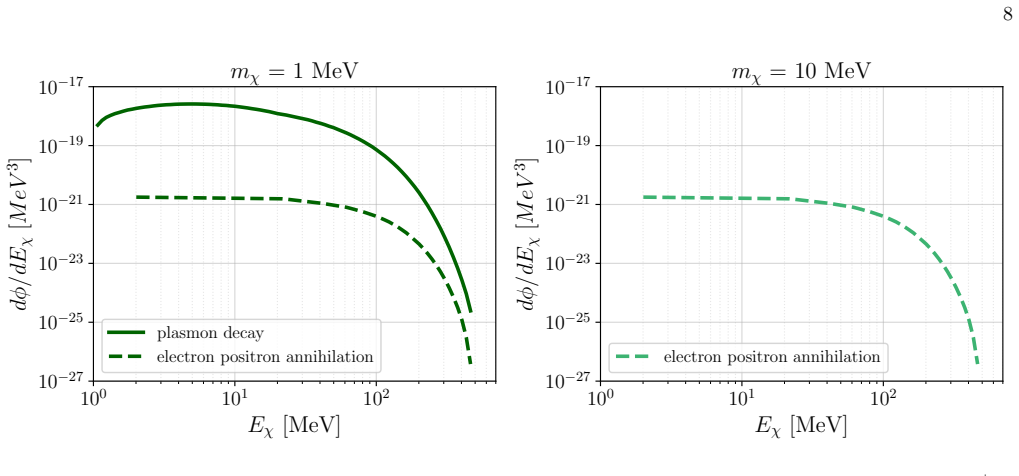
E. Hardy and R. Lasenby, JHEP02, 033 (2017), 7 arXiv:1611.05852 [hep-ph]. Appendix A: mCP Production Rate This appendix summarizes the mCP production rates from plasmon decay ande +e− annihilation in the one-zone SN model used throughout this work. The plasmon-decay calculation follows the finite-temperature plasma formalism of Ref. [56], as implemented f...
Pith/arXiv arXiv 2017
-
[59]
Time Profile of the Detected Event Rate Fig. 5 shows the arrival-time profile, i.e., the differential event rate per target electron defined as: 1 NT dR d(∆t) = dϕχ dEχ ¯Eχ(∆t) | {z } flux at Earth × Z Emax e ( ¯Eχ) Ethre dσ dEe dEe | {z } cross section × d ¯Eχ d(∆t) | {z } Jacobian ×∆t SN|{z} burst duration .(B1) For a fixedm χ, the ToF relation in Eq. (...
-
[60]
For a fixed number of events and fixedm χ, Eq
Detection at the Time of Explosion Neglecting the additionalD-dependence from the finite ToF observation window, the total event count scales relative to the reference valuesD 0 = 1 kpc andε 0 = 10−9 as: N(D, ε)≃N(D 0, ε0) ε ε0 4 D0 D 2 .(C1) The two factors ofε 2 originate from mCP production in the SN core and mCP-electron scattering in the detector, wh...
-
[61]
The ToF delay relation in Eq
Detection Today The second question concerns whether mCPs from past supernovae continue to arrive in detectable quantities today. The ToF delay relation in Eq. 3 maps a one-year observation window to a narrow mCP energy slice for fixedm χ andD. For long elapsed times ∆t≫1 yr, the relative width of this slice scales approximately as 1/(2∆t). This scaling y...
discussion (0)
Sign in with ORCID, Apple, or X to comment. Anyone can read and Pith papers without signing in.