JADES: the mass-metallicity relation at z=1-10. New calibrations, extremely metal-poor galaxies, and chemical diversity
Pith reviewed 2026-06-27 12:15 UTC · model grok-4.3
The pith
New stack-based calibrations from 1500 JWST spectra produce mass-metallicity relations at z=1-10 and flag 50 extremely metal-poor galaxy candidates.
A machine-rendered reading of the paper's core claim, the machinery that carries it, and where it could break.
Core claim
Stacking ~1500 JWST/NIRSpec spectra yields strong-line calibrations over 12+log(O/H)=7.0-8.7 that avoid the high-excitation bias of prior individual auroral-line samples; these calibrations produce canonical mass-metallicity relations at z=1-10 showing a metallicity decrease from z~0 to z~4-10 with no significant slope change, while also revealing 50 EMPG candidates at 12+log(O/H)=6.7-7.3 whose large MZR scatter and inverse sSFR-metallicity trend support stochastic star-formation histories driven by gas consumption, ejection, and metal-poor inflows, with two such objects also displaying broad Hα and prominent Lyα.
What carries the argument
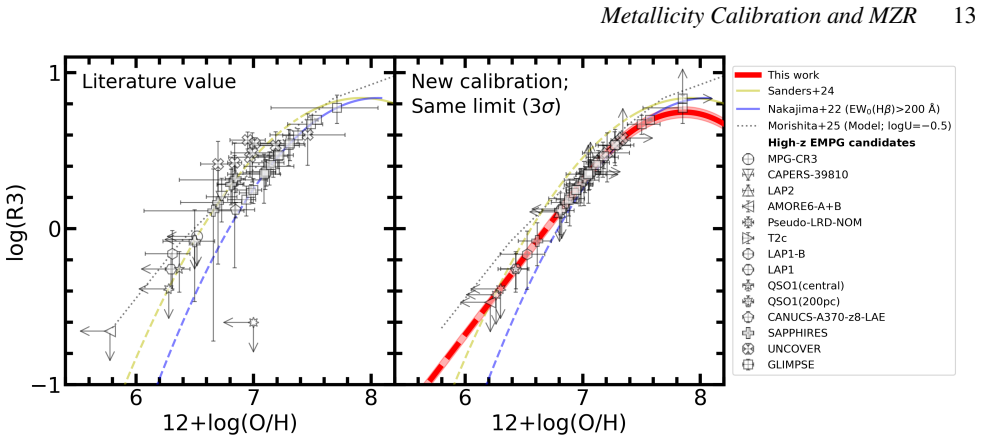
The stack-based strong-line calibrations obtained by averaging spectra to detect the [OIII]λ4363 auroral line without high-excitation selection bias.
If this is right
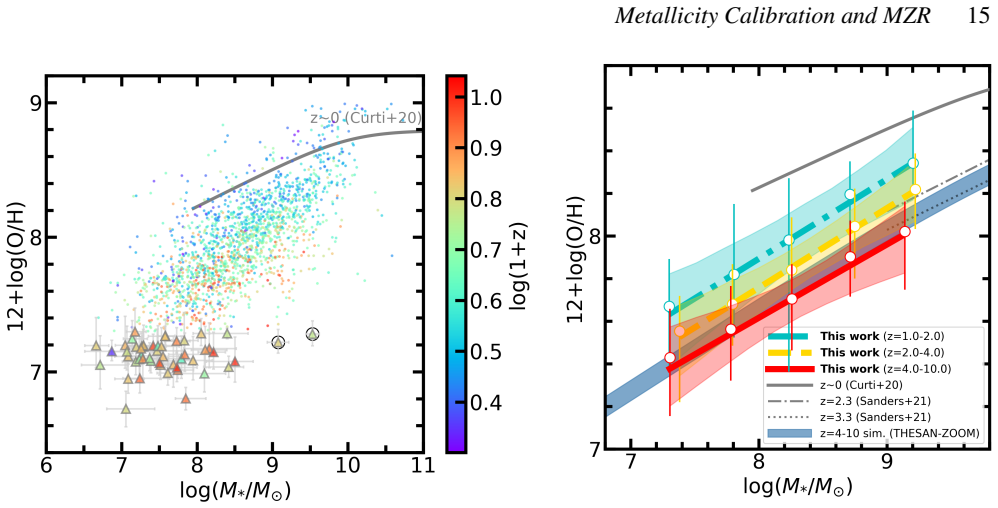
- Metallicities at fixed stellar mass are lower at z~4-10 than at z~0.
- The slope of the mass-metallicity relation remains roughly constant from z=1 to z=10.
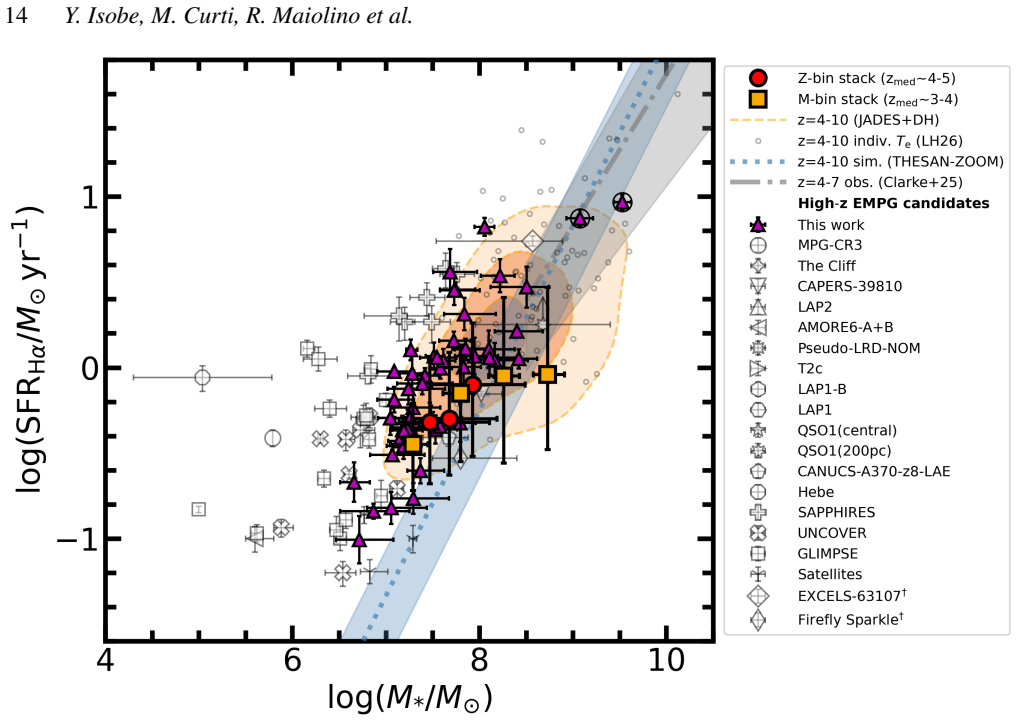
- Extremely metal-poor galaxies exhibit large scatter in the mass-metallicity relation, with lower-metallicity objects tending to have lower specific star-formation rates.
- Two Little Red Dot candidates among the EMPGs display broad Hα and strong Lyα, consistent with early black-hole growth in metal-poor gas.
Where Pith is reading between the lines
- The calibration approach could be applied to other deep JWST fields to test whether the reported redshift evolution holds across different survey selections.
- The reversed sSFR-metallicity trend in EMPGs may indicate that inflow-driven dilution dominates over star-formation-driven enrichment at the lowest masses and metallicities.
- Finding broad-line signatures in two EMPGs raises the possibility that black-hole seeds can form and grow before significant metal enrichment occurs.
Load-bearing premise
That the stacked spectra give unbiased strong-line calibrations because they avoid the higher-excitation bias that affects individual auroral-line detections.
What would settle it
If low-excitation individual galaxies at z>4 observed without an auroral-line requirement show the higher [OIII]/Hβ ratios used in earlier calibrations, the stack-derived relations would be shown to underestimate metallicities.
Figures



read the original abstract
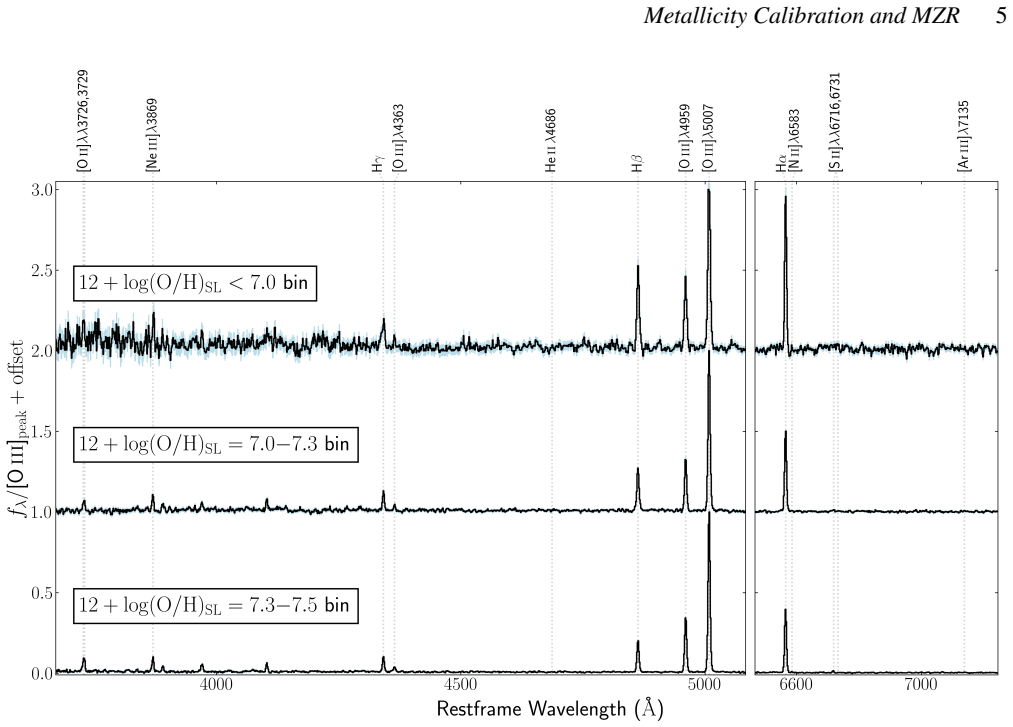
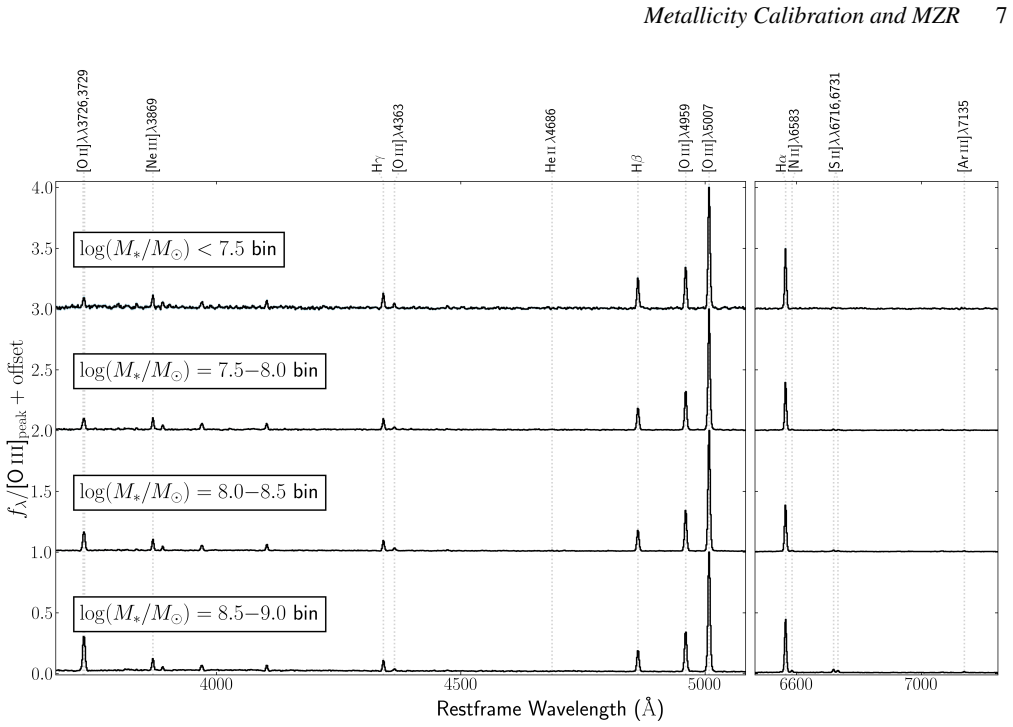
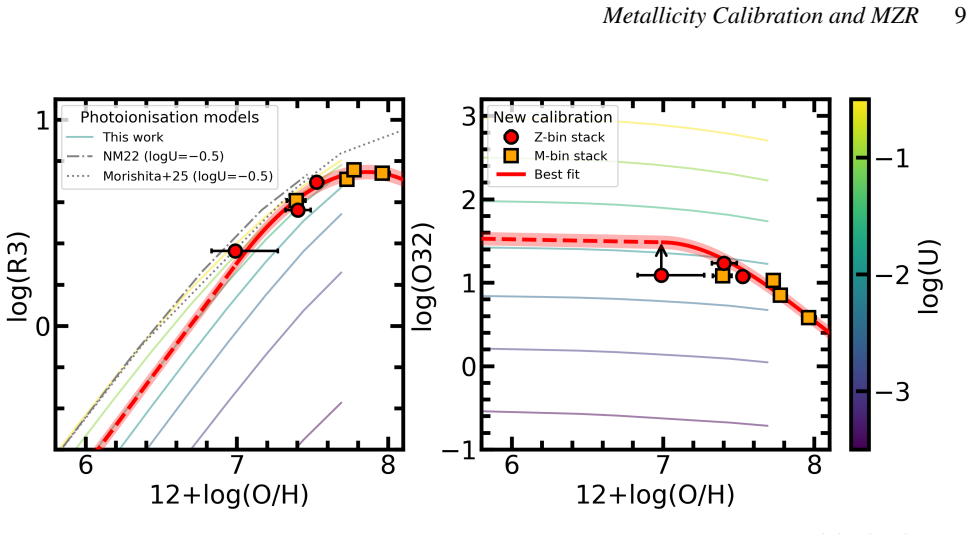
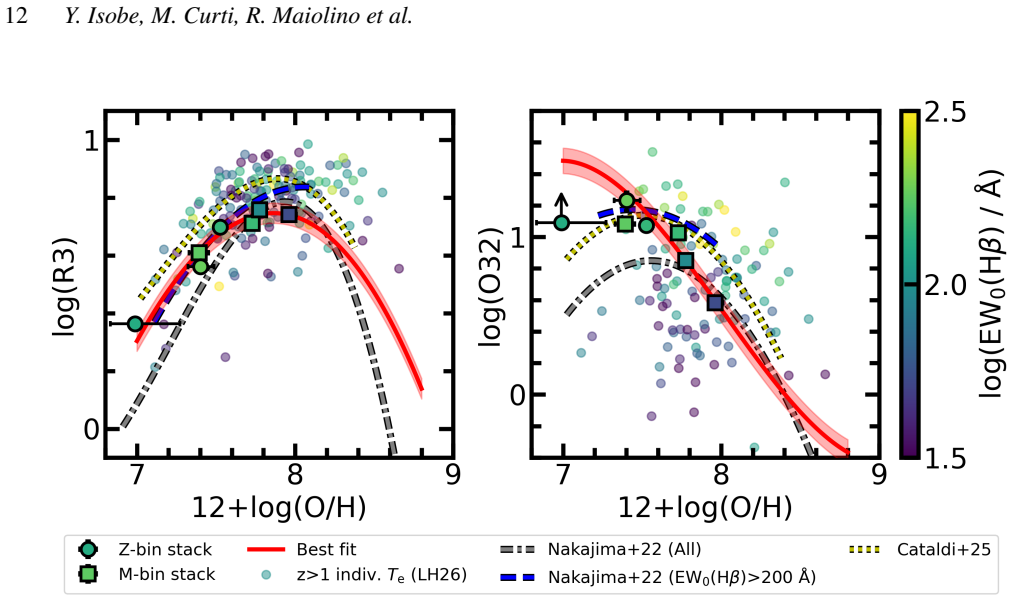
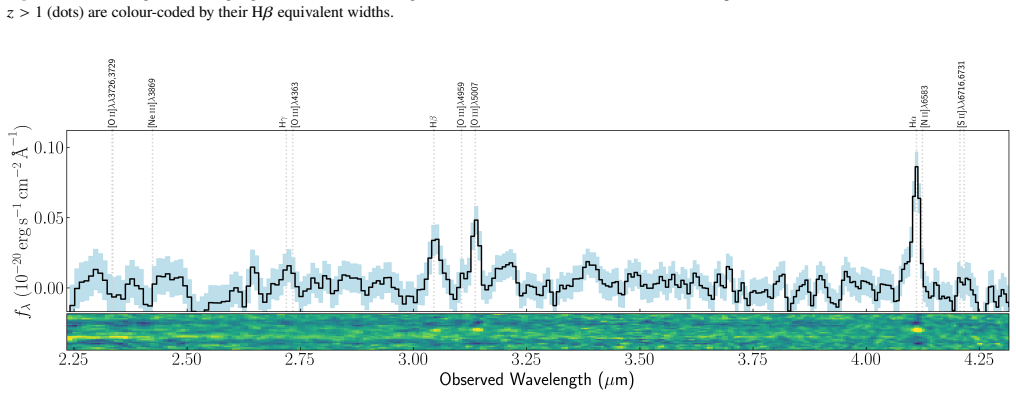
We present gas-phase metallicities of star-forming galaxies at $z=1$-10 with deep JWST/NIRSpec spectra from the JADES full data release, Dark Horse, and OASIS programmes. We stack $\sim$1500 medium-resolution spectra, yielding detections of the [OIII]$\lambda$4363 auroral line down to $12+\log(\mathrm{O/H})=7.0$ to derive stack-based strong-line calibrations over the metallicity range $12+\log(\mathrm{O/H})=7.0$-8.7. At a fixed metallicity, our stacks exhibit [OIII]$\lambda$5007/H$\beta$ and [OIII]$\lambda$5007/[OII]$\lambda\lambda$3726,3729 values generally lower than calibrations based on high-$z$ individual auroral-line emitters, suggesting an observational bias towards higher excitation introduced when requiring auroral line detections in individual spectra. Based on our new calibrations, we obtain canonical mass-metallicity relations (MZRs) at z$=$1-10, identifying a decrease in metallicities from $z\sim0$ to z$\sim$4-10, without significant change in slope. Moreover, we identify 50 promising candidates of extremely metal-poor galaxies (EMPGs) with $12+\log(\mathrm{O/H})=6.7$-7.3 (1-4\% solar metallicity) at $z=1.2$-9.1. The MZRs of EMPGs are characterised by a large scatter, with those having lower metallicities generally exhibiting lower sSFRs, opposite of what expected from the local Fundamental Metallicity Relation. These results support a stochastic star-formation history involving gas consumption/ejection and metal-poor inflow, strongly affecting metallicities of low-mass galaxies. Furthermore, we identify two Little Red Dots in our EMPG candidates, both exhibiting broad H$\alpha$ and prominent Ly$\alpha$, offering insights into the early black-hole growth in extremely metal-poor environments.
Editorial analysis
A structured set of objections, weighed in public.
Referee Report
Summary. The paper stacks ~1500 medium-resolution JWST/NIRSpec spectra from JADES, Dark Horse, and OASIS at z=1-10 to detect the [OIII]λ4363 auroral line down to 12+log(O/H)=7.0. This yields new strong-line calibrations spanning 12+log(O/H)=7.0-8.7. The stacks show lower [OIII]λ5007/Hβ and [OIII]λ5007/[OII] ratios than prior high-z auroral samples, which the authors attribute to reduced excitation bias. Applying the calibrations produces MZRs at z=1-10 with decreasing metallicity toward higher redshift but invariant slope, plus 50 EMPG candidates (12+log(O/H)=6.7-7.3) at z=1.2-9.1 whose MZR exhibits large scatter and an inverted sSFR-metallicity trend. The results are interpreted as evidence for stochastic star-formation histories with gas consumption, ejection, and metal-poor inflows; two Little Red Dots are also noted among the EMPGs.
Significance. If the stack-derived calibrations prove robust, the work supplies a large-sample empirical anchor for high-redshift metallicity diagnostics that is less susceptible to the selection effects plaguing individual auroral-line detections. The reported MZR evolution, the sizable EMPG sample, and the counter-intuitive sSFR trend would directly inform models of early chemical enrichment and gas accretion. The identification of LRDs in EMPG environments additionally links black-hole growth to extremely metal-poor conditions.
major comments (2)
- [calibration derivation and abstract] The central premise that the stacked spectra produce unbiased strong-line calibrations because they avoid the higher-excitation bias of individual auroral detections (abstract and calibration section) is not accompanied by a quantitative test. No variance decomposition, comparison against photoionization grids at fixed metallicity, or explicit check that the lower [OIII]λ5007/Hβ and [OIII]λ5007/[OII] ratios map one-to-one onto the claimed 12+log(O/H) range without residual mixing of ionization parameter or dust distributions is presented. This assumption directly underpins the reported MZR slope invariance, the 50 EMPG identifications at 6.7-7.3, and the inverted sSFR-metallicity relation.
- [EMPG selection and MZR analysis] The EMPG MZR scatter and the claim that lower-metallicity objects show lower sSFRs (opposite the local FMR) rest on the new calibrations applied to individual galaxies. Without an explicit propagation of the calibration uncertainty or a demonstration that the stack locus remains valid when applied to the lower-S/N individual spectra of the EMPG candidates, the robustness of the reported trend cannot be assessed.
minor comments (2)
- [methods] Clarify the exact stacking weights and any post-hoc S/N or redshift cuts applied before stacking; these choices affect the effective calibration locus.
- [results] Provide the full list of the 50 EMPG candidates with their individual line ratios and derived metallicities in a machine-readable table.
Simulated Author's Rebuttal
We thank the referee for their constructive and detailed review. We address each major comment below, providing clarifications on our methodology and indicating the revisions that will be incorporated to strengthen the manuscript.
read point-by-point responses
-
Referee: [calibration derivation and abstract] The central premise that the stacked spectra produce unbiased strong-line calibrations because they avoid the higher-excitation bias of individual auroral detections (abstract and calibration section) is not accompanied by a quantitative test. No variance decomposition, comparison against photoionization grids at fixed metallicity, or explicit check that the lower [OIII]λ5007/Hβ and [OIII]λ5007/[OII] ratios map one-to-one onto the claimed 12+log(O/H) range without residual mixing of ionization parameter or dust distributions is presented. This assumption directly underpins the reported MZR slope invariance, the 50 EMPG identifications at 6.7-7.3, and the inverted sSFR-metallicity relation.
Authors: We appreciate the referee's emphasis on the need for quantitative validation. The manuscript demonstrates that our stacks yield systematically lower [OIII]λ5007/Hβ and [OIII]λ5007/[OII] ratios than individual high-z auroral samples, which we attribute to the absence of the excitation bias inherent in requiring auroral detections in single objects. While this comparative evidence supports our interpretation, we agree that explicit tests against photoionization grids at fixed metallicity and a variance decomposition would provide stronger confirmation that the lower ratios correspond directly to the 7.0-8.7 metallicity range without residual ionization-parameter or dust mixing. In the revised manuscript we will add these analyses in the calibration section, including model-grid comparisons and an assessment of how stack properties vary with assumed ionization parameter, thereby reinforcing the robustness of the MZR slope invariance and EMPG results. revision: yes
-
Referee: [EMPG selection and MZR analysis] The EMPG MZR scatter and the claim that lower-metallicity objects show lower sSFRs (opposite the local FMR) rest on the new calibrations applied to individual galaxies. Without an explicit propagation of the calibration uncertainty or a demonstration that the stack locus remains valid when applied to the lower-S/N individual spectra of the EMPG candidates, the robustness of the reported trend cannot be assessed.
Authors: We agree that applying the stack-derived calibrations to individual lower-S/N spectra requires explicit uncertainty propagation and validation. The current analysis uses the new relations to identify the 50 EMPG candidates and derive their MZR and sSFR trends, but does not yet include a formal propagation of the calibration scatter or a direct test of the stack locus at reduced S/N. In the revised version we will add an error-propagation step when assigning metallicities to the EMPG candidates and will demonstrate the validity of the calibration by adding realistic noise to the stacks and re-deriving the relations, as well as by comparing results from high-S/N subsets. These additions will allow a quantitative assessment of the reported scatter and the inverted sSFR-metallicity trend. revision: yes
Circularity Check
No circularity: empirical calibrations derived directly from stacked auroral-line detections
full rationale
The paper derives strong-line calibrations from direct [OIII]λ4363 detections in stacks of ~1500 JWST spectra over 12+log(O/H)=7.0-8.7, then applies those calibrations to obtain MZRs and EMPG candidates. No quoted equation or claim reduces a target result (MZR slope, EMPG metallicities, or sSFR trend) to a fitted parameter or self-citation that defines it by construction. The process is observational and self-contained against the input spectra; any self-citations to prior JADES work are not load-bearing for the central empirical claims.
Axiom & Free-Parameter Ledger
axioms (1)
- domain assumption Strong-line ratios calibrated against auroral-line metallicities provide reliable gas-phase oxygen abundances across the range 12+log(O/H)=7.0-8.7.
Reference graph
Works this paper leans on
-
[1]
Alves de Oliveira C., et al., 2018, in Observatory Operations: Strategies, Processes, and Systems VII. p. 107040Q ( @eprint arXiv 1805.06922 ), @doi 10.1117/12.2313839
work page internal anchor Pith review Pith/arXiv arXiv doi:10.1117/12.2313839 2018
-
[2]
S., 2026, arXiv e-prints, https://ui.adsabs.harvard.edu/abs/2026arXiv260603522A p
Ando M., Harikane Y., Katz H., Inayoshi K., Tanaka T. S., 2026, arXiv e-prints, https://ui.adsabs.harvard.edu/abs/2026arXiv260603522A p. arXiv:2606.03522
Pith/arXiv arXiv 2026
-
[3]
Andrews B. H., Martini P., 2013, @doi [ ] 10.1088/0004-637X/765/2/140 , https://ui.adsabs.harvard.edu/abs/2013ApJ...765..140A 765, 140
-
[4]
Asada Y., et al., 2026, @doi [arXiv e-prints] 10.48550/arXiv.2601.20045 , https://ui.adsabs.harvard.edu/abs/2026arXiv260120045A p. arXiv:2601.20045
-
[5]
Asplund M., Amarsi A. M., Grevesse N., 2021, @doi [ ] 10.1051/0004-6361/202140445 , https://ui.adsabs.harvard.edu/abs/2021A&A...653A.141A 653, A141
work page internal anchor Pith review doi:10.1051/0004-6361/202140445 2021
-
[6]
Bagley M. B., et al., 2024, @doi [ ] 10.3847/2041-8213/ad2f31 , https://ui.adsabs.harvard.edu/abs/2024ApJ...965L...6B 965, L6
-
[9]
M., Terlevich R., 1981, @doi [PASP] 10.1086/130930 , 93, 817
Baldwin A., Phillips M. M., Terlevich R., 1981, @doi [PASP] 10.1086/130930 , 93, 817
-
[10]
Berg D. A., Erb D. K., Henry R. B. C., Skillman E. D., McQuinn K. B. W., 2019, @doi [ApJ] 10.3847/1538-4357/ab020a , 874, 93
-
[11]
Berg D. A., Chisholm J., Erb D. K., Skillman E. D., Pogge R. W., Olivier G. M., 2021, @doi [ ] 10.3847/1538-4357/ac141b , https://ui.adsabs.harvard.edu/abs/2021ApJ...922..170B 922, 170
-
[12]
Bezanson R., et al., 2024, @doi [ ] 10.3847/1538-4357/ad66cf , https://ui.adsabs.harvard.edu/abs/2024ApJ...974...92B 974, 92
-
[13]
Bian F., Kewley L. J., Dopita M. A., 2018, @doi [ ] 10.3847/1538-4357/aabd74 , https://ui.adsabs.harvard.edu/abs/2018ApJ...859..175B 859, 175
-
[15]
Bunker A. J., et al., 2024, @doi [ ] 10.1051/0004-6361/202347094 , https://ui.adsabs.harvard.edu/abs/2024A&A...690A.288B 690, A288
-
[18]
Cai S., et al., 2025, @doi [arXiv e-prints] 10.48550/arXiv.2507.17820 , https://ui.adsabs.harvard.edu/abs/2025arXiv250717820C p. arXiv:2507.17820
-
[19]
The Dust Content and Opacity of Actively Star-Forming Galaxies
Calzetti D., Armus L., Bohlin R. C., Kinney A. L., Koornneef J., Storchi‐Bergmann T., 2000, @doi [ApJ] 10.1086/308692 , 533, 682
work page internal anchor Pith review doi:10.1086/308692 2000
-
[20]
Cameron A. J., Katz H., Rey M. P., Saxena A., 2023, @doi [ ] 10.1093/mnras/stad1579 , https://ui.adsabs.harvard.edu/abs/2023MNRAS.523.3516C 523, 3516
-
[22]
Cappellari M., 2023, @doi [ ] 10.1093/mnras/stad2597 , https://ui.adsabs.harvard.edu/abs/2023MNRAS.526.3273C 526, 3273
-
[23]
Caputi K. I., Cooper R. A., Rinaldi P., Navarro-Carrera R., Iani E., 2026, @doi [arXiv e-prints] 10.48550/arXiv.2601.11466 , https://ui.adsabs.harvard.edu/abs/2026arXiv260111466C p. arXiv:2601.11466
work page internal anchor Pith review Pith/arXiv arXiv doi:10.48550/arxiv.2601.11466 2026
-
[24]
Cardelli J. A., Clayton G. C., Mathis J. S., 1989, @doi [ ] 10.1086/167900 , https://ui.adsabs.harvard.edu/abs/1989ApJ...345..245C 345, 245
-
[25]
SpectRes: A Fast Spectral Resampling Tool in Python
Carnall A. C., 2017, @doi [arXiv e-prints] 10.48550/arXiv.1705.05165 , https://ui.adsabs.harvard.edu/abs/2017arXiv170505165C p. arXiv:1705.05165
work page internal anchor Pith review Pith/arXiv arXiv doi:10.48550/arxiv.1705.05165 2017
-
[27]
Cataldi E., et al., 2025a, @doi [arXiv e-prints] 10.48550/arXiv.2504.03839 , https://ui.adsabs.harvard.edu/abs/2025arXiv250403839C p. arXiv:2504.03839
-
[28]
Tracing nitrogen enrichment across cosmic time with JWST
Cataldi E., et al., 2025b, @doi [arXiv e-prints] 10.48550/arXiv.2512.07955 , https://ui.adsabs.harvard.edu/abs/2025arXiv251207955C p. arXiv:2512.07955
work page internal anchor Pith review Pith/arXiv arXiv doi:10.48550/arxiv.2512.07955
-
[29]
Chabrier G., 2003, @doi [ ] 10.1086/376392 , https://ui.adsabs.harvard.edu/abs/2003PASP..115..763C 115, 763
work page internal anchor Pith review doi:10.1086/376392 2003
-
[30]
Chakraborty P., et al., 2025, @doi [ ] 10.3847/1538-4357/adc7b5 , https://ui.adsabs.harvard.edu/abs/2025ApJ...985...24C 985, 24
-
[31]
M., 2000, @doi [ ] 10.1086/309250 , https://ui.adsabs.harvard.edu/abs/2000ApJ...539..718C 539, 718
Charlot S., Fall S. M., 2000, @doi [ ] 10.1086/309250 , https://ui.adsabs.harvard.edu/abs/2000ApJ...539..718C 539, 718
work page internal anchor Pith review doi:10.1086/309250 2000
-
[32]
Chemerynska I., et al., 2024, @doi [ ] 10.3847/2041-8213/ad8dc9 , https://ui.adsabs.harvard.edu/abs/2024ApJ...976L..15C 976, L15
-
[33]
MESA Isochrones and Stellar Tracks (MIST). I: Solar-Scaled Models
Choi J., Dotter A., Conroy C., Cantiello M., Paxton B., Johnson B. D., 2016, @doi [ ] 10.3847/0004-637X/823/2/102 , https://ui.adsabs.harvard.edu/abs/2016ApJ...823..102C 823, 102
work page internal anchor Pith review doi:10.3847/0004-637x/823/2/102 2016
-
[34]
Chon S., Hosokawa T., Omukai K., Schneider R., 2024, @doi [ ] 10.1093/mnras/stae1027 , https://ui.adsabs.harvard.edu/abs/2024MNRAS.530.2453C 530, 2453
-
[36]
Clarke L., Shapley A. E., Sanders R. L., Topping M. W., Brammer G. B., Bento T., Reddy N. A., Kehoe E., 2024, @doi [ ] 10.3847/1538-4357/ad8ba4 , https://ui.adsabs.harvard.edu/abs/2024ApJ...977..133C 977, 133
-
[39]
Cullen F., et al., 2025, @doi [ ] 10.1093/mnras/staf838 , https://ui.adsabs.harvard.edu/abs/2025MNRAS.540.2176C 540, 2176
-
[40]
Curti M., Cresci G., Mannucci F., Marconi A., Maiolino R., Esposito S., 2017, @doi [ ] 10.1093/mnras/stw2766 , https://ui.adsabs.harvard.edu/abs/2017MNRAS.465.1384C 465, 1384
-
[41]
Curti M., Mannucci F., Cresci G., Maiolino R., 2020, @doi [ ] 10.1093/mnras/stz2910 , https://ui.adsabs.harvard.edu/abs/2020MNRAS.491..944C 491, 944
-
[42]
Curti M., et al., 2024, @doi [ ] 10.1051/0004-6361/202346698 , https://ui.adsabs.harvard.edu/abs/2024A&A...684A..75C 684, A75
-
[44]
Curtis-Lake E., et al., 2025, @doi [arXiv e-prints] 10.48550/arXiv.2510.01033 , https://ui.adsabs.harvard.edu/abs/2025arXiv251001033C p. arXiv:2510.01033
work page internal anchor Pith review Pith/arXiv arXiv doi:10.48550/arxiv.2510.01033 2025
-
[45]
D'Eugenio F., et al., 2025a, @doi [arXiv e-prints] 10.48550/arXiv.2510.11626 , https://ui.adsabs.harvard.edu/abs/2025arXiv251011626D p. arXiv:2510.11626
work page internal anchor Pith review Pith/arXiv arXiv doi:10.48550/arxiv.2510.11626
-
[46]
D'Eugenio F., et al., 2025b, @doi [ ] 10.3847/1538-4365/ada148 , https://ui.adsabs.harvard.edu/abs/2025ApJS..277....4D 277, 4
-
[47]
J., 2007, @doi [ ] 10.1086/508913 , https://ui.adsabs.harvard.edu/abs/2007ApJ...658..941D 658, 941
Dalcanton J. J., 2007, @doi [ ] 10.1086/508913 , https://ui.adsabs.harvard.edu/abs/2007ApJ...658..941D 658, 941
-
[48]
Monthly Notices of the Royal Astronomical Society , author =
Dav \'e R., Finlator K., Oppenheimer B. D., 2012, @doi [ ] 10.1111/j.1365-2966.2011.20148.x , https://ui.adsabs.harvard.edu/abs/2012MNRAS.421...98D 421, 98
-
[49]
Dorner B., et al., 2016, @doi [ ] 10.1051/0004-6361/201628263 , https://ui.adsabs.harvard.edu/abs/2016A&A...592A.113D 592, A113
-
[51]
Dotter A., 2016, @doi [ ] 10.3847/0067-0049/222/1/8 , https://ui.adsabs.harvard.edu/abs/2016ApJS..222....8D 222, 8
work page internal anchor Pith review doi:10.3847/0067-0049/222/1/8 2016
-
[53]
Eisenstein D. J., et al., 2023, @doi [arXiv e-prints] 10.48550/arXiv.2310.12340 , https://ui.adsabs.harvard.edu/abs/2023arXiv231012340E p. arXiv:2310.12340
-
[55]
Ellison S. L., Patton D. R., Simard L., McConnachie A. W., 2008, @doi [ ] 10.1086/527296 , https://ui.adsabs.harvard.edu/abs/2008ApJ...672L.107E 672, L107
-
[56]
Falc \'o n-Barroso J., S \'a nchez-Bl \'a zquez P., Vazdekis A., Ricciardelli E., Cardiel N., Cenarro A. J., Gorgas J., Peletier R. F., 2011, @doi [ ] 10.1051/0004-6361/201116842 , https://ui.adsabs.harvard.edu/abs/2011A&A...532A..95F 532, A95
-
[57]
J., et al., 2013, , https://ui.adsabs.harvard.edu/abs/2013RMxAA..49..137F 49, 137
Ferland G. J., et al., 2013, , https://ui.adsabs.harvard.edu/abs/2013RMxAA..49..137F 49, 137
2013
-
[58]
Ferruit P., et al., 2022, @doi [ ] 10.1051/0004-6361/202142673 , https://ui.adsabs.harvard.edu/abs/2022A&A...661A..81F 661, A81
-
[61]
Froese Fischer C., Tachiev G., 2004, @doi [Atomic Data and Nuclear Data Tables] 10.1016/j.adt.2004.02.001 , https://ui.adsabs.harvard.edu/abs/2004ADNDT..87....1F 87, 1
-
[62]
Fujimoto S., et al., 2025a, @doi [arXiv e-prints] 10.48550/arXiv.2512.11790 , https://ui.adsabs.harvard.edu/abs/2025arXiv251211790F p. arXiv:2512.11790
-
[63]
Fujimoto S., et al., 2025b, @doi [ ] 10.3847/1538-4357/ade9a1 , https://ui.adsabs.harvard.edu/abs/2025ApJ...989...46F 989, 46
-
[64]
Gallazzi A., Charlot S., Brinchmann J., White S. D. M., Tremonti C. A., 2005, @doi [ ] 10.1111/j.1365-2966.2005.09321.x , https://ui.adsabs.harvard.edu/abs/2005MNRAS.362...41G 362, 41
-
[66]
Geris S., et al., 2026, @doi [ ] 10.1093/mnras/staf1979 , https://ui.adsabs.harvard.edu/abs/2026MNRAS.545f1979G 545, staf1979
-
[68]
Guo Y., et al., 2016, @doi [ ] 10.3847/0004-637X/822/2/103 , https://ui.adsabs.harvard.edu/abs/2016ApJ...822..103G 822, 103
-
[69]
Hao C.-N., Kennicutt R. C., Johnson B. D., Calzetti D., Dale D. A., Moustakas J., 2011, @doi [ ] 10.1088/0004-637X/741/2/124 , https://ui.adsabs.harvard.edu/abs/2011ApJ...741..124H 741, 124
-
[70]
Harikane Y., et al., 2025, @doi [arXiv e-prints] 10.48550/arXiv.2505.09186 , https://ui.adsabs.harvard.edu/abs/2025arXiv250509186H p. arXiv:2505.09186
-
[71]
Heintz K. E., et al., 2023, @doi [Nature Astronomy] 10.1038/s41550-023-02078-7 , https://ui.adsabs.harvard.edu/abs/2023NatAs...7.1517H 7, 1517
-
[73]
Hirano S., Hosokawa T., Yoshida N., Omukai K., Yorke H. W., 2015, @doi [ ] 10.1093/mnras/stv044 , https://ui.adsabs.harvard.edu/abs/2015MNRAS.448..568H 448, 568
-
[74]
Hirschmann M., et al., 2023, @doi [ ] 10.1093/mnras/stad2955 , https://ui.adsabs.harvard.edu/abs/2023MNRAS.526.3610H 526, 3610
-
[75]
Hsiao T. Y.-Y., et al., 2025, @doi [arXiv e-prints] 10.48550/arXiv.2505.03873 , https://ui.adsabs.harvard.edu/abs/2025arXiv250503873H p. arXiv:2505.03873
-
[76]
Y.-Y., et al., 2026, arXiv e-prints, https://ui.adsabs.harvard.edu/abs/2026arXiv260506770H p
Hsiao T. Y.-Y., et al., 2026, arXiv e-prints, https://ui.adsabs.harvard.edu/abs/2026arXiv260506770H p. arXiv:2605.06770
Pith/arXiv arXiv 2026
-
[78]
Isobe Y., et al., 2022, @doi [ ] 10.3847/1538-4357/ac3509 , https://ui.adsabs.harvard.edu/abs/2022ApJ...925..111I 925, 111
-
[79]
Isobe Y., Ouchi M., Nakajima K., Harikane Y., Ono Y., Xu Y., Zhang Y., Umeda H., 2023, @doi [ ] 10.3847/1538-4357/acf376 , https://ui.adsabs.harvard.edu/abs/2023ApJ...956..139I 956, 139
-
[80]
Isobe Y., et al., 2025, @doi [ ] 10.1093/mnrasl/slaf056 , https://ui.adsabs.harvard.edu/abs/2025MNRAS.541L..71I 541, L71
-
[81]
Isobe Y., et al., 2026, @doi [ ] 10.1093/mnras/stag123 , https://ui.adsabs.harvard.edu/abs/2026MNRAS.547ag123I 547, stag123
-
[82]
The Cliff: A Metal-Poor Little Red Dot Hosting an Overmassive Black Hole at $z = 3.55$
Ivey L. R., et al., 2026a, @doi [arXiv e-prints] 10.48550/arXiv.2604.09177 , https://ui.adsabs.harvard.edu/abs/2026arXiv260409177I p. arXiv:2604.09177
work page internal anchor Pith review Pith/arXiv arXiv doi:10.48550/arxiv.2604.09177
-
[84]
I., Stasi \' n ska G., Meynet G., Guseva N
Izotov Y. I., Stasi \' n ska G., Meynet G., Guseva N. G., Thuan T. X., 2006, @doi [A & A] 10.1051/0004-6361:20053763 , 448, 955
-
[86]
Izotov Y. I., Thuan T. X., Guseva N. G., Liss S. E., 2018, @doi [ ] 10.1093/mnras/stx2478 , https://ui.adsabs.harvard.edu/abs/2018MNRAS.473.1956I 473, 1956
-
[89]
Ji X., Belokurov V., Maiolino R., Monty S., Isobe Y., Kravtsov A., McClymont W., \"U bler H., 2025, @doi [arXiv e-prints] 10.48550/arXiv.2505.12505 , https://ui.adsabs.harvard.edu/abs/2025arXiv250512505J p. arXiv:2505.12505
-
[91]
D., Leja J
Johnson B. D., Leja J. L., Conroy C., Speagle J. S., 2019, Prospector: Stellar population inference from spectra and SEDs , Astrophysics Source Code Library, record ascl:1905.025
2019
-
[92]
Stellar Population Inference with Prospector
Johnson B. D., Leja J., Conroy C., Speagle J. S., 2021, @doi [ ] 10.3847/1538-4365/abef67 , https://ui.adsabs.harvard.edu/abs/2021ApJS..254...22J 254, 22
work page internal anchor Pith review doi:10.3847/1538-4365/abef67 2021
-
[95]
Jones G. C., et al., 2025a, @doi [arXiv e-prints] 10.48550/arXiv.2509.20455 , https://ui.adsabs.harvard.edu/abs/2025arXiv250920455J p. arXiv:2509.20455
-
[97]
Juod z balis I., et al., 2025, @doi [arXiv e-prints] 10.48550/arXiv.2504.03551 , https://ui.adsabs.harvard.edu/abs/2025arXiv250403551J p. arXiv:2504.03551
-
[99]
Kannan R., et al., 2025, @doi [arXiv e-prints] 10.48550/arXiv.2502.20437 , https://ui.adsabs.harvard.edu/abs/2025arXiv250220437K p. arXiv:2502.20437
-
[101]
Kewley L. J., Dopita M. A., 2002, @doi [ ] 10.1086/341326 , https://ui.adsabs.harvard.edu/abs/2002ApJS..142...35K 142, 35
-
[103]
Kisielius R., Storey P. J., Ferland G. J., Keenan F. P., 2009, @doi [ ] 10.1111/j.1365-2966.2009.14989.x , https://ui.adsabs.harvard.edu/abs/2009MNRAS.397..903K 397, 903
-
[104]
Springer Nature, Netherlands, @doi 10.1007/978-981-15-8818-1\_106-1
Kobayashi C., Taylor P., 2023, Chemo-Dynamical Evolution of Galaxies. Springer Nature, Netherlands, @doi 10.1007/978-981-15-8818-1\_106-1
-
[105]
Kojima T., et al., 2020, @doi [ ] 10.3847/1538-4357/aba047 , https://ui.adsabs.harvard.edu/abs/2020ApJ...898..142K 898, 142
-
[111]
Langan I., Ceverino D., Finlator K., 2020, @doi [ ] 10.1093/mnras/staa880 , https://ui.adsabs.harvard.edu/abs/2020MNRAS.494.1988L 494, 1988
-
[113]
Langeroodi D., Hjorth J., 2026, @doi [ ] 10.3847/2041-8213/ae346f , https://ui.adsabs.harvard.edu/abs/2026ApJ...997L..30L 997, L30
-
[115]
Laseter I. H., et al., 2024, @doi [ ] 10.1051/0004-6361/202347133 , https://ui.adsabs.harvard.edu/abs/2024A&A...681A..70L 681, A70
-
[116]
Laseter I. H., Maseda M. V., Bunker A. J., Cameron A. J., Curti M., Simmonds C., 2025, @doi [arXiv e-prints] 10.48550/arXiv.2510.15024 , https://ui.adsabs.harvard.edu/abs/2025arXiv251015024L p. arXiv:2510.15024
-
[117]
How to Measure Galaxy Star Formation Histories II: Nonparametric Models
Leja J., Carnall A. C., Johnson B. D., Conroy C., Speagle J. S., 2019, @doi [ ] 10.3847/1538-4357/ab133c , https://ui.adsabs.harvard.edu/abs/2019ApJ...876....3L 876, 3
work page internal anchor Pith review doi:10.3847/1538-4357/ab133c 2019
-
[118]
J., Burke V
Lennon D. J., Burke V. M., 1994, , https://ui.adsabs.harvard.edu/abs/1994A&AS..103..273L 103, 273
1994
discussion (0)
Sign in with ORCID, Apple, or X to comment. Anyone can read and Pith papers without signing in.