Non-linear Structure Formation in Planck+DESI Favoured Interacting Dark Energy Cosmologies
Pith reviewed 2026-06-27 11:41 UTC · model grok-4.3
The pith
Interacting dark energy models produce scale-dependent deviations in non-linear structure that standard prescriptions miss.
A machine-rendered reading of the paper's core claim, the machinery that carries it, and where it could break.
Core claim
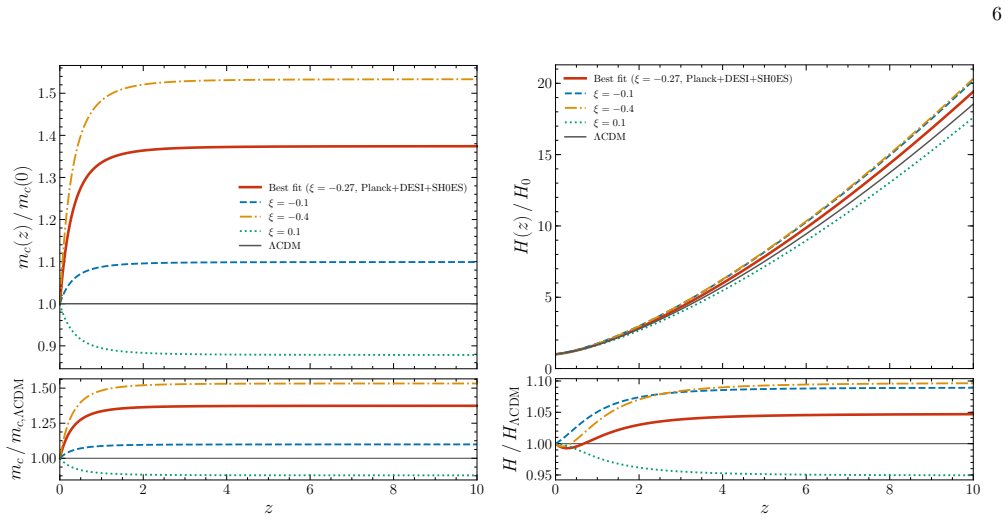
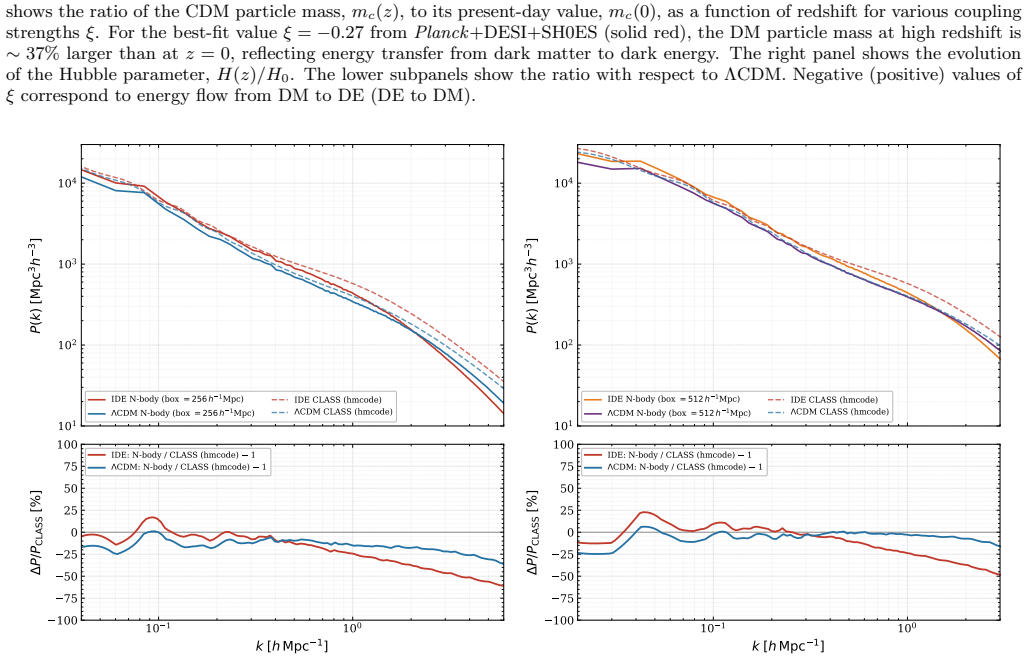
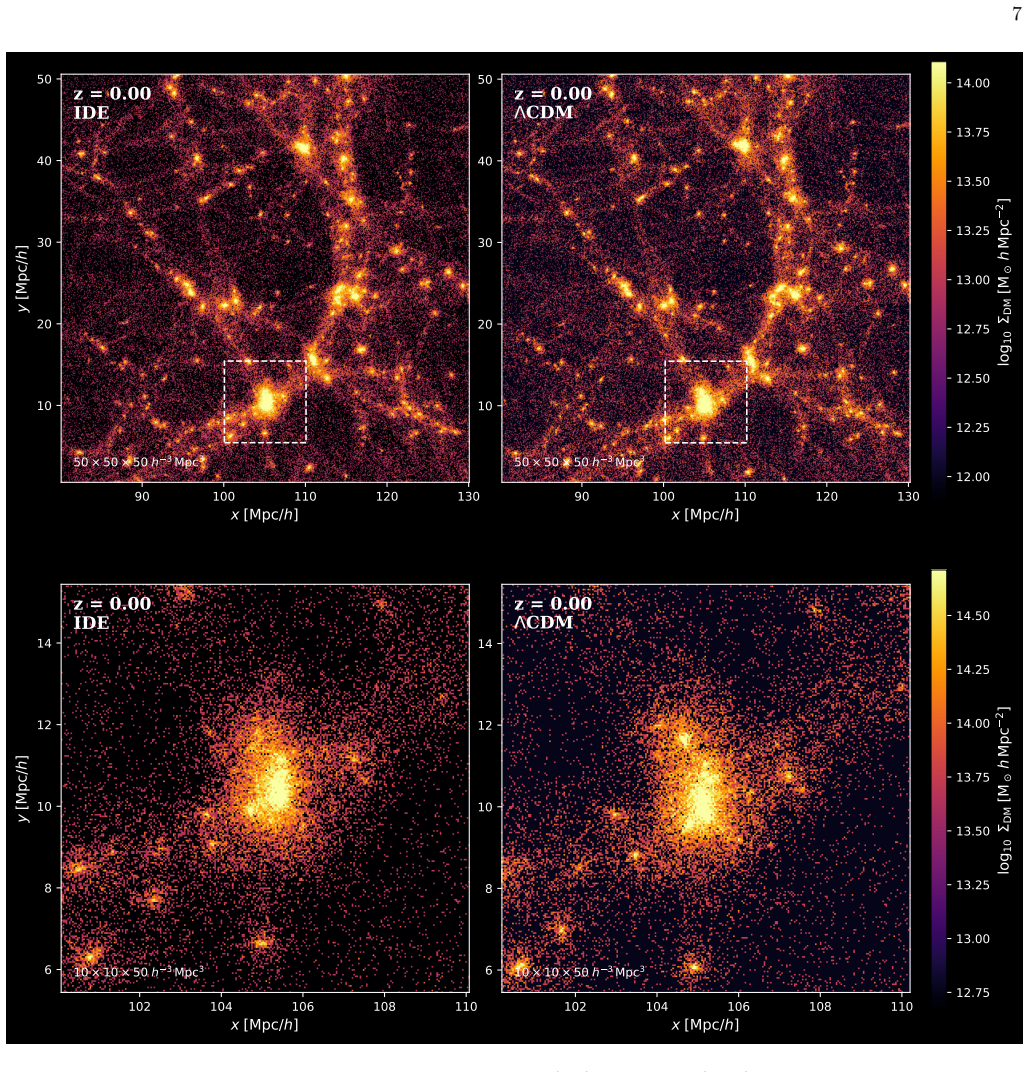
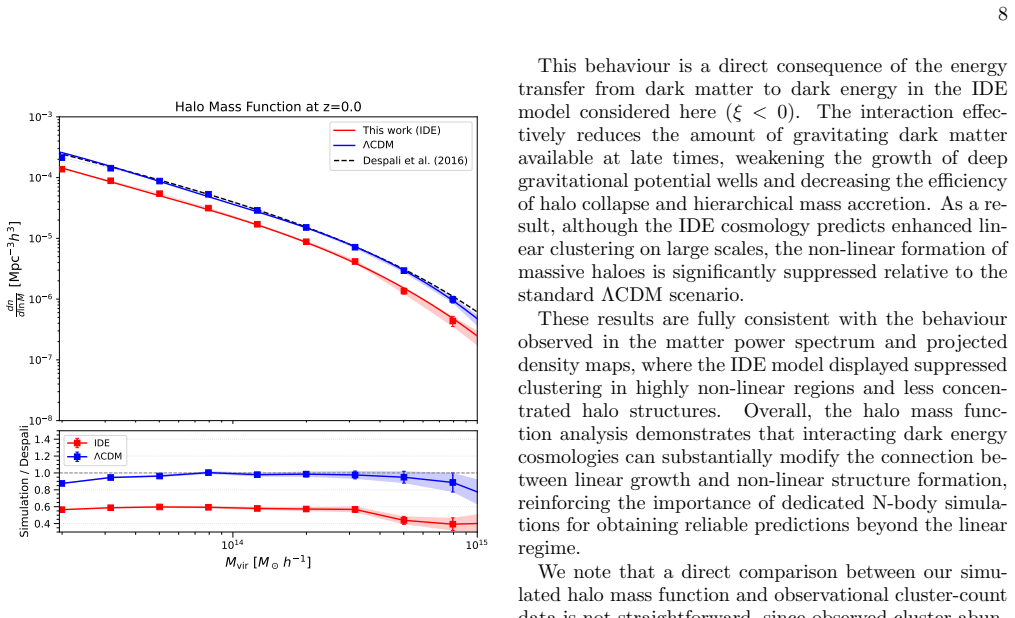
Using a modified RAMSES code, the authors simulate an interacting dark energy model with energy transfer rate Q equal to xi times H times rho_x. Because the dark matter Euler equation stays identical to Lambda-CDM, the interaction is carried only by the altered expansion history and a time-varying dark matter particle mass. The resulting runs show scale-dependent shifts in the quasi-linear and non-linear matter power spectrum, together with altered density-field morphology and halo abundance.
What carries the argument
Modified N-body simulation that incorporates the interaction solely through background evolution and an effective time-dependent dark matter particle mass.
If this is right
- Weak-lensing and large-scale-structure analyses must replace Lambda-CDM non-linear prescriptions with model-specific simulations when testing interacting dark energy.
- The S8 tension implications of these IDE models depend on the non-linear modeling choice.
- Halo abundance and density morphology differ measurably between the IDE runs and standard Lambda-CDM.
- Constraints on the interaction strength xi from future surveys require self-consistent non-linear modeling.
Where Pith is reading between the lines
- The same effective-mass trick might let other background-only extensions be added to existing simulation codes without rewriting the perturbation equations.
- Observers could search for the reported scale-dependent power-spectrum tilt as a direct signature in Euclid or LSST data.
- If the Euler equation assumption fails at higher order, the entire non-linear pipeline would need re-derivation from the perturbed continuity and Euler equations.
Load-bearing premise
The dark matter Euler equation stays exactly the same as in Lambda-CDM.
What would settle it
A measurement of the non-linear matter power spectrum or halo mass function on scales below roughly 10 Mpc/h that either matches or clearly rules out the specific deviations reported from the IDE simulations.
Figures
read the original abstract
Following our previous work constraining interacting dark energy (IDE) models, which showed their potential to alleviate the Hubble tension, in this work we investigate the non-linear effects of the IDE scenario favoured by CMB and DESI observations. The implications of IDE for the $S_8$ tension remain unclear, since current weak-lensing and large-scale-structure analyses either exclude highly non-linear scales or model the non-linear regime using prescriptions calibrated within $\Lambda$CDM. We address this issue by implementing a fully self-consistent IDE pipeline. We perform N-body simulations of the IDE model with a transfer rate $Q=\xi {\cal H}\rho_x$ using a modified implementation of RAMSES. Since the dark matter Euler equation remains unchanged with respect to $\Lambda$CDM, the interaction can be incorporated through the modified background evolution and an effective time-dependent dark matter particle mass. We find scale-dependent deviations in the quasi-linear and non-linear regimes of the matter power spectrum, together with modifications to the density-field morphology and halo abundance. Our results show that the impact of IDE on quasi-linear and non-linear structure formation cannot be captured by standard $\Lambda$CDM-calibrated prescriptions, highlighting the importance of model-consistent non-linear modelling for future weak-lensing and large-scale-structure constraints on interacting dark energy cosmologies.
Editorial analysis
A structured set of objections, weighed in public.
Referee Report
Summary. The paper performs N-body simulations of an interacting dark energy (IDE) model with energy transfer rate Q=ξ ℋ ρ_x, using parameters favored by Planck+DESI data. It implements the model in a modified RAMSES code by asserting that the dark matter Euler equation is identical to ΛCDM, so the interaction enters only through modified background evolution and an effective time-dependent DM particle mass. The central claim is that the resulting scale-dependent deviations in the matter power spectrum, halo abundance, and density-field morphology in the quasi-linear and non-linear regimes cannot be reproduced by standard ΛCDM-calibrated prescriptions, implying that model-consistent non-linear modeling is required for future weak-lensing and LSS constraints on IDE.
Significance. If the simulation pipeline is a faithful realization of the IDE model, the result would demonstrate that ΛCDM emulators are insufficient for IDE cosmologies and would strengthen the case for self-consistent non-linear modeling when using IDE to address the Hubble tension or to interpret S8 measurements. The work builds on the authors' prior parameter constraints and supplies concrete N-body evidence for the breakdown of standard prescriptions.
major comments (1)
- [Abstract / Implementation] Abstract and Implementation section: the claim that 'the dark matter Euler equation remains unchanged with respect to ΛCDM' is load-bearing for the entire simulation setup and for the headline conclusion that deviations are genuinely non-linear and uncaptured by emulators. No derivation is supplied showing that the background-only interaction Q=ξ ℋ ρ_x induces no additional source terms in the DM momentum or velocity equation at the perturbation level; if such terms exist, the RAMSES runs (and therefore the comparison to ΛCDM prescriptions) are incomplete.
minor comments (1)
- [Abstract] Abstract: the summary of results is entirely qualitative; inclusion of at least one quantitative measure (e.g., fractional deviation in P(k) at a specific k and redshift, or change in halo mass function) would strengthen the abstract.
Simulated Author's Rebuttal
We thank the referee for the careful and constructive review. The major comment identifies a key point regarding the justification of the N-body implementation, which we address directly below. We will incorporate the requested clarification to strengthen the manuscript.
read point-by-point responses
-
Referee: [Abstract / Implementation] Abstract and Implementation section: the claim that 'the dark matter Euler equation remains unchanged with respect to ΛCDM' is load-bearing for the entire simulation setup and for the headline conclusion that deviations are genuinely non-linear and uncaptured by emulators. No derivation is supplied showing that the background-only interaction Q=ξ ℋ ρ_x induces no additional source terms in the DM momentum or velocity equation at the perturbation level; if such terms exist, the RAMSES runs (and therefore the comparison to ΛCDM prescriptions) are incomplete.
Authors: We agree that an explicit derivation of the perturbation equations would improve clarity and address the load-bearing nature of this claim. For the specific interaction Q = ξ ℋ ρ_x (with no velocity-dependent momentum transfer term), the linear perturbation equations for cold dark matter yield an unmodified Euler equation identical to ΛCDM; the interaction modifies only the continuity equation, which is equivalent to an effective time-dependent DM particle mass. This is the basis for the RAMSES implementation. We will add a concise derivation of the relevant continuity and Euler equations (following standard IDE perturbation theory) to the Implementation section in the revised manuscript, explicitly showing the absence of additional source terms in the DM momentum equation. This will confirm that the simulations are model-consistent and that the reported scale-dependent deviations are not an artifact of an incomplete implementation. revision: yes
Circularity Check
No significant circularity; simulations yield independent results
full rationale
The paper's derivation consists of running new N-body simulations in a modified RAMSES code for the IDE model with Q=ξ ℋ ρ_x, producing outputs on the matter power spectrum, halo abundance, and density morphology. These computed results are then compared against ΛCDM-calibrated prescriptions, which are external benchmarks. The interaction form and background evolution are referenced from prior work, but the non-linear findings do not reduce to any fitted parameter or self-citation by construction; the Euler-equation assumption is asserted as a modeling choice rather than derived from the paper's own inputs. The pipeline is therefore self-contained against external benchmarks.
Axiom & Free-Parameter Ledger
free parameters (1)
- ξ
axioms (1)
- domain assumption Dark matter Euler equation remains unchanged with respect to ΛCDM
Reference graph
Works this paper leans on
-
[1]
A. G. Riesset al.(Supernova Search Team), Astron. J. 116, 1009 (1998), arXiv:astro-ph/9805201
Pith/arXiv arXiv 1998
-
[2]
Perlmutteret al.(Supernova Cosmology Project), As- trophys
S. Perlmutteret al.(Supernova Cosmology Project), As- trophys. J.517, 565 (1999), arXiv:astro-ph/9812133
Pith/arXiv arXiv 1999
-
[3]
Hinshawet al.(WMAP), Astrophys
G. Hinshawet al.(WMAP), Astrophys. J. Suppl.208, 19 (2013), arXiv:1212.5226 [astro-ph.CO]
Pith/arXiv arXiv 2013
-
[4]
N. Aghanimet al.(Planck), Astron. Astrophys.641, A6 (2020), [Erratum: Astron.Astrophys. 652, C4 (2021)], arXiv:1807.06209 [astro-ph.CO]
Pith/arXiv arXiv 2020
-
[5]
N. Aghanimet al.(Planck), Astron. Astrophys.641, A1 (2020), arXiv:1807.06205 [astro-ph.CO]
Pith/arXiv arXiv 2020
-
[6]
Aiolaet al.(ACT), JCAP12, 047 (2020), arXiv:2007.07288 [astro-ph.CO]
S. Aiolaet al.(ACT), JCAP12, 047 (2020), arXiv:2007.07288 [astro-ph.CO]
arXiv 2020
-
[7]
Louiset al.(Atacama Cosmology Telescope), JCAP 11, 062 (2025), arXiv:2503.14452 [astro-ph.CO]
T. Louiset al.(Atacama Cosmology Telescope), JCAP 11, 062 (2025), arXiv:2503.14452 [astro-ph.CO]
Pith/arXiv arXiv 2025
-
[8]
E. Camphuiset al.(SPT-3G), Phys. Rev. D113, 083504 (2026), arXiv:2506.20707 [astro-ph.CO]
Pith/arXiv arXiv 2026
-
[9]
S. Alamet al.(BOSS), Mon. Not. Roy. Astron. Soc. 470, 2617 (2017), arXiv:1607.03155 [astro-ph.CO]
Pith/arXiv arXiv 2017
-
[10]
K. Lodhaet al.(DESI), Phys. Rev. D112, 083511 (2025), arXiv:2503.14743 [astro-ph.CO]
Pith/arXiv arXiv 2025
-
[11]
A. G. Adameet al.(DESI), JCAP02, 021 (2025), arXiv:2404.03002 [astro-ph.CO]
Pith/arXiv arXiv 2025
-
[12]
L. Verde, T. Treu, and A. G. Riess, Nature Astron.3, 10 891 (2019), arXiv:1907.10625 [astro-ph.CO]
Pith/arXiv arXiv 2019
-
[13]
E. Di Valentinoet al., Astropart. Phys.131, 102605 (2021), arXiv:2008.11284 [astro-ph.CO]
arXiv 2021
-
[14]
E. Di Valentino, O. Mena, S. Pan, L. Visinelli, W. Yang, A. Melchiorri, D. F. Mota, A. G. Riess, and J. Silk, Class. Quant. Grav.38, 153001 (2021), arXiv:2103.01183 [astro-ph.CO]
Pith/arXiv arXiv 2021
-
[15]
L. Perivolaropoulos and F. Skara, New Astron. Rev.95, 101659 (2022), arXiv:2105.05208 [astro-ph.CO]
Pith/arXiv arXiv 2022
-
[16]
C. Heymanset al., Astron. Astrophys.646, A140 (2021), arXiv:2007.15632 [astro-ph.CO]
arXiv 2021
-
[17]
A. H. Wrightet al., Astron. Astrophys.703, A158 (2025), arXiv:2503.19441 [astro-ph.CO]
Pith/arXiv arXiv 2025
-
[18]
T. M. C. Abbottet al.(DES), (2026), arXiv:2601.14559 [astro-ph.CO]
arXiv 2026
-
[19]
I. Pantos and L. Perivolaropoulos, Phys. Dark Univ.52, 102286 (2026), arXiv:2602.12238 [astro-ph.CO]
arXiv 2026
-
[20]
Abdallaet al., JHEAp34, 49 (2022), arXiv:2203.06142 [astro-ph.CO]
E. Abdallaet al., JHEAp34, 49 (2022), arXiv:2203.06142 [astro-ph.CO]
Pith/arXiv arXiv 2022
-
[21]
Di Valentinoet al.(CosmoVerse Network), Phys
E. Di Valentinoet al.(CosmoVerse Network), Phys. Dark Univ.49, 101965 (2025), arXiv:2504.01669 [astro- ph.CO]
Pith/arXiv arXiv 2025
-
[22]
C. Wetterich, Astron. Astrophys.301, 321 (1995), arXiv:hep-th/9408025
Pith/arXiv arXiv 1995
-
[23]
L. Amendola, Phys. Rev. D62, 043511 (2000), arXiv:astro-ph/9908023
Pith/arXiv arXiv 2000
-
[24]
W. Zimdahl and D. Pavon, Phys. Lett. B521, 133 (2001), arXiv:astro-ph/0105479
Pith/arXiv arXiv 2001
-
[25]
G. R. Farrar and P. J. E. Peebles, Astrophys. J.604, 1 (2004), arXiv:astro-ph/0307316
Pith/arXiv arXiv 2004
-
[26]
A. W. Brookfield, C. van de Bruck, and L. M. H. Hall, Phys. Rev. D77, 043006 (2008), arXiv:0709.2297 [astro- ph]
Pith/arXiv arXiv 2008
-
[27]
C. Van De Bruck and J. Mifsud, Phys. Rev. D97, 023506 (2018), arXiv:1709.04882 [astro-ph.CO]
Pith/arXiv arXiv 2018
-
[28]
L. Amendola, Phys. Rev. D60, 043501 (1999), arXiv:astro-ph/9904120
Pith/arXiv arXiv 1999
-
[29]
M. Zumalacarregui, T. S. Koivisto, D. F. Mota, and P. Ruiz-Lapuente, JCAP05, 038 (2010), arXiv:1004.2684 [astro-ph.CO]
Pith/arXiv arXiv 2010
-
[30]
C. van de Bruck and J. Morrice, JCAP04, 036 (2015), arXiv:1501.03073 [gr-qc]
Pith/arXiv arXiv 2015
-
[31]
V. Salvatelli, A. Marchini, L. Lopez-Honorez, and O. Mena, Phys. Rev. D88, 023531 (2013), arXiv:1304.7119 [astro-ph.CO]
Pith/arXiv arXiv 2013
-
[32]
S. Kumar and R. C. Nunes, Phys. Rev. D94, 123511 (2016), arXiv:1608.02454 [astro-ph.CO]
Pith/arXiv arXiv 2016
-
[33]
C. Caprini and N. Tamanini, JCAP10, 006 (2016), arXiv:1607.08755 [astro-ph.CO]
Pith/arXiv arXiv 2016
-
[34]
R. Murgia, S. Gariazzo, and N. Fornengo, JCAP04, 014 (2016), arXiv:1602.01765 [astro-ph.CO]
Pith/arXiv arXiv 2016
-
[35]
X. Zheng, M. Biesiada, S. Cao, J. Qi, and Z.-H. Zhu, JCAP10, 030 (2017), arXiv:1705.06204 [astro-ph.CO]
Pith/arXiv arXiv 2017
-
[36]
S. Kumar and R. C. Nunes, Phys. Rev. D96, 103511 (2017), arXiv:1702.02143 [astro-ph.CO]
Pith/arXiv arXiv 2017
-
[37]
E. Di Valentino, A. Melchiorri, and O. Mena, Phys. Rev. D96, 043503 (2017), arXiv:1704.08342 [astro- ph.CO]
Pith/arXiv arXiv 2017
- [38]
- [39]
-
[40]
On the interacting dark en- ergy scenarios−the case for Hubble constant tension,
S. Pan and W. Yang, “On the interacting dark en- ergy scenarios−the case for Hubble constant tension,” (2023), arXiv:2310.07260 [astro-ph.CO]
arXiv 2023
-
[41]
D. Benisty, S. Pan, D. Staicova, E. Di Valentino, and R. C. Nunes, Astron. Astrophys.688, A156 (2024), arXiv:2403.00056 [astro-ph.CO]
arXiv 2024
-
[42]
W. Yang, E. Di Valentino, O. Mena, S. Pan, and R. C. Nunes, Phys. Rev. D101, 083509 (2020), arXiv:2001.10852 [astro-ph.CO]
arXiv 2020
-
[43]
M. Forconi, W. Giar` e, O. Mena, Ruchika, E. Di Valentino, A. Melchiorri, and R. C. Nunes, JCAP05, 097 (2024), arXiv:2312.11074 [astro-ph.CO]
arXiv 2024
-
[44]
A. Pourtsidou and T. Tram, Phys. Rev. D94, 043518 (2016), arXiv:1604.04222 [astro-ph.CO]
Pith/arXiv arXiv 2016
-
[45]
E. Di Valentino, Mon. Not. Roy. Astron. Soc.502, 2065 (2021), arXiv:2011.00246 [astro-ph.CO]
arXiv 2065
-
[46]
E. Di Valentino and O. Mena, Mon. Not. Roy. Astron. Soc.500, L22 (2020), arXiv:2009.12620 [astro-ph.CO]
arXiv 2020
-
[47]
R. C. Nunes and E. Di Valentino, Phys. Rev. D104, 063529 (2021), arXiv:2107.09151 [astro-ph.CO]
arXiv 2021
-
[48]
W. Yang, A. Mukherjee, E. Di Valentino, and S. Pan, Phys. Rev. D98, 123527 (2018), arXiv:1809.06883 [astro-ph.CO]
Pith/arXiv arXiv 2018
-
[49]
J. Zhang, R. An, W. Luo, Z. Li, S. Liao, and B. Wang, Astrophys. J. Lett.875, L11 (2019), arXiv:1807.05522 [astro-ph.CO]
Pith/arXiv arXiv 2019
-
[50]
R. von Marttens, L. Lombriser, M. Kunz, V. Marra, L. Casarini, and J. Alcaniz, Phys. Dark Univ.28, 100490 (2020), arXiv:1911.02618 [astro-ph.CO]
arXiv 2020
-
[51]
M. Lucca and D. C. Hooper, Phys. Rev. D102, 123502 (2020), arXiv:2002.06127 [astro-ph.CO]
arXiv 2020
-
[52]
L. Xiao, A. A. Costa, and B. Wang, Mon. Not. Roy. Astron. Soc.510, 1495 (2021), arXiv:2103.01796 [astro- ph.CO]
arXiv 2021
-
[53]
B. Wang, E. Abdalla, F. Atrio-Barandela, and D. Pav´ on, Rept. Prog. Phys.87, 036901 (2024), arXiv:2402.00819 [astro-ph.CO]
arXiv 2024
- [54]
-
[55]
Y. Zhai, W. Giar` e, C. van de Bruck, E. Di Valentino, O. Mena, and R. C. Nunes, JCAP07, 032 (2023), arXiv:2303.08201 [astro-ph.CO]
arXiv 2023
-
[56]
A. Joseph and R. Saha, Mon. Not. Roy. Astron. Soc. 519, 1809 (2022), arXiv:2209.07167 [astro-ph.CO]
arXiv 2022
- [57]
- [58]
-
[59]
G. A. Hoerning, R. G. Landim, L. O. Ponte, R. P. Rolim, F. B. Abdalla, and E. Abdalla, Phys. Rev. D 112, 023523 (2025), arXiv:2308.05807 [astro-ph.CO]
arXiv 2025
-
[60]
W. Giar` e, Y. Zhai, S. Pan, E. Di Valentino, R. C. Nunes, and C. van de Bruck, Phys. Rev. D110, 063527 (2024), arXiv:2404.02110 [astro-ph.CO]
arXiv 2024
-
[61]
U. Mukhopadhyay, D. Majumdar, and K. K. Datta, Phys. Rev. D103, 063510 (2021), arXiv:2008.09972 [astro-ph.CO]
arXiv 2021
-
[62]
L. A. Escamilla, O. Akarsu, E. Di Valentino, and J. A. Vazquez, JCAP11, 051 (2023), arXiv:2305.16290 [astro-ph.CO]
arXiv 2023
-
[63]
M. A. van der Westhuizen and A. Abebe, JCAP01, 048 (2024), arXiv:2302.11949 [gr-qc]
arXiv 2024
- [64]
-
[65]
E. Di Valentino, A. Melchiorri, O. Mena, and S. Vagnozzi, Phys. Dark Univ.30, 100666 (2020), arXiv:1908.04281 [astro-ph.CO]
arXiv 2020
-
[66]
Y. Zhao, Y. Liu, S. Liao, J. Zhang, X. Liu, and W. Du, Mon. Not. Roy. Astron. Soc.523, 5962 (2023), arXiv:2212.02050 [astro-ph.CO]
arXiv 2023
- [67]
-
[68]
N. N. Pooya, Phys. Rev. D110, 043510 (2024), arXiv:2407.03766 [astro-ph.CO]
arXiv 2024
- [69]
-
[70]
S. Castello, M. Mancarella, N. Grimm, D. Sobral- Blanco, I. Tutusaus, and C. Bonvin, JCAP05, 003 (2024), arXiv:2311.14425 [astro-ph.CO]
arXiv 2024
-
[71]
Y.-H. Yao and X.-H. Meng, Phys. Dark Univ.39, 101165 (2023), arXiv:2207.05955 [astro-ph.CO]
arXiv 2023
-
[72]
K. R. Mishra, S. K. J. Pacif, R. Kumar, and K. Bamba, Phys. Dark Univ.40, 101211 (2023), arXiv:2301.08743 [gr-qc]
arXiv 2023
-
[73]
R. C. Nunes, S. Pan, and E. N. Saridakis, Phys. Rev. D94, 023508 (2016), arXiv:1605.01712 [astro-ph.CO]
Pith/arXiv arXiv 2016
- [74]
-
[75]
W. Yang, S. Zhang, O. Mena, S. Pan, and E. Di Valentino, (2025), arXiv:2508.19109 [astro- ph.CO]
arXiv 2025
-
[76]
M. van der Westhuizen, A. Abebe, and E. Di Valentino, Phys. Dark Univ.50, 102121 (2025), arXiv:2509.04496 [gr-qc]
arXiv 2025
-
[77]
Y.-M. Zhang, T.-N. Li, G.-H. Du, S.-H. Zhou, L.- Y. Gao, J.-F. Zhang, and X. Zhang, (2025), arXiv:2510.12627 [astro-ph.CO]
Pith/arXiv arXiv 2025
- [78]
- [79]
-
[80]
T.-N. Li, W. Giar` e, G.-H. Du, Y.-H. Li, E. Di Valentino, J.-F. Zhang, and X. Zhang, (2026), arXiv:2601.07361 [astro-ph.CO]
arXiv 2026
discussion (0)
Sign in with ORCID, Apple, or X to comment. Anyone can read and Pith papers without signing in.