Numerical Simulations of Hypervelocity Micrometeoroid Impacts: Rocky Impactors onto Icy Targets and the Role of Porosity
Pith reviewed 2026-06-27 11:22 UTC · model grok-4.3
The pith
Rocky micrometeoroids striking icy targets at 30 km/s are efficiently vaporized regardless of porosity.
A machine-rendered reading of the paper's core claim, the machinery that carries it, and where it could break.
Core claim
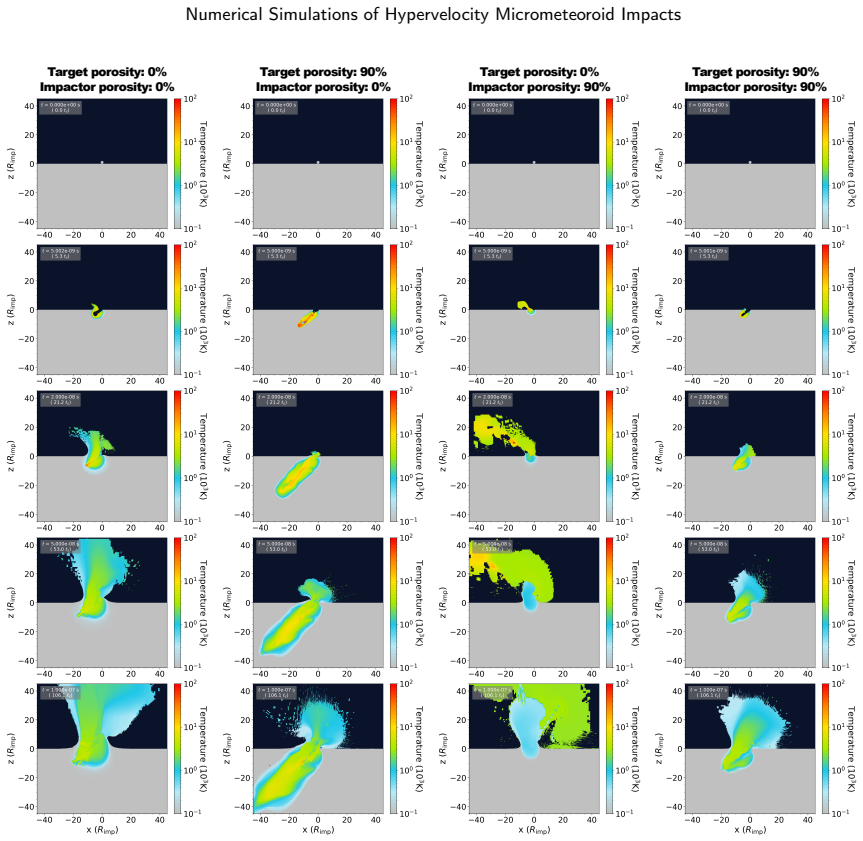
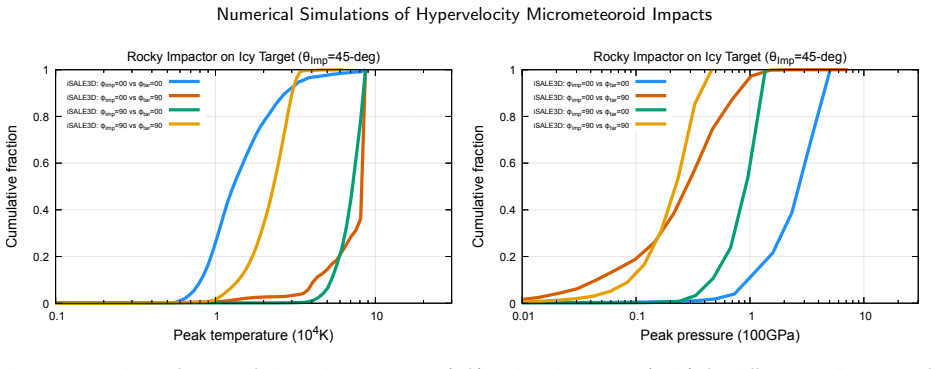
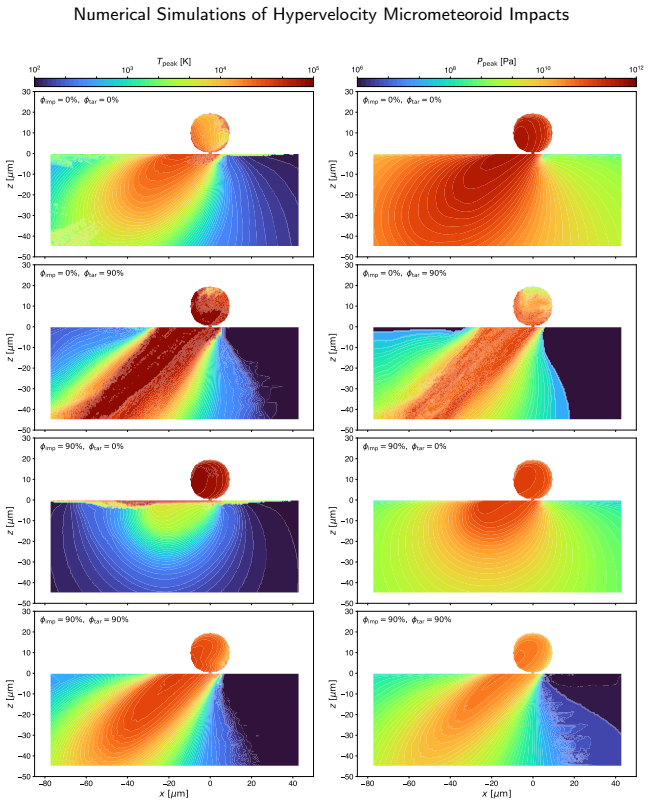
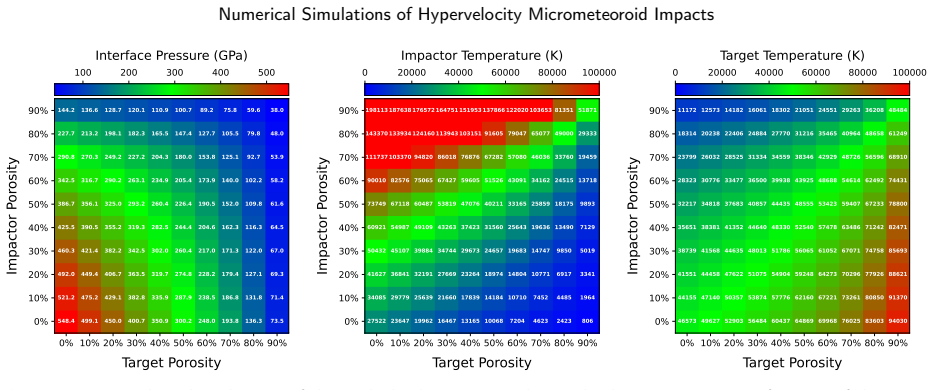
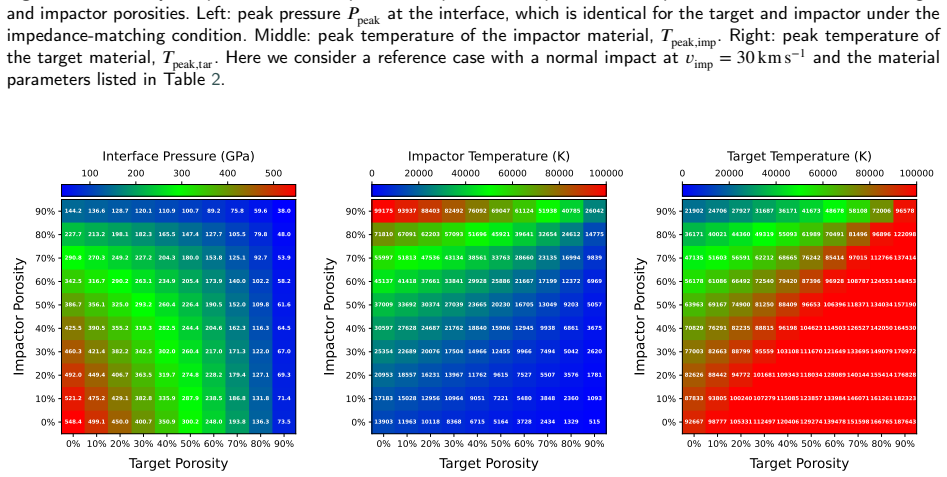
At an impact velocity of 30 km/s, the impactor material is strongly heated and is efficiently vaporized regardless of the porosities of the impactor and target. However, the peak pressure and peak temperature experienced by the impactor vary by nearly an order of magnitude.
What carries the argument
Three-dimensional iSALE hydrocode simulations that follow the thermodynamic states of the rocky impactor for end-member porosity pairs (0% and 90%) at 45-degree impact angle.
If this is right
- Early crater shapes shift from deep narrow channels when the target is porous to shallow vapor-driven blowoff when the impactor is porous.
- The vaporized impactor material can follow different condensation and chemical pathways depending on the porosity-controlled peak conditions.
- Exogenic non-icy material delivered to icy surfaces is fully vaporized at Saturn-ring speeds.
- The same vaporization outcome holds across a range of planetary systems that experience comparable hypervelocity impacts.
Where Pith is reading between the lines
- Porosity-dependent peak conditions could produce measurable differences in the final surface composition or mixing depth of delivered material.
- Models of long-term ring or satellite surface evolution may need separate treatment of vapor states for high- versus low-porosity cases.
- Lower-speed experiments could check whether the efficient vaporization result persists below 30 km/s.
Load-bearing premise
The material models inside the simulation code correctly reproduce the real heating, vaporization, and pressure evolution of porous rock and ice under these impact speeds.
What would settle it
A laboratory experiment or in-situ measurement showing that the impactor material remains mostly solid or that peak temperatures stay within a narrow range across the same porosity combinations.
Figures
read the original abstract
In the outer Solar System, for example in the Saturnian system, a planet's strong gravity attracts micrometeoroids and generates hypervelocity impacts on bodies such as rings and satellites. Micrometeoroids are seemingly non-icy, whereas the targets are typically icy, and both the impactor and the target may span a wide range of porosities. In this study, we perform three-dimensional iSALE simulations of hypervelocity impacts of rocky impactors onto icy targets, varying the impact angle and the porosities of the impactor and target ($\phi_{\rm imp}$ and $\phi_{\rm tar}$). We consider two end-member porosities (0% and 90%) for oblique ($45^\circ$) impacts. At an impact velocity of 30 km/s, characteristic of Saturn's rings, we find that the morphology of early-stage crater formation varies significantly with porosity, transitioning from deep-penetration, narrow-channel cavities ($\phi_{\rm imp}=0$, $\phi_{\rm tar}=90%$) to very shallow craters driven by near-surface vapor blowoff ($\phi_{\rm imp}=90%$, $\phi_{\rm tar}=0%$), with intermediate, more hemispherical cavity shapes when the porosities are comparable. Here, we focus on the thermodynamic fate of the impactor, which represents the exogenic material responsible for modifying the target surface. The impactor material is strongly heated and is efficiently vaporized regardless of the porosities of the impactor and target. However, the peak pressure and peak temperature experienced by the impactor vary by nearly an order of magnitude. These results imply that hypervelocity impacts occurring, for example, in Saturn's rings efficiently vaporize exogenic non-icy impactors upon impact, while the subsequent thermodynamic pathways $-$ such as condensation and chemical evolution $-$ may differ depending on the thermodynamic conditions. Our results are expected to be applicable to a variety of planetary systems.
Editorial analysis
A structured set of objections, weighed in public.
Referee Report
Summary. The manuscript presents three-dimensional iSALE hydrocode simulations of 30 km/s hypervelocity impacts of rocky micrometeoroids onto icy targets at 45° incidence, varying impactor and target porosities between the end-member values of 0% and 90%. The central claims are that crater morphology depends strongly on the porosity combination (narrow deep channels for low-impactor/high-target porosity; shallow vapor-driven craters for the reverse) while the impactor material is nevertheless strongly heated and efficiently vaporized in all cases, although peak pressures and temperatures experienced by the impactor differ by nearly an order of magnitude.
Significance. If the numerical results hold, the work would demonstrate that exogenic rocky material delivered to icy surfaces in the outer Solar System (e.g., Saturn’s rings) is efficiently vaporized upon impact, with the subsequent condensation and chemical pathways potentially sensitive to the porosity-dependent thermodynamic histories. The explicit exploration of porosity end-members and the focus on the thermodynamic fate of the impactor rather than only morphology constitute a useful addition to the literature on micrometeoroid processing.
major comments (2)
- [Abstract / Methods] Abstract and Methods: the assertion that the impactor is 'efficiently vaporized regardless of the porosities' is load-bearing for the central claim yet is presented without quantitative vaporized mass fractions, time-integrated vapor fractions, or direct comparison to impedance-match calculations. The reported order-of-magnitude spread in peak pressure and temperature already indicates strong sensitivity; without explicit metrics it is unclear whether vaporization remains 'efficient' in all four porosity combinations.
- [Methods] Methods: no grid-resolution study, convergence tests, or validation of the chosen porosity-compaction model (ε-α or equivalent) and ANEOS-style EOS against 30 km/s porous rock-ice experiments or analytic solutions is described. Because the thermodynamic partitioning into heating and phase change is the least secure link, these omissions directly affect in the vaporization conclusion.
minor comments (2)
- [Abstract] The abstract would be strengthened by inclusion of at least one quantitative vaporization metric (e.g., percentage of impactor mass above the vapor dome at late times) for each porosity case.
- [Figures / Methods] Figure captions and text should explicitly state the spatial resolution (cells per impactor radius) and the porosity-compaction parameters employed.
Simulated Author's Rebuttal
We thank the referee for their constructive comments and for recognizing the potential significance of our porosity end-member study. We address each major comment below and will revise the manuscript to strengthen the presentation of the vaporization results.
read point-by-point responses
-
Referee: [Abstract / Methods] Abstract and Methods: the assertion that the impactor is 'efficiently vaporized regardless of the porosities' is load-bearing for the central claim yet is presented without quantitative vaporized mass fractions, time-integrated vapor fractions, or direct comparison to impedance-match calculations. The reported order-of-magnitude spread in peak pressure and temperature already indicates strong sensitivity; without explicit metrics it is unclear whether vaporization remains 'efficient' in all four porosity combinations.
Authors: We agree that explicit quantitative metrics would make the central claim more robust. In the revised manuscript we will add the mass fraction of impactor material exceeding the vaporization threshold (defined via the ANEOS tables) for each of the four porosity combinations, together with time-integrated vapor fractions extracted from the tracer particles. We will also include a direct comparison to one-dimensional impedance-match calculations for the non-porous end-member cases to contextualize the three-dimensional results. Although peak pressures and temperatures vary by nearly an order of magnitude, the simulations show that even the lowest values still drive the majority of the rocky impactor above the vaporization curve. revision: yes
-
Referee: [Methods] Methods: no grid-resolution study, convergence tests, or validation of the chosen porosity-compaction model (ε-α or equivalent) and ANEOS-style EOS against 30 km/s porous rock-ice experiments or analytic solutions is described. Because the thermodynamic partitioning into heating and phase change is the least secure link, these omissions directly affect in the vaporization conclusion.
Authors: We will add a dedicated grid-resolution and convergence study to the Methods section, demonstrating that the reported vaporization fractions are insensitive to further refinement at the resolutions used. The ε-α compaction model is the standard iSALE implementation and has been validated against a range of laboratory data in the cited literature; we will expand the Methods text with those references. Direct 30 km/s porous rock-ice experiments do not exist in the published record, but we will add analytic impedance-match comparisons for the non-porous cases and a brief discussion of the ANEOS applicability limits at these velocities. revision: yes
Circularity Check
No significant circularity: forward simulation outputs with no reduction to inputs
full rationale
The paper reports direct results from 3D iSALE hydrocode runs at fixed 30 km/s velocity, with porosity as an explicit input parameter varied across end-member cases. Thermodynamic outcomes (heating, vaporization fractions, peak P/T) are computed quantities, not fitted parameters renamed as predictions, nor derived via self-citation chains or ansatzes smuggled from prior author work. No equations or claims reduce by construction to the simulation setup itself; the central statements follow from the numerical integration under the chosen EOS and compaction models. This is the expected non-circular outcome for a pure forward-modeling study.
Axiom & Free-Parameter Ledger
free parameters (2)
- porosity values =
0% and 90%
- impact velocity =
30 km/s
axioms (1)
- domain assumption iSALE hydrocode and associated material models correctly simulate the physics of hypervelocity impacts between porous rocky and icy materials
Reference graph
Works this paper leans on
-
[1]
JournalofGeophysicalResearch(Planets)124,1044–1083
Space Weathering Induced Via MicroparticleImpacts:1.ModelingofImpactVelocitiesandFluxofMicrometeoroidsFromCometary,Asteroidal,andInterstellarOrigininthe MainAsteroidBeltandtheNear-EarthEnvironment. JournalofGeophysicalResearch(Planets)124,1044–1083. doi:10.1029/2018JE005563. Babadzhanov, P.B., Kokhirova, G.I.,
-
[2]
Densities and porosities of meteoroids. A&A 495, 353–358. doi:10.1051/0004-6361:200810460. Benz,W.,Cameron,A.G.W.,Melosh,H.J.,1989. TheoriginoftheMoonandthesingle-impacthypothesisIII. Icarus81,113–131. doi:10.1016/ 0019-1035(89)90129-2. Blum, J.,
-
[3]
Advances in Physics 55, 881–947
Dust agglomeration. Advances in Physics 55, 881–947. doi:10.1080/00018730601095039. Blum, J., Bischoff, D., Gundlach, B.,
-
[4]
doi:10.3390/universe8070381,arXiv:2207.12731. Blum, J., Wurm, G.,
-
[5]
The growth mechanisms of macroscopic bodies in protoplanetary disks. Annu. Rev. Astron. Astrophys. 46, 21–56. doi:10.1146/annurev.astro.46.060407.145152. Bray, V.J., Collins, G.S., Morgan, J.V., Melosh, H.J., Schenk, P.M.,
-
[6]
doi:10.1016/j.icarus.2013.12.009
Hydrocode simulation of Ganymede and Europa cratering trends - How thick is Europa’s crust? Icarus 231, 394–406. doi:10.1016/j.icarus.2013.12.009. Brownlee, D., Tsou, P., Aléon, J., Alexander, C.M.O.D., Araki, T., Bajt, S., Baratta, G.A., Bastien, R., Bland, P., Bleuet, P., Borg, J., Bradley, J.P., Brearley,A.,Brenker,F.,Brennan,S.,Bridges,J.C.,Browning,N...
-
[7]
doi:10.1126/science.1135840. Carroll, M.M., Holt, A.C.,
-
[8]
Journal of Applied Physics 43, 1626–1636
Static and Dynamic Pore-Collapse Relations for Ductile Porous Materials. Journal of Applied Physics 43, 1626–1636. doi:10.1063/1.1661372. Collins,G.,Melosh,H.,Wünnemann,K.,2011. Improvementstothe𝜖-𝛼porouscompactionmodelforsimulatingimpactsintohigh-porositysolar system objects. International Journal of Impact Engineering 38, 434–439. URL:https://www.scienc...
-
[9]
Springer International Publishing, Cham
Planetary Impact Processes in Porous Materials. Springer International Publishing, Cham. pp. 103–136. URL:https://doi.org/10.1007/978-3-030-23002-9_4, doi:10.1007/978-3-030-23002-9_4. Collins, G.S., Melosh, H.J., Ivanov, B.A.,
-
[10]
Meteoritics & Planetary Science 39, 217–231
Modeling damage and deformation in impact simula- tions. Meteoritics & Planetary Science 39, 217–231. URL:https://onlinelibrary.wiley.com/doi/ abs/10.1111/j.1945-5100.2004.tb00337.x, doi:https://doi.org/10.1111/j.1945-5100.2004.tb00337.x, arXiv:https://onlinelibrary.wiley.com/doi/pdf/10.1111/j.1945-5100.2004.tb00337.x. Davison, T.M., Collins, G.S., Ciesla, F.J.,
-
[11]
Numerical modelling of heating in porous planetesimal collisions. Icarus 208, 468–481. doi:10.1016/j.icarus.2010.01.034. Davison, T.M., Collins, G.S., Elbeshausen, D., Wünnemann, K., Kearsley, A.,
-
[12]
Meteoritics & Planetary Science 46, 1510–1524
Numerical modeling of oblique hypervelocity impacts on strong ductile targets. Meteoritics & Planetary Science 46, 1510–1524. doi:10.1111/j.1945-5100.2011.01246.x. Elbeshausen,D.,Wünnemann,K.,2011. isale-3d:Athree-dimensional,multi-material,multi-rheologyhydrocodeanditsapplicationstolarge-scale geodynamic processes, in: Proceedings of 11th Hypervelocity I...
-
[13]
Scaling of oblique impacts in frictional targets: Implications for crater size and formation mechanisms. Icarus 204, 716–731. doi:10.1016/j.icarus.2009.07.018. Flynn, G.J., Moore, L.B., Klöck, W.,
-
[14]
Density and Porosity of Stone Meteorites: Implications for the Density, Porosity, Cratering, and Collisional Disruption of Asteroids. Icarus 142, 97–105. doi:10.1006/icar.1999.6210. Genge, M.J., Engrand, C., Gounelle, M., Taylor, S.,
-
[15]
Meteoritics & Planetary Science 43, 497–515
The classification of micrometeorites. Meteoritics & Planetary Science 43, 497–515. doi:10.1111/j.1945-5100.2008.tb00668.x. Güttler, C., Mannel, T., Rotundi, A., Merouane, S., Fulle, M., Bockelée-Morvan, D., Lasue, J., Levasseur-Regourd, A.C., Blum, J., Naletto, G., Sierks, H., Hilchenbach, M., Tubiana, C., Capaccioni, F., Paquette, J.A., Flandes, A., Mor...
-
[16]
Synthesis of the morphological description of cometary dust at comet 67P/Churyumov-Gerasimenko. A&A 630, A24. doi:10.1051/0004-6361/201834751,arXiv:1902.10634. Hirt,C.W.,Amsden,A.A.,Cook,J.L.,1974. AnArbitraryLagrangian-EulerianComputingMethodforAllFlowSpeeds. JournalofComputational Physics 14, 227–253. doi:10.1016/0021-9991(74)90051-5. R.Hyodo et al.:Pre...
-
[17]
doi:10.3847/1538-4357/ab9897,arXiv:2006.00732. Hyodo, R., Genda, H.,
-
[18]
Abeysekara, et al., Measurement of the Crab Nebula Spectrum Past 100 TeV with HAWC, Astrophys
doi:10.3847/1538-4357/ abf6d8,arXiv:2104.04981. Hyodo, R., Genda, H., Brasser, R.,
-
[19]
Modification of the composition and density of Mercury from late accretion. Icarus 354, 114064. doi:10.1016/j.icarus.2020.114064,arXiv:2008.08490. Hyodo, R., Genda, H., Madeira, G.,
-
[20]
Pollution resistance of saturn’s ring particles during micrometeoroid impact. Nature Geoscience 18, 44–49. doi:10.1038/s41561-024-01598-9. Ivanov,B.,Deniem,D.,Neukum,G.,1997. Implementationofdynamicstrengthmodelsinto2dhydrocodes:Applicationsforatmosphericbreakup and impact cratering. International Journal of Impact Engineering 20, 411–430. URL:https://www...
-
[21]
Micrometeoroid infall onto saturn’s rings constrains their age to nomorethanafewhundredmillionyears. ScienceAdvances9,eadf8537. URL:https://www.science.org/doi/abs/10.1126/sciadv. adf8537, doi:10.1126/sciadv.adf8537,arXiv:https://www.science.org/doi/pdf/10.1126/sciadv.adf8537. Kraus, R.G., Senft, L.E., Stewart, S.T.,
-
[22]
Effects of friction and plastic deformation in shock-comminuted damaged rocks on impact heating
Impacts onto h2o ice: Scaling laws for melting, vaporization, excavation, and final crater size. Icarus214,724–738. URL:https://www.sciencedirect.com/science/article/pii/S0019103511001898,doi:https://doi.org/ 10.1016/j.icarus.2011.05.016. Kurosawa,K.,Genda,H.,2018. EffectsofFrictionandPlasticDeformationinShock-ComminutedDamagedRocksonImpactHeating. Geophy...
work page internal anchor Pith review Pith/arXiv arXiv doi:10.1016/j.icarus.2011.05.016 2011
-
[23]
Luo, X.Z., Zhu, M.H., Ding, M.,
doi:10.1007/s11214-018-0496-3. Luo, X.Z., Zhu, M.H., Ding, M.,
-
[24]
Journal of Geophysical Research (Planets) 127, e2022JE007333
Ejecta Pattern of Oblique Impacts on the Moon From Numerical Simulations. Journal of Geophysical Research (Planets) 127, e2022JE007333. doi:10.1029/2022JE007333. Luther, R., Artemieva, N., Ivanova, M., Lorenz, C., Wünnemann, K.,
-
[25]
Meteoritics & Planetary Science 52, 979–999
Snow carrots after the Chelyabinsk event and model implications for highly porous solar system objects. Meteoritics & Planetary Science 52, 979–999. doi:10.1111/maps.12831. Manske, L., Wünnemann, K., Kurosawa, K.,
-
[26]
Journal of Geophysical Research (Planets) 127, e2022JE007426
Quantification of Impact-Induced Melt Production in Numerical Modeling Revisited. Journal of Geophysical Research (Planets) 127, e2022JE007426. doi:10.1029/2022JE007426. Melosh, H.J.,
-
[27]
Impact ejection, spallation, and the origin of meteorites. Icarus 59, 234–260. doi:10.1016/0019-1035(84)90026-5. MELOSH,H.J.,2007. Ahydrocodeequationofstateforsio2. Meteoritics&PlanetaryScience42,2079–2098. URL:https://onlinelibrary. wiley.com/doi/abs/10.1111/j.1945-5100.2007.tb01009.x, doi:https://doi.org/10.1111/j.1945-5100.2007.tb01009.x, arXiv:https:/...
-
[28]
Journal of Geophysical Research: Planets 97, 14735–14759
Dynamic fragmentation in impacts: Hydrocode simulation of laboratory impacts. Journal of Geophysical Research: Planets 97, 14735–14759. URL:https:// agupubs.onlinelibrary.wiley.com/doi/abs/10.1029/92JE01632, doi:https://doi.org/10.1029/92JE01632, arXiv:https://agupubs.onlinelibrary.wiley.com/doi/pdf/10.1029/92JE01632. Okamoto, T., Nakamura, A.M., Hasegawa...
-
[29]
Impact experiments of exotic dust grain capture by highly porous primitive bodies. Icarus 224, 209–217. doi:10.1016/j.icarus.2013.02.023. Pierazzo, E., Vickery, A., Melosh, H.,
-
[30]
A reevaluation of impact melt production. Icarus 127, 408–423. URL:https://www. sciencedirect.com/science/article/pii/S0019103597957134, doi:https://doi.org/10.1006/icar.1997.5713. Pokorný, P., Sarantos, M., Janches, D.,
-
[31]
Reconciling the Dawn-Dusk Asymmetry in Mercury’s Exosphere with the Micrometeoroid Impact Directionality. The Astrophysical Journal Letters 842, L17. doi:10.3847/2041-8213/aa775d,arXiv:1706.01461. Senft, L.E., Stewart, S.T.,
work page internal anchor Pith review Pith/arXiv arXiv doi:10.3847/2041-8213/aa775d 2041
-
[32]
Meteoritics & Planetary Science 43, 497–515
Impact crater formation in icy layered terrains on Mars. Meteoritics and Planetary Science 43, 1993–2013. doi:10.1111/j.1945-5100.2008.tb00657.x. Silber, E.A., Johnson, B.C.,
-
[33]
Impact crater morphology and the structure of Europa's ice shell
Impact Crater Morphology and the Structure of Europa’s Ice Shell. Journal of Geophysical Research (Planets) 122, 2685–2701. doi:10.1002/2017JE005456,arXiv:1711.08997. Stewart, S.T., Ahrens, T.J.,
work page internal anchor Pith review Pith/arXiv arXiv doi:10.1002/2017je005456
-
[34]
URL:https://agupubs. onlinelibrary.wiley.com/doi/abs/10.1029/2008GL035947, doi:https://doi.org/10.1029/2008GL035947, arXiv:https://agupubs.onlinelibrary.wiley.com/doi/pdf/10.1029/2008GL035947. Svetsov, V.V., Shuvalov, V.V.,
-
[35]
Planetary and Space Science 117, 444–452
Water delivery to the Moon by asteroidal and cometary impacts. Planetary and Space Science 117, 444–452. doi:10.1016/j.pss.2015.09.011. Thompson, S.L., Lauson, H.S.,
-
[36]
Geophysical Research Letters 46, 13,678–13,686
Enhancement of Impact Heating in Pressure-Strengthened Rocks in Oblique Impacts. Geophysical Research Letters 46, 13,678–13,686. doi:10.1029/2019GL085174,arXiv:1912.00371. Wakita, S., Genda, H., Kurosawa, K., Davison, T.M., Johnson, B.C.,
-
[37]
Journal of Geophysical Research (Planets) 127, e07266
Effect of Impact Velocity and Angle on Deformational Heating and Postimpact Temperature. Journal of Geophysical Research (Planets) 127, e07266. doi:10.1029/2022JE007266,arXiv:2208.07630. Wakita, S., Johnson, B.C., Denton, C.A., Davison, T.M.,
-
[38]
Jetting during oblique impacts of spherical impactors. Icarus 360, 114365. doi:10.1016/j.icarus.2021.114365,arXiv:2102.02303. Wakita, S., Matsumoto, Y., Oshino, S., Hasegawa, Y.,
-
[39]
Planetesimal collisions as a chondrule forming event
doi:10.3847/1538-4357/834/2/125,arXiv:1611.05511. Wünnemann, K., Collins, G., Melosh, H.,
work page internal anchor Pith review Pith/arXiv arXiv doi:10.3847/1538-4357/834/2/125
-
[40]
A strain-based porosity model for use in hydrocode simulations of impacts and implications for transient crater growth in porous targets. Icarus 180, 514–527. URL:https://www.sciencedirect.com/science/article/pii/ S0019103505004124, doi:https://doi.org/10.1016/j.icarus.2005.10.013. Zhang, Z., Hayes, A.G., Janssen, M.A., Nicholson, P.D., Cuzzi, J.N., de Pa...
-
[41]
Exposure age of Saturn’s A and B rings, and the Cassini Division as suggested by their non-icy material content. Icarus 294, 14–42. doi:10.1016/j.icarus.2017.04.008. R.Hyodo et al.:Preprint submitted to ElsevierPage 21 of 21
discussion (0)
Sign in with ORCID, Apple, or X to comment. Anyone can read and Pith papers without signing in.