Background-Pressure Effects on Charge-Exchange Measurements in Plasma Flows at Elevated Pressures
Pith reviewed 2026-06-27 11:11 UTC · model grok-4.3
The pith
A quasi-2D model that includes charge exchange and plume divergence describes fast-ion attenuation in elevated-pressure plasma plumes more accurately than a one-dimensional law.
A machine-rendered reading of the paper's core claim, the machinery that carries it, and where it could break.
Core claim
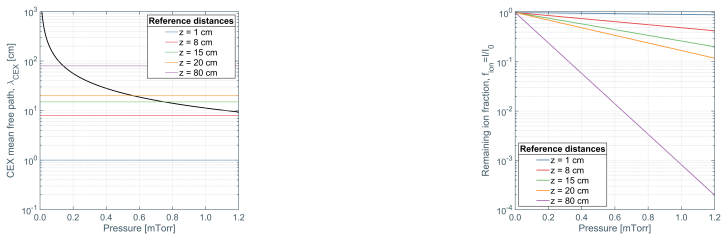
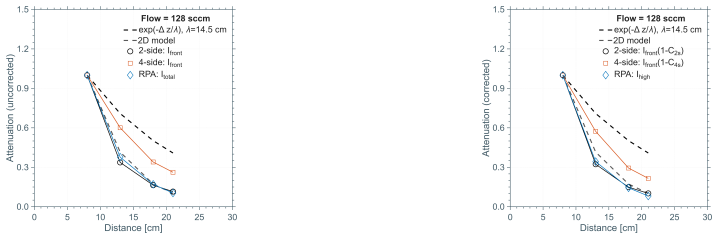
After the fast-ion component is isolated, its attenuation is described more accurately by an analytical reduced semi-empirical quasi-2D model that includes charge exchange and the experimentally observed plume divergence than by a one-dimensional attenuation law; the inferred fast-neutral flux increases with pressure but deviates from the model at small axial distances and at elevated pressure and larger distances, indicating additional angular and collisional effects plus possible fast-neutral production near or inside the source.
What carries the argument
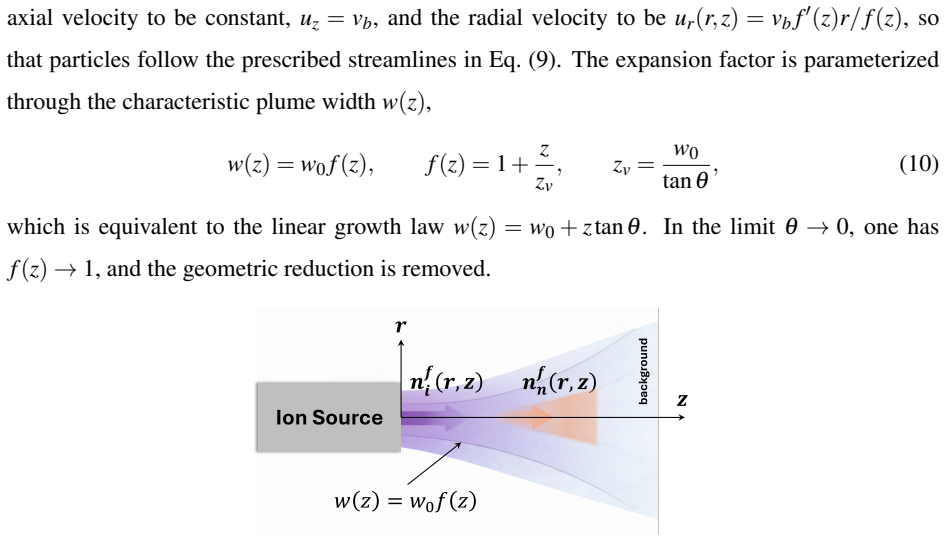
Analytical reduced semi-empirical quasi-2D model incorporating charge exchange and plume divergence, applied after isolating the fast-ion component from RPA and probe data.
If this is right
- Low-energy ion flux increases with both background gas pressure and axial distance.
- Detection of low-energy ions depends on probe geometry.
- Inferred fast-neutral flux increases with pressure.
- Complementary electrostatic, thermal, and energy-selective diagnostics are required to distinguish source behavior from facility-induced effects.
Where Pith is reading between the lines
- The observed model discrepancies at small distances suggest fast-neutral production mechanisms inside the ion source that could be tested by varying source operating conditions.
- Accounting for angular scattering in addition to divergence might reduce overprediction at larger distances and higher pressures.
- Similar pressure-dependent attenuation effects are likely to appear in other neutralized ion flows whenever mean free path approaches facility scale.
- Facility design for accurate plume characterization may require either lower operating pressures or explicit corrections derived from the quasi-2D approach.
Load-bearing premise
The power-balance analysis performed on the thermal flux probe measurements accurately infers the fast-neutral flux without unaccounted contributions from other heat sources, probe surface effects, or facility-induced particles.
What would settle it
Direct comparison of fast-neutral flux measured by an independent technique such as time-of-flight or secondary-electron emission against the power-balance values at multiple background pressures and axial distances.
Figures





read the original abstract
Charge-exchange (CEX) collisions can affect measurements of plasma plumes and neutralized ion flows in vacuum facilities, particularly when the background gas pressure increases and the CEX mean free path becomes comparable to the characteristic plume or facility dimension. Here, we investigate that regime in the plasma plume of a gridded ion source operating with a 400 eV argon ion beam. The fast-ion flux and low-energy ion flux were measured using a retarding potential analyzer (RPA) and planar probes, while the fast-neutral flux was inferred from deposited-power measurements with a thermal flux probe using a power-balance analysis. The low-energy ion flux increases with both background gas pressure and axial distance and its detection also depends on probe geometry. After the fast-ion component is isolated, its attenuation is described more accurately by an analytical reduced semi-empirical quasi-2D model that includes charge exchange and the experimentally observed plume divergence than by a one-dimensional attenuation law. The inferred fast-neutral flux also increases with pressure; however, the model underpredicts it at small axial distance and overpredicts it at elevated pressure and larger axial distance. This discrepancy suggests additional angular and collisional effects, as well as possible fast-neutral production near or inside the ion source, that are not captured by the present model. These results show that background gas pressure affects both the plasma plume and the diagnostic response, and that complementary electrostatic, thermal, and energy-selective diagnostics are required to distinguish source behavior from facility-induced effects.
Editorial analysis
A structured set of objections, weighed in public.
Referee Report
Summary. The paper studies charge-exchange effects in the plume of a 400 eV argon gridded ion source at elevated background pressures. Fast-ion flux is measured with an RPA, low-energy ions with planar probes, and fast-neutral flux is inferred via power-balance on a thermal flux probe. After isolating the fast-ion component, its attenuation is reported to be better captured by an analytical reduced semi-empirical quasi-2D model (CEX plus observed plume divergence) than by a 1D attenuation law. The inferred fast-neutral flux rises with pressure, but the same model underpredicts it at small axial distance and overpredicts it at higher pressure and larger distance; the authors attribute the mismatch to additional angular/collisional effects and possible fast-neutral production near the source.
Significance. If the reported superiority of the quasi-2D model for fast-ion attenuation holds after the noted discrepancies are resolved, the work would provide a practical, experimentally anchored correction for CEX in vacuum-facility testing of plasma devices. The use of complementary RPA, planar-probe, and thermal diagnostics is a methodological strength that helps separate source behavior from facility effects.
major comments (2)
- [Abstract/Results] Abstract and results sections: the central claim that the quasi-2D model 'describes more accurately' the fast-ion attenuation rests on the same model framework that produces systematic under- and over-predictions for the inferred fast-neutral flux. Because the model is applied to both observables, the unaccounted processes invoked to explain the neutral-flux mismatch (angular/collisional effects, near-source neutral production) are likely to affect the fast-ion population or its measured attenuation as well; this undermines the robustness of the superiority claim over the 1D law until the discrepancy is quantitatively reconciled.
- [Methods/Results (power-balance)] Power-balance analysis (thermal flux probe): the inference of fast-neutral flux assumes that deposited power is dominated by fast neutrals with no significant contributions from other heat sources, probe surface effects, or facility-induced particles. The reported model mismatches at small axial distance and at elevated pressure/larger distance directly challenge this assumption and make the fast-neutral data a weak point for validating the CEX physics in the quasi-2D model.
minor comments (2)
- Quantitative error bars or uncertainty estimates on the RPA, planar-probe, and thermal-probe data are not mentioned in the abstract and should be added to all reported trends and model comparisons.
- The plume divergence angle is listed as a free parameter; its experimental determination and sensitivity in the quasi-2D model should be shown explicitly.
Simulated Author's Rebuttal
We thank the referee for the constructive feedback on our manuscript. We address the two major comments point by point below, providing clarifications on the separation between direct fast-ion measurements and inferred neutral fluxes while acknowledging limitations in the power-balance analysis.
read point-by-point responses
-
Referee: [Abstract/Results] Abstract and results sections: the central claim that the quasi-2D model 'describes more accurately' the fast-ion attenuation rests on the same model framework that produces systematic under- and over-predictions for the inferred fast-neutral flux. Because the model is applied to both observables, the unaccounted processes invoked to explain the neutral-flux mismatch (angular/collisional effects, near-source neutral production) are likely to affect the fast-ion population or its measured attenuation as well; this undermines the robustness of the superiority claim over the 1D law until the discrepancy is quantitatively reconciled.
Authors: The fast-ion attenuation data are obtained directly from RPA measurements after isolating the fast-ion component, providing an independent observable from the thermal-probe inference of fast-neutral flux. The quasi-2D model comparison is performed specifically against this RPA-derived attenuation, where it shows improved agreement over the 1D law due to explicit inclusion of observed plume divergence. The neutral-flux discrepancies are already noted in the manuscript as evidence of additional unmodeled processes (e.g., near-source production), which may preferentially affect neutral generation and transport rather than symmetrically impacting the measured fast-ion beam. We therefore maintain that the superiority claim for fast-ion attenuation is robust on the basis of the direct measurements. That said, we agree a more explicit qualification is warranted and will revise the abstract and results sections to state that the quasi-2D model improves fast-ion attenuation predictions while the neutral-flux mismatches indicate remaining model limitations. revision: partial
-
Referee: [Methods/Results (power-balance)] Power-balance analysis (thermal flux probe): the inference of fast-neutral flux assumes that deposited power is dominated by fast neutrals with no significant contributions from other heat sources, probe surface effects, or facility-induced particles. The reported model mismatches at small axial distance and at elevated pressure/larger distance directly challenge this assumption and make the fast-neutral data a weak point for validating the CEX physics in the quasi-2D model.
Authors: We acknowledge that the power-balance inference rests on the assumption of fast-neutral dominance and that the observed mismatches indicate this assumption is imperfect, particularly at small axial distances and higher pressures. The manuscript already discusses these discrepancies as pointing to additional angular/collisional effects and possible near-source neutral production. To strengthen the presentation, we will expand the methods and discussion sections to quantify the uncertainty range in the inferred neutral flux and to emphasize that the fast-neutral data serve primarily to illustrate pressure-dependent trends rather than to provide quantitative validation of the CEX model. This revision will better contextualize the limitations of the thermal-probe approach while retaining the value of the complementary diagnostics. revision: yes
Circularity Check
No significant circularity; claims rest on direct measurements and non-reductive model comparison
full rationale
The paper's central claims derive from experimental isolation of fast-ion flux (RPA and planar probes) and inference of fast-neutral flux (thermal flux probe with power-balance analysis). The quasi-2D model is explicitly semi-empirical, taking the separately measured plume divergence as an input alongside CEX to compare against observed attenuation; this comparison does not reduce to a tautology by construction. No load-bearing self-citations, self-definitional equations, or fitted parameters renamed as predictions are identifiable from the provided text. Discrepancies are reported openly as evidence of missing physics rather than forced validations.
Axiom & Free-Parameter Ledger
free parameters (1)
- plume divergence angle
axioms (1)
- domain assumption Charge exchange is the dominant process responsible for fast-ion attenuation and slow-ion production in the observed pressure range.
Reference graph
Works this paper leans on
-
[1]
AIAA SCITECH 2026 Forum , chapter =
Stanislav Musikhin and Ivan Romadanov and Yevgeny Raitses , title =. AIAA SCITECH 2026 Forum , chapter =. doi:10.2514/6.2026-2134 , abstract =
-
[2]
and Gallimore, Alec D
Brown, Daniel L. and Gallimore, Alec D. , title =. Journal of Propulsion and Power , volume =. 2011 , doi =
2011
-
[3]
Kahn, J R , year = 2005, abstract =. Low-. 48th
2005
-
[4]
Walker, Mitchell L. R. and Victor, Allen L. and Hofer, Richard R. and Gallimore, Alec D. , title =. Journal of Propulsion and Power , volume =. 2005 , doi =
2005
-
[5]
Review of Scientific Instruments , volume =
Stahl, Marc and Trottenberg, Thomas and Kersten, Holger , title =. Review of Scientific Instruments , volume =. 2010 , month =
2010
-
[6]
and Topham, Tyler J
Foster, John E. and Topham, Tyler J. , title =. Physics of Plasmas , volume =. 2024 , month =
2024
-
[7]
and Hargus, William A
Nakles, Michael R. and Hargus, William A. , title =. Journal of Propulsion and Power , volume =. 2011 , doi =
2011
-
[8]
Johnson, J. D. and Holmes, A. J. T. , title =. Review of Scientific Instruments , volume =. 1990 , month =
1990
-
[9]
Sheridan, T. E. , title =. Physics of Plasmas , volume =. 2000 , month =
2000
-
[10]
Physics of Plasmas , volume =
Lee, Dongsoo and Hershkowitz, Noah , title =. Physics of Plasmas , volume =. 2007 , month =
2007
-
[11]
and Raitses, Y
Smirnov, A. and Raitses, Y. and Fisch, N. J. , title =. Journal of Applied Physics , volume =. 2004 , month =
2004
-
[12]
the proceedings of the 30th International Electric Propulsion Conference, Florence, Italy , pages=
AEDC plume measurements using bi-directional ion flux probes , author=. the proceedings of the 30th International Electric Propulsion Conference, Florence, Italy , pages=
-
[13]
MRS Bulletin , volume=
Principles of plasma discharges and materials processing , author=. MRS Bulletin , volume=
-
[14]
, title =
Boyd, Iain D. , title =. Journal of Spacecraft and Rockets , volume =. 2001 , doi =
2001
-
[15]
Journal of Physics D: Applied Physics , abstract =
Economou, Demetre J , title =. Journal of Physics D: Applied Physics , abstract =. 2008 , month =. doi:10.1088/0022-3727/41/2/024001 , url =
-
[16]
Hopf, C. and Starnella, G. and den Harder, N. and Fantz, U. , title =. Nuclear Fusion , abstract =. 2021 , month =. doi:10.1088/1741-4326/ac227a , url =
-
[17]
40th AIAA/ASME/SAE/ASEE Joint Propulsion Conference and Exhibit , chapter =
Martin Tajmar and Bernard Foing and Jose Gonzalez and Giovanni Noci and Walter Schmidt and Franck Darnon , title =. 40th AIAA/ASME/SAE/ASEE Joint Propulsion Conference and Exhibit , chapter =. doi:10.2514/6.2004-3437 , URL =
-
[18]
Stotler, D. P. and Scotti, F. and Bell, R. E. and Diallo, A. and LeBlanc, B. P. and Podestà, M. and Roquemore, A. L. and Ross, P. W. , title =. Physics of Plasmas , volume =. 2015 , month =
2015
-
[19]
52nd AIAA/SAE/ASEE Joint Propulsion Conference , pages=
Facility effect characterization test of NASA’s HERMeS Hall thruster , author=. 52nd AIAA/SAE/ASEE Joint Propulsion Conference , pages=
-
[20]
Journal of Propulsion and Power , volume=
Effects of background pressure on SPT-140 Hall thruster performance , author=. Journal of Propulsion and Power , volume=. 2020 , publisher=
2020
-
[21]
35th AIAA Plasmadynamics and Lasers Conference , pages=
Plasma thruster plume simulation: Effect of vacuum chamber environment , author=. 35th AIAA Plasmadynamics and Lasers Conference , pages=
-
[22]
Journal of Vacuum Science & Technology B , volume=
Vacuum control system for the space plasma environment research facility , author=. Journal of Vacuum Science & Technology B , volume=. 2022 , publisher=
2022
-
[23]
IEEE transactions on plasma science , volume=
Plasma plume of annular and cylindrical Hall thrusters , author=. IEEE transactions on plasma science , volume=. 2008 , publisher=
2008
-
[24]
2007 , school=
Experimental and theoretical characterization of a Hall thruster plume , author=. 2007 , school=
2007
-
[25]
Applied physics letters , volume=
Enhanced performance of cylindrical Hall thrusters , author=. Applied physics letters , volume=. 2007 , publisher=
2007
-
[26]
2018 Joint Propulsion Conference , pages=
Long duration wear test of the NASA HERMeS Hall thruster , author=. 2018 Joint Propulsion Conference , pages=
2018
-
[27]
Review of Scientific Instruments , volume=
Electrostatic probe apparatus for measurements in the near-anode region of Hall thrusters , author=. Review of Scientific Instruments , volume=. 2004 , publisher=
2004
-
[28]
Review of Scientific Instruments , volume=
Shielded electrostatic probe for nonperturbing plasma measurements in Hall thrusters , author=. Review of Scientific Instruments , volume=. 2004 , publisher=
2004
-
[29]
Journal of Propulsion and Power , volume=
Recommended practice for use of electrostatic analyzers in electric propulsion testing , author=. Journal of Propulsion and Power , volume=. 2017 , publisher=
2017
-
[30]
IEEE Transactions on Plasma Science , volume=
The Use of Passive Thermal Probes for the Determination of Energy Fluxes in Atmospheric Pressure Plasmas , author=. IEEE Transactions on Plasma Science , volume=. 2021 , publisher=
2021
-
[31]
Thin solid films , volume=
Substrate heating in cylindrical magnetron sputtering sources , author=. Thin solid films , volume=. 1978 , publisher=
1978
-
[32]
EPJ Techniques and Instrumentation , volume=
Energy influx measurements with an active thermal probe in plasma-technological processes , author=. EPJ Techniques and Instrumentation , volume=. 2015 , publisher=
2015
-
[33]
The European Physical Journal D , volume=
Transient calorimetric diagnostics for plasma processing , author=. The European Physical Journal D , volume=. 2013 , publisher=
2013
-
[34]
EPJ Techniques and Instrumentation , volume=
A retarding field thermal probe for combined plasma diagnostics , author=. EPJ Techniques and Instrumentation , volume=. 2023 , publisher=
2023
-
[35]
Surface and Coatings Technology , volume=
Energy-dependent film growth of Cu and NiTi from a tilted DC magnetron sputtering source determined by calorimetric probe analysis , author=. Surface and Coatings Technology , volume=. 2022 , publisher=
2022
-
[36]
Journal of Physics D: Applied Physics , volume=
On the correlation between the TiN thin film properties and the energy flux of neutral sputtered atoms in direct current magnetron discharge , author=. Journal of Physics D: Applied Physics , volume=. 2022 , publisher=
2022
-
[37]
Vacuum , volume=
Characterization of a 3 cm Kaufman ion source with nitrogen feed gas , author=. Vacuum , volume=. 1986 , publisher=
1986
-
[38]
Physical Review , volume=
Resonant charge exchange in atomic collisions , author=. Physical Review , volume=. 1963 , publisher=
1963
-
[39]
Journal of chemical education , volume=
The beer-lambert law , author=. Journal of chemical education , volume=. 1962 , publisher=
1962
-
[40]
Journal of Applied Physics , volume=
Comparative analyses of plasma probe diagnostics techniques , author=. Journal of Applied Physics , volume=. 2015 , publisher=
2015
-
[41]
Plasma sources science and technology , volume=
Foundations of measurement of electrons, ions and species fluxes toward surfaces in low-temperature plasmas , author=. Plasma sources science and technology , volume=. 2021 , publisher=
2021
-
[42]
Journal of Physics B: Atomic, Molecular and Optical Physics , volume=
Symmetric charge exchange for intermediate velocity noble gas projectiles , author=. Journal of Physics B: Atomic, Molecular and Optical Physics , volume=. 2019 , publisher=
2019
-
[43]
IEEE-ICOPS Meeting, Jeju, Korea , volume=
Langmuir probe diagnostics , author=. IEEE-ICOPS Meeting, Jeju, Korea , volume=. 2003 , organization=
2003
-
[44]
2018 , school=
Calorimetric investigation on plasma and ion beam sources used for thin film deposition , author=. 2018 , school=
2018
-
[45]
Applied physics letters , volume=
Plasma acceleration from radio-frequency discharge in dielectric capillary , author=. Applied physics letters , volume=. 2006 , publisher=
2006
-
[46]
Journal of Applied Physics , volume=
Cathode effects in cylindrical Hall thrusters , author=. Journal of Applied Physics , volume=. 2008 , publisher=
2008
-
[47]
AIAA Propulsion and Energy 2020 Forum , pages=
Application of Hall thrusters with modulated oscillations , author=. AIAA Propulsion and Energy 2020 Forum , pages=
2020
-
[48]
2000 , url=
Ion Beam Etching of Compound Semiconductors , author=. 2000 , url=
2000
-
[49]
doi:https://doi.org/10.1002/9783527635726.ch11 , url =
Ion and Plasma Sources for Science and Technology , booktitle =. doi:https://doi.org/10.1002/9783527635726.ch11 , url =. https://onlinelibrary.wiley.com/doi/pdf/10.1002/9783527635726.ch11 , year =
-
[50]
and Walker, Mitchell L
Rovey, Joshua L. and Walker, Mitchell L. R. and Gallimore, Alec D. and Peterson, Peter Y. , title =. Review of Scientific Instruments , volume =. 2006 , month =
2006
-
[51]
Journal of Propulsion and Power , volume =
MacDonald-Tenenbaum, Natalia and Pratt, Quinn and Nakles, Michael and Pilgram, Nickolas and Holmes, Michael and Hargus, William , title =. Journal of Propulsion and Power , volume =
-
[52]
Gahan, D. and Dolinaj, B. and Hopkins, M. B. , title =. Review of Scientific Instruments , volume =. 2008 , month =. doi:10.1063/1.2890100 , url =
-
[53]
Ellmer and R
K. Ellmer and R. Wendt and K. Wiesemann , title =. International Journal of Mass Spectrometry , year =
-
[54]
Hutchinson, I. H. , year=. Principles of Plasma Diagnostics , publisher=
-
[55]
+ command, where the argument is the citation key mentioned above. +
-
[56]
The AIP styles for REV 4 include Bib \ style files +aipnum.bst+ and +aipauth.bst+, appropriate for numbered and author-year bibliographies, respectively
+ commands may be crafted by hand or, preferably, generated by using Bib . The AIP styles for REV 4 include Bib \ style files +aipnum.bst+ and +aipauth.bst+, appropriate for numbered and author-year bibliographies, respectively. REV 4 will automatically choose the style appropriate for the document's selected class options: the default is numerical, and y...
discussion (0)
Sign in with ORCID, Apple, or X to comment. Anyone can read and Pith papers without signing in.