Defeater Cards: Characterizing and Managing Safety Assurance Case Defeaters
Pith reviewed 2026-06-27 12:05 UTC · model grok-4.3
The pith
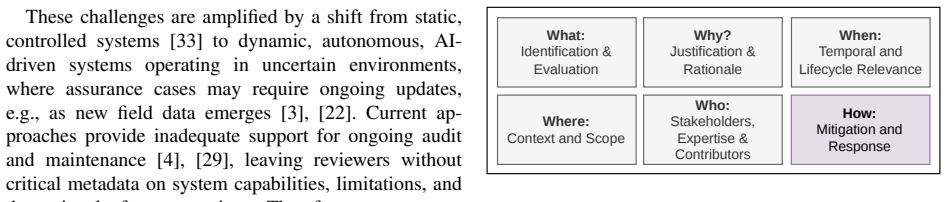
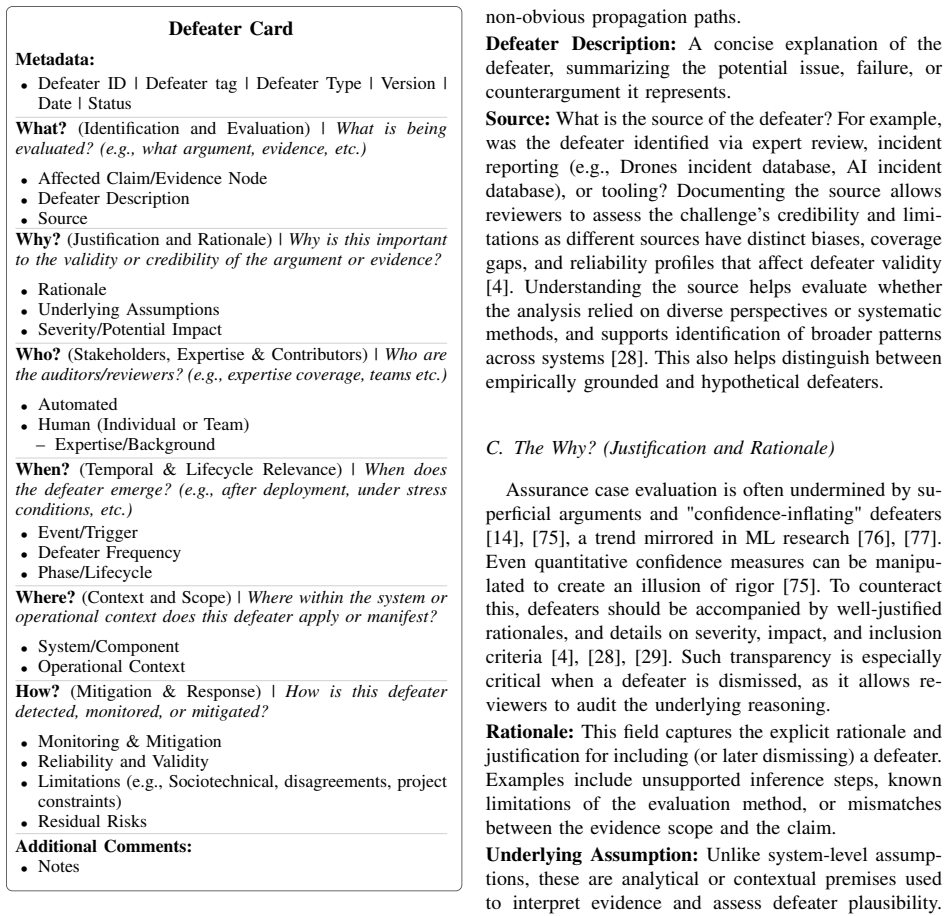
Defeater Cards supply a 5W1H template to document and manage challenges to safety assurance cases.
A machine-rendered reading of the paper's core claim, the machinery that carries it, and where it could break.
Core claim
Defeater Cards are a structured documentation artifact for systematically characterizing, reasoning about, and managing defeaters in safety cases. Their structure is informed by documentation criteria identified through literature survey and thematic analysis using the 5W1H framework. The cards are designed to support informed analysis and evolution, improve traceability and auditability, and enable the reuse of defeater knowledge across systems and product variants.
What carries the argument
Defeater Cards, a template organized by the 5W1H questions to capture what the defeater is, who raises it, when and where it applies, why it matters, and how it is addressed.
Load-bearing premise
The documentation criteria identified via literature survey and thematic analysis using the 5W1H framework are sufficient to systematically address the ad hoc, inconsistently described nature of defeaters in safety cases.
What would settle it
A safety case review in which experts equipped with Defeater Cards still fail to document a defeater that is later shown to invalidate a key safety claim.
Figures


read the original abstract
Safety assurance cases provide structured justifications that safety-critical systems meet their safety requirements. Recently, the notion of defeaters has emerged as a rigorous means of challenging the validity of safety arguments. Examples of defeaters might include overly strict claims, unreliable evidence, or reasoning gaps. However, defeaters remain ad hoc, lack structured support for critical reflection, are inconsistently described, are difficult to review, and lack documentation standards. To address this, we propose Defeater Cards, a new structured documentation artifact for systematically characterizing, reasoning about, and managing defeaters in safety cases. Drawing on a literature survey and thematic analysis, we identify documentation criteria that inform the card's structure, based on the 5W1H framework. Defeater Cards are designed to support informed analysis and evolution, improve traceability and auditability, and enable the reuse of defeater knowledge across systems and product variants. We demonstrate their applicability through two cross-domain case studies, showing how they expose hidden assumptions, surface reasoning gaps, and support ongoing safety assurance case evolution. To support adoption and community reuse, we also release an open-source repository of defeater cards as a baseline upon which researchers and practitioners can build and describe lessons learned.
Editorial analysis
A structured set of objections, weighed in public.
Referee Report
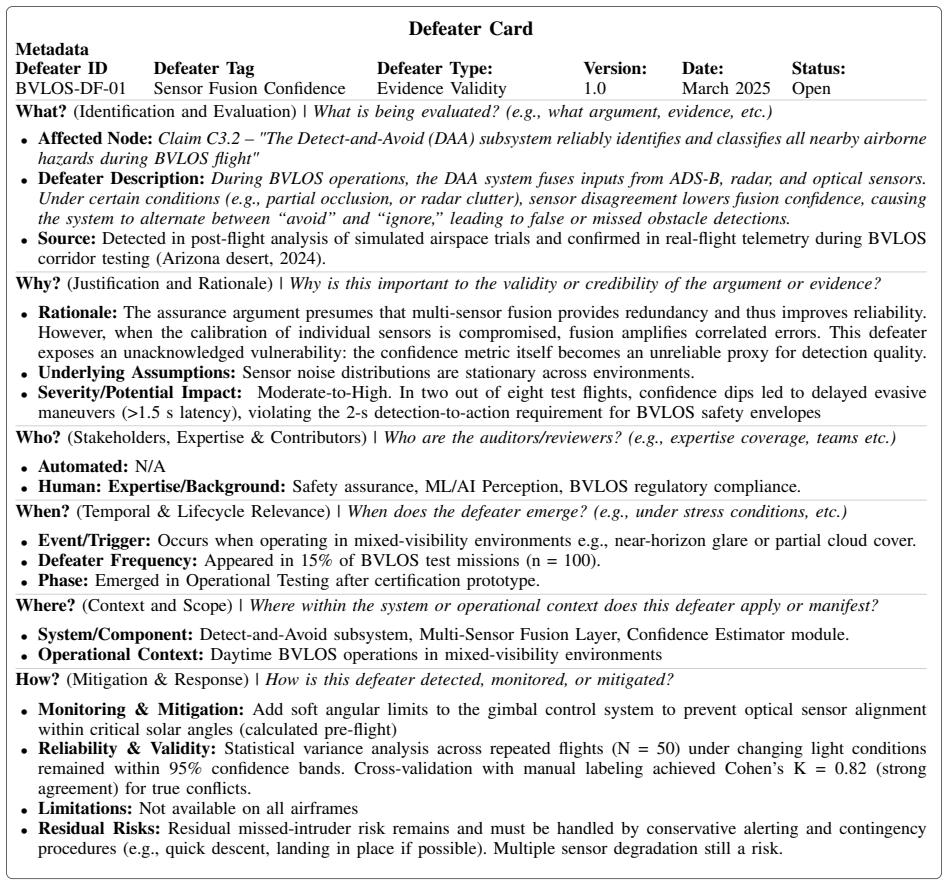
Summary. The paper proposes Defeater Cards, a structured documentation artifact for characterizing, reasoning about, and managing defeaters in safety assurance cases. Drawing on a literature survey and thematic analysis using the 5W1H framework, it identifies documentation criteria to address the ad hoc and inconsistently described nature of defeaters. The cards are intended to support analysis, evolution, traceability, auditability, and reuse across systems and variants. Applicability is demonstrated through two cross-domain case studies that expose hidden assumptions and reasoning gaps, and an open-source repository of cards is released as a reusable baseline.
Significance. If the cards prove effective in practice, the work could standardize defeater handling in safety cases for safety-critical systems, a key area in software and systems engineering. The release of the open repository supports reproducibility, community reuse, and incremental extension, which are positive contributions to the field.
major comments (2)
- [Methods (literature survey and thematic analysis)] The section describing the literature survey and thematic analysis does not report the number of papers surveyed, the exact coding protocol, inter-rater reliability statistics, or how disagreements among coders were resolved. These details are needed to assess whether the 5W1H-derived documentation criteria are robust and comprehensive enough to systematically address the ad hoc nature of defeaters.
- [Case studies section] The two case studies are presented as demonstrations of applicability rather than controlled evaluations. The paper does not provide concrete metrics or before/after comparisons showing that the cards measurably improve traceability or reduce reasoning gaps, which weakens the claim that they enable systematic management.
minor comments (2)
- [Abstract] The abstract mentions 'two cross-domain case studies' but does not name the domains; adding this would improve clarity for readers.
- [Defeater Cards structure] Notation for the 5W1H criteria could be presented in a table for easier reference when the cards are described.
Simulated Author's Rebuttal
We thank the referee for the constructive review and recommendation for minor revision. We address each major comment below.
read point-by-point responses
-
Referee: [Methods (literature survey and thematic analysis)] The section describing the literature survey and thematic analysis does not report the number of papers surveyed, the exact coding protocol, inter-rater reliability statistics, or how disagreements among coders were resolved. These details are needed to assess whether the 5W1H-derived documentation criteria are robust and comprehensive enough to systematically address the ad hoc nature of defeaters.
Authors: We agree that greater methodological transparency is warranted. In the revised manuscript we will expand the relevant section to report the number of papers surveyed, describe the coding protocol in detail, provide inter-rater reliability statistics, and explain how coder disagreements were resolved. These additions will allow readers to evaluate the robustness of the derived criteria. revision: yes
-
Referee: [Case studies section] The two case studies are presented as demonstrations of applicability rather than controlled evaluations. The paper does not provide concrete metrics or before/after comparisons showing that the cards measurably improve traceability or reduce reasoning gaps, which weakens the claim that they enable systematic management.
Authors: The case studies are deliberately framed as demonstrations of applicability, consistent with the manuscript's stated claims of showing how the cards expose hidden assumptions and reasoning gaps. The paper does not advance quantitative claims about measurable improvements, which would require a different study design. We will add a short discussion of possible future metrics and evaluation approaches to clarify the intended scope. revision: partial
Circularity Check
No significant circularity
full rationale
The paper is a methodological proposal for Defeater Cards, constructed via external literature survey and thematic analysis under the 5W1H framework. No equations, parameters, derivations, or self-referential fitting exist. The central claim (structured documentation criteria suffice to systematize defeater handling) is grounded in cited external sources rather than reducing to the paper's own inputs or self-citations. Case studies function as applicability demonstrations, not closed-loop validations. The work remains self-contained against external benchmarks.
Axiom & Free-Parameter Ledger
axioms (1)
- domain assumption Safety assurance cases provide structured justifications that safety-critical systems meet their safety requirements.
invented entities (1)
-
Defeater Cards
no independent evidence
Reference graph
Works this paper leans on
-
[1]
Software considerations in airborne systems and equip- ment certification,
RTCA, “Software considerations in airborne systems and equip- ment certification,”DO-178C, 2011
2011
-
[2]
ISO 26262 safety cases: Compliance and assurance,
R. Palin, D. Ward, I. Habli, and R. Rivett, “ISO 26262 safety cases: Compliance and assurance,” 2011
2011
-
[3]
A safety stan- dard approach for fully autonomous vehicles,
P. Koopman, U. Ferrell, F. Fratrik, and M. Wagner, “A safety stan- dard approach for fully autonomous vehicles,” inSAFECOMP. Springer, 2019, pp. 326–332
2019
-
[4]
Assurance case guidance,
Assurance Case Working Group, “Assurance case guidance,” ACWG, Tech. Rep. SCSC-159, 2021
2021
-
[5]
R. Bloomfield and J. Rushby, “Assurance 2.0: A manifesto,” arXiv preprint arXiv:2004.10474, 2020
-
[6]
Knight,Fundamentals of Dependable Computing for Software Engineers
J. Knight,Fundamentals of Dependable Computing for Software Engineers. CRC Press, 2012
2012
-
[7]
A survey of tool- supported assurance case assessment techniques,
M. Maksimov, S. Kokaly, and M. Chechik, “A survey of tool- supported assurance case assessment techniques,”ACM Comput- ing Surveys (CSUR), vol. 52, no. 5, pp. 1–34, 2019
2019
-
[8]
AdvoCATE: An assurance case automation toolset,
E. Denney, G. Pai, and J. Pohl, “AdvoCATE: An assurance case automation toolset,” inSAFECOMP. Springer, 2012, pp. 8–21
2012
-
[9]
The goal structuring notation–a safety argument notation,
T. Kelly and R. Weaver, “The goal structuring notation–a safety argument notation,” inDSN workshop on assurance cases. Cite- seer, 2004
2004
-
[10]
Clarissa: Foundations, tools & automation for assurance cases,
S. Varadarajan, R. Bloomfield, J. Rushby, G. Gupta, A. Mu- rugesan, R. Stroud, K. Netkachova, and I. H. Wong, “Clarissa: Foundations, tools & automation for assurance cases,” inDASC, 2023, pp. 1–10
2023
-
[11]
Handling obstacles in goal- oriented requirements engineering,
A. van Lamsweerde and E. Letier, “Handling obstacles in goal- oriented requirements engineering,”IEEE TSE, vol. 26, pp. 978– 1005, 2000
2000
-
[12]
Towards measurement of confidence in safety cases,
E. Denney, G. Pai, and I. Habli, “Towards measurement of confidence in safety cases,” inESEM. IEEE, 2011, pp. 380–383
2011
-
[13]
Elimina- tive induction: A basis for arguing system confidence,
J. B. Goodenough, C. B. Weinstock, and A. Z. Klein, “Elimina- tive induction: A basis for arguing system confidence,” inICSE, 2013, pp. 1161–1164
2013
-
[14]
A taxonomy of real-world defeaters in safety assurance cases,
U. Gohar, M. C. Hunter, M. B. Cohen, and R. R. Lutz, “A taxonomy of real-world defeaters in safety assurance cases,” in2025 IEEE/ACM Workshop on Multi-disciplinary, Open, and RElevant Requirements Engineering (MO2RE). IEEE Computer Society, Apr. 2025, pp. 3–9
2025
-
[15]
Obstacle analysis in re- quirements engineering: Retrospective and emerging challenges,
E. Letier and A. van Lamsweerde, “Obstacle analysis in re- quirements engineering: Retrospective and emerging challenges,” IEEE Trans. Software Eng., vol. 51, no. 3, pp. 795–801, 2025
2025
-
[16]
An independent review into the broader issues sur- rounding the loss of the RAF Nimrod MR2 Aircraft XV230 in Afghanistan in 2006,
C. Cave, “An independent review into the broader issues sur- rounding the loss of the RAF Nimrod MR2 Aircraft XV230 in Afghanistan in 2006,”The Stationary Office, Tech. Rep, 2006
2006
-
[17]
SafeCert: Towards automated safety-case generation for risk assessment in small uncrewed aerial vehicles,
M. C. Hunter, U. Gohar, S. Purandare, K. Kjeer, R. Lutz, B. A. Duncan, J. Cleland-Huang, and M. Cohen, “SafeCert: Towards automated safety-case generation for risk assessment in small uncrewed aerial vehicles,” inAIAA AVIATION FORUM AND ASCEND 2025, 2025, p. 3169
2025
-
[18]
Se- mantic analysis of assurance cases using s(CASP),
A. Murugesan, I. H. Wong, R. J. Stroud, J. Arias, E. Salazar, G. Gupta, R. Bloomfield, S. Varadarajan, and J. Rushby, “Se- mantic analysis of assurance cases using s(CASP),” inICLP Workshops, 2023
2023
-
[19]
Understand- ing and evaluating assurance cases,
J. Rushby, X. Xu, M. Rangarajan, and T. L. Weaver, “Understand- ing and evaluating assurance cases,”NASA, no. 20160000772, 2015
2015
-
[20]
ATTEST: Automating the review and update of assurance case arguments,
F. U. Muram and M. A. Javed, “ATTEST: Automating the review and update of assurance case arguments,”Journal of Systems Architecture, vol. 134, p. 102781, 2023
2023
-
[21]
Automatically detecting fallacies in system safety arguments,
T. Yuan, S. Manandhar, T. Kelly, and S. Wells, “Automatically detecting fallacies in system safety arguments,” inPrinciples and Practice of Multi-Agent Systems: International Workshops: IWEC 2014, and CMNA XV and IWEC 2015. Springer, 2016, pp. 47– 59
2014
-
[22]
CoDe- feater: Using LLMs to find defeaters in assurance cases,
U. Gohar, M. C. Hunter, R. R. Lutz, and M. B. Cohen, “CoDe- feater: Using LLMs to find defeaters in assurance cases,” in Proceedings of the 39th IEEE/ACM International Conference on Automated Software Engineering, 2024, p. 2262–2267
2024
-
[23]
AI-Supported Eliminative Argumentation: Practical Experience Generating Defeaters to Increase Confidence in Assurance Cases,
T. Viger, L. Murphy, S. Diemert, C. Menghi, J. Joyce, A. D. San- dro, and M. Chechik, “AI-Supported Eliminative Argumentation: Practical Experience Generating Defeaters to Increase Confidence in Assurance Cases,” inISSRE. IEEE, 2024
2024
-
[24]
Ai documentation: A path to accountability,
F. Königstorfer and S. Thalmann, “Ai documentation: A path to accountability,”Journal of Responsible Technology, vol. 11, p. 100043, 2022
2022
-
[25]
Using obstacle analysis to identify contingency re- quirements on an unpiloted aerial vehicle,
R. R. Lutz, A. Patterson-Hine, S. Nelson, C. R. Frost, D. Tal, and R. Harris, “Using obstacle analysis to identify contingency re- quirements on an unpiloted aerial vehicle,”Requir. Eng., vol. 12, no. 1, pp. 41–54, 2007
2007
-
[26]
Engineering and verifying requirements for programmable self-assembling nanomachines,
R. R. Lutz, J. H. Lutz, J. I. Lathrop, T. H. Klinge, E. R. Hender- son, D. Mathur, and D. A. Sheasha, “Engineering and verifying requirements for programmable self-assembling nanomachines,” inICSE, 2012
2012
-
[27]
Requirements engineering for safety-critical molec- ular programs,
R. R. Lutz, “Requirements engineering for safety-critical molec- ular programs,” inRE. IEEE, 2022, pp. 302–308
2022
-
[28]
Safety case templates for autonomous systems,
R. Bloomfield, G. Fletcher, H. Khlaaf, L. Hinde, and P. Ryan, “Safety case templates for autonomous systems,”arXiv preprint arXiv:2102.02625, 2021
-
[29]
Assurance case guidance: Challenges, common issues and good practice, version 1,
A. C. W. Groupet al., “Assurance case guidance: Challenges, common issues and good practice, version 1,”Safety Critical Systems Club, 2021
2021
-
[30]
Model cards revisited: Bridging the gap between theory and practice for ethical ai requirements,
T. Puhlfürß, J. Butzke, and W. Maalej, “Model cards revisited: Bridging the gap between theory and practice for ethical ai requirements,” inIEEE RE, 2025, pp. 280–291
2025
-
[31]
Red-teaming for generative AI: Silver bullet or security theater?
M. Feffer, A. Sinha, W. H. Deng, Z. C. Lipton, and H. Heidari, “Red-teaming for generative AI: Silver bullet or security theater?” inAIES, 2024, pp. 421–437
2024
-
[32]
Available: https://www.anthropic.com/news/ evaluating-ai-systems
[Online]. Available: https://www.anthropic.com/news/ evaluating-ai-systems
-
[33]
Dynamic safety cases for through-life safety assurance,
E. Denney, G. Pai, and I. Habli, “Dynamic safety cases for through-life safety assurance,” inICSE, vol. 2. IEEE, 2015, pp. 587–590
2015
-
[34]
Data cards: Purposeful and transparent dataset documentation for responsible AI,
M. Pushkarna, A. Zaldivar, and O. Kjartansson, “Data cards: Purposeful and transparent dataset documentation for responsible AI,” inACM FAccT, 2022, pp. 1776–1826
2022
-
[35]
Model cards for model reporting,
M. Mitchell, S. Wu, A. Zaldivar, P. Barnes, L. Vasserman, B. Hutchinson, E. Spitzer, I. D. Raji, and T. Gebru, “Model cards for model reporting,” inACM FAccT, 2019, pp. 220–229
2019
-
[36]
V olere,
J. Robertson and S. Robertson, “V olere,”Requirements Specifi- cation Templates, 2000
2000
-
[37]
A family-based approach to safety cases for controlled airspaces in small uncrewed aerial systems,
M. Hunter, U. Gohar, M. Cohen, R. Lutz, and J. Cleland-Huang, “A family-based approach to safety cases for controlled airspaces in small uncrewed aerial systems,” inAIAA AVIATION FORUM AND ASCEND 2024, 2024, p. 4626
2024
-
[38]
arXiv preprint arXiv:2504.13839 , year =
L. Staufer, M. Yang, A. Reuel, and S. Casper, “Audit cards: Con- textualizing ai evaluations,”arXiv preprint arXiv:2504.13839, 2025
-
[39]
Documentation for safety critical software,
P.-J. Courtois and D. L. Parnas, “Documentation for safety critical software,” inProceedings of 1993 15th International Conference on Software Engineering. IEEE, 1993, pp. 315–323
1993
-
[40]
The interpretation and evaluation of assurance cases,
J. Rushby, “The interpretation and evaluation of assurance cases,” Comp. Science Laboratory, SRI International, Tech. Rep. SRI- CSL-15-01, 2015. 11
2015
-
[41]
Tool support for assurance case devel- opment,
E. Denney and G. Pai, “Tool support for assurance case devel- opment,”ASE, vol. 25, no. 3, pp. 435–499, 2018
2018
-
[42]
Mmint-a 2.0: tool support for the lifecycle of model- based safety artifacts,
A. Di Sandro, G. Selim, R. Salay, T. Viger, M. Chechik, and S. Kokaly, “Mmint-a 2.0: tool support for the lifecycle of model- based safety artifacts,” inACM/IEEE MODELS, 2020, pp. 1–5
2020
-
[43]
Support for argument structures re- view and assessment,
L. Cyra and J. Gorski, “Support for argument structures re- view and assessment,”Reliability Engineering & System Safety, vol. 96, no. 1, pp. 26–37, 2011
2011
-
[44]
Structured safety case evaluation: a systematic ap- proach to safety case review,
P. Mayo, “Structured safety case evaluation: a systematic ap- proach to safety case review,” inInternational Conference on System Safety. IET, 2006, pp. 10–pp
2006
-
[45]
Characterizing the chain of evidence for software safety cases: A conceptual model based on the IEC 61508 standard,
R. K. Panesar-Walawege, M. Sabetzadeh, L. Briand, and T. Coq, “Characterizing the chain of evidence for software safety cases: A conceptual model based on the IEC 61508 standard,” inICST. IEEE, 2010, pp. 335–344
2010
-
[46]
Sys- tematic evaluation of (safety) assurance cases,
T. Chowdhury, A. Wassyng, R. F. Paige, and M. Lawford, “Sys- tematic evaluation of (safety) assurance cases,” inSAFECOMP Springer, 2020, pp. 18–33
2020
-
[47]
Reasoning about confidence and uncertainty in assurance cases: A survey,
L. Duan, S. Rayadurgam, M. P. Heimdahl, A. Ayoub, O. Sokol- sky, and I. Lee, “Reasoning about confidence and uncertainty in assurance cases: A survey,” inSEHC, FHIES 2014. Springer, 2017, pp. 64–80
2014
-
[48]
Confidence as- sessment in safety argument structure-quantitative vs. qualitative approaches,
Y . Idmessaoud, D. Dubois, and J. Guiochet, “Confidence as- sessment in safety argument structure-quantitative vs. qualitative approaches,”IJAR, vol. 165, p. 109100, 2024
2024
-
[49]
Toward a theory of assurance case confidence,
J. B. Goodenough, C. B. Weinstock, and A. Z. Klein, “Toward a theory of assurance case confidence,”Pittsburgh, PA: Software Engineering Institute, Carnegie Mellon University, 2012
2012
-
[50]
Examining proposed uses of llms to produce or assess assurance arguments, NASA/TM–20250001849,
M. Graydon and S. Lehman, “Examining proposed uses of llms to produce or assess assurance arguments, NASA/TM–20250001849,” Tech. Rep., 2025
2025
-
[51]
LLMs as judges: Toward the automatic review of GSN-compliant assurance cases,
G. Yu, M. Sivakumar, A. B. Belle, S. Ghari, S. Wang, and T. C. Lethbridge, “LLMs as judges: Toward the automatic review of GSN-compliant assurance cases,”arXiv preprint arXiv:2511.02203, 2025
-
[52]
Defeaters and eliminative argumentation in Assurance 2.0,
R. Bloomfield, K. Netkachova, and J. Rushby, “Defeaters and eliminative argumentation in Assurance 2.0,”arXiv preprint arXiv:2405.15800, 2024
-
[53]
Incre- mental assurance through eliminative argumentation,
S. Diemert, J. Goodenough, J. Joyce, and C. Weinstock, “Incre- mental assurance through eliminative argumentation,”Journal of System Safety, vol. 58, no. 1, pp. 7–15, 2023
2023
-
[54]
Leveraging artifact trees to evolve and reuse safety cases,
A. Agrawal, S. Khoshmanesh, M. Vierhauser, M. Rahimi, J. Cleland-Huang, and R. Lutz, “Leveraging artifact trees to evolve and reuse safety cases,” inIEEE ICSE, 2019
2019
-
[55]
Towards dynamic safety assurance for industry 4.0,
M. A. Javed, F. U. Muram, H. Hansson, S. Punnekkat, and H. Thane, “Towards dynamic safety assurance for industry 4.0,” Journal of Systems Architecture, vol. 114, p. 101914, 2021
2021
-
[56]
Towards continuous safety assurance for autonomous systems,
P. Schleiss, F. Carella, and I. Kurzidem, “Towards continuous safety assurance for autonomous systems,” inIEEE ICSRS, 2022, pp. 457–462
2022
-
[57]
Facilitating the mainte- nance of safety cases,
O. Jaradat, I. Bate, and S. Punnekkat, “Facilitating the mainte- nance of safety cases,” inCurrent Trends in Reliability, Avail- ability, Maintainability and Safety: An Industry Perspective. Springer, 2015, pp. 349–371
2015
-
[58]
Safety case maintenance: a systematic literature review,
C. Cârlan, B. Gallina, and L. Soima, “Safety case maintenance: a systematic literature review,” inSAFECOMP. Springer, 2021, pp. 115–129
2021
-
[59]
The 5Ws and 1H of digital journalism,
S. Waisbord, “The 5Ws and 1H of digital journalism,” inDef- initions of Digital Journalism (Studies). Routledge, 2021, pp. 38–45
2021
-
[60]
Defining a model for content requirements from the law: An experience report,
M. Ceci, D. Bianculli, and L. C. Briand, “Defining a model for content requirements from the law: An experience report,” inRE. IEEE, 2024, pp. 18–30
2024
-
[61]
A design science research methodology for information systems research,
K. Peffers, T. Tuunanen, M. A. Rothenberger, and S. Chatterjee, “A design science research methodology for information systems research,”Journal of management information systems, vol. 24, no. 3, pp. 45–77, 2007
2007
-
[62]
Driving the development process from the safety case,
C. Hobbs, S. Diemert, and J. Joyce, “Driving the development process from the safety case,”Safety-Critical Systems Club, 2024
2024
-
[63]
Who audits the auditors? recommendations from a field scan of the algorith- mic auditing ecosystem,
S. Costanza-Chock, I. D. Raji, and J. Buolamwini, “Who audits the auditors? recommendations from a field scan of the algorith- mic auditing ecosystem,” inACM FAccT, 2022, pp. 1571–1583
2022
-
[64]
Datasheets for datasets,
T. Gebru, J. Morgenstern, B. Vecchione, J. W. Vaughan, H. Wal- lach, H. D. Iii, and K. Crawford, “Datasheets for datasets,” Communications of the ACM, vol. 64, no. 12, pp. 86–92, 2021
2021
-
[65]
Rationale-based support for software maintenance,
J. E. Burge and D. C. Brown, “Rationale-based support for software maintenance,” inRationale management in software engineering. Springer, 2006, pp. 273–296
2006
-
[66]
Explicate ’78: Assurance case applicability to digital systems,
C. M. Holloway and P. J. Graydon, “Explicate ’78: Assurance case applicability to digital systems,” Federal Aviation Adminis- tration, Atlantic City International Airport, NJ, Technical Report DOT/FAA/TC-17/67, January 2018
2018
-
[67]
Guidelines for performing systematic literature reviews in software engineering,
S. Keeleet al., “Guidelines for performing systematic literature reviews in software engineering,” Technical report, ver. 2.3 EBSE technical report, Tech. Rep., 2007
2007
-
[68]
Robertson and J
S. Robertson and J. Robertson,Mastering the Requirements Process: Getting Requirements Right, 3rd ed. Addison-Wesley Professional, 2012
2012
-
[69]
Clarke and V
V . Clarke and V . Braun,Thematic Analysis. Dordrecht: Springer Netherlands, 2014, pp. 6626–6628
2014
-
[70]
Content analysis and thematic analysis: Implications for conducting a qualitative descriptive study,
M. Vaismoradi, H. Turunen, and T. Bondas, “Content analysis and thematic analysis: Implications for conducting a qualitative descriptive study,”Nursing & health sciences, vol. 15, no. 3, pp. 398–405, 2013
2013
-
[71]
Ai auditing: The broken bus on the road to ai accountability,
A. Birhane, R. Steed, V . Ojewale, B. Vecchione, and I. D. Raji, “Ai auditing: The broken bus on the road to ai accountability,” inIEEE SaTML, 2024, pp. 612–643
2024
-
[72]
Artificial intelligence risk management framework (ai rmf 1.0),
N. AI, “Artificial intelligence risk management framework (ai rmf 1.0),”URL: https://nvlpubs. nist. gov/nistpubs/ai/nist. ai, pp. 100–1, 2023
2023
-
[73]
D. N. Walton,The new dialectic: Conversational contexts of argument. University of Toronto Press, 1998
1998
-
[74]
A taxonomy of fallacies in system safety arguments,
W. S. Greenwell, J. C. Knight, C. M. Holloway, and J. J. Pease, “A taxonomy of fallacies in system safety arguments,” in24th ISSC, 2006
2006
-
[75]
An investigation of proposed techniques for quantifying confidence in assurance arguments,
P. J. Graydon and C. M. Holloway, “An investigation of proposed techniques for quantifying confidence in assurance arguments,” Safety science, vol. 92, pp. 53–65, 2017
2017
-
[76]
The extent and consequences of p-hacking in science,
M. L. Head, L. Holman, R. Lanfear, A. T. Kahn, and M. D. Jennions, “The extent and consequences of p-hacking in science,” PLoS biology, vol. 13, no. 3, p. e1002106, 2015
2015
-
[77]
Different horses for different courses: Comparing bias mitigation algorithms in ml,
P. Ganesh, U. Gohar, L. Cheng, and G. Farnadi, “Different horses for different courses: Comparing bias mitigation algorithms in ml,” inWorkshop on Algorithmic Fairness Through the Lens of Metrics and Evaluation. PMLR, 2025, pp. 96–118
2025
-
[78]
AI risk assessment: a scenario-based, proportional methodology for the ai act,
C. Novelli, F. Casolari, A. Rotolo, M. Taddeo, and L. Floridi, “AI risk assessment: a scenario-based, proportional methodology for the ai act,”Digital Society, vol. 3, no. 1, p. 13, 2024
2024
-
[79]
L. Koessler and J. Schuett, “Risk assessment at AGI companies: A review of popular risk assessment techniques from other safety- critical industries,”arXiv preprint arXiv:2307.08823, 2023
-
[80]
NASA risk management handbook,
H. Dezfuli, A. Benjamin, C. Everett, G. Maggio, M. Stamatelatos, R. Youngblood, S. Guarro, P. Rutledge, J. Sherrard, C. Smith et al., “NASA risk management handbook,” Tech. Rep., 2011
2011
discussion (0)
Sign in with ORCID, Apple, or X to comment. Anyone can read and Pith papers without signing in.