Summary of the First Year of the Space Weather Around Young Suns Program: 900 Hours of Low-frequency Radio and Optical Data Dedicated to Young, Solar-type Stars
Pith reviewed 2026-06-27 11:22 UTC · model grok-4.3
The pith
Hot dense coronae around young active stars may prevent the radio bursts that mark space weather events.
A machine-rendered reading of the paper's core claim, the machinery that carries it, and where it could break.
Core claim
The exceptionally hot, dense coronae of incredibly active stars may not be conducive to the development of the instabilities required for type II and III bursts, or else inspire new expectations for when we should expect to observe a signal relative to the time of the flare. This may represent the plasma-density complement to the magnetospheric limitations to observing space-weather signatures at low frequencies.
What carries the argument
Simultaneous OVRO-LWA radio monitoring (13-87 MHz) and Flarescope optical photometry to tie detected flares directly to the presence or absence of low-frequency particle-flux signals.
Load-bearing premise
The non-detection of low-frequency radio emission is caused by the physical state of the stellar corona rather than by the timing of the observations relative to flare peak, instrumental sensitivity limits, or other unstated selection effects.
What would settle it
A clear detection of type II or III radio bursts from a young active star with comparable coronal temperature and density, timed to a documented optical flare.
Figures



read the original abstract
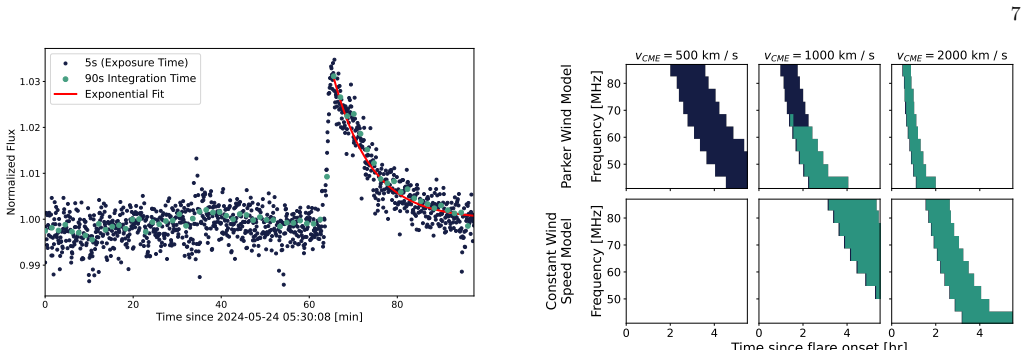
The Space Weather Around Young Suns (SWAYS) program was introduced in \citet{Davis2025} as a multi-wavelength monitoring program for studying the activity and particle environments of nearby, young, solar-type stars. The SWAYS program currently includes the Owens Valley Radio Observatory Long Wavelength Array (OVRO-LWA) operating between 13--87\,MHz to search for stellar equivalents of solar type~II and III bursts, which are associated with bulk plasma motion in the corona and interplanetary medium. These observations are accompanied by simultaneous photometric data from the high-precision, optical instrument Flarescope to identify associated flare events. These two instruments have collectively acquired nearly 900\,hr of data with $\approx70\%$ overlap between November 2023--June 2024, dedicated to six stars. Here, we present the results of this first season of the SWAYS observing campaign, which include a superflare from the star EK~Draconis with no accompanying low-frequency particle-flux signal. The novelty of the coordination at these specific parts of the spectrum allow us to uniquely evaluate the conditions that may have inhibited a radio detection. We find that the exceptionally hot, dense coronae of incredibly active stars may not be conducive to the development of the instabilities required for type~II and III bursts, or else inspire new expectations for when we should expect to observe a signal relative to the time of the flare. This may represent the plasma-density complement to the magnetospheric limitations to observing space-weather signatures at low frequencies.
Editorial analysis
A structured set of objections, weighed in public.
Referee Report
Summary. The manuscript summarizes the first year of the Space Weather Around Young Suns (SWAYS) program, which acquired nearly 900 hours of coordinated low-frequency radio observations (OVRO-LWA, 13-87 MHz) and optical photometry (Flarescope) on six young solar-type stars from November 2023 to June 2024, with ~70% overlap. The central result is the detection of a superflare on EK Draconis with no accompanying low-frequency radio signal, interpreted as evidence that the exceptionally hot, dense coronae of highly active stars may suppress the plasma instabilities required for type II and III bursts or require revised expectations for radio emission timing relative to the flare; this is presented as a plasma-density complement to magnetospheric limitations on low-frequency space-weather signatures.
Significance. If the non-detection is placed on a quantitative footing and alternative explanations are excluded, the result would provide a useful observational constraint on differences in coronal particle acceleration and radio burst production between the Sun and young active stars. The coordinated multi-wavelength dataset itself represents a valuable resource for the field.
major comments (2)
- [Abstract] Abstract: The interpretation that hot, dense coronae inhibit type II/III instabilities rests on a single superflare non-detection but supplies no quantitative upper limits on radio flux, no scaling of expected solar-analog burst strength to EK Dra's distance (~100 pc) and flare energy, and no statistical assessment of the non-detection significance.
- [Abstract] Abstract: No information is given on the temporal alignment between the radio window and the optical flare peak, nor on the expected delay for plasma-frequency emission, preventing separation of a physical coronal explanation from possible timing or scheduling limitations.
Simulated Author's Rebuttal
We thank the referee for their constructive comments on our manuscript. We address each major comment below and will revise the manuscript accordingly to strengthen the presentation of our results.
read point-by-point responses
-
Referee: [Abstract] Abstract: The interpretation that hot, dense coronae inhibit type II/III instabilities rests on a single superflare non-detection but supplies no quantitative upper limits on radio flux, no scaling of expected solar-analog burst strength to EK Dra's distance (~100 pc) and flare energy, and no statistical assessment of the non-detection significance.
Authors: We agree that the abstract would be improved by the inclusion of these quantitative elements to better support the interpretation. In the revised manuscript we will add an upper limit on the radio flux density from the non-detection, a scaling of typical solar type II/III burst strengths to the distance and energy of the EK Dra event, and a brief statistical assessment of the non-detection. These additions will also be expanded in the main text. revision: yes
-
Referee: [Abstract] Abstract: No information is given on the temporal alignment between the radio window and the optical flare peak, nor on the expected delay for plasma-frequency emission, preventing separation of a physical coronal explanation from possible timing or scheduling limitations.
Authors: We concur that explicit timing information is necessary to distinguish physical suppression from observational constraints. The revised version will report the precise temporal overlap between the radio observations and the optical flare peak, together with an estimate of the expected delay for plasma-frequency emission based on solar scaling relations. This will allow readers to evaluate the robustness of the coronal-density interpretation. revision: yes
Circularity Check
No circularity: purely observational non-detection with interpretive hypothesis
full rationale
The paper reports coordinated radio and optical observations of young solar-type stars, including a superflare on EK Dra with no detected low-frequency emission. The central claim is an interpretive suggestion that hot dense coronae may inhibit type II/III burst instabilities. No equations, parameter fits, derivations, or model predictions appear in the provided text. The non-detection is presented as data; the physical interpretation is offered as one possible explanation alongside alternatives (timing, sensitivity). No self-citation chains, ansatzes, or renamings reduce any result to its inputs by construction. This is a standard observational report whose conclusions rest on the data rather than on any internal definitional loop.
Axiom & Free-Parameter Ledger
Reference graph
Works this paper leans on
-
[1]
Alvarado-G \'o mez , J. D., Drake , J. J., Cohen , O., Moschou , S. P., & Garraffo , C. 2018, , 862, 93, 10.3847/1538-4357/aacb7f
-
[2]
Alvarado-G \'o mez , J. D., Cohen , O., Drake , J. J., et al. 2022, , 928, 147, 10.3847/1538-4357/ac54b8
-
[3]
Alvarez , H., & Haddock , F. T. 1973, , 29, 197, 10.1007/BF00153449
-
[4]
Aschwanden , M. J., Nightingale , R. W., & Alexander , D. 2000, , 541, 1059, 10.1086/309486
-
[5]
Ayres , T. R. 2015, , 150, 7, 10.1088/0004-6256/150/1/7
-
[6]
Berger , V. L., Hinkle , J. T., Tucker , M. A., et al. 2023, arXiv e-prints, arXiv:2312.12511, 10.48550/arXiv.2312.12511
-
[7]
R., Tasse , C., Keers , R., et al
Callingham , J. R., Tasse , C., Keers , R., et al. 2025, , 647, 603, 10.1038/s41586-025-09715-3
-
[8]
CASA, the Common Astronomy Software Applications for Radio Astronomy
CASA Team , Bean , B., Bhatnagar , S., et al. 2022, , 134, 114501, 10.1088/1538-3873/ac9642
work page internal anchor Pith review doi:10.1088/1538-3873/ac9642 2022
-
[9]
Cranmer , S. R. 2017, , 840, 114, 10.3847/1538-4357/aa6f0e
-
[10]
2025, , 993, 82, 10.3847/1538-4357/adfbe9
Davis , I., Hallinan , G., Saini , N., et al. 2025, , 993, 82, 10.3847/1538-4357/adfbe9
-
[11]
Dorren, J. D., & Guinan, E. F. 1994, International Astronomical Union Colloquium, 143, 206–216, 10.1017/S0252921100024702
-
[12]
Dulk , G. A. 1985, , 23, 169, 10.1146/annurev.aa.23.090185.001125
-
[13]
Eastwood, M. W. 2017, TTCal, 0.3.0, Zenodo, 10.5281/zenodo.1049160
-
[14]
Fichtinger , B., G \"u del , M., Mutel , R. L., et al. 2017, , 599, A127, 10.1051/0004-6361/201629886
-
[15]
2022, VizieR Online Data Catalog, I/357
Gaia Collaboration . 2022, VizieR Online Data Catalog, I/357
2022
-
[16]
Gaia Collaboration , Brown , A. G. A., Vallenari , A., et al. 2018, , 616, A1, 10.1051/0004-6361/201833051
work page internal anchor Pith review doi:10.1051/0004-6361/201833051 2018
-
[17]
2000, Geophysical Monograph Series, 119, 123, 10.1029/GM119p0123
Gopalswamy , N. 2000, Geophysical Monograph Series, 119, 123, 10.1029/GM119p0123
-
[18]
2004, , 12, 71, 10.1007/s00159-004-0023-2
G \"u del , M. 2004, , 12, 71, 10.1007/s00159-004-0023-2
-
[19]
2007, Living Reviews in Solar Physics, 4, 3, 10.12942/lrsp-2007-3
---. 2007, Living Reviews in Solar Physics, 4, 3, 10.12942/lrsp-2007-3
-
[20]
G \"u del , M., Guinan , E. F., & Skinner , S. L. 1997, , 483, 947, 10.1086/304264
-
[21]
Guedel , M., Schmitt , J. H. M. M., Benz , A. O., & Elias , II, N. M. 1995, , 301, 201
1995
-
[22]
P., Korhonen , H., Berdyugina , S
J \"a rvinen , S. P., Korhonen , H., Berdyugina , S. V., et al. 2008, , 488, 1047, 10.1051/0004-6361:200809837
-
[23]
Johns-Krull , C. M., & Herczeg , G. J. 2007, , 655, 345, 10.1086/508770
-
[24]
Kochukhov , O., Hackman , T., Lehtinen , J. J., & Wehrhahn , A. 2020, , 635, A142, 10.1051/0004-6361/201937185
-
[25]
Konijn , D. C., Vedantham , H. K., Tasse , C., et al. 2025, , 703, A198, 10.1051/0004-6361/202554317
-
[26]
Lazio , W., T. J., Farrell , W. M., Dietrick , J., et al. 2004, , 612, 511, 10.1086/422449
-
[27]
2020, , 493, 4570, 10.1093/mnras/staa504
Leitzinger , M., Odert , P., Greimel , R., et al. 2020, , 493, 4570, 10.1093/mnras/staa504
-
[28]
Loyd , R. O. P., Mason , J. P., Jin , M., et al. 2022, , 936, 170, 10.3847/1538-4357/ac80c1
-
[29]
Marsden , S. C., Donati , J. F., Semel , M., Petit , P., & Carter , B. D. 2006, , 370, 468, 10.1111/j.1365-2966.2006.10503.x
-
[30]
Mawet , D., Hirsch , L., Lee , E. J., et al. 2019, , 157, 33, 10.3847/1538-3881/aaef8a
-
[31]
1958, , 181, 36, 10.1038/181036a0
Maxwell , A., & Swarup , G. 1958, , 181, 36, 10.1038/181036a0
-
[32]
Melrose , D. B. 1989, , 120, 369, 10.1007/BF00159885
-
[33]
2024, , 691, L8, 10.1051/0004-6361/202451072
Mohan , A., Gopalswamy , N., Raju , H., & Akiyama , S. 2024, , 691, L8, 10.1051/0004-6361/202451072
-
[34]
Moschou , S.-P., Drake , J. J., Cohen , O., et al. 2019, , 877, 105, 10.3847/1538-4357/ab1b37
-
[35]
2025 a , , 993, 80, 10.3847/1538-4357/adfe70
Namekata , K., Maehara , H., Notsu , Y., et al. 2025 a , , 993, 80, 10.3847/1538-4357/adfe70
-
[36]
2021, Nature Astronomy, 6, 241, 10.1038/s41550-021-01532-8
Namekata , K., Maehara , H., Honda , S., et al. 2021, Nature Astronomy, 6, 241, 10.1038/s41550-021-01532-8
-
[38]
2022 b , , 926, L5, 10.3847/2041-8213/ac4df0
---. 2022 b , , 926, L5, 10.3847/2041-8213/ac4df0
-
[39]
Namekata , K., Airapetian , V. S., Petit , P., et al. 2024 a , , 961, 23, 10.3847/1538-4357/ad0b7c
-
[40]
2024 b , , 976, 255, 10.3847/1538-4357/ad85df
Namekata , K., Ikuta , K., Petit , P., et al. 2024 b , , 976, 255, 10.3847/1538-4357/ad85df
-
[41]
2025 b , arXiv e-prints, arXiv:2510.22110, 10.48550/arXiv.2510.22110
Namekata , K., France , K., Chae , J., et al. 2025 b , arXiv e-prints, arXiv:2510.22110, 10.48550/arXiv.2510.22110
-
[42]
J., & Melrose , D
Nelson , G. J., & Melrose , D. B. 1985, in Solar Radiophysics: Studies of Emission from the Sun at Metre Wavelengths, ed. D. J. McLean & N. R. Labrum , 333--359
1985
-
[43]
R., McKinley, B., Hurley-Walker, et al
Offringa, A. R., McKinley, B., Hurley-Walker, et al. 2014, MNRAS, 444, 606, 10.1093/mnras/stu1368
-
[44]
Offringa , A. R., van de Gronde , J. J., & Roerdink , J. B. T. M. 2012, , 539, A95, 10.1051/0004-6361/201118497
-
[45]
Osten , R. A., & Wolk , S. J. 2015, , 809, 79, 10.1088/0004-637X/809/1/79
-
[46]
Pal , T., Khan , I., Worthey , G., Gregg , M. D., & Silva , D. R. 2023, , 266, 41, 10.3847/1538-4365/accea7
-
[47]
Parker , E. N. 1965, , 4, 666, 10.1007/BF00216273
-
[48]
Reid , H. A. S., & Ratcliffe , H. 2014, Research in Astronomy and Astrophysics, 14, 773, 10.1088/1674-4527/14/7/003
-
[49]
Ricker , G. R., Winn , J. N., Vanderspek , R., et al. 2014, in Society of Photo-Optical Instrumentation Engineers (SPIE) Conference Series, Vol. 9143, Space Telescopes and Instrumentation 2014: Optical, Infrared, and Millimeter Wave, ed. J. Oschmann , Jacobus M., M. Clampin , G. G. Fazio , & H. A. MacEwen , 914320, 10.1117/12.2063489
-
[50]
2013, , 762, 60, 10.1088/0004-637X/762/1/60
Saint-Hilaire , P., Vilmer , N., & Kerdraon , A. 2013, , 762, 60, 10.1088/0004-637X/762/1/60
-
[51]
Sasikumar Raja , K., Maksimovic , M., Kontar , E. P., et al. 2022, , 924, 58, 10.3847/1538-4357/ac34ed
-
[52]
G., Pichler , T., Weber , M., & Granzer , T
Strassmeier , K. G., Pichler , T., Weber , M., & Granzer , T. 2003, , 411, 595, 10.1051/0004-6361:20031538
-
[53]
2005, , 622, 653, 10.1086/428109
Telleschi , A., G \"u del , M., Briggs , K., et al. 2005, , 622, 653, 10.1086/428109
-
[54]
2021, Journal of Geophysical Research (Space Physics), 126, e28380, 10.1029/2020JA028380
Temmer , M., Holzknecht , L., Dumbovi \'c , M., et al. 2021, Journal of Geophysical Research (Space Physics), 126, e28380, 10.1029/2020JA028380
-
[55]
Vedantham , H. K. 2020, , 639, L7, 10.1051/0004-6361/202038576
-
[56]
M., Odert , P., Leitzinger , M., et al
Veronig , A. M., Odert , P., Leitzinger , M., et al. 2021, Nature Astronomy, 5, 697, 10.1038/s41550-021-01345-9
-
[57]
2019, , 871, 214, 10.3847/1538-4357/aaf88e
Villadsen , J., & Hallinan , G. 2019, , 871, 214, 10.3847/1538-4357/aaf88e
-
[58]
Virtanen, P., Gommers, R., Oliphant, T. E., et al. 2020, Nature Methods, 17, 261, 10.1038/s41592-019-0686-2
-
[59]
J., Korpi-Lagg , M., & Kochukhov , O
Williamo , T., Hackman , T., Lehtinen , J. J., Korpi-Lagg , M., & Kochukhov , O. 2022, The Open Journal of Astrophysics, 5, 10, 10.21105/astro.2203.13398
-
[60]
Wilson , O. C. 1963, , 138, 832, 10.1086/147689
-
[61]
Wood , B. E., M \"u ller , H. R., Zank , G. P., Linsky , J. L., & Redfield , S. 2005, , 628, L143, 10.1086/432716
-
[62]
Yashiro , S., Akiyama , S., Gopalswamy , N., & Howard , R. A. 2006, , 650, L143, 10.1086/508876
-
[63]
2009, in Universal Heliophysical Processes, ed
Yashiro , S., & Gopalswamy , N. 2009, in Universal Heliophysical Processes, ed. N. Gopalswamy & D. F. Webb , Vol. 257, 233--243, 10.1017/S1743921309029342
discussion (0)
Sign in with ORCID, Apple, or X to comment. Anyone can read and Pith papers without signing in.