Unveiling the Interplay of Charge and Magnetic Excitations in HgBa₂Ca₂Cu₃O_(8+δ)
Pith reviewed 2026-06-27 08:27 UTC · model grok-4.3
The pith
Dynamic charge fluctuations soften paramagnons at shared momentum in Hg1223, indicating they mediate coupling among charge, spin and lattice.
A machine-rendered reading of the paper's core claim, the machinery that carries it, and where it could break.
Core claim
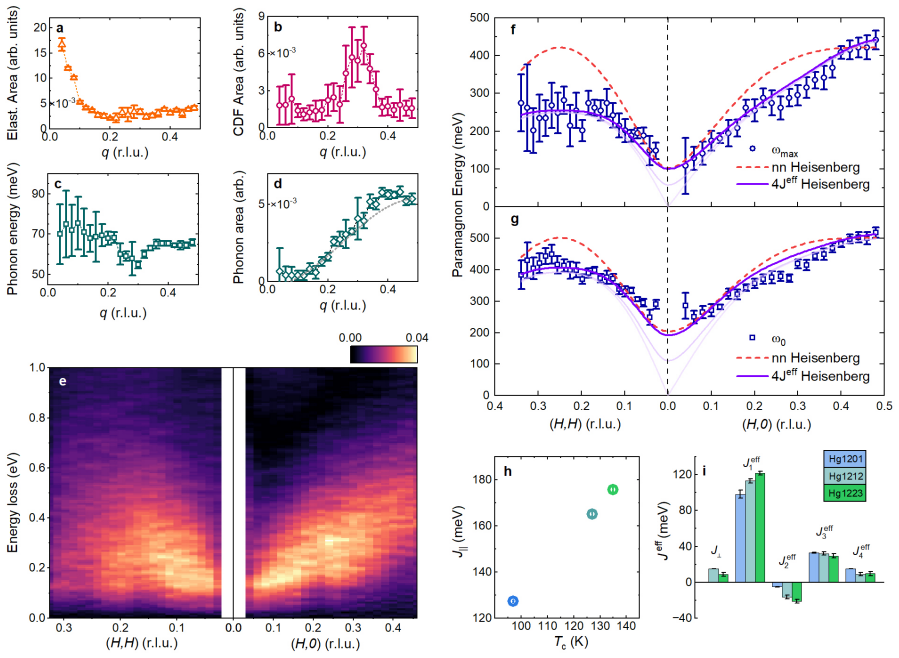
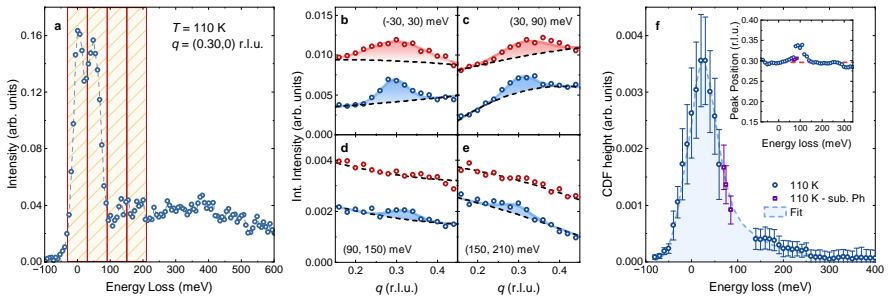
Resonant inelastic X-ray scattering on HgBa₂Ca₂Cu₃O₈₊δ shows that the charge response is dominated by dynamic charge density fluctuations extending up to several hundred meV. At the momentum of maximum CDF intensity the paramagnon energy displays pronounced softening. The data therefore indicate a strong interplay among charge, lattice and spin excitations, supporting a cooperative mechanism in which the dynamic charge fluctuations mediate the coupling between these degrees of freedom.
What carries the argument
Momentum-matched paramagnon softening induced by dynamic charge density fluctuations (CDF), which couple lattice vibrations to spin excitations.
If this is right
- Pairing in cuprates can involve simultaneous participation of charge, spin and lattice channels rather than a single dominant interaction.
- The energy overlap between CDF and paramagnons supplies a natural route for the fluctuations to influence the electronic spectrum near the Fermi level.
- The same momentum-space coincidence may appear in other cuprate families once comparable RIXS resolution is achieved.
- Lattice degrees of freedom are indirectly entangled with spin excitations through the charge channel.
Where Pith is reading between the lines
- If the CDF-paramagnon coupling scales with Tc across the cuprate family, it would provide a quantitative test for theories that treat charge fluctuations as a mediator.
- Doping-dependent RIXS maps could check whether the softening maximum tracks the CDF intensity maximum, offering an internal consistency check.
- The mechanism suggests that theoretical models limited to pure spin-fluctuation or phonon exchange may miss an essential cross-term.
Load-bearing premise
The observed softening of paramagnons occurs specifically because of the charge fluctuations and not because of doping inhomogeneity, lattice distortions or limits of experimental resolution.
What would settle it
Mapping the paramagnon dispersion in a sample series where the CDF intensity or its momentum maximum is deliberately suppressed while keeping doping fixed; persistence of the softening would falsify the mediation claim.
Figures


read the original abstract
Unraveling the mechanism that binds electrons into Cooper pairs in cuprate high-temperature superconductors remains one of the most fundamental challenges in condensed-matter physics. While both magnetic interactions and lattice vibrations are known to govern key electronic properties, their possible cooperation has never been directly observed. We investigate HgBa$_2$Ca$_2$Cu$_3$O$_{8+\delta}$ (Hg1223) - the cuprate with the highest $T_{\mathrm{c}}$ at ambient pressure - as a magnifying glass to probe the possible entwining of the excitations at the core of the pairing. Using resonant inelastic X-ray scattering, we find that the charge response is dominated by dynamic charge density fluctuations (CDF) extending up to several hundred meV, where magnetic excitations reside. At the same momentum where CDF are most intense, the paramagnon energy exhibits a pronounced softening, revealing a strong interplay among charge, lattice, and spin excitations. Our results point to a cooperative mechanism in which dynamic charge fluctuations mediate the coupling between lattice, charge and spin degrees of freedom-shedding new light on the fundamental origin of high-$T_{\mathrm{c}}$ superconductivity.
Editorial analysis
A structured set of objections, weighed in public.
Referee Report
Summary. The manuscript reports resonant inelastic X-ray scattering (RIXS) measurements on the trilayer cuprate HgBa₂Ca₂Cu₃O₈₊δ (Hg1223). It finds that the charge response is dominated by dynamic charge density fluctuations (CDF) extending to several hundred meV, overlapping the energy range of magnetic excitations. At the momentum where CDF intensity is maximum, the paramagnon dispersion exhibits pronounced softening. The authors interpret these observations as evidence for a cooperative mechanism in which dynamic charge fluctuations mediate the coupling among lattice, charge, and spin degrees of freedom, with implications for the pairing mechanism in the highest-Tc cuprate.
Significance. If the reported paramagnon softening is unambiguously attributable to CDF-mediated coupling rather than alternative explanations, the result would be significant: it would furnish direct experimental support for an intertwined excitation mechanism in Hg1223, the cuprate with the highest ambient-pressure Tc, and thereby constrain theoretical models of high-Tc superconductivity. The work is experimental and reports no machine-checked proofs or parameter-free derivations.
major comments (2)
- [Abstract] Abstract: the central claim that CDF 'mediate the coupling' rests on the spatial coincidence of maximum CDF intensity with paramagnon softening. No quantitative modeling (e.g., convolution with known doping maps or lattice-dynamical calculations) or isolating temperature/field dependence is described to exclude doping inhomogeneity, phonon coupling, or RIXS resolution/momentum-resolution effects as the origin of the softening.
- [Abstract] Abstract: the statement that the softening is 'pronounced' is presented without reported energy shift values, error bars, comparison to instrumental resolution, or background-subtracted spectra, preventing assessment of whether the effect exceeds experimental limits.
Simulated Author's Rebuttal
We thank the referee for the careful reading of our manuscript and the constructive comments. We address each point below and will revise the abstract and discussion sections to improve clarity and quantitative detail where feasible.
read point-by-point responses
-
Referee: [Abstract] Abstract: the central claim that CDF 'mediate the coupling' rests on the spatial coincidence of maximum CDF intensity with paramagnon softening. No quantitative modeling (e.g., convolution with known doping maps or lattice-dynamical calculations) or isolating temperature/field dependence is described to exclude doping inhomogeneity, phonon coupling, or RIXS resolution/momentum-resolution effects as the origin of the softening.
Authors: The interpretation relies on the observed momentum-specific coincidence between peak CDF intensity and paramagnon softening, which occurs in a uniformly doped single crystal. Doping inhomogeneity is unlikely to produce a softening localized precisely at the CDF maximum, and the RIXS momentum resolution is accounted for in the data analysis. We did not perform explicit convolution modeling or temperature/field-dependent isolation in the original work. In revision we will expand the discussion to explicitly address why alternative explanations are less consistent with the full dataset, while noting that a full quantitative exclusion would require additional calculations beyond the present scope. revision: partial
-
Referee: [Abstract] Abstract: the statement that the softening is 'pronounced' is presented without reported energy shift values, error bars, comparison to instrumental resolution, or background-subtracted spectra, preventing assessment of whether the effect exceeds experimental limits.
Authors: The abstract is necessarily concise; the main text and figures present background-subtracted spectra, direct comparison to the instrumental resolution function, and the observed energy shift (with statistical uncertainties derived from fitting). We will revise the abstract to include a brief quantitative statement of the softening magnitude and its relation to resolution, together with a reference to the relevant figures. revision: yes
Circularity Check
No circularity: purely observational RIXS report with no derivation chain
full rationale
The paper reports RIXS spectra showing CDF intensity and paramagnon softening at overlapping momenta in Hg1223, followed by an interpretive statement that the observations point to charge fluctuations mediating coupling. No equations, fitted parameters, model predictions, ansatze, or uniqueness theorems appear in the abstract or described content. The central claim is correlative interpretation of experimental data rather than a derivation that reduces to its inputs by construction. Self-citations, if present in the full text, are not load-bearing for any mathematical step. This matches the default case of an experimental report with independent content from measurements.
Axiom & Free-Parameter Ledger
Reference graph
Works this paper leans on
-
[1]
Complexity in strongly correlated electronic systems.Science, 309(5732): 257–262, 2005
Elbio Dagotto. Complexity in strongly correlated electronic systems.Science, 309(5732): 257–262, 2005. URLhttps://doi.org/10.1126/science.1107559. 33
-
[2]
Bernhard Keimer, Steven A Kivelson, Michael R Norman, Shinichi Uchida, and J Zaanen. From quantum matter to high-temperature superconductivity in copper oxides.Nature, 518(7538):179–186, 2015. URLhttps://doi.org/10.1038/nature14165
-
[3]
Spin-orbit physics giving rise to novel phases in correlated systems: Iridates and related materials.Annu
Jeffrey G Rau, Eric Kin-Ho Lee, and Hae-Young Kee. Spin-orbit physics giving rise to novel phases in correlated systems: Iridates and related materials.Annu. Rev. Condens. Matter Phys., 7(1):195–221, 2016. URLhttps://doi.org/10.1146/ annurev-conmatphys-031115-011319
2016
-
[4]
Giant thermal hall effect in multiferroics.Nat
Toshiya Ideue, Takashi Kurumaji, Shintaro Ishiwata, and Yoshinori Tokura. Giant thermal hall effect in multiferroics.Nat. Mater., 16(8):797–802, 2017. URLhttps://doi.org/10. 1038/nmat4905
2017
-
[5]
The evolution of multiferroics.Nat
Manfred Fiebig, Thomas Lottermoser, Dennis Meier, and Morgan Trassin. The evolution of multiferroics.Nat. Rev. Mater., 1(8):1–14, 2016. URLhttps://doi.org/10.1038/ natrevmats.2016.46
2016
-
[6]
Multiple structural transitions driven by spin-phonon couplings in a perovskite oxide.Sci
Claudio Cazorla, Oswaldo Di´ eguez, and Jorge´I˜ niguez. Multiple structural transitions driven by spin-phonon couplings in a perovskite oxide.Sci. Adv., 3(6):e1700288, 2017. URL https://doi.org/10.1126/sciadv.1700288
-
[7]
Colloquium: Theory of intertwined orders in high temperature superconductors.Rev
Eduardo Fradkin, Steven A Kivelson, and John M Tranquada. Colloquium: Theory of intertwined orders in high temperature superconductors.Rev. Mod. Phys., 87(2):457–482,
-
[8]
URLhttps://doi.org/10.1103/RevModPhys.87.457
-
[9]
Accurate Prediction of Large Antiferromag- netic Interactions in High-T c HgBa2Can−1CunO2n+2+δ (n= 2,3) Superconductor Par- ent Compounds.Phys
D Mu˜ noz, F Illas, and I de PR Moreira. Accurate Prediction of Large Antiferromag- netic Interactions in High-T c HgBa2Can−1CunO2n+2+δ (n= 2,3) Superconductor Par- ent Compounds.Phys. Rev. Lett., 84(7):1579, 2000. URLhttps://doi.org/10.1103/ PhysRevLett.84.1579
2000
-
[10]
Paramagnons and high-temperature superconductivity in a model family of cuprates.Nat
Lichen Wang, Guanhong He, Zichen Yang, Mirian Garcia-Fernandez, Abhishek Nag, Ke- jin Zhou, Matteo Minola, Matthieu Le Tacon, Bernhard Keimer, Yingying Peng, et al. Paramagnons and high-temperature superconductivity in a model family of cuprates.Nat. Commun., 13(1):3163, 2022. URLhttps://doi.org/10.1038/s41467-022-30918-z
-
[11]
Dmitri Reznik, L Pintschovius, M Ito, S Iikubo, M Sato, H Goka, M Fujita, K Yamada, GD Gu, and JM Tranquada. Electron–phonon coupling reflecting dynamic charge inho- 34 mogeneity in copper oxide superconductors.Nature, 440(7088):1170–1173, 2006. URL https://doi.org/10.1038/nature04704
-
[12]
B Brookes, Floriana Lombardi, Sergio Caprara, Giacomo Ghiringhelli, and Riccardo Arpaia
Martina Fedele, Giacomo Merzoni, Marco Moretti Sala, Francesco Rosa, N. B Brookes, Floriana Lombardi, Sergio Caprara, Giacomo Ghiringhelli, and Riccardo Arpaia. Electron- phonon coupling revealed by charge density fluctuations in cuprate superconductors.arXiv preprint arXiv:2602.18112, 2026. URLhttps://doi.org/10.48550/arXiv.2602.18112
-
[13]
T Jarlborg. Spin-phonon coupling and q-dependence of spin excitations and high-T c su- perconductivity from band models.Phys. Rev. B, 79(9):094530, 2009. URLhttps: //doi.org/10.1103/PhysRevB.79.094530
-
[14]
Chiral phonons in the pseudogap phase of cuprates.Nat
Gael Grissonnanche, Steven Th´ eriault, Adrien Gourgout, M-E Boulanger, Etienne Lefran¸ cois, Amirreza Ataei, Francis Lalibert´ e, Maxime Dion, J-S Zhou, Sunseng Pyon, et al. Chiral phonons in the pseudogap phase of cuprates.Nat. Phys., 16(11):1108–1111,
-
[15]
URLhttps://doi.org/10.1038/s41567-020-0965-y
-
[16]
Vincent Oliviero, Siham Benhabib, Ildar Gilmutdinov, Baptiste Vignolle, Lo¨ ıc Drigo, Maxime Massoudzadegan, M Leroux, GLJA Rikken, Anne Forget, Dorothee Colson, et al. Magnetotransport signatures of antiferromagnetism coexisting with charge or- der in the trilayer cuprate HgBa 2Ca2Cu3O8+δ.Nat. Commun., 13(1):1568, 2022. URL https://doi.org/10.1038/s41467...
-
[17]
B Loret, N Auvray, Y Gallais, M Cazayous, A Forget, Doroth´ ee Colson, M-H Julien, I Paul, M Civelli, and A Sacuto. Intimate link between charge density wave, pseudogap and superconducting energy scales in cuprates.Nat. Phys., 15(8):771–775, 2019. URL https://doi.org/10.1038/s41567-019-0509-5
-
[18]
Chuanhao Wen, Zhiyong Hou, Alireza Akbari, Kailun Chen, Wenshan Hong, Huan Yang, Ilya Eremin, Yuan Li, and Hai-Hu Wen. Unprecedentedly large gap in HgBa 2Ca2Cu3O8+δ with the highestT c at ambient pressure.npj Quantum Mater., 10(1):20, 2025. URL https://doi.org/10.1038/s41535-025-00735-w
-
[19]
NMR study of carrier distribution and superconductivity in multilayered high-Tc cuprates.J
H Kotegawa, Y Tokunaga, K Ishida, Y Kitaoka, K Asayama, H Kito, A Iyo, H Ihara, K Tanaka, K Tokiwa, et al. NMR study of carrier distribution and superconductivity in multilayered high-Tc cuprates.J. Phys. Chem. Solids, 62(1-2):171–175, 2001. URL https://doi.org/10.1016/S0022-3697(00)00122-0. 35
-
[20]
Spin gap in HgBa 2Ca2Cu3O8+δ single crystals from 63 Cu NMR.Phys
M-H Julien, Pietro Carretta, M Horvati´ c, C Berthier, Y Berthier, P S´ egransan, A Carring- ton, and D Colson. Spin gap in HgBa 2Ca2Cu3O8+δ single crystals from 63 Cu NMR.Phys. Rev. Lett., 76(22):4238, 1996. URLhttps://doi.org/10.1103/PhysRevLett.76.4238
-
[21]
Enhanced superconducting gaps in the trilayer high- temperature Bi2Sr2Ca2Cu3O10+δ cuprate superconductor.Phys
S Ideta, K Takashima, M Hashimoto, T Yoshida, A Fujimori, H Anzai, T Fujita, Y Nakashima, A Ino, M Arita, et al. Enhanced superconducting gaps in the trilayer high- temperature Bi2Sr2Ca2Cu3O10+δ cuprate superconductor.Phys. Rev. Lett., 104(22):227001,
-
[22]
URLhttps://doi.org/10.1103/PhysRevLett.104.227001
-
[23]
M Horio, M Miyamoto, Y Mino, S Ishida, B Thiagarajan, CM Polley, CH Lee, T Nishio, H Eisaki, and I Matsuda. Enhanced superconducting gap in the outer Cuo 2 plane of the trilayer cuprate (Hg,Re)Ba 2Ca2Cu3O8+δ.Phys. Rev. Lett., 135(4):046501, 2025. URL https://doi.org/10.1103/p4c3-t34b
-
[24]
Bastien Loret, Anne Forget, Jean-Baptiste Moussy, Sylvie Poissonnet, Patrick Bonnail- lie, Gaston Collin, Pierre Thu´ ery, Alain Sacuto, and Doroth´ ee Colson. Crystal growth and characterization of HgBa 2Ca2Cu3O8+δ superconductors with the highest critical tem- perature at ambient pressure.Inorg. Chem, 56(16):9396–9399, 2017. URLhttps: //pubs.acs.org/doi...
-
[25]
N. B. Brookes, F. Yakhou-Harris, K. Kummer, A. Fondacaro, J.C. Cezar, D. Betto, E. Velez- Fort, A. Amorese, G. Ghiringhelli, L. Braicovich, R. Barrett, G. Berruyer, F. Cianciosi, L. Eybert, P. Marion, P. van der Linden, and L. Zhang. The beamline ID32 at the ESRF for soft X-ray high energy resolution resonant inelastic X-ray scattering and polarisation de...
-
[26]
G Ghiringhelli, M Le Tacon, Matteo Minola, S Blanco-Canosa, Claudio Mazzoli, NB Brookes, GM De Luca, A Frano, DG Hawthorn, F He, et al. Long-range incom- mensurate charge fluctuations in (Y,Nd)Ba 2Cu3O6+x.Science, 337(6096):821–825, 2012. URLhttps://www.science.org/doi/abs/10.1126/science.1223532
-
[27]
Direct observation of competition between superconductivity and charge density wave order 36 in YBa 2Cu3O6.67.Nat
J Chang, AT Holmes, J Mesot, Ruixing Liang, DA Bonn, WN Hardy, A Watenphul, et al. Direct observation of competition between superconductivity and charge density wave order 36 in YBa 2Cu3O6.67.Nat. Phys., 8(12):871–876, 2012. URLhttps://doi.org/10.1038/ nphys2456
2012
-
[28]
Charge order at high temperature in cuprate superconductors.J
Riccardo Arpaia and Giacomo Ghiringhelli. Charge order at high temperature in cuprate superconductors.J. Phys. Soc. Jpn., 90(11):111005, 2021. URLhttps://journals.jps. jp/doi/abs/10.7566/JPSJ.90.111005
-
[29]
Determining the electron-phonon coupling in superconducting cuprates by resonant inelas- tic x-ray scattering: Methods and results on Nd 1+xBa2−xCu3O7−δ.Phys
Lucio Braicovich, Matteo Rossi, Roberto Fumagalli, Yingying Peng, Yan Wang, Riccardo Arpaia, Davide Betto, Gabriella M De Luca, Daniele Di Castro, Kurt Kummer, et al. Determining the electron-phonon coupling in superconducting cuprates by resonant inelas- tic x-ray scattering: Methods and results on Nd 1+xBa2−xCu3O7−δ.Phys. Rev. Research, 2(2):023231, 202...
2020
-
[30]
Hole localization in underdoped super- conducting cuprates near 1 8 doping.Physical Review B, 59(5):3823, 1999
JL Cohn, CP Popoviciu, QM Lin, and CW Chu. Hole localization in underdoped super- conducting cuprates near 1 8 doping.Physical Review B, 59(5):3823, 1999
1999
-
[31]
C. A. C. Passos, M. T. D. Orlando, J. L. Passamai, E. V. L. de Mello, H. P. S. Correa, and L. G. Martinez. Resistivity study of the pseudogap phase for (hg,re)-1223 superconductors. Phys. Rev. B, 74:094514, Sep 2006. doi: 10.1103/PhysRevB.74.094514. URLhttps:// link.aps.org/doi/10.1103/PhysRevB.74.094514
-
[32]
Spectroscopic fingerprint of charge order melting driven by quantum fluctuations in a cuprate.Nat
Wei-Sheng Lee, Ke-Jin Zhou, M Hepting, J Li, A Nag, AC Walters, M Garcia-Fernandez, HC Robarts, M Hashimoto, H Lu, et al. Spectroscopic fingerprint of charge order melting driven by quantum fluctuations in a cuprate.Nat. Phys., 17(1):53–57, 2021. URLhttps: //doi.org/10.1038/s41567-020-0993-7
-
[33]
Charge order lock-in by electron-phonon coupling in La 1.675Eu0.2Sr0.125CuO4.Sci
Qisi Wang, Karin von Arx, Masafumi Horio, Deepak John Mukkattukavil, Julia K¨ uspert, Yasmine Sassa, Thorsten Schmitt, Abhishek Nag, Sunseng Pyon, Tomohiro Takayama, et al. Charge order lock-in by electron-phonon coupling in La 1.675Eu0.2Sr0.125CuO4.Sci. Adv., 7(27):eabg7394, 2021. doi: 10.1126/sciadv.abg7394. URLhttps://www.science. org/doi/full/10.1126/...
-
[34]
Intense paramagnon excitations in a large family of high-temperature superconductors.Nat
Mathieu Le Tacon, G Ghiringhelli, J Chaloupka, M Moretti Sala, V Hinkov, MW Haverkort, Matteo Minola, M Bakr, KJ Zhou, S Blanco-Canosa, et al. Intense paramagnon excitations in a large family of high-temperature superconductors.Nat. Phys., 7(9):725–730, 2011. URLhttps://doi.org/10.1038/nphys2041. 37
-
[35]
Persistence of magnetic excitations in La 2−xSrxCuO4 from the undoped insulator to the heavily overdoped non- superconducting metal.Nat
MPM Dean, Greta Dellea, Ross S Springell, Flora Yakhou-Harris, Kurt Kummer, NB Brookes, X Liu, YJ Sun, J Strle, Thorsten Schmitt, et al. Persistence of magnetic excitations in La 2−xSrxCuO4 from the undoped insulator to the heavily overdoped non- superconducting metal.Nat. Mater., 12(11):1019–1023, 2013. URLhttps://doi.org/10. 1038/nmat3723
2013
-
[36]
CJ Jia, EA Nowadnick, K Wohlfeld, YF Kung, C-C Chen, S Johnston, T Tohyama, B Moritz, and TP Devereaux. Persistent spin excitations in doped antiferromagnets revealed by resonant inelastic light scattering.Nat. Commun., 5(1):3314, 2014. URL https://doi.org/10.1038/ncomms4314
-
[37]
Y. Y. Peng, E. W. Huang, R. Fumagalli, M. Minola, Y. Wang, X. Sun, Y. Ding, K. Kummer, X. J. Zhou, N. B. Brookes, B. Moritz, L. Braicovich, T. P. Devereaux, and G. Ghiringhelli. Dispersion, damping, and intensity of spin excitations in the monolayer (Bi,Pb)2(Sr,La)2CuO6+δ cuprate superconductor family.Phys. Rev. B, 98:144507, Oct
-
[38]
URLhttps://link.aps.org/doi/10.1103/ PhysRevB.98.144507
doi: 10.1103/PhysRevB.98.144507. URLhttps://link.aps.org/doi/10.1103/ PhysRevB.98.144507
-
[39]
Magnetic analog of the isotope effect in cuprates.Phys
Rinat Ofer, Galina Bazalitsky, Amit Kanigel, Amit Keren, Assa Auerbach, James S Lord, and Alex Amato. Magnetic analog of the isotope effect in cuprates.Phys. Rev. B, 74(22): 220508, 2006. URLhttps://doi.org/10.1103/PhysRevB.74.220508
-
[40]
YY Peng, G Dellea, M Minola, M Conni, A Amorese, D Di Castro, GM De Luca, K Kum- mer, M Salluzzo, X Sun, et al. Influence of apical oxygen on the extent of in-plane ex- change interaction in cuprate superconductors.Nat. Phys., 13(12):1201–1206, 2017. URL https://doi.org/10.1038/nphys4248
-
[41]
Hu Miao, Jos´ e Lorenzana, G¨ otz Seibold, YY Peng, Andrea Amorese, Flora Yakhou-Harris, Kurt Kummer, N. B Brookes, RM Konik, Vivek Thampy, et al. High-temperature charge density wave correlations in La 1.875Ba0.125CuO4 without spin–charge locking.Proc. Natl. Acad. Sci. U.S.A., 114(47):12430–12435, 2017. URLhttps://doi.org/10.1073/pnas. 1708549114
-
[42]
Unusual dynamic charge correlations in simple-tetragonal HgBa2CuO4+δ.Phys
Biqiong Yu, W Tabis, I Bialo, F Yakhou, NB Brookes, Z Anderson, Y Tang, G Yu, and M Greven. Unusual dynamic charge correlations in simple-tetragonal HgBa2CuO4+δ.Phys. Rev. X, 10(2):021059, 2020. URLhttps://doi.org/10.1103/PhysRevX.10.021059. 38
-
[43]
Dispersive spin excitations in highly over- doped cuprates revealed by resonant inelastic x-ray scattering.Phys
M Le Tacon, Matteo Minola, DC Peets, M Moretti Sala, S Blanco-Canosa, V Hinkov, R Liang, DA Bonn, WN Hardy, CT Lin, et al. Dispersive spin excitations in highly over- doped cuprates revealed by resonant inelastic x-ray scattering.Phys. Rev. B, 88(2):020501,
-
[44]
URLhttps://doi.org/10.1103/PhysRevB.88.020501
-
[45]
Systematic study of electron-phonon coupling to oxygen modes across the cuprates.Phys
S Johnston, F Vernay, B Moritz, Z-X Shen, N Nagaosa, J Zaanen, and TP Devereaux. Systematic study of electron-phonon coupling to oxygen modes across the cuprates.Phys. Rev. B, 82(6):064513, 2010. URLhttps://doi.org/10.1103/PhysRevB.82.064513
-
[46]
Wenshan Hong, Qizhi Li, Shilong Zhang, Qian Xiao, Sahil Tippireddy, Jie Li, Yuchen Gu, Shichi Dong, Taimin Miao, Xiangyu Luo, et al. Dominant apical-oxygen electron- phonon coupling in HgBa 2Ca2Cu3O8+δ.arXiv preprint arXiv:2505.00223, 2025. URL https://doi.org/10.48550/arXiv.2505.00223
-
[47]
LJP Ament, M Van Veenendaal, and J Van Den Brink. Determining the electron-phonon coupling strength from resonant inelastic x-ray scattering at transition metal l-edges.Eu- rophys. Lett., 95(2):27008, 2011. URLhttps://doi.org/10.1209/0295-5075/95/27008
-
[48]
Chiral phonon mediated high-temperature superconductivity.Phys
Yi Gao, Yang Pan, Jun Zhou, and Lifa Zhang. Chiral phonon mediated high-temperature superconductivity.Phys. Rev. B, 108(6):064510, 2023. URLhttps://doi.org/10.1103/ PhysRevB.108.064510
2023
-
[49]
Yanyong Wang, Manuel Engel, Christopher Lane, Henrique Miranda, Lin Hou, Bernardo Barbiellini, Adrienn Ruzsinszky, John P Perdew, Robert S Markiewicz, Arun Bansil, et al. Rotational phonons drive low-energy kinks in cuprate superconductors.arXiv preprint arXiv:2602.21438, 2026. URLhttps://doi.org/10.48550/arXiv.2602.21438
-
[50]
Emerg- ing spin–phonon coupling through cross-talk of two magnetic sublattices.Nat
Mads C Weber, Mael Guennou, Donald M Evans, Constance Toulouse, Arkadiy Simonov, Yevheniia Kholina, Xiaoxuan Ma, Wei Ren, Shixun Cao, Michael A Carpenter, et al. Emerg- ing spin–phonon coupling through cross-talk of two magnetic sublattices.Nat. Commun., 13(1):443, 2022. URLhttps://doi.org/10.1038/s41467-021-27267-8
-
[51]
V Sazgari, SS Islam, M Lamotte, JN Graham, O Gerguri, P Kr` al, I Maetsu, T Shiroka, G Simutis, R Khasanov, et al. The stripe state at 1/8 Ba doping hosts optimal supercon- ductivity in La-214 cuprates under low in-plane stress.arXiv preprint arXiv:2603.14108,
-
[52]
URLhttps://doi.org/10.48550/arXiv.2603.14108. 39
-
[53]
MR Presland, JL Tallon, RG Buckley, RS Liu, and NE Flower. General trends in oxygen stoichiometry effects on Tc in Bi and Tl superconductors.Physica C, 176(1-3):95–105, 1991. URLhttps://doi.org/10.1016/0921-4534(91)90700-9
-
[54]
Evaluation of CuO 2 plane hole doping in YBa2Cu3O6+x single crystals.Phys
Ruixing Liang, DA Bonn, and WN Hardy. Evaluation of CuO 2 plane hole doping in YBa2Cu3O6+x single crystals.Phys. Rev. B, 73(18):180505, 2006. URLhttps://doi. org/10.1103/PhysRevB.73.180505
-
[55]
Probing the phase diagram of cuprates with YBa2Cu3O7−δ thin films and nanowires.Phys
Riccardo Arpaia, Eric Andersson, Edoardo Trabaldo, Thilo Bauch, and Floriana Lombardi. Probing the phase diagram of cuprates with YBa2Cu3O7−δ thin films and nanowires.Phys. Rev. Mater., 2:024804, Feb 2018. doi: 10.1103/PhysRevMaterials.2.024804. URLhttps: //link.aps.org/doi/10.1103/PhysRevMaterials.2.024804
-
[56]
Riccardo Arpaia, Leonardo Martinelli, Marco Moretti Sala, Sergio Caprara, Abhishek Nag, N. B. Brookes, Pietro Camisa, Qizhi Li, Qiang Gao, Xingjiang Zhou, et al. Signature of quantum criticality in cuprates by charge density fluctuations.Nat. Commun., 14(1):7198,
-
[57]
URLhttps://doi.org/10.1038/s41467-023-42961-5
-
[58]
Theory of resonant inelastic x-ray scattering by collective magnetic ex- citations.Phys
MW Haverkort. Theory of resonant inelastic x-ray scattering by collective magnetic ex- citations.Phys. Rev. Lett., 105(16):167404, 2010. URLhttps://doi.org/10.1103/ PhysRevLett.105.167404
2010
-
[59]
M Roger and JM Delrieu. Cyclic four-spin exchange on a two-dimensional square lattice: Possible applications in high-Tc superconductors.Phys. Rev. B, 39(4):2299, 1989. URL https://doi.org/10.1103/PhysRevB.39.2299
-
[60]
Spin waves and electronic interactions in La 2CuO4.Phys
R Coldea, SM Hayden, G Aeppli, TG Perring, CD Frost, TE Mason, S-W Cheong, and Z Fisk. Spin waves and electronic interactions in La 2CuO4.Phys. Rev. Lett., 86(23):5377,
-
[61]
URLhttps://doi.org/10.1103/PhysRevLett.86.5377
-
[62]
J-YP Delannoy, MJP Gingras, Peter CW Holdsworth, and A-MS Tremblay. Low-energy theory of the t-t’-t”-U Hubbard model at half-filling: Interaction strengths in cuprate su- perconductors and an effective spin-only description of La 2CuO4.Phys. Rev. B, 79(23): 235130, 2009. URLhttps://doi.org/10.1103/PhysRevB.79.235130
-
[63]
Linear spin wave theory for single-Q incommensurate magnetic struc- 40 tures.J
S Toth and B Lake. Linear spin wave theory for single-Q incommensurate magnetic struc- 40 tures.J. Phys. Condens. Matter, 27(16):166002, 2015. URLhttps://doi.org/10.1088/ 0953-8984/27/16/166002
2015
-
[64]
Paramagnon-induced dispersion anomalies in the cuprates.Phys
RS Markiewicz, S Sahrakorpi, and A Bansil. Paramagnon-induced dispersion anomalies in the cuprates.Phys. Rev. B, 76(17):174514, 2007. URLhttps://doi.org/10.1103/ PhysRevB.76.174514
2007
-
[65]
RS Markiewicz, S Sahrakorpi, M Lindroos, Hsin Lin, and A Bansil. One-band tight-binding model parametrization of the high-tc cuprates including the effect of kz dispersion.Phys. Rev. B, 72(5):054519, 2005. URLhttps://doi.org/10.1103/PhysRevB.72.054519. 41
discussion (0)
Sign in with ORCID, Apple, or X to comment. Anyone can read and Pith papers without signing in.