Invariants of Sequential Circuits and Generalized Non-Abelian Statistics
Pith reviewed 2026-06-27 08:36 UTC · model grok-4.3
The pith
Berry phases from sequential circuits moving non-invertible defects define invariants that detect 't Hooft anomalies and classify non-Abelian loop statistics in 3D.
A machine-rendered reading of the paper's core claim, the machinery that carries it, and where it could break.
Core claim
Sequential unitary circuits that move non-invertible defects generate a Berry phase evaluated on quantum states with defects. This phase defines an invariant under local deformations provided the sequential circuits preserve the locality of those deformations. The invariant rules out a short-range-entangled state that preserves the non-invertible symmetry, thereby signaling the 't Hooft anomaly purely in terms of unitary operators acting on a state. Applied to loop excitations in three spatial dimensions, the invariant characterizes a new non-Abelian fermionic loop in the (3+1)D D4 topological order and its statistics; it also identifies a new (3+1)D mixed topological order with a single suc
What carries the argument
The Berry phase invariant generated by locality-preserving sequential unitary circuits that move non-invertible symmetry defects.
If this is right
- The invariant rules out short-range-entangled states that preserve non-invertible symmetries.
- It characterizes the generalized statistics of non-Abelian fermionic loops in (3+1)D topological orders.
- It identifies and protects a new mixed topological order containing a single non-Abelian fermionic loop.
- The construction applies directly to loop excitations in three spatial dimensions.
Where Pith is reading between the lines
- The locality-preserving condition may allow similar invariants to be constructed for other classes of excitations or symmetries in higher dimensions.
- Numerical evaluation of the Berry phase on lattice models with sequential circuits could provide concrete checks of the predicted statistics.
- The new non-Abelian fermionic loop may impose additional constraints on possible fusion or braiding rules in related topological phases.
Load-bearing premise
Sequential circuits must preserve the locality of the deformations for the Berry phase to remain invariant under those deformations.
What would settle it
An explicit short-range-entangled state that preserves a given non-invertible symmetry yet yields a trivial or non-invariant Berry phase under the corresponding sequential circuits would falsify the anomaly-detection claim.
Figures






read the original abstract
Non-invertible symmetries in quantum many-body systems generally give rise to sequential unitary circuits that move symmetry defects. In this paper, we investigate invariants defined by sequences of such circuits, which move non-invertible defects and generate a Berry phase evaluated on quantum states with defects. We show that this Berry phase generally defines an invariant under local deformations, provided that the sequential circuits preserve the locality of those deformations. This invariant also rules out a short-range-entangled state that preserves the non-invertible symmetry, thereby signaling the 't Hooft anomaly of a non-invertible symmetry purely in terms of unitary operators acting on a state. We then apply this framework to loop excitations in three spatial dimensions and identify a new loop excitation in the (3+1)D $\mathbb{D}_4$ topological order, which we dub a non-Abelian fermionic loop. Using the invariant of sequential circuits, we characterize the statistics of non-Abelian fermionic loops. In addition, we find a new (3+1)D mixed topological order with a single non-Abelian fermionic loop, whose long-range entanglement is protected by an invariant of sequential circuits.
Editorial analysis
A structured set of objections, weighed in public.
Referee Report
Summary. The paper claims that sequences of unitary circuits moving non-invertible symmetry defects generate a Berry phase on defect states that defines an invariant under local deformations, provided the circuits preserve locality of the deformations. This invariant detects 't Hooft anomalies of non-invertible symmetries by ruling out short-range-entangled states that preserve the symmetry. The framework is applied to loop excitations in (3+1)D, identifying a new non-Abelian fermionic loop in D4 topological order whose statistics are characterized via the invariant, and a new mixed topological order whose long-range entanglement is protected by the same invariant.
Significance. If the invariance holds with the stated condition verified, the work supplies an operator-centric method for diagnosing anomalies and generalized non-Abelian statistics without reference to field-theory or lattice Hamiltonians, which could aid classification of 3+1D topological orders with non-invertible symmetries. The concrete identification of the non-Abelian fermionic loop and the new mixed order provides falsifiable examples.
major comments (2)
- [Abstract / Berry phase invariant section] Abstract and the paragraph defining the Berry phase invariant: the invariance under local deformations is asserted only when sequential circuits preserve locality of deformations, yet no explicit support-size tracking, locality bound, or step-by-step verification is supplied for the circuits constructed in the (3+1)D D4 or mixed topological order examples; this condition is load-bearing for both the invariance claim and the subsequent anomaly-detection argument.
- [D4 topological order application] Section applying the invariant to the D4 topological order: the characterization of the non-Abelian fermionic loop statistics is stated to follow from the invariant, but the manuscript supplies neither the explicit sequential circuit construction nor the Berry phase evaluation on the defect state that would confirm the invariance holds for this case.
minor comments (1)
- [Introduction of new excitation] Notation for the non-Abelian fermionic loop is introduced without a clear comparison table to existing loop excitations in the same order.
Simulated Author's Rebuttal
We thank the referee for their careful reading and constructive feedback on our manuscript. We address each major comment below.
read point-by-point responses
-
Referee: [Abstract / Berry phase invariant section] Abstract and the paragraph defining the Berry phase invariant: the invariance under local deformations is asserted only when sequential circuits preserve locality of deformations, yet no explicit support-size tracking, locality bound, or step-by-step verification is supplied for the circuits constructed in the (3+1)D D4 or mixed topological order examples; this condition is load-bearing for both the invariance claim and the subsequent anomaly-detection argument.
Authors: We agree that the invariance relies on the locality-preservation condition and that the general argument is presented in the Berry phase invariant section. However, the manuscript does not include explicit support-size tracking, locality bounds, or step-by-step verification for the circuits in the (3+1)D examples. We will add this verification in the revised manuscript. revision: yes
-
Referee: [D4 topological order application] Section applying the invariant to the D4 topological order: the characterization of the non-Abelian fermionic loop statistics is stated to follow from the invariant, but the manuscript supplies neither the explicit sequential circuit construction nor the Berry phase evaluation on the defect state that would confirm the invariance holds for this case.
Authors: The manuscript applies the general framework to characterize the statistics, but does not supply the explicit sequential circuit constructions or Berry phase evaluations for the D4 case. We will include these explicit constructions and evaluations in the revised version. revision: yes
Circularity Check
No significant circularity detected; central invariant derived from Berry phase with explicit condition
full rationale
The abstract and described framework define the Berry phase invariant directly from sequences of unitary circuits acting on defect states, with invariance under local deformations holding only under the stated locality-preservation condition on the circuits. No equations or steps reduce by construction to fitted parameters, self-definitions, or self-citation chains; the anomaly-detection argument follows from applying this definition to rule out SRE states. The derivation chain remains self-contained against the provided text, with the locality condition serving as an explicit assumption rather than a hidden reduction.
Axiom & Free-Parameter Ledger
axioms (1)
- domain assumption Berry phase generated by sequential circuits is invariant under local deformations when the circuits preserve locality of the deformations
invented entities (1)
-
non-Abelian fermionic loop
no independent evidence
Reference graph
Works this paper leans on
-
[1]
In- variance under these shifts corresponds to the lin- ear constraints X a,D′ ϵ(Σ, a;D,D ′)− X a,D′ ϵ(Σ, a∗;D ′,D) = 0.(7)
By redefining each state by a phase|D⟩ → eiϕ(D) |D⟩, each phase factor is shifted as θ(Σ, a;D,D ′)→θ(Σ, a;D,D ′) +ϕ(D)−ϕ(D ′). In- variance under these shifts corresponds to the lin- ear constraints X a,D′ ϵ(Σ, a;D,D ′)− X a,D′ ϵ(Σ, a∗;D ′,D) = 0.(7)
-
[2]
We can redefine each operator by a phase V(Σ, a;D,D ′)→e iϕ(Σ,a;D,D′)V(Σ, a;D,D ′). The redefinitions have to be consistent with the con- straints (3), (4); for instance, when Σ D1,D2 = ΣD3,D4 = Σ and (D 1,D 2)|∂Σ = (D 3,D 4)|∂Σ, the phase shift must be identical:ϕ(Σ, a;D 1,D 2) = ϕ(Σ, a;D 3,D 4). The invariance under such phase redefinitions corresponds ...
-
[3]
thickening
We also require the Berry phase to be invariant un- der admissible local deformations of a movement operatorV(Σ, a;D 1,D 2). Such deformations may occur near the boundary∂Σ and are associated with possible redefinitions of defect states along the defect network. Unlike the case of invertible symmetries, however, local deformations of sequen- tial circuits...
-
[4]
For each 1d line operator support Σ of the sequential circuit eV(Σ, a;D,D ′), we consider a partition of a line that separates Σ into small fractions{L r′}
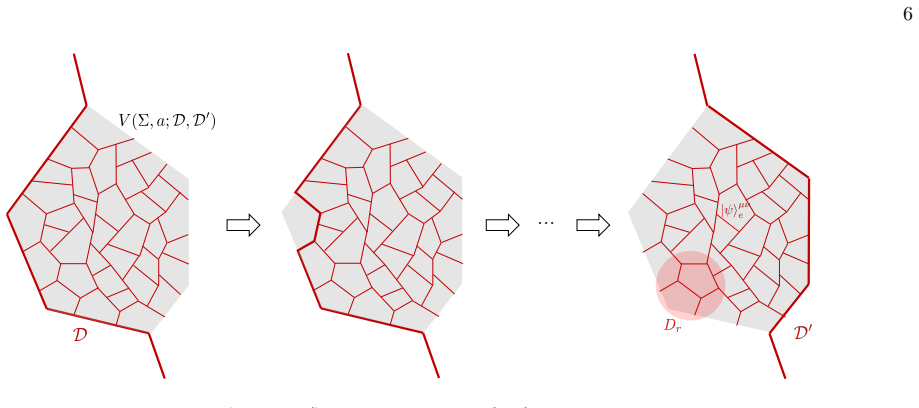
When defects are points We first consider the case when the defects are 0d point objects; the defect state eD E has a local 0d state along the defect network, eD E =|ψ⟩ D ⊗ |0⟩,(18) 5 where|ψ⟩ D is regarded as a union of 0d local states lo- calized at each defect. For each 1d line operator support Σ of the sequential circuit eV(Σ, a;D,D ′), we consider a ...
-
[5]
patchwork
When defects are lines Let us now consider the case when the defects are 1d objects; the defect state eD E has a 1d localized state along the defect network, eD E =|ψ⟩ D ⊗ |0⟩,(24) where|ψ⟩ D is regarded as a 1d gapped state localized at the defect network, which admits a matrix product state (MPS) representation. For each 2d operator support Σ of the seq...
-
[6]
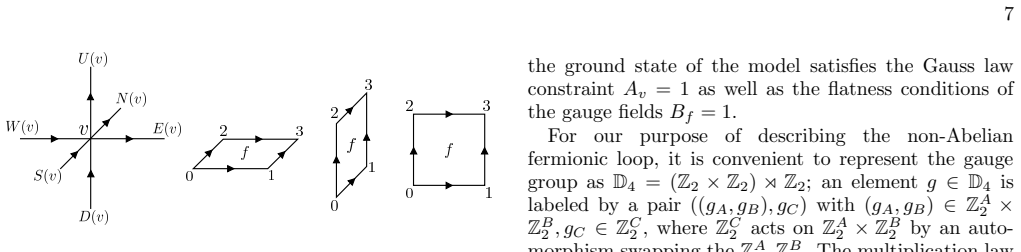
Lattice Hamiltonian The Hamiltonian on a 3D cubic lattice is defined as H=− X v Av − X f Bf (32) where the vertex termA v and the face termB f are given by Av := 1 |D4| X g∈D4 − →X g E(v) − →X g N(v) − →X g U(v) ← −X g W(v) ← −X g S(v) ← −X g D(v), (33) Bf :=δ g01g13g−1 23 g−1 02 ,e,(34) whereeis an identity element in a group, and an orien- tation of an ...
-
[7]
This can be achieved by considering the (Z A 4 × ZB 4 )⋊ZC 2 gauge theory with the condensation of the mag- netic flux (m i)2 in eachZ 4 toric code part
Qudit representation of the model We introduce the qudit description of theD 4 gauge theory. This can be achieved by considering the (Z A 4 × ZB 4 )⋊ZC 2 gauge theory with the condensation of the mag- netic flux (m i)2 in eachZ 4 toric code part. An explicit construction is as follows. We denoteZ 4 Pauli operators as eZand eX, satisfying eZeX=i eXeZ. We n...
-
[8]
Let us introduce the Hamiltonian HZ2 =− X v Y ∂e∋v Xe − X f Y e∈∂f Ze (43) where aZ 2 qubit lives on each edge, andX e andZ e are Pauli operators
Warm-up: fermionic loop in(3 + 1)DZ 2 gauge theory Let us first recall the Abelian fermionic loop in (3 + 1)DZ 2 gauge theory on the cubic lattice [69]. Let us introduce the Hamiltonian HZ2 =− X v Y ∂e∋v Xe − X f Y e∈∂f Ze (43) where aZ 2 qubit lives on each edge, andX e andZ e are Pauli operators. The theory has an anomalousZ 2 1-form symmetry generated ...
-
[9]
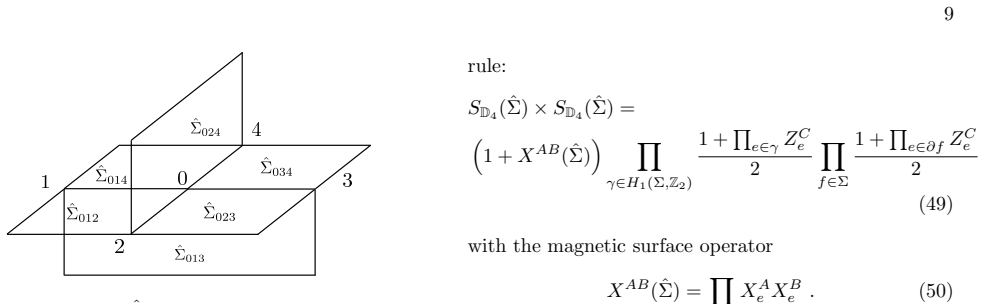
Non-Abelian fermionic loop in (3+1)DD 4 gauge theory Let us now consider a non-Abelian fermionic loop of D4 gauge theory. We define the following surface opera- tor on a closed surface ˆΣ on the dual cubic lattice: SD4(ˆΣ) :=W S(Σ)· 1 2 X α=A,B T α X(ˆΣ)· Y γ∈H1(Σ,Z2) 1 +Q e∈γ Z C e 2 Y f∈Σ 1 +Q e∈∂f Z C e 2 ,(46) T α X(ˆΣ) := Y e∈ˆΣ X cγ(e0 ,e)(α) e , (4...
-
[10]
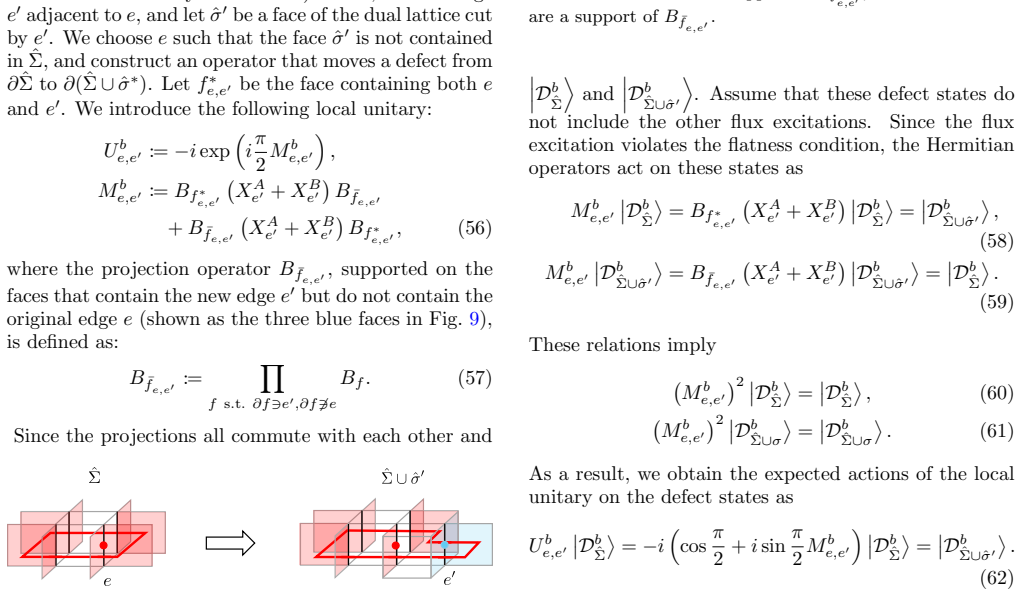
Definition of local unitary for sequential circuits We first introduce a local unitary to expand the defect by a unit open surface on the dual cube generated by a single edge (see Fig. 8). Let us take an edgeeat∂ ˆΣ, on which a magnetic flux excitation is supported (where∂ denotes the boundary of a surface). Then, take an edge e′ adjacent toe, and let ˆσ′...
-
[11]
Let us consider the defect states FIG
Action of the local unitary on the defect states Now we show that the above local unitary deforms the defect configurations. Let us consider the defect states FIG. 9. The red face is a support ofB f ∗ e,e′ , and the blue faces are a support ofB ¯fe,e′ . Db ˆΣ E and Db ˆΣ∪ˆσ′ E . Assume that these defect states do not include the other flux excitations. Si...
-
[12]
, eN) as V b(ˆΣ, ˆΣ1) = N−1Y k=1 U b ek,ek+1 ,(63) where the product is path-ordered to represent a step- by-step expansion of the surface defect as follows
Construction of the sequential circuitV b We then defineV b(ˆΣ, ˆΣ1) by assigning a strict order- ing to the edges (e 1, . . . , eN) as V b(ˆΣ, ˆΣ1) = N−1Y k=1 U b ek,ek+1 ,(63) where the product is path-ordered to represent a step- by-step expansion of the surface defect as follows. Let ˆσk 11 be the unit open surface expanded by thek-th local uni- taryU...
-
[13]
Unitary circuits in qudit representation In theZ 4 qudit representation, the defect states and related sequential circuits are also defined in a similar manner. The defect states are defined by eDf ˆΣ E := eSD4(ˆΣ)|GS⟩, eDb ˆΣ E := 1√ 2 eT A X(ˆΣ) +eT B X (ˆΣ) |GS⟩.(64) These defect configurations are deformed by sequential unitaries: eV f(ˆΣ, ˆΣ1) =fWS(Σ...
-
[14]
To defineZ 2 invariant associated to the loop excitations, we again employ the 24-step unitary sequence shown in Fig
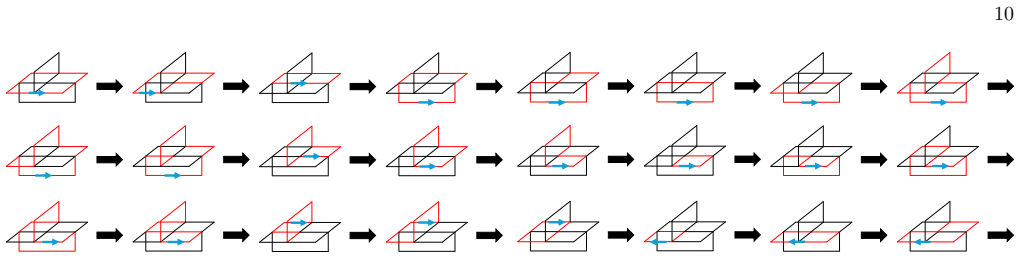
24-step unitary sequence Let us consider theZ 2 invariant for non-Abelian loop excitation. To defineZ 2 invariant associated to the loop excitations, we again employ the 24-step unitary sequence shown in Fig. 7, and define the Berry phase eiΘf := D Df ˆΣ0 V f 014V f 034V f 023V f† 014V f† 024V f 012V f† 023 ×V f† 013V f 024V f 014V f 013V f† 024V f† 034V ...
-
[15]
For simplicity of computations, we work on defect operators withZ 4 qudits instead of qubits for the Hilbert spaceA, B[69]
-
[16]
Evaluate the relative phase between our targeteiΘf and the Berry phase of pure non-Abelian fluxe iΘb
-
[17]
Evaluate the phase of pure non-Abelian fluxe iΘb. In the first step, we replace all operators by theZ 4 qudit representation for the invariance: eiΘf = D eDf ˆΣ0 eV f 014eV f 034eV f 023eV f† 014eV f† 024eV f 012eV f† 023 ×eV f† 013eV f 024eV f 014eV f 013eV f† 024eV f† 034eV f 023eV f† 013eV f† 012 ×eV f 034eV f 024eV f 012eV f† 034eV f† 014eV f 013eV f†...
-
[18]
classical gauging
Let the initial state be a pure toric-code ground stateρ 0 =|TC⟩ ⟨TC|. It is often con- venient to represent the mixed stateρ=Nρ 0 as a pure Choi state in a doubled Hilbert spaceH + ⊗ H−, |ρ⟩⟩= X j,k ρjk |j⟩+ ⊗ |k⟩∗ − ,(85) where (·) ∗ denotes complex conjugation in a fixed com- putational basis. Atp= 1 2, the Choi state can be written compactly as |Nρ 0⟩...
-
[19]
Symmetry protected topological orders and the group cohomology of their symmetry group,
Xie Chen, Zheng-Cheng Gu, Zheng-Xin Liu, and Xiao- Gang Wen, “Symmetry protected topological orders and the group cohomology of their symmetry group,” Phys. Rev. B87, 155114 (2013), arXiv:1106.4772 [cond- mat.str-el]
Pith/arXiv arXiv 2013
-
[20]
Generalized Global Symmetries,
Davide Gaiotto, Anton Kapustin, Nathan Seiberg, and 14 Brian Willett, “Generalized Global Symmetries,” JHEP 02, 172 (2015), arXiv:1412.5148 [hep-th]
Pith/arXiv arXiv 2015
-
[21]
Topological Defect Lines and Renormalization Group Flows in Two Dimensions,
Chi-Ming Chang, Ying-Hsuan Lin, Shu-Heng Shao, Yi- fan Wang, and Xi Yin, “Topological Defect Lines and Renormalization Group Flows in Two Dimensions,” JHEP01, 026 (2019), arXiv:1802.04445 [hep-th]
Pith/arXiv arXiv 2019
-
[22]
Topological Defects on the Lattice: Dualities and De- generacies,
David Aasen, Paul Fendley, and Roger S. K. Mong, “Topological Defects on the Lattice: Dualities and De- generacies,” (2020), arXiv:2008.08598 [cond-mat.stat- mech]
arXiv 2020
-
[23]
Noninvertible duality defects in 3+1 dimensions,
Yichul Choi, Clay C´ ordova, Po-Shen Hsin, Ho Tat Lam, and Shu-Heng Shao, “Noninvertible duality defects in 3+1 dimensions,” Phys. Rev. D105, 125016 (2022), arXiv:2111.01139 [hep-th]
Pith/arXiv arXiv 2022
-
[24]
Kramers-Wannier-like Duality Defects in (3+1)D Gauge Theories,
Justin Kaidi, Kantaro Ohmori, and Yunqin Zheng, “Kramers-Wannier-like Duality Defects in (3+1)D Gauge Theories,” Phys. Rev. Lett.128, 111601 (2022), arXiv:2111.01141 [hep-th]
arXiv 2022
-
[25]
Non-invertible Condensation, Du- ality, and Triality Defects in 3+1 Dimensions,
Yichul Choi, Clay C´ ordova, Po-Shen Hsin, Ho Tat Lam, and Shu-Heng Shao, “Non-invertible Condensation, Du- ality, and Triality Defects in 3+1 Dimensions,” (2022), arXiv:2204.09025 [hep-th]
arXiv 2022
-
[26]
Anomalies of (1 + 1)Dcategorical symmetries,
Carolyn Zhang and Clay C´ ordova, “Anomalies of (1 + 1)Dcategorical symmetries,” (2023), arXiv:2304.01262 [cond-mat.str-el]
arXiv 2023
-
[27]
Anomalies of Non-Invertible Symmetries in (3+1)d,
Clay Cordova, Po-Shen Hsin, and Carolyn Zhang, “Anomalies of Non-Invertible Symmetries in (3+1)d,” (2023), arXiv:2308.11706 [hep-th]
arXiv 2023
-
[28]
Gener- alized Charges, Part II: Non-Invertible Symmetries and the Symmetry TFT,
Lakshya Bhardwaj and Sakura Schafer-Nameki, “Gener- alized Charges, Part II: Non-Invertible Symmetries and the Symmetry TFT,” (2023), arXiv:2305.17159 [hep-th]
arXiv 2023
-
[29]
Categorical Landau Paradigm for Gapped Phases,
Lakshya Bhardwaj, Lea E. Bottini, Daniel Pajer, and Sakura Schafer-Nameki, “Categorical Landau Paradigm for Gapped Phases,” Phys. Rev. Lett.133, 161601 (2024), arXiv:2310.03786 [cond-mat.str-el]
arXiv 2024
-
[30]
Ictp lectures on (non- )invertible generalized symmetries,
Sakura Schafer-Nameki, “Ictp lectures on (non- )invertible generalized symmetries,” (2023), arXiv:2305.18296 [hep-th]
Pith/arXiv arXiv 2023
-
[31]
What’s Done Cannot Be Undone: TASI Lectures on Non-Invertible Symmetries,
Shu-Heng Shao, “What’s Done Cannot Be Undone: TASI Lectures on Non-Invertible Symmetries,” (2023), arXiv:2308.00747 [hep-th]
Pith/arXiv arXiv 2023
-
[32]
Non-invertible sym- metries act locally by quantum operations,
Masaki Okada and Yuji Tachikawa, “Non-invertible sym- metries act locally by quantum operations,” (2024), arXiv:2403.20062 [hep-th]
arXiv 2024
-
[33]
Beyond wigner: Non-invertible symme- tries preserve probabilities,
Thomas Bartsch, Yuhan Gai, and Sakura Schafer- Nameki, “Beyond wigner: Non-invertible symme- tries preserve probabilities,” (2026), arXiv:2602.07110 [quant-ph]
arXiv 2026
-
[34]
On the structure of categorical duality operators,
Corey Jones and Xinping Yang, “On the structure of categorical duality operators,” (2026), arXiv:2603.09949 [math.QA]
arXiv 2026
-
[35]
To appear,
Sahand Seifnashri and Shu-Heng Shao, “To appear,” (2026)
2026
-
[36]
An operator algebraic approach to fusion category symmetry on the lattice,
David E. Evans and Corey Jones, “An operator algebraic approach to fusion category symmetry on the lattice,” (2026), arXiv:2507.05185 [math-ph]
Pith/arXiv arXiv 2026
-
[37]
Remarks on non-invertible symmetries on a tensor product hilbert space in 1+1 dimensions,
Kansei Inamura, “Remarks on non-invertible symmetries on a tensor product hilbert space in 1+1 dimensions,” (2026), arXiv:2602.12053 [cond-mat.str-el]
arXiv 2026
-
[38]
Non-invertible symmetries on tensor-product hilbert spaces and quantum cellular automata,
Rui Wen, Kansei Inamura, and Sakura Schafer- Nameki, “Non-invertible symmetries on tensor-product hilbert spaces and quantum cellular automata,” (2026), arXiv:2605.15194 [cond-mat.str-el]
Pith/arXiv arXiv 2026
-
[39]
Sequential circuit as generalized symmetry on lattice,
Nathanan Tantivasadakarn, Xinyu Liu, and Xie Chen, “Sequential circuit as generalized symmetry on lattice,” (2025), arXiv:2507.22394 [cond-mat.str-el]
arXiv 2025
-
[40]
Cluster state as a non-invertible symmetry protected topological phase,
Sahand Seifnashri and Shu-Heng Shao, “Cluster state as a non-invertible symmetry protected topological phase,” (2024), arXiv:2404.01369 [cond-mat.str-el]
arXiv 2024
-
[41]
Anomaly con- straints on deconfinement and chiral phase transition,
Hiroyuki Shimizu and Kazuya Yonekura, “Anomaly con- straints on deconfinement and chiral phase transition,” Phys. Rev. D97, 105011 (2018)
2018
-
[42]
Symmetry-enriched quantum spin liquids in (3 + 1)d,
Po-Shen Hsin and Alex Turzillo, “Symmetry-enriched quantum spin liquids in (3 + 1)d,” Journal of High En- ergy Physics2020, 22 (2020)
2020
-
[43]
Symmetries and strings of adjoint QCD 2,
Zohar Komargodski, Kantaro Ohmori, Konstantinos Roumpedakis, and Sahand Seifnashri, “Symmetries and strings of adjoint QCD 2,” Journal of High Energy Physics2021, 103 (2021)
2021
-
[44]
Symmetry protected topological orders and the group cohomology of their symmetry group,
Xie Chen, Zheng-Cheng Gu, Zheng-Xin Liu, and Xiao- Gang Wen, “Symmetry protected topological orders and the group cohomology of their symmetry group,” Phys. Rev. B87, 155114 (2013)
2013
-
[45]
Dominic V. Else and Chetan Nayak, “Classifying symmetry-protected topological phases through the anomalous action of the symmetry on the edge,” Physi- cal Review B90(2014), 10.1103/physrevb.90.235137
-
[46]
Bosonic topological phases of matter: Bulk- boundary correspondence, symmetry protected topolog- ical invariants, and gauging,
Apoorv Tiwari, Xiao Chen, Ken Shiozaki, and Shin- sei Ryu, “Bosonic topological phases of matter: Bulk- boundary correspondence, symmetry protected topolog- ical invariants, and gauging,” Phys. Rev. B97, 245133 (2018)
2018
-
[47]
Two soluble models of an antiferromagnetic chain,
Elliott Lieb, Theodore Schultz, and Daniel Mattis, “Two soluble models of an antiferromagnetic chain,” Annals of Physics16, 407 – 466 (1961)
1961
-
[48]
Commensurability, excitation gap, and topology in quantum many-particle systems on a periodic lattice,
Masaki Oshikawa, “Commensurability, excitation gap, and topology in quantum many-particle systems on a periodic lattice,” Phys. Rev. Lett.84, 1535–1538 (2000)
2000
-
[49]
Lieb-schultz-mattis in higher dimen- sions,
M. B. Hastings, “Lieb-schultz-mattis in higher dimen- sions,” Phys. Rev. B69, 104431 (2004)
2004
-
[50]
Trans- lational symmetry and microscopic constraints on symmetry-enriched topological phases: A view from the surface,
Meng Cheng, Michael Zaletel, Maissam Barkeshli, Ashvin Vishwanath, and Parsa Bonderson, “Trans- lational symmetry and microscopic constraints on symmetry-enriched topological phases: A view from the surface,” Phys. Rev. X6, 041068 (2016)
2016
-
[51]
Anomaly manifestation of lieb-schultz-mattis theorem and topological phases,
Gil Young Cho, Chang-Tse Hsieh, and Shinsei Ryu, “Anomaly manifestation of lieb-schultz-mattis theorem and topological phases,” Phys. Rev. B96, 195105 (2017)
2017
-
[52]
Measurement ofCP-averaged observables in theB 0 →K ∗0µ+µ− decay,
Ryohei Kobayashi, Ken Shiozaki, Yuta Kikuchi, and Shinsei Ryu, “Lieb-schultz-mattis type theorem with higher-form symmetry and the quantum dimer mod- els,” Physical Review B99(2019), 10.1103/phys- revb.99.014402
-
[53]
Topological the- ory of lieb-schultz-mattis theorems in quantum spin sys- tems,
Dominic V. Else and Ryan Thorngren, “Topological the- ory of lieb-schultz-mattis theorems in quantum spin sys- tems,” Phys. Rev. B101, 224437 (2020)
2020
-
[54]
Lieb-schultz- mattis–type constraints on fractonic matter,
Huan He, Yizhi You, and Abhinav Prem, “Lieb-schultz- mattis–type constraints on fractonic matter,” Phys. Rev. B101, 165145 (2020)
2020
-
[55]
Lieb-Schultz-Mattis, Luttinger, and ’t Hooft - anomaly matching in lattice systems,
Meng Cheng and Nathan Seiberg, “Lieb-Schultz-Mattis, Luttinger, and ’t Hooft - anomaly matching in lattice systems,” SciPost Phys.15, 051 (2023)
2023
-
[56]
Sahand Seifnashri, “Lieb-schultz-mattis anomalies as ob- structions to gauging (non-on-site) symmetries,” SciPost Physics16(2024), 10.21468/scipostphys.16.4.098
-
[57]
Higher-form anomalies on lattices,
Yitao Feng, Ryohei Kobayashi, Yu-An Chen, and Shin- sei Ryu, “Higher-form anomalies on lattices,” Physical Review Letters136(2026), 10.1103/2jz1-m1lb
-
[58]
Generalized statistics on lat- 15 tices,
Ryohei Kobayashi, Yuyang Li, Hanyu Xue, Po-Shen Hsin, and Yu-An Chen, “Generalized statistics on lat- 15 tices,” Physical Review X16(2026), 10.1103/6k88- w52n
-
[59]
Anomaly diagnosis via symmetry restriction in two-dimensional lattice sys- tems,
Kyle Kawagoe and Wilbur Shirley, “Anomaly diagnosis via symmetry restriction in two-dimensional lattice sys- tems,” (2025), arXiv:2507.07430 [cond-mat.str-el]
arXiv 2025
-
[60]
Higher symmetries and anomalies in quantum lattice systems,
Anton Kapustin and Shixiong Xu, “Higher symmetries and anomalies in quantum lattice systems,” (2025), arXiv:2505.04719 [math-ph]
arXiv 2025
-
[61]
Anomaly-free symmetries with obstructions to gauging and onsiteability,
Wilbur Shirley, Carolyn Zhang, Wenjie Ji, and Michael Levin, “Anomaly-free symmetries with obstructions to gauging and onsiteability,” (2025), arXiv:2507.21267 [cond-mat.str-el]
arXiv 2025
-
[62]
Anomalies of global symmetries on the lattice,
Yi-Ting Tu, David M. Long, and Dominic V. Else, “Anomalies of global symmetries on the lattice,” (2025), arXiv:2507.21209 [cond-mat.str-el]
arXiv 2025
-
[63]
Microscopic defini- tions of anyon data,
Kyle Kawagoe and Michael Levin, “Microscopic defini- tions of anyon data,” Physical Review B101(2020), 10.1103/physrevb.101.115113
-
[64]
Framed wilson operators, fermionic strings, and gravitational anomaly in 4d,
Ryan Thorngren, “Framed wilson operators, fermionic strings, and gravitational anomaly in 4d,” Journal of High Energy Physics2015(2015), 10.1007/jhep02(2015)152
-
[65]
Lukasz Fidkowski, Jeongwan Haah, and Matthew B. Hastings, “Gravitational anomaly of (3+1)-dimensional Z2 toric code with fermionic charges and fermionic loop self-statistics,” Phys. Rev. B106, 165135 (2022), arXiv:2110.14654 [cond-mat.str-el]
arXiv 2022
-
[66]
Exactly solvable lat- tice Hamiltonians and gravitational anomalies,
Yu-An Chen and Po-Shen Hsin, “Exactly solvable lat- tice Hamiltonians and gravitational anomalies,” SciPost Phys.14, 089 (2023), arXiv:2110.14644 [cond-mat.str- el]
arXiv 2023
-
[67]
Pauli stabilizer formalism for topological quantum field theories and generalized statis- tics,
Yitao Feng, Hanyu Xue, Ryohei Kobayashi, Po-Shen Hsin, and Yu-An Chen, “Pauli stabilizer formalism for topological quantum field theories and generalized statis- tics,” (2026), arXiv:2601.00064 [quant-ph]
Pith/arXiv arXiv 2026
-
[68]
Noisy Approach to Intrinsically Mixed-State Topological Order,
Ramanjit Sohal and Abhinav Prem, “Noisy Approach to Intrinsically Mixed-State Topological Order,” PRX Quantum6, 010313 (2025), arXiv:2403.13879 [cond- mat.str-el]
arXiv 2025
-
[69]
Toward a Classification of Mixed-State Topological Orders in Two Dimensions,
Tyler D. Ellison and Meng Cheng, “Toward a Classification of Mixed-State Topological Orders in Two Dimensions,” PRX Quantum6, 010315 (2025), arXiv:2405.02390 [cond-mat.str-el]
arXiv 2025
-
[70]
Intrinsic mixed-state topological order,
Zijian Wang, Zhengzhi Wu, and Zhong Wang, “Intrinsic mixed-state topological order,” PRX Quantum6(2025), 10.1103/prxquantum.6.010314, arXiv:2307.13758 [quant-ph]
-
[71]
Carolyn Zhang, Yichen Xu, Jian-Hao Zhang, Cenke Xu, Zhen Bi, and Zhu-Xi Luo, “Strong-to-weak spon- taneous breaking of 1-form symmetry and intrinsi- cally mixed topological order,” arXiv e-prints (2024), 10.48550/arXiv.2409.17530, arXiv:2409.17530 [quant- ph]
-
[72]
Jong Yeon Lee, Chao-Ming Jian, and Cenke Xu, “Quantum criticality under decoherence or weak mea- surement,” PRX Quantum4(2023), 10.1103/prxquan- tum.4.030317
-
[73]
Diagnostics of mixed-state topological order and breakdown of quantum memory,
Ruihua Fan, Yimu Bao, Ehud Altman, and Ashvin Vish- wanath, “Diagnostics of mixed-state topological order and breakdown of quantum memory,” PRX Quantum5 (2024), 10.1103/prxquantum.5.020343
-
[74]
Yimu Bao, Ruihua Fan, Ashvin Vishwanath, and Ehud Altman, “Mixed-state topological order and the errorfield double formulation of decoherence- induced transitions,” arXiv e-prints (2023), 10.48550/arXiv.2301.05687, arXiv:2301.05687 [quant- ph]
work page internal anchor Pith review Pith/arXiv arXiv doi:10.48550/arxiv.2301.05687 2023
-
[75]
Separability transi- tions in topological states induced by local decoherence,
Yu-Hsueh Chen and Tarun Grover, “Separability transi- tions in topological states induced by local decoherence,” Phys. Rev. Lett.132, 170602 (2024)
2024
-
[76]
Anomalous matrix product operator symmetries and 1d mixed-state phases,
Xiao-Qi Sun, “Anomalous matrix product operator symmetries and 1d mixed-state phases,” (2025), arXiv:2504.16985 [quant-ph]
arXiv 2025
-
[77]
Mixed-State Quantum Anomaly and Multipartite Entanglement,
Leonardo A. Lessa, Meng Cheng, and Chong Wang, “Mixed-State Quantum Anomaly and Multipartite Entanglement,” Phys. Rev. X15, 011069 (2025), arXiv:2401.17357 [cond-mat.str-el]
arXiv 2025
-
[78]
Anomalies of average symmetries: entanglement and open quantum systems,
Po-Shen Hsin, Zhu-Xi Luo, and Hao-Yu Sun, “Anomalies of average symmetries: entanglement and open quantum systems,” JHEP10, 134 (2024), arXiv:2312.09074 [cond-mat.str-el]
arXiv 2024
-
[79]
Reviving the Lieb–Schultz–Mattis theorem in open quantum systems,
Yi-Neng Zhou, Xingyu Li, Hui Zhai, Chengshu Li, and Yingfei Gu, “Reviving the Lieb–Schultz–Mattis theorem in open quantum systems,” Natl. Sci. Rev.12, nwae287 (2024), arXiv:2310.01475 [cond-mat.str-el]
arXiv 2024
-
[80]
De- tecting Quantum Anomalies in Open Systems,
Yunlong Zang, Yingfei Gu, and Shenghan Jiang, “De- tecting Quantum Anomalies in Open Systems,” Phys. Rev. Lett.133, 106503 (2024), arXiv:2312.11188 [cond- mat.str-el]
arXiv 2024
discussion (0)
Sign in with ORCID, Apple, or X to comment. Anyone can read and Pith papers without signing in.