Structure-Preserving Neural Surrogates with Tractable Uncertainty Quantification
Pith reviewed 2026-06-27 11:01 UTC · model grok-4.3
The pith
A combination of mixed finite elements and Gaussian processes yields structure-preserving PDE surrogates with closed-form uncertainty on boundary fluxes.
A machine-rendered reading of the paper's core claim, the machinery that carries it, and where it could break.
Core claim
By posing Gaussian process regression as an optimal recovery problem with equality constraints that enforce conservation, the model reduces to a constrained optimization that admits fast training; once trained, it delivers real-time solutions for boundary fluxes from prescribed Dirichlet data along with closed-form posterior uncertainty estimates for quantities of interest, supported by RKHS error bounds.
What carries the argument
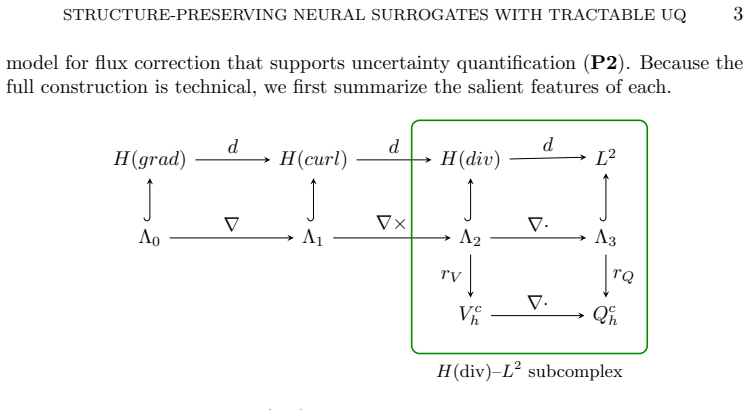
The interface between H(div)-L2 mixed finite element spaces and Gaussian process regression, where the optimal recovery problem imposes conservation structure through equality constraints for fast Schur-complement training.
If this is right
- The trained surrogate solves in real time for boundary fluxes driven by Dirichlet data.
- Posterior uncertainty for quantities of interest has closed-form expressions.
- RKHS posterior error bounds provide theoretical support for uncertainty quantification.
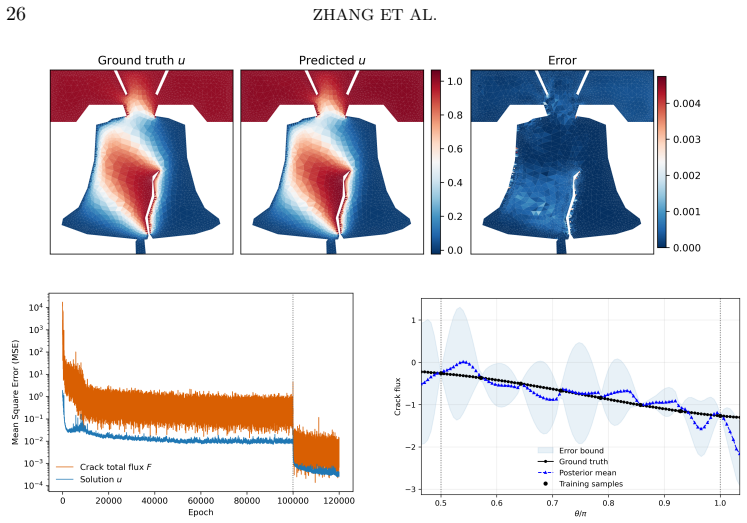
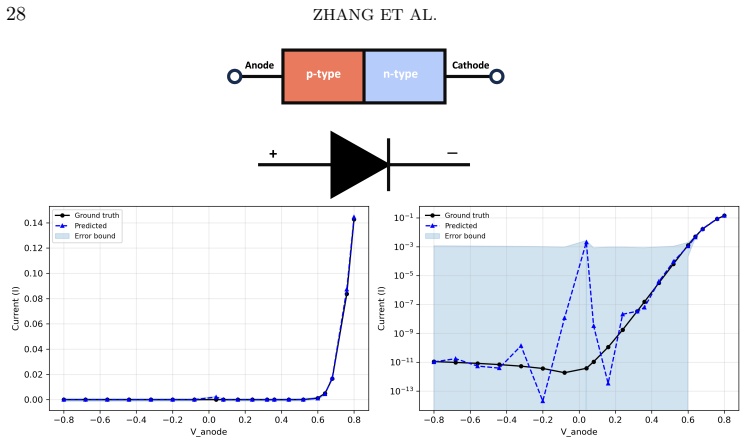
- Numerical experiments confirm the posterior distribution accurately estimates errors.
- Reduced-order dynamics remain consistent with the prescribed subspace structure.
Where Pith is reading between the lines
- This framework could be applied to time-dependent problems or nonlinear conservation laws by extending the GP flux model.
- Real-time capability with UQ might support applications in uncertainty-aware control or optimization of physical systems.
- The use of a transformer to prescribe subspaces suggests potential for learned discretizations in other structure-preserving methods.
- Closed-form uncertainty could enable efficient Monte Carlo sampling for risk assessment in engineering simulations.
Load-bearing premise
That the topological structure from exterior calculus allows construction of a Gaussian process on state-flux relationships that, when formulated as an optimal recovery problem, produces a regression with equality constraints solvable by fast Schur-complement methods.
What would settle it
A test case on a known PDE where the surrogate's posterior uncertainty intervals fail to contain the actual discrepancy between the surrogate prediction and the true solution for boundary fluxes or quantities of interest.
Figures



read the original abstract
Recent advances in scientific machine learning provide a means of near-real-time solution to partial differential equations (PDEs), but lack the theoretical underpinnings of conventional simulators that support contemporary verification and validation. In this work, we construct data-driven reduced-order models that serve as structure-preserving, real-time surrogates. Remarkably, the exterior calculus that imposes physical conservation structure also exposes topological structure that we use to build a Gaussian process (GP) representation of uncertainty in state-flux relationships, ultimately yielding a Dirichlet-to-Neumann map for quantities of interest with closed-form expressions for posterior uncertainty. We specifically propose structure-preserving $H(\mathrm{div})$--$L^2$ subspaces of conventional Raviart--Thomas and $dgP_0$ elements prescribed by a lightweight transformer. Reduced-order dynamics consistent with this subspace are learned by posing a conservation law in which a GP describes the fluxes between volumes. This work hinges on a novel interface between mixed FEM spaces and GP regression; when training is posed as the optimal recovery problem (ORP), the resulting GP regression can be written as an optimization problem with equality constraints that impose a conservation structure, amenable to a fast Schur-complement training strategy. The trained model can then be solved in real time with closed-form estimators for boundary fluxes driven by prescribed Dirichlet data. The paper includes RKHS posterior error bounds for linear functionals to support uncertainty quantification, as well as numerical experiments demonstrating the accuracy of the posterior distribution as a surrogate for error estimation.
Editorial analysis
A structured set of objections, weighed in public.
Referee Report
Summary. The paper proposes structure-preserving reduced-order surrogates for PDEs by combining H(div)-L2 mixed finite-element spaces (Raviart-Thomas and dgP0 elements selected by a lightweight transformer) with a Gaussian-process model of inter-volume fluxes. Training is recast as an optimal recovery problem whose equality constraints enforce conservation; the resulting constrained regression is solved via Schur complement to produce a real-time Dirichlet-to-Neumann map equipped with closed-form posterior mean and variance, together with RKHS error bounds for linear functionals. Numerical experiments are presented to illustrate accuracy of the posterior as an error surrogate.
Significance. If the central construction is valid, the work supplies a concrete route to real-time, structure-preserving surrogates that also deliver rigorous, closed-form uncertainty quantification derived from the same RKHS framework used for the mean. The explicit interface between mixed FEM and constrained GP regression, together with the provision of posterior error bounds, would be a notable contribution to scientific machine learning.
major comments (2)
- [Abstract / ORP section] Abstract and the section describing the ORP formulation: the claim that recasting GP regression as an optimization problem with equality constraints for conservation yields a posterior whose mean and variance remain the standard unconstrained Schur-complement expressions requires an explicit derivation. Standard results on GPs with linear equality constraints produce a modified posterior covariance that incorporates the constraint matrix; it is not immediate that the paper's construction recovers the simple Schur form while preserving the stated RKHS bounds.
- [Abstract / Dirichlet-to-Neumann paragraph] The paragraph on the Dirichlet-to-Neumann map and closed-form boundary-flux estimators: the argument that the trained model furnishes closed-form estimators for boundary fluxes driven by prescribed Dirichlet data must be shown to survive the introduction of the equality constraints; otherwise the tractable-UQ claim is not load-bearing.
minor comments (2)
- Notation for the mixed spaces and the transformer that selects the reduced subspace should be introduced with a short table or diagram for clarity.
- The numerical-experiments section would benefit from an explicit statement of the kernel hyperparameters used and whether they were held fixed or optimized.
Simulated Author's Rebuttal
We thank the referee for their thorough review and for highlighting the need for greater clarity in the theoretical development. The comments identify two places where explicit derivations would strengthen the manuscript; we agree and will incorporate them in the revision. Below we respond point by point.
read point-by-point responses
-
Referee: [Abstract / ORP section] Abstract and the section describing the ORP formulation: the claim that recasting GP regression as an optimization problem with equality constraints for conservation yields a posterior whose mean and variance remain the standard unconstrained Schur-complement expressions requires an explicit derivation. Standard results on GPs with linear equality constraints produce a modified posterior covariance that incorporates the constraint matrix; it is not immediate that the paper's construction recovers the simple Schur form while preserving the stated RKHS bounds.
Authors: We agree that an explicit derivation is required. In the revised manuscript we will add a dedicated subsection (and supporting appendix) that starts from the constrained optimal-recovery problem, forms the Lagrangian, eliminates the multipliers via the Schur complement, and shows that the resulting posterior mean and covariance are identical to the unconstrained expressions because the conservation constraints are linear and homogeneous in the flux variables. We will also verify that the RKHS error bounds for linear functionals continue to hold, as they depend only on the reproducing kernel and the observation operator, not on the particular form of the equality constraints. This addition will be placed immediately after the ORP formulation. revision: yes
-
Referee: [Abstract / Dirichlet-to-Neumann paragraph] The paragraph on the Dirichlet-to-Neumann map and closed-form boundary-flux estimators: the argument that the trained model furnishes closed-form estimators for boundary fluxes driven by prescribed Dirichlet data must be shown to survive the introduction of the equality constraints; otherwise the tractable-UQ claim is not load-bearing.
Authors: We will revise the Dirichlet-to-Neumann paragraph and the associated algorithmic description to include a short proof that the closed-form boundary-flux estimators remain valid after the equality constraints are enforced. Because the constraints act only on the interior fluxes and the boundary data enter as inhomogeneous terms in the linear system, the Schur-complement solution for the boundary fluxes retains its closed-form posterior mean and variance. The same derivation referenced in the first response will be cross-referenced here to make the tractability claim self-contained. revision: yes
Circularity Check
No significant circularity; derivation introduces novel mixed-FEM/GP interface via ORP with equality constraints and Schur training, supported by independent RKHS bounds.
full rationale
The paper's central construction—posing GP regression as an optimal recovery problem with conservation-enforcing equality constraints, then using Schur complement for training and closed-form Dirichlet-to-Neumann estimators—does not reduce to its inputs by definition or self-citation in the provided text. The abstract and description present this as a new interface between Raviart-Thomas/dgP0 subspaces and GP fluxes, with posterior uncertainty derived from RKHS error bounds for linear functionals. No quoted equations show a fitted parameter renamed as prediction, self-definitional loop, or load-bearing self-citation chain. The setup is self-contained against external benchmarks like standard GP posteriors and mixed FEM, with no evidence that the tractable UQ formulas are tautological. This is the expected honest non-finding for a methods paper describing a technical interface.
Axiom & Free-Parameter Ledger
free parameters (1)
- GP kernel hyperparameters
axioms (1)
- standard math Raviart-Thomas and dgP0 elements form H(div)-L2 conforming subspaces that preserve conservation structure
Reference graph
Works this paper leans on
-
[1]
2013 , doi =
Daniele Boffi and Franco Brezzi and Michel Fortin , title =. 2013 , doi =
2013
-
[2]
SIAM Journal on Scientific Computing , volume=
Discovery of Probabilistic Dirichlet-to-Neumann Maps on Graphs , author=. SIAM Journal on Scientific Computing , volume=. 2026 , publisher=
2026
-
[3]
2006 , publisher =
Gaussian Processes for Machine Learning , author =. 2006 , publisher =
2006
-
[4]
International Conference on Machine Learning , pages=
Shampoo: Preconditioned stochastic tensor optimization , author=. International Conference on Machine Learning , pages=. 2018 , organization=
2018
-
[5]
Journal of Computational Physics , volume=
Data-driven Whitney forms for structure-preserving control volume analysis , author=. Journal of Computational Physics , volume=. 2024 , publisher=
2024
-
[6]
Research in the Mathematical Sciences , volume=
Computational graph completion , author=. Research in the Mathematical Sciences , volume=. 2022 , publisher=
2022
-
[7]
arXiv preprint arXiv:2510.05568 , year=
Bilevel optimization for learning hyperparameters: Application to solving PDEs and inverse problems with Gaussian processes , author=. arXiv preprint arXiv:2510.05568 , year=
-
[8]
arXiv preprint arXiv:2508.06981 , year=
Structure-preserving digital twins via conditional neural whitney forms , author=. arXiv preprint arXiv:2508.06981 , year=
-
[9]
Journal of Computational Physics , volume=
Enforcing exact physics in scientific machine learning: a data-driven exterior calculus on graphs , author=. Journal of Computational Physics , volume=. 2022 , publisher=
2022
-
[10]
Journal of Computational Physics , volume=
Solving and learning nonlinear PDEs with Gaussian processes , author=. Journal of Computational Physics , volume=. 2021 , publisher=
2021
-
[11]
International conference on machine learning , pages=
Gaussian process priors for systems of linear partial differential equations with constant coefficients , author=. International conference on machine learning , pages=. 2023 , organization=
2023
-
[12]
Nature Computational Science , volume=
Promising directions of machine learning for partial differential equations , author=. Nature Computational Science , volume=. 2024 , publisher=
2024
-
[13]
Machine learning for computational science and engineering , volume=
A survey on machine learning approaches for uncertainty quantification of engineering systems , author=. Machine learning for computational science and engineering , volume=. 2025 , publisher=
2025
-
[14]
arXiv preprint arXiv:2407.05477 , year=
Solving forward and inverse PDE problems on unknown manifolds via physics-informed neural operators , author=. arXiv preprint arXiv:2407.05477 , year=
-
[15]
Computers & Chemical Engineering , volume=
Physics-informed neural networks with hard linear equality constraints , author=. Computers & Chemical Engineering , volume=. 2024 , publisher=
2024
-
[16]
Advances in neural information processing systems , volume=
Characterizing possible failure modes in physics-informed neural networks , author=. Advances in neural information processing systems , volume=
-
[17]
Advances in neural information processing systems , volume=
The challenges of the nonlinear regime for physics-informed neural networks , author=. Advances in neural information processing systems , volume=
-
[18]
Bulletin of the American mathematical society , volume=
Finite element exterior calculus: from Hodge theory to numerical stability , author=. Bulletin of the American mathematical society , volume=
-
[19]
Arnold, Douglas N. and Falk, Richard S. and Winther, Ragnar , year=. Finite element exterior calculus, homological techniques, and applications , volume=. doi:10.1017/S0962492906210018 , journal=
-
[20]
Learning nonlinear operators via
Lu, Lu and Jin, Pengzhan and Pang, Guofei and Zang, Handy and Karniadakis, George , year =. Learning nonlinear operators via. Nature Machine Intelligence , doi =
-
[21]
Nature Reviews Physics , volume=
Physics-informed machine learning , author=. Nature Reviews Physics , volume=. 2021 , publisher=
2021
-
[22]
Gradient-enhanced physics-informed neural networks for forward and inverse
Yu, Jeremy and Lu, Lu and Meng, Xuhui and Karniadakis, George Em , journal=. Gradient-enhanced physics-informed neural networks for forward and inverse. 2022 , publisher=
2022
-
[23]
Science Advances , volume =
Sifan Wang and Hanwen Wang and Paris Perdikaris , title =. Science Advances , volume =. 2021 , doi =
2021
-
[24]
Fourier Neural Operator for Parametric Partial Differential Equations
Fourier neural operator for parametric partial differential equations , author=. arXiv preprint arXiv:2010.08895 , year=
work page internal anchor Pith review Pith/arXiv arXiv 2010
-
[25]
IEEE Transactions on Reliability , volume=
Accurate remaining useful life prediction with uncertainty quantification: a deep learning and nonstationary gaussian process approach , author=. IEEE Transactions on Reliability , volume=. 2021 , publisher=
2021
-
[26]
Journal of Computational Physics , volume=
Uncertainty quantification in scientific machine learning: Methods, metrics, and comparisons , author=. Journal of Computational Physics , volume=. 2023 , publisher=
2023
-
[27]
Information fusion , volume=
A review of uncertainty quantification in deep learning: Techniques, applications and challenges , author=. Information fusion , volume=. 2021 , publisher=
2021
-
[28]
Computer Methods in Applied Mechanics and Engineering , volume=
POD-DL-ROM: Enhancing deep learning-based reduced order models for nonlinear parametrized PDEs by proper orthogonal decomposition , author=. Computer Methods in Applied Mechanics and Engineering , volume=. 2022 , publisher=
2022
-
[29]
International Journal for Numerical Methods in Engineering , volume=
Data-driven physics-based digital twins via a library of component-based reduced-order models , author=. International Journal for Numerical Methods in Engineering , volume=. 2022 , publisher=
2022
-
[30]
Computer Methods in Applied Mechanics and Engineering , volume=
Accelerating high-fidelity simulations of chemically reacting flows using reduced-order modeling with time-dependent bases , author=. Computer Methods in Applied Mechanics and Engineering , volume=. 2025 , publisher=
2025
-
[31]
Foundation Models for Scientific Discovery and Innovation: Opportunities Across the Department of Energy and the Scientific Enterprise , isbn =. 2025 , publisher =. doi:10.17226/29212 , url =
-
[32]
Nature Electronics , volume=
Two-dimensional semiconductor integrated circuits operating at gigahertz frequencies , author=. Nature Electronics , volume=. 2023 , publisher=
2023
-
[33]
Proceedings of The First Mathematical and Scientific Machine Learning Conference , pages =
Data-driven Compact Models for Circuit Design and Analysis , author =. Proceedings of The First Mathematical and Scientific Machine Learning Conference , pages =. 2020 , editor =
2020
-
[34]
Pressure-flow dynamics with semi-stable limit cycles in hydraulic cylinder circuits , year=
Ruderman, Michael and Kaltenbacher, Stefan and Horn, Martin , booktitle=. Pressure-flow dynamics with semi-stable limit cycles in hydraulic cylinder circuits , year=
-
[35]
2021 , publisher=
Hydraulic fluid power: Fundamentals, applications, and circuit design , author=. 2021 , publisher=
2021
-
[36]
Physical Chemistry Chemical Physics , volume=
Microscale solid-state thermal diodes enabling ambient temperature thermal circuits for energy applications , author=. Physical Chemistry Chemical Physics , volume=. 2017 , publisher=
2017
-
[37]
Optimal estimation in approximation theory , pages=
A survey of optimal recovery , author=. Optimal estimation in approximation theory , pages=. 1977 , publisher=
1977
-
[38]
2.2 (revision1) , author=
Charon user manual: v. 2.2 (revision1) , author=. 2022 , institution=
2022
-
[39]
arXiv preprint arXiv:2603.11052 , year=
Structure-Aware Epistemic Uncertainty Quantification for Neural Operator PDE Surrogates , author=. arXiv preprint arXiv:2603.11052 , year=
-
[40]
Journal of Computational Physics , volume=
Adversarial uncertainty quantification in physics-informed neural networks , author=. Journal of Computational Physics , volume=. 2019 , publisher=
2019
-
[41]
Journal of Computational Physics , volume=
Conservative Model Reduction for Finite-Volume Models , author=. Journal of Computational Physics , volume=. 2018 , doi=
2018
-
[42]
SIAM Review , volume=
A Survey of Projection-Based Model Reduction Methods for Parametric Dynamical Systems , author=. SIAM Review , volume=. 2015 , doi=
2015
-
[43]
2016 , doi=
Reduced Basis Methods for Partial Differential Equations: An Introduction , author=. 2016 , doi=
2016
-
[44]
, title =
Musson, Lawrence and Gao, Xujiao and Negoita, Mihai and Huang, Andy and Hennigan, Gary L. , title =. 2018 , month =
2018
discussion (0)
Sign in with ORCID, Apple, or X to comment. Anyone can read and Pith papers without signing in.