Centrifugal instability of compressible flows and the hydrodynamic stability of accretion disks
Pith reviewed 2026-06-27 09:01 UTC · model grok-4.3
The pith
The centrifugal instability of compressible rotating flows depends on Mach number even in the Newtonian limit.
A machine-rendered reading of the paper's core claim, the machinery that carries it, and where it could break.
Core claim
A generalization of the Rayleigh criterion for compressible relativistic rotation shows the centrifugal instability depends on the flow Mach number. This holds in the Newtonian limit as well. Simulations of transonic rotating flows stable under the original Rayleigh criterion but potentially unstable under the new one agree perfectly with the theory. The criterion for accretion disks is equivalent to the Solberg-Høiland criterion, which lacks explicit Mach number dependence.
What carries the argument
The Mach-number-dependent generalization of the Rayleigh criterion for pressure-supported compressible rotation.
If this is right
- Simulations of non-relativistic transonic flows agree perfectly with the Mach-dependent criterion.
- The criterion applies to both relativistic and Newtonian compressible flows.
- The derived criterion for pressure-supported rotation about a central object is equivalent to the Solberg-Høiland criterion.
Where Pith is reading between the lines
- Stability analyses of highly supersonic accretion disks that rely solely on the classical Rayleigh criterion may overlook Mach-number effects that the equivalent Solberg-Høiland form already incorporates.
- The analogy between centrifugal force and gravity in the stability criteria suggests similar Mach-dependent generalizations could apply to other rotating astrophysical flows.
Load-bearing premise
The generalization of the Rayleigh criterion to compressible pressure-supported rotation is taken as given from prior analysis.
What would settle it
An axisymmetric simulation of a transonic Newtonian rotating flow that is stable according to the classical Rayleigh criterion but shows instability (or vice versa) according to the Mach-dependent criterion.
Figures

read the original abstract
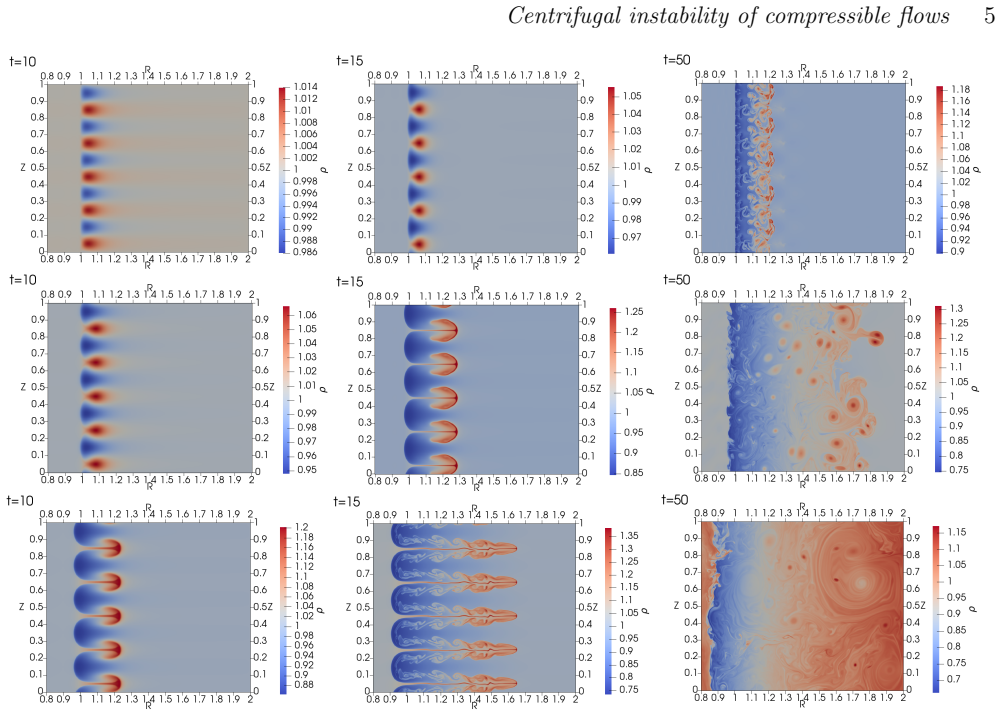
A recent analysis of the centrifugal instability in the case of pressure-supported compressible relativistic rotation, with application to astrophysical jets, yielded a generalisation of the famous Rayleigh criterion for Newtonian flows. According to this criterion, the centrifugal instability is strongly affected by the flow Mach number, and not only in the relativistic fluid dynamics but also in its Newtonian limit. To validate the Newtonian version of this criterion, we performed axisymmetric numerical simulations of non-relativistic transonic rotating flows which are stable according to the original Rayleigh criterion but can be either stable or unstable according to the new one. The results of computer simulations are found to be in perfect agreement with the theory. The hydrodynamic stability of accretion disks is often explained by referring to the original Rayleigh criterion, even if their rotation is highly supersonic. To clarify the matter, we analysed the hydrodynamic stability of flows rotating about central compact object and derived an instability criterion that retains the explicit dependence on the flow Mach number. This criterion turns out to be equivalent to the standard Solberg-H{\o}iland criterion, which does not involve the Mach number. The same applies to the case of pressure-supported rotation, where the role of gravity is played by the centrifugal force.
Editorial analysis
A structured set of objections, weighed in public.
Referee Report
Summary. The paper generalizes the Rayleigh criterion for centrifugal instability to compressible pressure-supported rotation, showing Mach number dependence even in the Newtonian limit. It validates the Newtonian transonic case via axisymmetric simulations of flows stable by the original Rayleigh criterion but potentially unstable by the new criterion, reporting perfect agreement with theory. For accretion disks, it derives a Mach-dependent instability criterion shown to be equivalent to the standard Solberg-Høiland criterion.
Significance. If the results hold, the work supplies targeted numerical validation for the compressible generalization in the Newtonian regime and resolves applicability questions for supersonic accretion disks by establishing mathematical equivalence to the Solberg-Høiland criterion. The simulation agreement and the equivalence demonstration are explicit strengths that support the central claims without introducing free parameters.
major comments (1)
- The validation of the Newtonian transonic case rests on the claim that simulation results are in 'perfect agreement' with the generalized criterion. The manuscript should report quantitative measures of this agreement (e.g., comparison of measured growth rates to theoretical predictions) and details on simulation parameters such as resolution, initial perturbation amplitudes, and case selection criteria to substantiate the load-bearing validation result.
minor comments (2)
- The abstract states that the disk criterion 'turns out to be equivalent' to Solberg-Høiland; the main text should include an explicit cross-reference to the equations or subsection where the algebraic equivalence is demonstrated.
- Clarify in the introduction or methods the precise scope of the new contribution versus the referenced prior compressible generalization to avoid any ambiguity about what is being validated here.
Simulated Author's Rebuttal
We thank the referee for the careful review and the recommendation of minor revision. The single major comment concerns the presentation of the numerical validation, which we address below.
read point-by-point responses
-
Referee: The validation of the Newtonian transonic case rests on the claim that simulation results are in 'perfect agreement' with the generalized criterion. The manuscript should report quantitative measures of this agreement (e.g., comparison of measured growth rates to theoretical predictions) and details on simulation parameters such as resolution, initial perturbation amplitudes, and case selection criteria to substantiate the load-bearing validation result.
Authors: We agree that the current description of the simulation results would benefit from quantitative support. In the revised manuscript we will add a direct comparison of the growth rates extracted from the simulations against the analytic predictions of the generalized criterion, together with the requested technical details on resolution, initial perturbation amplitudes, and case selection. These additions will be placed in the section describing the Newtonian validation runs. revision: yes
Circularity Check
No significant circularity; derivation chain is self-contained
full rationale
The paper imports the compressible generalization of the Rayleigh criterion from a cited prior analysis but does not claim to re-derive it here; instead it validates the Newtonian transonic case via independent axisymmetric simulations of flows stable under the original Rayleigh criterion. The accretion-disk criterion is derived directly in the present work and shown mathematically equivalent to the Solberg-Høiland criterion through the paper's own analysis, without any reduction of predictions to fitted parameters, self-definitional loops, or load-bearing self-citations that lack external verification. No step equates an output to its input by construction.
Axiom & Free-Parameter Ledger
Reference graph
Works this paper leans on
-
[1]
Proceedings of the Royal Society of London Series A , year = 1917, month = mar, volume =
On the Dynamics of Revolving Fluids. Proceedings of the Royal Society of London Series A , year = 1917, month = mar, volume =. doi:10.1098/rspa.1917.0010 , adsurl =
-
[2]
Transient dynamics of rotating shear flow
Accretion disk instability revisited. Transient dynamics of rotating shear flow. , keywords =. doi:10.1051/0004-6361:20041273 , adsurl =
-
[3]
Reconfinement and Loss of Stability in Jets from Active Galactic Nuclei
Reconfinement and loss of stability in jets from active galactic nuclei. Nature Astronomy , keywords =. doi:10.1038/s41550-017-0338-3 , archivePrefix =. 1806.05683 , primaryClass =
work page internal anchor Pith review Pith/arXiv arXiv doi:10.1038/s41550-017-0338-3
-
[4]
The stability of nonuniform rotation in relativistic stars. , keywords =. doi:10.1086/153563 , adsurl =
-
[5]
Centrifugal instability of the jovian magnetosphere and its interaction with the solar wind. , keywords =. doi:10.1016/0032-0633(74)90015-4 , adsurl =
-
[6]
Journal of Physical Oceanography , year = 2015, month = jun, volume =
The Energetics of Centrifugal Instability. Journal of Physical Oceanography , year = 2015, month = jun, volume =. doi:10.1175/JPO-D-14-0064.1 , adsurl =
-
[7]
EGU General Assembly Conference Abstracts , year = 2020, series =
Centrifugal Instability of a Geostrophic Jet. EGU General Assembly Conference Abstracts , year = 2020, series =. doi:10.5194/egusphere-egu2020-3610 , adsurl =
-
[8]
NASA STI/Recon Technical Report A , keywords =
Hydrodynamic stability. NASA STI/Recon Technical Report A , keywords =
-
[9]
Annual Review of Fluid Mechanics , keywords =
Instability mechanisms in shear-flow transition. Annual Review of Fluid Mechanics , keywords =. doi:10.1146/annurev.fl.20.010188.002043 , adsurl =
-
[10]
Role of Compressibility, Turbulent Viscosity, and Mass-Transfer-Rate on Accretion Discs in Close Binaries. , keywords =. doi:10.1093/pasj/60.2.259 , adsurl =
-
[11]
Solar System Research , year = 2024, month = mar, volume =
On the Modeling of a Compressible MHD Turbulence of an Accretion Protoplanetary Disk. Solar System Research , year = 2024, month = mar, volume =. doi:10.1134/S0038094623070067 , adsurl =
-
[12]
The reconfinement of AGN jets. arXiv e-prints , keywords =. doi:10.48550/arXiv.1811.06764 , archivePrefix =. 1811.06764 , primaryClass =
work page internal anchor Pith review Pith/arXiv arXiv doi:10.48550/arxiv.1811.06764
-
[13]
A structure and energy dissipation efficiency of relativistic reconfinement shocks. , keywords =. doi:10.1111/j.1365-2966.2008.14123.x , archivePrefix =. 0810.3912 , primaryClass =
-
[14]
Numerical simulations of jets. , keywords =. doi:10.1016/j.newar.2021.101610 , adsurl =
-
[15]
Relativistic Centrifugal Instability
Relativistic centrifugal instability. , keywords =. doi:10.1093/mnrasl/sly016 , archivePrefix =. 1710.01345 , primaryClass =
work page internal anchor Pith review Pith/arXiv arXiv doi:10.1093/mnrasl/sly016
-
[16]
How do recollimation-induced instabilities shape the propagation of hydrodynamic relativistic jets?. , keywords =. doi:10.1051/0004-6361/202554698 , archivePrefix =. 2503.18602 , primaryClass =
-
[17]
The structure of hydrodynamic -ray burst jets. , keywords =. doi:10.1093/mnras/staa3501 , archivePrefix =. 2006.02466 , primaryClass =
-
[18]
2024 , eprint=
Gauging Centrifugal Instabilities in Compressible Free-Shear Layers Via Nonlinear Boundary Region Equations , author=. 2024 , eprint=
2024
-
[19]
Z. Angew. Math. Mech. , year = 1955, volume =
1955
-
[20]
Greene , year=
Fei Li and Meelan Choudhari and Chau-Lyan Chang and Minwei Wu and Patrick T. Greene , year=. Development and Breakdown of Goertler Vortices in High Speed Boundary Layers , booktitle =
-
[21]
Journal of Fluid Mechanics , year=
On the spatial evolution of centrifugal instabilities within curved incompressible mixing layers , author=. Journal of Fluid Mechanics , year=
-
[22]
Boiko and Andrey V
Andrey V. Boiko and Andrey V. Ivanov and Y. S. Kachanov and D. A. Mischenko , journal=. Steady and unsteady G. 2010 , volume=
2010
-
[23]
Bayly, B. J. , title =. The Physics of Fluids , volume =. 1988 , month =. doi:10.1063/1.867002 , url =
-
[24]
Nat Commun , year=
Topographic generation of submesoscale centrifugal instability and energy dissipation , author=. Nat Commun , year=
-
[25]
Global Climatology of Tropospheric Inertial Instability , author=. J. Atmos. Sci. , year=
-
[26]
, year = 1967, month = nov, volume =
Differential Rotation in Stars. , year = 1967, month = nov, volume =. doi:10.1086/149360 , adsurl =
-
[27]
a t station \
Instabilit \"a t station \"a rer Rotation in Sternen. , year = 1968, month = jan, volume =
1968
-
[28]
Annual Review of Fluid Mechanics , year = 1994, volume = 26, pages =
Gurtler vortices. Annual Review of Fluid Mechanics , year = 1994, volume = 26, pages =. doi:10.1146/annurev.fl.26.010194.002115 , adsurl =
-
[29]
MPI-AMRVAC for Solar and Astrophysics
doi:10.1088/0067-0049/214/1/4 , Eid =. arXiv , Author =:1407.2052 , Journal =
work page internal anchor Pith review Pith/arXiv arXiv doi:10.1088/0067-0049/214/1/4 2052
-
[30]
R. Keppens and Z. Meliani and A.J. van Marle and P. Delmont and A. Vlasis and B. van der Holst , Date-Added =. Parallel, grid-adaptive approaches for relativistic hydro and magnetohydrodynamics , Url =. Journal of Computational Physics , Keywords =. doi:https://doi.org/10.1016/j.jcp.2011.01.020 , Issn =
-
[31]
, keywords =
Self-similar jets. , keywords =
-
[32]
, archivePrefix = "arXiv", eprint =
Causality and stability of cosmic jets. , archivePrefix = "arXiv", eprint =. doi:10.1093/mnras/stv1295 , adsurl =
-
[33]
Observational appearance
Black holes in binary systems. Observational appearance. , year = 1973, month = jan, volume =
1973
-
[34]
A powerful local shear instability in weakly magnetized disks. I - Linear analysis. II - Nonlinear evolution. , keywords =. doi:10.1086/170270 , adsurl =
-
[35]
Enhanced Angular Momentum Transport in Accretion Disks. , keywords =. 2003. doi:10.1146/annurev.astro.41.081401.155207 , archivePrefix =. astro-ph/0306208 , primaryClass =
-
[36]
Proceedings of the National Academy of Science , year = 1960, month = feb, volume =
The Stability of Non-Dissipative Couette Flow in Hydromagnetics. Proceedings of the National Academy of Science , year = 1960, month = feb, volume =. doi:10.1073/pnas.46.2.253 , adsurl =
-
[37]
Nonlinear Stability, Hydrodynamical Turbulence, and Transport in Disks. , keywords =. doi:10.1086/177585 , adsurl =
-
[38]
Stability
The Hydrodynamics of Accretion Discs I. Stability. , year = 1975, month = aug, volume =
1975
-
[39]
Hydrodynamic stability in accretion disks under the combined influence of shear and density stratification. , keywords =. doi:10.1051/0004-6361:20020853 , archivePrefix =. astro-ph/0202246 , primaryClass =
work page internal anchor Pith review Pith/arXiv arXiv doi:10.1051/0004-6361:20020853
-
[40]
U ber die freien Schwingungen einer homogenen Fl \
\"U ber die freien Schwingungen einer homogenen Fl \"u ssigkeitsschicht auf der rotierenden Erde. I. Mit 4 Textfiguren. Astrophysica Norvegica , year = 1936, month = jan, volume =
1936
-
[41]
PhD thesis , booktitle =
H. PhD thesis , booktitle =. 1941 , volume =
1941
-
[42]
Accretion Power in Astrophysics: Third Edition
-
[43]
Foundations of Black Hole Accretion Disk Theory
Foundations of Black Hole Accretion Disk Theory. Living Reviews in Relativity , keywords =. doi:10.12942/lrr-2013-1 , archivePrefix =. 1104.5499 , primaryClass =
work page internal anchor Pith review Pith/arXiv arXiv doi:10.12942/lrr-2013-1 2013
-
[44]
Chandrasekhar, S , title =
-
[45]
Fluid Mechanics , publisher =. 1987 , isbn =. doi:https://doi.org/10.1016/B978-0-08-033933-7.50009-X , url =
-
[46]
Geophysical and Astrophysical Fluid Dynamics , keywords =
The convective stability of a thin viscous disc. Geophysical and Astrophysical Fluid Dynamics , keywords =. doi:10.1080/03091929308203593 , adsurl =
-
[47]
Axisymmetric Perturbations of Thin Gaseous Disks. I. Unstable Convective Modes and Their Consequences for the Solar Nebula. , keywords =. doi:10.1086/166418 , adsurl =
-
[48]
Magnetic and vertical shear instabilities in accretion discs. , keywords =. doi:10.1046/j.1365-8711.1998.01118.x10.1111/j.1365-8711.1998.01118.x , adsurl =
work page doi:10.1046/j.1365-8711.1998.01118.x10.1111/j.1365-8711.1998.01118.x 1998
-
[49]
Simulations of vertical shear instability in accretion discs. , keywords =. doi:10.1051/0004-6361:20035896 , adsurl =
discussion (0)
Sign in with ORCID, Apple, or X to comment. Anyone can read and Pith papers without signing in.