LLM-Enabled NWDAF: A Step Toward AI-Native 6G Network Intelligence
Pith reviewed 2026-06-27 08:19 UTC · model grok-4.3
The pith
An open-source NWDAF adds an LLM interface so operators can issue commands in natural language.
A machine-rendered reading of the paper's core claim, the machinery that carries it, and where it could break.
Core claim
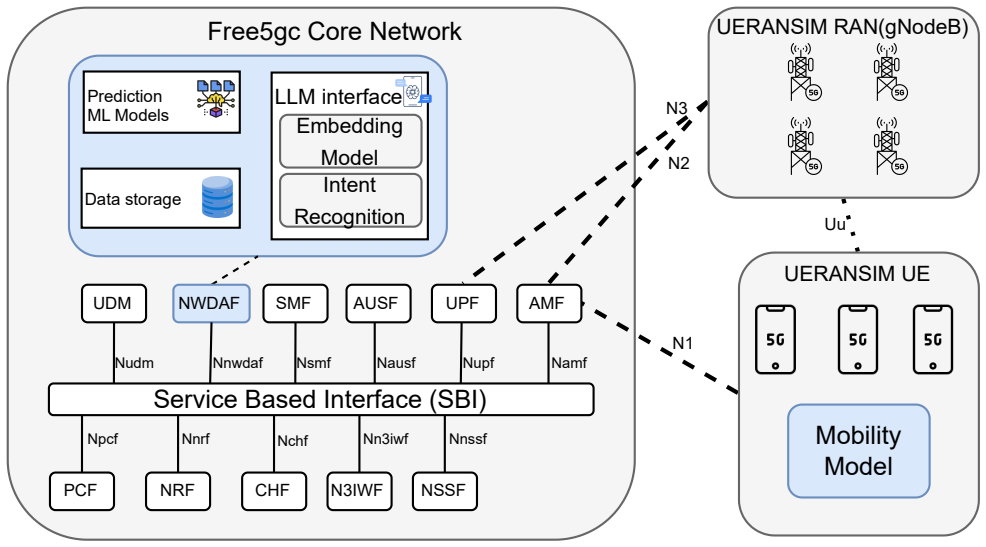
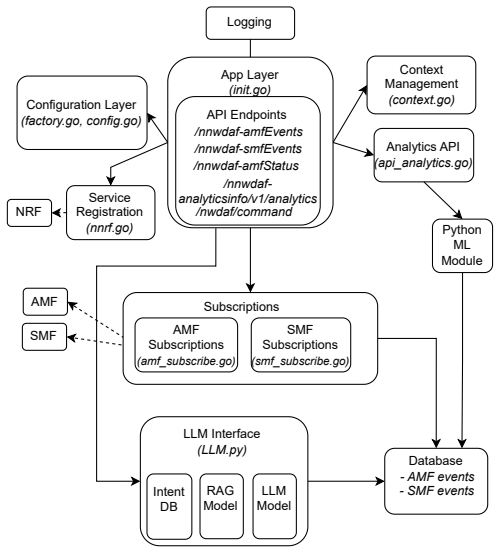
The authors present an open-source NWDAF compatible with Free5GC that collects data from network functions and includes an LLM interface. User inputs are encoded with a semantic embedding model and mapped to one of seven predefined intent categories, which then trigger analytics queries or event subscriptions. This setup supports AMF and SMF subscriptions, real-time monitoring through Prometheus, and all operations via a conversational interface.
What carries the argument
The LLM-based intent recognition system that encodes inputs and classifies them into seven categories to automate network analytics commands.
Load-bearing premise
The semantic embedding model will correctly map varied user inputs to one of the seven predefined intent categories with sufficient accuracy for practical use.
What would settle it
A collection of natural language inputs from operators that the model misclassifies into incorrect intent categories at a high rate.
Figures


read the original abstract
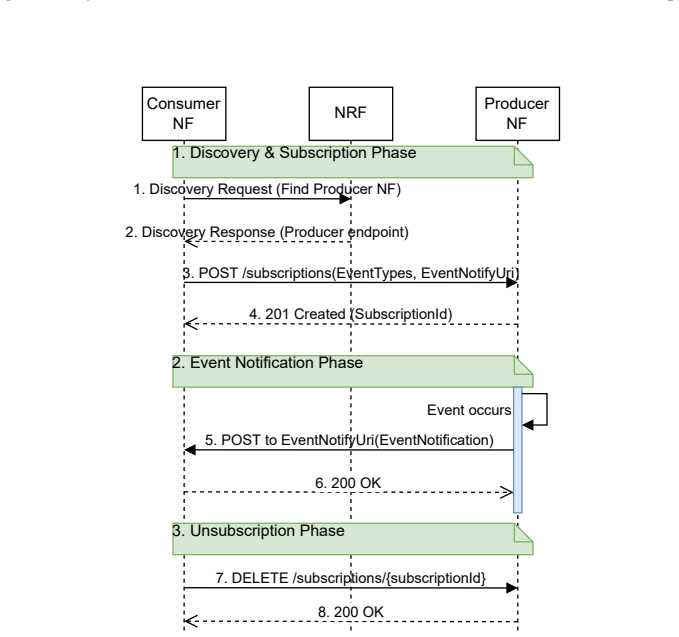
The Network Data Analytics Function (NWDAF) is central to enabling zero-touch network management in fifth-generation (5G) networks by supporting real-time analytics and closed-loop automation. Despite its critical role, open-source NWDAF implementations remain limited in scope and accessibility. In this paper, we develop an open-source NWDAF, compatible with the open-source core network Free5GC, that collects network data via subscriptions to Network Functions (NFs), and also includes an integrated Large Language Model (LLM) interface that enables natural language interaction with human operators. The interface processes user intents, encodes them using a semantic embedding model, and maps them to one of seven predefined intent categories to trigger analytics queries or event subscription commands. This architecture abstracts the complexity of traditional interfaces, allowing non-expert users to manage network analytics and subscriptions with ease. The system supports Access and Management Function (AMF) and Session Management Function (SMF) event subscriptions, real-time monitoring, and analytics retrieval via Prometheus, all accessible through a conversational interface. By bridging AI-driven intent recognition with standardized network analytics, our implementation enhances operator usability and provides a foundation towards AI-native 6G networks. The source code and datasets generated during the current study are available in the github repository, https://github.com/HenokDanielbfg/testbed.
Editorial analysis
A structured set of objections, weighed in public.
Referee Report
Summary. The paper presents an open-source NWDAF implementation compatible with Free5GC that collects data via NF subscriptions and integrates an LLM interface. User intents are encoded via semantic embedding and mapped to one of seven predefined categories to trigger analytics queries or event subscriptions (AMF/SMF). The system supports real-time monitoring via Prometheus and is positioned as improving operator usability for non-experts while laying groundwork for AI-native 6G networks; source code is released on GitHub.
Significance. An open-source, LLM-augmented NWDAF with Free5GC integration could lower barriers to network analytics management if the intent-mapping component proves reliable. The released code and datasets constitute a concrete contribution that enables reproducibility and extension by the community.
major comments (2)
- [Abstract] Abstract: the central claim that the implementation 'enhances operator usability' rests on the unverified assumption that the semantic embedding model correctly maps varied natural-language inputs to the seven intent categories; no accuracy, precision, recall, or confusion-matrix results are reported on any test set.
- [LLM interface description] The description of the LLM interface (semantic embedding + category mapping): without quantitative evaluation of classification performance or end-to-end latency for LLM-triggered subscriptions, the assertion that the architecture supplies a 'foundation towards AI-native 6G networks' remains an architectural sketch rather than a demonstrated capability.
minor comments (2)
- [Abstract] Clarify what the 'datasets generated during the current study' consist of and whether they were used for any validation of the intent-mapping component.
- Add a dedicated evaluation section (or subsection) reporting metrics for the intent classifier and any user-study or benchmark results.
Simulated Author's Rebuttal
We thank the referee for the constructive comments. We address each major point below and will revise the manuscript accordingly to strengthen the evaluation of the LLM interface.
read point-by-point responses
-
Referee: [Abstract] Abstract: the central claim that the implementation 'enhances operator usability' rests on the unverified assumption that the semantic embedding model correctly maps varied natural-language inputs to the seven intent categories; no accuracy, precision, recall, or confusion-matrix results are reported on any test set.
Authors: We agree that the abstract's claim regarding enhanced usability would be better supported by quantitative results on intent classification. The manuscript currently emphasizes the open-source implementation and integration with Free5GC but does not report accuracy, precision, recall, or confusion matrices for the semantic embedding model. In the revised version we will add a dedicated evaluation subsection that includes these metrics on a held-out test set of natural-language inputs, along with details on the test-set construction. revision: yes
-
Referee: [LLM interface description] The description of the LLM interface (semantic embedding + category mapping): without quantitative evaluation of classification performance or end-to-end latency for LLM-triggered subscriptions, the assertion that the architecture supplies a 'foundation towards AI-native 6G networks' remains an architectural sketch rather than a demonstrated capability.
Authors: We acknowledge the referee's observation. The current text presents the LLM interface primarily through its architecture and functional description without accompanying performance numbers. To address this, the revision will incorporate quantitative results on classification performance (accuracy, precision, recall, confusion matrix) as well as measured end-to-end latency for LLM-triggered AMF/SMF subscriptions and analytics queries. These additions will allow the paper to demonstrate rather than merely sketch the claimed capability. revision: yes
Circularity Check
No circularity: implementation report with no derivations or fitted predictions
full rationale
The manuscript is a system description of an open-source NWDAF with LLM-based intent interface. It contains no equations, parameter fittings, uniqueness theorems, or derivation chains. The architecture (semantic embedding + mapping to seven categories + Free5GC integration) is presented as an implemented artifact whose usability claim is left to external verification rather than derived from self-referential steps. No load-bearing element reduces to its own inputs by construction.
Axiom & Free-Parameter Ledger
Reference graph
Works this paper leans on
-
[1]
Chettri, L. & Bera, R. A comprehensive survey on internet of things (iot) toward 5g wireless systems.IEEE Internet Things J.7, 16–32, DOI: 10.1109/JIOT.2019.2948888 (2020)
-
[2]
Ullah, A., Anwar, S. M. & Li, J. Smart cities: the role of internet of things and machine learning in realizing a data-centric smart environment.Complex Intell. Syst.10, 1607–1637, DOI: 10.1007/s40747-023-01175-4 (2024)
-
[3]
Qian, B.et al.Multi-operator spectrum sharing for massive iot coexisting in 5g/b5g wireless networks.IEEE J. Sel. Areas Commun.39, 881–895, DOI: 10.1109/JSAC.2020.3018803 (2021)
-
[4]
Taniguchi, Y ., Ikegami, Y . & Fujikawa, H. Counseling (ro)bot as a use case for 5g/6g.Complex Intell. Syst.8, 3899–3917, DOI: 10.1007/s40747-022-00664-2 (2022)
-
[5]
Lando, G., Schierholt, L. A. F., Milesi, M. P. & Wickboldt, J. A. Evaluating the performance of open source software implementations of the 5g network core. InProc. IEEE/IFIP NOMS, 1–7 (Miami, FL, USA, 2023). 6.Srsran project. https://www.srslte.com/ (2025). Accessed: March 17, 2025. 7.Open air interface. https://openairinterface.org/oai-5g-core-network-p...
2023
-
[6]
https://www.3gpp.org/specifications-technologies/releases/release-15 (2025)
3gpp release 15. https://www.3gpp.org/specifications-technologies/releases/release-15 (2025). Accessed: March 17, 2025
2025
-
[7]
Sevgican, S., Turan, M., Gökarslan, K., Yilmaz, H. B. & Tugcu, T. Intelligent network data analytics function in 5g cellular networks using machine learning.J. Commun. Netw.22, 269–280, DOI: 10.1109/JCN.2020.000019 (2020)
-
[8]
M., Chouman, A
Manias, D. M., Chouman, A. & Shami, A. Towards intent-based network management: Large language models for intent extraction in 5g core networks. InProc. DRCN, 1–6 (Montreal, QC, Canada, 2024)
2024
-
[9]
Coronado, E.et al.Zero touch management: A survey of network automation solutions for 5g and 6g networks.IEEE Commun. Surv. Tuts.24, 2535–2578, DOI: 10.1109/COMST.2022.3212586 (2022)
-
[10]
Abbas, K., Khan, T. A., Afaq, M., Diaz Rivera, J. J. & Song, W.-C. Network data analytics function for ibn-based network slice lifecycle management. InProc. APNOMS, 148–153, DOI: 10.23919/APNOMS52696.2021.9562662 (2021)
-
[11]
AlSamarneh, A. A., Al-Hammouri, A. T. & Al-Jarrah, O. Y . Navigating intent-based networking: from user descriptions to deployable configurations.Neural Comput. Appl.DOI: 10.1007/s00521-025-11193-7 (2025)
-
[12]
Clemm, A., Ciavaglia, L., Granville, L. Z. & Tantsura, J. Intent-based networking - concepts and definitions. RFC 9315, DOI: 10.17487/RFC9315 (2022)
-
[13]
Mcnamara, J.et al.Nlp powered intent based network management for private 5g networks.IEEE Access11, 36642–36657, DOI: 10.1109/ACCESS.2023.3265894 (2023)
-
[14]
Zhu, K. T., Wu, Y ., Yang, R.et al.Anomaly detection in metaverse healthcare and fitness: Bigdata analytics using 6g-enabled internets of things.Wirel. Pers. Commun.DOI: 10.1007/s11277-024-11220-1 (2024). Published: 04 June 2024
-
[15]
Hong, J.et al.A context-aware onboarding agent for metaverse powered by large language models. InProc. ACM DIS, 1857–1874, DOI: 10.1145/3643834.3661579 (Association for Computing Machinery, New York, NY , USA, 2024)
-
[16]
Kan, K. B., Mun, H., Cao, G. & Lee, Y . Mobile-llama: Instruction fine-tuning open-source llm for network analysis in 5g networks.IEEE Netw.38, 76–83, DOI: 10.1109/MNET.2024.3421306 (2024)
-
[17]
ACM Netw.2, DOI: 10.1145/3656296 (2024)
Wang, C.et al.Netconfeval: Can llms facilitate network configuration?Proc. ACM Netw.2, DOI: 10.1145/3656296 (2024)
-
[18]
Alabbasi, N.et al.Teleoracle: Fine-tuned retrieval-augmented generation with long-context support for networks.IEEE Internet Things J.12, 13170–13182, DOI: 10.1109/JIOT.2025.3553161 (2025). 17/20
-
[19]
Hang, C.-N., Yu, P.-D., Morabito, R. & Tan, C.-W. Large language models meet next-generation networking technologies: A review.Futur. Internet16, DOI: 10.3390/fi16100365 (2024)
-
[20]
& Schotten, H
Reddy, R., Gundall, M., Lipps, C. & Schotten, H. D. Open source 5g core network implementations: A qualitative and quantitative analysis. InProc. IEEE BlackSeaCom, 253–258 (Istanbul,Turkiye, 2023). 25.Ieee testbed. https://testbed.ieee.org/our-platform/features-benefits/ (2025). Accessed: March 17, 2025. 26.Free5gc. https://free5gc.org/doc/. Accessed: Mar...
2023
-
[21]
& Outtagarts, A
Rajabzadeh, P. & Outtagarts, A. Federated learning for distributed nwdaf architecture. Inproc. ICIN, 24–26 (Paris, France, 2023)
2023
-
[22]
A., Franco Silva, E
de Oliveira, L. A., Franco Silva, E. & Ribeiro Dantas, M. A. A nwdaf study employing machine learning models on a simulated 5g network dataset. InProc. IEEE ISCC, 1–6 (Paris, France, 2024)
2024
-
[23]
Chouman, A., Manias, D. M. & Shami, A. Towards supporting intelligence in 5g/6g core networks: Nwdaf implementation and initial analysis. InProc. IWCMC, 324–329 (Dubrovnik, Croatia, 2022)
2022
-
[24]
Kim, T.et al.An implementation study of network data analytic function in 5G. InProc. IEEE ICCE, 1–3 (Vegas, NV , USA, 2022)
2022
-
[25]
Chouman, A., Manias, D. M. & Shami, A. A modular, end-to-end next-generation network testbed: Toward a fully automated network management platform.IEEE Trans. Netw. Serv. Manag.21, 5445–5463 (2024)
2024
-
[26]
Ahn, Y . & Jeong, J. P. An intent-driven management automation for 5g mobile networks. InProc. ICOIN, 714–719, DOI: 10.1109/ICOIN59985.2024.10572068 (2024)
-
[27]
Abbas, K.et al.Ai-driven data analytics and intent-based networking for orchestration and control of b5g consumer electronics services.IEEE Trans. Consum. Electron.70, 2155–2169, DOI: 10.1109/TCE.2023.3324010 (2024). 34.Gorawski, M. & Grochla, K. The real-life mobility model: Rlmm. InProc. FGCT, 201–206 (2013)
-
[28]
& Ott, J
Ekman, F., Keränen, A., Karvo, J. & Ott, J. Working day movement model. Technical Report, Helsinki University of Technology TKK, Dept. of Communications and Networking, Helsinki, Finland (2008)
2008
-
[29]
& Helmy, A
Hsu, W.-j., Merchant, K., Shu, H.-w., Hsu, C.-h. & Helmy, A. Weighted waypoint mobility model and its impact on ad hoc networks.SIGMOBILE Mob. Comput. Commun. Rev.9, 59–63 (2005)
2005
-
[30]
K., Lipps, C
Reddy, R., Singh, A. K., Lipps, C. & Schotten, H. D. 5g testbed as a service (5gtaas): An open source implementation for networks of the future. InProc. IEEE FNWF, 1–5 (2023). 38.3gpp 5g system overview. https://www.3gpp.org/technologies/5g-system-overview. Accessed: March 17, 2025. 39.3gpp 5g architecture. https://www.3gpp.org/ftp/Specs/archive/23_series...
2023
-
[31]
& Gao, Y
Bertenyi, B., Burbidge, R., Masini, G., Sirotkin, S. & Gao, Y . Ng radio access network (ng-ran).J. ICT Stand.6, 59–76 (2018). 41.G, E. V ., R, D., Krishnamurthy, S. & Sarma, A. 5g ue simulation. InProc. RAEEUCCI, 1–5 (Chennai, India, 2023)
2018
-
[32]
& Huang, C.-Y
Chen, P.-Y . & Huang, C.-Y . Evaluation of ue registration performance in open-source 5g core networks. InProc. IEEE APWCS, 1–5 (2024)
2024
-
[33]
5g; non-access-stratum (nas) protocol for 5g system (5gs); stage 3
ETSI. 5g; non-access-stratum (nas) protocol for 5g system (5gs); stage 3. Tech. Rep. TS 124 501 V16.5.1, European Telecommunications Standards Institute (ETSI) (2020)
2020
-
[34]
5g; nr; nr and ng-ran overall description; stage-2
ETSI. 5g; nr; nr and ng-ran overall description; stage-2. Tech. Rep. TS 138 300 V15.13.0, European Telecommunications Standards Institute (ETSI) (2021)
2021
-
[35]
& Cica, Z
Zivkovic, B. & Cica, Z. Multi-connectivity framework based on open-source 5g network core. InProc. TELFOR, 1–4 (Belgrade, Serbia, 2024)
2024
-
[36]
Shahen Shah, A. F. M. A survey from 1g to 5g including the advent of 6g: Architectures, multiple access techniques, and emerging technologies. InProc. IEEE CCWC, 1117–1123 (2022)
2022
-
[37]
Mamushiane, L.et al.Towards stress testing open5gs core (upf node) on a 5g standalone testbed. InProc. IEEE AFRICON, 1–6 (2023)
2023
-
[38]
& Damiani, E
Daniel, H., Alhussein, O., Liang, J., Li, C. & Damiani, E. Enhanced open-source nwdaf for event-driven analytics in 5g networks. InProc. IFIP, 1–1 (Limassol, Cyprus, 2025). 18/20
2025
-
[39]
https://www.3gpp.org/technologies/ue-data-sa4 (2025)
Ue data collection, reporting, and exposure. https://www.3gpp.org/technologies/ue-data-sa4 (2025). Accessed: March 17, 2025
2025
-
[40]
& Qian, S
He, X., Yang, Z., Xiang, Y . & Qian, S. Nwdaf in 3gpp 5g advanced: A survey. InProc. EIECS, 756–761 (Changchun, China, 2023)
2023
-
[41]
A., Bellandi, V ., Damiani, E
Anisetti, M., Ardagna, C. A., Bellandi, V ., Damiani, E. & Reale, S. Map-based location and tracking in multipath outdoor mobile networks.IEEE Trans. Wirel. Commun.10, 814–824 (2011)
2011
-
[42]
IEEE Trans
Anisetti, M.et al.On the robustness of random forest against untargeted data poisoning: An ensemble-based approach. IEEE Trans. Sustain. Comput.8, 540–554 (2023). Author contributions statement H.D. implemented the system and executed the experiments. O.A. conceptualized the study and served as the project administrator. C.L. and J.L. provided critical me...
2023
discussion (0)
Sign in with ORCID, Apple, or X to comment. Anyone can read and Pith papers without signing in.