Building three-dimensional giant stellar models for common envelope simulations
Pith reviewed 2026-06-27 08:26 UTC · model grok-4.3
The pith
Depositing stellar luminosity in an inner shell while cooling low-density outer cells produces stable pulsating 3D giant star models without any relaxation step.
A machine-rendered reading of the paper's core claim, the machinery that carries it, and where it could break.
Core claim
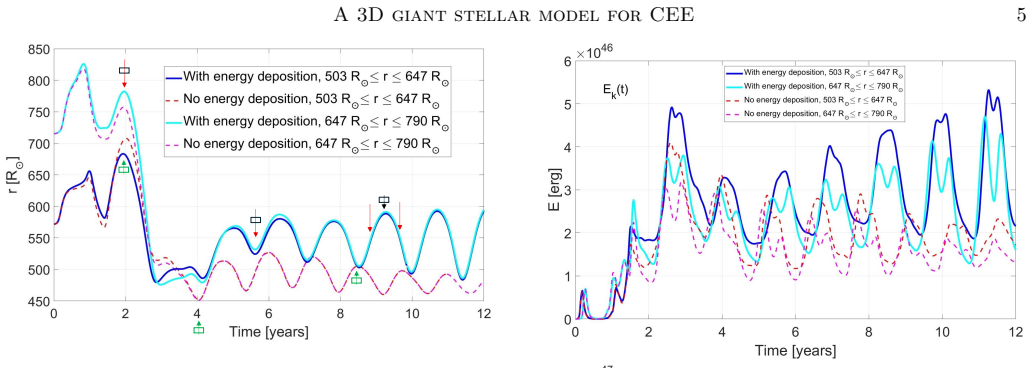
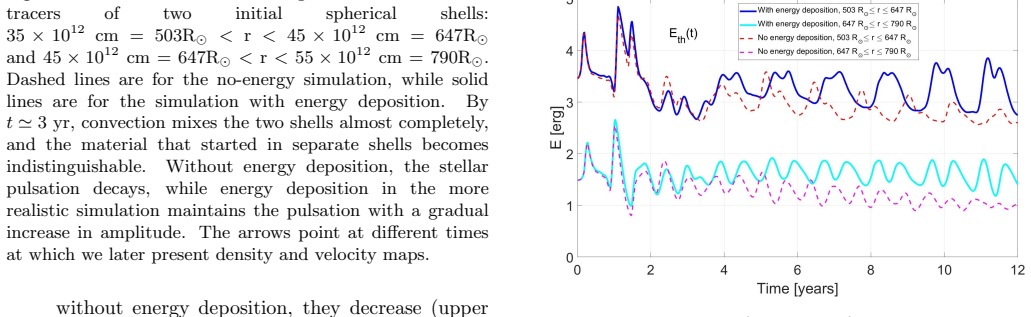
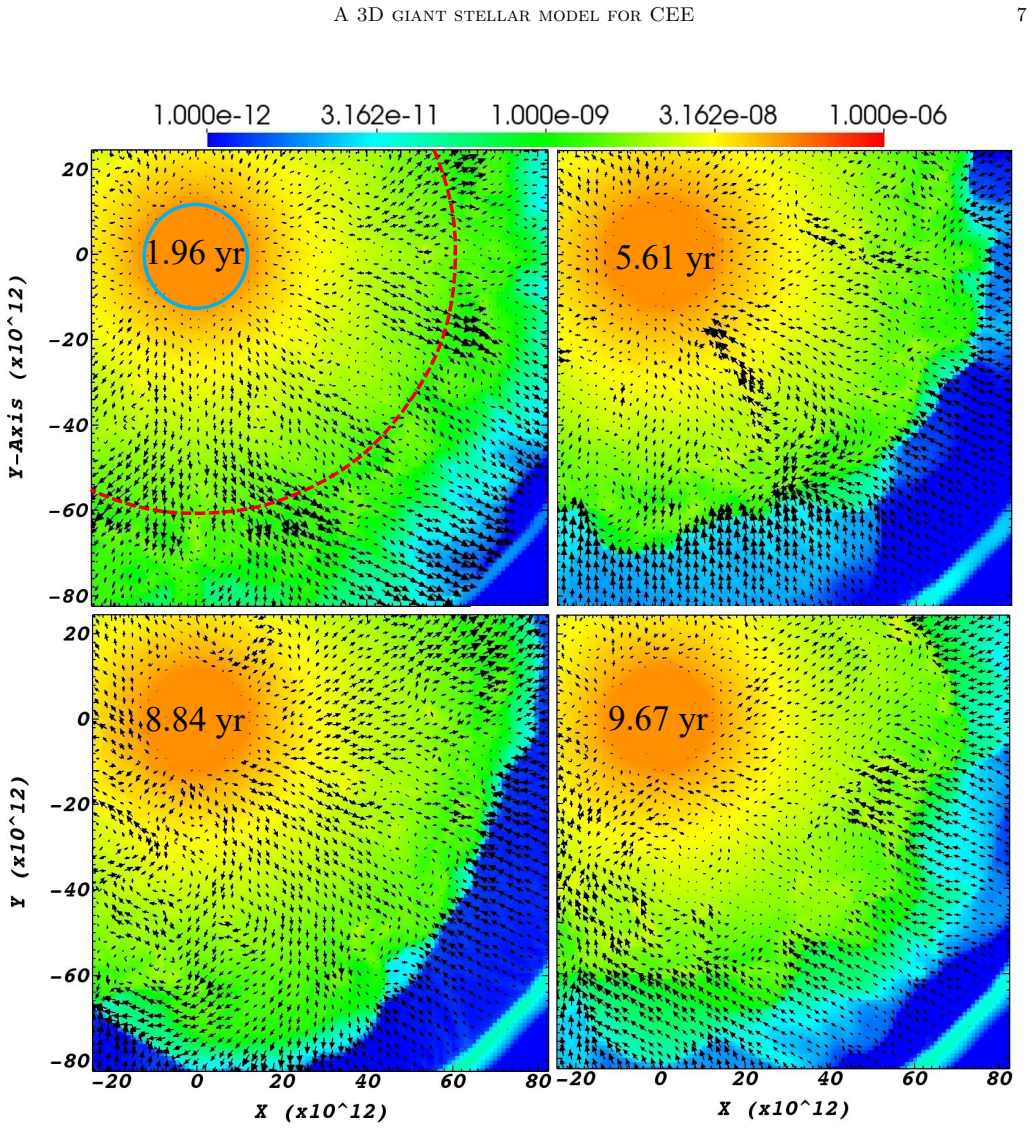
Transporting a 1D stellar model to a 3D grid, depositing energy at the stellar luminosity in an inner shell above the inert core, and cooling cells with densities below the photospheric value allows the model to execute its natural pulsations without relaxation. With both energy deposition and cooling active the oscillations do not decay and their amplitude slowly grows; the dominant period is about one year, comparable to the dynamical time, and the model also develops non-spherical structure, radius variations, and vigorous convection.
What carries the argument
Inner-shell energy deposition at the stellar luminosity rate combined with cooling of low-density outer cells, which together replace nuclear burning and photospheric emission while letting the 3D model evolve its own pulsations.
If this is right
- The resulting model shows a dominant pulsation period of about one year that matches the stellar dynamical timescale.
- Non-spherical density structure and slow changes in average radius appear, indicating superposed non-radial modes.
- Vigorous convection develops naturally inside the model.
- The same preparation can be used directly for grazing-envelope evolution simulations.
Where Pith is reading between the lines
- This preparation might allow simulations to begin from a more realistic pulsating state rather than an artificially static one.
- The sustained pulsations could influence the efficiency of envelope ejection during common-envelope interactions.
- The approach might be tested on other giant-star masses or metallicities to check whether the same inner-shell plus outer-cooling recipe remains sufficient.
Load-bearing premise
That replacing nuclear burning with inner-shell energy input at the observed luminosity and replacing surface emission with cooling of low-density cells will reproduce the essential dynamical behavior of a real giant star on a 3D grid.
What would settle it
A 3D simulation run lasting several dynamical times in which both inner-shell heating and outer cooling are applied, then checking whether the pulsation amplitude remains roughly constant or continues to grow instead of decaying.
Figures


read the original abstract
We build a three-dimensional (3D) red supergiant (RSG) stellar model for common envelope evolution (CEE) simulations by transporting a 1D stellar model to a 3D numerical grid, mimicking core nuclear power by depositing energy to an inner shell, and mimicking stellar emission by cooling grid cells with densities below the photospheric density. We do not relax the model; rather, we let it perform its natural pulsation. We find that when we mimic photospheric emission by cooling low-density grid cells, the oscillations slowly decay on a time scale much longer than in the absence of photospheric cooling. When we mimic both nuclear energy production, by depositing the stellar luminosity in an inner shell above the inert core of the stellar model, and the photospheric cooling, the oscillations do not decay and their amplitude slowly increases with time. The main pulsational period is about 1 year, comparable to the stellar dynamical time, suggesting a fundamental radial pulsation mode. The non-spherical structure of the stellar model and rapid low-amplitude temporal variations in the average stellar radius testify to the presence of non-radial oscillation modes on top of the fundamental radial mode. We also obtain vigorous convection, as RSG stars have. We conclude that the best way of preparing a giant star to simulate CEE and grazing-envelope evolution is to deposit energy with the stellar luminosity in an inner shell, and to cool the outer low-density numerical shell. There is no need to relax the model.
Editorial analysis
A structured set of objections, weighed in public.
Referee Report
Summary. The manuscript presents a procedure for constructing 3D red supergiant models from 1D stellar models for common-envelope evolution simulations. The approach maps the 1D structure to a 3D grid, deposits energy at the stellar luminosity rate in an inner shell above the inert core to mimic nuclear burning, and cools low-density cells to mimic photospheric emission, without any relaxation step. The authors report that oscillations decay in the absence of cooling, remain stable or grow slowly when both energy deposition and cooling are active, exhibit a dominant ~1 yr period consistent with the dynamical timescale (suggesting a fundamental radial mode), display non-radial modes via non-spherical structure and radius variations, and produce vigorous convection. They conclude that this combination is the optimal preparation method and that relaxation is unnecessary.
Significance. If validated, the method supplies a parameter-free initialization route that directly imports quantities from the input 1D model and permits natural pulsations and convection to emerge, potentially reducing computational overhead for CEE and grazing-envelope simulations. The absence of invented entities or fitted parameters in the core procedure is a clear strength.
major comments (2)
- [Abstract] Abstract and results description: the statements that oscillations 'slowly decay', 'do not decay', or 'slowly increase' with time are presented without any quantitative metrics (e.g., e-folding times, amplitude growth rates, or time-series statistics of radius or kinetic energy), error estimates, or resolution studies. These quantitative diagnostics are load-bearing for the central claim that the combined inner-shell deposition plus low-density cooling produces sustained natural pulsations without relaxation.
- [Abstract] Abstract and method description: no grid-resolution tests, convergence checks, or direct comparisons to 1D linear pulsation calculations or other 3D codes are reported to confirm that the ~1 yr period, non-radial mode content, and convection are physical rather than numerical artifacts. Such tests are required to substantiate the assertion that the procedure accurately represents essential stellar physics.
Simulated Author's Rebuttal
We thank the referee for their constructive comments on our manuscript. We address each major comment below and indicate the revisions we will make.
read point-by-point responses
-
Referee: [Abstract] Abstract and results description: the statements that oscillations 'slowly decay', 'do not decay', or 'slowly increase' with time are presented without any quantitative metrics (e.g., e-folding times, amplitude growth rates, or time-series statistics of radius or kinetic energy), error estimates, or resolution studies. These quantitative diagnostics are load-bearing for the central claim that the combined inner-shell deposition plus low-density cooling produces sustained natural pulsations without relaxation.
Authors: We agree that quantitative support would improve the abstract and results. In the revised manuscript we will add time-series statistics of the average stellar radius and total kinetic energy, together with estimates of e-folding times or growth rates extracted from the existing simulation data. These metrics will be described in the results section and briefly summarized in the abstract. revision: yes
-
Referee: [Abstract] Abstract and method description: no grid-resolution tests, convergence checks, or direct comparisons to 1D linear pulsation calculations or other 3D codes are reported to confirm that the ~1 yr period, non-radial mode content, and convection are physical rather than numerical artifacts. Such tests are required to substantiate the assertion that the procedure accurately represents essential stellar physics.
Authors: The manuscript demonstrates the initialization procedure and reports the emergent behavior from the simulations performed. We did not carry out resolution studies or comparisons to other codes. In revision we will add a limitations paragraph in the discussion noting the absence of these tests and reiterating that the dominant period is consistent with the dynamical timescale of the input 1D model. We maintain that the method's parameter-free character remains a useful contribution for CEE simulations, while acknowledging that further validation lies beyond the present scope. revision: partial
Circularity Check
No significant circularity; procedure is self-contained numerical construction
full rationale
The paper presents a direct numerical method: map a 1D stellar model to a 3D grid, deposit energy in an inner shell at the input stellar luminosity rate, and cool low-density cells to mimic photospheric emission. Outcomes such as oscillation decay/growth, ~1 yr period matching dynamical time, non-radial modes, and convection are reported as simulation results, not used to define or fit the inputs. No equations reduce by construction to outputs, no fitted parameters are renamed as predictions, and no self-citations or uniqueness theorems are invoked as load-bearing. The central claim (this preparation method works without relaxation) rests on the described procedure's internal consistency with known stellar timescales, which is externally falsifiable via the reported behavior.
Axiom & Free-Parameter Ledger
axioms (3)
- domain assumption A 1D stellar evolution model provides an accurate initial structure for a red supergiant that can be directly transported to a 3D grid.
- domain assumption Depositing energy at the stellar luminosity rate into an inner shell above the inert core accurately mimics core nuclear power production.
- domain assumption Cooling grid cells with densities below the photospheric density accurately mimics stellar photospheric emission.
Reference graph
Works this paper leans on
-
[1]
SN 2006jc: A Wolf-Rayet Star Exploding in a Dense He-Rich Circumstellar Medium
SN 2006jc: A Wolf-Rayet Star Exploding in a Dense He-rich Circumstellar Medium. , keywords =. doi:10.1086/513145 , archivePrefix =. astro-ph/0612711 , primaryClass =
work page internal anchor Pith review Pith/arXiv arXiv doi:10.1086/513145
-
[2]
Numerical simulations of the random angular momentum in convection: Implications for supergiant collapse to form black holes. , keywords =. doi:10.1093/mnras/stab3776 , archivePrefix =. 2107.09068 , primaryClass =
-
[3]
Delayed explosions of red supergiants following 'failed' supernovae
Numerical simulations of the random angular momentum in convection - II. Delayed explosions of red supergiants following 'failed' supernovae. , keywords =. doi:10.1093/mnras/stad2328 , archivePrefix =. 2301.05237 , primaryClass =
-
[4]
Spitzer Observations of Dust Destruction in the Puppis A Supernova Remnant. , keywords =. doi:10.1088/0004-637X/725/1/585 , adsurl =
-
[5]
Comparative Morphological Analysis of Puppis A at Radio, Infrared, Optical, and X-Ray Wavelengths. , keywords =. doi:10.1086/168378 , adsurl =
-
[6]
Planetary Nebula Image Catalogue: HST data
-
[7]
Research Notes of the American Astronomical Society , keywords =
The Jets and the Neutron Star Kick Velocity of the Supernova Remnant CTB 1. Research Notes of the American Astronomical Society , keywords =. doi:10.3847/2515-5172/ad1392 , archivePrefix =. 2312.02026 , primaryClass =
-
[8]
Relativistic MHD simulations of core-collapse GRB jets: 3D instabilities and magnetic dissipation
Relativistic MHD simulations of core-collapse GRB jets: 3D instabilities and magnetic dissipation. , keywords =. doi:10.1093/mnras/stv2591 , archivePrefix =. 1508.02721 , primaryClass =
work page internal anchor Pith review Pith/arXiv arXiv doi:10.1093/mnras/stv2591
-
[9]
Core-collapse supernova explosion theory. , keywords =. doi:10.1038/s41586-020-03059-w , archivePrefix =. 2009.14157 , primaryClass =
-
[10]
The most complete and detailed X-ray view of the SNR Puppis A
The most complete and detailed X-ray view of the SNR Puppis A. , keywords =. doi:10.1051/0004-6361/201321401 , archivePrefix =. 1305.1275 , primaryClass =
work page internal anchor Pith review Pith/arXiv arXiv doi:10.1051/0004-6361/201321401
-
[11]
American Astronomical Society Meeting Abstracts \#215 , year = 2010, series =
Three-Dimensional Kinematics of the Supernova Remnant Puppis A. American Astronomical Society Meeting Abstracts \#215 , year = 2010, series =
2010
-
[12]
Explaining the most energetic supernovae with an inefficient jet-feedback mechanism
Explaining the Most Energetic Supernovae with an Inefficient Jet-feedback Mechanism. , keywords =. doi:10.3847/0004-637X/826/2/178 , archivePrefix =. 1511.01471 , primaryClass =
work page internal anchor Pith review Pith/arXiv arXiv doi:10.3847/0004-637x/826/2/178
-
[13]
Triggering jet-driven explosions of core-collapse supernovae by accretion from convective regions
Triggering jet-driven explosions of core-collapse supernovae by accretion from convective regions. , keywords =. doi:10.1093/mnras/stu257 , archivePrefix =. 1401.1597 , primaryClass =
work page internal anchor Pith review Pith/arXiv arXiv doi:10.1093/mnras/stu257
-
[14]
Angular momentum fluctuations in the convective helium shell of massive stars
Angular Momentum Fluctuations in the Convective Helium Shell of Massive Stars. , keywords =. doi:10.3847/0004-637X/827/1/40 , archivePrefix =. 1505.05756 , primaryClass =
work page internal anchor Pith review Pith/arXiv arXiv doi:10.3847/0004-637x/827/1/40
-
[15]
The Peculiar Ejecta Rings in the O-Rich Supernova Remnant Puppis A: Evidence of a Binary Interaction?. , keywords =. doi:10.3847/1538-4357/ad0156 , archivePrefix =. 2310.00661 , primaryClass =
-
[16]
Evidence for proton acceleration and escape from the Puppis A SNR using Fermi-LAT observations. arXiv e-prints , keywords =. doi:10.48550/arXiv.2308.14848 , archivePrefix =. 2308.14848 , primaryClass =
-
[17]
Black Hole to Photosphere: 3D GRMHD Simulations of Collapsars Reveal Wobbling and Hybrid Composition Jets. , keywords =. doi:10.3847/2041-8213/ac7530 , archivePrefix =. 2204.12501 , primaryClass =
-
[18]
The chemical signature of jet-driven hypernovae. , keywords =. doi:10.1093/mnras/staa3819 , archivePrefix =. 2010.06766 , primaryClass =
-
[19]
Constraining the fraction of core-collapse supernovae harbouring choked jets with high-energy neutrinos. , keywords =. doi:10.1093/mnras/stz3245 , archivePrefix =. 1906.07399 , primaryClass =
-
[20]
Hubble Space Telescope Observations and Geometric Models of Compact Multipolar Planetary Nebulae. , keywords =. doi:10.1088/0004-637X/787/1/25 , adsurl =
-
[21]
Fermi-LAT and WMAP Observations of the Puppis A Supernova Remnant. , keywords =. doi:10.1088/0004-637X/759/2/89 , adsurl =
-
[22]
Chandra X-Ray Observation of a Mature Cloud-Shock Interaction in the Bright Eastern Knot Region of Puppis A. , keywords =. doi:10.1086/497298 , archivePrefix =. astro-ph/0508243 , primaryClass =
work page internal anchor Pith review Pith/arXiv arXiv doi:10.1086/497298
-
[23]
X-ray Emitting Ejecta in Puppis A Observed with Suzaku
X-Ray-emitting Ejecta in Puppis A Observed with Suzaku. , keywords =. doi:10.1086/528925 , archivePrefix =. 0712.3208 , primaryClass =
work page internal anchor Pith review Pith/arXiv arXiv doi:10.1086/528925
-
[24]
Discovery of Fast-Moving X-Ray--Emitting Ejecta Knots in the Oxygen-Rich Supernova Remnant Puppis A
Discovery of Fast-Moving X-Ray-Emitting Ejecta Knots in the Oxygen-Rich Supernova Remnant Puppis A. , keywords =. doi:10.1086/586891 , archivePrefix =. 0805.1369 , primaryClass =
work page internal anchor Pith review Pith/arXiv arXiv doi:10.1086/586891
-
[25]
Discovery of X-Ray-Emitting O-Ne-Mg-Rich Ejecta in the Galactic Supernova Remnant Puppis A
Discovery of X-ray-emitting O-Ne-Mg-rich Ejecta in the Galactic Supernova Remnant Puppis A. , keywords =. doi:10.1088/0004-637X/714/2/1725 , archivePrefix =. 1004.4132 , primaryClass =
work page internal anchor Pith review Pith/arXiv arXiv doi:10.1088/0004-637x/714/2/1725
-
[26]
Dynamics of X-Ray-emitting Ejecta in the Oxygen-rich Supernova Remnant Puppis A Revealed by the XMM-Newton Reflection Grating Spectrometer. , keywords =. doi:10.1088/0004-637X/768/2/182 , archivePrefix =. 1303.6607 , primaryClass =
work page internal anchor Pith review Pith/arXiv arXiv doi:10.1088/0004-637x/768/2/182
-
[27]
Jet-Induced Explosions of Core Collapse Supernovae
Jet-induced Explosions of Core Collapse Supernovae. , keywords =. doi:10.1086/312305 , archivePrefix =. astro-ph/9904419 , primaryClass =
work page internal anchor Pith review Pith/arXiv arXiv doi:10.1086/312305
-
[28]
Wide-field X-ray observations of the supernova remnant Puppis A with the SRG/ART-XC telescope. , keywords =. doi:10.1093/mnras/stab3647 , archivePrefix =. 2107.05586 , primaryClass =
-
[29]
Three-dimensional Adaptive Mesh Refinement Simulations of Long-duration Gamma-Ray Burst Jets inside Massive Progenitor Stars. , keywords =. doi:10.1088/0004-637X/767/1/19 , archivePrefix =. 1212.0539 , primaryClass =
work page internal anchor Pith review Pith/arXiv arXiv doi:10.1088/0004-637x/767/1/19
-
[30]
From the weakest to most powerful explosions
Core-collapse supernova diversities . From the weakest to most powerful explosions. , keywords =
-
[31]
The IAC morphological catalog of northern Galactic planetary nebulae
-
[32]
The intermediate r-process in core-collapse supernovae driven by the magneto-rotational instability
The Intermediate r-process in Core-collapse Supernovae Driven by the Magneto-rotational Instability. , keywords =. doi:10.3847/2041-8213/aa5dee , archivePrefix =. 1611.02280 , primaryClass =
work page internal anchor Pith review Pith/arXiv arXiv doi:10.3847/2041-8213/aa5dee 2041
-
[33]
Nucleosynthesis in jet-driven and jet-associated supernovae. arXiv e-prints , keywords =. doi:10.48550/arXiv.2303.12458 , archivePrefix =. 2303.12458 , primaryClass =
-
[34]
Modeling the Evolution from Massive Stars to Supernovae and Supernova Remnants. arXiv e-prints , keywords =. doi:10.48550/arXiv.2311.05612 , archivePrefix =. 2311.05612 , primaryClass =
-
[35]
Exploding core collapse supernovae with jittering jets. , keywords =. doi:10.1111/j.1365-2966.2011.18671.x , archivePrefix =. 1103.1554 , primaryClass =
-
[36]
A Planar Jitternig-Jets Pattern in Core-Collapse Supernova Explosions
A planar jittering-jets pattern in core collapse supernova explosions. , keywords =. doi:10.1093/mnras/stu1129 , archivePrefix =. 1403.5152 , primaryClass =
work page internal anchor Pith review Pith/arXiv arXiv doi:10.1093/mnras/stu1129
-
[37]
Black hole accretion discs and luminous transients in failed supernovae from non-rotating supergiants. , keywords =. doi:10.1093/mnrasl/slz031 , archivePrefix =. 1811.12427 , primaryClass =
work page internal anchor Pith review Pith/arXiv arXiv doi:10.1093/mnrasl/slz031
-
[38]
A high resolution HI study towards the supernova remnant Puppis A and its environments
A high-resolution H I study towards the supernova remnant Puppis A and its environments. , keywords =. doi:10.1093/mnras/stw2219 , archivePrefix =. 1609.01779 , primaryClass =
work page internal anchor Pith review Pith/arXiv arXiv doi:10.1093/mnras/stw2219
-
[39]
New perspectives on the supernova remnant Puppis A based on a radio polarization study
New perspectives on the supernova remnant Puppis A based on a radio polarization study. , keywords =. doi:10.1093/mnras/sty751 , archivePrefix =. 1803.07104 , primaryClass =
work page internal anchor Pith review Pith/arXiv arXiv doi:10.1093/mnras/sty751
-
[40]
The Starfish Twins: Two Young Planetary Nebulae with Extreme Multipolar Morphology. , keywords =. doi:10.1086/312748 , adsurl =
-
[41]
Supplying angular momentum to the jittering jets explosion mechanism using inner convection layers. , keywords =. doi:10.1093/mnrasl/slab105 , archivePrefix =. 2107.08779 , primaryClass =
-
[42]
Remnant masses of core collapse supernovae in the jittering jets explosion mechanism. , keywords =. doi:10.1093/mnras/stac1075 , archivePrefix =. 2112.10697 , primaryClass =
-
[43]
The implications of large binding energies of massive stripped core collapse supernova progenitors on the explosion mechanism. , keywords =. doi:10.1093/mnras/stad889 , archivePrefix =. 2301.05144 , primaryClass =
-
[44]
In preparation , keywords =
The point-symmetrical morphology of supernova remnant G321.3-3.9: Exploding jets jitter around an axis. In preparation , keywords =. doi:, archivePrefix =. , primaryClass =
-
[45]
Applying the jet feedback mechanism to core-collapse supernova explosions. , keywords =. doi:10.1111/j.1365-2966.2009.15862.x , archivePrefix =. 0909.5276 , primaryClass =
-
[46]
Research in Astronomy and Astrophysics , keywords =
Amplifying magnetic fields of a newly born neutron star by stochastic angular momentum accretion in core collapse supernovae. Research in Astronomy and Astrophysics , keywords =. doi:10.1088/1674-4527/20/2/24 , archivePrefix =. 1903.08349 , primaryClass =
-
[47]
Research in Astronomy and Astrophysics , keywords =
Imprints of the Jittering Jets Explosion Mechanism in the Morphology of the Supernova Remnant SNR 0540-69.3. Research in Astronomy and Astrophysics , keywords =. doi:10.1088/1674-4527/ac49e6 , archivePrefix =. 2109.10230 , primaryClass =
-
[48]
Research in Astronomy and Astrophysics , keywords =
The Neutron Star to Black Hole Mass Gap in the Frame of the Jittering Jets Explosion Mechanism (JJEM). Research in Astronomy and Astrophysics , keywords =. doi:10.1088/1674-4527/ace9b3 , archivePrefix =. 2304.05705 , primaryClass =
-
[49]
Research in Astronomy and Astrophysics , keywords =
Classifying Core Collapse Supernova Remnants by Their Morphology as Shaped by the Last Exploding Jets. Research in Astronomy and Astrophysics , keywords =. doi:10.1088/1674-4527/acf446 , archivePrefix =. 2307.15666 , primaryClass =
-
[50]
Hints of point-symmetric structures in SN 1987A: The jittering jets explosion mechanism. , keywords =. doi:10.1016/j.newast.2023.102154 , archivePrefix =. 2309.07863 , primaryClass =
-
[51]
Jet - counter-jet asymmetry in the jittering jets explosion mechanism of supernovae. arXiv e-prints , keywords =. doi:10.48550/arXiv.2311.03286 , archivePrefix =. 2311.03286 , primaryClass =
-
[52]
Three-dimensional numerical simulations of structured gamma-ray burst jets. , keywords =. doi:10.1093/mnras/stac3401 , archivePrefix =. 2207.07925 , primaryClass =
-
[53]
The collapse and three-dimensional explosion of three-dimensional massive-star supernova progenitor models. , keywords =. doi:10.1093/mnras/stab3702 , archivePrefix =. 2109.10920 , primaryClass =
-
[54]
The Jittering Jets Explosion Mechanism in Electron Capture Supernovae. , keywords =. doi:10.3847/1538-4357/ad487f , archivePrefix =. 2401.06652 , primaryClass =
-
[55]
The Energy Sources of Superluminous Supernovae
The Energy Sources of Superluminous Supernovae. Research in Astronomy and Astrophysics , keywords =. doi:10.1088/1674-4527/19/5/63 , archivePrefix =. 1902.07943 , primaryClass =
work page internal anchor Pith review Pith/arXiv arXiv doi:10.1088/1674-4527/19/5/63 1902
-
[56]
Production and Distribution of ^ 44 Ti and ^ 56 Ni in a Three-dimensional Supernova Model Resembling Cassiopeia A. , keywords =. doi:10.3847/1538-4357/aa72de , archivePrefix =. 1610.05643 , primaryClass =
work page internal anchor Pith review Pith/arXiv arXiv doi:10.3847/1538-4357/aa72de
-
[57]
Three-Dimensional Simulations of Core-Collapse Supernovae: From Shock Revival to Shock Breakout
Three-dimensional simulations of core-collapse supernovae: from shock revival to shock breakout. , keywords =. doi:10.1051/0004-6361/201425025 , archivePrefix =. 1409.5431 , primaryClass =
work page internal anchor Pith review Pith/arXiv arXiv doi:10.1051/0004-6361/201425025
-
[58]
Neutron Star Kicks by the Gravitational Tug-boat Mechanism in Asymmetric Supernova Explosions: Progenitor and Explosion Dependence. , keywords =. doi:10.3847/1538-4357/aa618e , archivePrefix =. 1611.07562 , primaryClass =
work page internal anchor Pith review Pith/arXiv arXiv doi:10.3847/1538-4357/aa618e
-
[59]
Gravitational waves from 3D core-collapse supernova models: The impact of moderate progenitor rotation. , keywords =. doi:10.1093/mnras/stz990 , archivePrefix =. 1810.07638 , primaryClass =
work page internal anchor Pith review Pith/arXiv arXiv doi:10.1093/mnras/stz990
-
[60]
Neutrino emission characteristics of black hole formation in three-dimensional simulations of stellar collapse. , keywords =. doi:10.1103/PhysRevD.101.123013 , archivePrefix =. 1910.12971 , primaryClass =
-
[61]
Core-collapse supernova neutrino emission and detection informed by state-of-the-art three-dimensional numerical models. , keywords =. doi:10.1093/mnras/staa2691 , archivePrefix =. 2007.05000 , primaryClass =
-
[62]
Characteristic time variability of gravitational-wave and neutrino signals from three-dimensional simulations of non-rotating and rapidly rotating stellar core collapse. , keywords =. doi:10.1093/mnras/stab228 , archivePrefix =. 2010.03882 , primaryClass =
-
[63]
The Parkes-MIT-NRAO Surveys. IV. Maps fpr the Southern Survey Covering -88degrees < delta < -37degrees. , keywords =. doi:10.1086/116707 , adsurl =
-
[64]
Deep Optical Emission-Line Images of Nine Known and Three New Galactic Supernova Remnants. arXiv e-prints , keywords =. doi:10.48550/arXiv.2403.00317 , archivePrefix =. 2403.00317 , primaryClass =
-
[65]
The distribution of radioactive $^{44}$Ti in Cassiopeia A
The Distribution of Radioactive ^ 44 Ti in Cassiopeia A. , keywords =. doi:10.3847/1538-4357/834/1/19 , archivePrefix =. 1612.02774 , primaryClass =
work page internal anchor Pith review Pith/arXiv arXiv doi:10.3847/1538-4357/834/1/19
-
[66]
Identifying a point-symmetric morphology in supernova remnant Cassiopeia A: explosion by jittering jets. arXiv e-prints , keywords =. doi:10.48550/arXiv.2403.07625 , archivePrefix =. 2403.07625 , primaryClass =
-
[67]
A JWST Survey of the Supernova Remnant Cassiopeia A. , keywords =. doi:10.3847/2041-8213/ad324b , archivePrefix =. 2401.02477 , primaryClass =
-
[68]
The Three-Dimensional Structure of Cassiopeia A
The Three-dimensional Structure of Cassiopeia A. , keywords =. doi:10.1088/0004-637X/725/2/2038 , archivePrefix =. 1011.3858 , primaryClass =
work page internal anchor Pith review Pith/arXiv arXiv doi:10.1088/0004-637x/725/2/2038 2038
-
[69]
Planetary Nebula Morphologies Indicate a Jet-Driven Explosion of SN 1987A and Other Core-Collapse Supernovae. Galaxies , keywords =. doi:10.3390/galaxies12030029 , archivePrefix =. 2404.14843 , primaryClass =
-
[70]
The Open Journal of Astrophysics , keywords =
Comparing jet-shaped point symmetry in cluster cooling flows and supernovae. The Open Journal of Astrophysics , keywords =. doi:10.33232/001c.120279 , archivePrefix =. 2403.08544 , primaryClass =
-
[71]
Jet - counter-jet asymmetry in the jittering jets explosion mechanism of supernovae. The Open Journal of Astrophysics , keywords =. doi:10.21105/astro.2311.03286 , archivePrefix =. 2311.03286 , primaryClass =
-
[72]
Hubble Space Telescope Observations of Oxygen-rich Supernova Remnants in the Magellanic Clouds. III. WFPC2 Imaging of the Young, Crab-like Supernova Remnant SNR 0540-69.3. , keywords =. doi:10.1086/503313 , adsurl =
-
[73]
A detailed look at the thermal and nonthermal X-ray emission from the Vela supernova remnant with SRG/eROSITA. , keywords =. doi:10.1051/0004-6361/202346691 , archivePrefix =. 2306.10975 , primaryClass =
-
[74]
Three-dimensional neutrino-driven supernovae: Neutron star kicks, spins, and asymmetric ejection of nucleosynthesis products. , keywords =. doi:10.1051/0004-6361/201220636 , archivePrefix =. 1210.8148 , primaryClass =
work page internal anchor Pith review Pith/arXiv arXiv doi:10.1051/0004-6361/201220636
-
[75]
A Detailed Kinematic Map of Cassiopeia A's Optical Main Shell and Outer High-Velocity Ejecta
A Detailed Kinematic Map of Cassiopeia A's Optical Main Shell and Outer High-velocity Ejecta. , keywords =. doi:10.1088/0004-637X/772/2/134 , archivePrefix =. 1306.2310 , primaryClass =
work page internal anchor Pith review Pith/arXiv arXiv doi:10.1088/0004-637x/772/2/134
-
[76]
The mass and energy budget of Cassiopeia A
The mass and energy budget of Cassiopeia A. , keywords =. doi:10.1051/0004-6361:20021554 , archivePrefix =. astro-ph/0207273 , primaryClass =
work page internal anchor Pith review Pith/arXiv arXiv doi:10.1051/0004-6361:20021554
-
[77]
Fallback onto kicked neutron stars and its effect on spin-kick alignment. , keywords =. doi:10.1093/mnras/stad2881 , archivePrefix =. 2308.08312 , primaryClass =
-
[78]
Supernova Fallback as Origin of Neutron Star Spins and Spin-kick Alignment. , keywords =. doi:10.3847/1538-4357/ac403c , archivePrefix =. 2104.07493 , primaryClass =
-
[79]
Clumps and Rings of Ejecta in SNR 0540-69.3 as Seen in 3D. , keywords =. doi:10.3847/1538-4357/ac2a41 , archivePrefix =. 2109.03683 , primaryClass =
-
[80]
Core collapse supernova remnants with ears
Core collapse supernova remnants with ears. , keywords =. doi:10.1093/mnras/stx534 , archivePrefix =. 1610.09647 , primaryClass =
work page internal anchor Pith review Pith/arXiv arXiv doi:10.1093/mnras/stx534
discussion (0)
Sign in with ORCID, Apple, or X to comment. Anyone can read and Pith papers without signing in.