Emergent gravity from Michel flow with position dependent adiabatic index
Pith reviewed 2026-06-27 08:49 UTC · model grok-4.3
The pith
Stability of radially perturbed transonic Michel flow with varying adiabatic index permits construction of an embedded acoustic spacetime whose sonic horizon is located via causal diagrams.
A machine-rendered reading of the paper's core claim, the machinery that carries it, and where it could break.
Core claim
Stationary integral transonic solutions are constructed for the Michel flow with a position-dependent adiabatic index. The phase portrait in radial distance and Mach number is obtained and transonic points are classified via dynamical systems theory. Linear radial perturbations demonstrate stability of these stationary solutions. The stability analysis yields an acoustic spacetime metric embedded in the accreting matter, and Carter-Penrose diagrams identify the horizon of this sonic spacetime.
What carries the argument
The acoustic spacetime metric derived from linear stability analysis of the transonic solutions, whose causal structure reveals the sonic horizon.
If this is right
- The transonic points are classified according to their nature in the phase portrait using dynamical systems theory.
- The stationary solutions are stable under linear radial perturbations.
- An acoustic spacetime is embedded within the accreting matter as a result of the stability.
- The horizon of the sonic spacetime metric is identified by constructing its causal structure with Carter-Penrose diagrams.
- Accreting black hole systems are investigated from astrophysical, dynamical systems, and analogue gravity perspectives.
Where Pith is reading between the lines
- Including non-radial perturbations could potentially modify the causal structure of the acoustic spacetime.
- The varying adiabatic index model may correspond to realistic multi-component flows in astrophysical settings.
- This stability-based derivation of analogue metrics could be applied to other transonic flows in different geometries.
Load-bearing premise
Linear radial perturbations around the stationary transonic solutions suffice to establish stability and define a well-behaved acoustic spacetime metric without higher-order or non-radial effects altering the causal structure.
What would settle it
Demonstration that non-linear or non-radial perturbations lead to a different or absent sonic horizon in the causal structure would falsify the identification of the acoustic spacetime.
Figures

read the original abstract
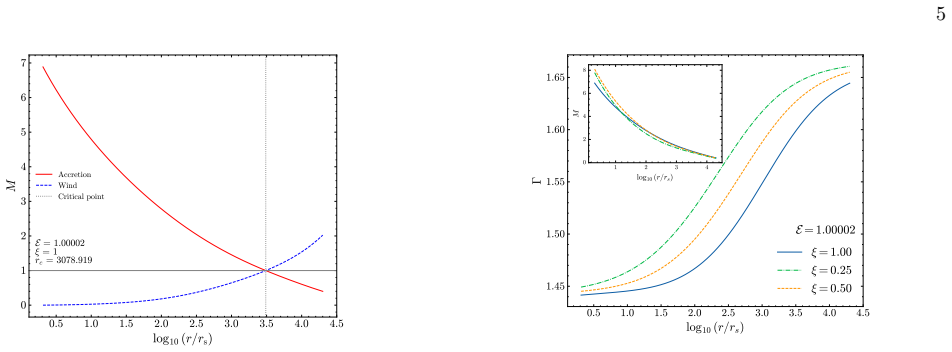
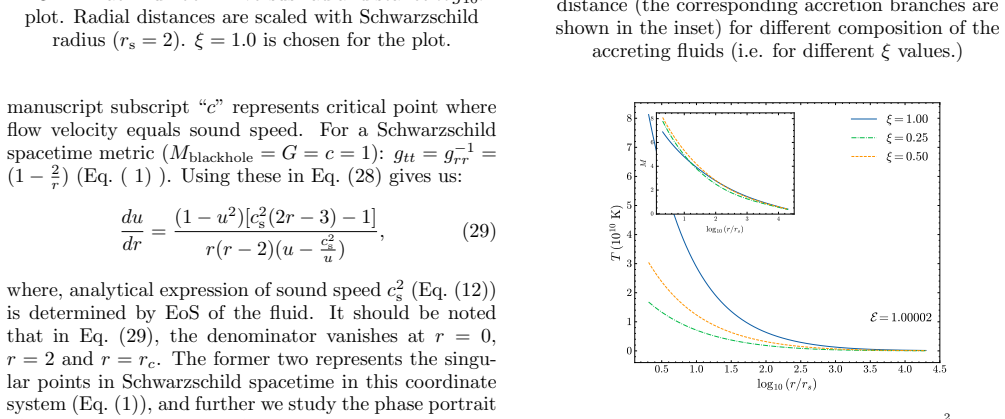
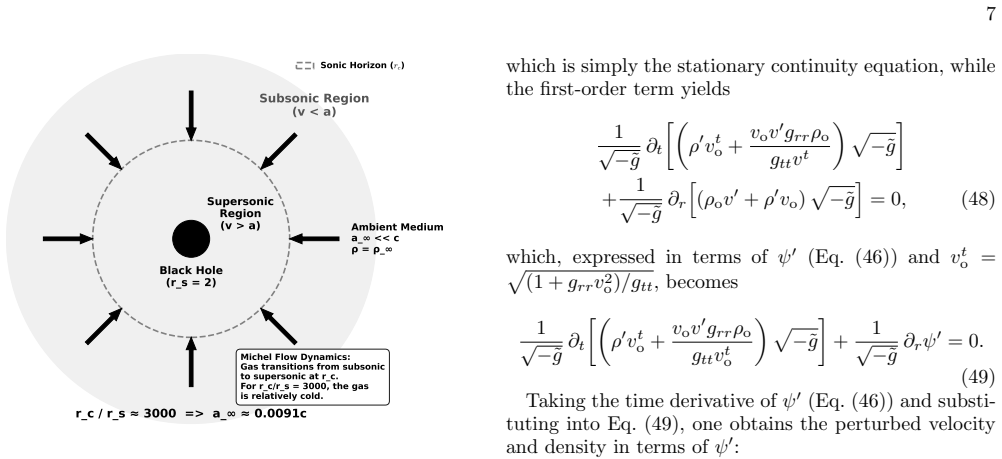
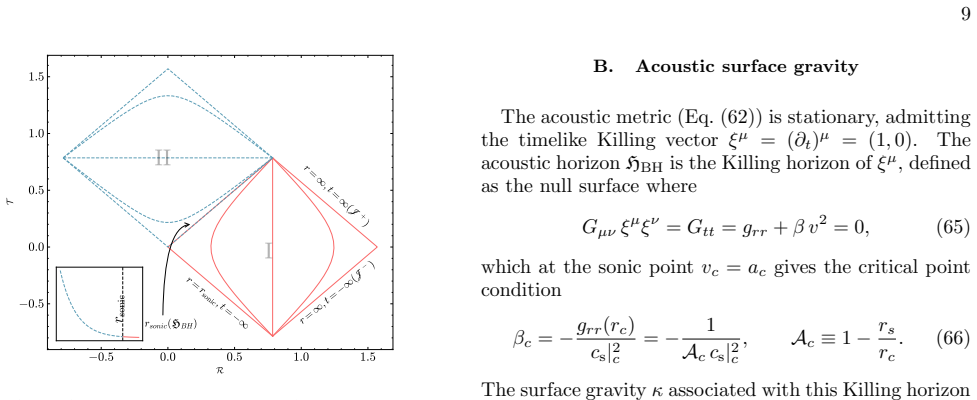
Spherically symmetric, general relativistic Bondi accretion is known as the Michel flow. The stationary integral transonic solutions for the Michel flow has been constructed for multi-component accretion described by an equation of state where the adiabatic index varies with the radial distance along which the streamlines are studied, and the corresponding phase portrait spanned by such radial distance and the flow Mach number has been obtained. Borrowing the techniques used in the dynamical systems theory, the nature of the transonic points of the aforementioned flow has been classified. The steady state flow has been perturbed to study the stability of the stationary solutions, and it has been found that such flows are stable under the (linear) radial perturbation. As a consequence of the stability analysis, the corresponding acoustic space time embedded within the accreting matter has been obtained, and the horizon of the metric of such sonic space time has been identified by constructing the causal structure with the help of the Carter-Penrose diagrams. In this way, the accreting black hole systems in the general relativistic set up has been investigated from various different perspectives - from its astrophysical aspects, from the dynamical systems point of view, as well as within the realm of the classical analogue gravity phenomena.
Editorial analysis
A structured set of objections, weighed in public.
Referee Report
Summary. The paper analyzes spherically symmetric general relativistic Bondi accretion (Michel flow) with a radially position-dependent adiabatic index. It constructs stationary integral transonic solutions, obtains the phase portrait in radial distance-Mach number space, classifies transonic points using dynamical systems techniques, demonstrates stability of the steady solutions under linear radial perturbations, derives the corresponding acoustic spacetime metric embedded in the flow, and identifies the sonic horizon via Carter-Penrose diagrams of the causal structure.
Significance. If the central derivation holds, the work provides an extension of analogue gravity techniques to GR accretion flows with variable adiabatic index, linking astrophysical transonic solutions to emergent acoustic metrics and horizons. The use of dynamical systems classification and explicit Carter-Penrose construction for the sonic spacetime are potentially useful additions to the literature on analogue spacetimes in accretion.
major comments (2)
- [stability analysis / acoustic metric derivation] The stability analysis section: the claim that linear radial perturbations suffice to obtain the acoustic metric (and its causal structure) is not supported by an explicit derivation of the wave equation □_g ϕ = 0 that accounts for the radial gradient of the adiabatic index; the position dependence may generate non-absorbable first-derivative terms or modify g^{μν} in a way that changes the location of the sonic horizon relative to the standard constant-index case.
- [acoustic spacetime and causal structure] Carter-Penrose diagram construction: the identification of the horizon relies on the acoustic metric obtained from radial perturbations only; it is unclear whether non-radial (l>0) modes or the variable-index terms alter the null geodesics, and no verification is provided that the diagrams remain consistent when the full angular dependence is restored.
minor comments (2)
- [abstract] Abstract: the phrasing 'the corresponding acoustic space time embedded within the accreting matter has been obtained' is vague; it should explicitly state the form of the derived metric and the assumptions under which it emerges from the perturbation equations.
- [equation of state section] Notation: the position-dependent adiabatic index is introduced without a clear functional form or calibration against external data; a brief statement of its explicit radial dependence would improve reproducibility.
Simulated Author's Rebuttal
We thank the referee for their careful reading and constructive comments. We address the two major points below, providing clarifications on the derivation and agreeing to strengthen the manuscript with additional explicit steps.
read point-by-point responses
-
Referee: [stability analysis / acoustic metric derivation] The stability analysis section: the claim that linear radial perturbations suffice to obtain the acoustic metric (and its causal structure) is not supported by an explicit derivation of the wave equation □_g ϕ = 0 that accounts for the radial gradient of the adiabatic index; the position dependence may generate non-absorbable first-derivative terms or modify g^{μν} in a way that changes the location of the sonic horizon relative to the standard constant-index case.
Authors: We thank the referee for this observation. The position-dependent adiabatic index γ(r) is fully incorporated into the background Michel flow solution via the relativistic Bernoulli equation and sound speed. Linearizing the continuity and Euler equations around this background yields a wave equation for the perturbation potential whose principal part defines an effective acoustic metric g^{μν}. The radial derivatives of γ appear only in lower-order terms that can be absorbed by a redefinition of the metric coefficients without altering the principal symbol or the location of the sonic horizon (where the radial three-velocity equals the local sound speed). We will add the complete step-by-step derivation of □_g ϕ = 0, including all variable-γ contributions, as an appendix in the revised manuscript. revision: yes
-
Referee: [acoustic spacetime and causal structure] Carter-Penrose diagram construction: the identification of the horizon relies on the acoustic metric obtained from radial perturbations only; it is unclear whether non-radial (l>0) modes or the variable-index terms alter the null geodesics, and no verification is provided that the diagrams remain consistent when the full angular dependence is restored.
Authors: The acoustic metric is constructed from the spherically symmetric radial flow; the Carter-Penrose diagrams therefore display the causal structure of the effective (1+1)-dimensional radial spacetime. The sonic horizon is the surface at which the radial component of the flow velocity equals the sound speed; this coordinate singularity is independent of angular momentum l. Variable γ(r) modifies the background profiles but enters the effective metric only through position-dependent coefficients that do not change the null radial geodesics. We will insert a clarifying paragraph stating that the diagrams refer to the radial sector under spherical symmetry, consistent with standard treatments of analogue horizons in accretion, while noting that a full 3+1 analysis of non-radial modes lies beyond the present scope. revision: partial
Circularity Check
No significant circularity; derivation follows standard linearization without reduction to inputs by construction
full rationale
The paper introduces a position-dependent adiabatic index as an explicit modeling choice for the equation of state in Michel flow, constructs stationary transonic solutions, classifies critical points via dynamical systems methods, and performs linear radial perturbation analysis. The acoustic metric is then obtained by casting the linearized continuity and Euler equations into a wave equation, with the sonic horizon identified via causal structure. This follows the standard procedure in analogue gravity literature, where the effective metric is determined directly from the background flow variables (velocity, density, sound speed) without the metric being presupposed or the stability result being redefined in terms of the metric itself. No equations reduce a claimed prediction to a fitted parameter or self-citation chain by construction. The position-dependent index shapes the background but is not derived from or equivalent to the acoustic spacetime. The derivation remains self-contained against the fluid equations and Carter-Penrose construction.
Axiom & Free-Parameter Ledger
Reference graph
Works this paper leans on
-
[1]
W. G. Unruh, Physical Review Letters46, 1351 (1981)
1981
-
[2]
Moncrief, The Astrophysical Journal235, 1038 (1980)
V. Moncrief, The Astrophysical Journal235, 1038 (1980)
1980
-
[3]
Visser, Classical and Quantum Gravity15, 1767 (1998)
M. Visser, Classical and Quantum Gravity15, 1767 (1998)
1998
-
[4]
Bili´ c, Classical and Quantum Gravity16, 3953 (1999)
N. Bili´ c, Classical and Quantum Gravity16, 3953 (1999)
1999
-
[5]
Barcel´ o, S
C. Barcel´ o, S. Liberati, and M. Visser, Living Reviews in Relativity8, 12 (2005)
2005
-
[6]
C. R. Almeida and M. J. Jacquet, The European Physical Journal H48, 15 (2023)
2023
-
[7]
E. P. T. Liang and K. A. Thompson, The Astrophysical Journal240, 271 (1980)
1980
-
[8]
T. K. Das, arXiv e-prints (2004), arXiv:gr-qc/0411006
Pith/arXiv arXiv 2004
-
[9]
T. K. Das, Monthly Notices of the Royal Astronomical Society361, 1305 (2005)
2005
-
[10]
Abraham, N
H. Abraham, N. Bili´ c, and T. K. Das, Classical and Quantum Gravity23, 2371 (2006)
2006
-
[11]
Maity, M
S. Maity, M. A. Shaikh, P. Tarafdar, and T. K. Das, Physical Review D106, 044062 (2022)
2022
-
[12]
M. A. Shaikh, I. Firdousi, and T. K. Das, New Astronomy 57, 94 (2017)
2017
-
[13]
Chandrasekhar,An Introduction to the Study of Stellar Structure(University of Chicago Press, Chicago, 1939)
S. Chandrasekhar,An Introduction to the Study of Stellar Structure(University of Chicago Press, Chicago, 1939)
1939
-
[14]
J. L. Synge,The Relativistic Gas(North-Holland, Ams- terdam, 1957)
1957
-
[15]
D. Ryu, I. Chattopadhyay, and E. Choi, The Astrophys- ical Journal Supplement Series166, 410 (2006)
2006
-
[16]
Chattopadhyay, International Journal of Modern Physics D17, 1929 (2008)
I. Chattopadhyay, International Journal of Modern Physics D17, 1929 (2008)
1929
-
[17]
Chattopadhyay and D
I. Chattopadhyay and D. Ryu, The Astrophysical Journal 694, 492 (2009)
2009
-
[18]
Kumar and I
R. Kumar and I. Chattopadhyay, Monthly Notices of the Royal Astronomical Society443, 3444 (2014)
2014
-
[19]
M. K. Vyas, R. Kumar, S. Mandal, and I. Chattopad- hyay, Monthly Notices of the Royal Astronomical Society 453, 2992 (2015)
2015
-
[20]
Sarkar and I
T. Sarkar and I. Chattopadhyay, International Journal of Modern Physics D28, 1950037 (2019)
2019
-
[21]
F. C. Michel, Astrophysics and Space Science15, 153 (1972)
1972
-
[22]
S. L. Shapiro and S. A. Teukolsky,Black Holes, White Dwarfs and Neutron Stars: The Physics of Compact Objects(Wiley-Interscience, New York, 1983) see Ap- pendix G for general relativistic spherical accretion
1983
-
[23]
Bondi, Monthly Notices of the Royal Astronomical Society112, 195 (1952)
H. Bondi, Monthly Notices of the Royal Astronomical Society112, 195 (1952)
1952
-
[24]
J. A. Font, Living Reviews in Relativity11, 7 (2008)
2008
-
[25]
Porthet al.(Event Horizon Telescope Collaboration), The Astrophysical Journal Supplement Series243, 26 (2019)
O. Porthet al.(Event Horizon Telescope Collaboration), The Astrophysical Journal Supplement Series243, 26 (2019)
2019
-
[26]
D. W. Jordan and P. Smith,Nonlinear Ordinary Differ- ential Equations: An Introduction for Scientists and En- gineers, 4th ed. (Oxford University Press, Oxford, 2007)
2007
-
[27]
R. C. Hilborn,Chaos and Nonlinear Dynamics: An In- troduction for Scientists and Engineers, 2nd ed. (Oxford University Press, Oxford, 2001)
2001
-
[28]
Ghose and T
S. Ghose and T. K. Das, inThe Relativistic Universe: From Classical to Quantum, Astrophysics and Space Sci- ence Proceedings, Vol. 61, edited by S. Ghosh and A. R. Rao (Springer, Cham, 2025)
2025
-
[29]
Joshi, I
P. Joshi, I. Chattopadhyay, D. Ryu, and A. Yadav, Monthly Notices of the Royal Astronomical Society501, 2776 (2021)
2021
-
[30]
R. M. Wald,General Relativity(University of Chicago Press, Chicago, 1984)
1984
-
[31]
M. A. Shaikh and T. K. Das, Physical Review D98, 123022 (2018)
2018
-
[32]
Painlev´ e, Comptes Rendus de l’Acad´ emie des Sciences 173, 677 (1921)
P. Painlev´ e, Comptes Rendus de l’Acad´ emie des Sciences 173, 677 (1921)
1921
-
[33]
Gullstrand, Arkiv f¨ or Matematik, Astronomi och Fysik16, 1 (1922)
A. Gullstrand, Arkiv f¨ or Matematik, Astronomi och Fysik16, 1 (1922)
1922
-
[34]
S. W. Hawking and G. F. R. Ellis,The Large Scale Struc- ture of Space-Time(Cambridge University Press, Cam- bridge, 1973)
1973
-
[35]
T. Paul, A. Chakraborty, S. Ghose, and T. K. Das, Phys. Rev. D112, 063018 (2025)
2025
-
[36]
Maity, P
S. Maity, P. Tarafdar, M. A. Shaikh, S. Ghose, and T. K. Das, Eur. Phys. J. C86, 127 (2026)
2026
-
[37]
H. Abraham, N. Bilic, and T. K. Das, Class. Quant. Grav. 23, 2371 (2006), arXiv:gr-qc/0509057
Pith/arXiv arXiv 2006
-
[38]
Fernandes, S
K. Fernandes, S. Maity, and T. Das, Phys. Rev. D106, 025020 (2022)
2022
discussion (0)
Sign in with ORCID, Apple, or X to comment. Anyone can read and Pith papers without signing in.