Axiomatic Tools for Separating Electoral Control Types, with Applications to Concrete Systems
Pith reviewed 2026-06-27 07:58 UTC · model grok-4.3
The pith
Axiomatic conditions suffice to prove collapses and separations among electoral control types, including pairs that separate under every voting rule.
A machine-rendered reading of the paper's core claim, the machinery that carries it, and where it could break.
Core claim
The authors establish axiomatic sufficient conditions guaranteeing that certain pairs of control types collapse or separate for any voting rule meeting the conditions. They further identify pairs that separate under every voting rule. When the conditions are checked against seven important voting systems, they yield sixty-four new collapses and nineteen hundred one new separations.
What carries the argument
Axiomatic sufficient conditions for collapse and separation of electoral control types, which derive relations without per-system counterexamples.
If this is right
- Sixty-four new collapses hold among the control types for the seven systems.
- Nineteen hundred one new separations hold for those systems.
- Certain control pairs separate for every possible voting rule.
- The complete characterization pins down the exact relation in at least one family of cases.
Where Pith is reading between the lines
- The axioms could be checked on additional voting systems to classify their control behaviors with limited extra effort.
- Universal separators offer a route to distinguish control types that remain distinct no matter which rule is used.
- The method may extend to other structural election changes beyond the standard forty-four types.
- The separations could help separate the computational complexities of the underlying control problems.
Load-bearing premise
The standard definitions of the forty-four electoral control types and the seven voting systems satisfy the paper's axiomatic conditions in a way that directly produces the reported counts of collapses and separations.
What would settle it
A concrete voting rule where one of the claimed universal separating pairs instead collapses would disprove the universal separation result.
Figures

read the original abstract
Electoral control is the study of whether an attacker, by structural changes on an election such as adding/deleting/partitioning voters or candidates, can affect the winner in some desired way. Forty-four such attack types are often considered standard, and recently there has been work showing that sometimes the attack types -- though seemingly distinct -- in fact "collapse," that is, for every input, either the attacker can achieve their goal under both of the control types or under neither of the control types. The papers doing this, however, while often exploiting axiomatic results that ensured collapses, found all the separations by human or computer-generated counterexamples. This left open the issue of whether even the separation direction can be driven by axiomatic results that allow large groups of separations to be almost automatically obtained. Our paper provides many such results, and we apply them to seven important voting systems, finding sixty-four new collapses and 1901 new separations. We not only give axiomatic sufficient conditions and one complete characterization result, but also identify some control-problem pairs that universally separate -- in other words, they separate under every voting rule.
Editorial analysis
A structured set of objections, weighed in public.
Referee Report
Summary. The paper develops axiomatic sufficient conditions for collapses and separations among the 44 standard electoral control types, along with one complete characterization result. These tools are instantiated on seven concrete voting systems to derive 64 new collapses and 1901 new separations; the work also identifies control-problem pairs that separate under every voting rule.
Significance. If the axiomatic conditions and their instantiations hold, the results supply a systematic, largely automatic method for obtaining large families of separations without per-pair counterexamples. This strengthens the methodological toolkit in computational social choice and yields concrete new facts about control for plurality, Copeland, etc. The zero free-parameter count and machine-checkable flavor of the derivations are strengths.
minor comments (2)
- [§3.2] §3.2: the statement of the complete characterization could explicitly list the two control types that remain non-characterized after the result is applied.
- [Table 5] Table 5: the column headers for the seven systems are abbreviated without a legend on the same page; this reduces readability for readers unfamiliar with the acronyms.
Simulated Author's Rebuttal
We thank the referee for the positive summary, significance assessment, and recommendation to accept. No major comments were raised in the report.
Circularity Check
No significant circularity; derivation is self-contained
full rationale
The paper introduces new axiomatic sufficient conditions and a complete characterization result for electoral control collapses and separations. These are then instantiated on the standard, externally defined 44 control types and seven voting systems. No step reduces a claimed prediction or separation to a fitted parameter, self-definition, or load-bearing self-citation chain; the results follow directly from applying the stated axioms to the given definitions without internal equivalence by construction. This matches the default expectation of a non-circular axiomatic paper.
Axiom & Free-Parameter Ledger
axioms (1)
- domain assumption Standard definitions of the 44 electoral control types
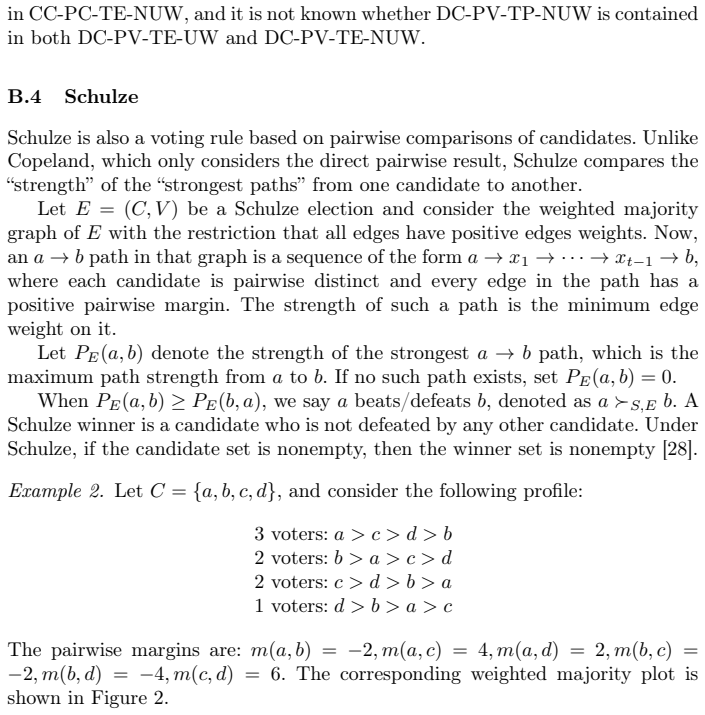
Reference graph
Works this paper leans on
-
[1]
In: Proceedings of the 23rd International Confer- ence on Autonomous Agents and Multiagent Systems
Alouf-Heffetz, S., Inamdar, T., Jain, P., Talmon, N., Hiren, Y.M.: Controlling del- egations in liquid democracy. In: Proceedings of the 23rd International Confer- ence on Autonomous Agents and Multiagent Systems. pp. 2624–2632. International Foundation for Autonomous Agents and Multiagent Systems (May 2024)
2024
-
[2]
In: Proceedings of the 39th AAAI Conference on Artificial Intelligence
Alouf-Heffetz, S., Janeczko, Ł., Lisowski, G., Papasotiropoulos, G.: The cost per- spective of liquid democracy: Feasibility and control. In: Proceedings of the 39th AAAI Conference on Artificial Intelligence. pp. 13538–13546. AAAI Press (Jul 2025)
2025
-
[3]
Social Choice and Welfare8(4), 341–354 (1991)
Bartholdi, III, J., Orlin, J.: Single transferable vote resists strategic voting. Social Choice and Welfare8(4), 341–354 (1991)
1991
-
[4]
Social Choice and Welfare6(3), 227–241 (1989)
Bartholdi, III, J., Tovey, C., Trick, M.: The computational difficulty of manipulating an election. Social Choice and Welfare6(3), 227–241 (1989). https://doi.org/10.1007/BF00295861
-
[5]
Social Choice and Welfare6(2), 157–165 (1989)
Bartholdi, III, J., Tovey, C., Trick, M.: Voting schemes for which it can be difficult to tell who won the election. Social Choice and Welfare6(2), 157–165 (1989)
1989
-
[6]
Bartholdi, III, J., Tovey, C., Trick, M.: How hard is it to control an election? Mathematical and Computer Modeling16(8–9), 27–40 (1992)
1992
-
[7]
In: Proceedings of the 26th AAAI Conference on Artificial Intelligence
Brill, M., Fischer, F.: The price of neutrality for the ranked pairs method. In: Proceedings of the 26th AAAI Conference on Artificial Intelligence. pp. 1299–1305. AAAI Press (Aug 2012)
2012
-
[8]
In: Proceedings of the 25th International Confer- ence on Autonomous Agents and Multiagent Systems
Bui, H., Chavrimootoo, M., Le, K., Nguyen, S.: Approximating electoral control problems (extended abstract). In: Proceedings of the 25th International Confer- ence on Autonomous Agents and Multiagent Systems. pp. 3347–3349. International Foundation for Autonomous Agents and Multiagent Systems (May 2026)
2026
-
[9]
Journal of Artificial Intelligence Research81, 71–116 (2024) 14
Carleton, B., Chavrimootoo, M., Hemaspaandra, L., Narváez, D., Taliancich, C., Welles, H.: Separating and collapsing electoral control types. Journal of Artificial Intelligence Research81, 71–116 (2024) 14
2024
-
[10]
In: Proceedings of the 25th International Conference on Autonomous Agents and Mul- tiagent Systems
Chen, J., Guttmann, J., Mustajbašić, M., Simola, S.: Control in hedonic games. In: Proceedings of the 25th International Conference on Autonomous Agents and Mul- tiagent Systems. pp. 920–928. International Foundation for Autonomous Agents and Multiagent Systems (May 2026)
2026
-
[11]
In: Proceedings of the 33rd International Joint Conference on Artificial Intelligence
Chen, J., Kaczmarek, J., Nüsken, P., Rothe, J., Schlotter, I., Seeger, T.: Control in computational social choice. In: Proceedings of the 33rd International Joint Conference on Artificial Intelligence. pp. 10391–10399. AAAI Press (Aug 2025)
2025
-
[12]
In: Proceedings of the 24th International Conference on Autonomous Agents and Multiagent Systems
De, K., Dey, P., Sanyal, S.: Voter participation control in online polls (extended abstract). In: Proceedings of the 24th International Conference on Autonomous Agents and Multiagent Systems. pp. 2484–2486. International Foundation for Au- tonomous Agents and Multiagent Systems (May 2025)
2025
-
[13]
Journal of Computer and System Sciences 81(4), 632–660 (2015)
Erdélyi, G., Fellows, M., Rothe, J., Schend, L.: Control complexity in Bucklin and fallback voting: A theoretical analysis. Journal of Computer and System Sciences 81(4), 632–660 (2015)
2015
-
[14]
In: Proceedings the 16th Australasian Theory Symposium
Erdélyi, G., Rothe, J.: Control complexity in fallback voting. In: Proceedings the 16th Australasian Theory Symposium. pp. 39–48. Australian Computer Society (Jan 2010)
2010
-
[15]
Journal of Artificial Intelligence Research35, 275–341 (2009)
Faliszewski, P., Hemaspaandra, E., Hemaspaandra, L., Rothe, J.: Llull and Copeland voting computationally resist bribery and constructive control. Journal of Artificial Intelligence Research35, 275–341 (2009)
2009
-
[16]
In: Proceedings of the 33rd International Joint Conference on Artificial Intelligence
Faliszewski, P., Janeczko, Ł., Knop, D., Pokorný, J., Schierreich, Š., Słuszniak, M., Sornat, K.: Participatory budgeting project strength via candidate control. In: Proceedings of the 33rd International Joint Conference on Artificial Intelligence. pp. 3821–3829. AAAI Press (Aug 2025)
2025
-
[17]
Theoretical Computer Science915, 74–89 (2022)
Gupta, S., Roy, S., Saurabh, S., Zehavi, M.: Resolute control: Forbidding candi- dates from winning an election is hard. Theoretical Computer Science915, 74–89 (2022)
2022
-
[18]
ACM Transactions on Computation Theory12(#1, Article 3), 1–42 (2020)
Hemaspaandra, E., Hemaspaandra, L., Menton, C.: Search versus decision for elec- tion manipulation problems. ACM Transactions on Computation Theory12(#1, Article 3), 1–42 (2020). https://doi.org/10.1145/3369937
-
[19]
Artificial Intelligence171(5–6), 255–285 (2007)
Hemaspaandra, E., Hemaspaandra, L., Rothe, J.: Anyone but him: The complexity of precluding an alternative. Artificial Intelligence171(5–6), 255–285 (2007)
2007
-
[20]
Annals of Mathemat- ics and Artificial Intelligence77(3–4), 191–223 (2016)
Hemaspaandra, L., Lavaee, R., Menton, C.: Schulze and ranked-pairs voting are fixed-parameter tractable to bribe, manipulate, and control. Annals of Mathemat- ics and Artificial Intelligence77(3–4), 191–223 (2016)
2016
-
[21]
In: Proceedings of the 27th European Conference on Artificial Intelligence
Kaczmarek, J., Rothe, J.: Control by adding players to change or maintain the Shapley–Shubik or the Penrose–Banzhaf power index in weighted voting games is complete for NPPP. In: Proceedings of the 27th European Conference on Artificial Intelligence. pp. 3525–3532. IOS Press (Oct 2024)
2024
-
[22]
In: Proceedings of the 28th European Conference on Artificial Intelligence
Kaczmarek,J.,Rothe,J.:Controlbydeletingplayersfromweightedvotinggamesis NPPP-complete for the Penrose–Banzhaf power index. In: Proceedings of the 28th European Conference on Artificial Intelligence. pp. 3663–3670. IOS Press (October 2025)
2025
-
[23]
Springer (2010)
Laslier, J., Sanver, M.: Handbook on Approval Voting. Springer (2010)
2010
-
[24]
In: Proceedings of the 33rd International Joint Conference on Artificial Intelligence
Maushagen, C., Niclaus, D., Nüsken, P., Rothe, J., Seeger, T.: Toward completing the picture of control in Schulze and Ranked Pairs elections. In: Proceedings of the 33rd International Joint Conference on Artificial Intelligence. pp. 2940–2948. AAAI Press (Aug 2024)
2024
-
[25]
Theory of Computing Systems53(4), 507–531 (2013) 15
Menton, C.: Normalized range voting broadly resists control. Theory of Computing Systems53(4), 507–531 (2013) 15
2013
-
[26]
In: Proceedings of the 23rd International Joint Conference on Artificial Intelligence
Menton, C., Singh, P.: Control complexity of Schulze voting. In: Proceedings of the 23rd International Joint Conference on Artificial Intelligence. pp. 286–292. AAAI Press (Aug 2013)
2013
-
[27]
In: Proceedings of the 25th Interna- tional Conference on Autonomous Agents and Multiagent Systems
Schierreich, Š., Sornat, K.: Algorithms for candidate control in sequential partic- ipatory budgeting rules (extended abstract). In: Proceedings of the 25th Interna- tional Conference on Autonomous Agents and Multiagent Systems. pp. 3450–3452. International Foundation for Autonomous Agents and Multiagent Systems (May 2026)
2026
-
[28]
Social Choice and Welfare 36(2), 267–303 (2011)
Schulze, M.: A new monotonic, clone-independent, reversal symmetric, and Condorcet-consistent single-winner election method. Social Choice and Welfare 36(2), 267–303 (2011)
2011
-
[29]
Social Choice and Welfare4(3), 185–206 (1987)
Tideman, T.: Independence of clones as a criterion for voting rules. Social Choice and Welfare4(3), 185–206 (1987)
1987
-
[30]
Ashgate Publishing (2006)
Tideman, T.: Collective Decisions and Voting: The Potential for Public Choice. Ashgate Publishing (2006)
2006
-
[31]
Yang, Y.: How hard is it to impact the impact of your paper? In: Proceedings of the 33rd International Joint Conference on Artificial Intelligence. pp. 3023–3031. AAAI Press (Aug 2024)
2024
-
[32]
masked down
Yang, Y., Wang, J.: Anyone but them: The complexity challenge for a resolute election controller. In: Proceedings of the 16th International Conference on Au- tonomous Agents and Multiagent Systems. pp. 1133–1141 (May 2017) 16 A Deferred Definitions for Partitioning A partition of a candidate setCis a pair(C 1, C2)such thatC 1 ∩C 2 =∅ andC 1 ∪C 2 =C. A par...
2017
-
[33]
In theconstructive control by partition of votersproblem forE, in the TP or TE tie-handling rule model (denoted byE-CC-PV-TP-NUWor E-CC-PV-TE-NUW, respectively), we are given an election(C, V), and a candidatep∈C. We ask if there is a partition ofVintoV1 andV 2 such thatp is a winner of the two-stage election where the winners of subelection(C, V1) that s...
-
[34]
In theconstructive control by run-off partition of candidates problem forE, in the TP or TE tie-handling rule model (denoted by E-CC-RPC-TP-NUWorE-CC-RPC-TE-NUW, respectively), we are given an election(C, V), and a candidatep∈C. We ask if there is a partition of CintoC 1 andC 2 such thatpis a winner of the two-stage election where the winners of subelecti...
-
[35]
most preferred
In theconstructive control by partition of candidatesproblem forE, in the TP or TE tie-handling rule model (denoted byE-CC-PC-TP-NUW orE-CC-PC-TE-NUW, respectively), we are given an election(C, V), and a candidatep∈C. We ask if there is a partition ofCintoC 1 andC 2 such 17 thatpis a winner of the two-stage election where the winners of subelec- tion(C 1,...
-
[36]
After this process, we consider a few cases, which are handled in exactly the same way as the proof of Theorem 9
By Lemma 1, each such move will not disruptp’s winning status inC′ 2. After this process, we consider a few cases, which are handled in exactly the same way as the proof of Theorem 9. If there is no unique winner in(C′ 1, V), or if the newly added candidaterbecomes a unique winner in(C ′ 1, V), then a successful control action is immediately obtained. Fur...
-
[37]
Otherwise,pwill at most tie withdin(D, V)
We claim that in(D, V),pmust strictly leadd. Otherwise,pwill at most tie withdin(D, V). Sinceq≻pandd≽q, addingq would givedone more point thanp, thus strictly surpassingpin({q} ∪D, V). This is impossible. Because the candidates removed fromD2 all beat bothp andd, removing them does not change the score difference betweenpandd. 26 Therefore, ifdstrictly ex...
-
[38]
no unique winner
As before, if there is no unique winner in (C ′ 1, V)or the newly movedxbecomes the unique winner in(C ′ 1, V), then we have obtained a desired partition, becauseqinitially leads all the old candidates by at least1point, and adding a candidatexcan only reduce each gap by a maximum of1point, so no old candidate can strictly surpassq. The worst case is that...
-
[39]
stopping rule,
In the latter case, together with the fact already proved after the first phase thatqcannot strictly beatp, this implies thatpremains a winner of the final round. End of Phase 2. In summary, starting from any successfulCC-RPC-TP-NUWpartition, we can construct a successfulCC-PC-TE-NUWpartition.⊓ ⊔ This next result also follows a procedural process with ite...
-
[40]
Thus assumeC ′ 1 also has unique winnerq, who is naturally not inD1
Hencepwins. Thus assumeC ′ 1 also has unique winnerq, who is naturally not inD1. We will repeatedly use the following stopping rule. Whenever we move a candidaterwithr≻ M pfrom the currentC ′ 2 to the currentC ′ 1, we check the winner set ofC′
-
[41]
IfC ′ 1 has no unique winner, then TE eliminates it, and the final is the currentC ′
-
[42]
strength
If the newly moved candidaterbecomes the unique winner, thenradvances back to the final. In both cases, the final is obtained from the original safe setC 2 ∪D 1 by deleting only candidates that defeatp. Hence, by Lemma 1,premains a winner. First move candidatesr∈C ′ 2 such thatr≻pandr≻q, one at a time. After each move, apply the stopping rule above. Moreo...
-
[43]
Ifpis a weak Condorcet winner of election(C, V), thenpwill always be a Schulze winner ofE
-
[44]
We first address the Group 4 relationships
Ifpis a Condorcet winner of election(C, V), thenpwill always be a unique Schulze winner ofE. We first address the Group 4 relationships. Proposition 3.Schulze satisfies the majority criterion and fails to satisfy Prop- ertiesαand Unique-αvia a 1-abstention-safe election. Proof.The satisfaction of the majority criterion is immediate as a majority winner is...
-
[45]
each control type in the UW model collapses to the corresponding control type in the NUW model, and
-
[46]
each partition-based control type using the TP tie-handling rule collapses to the corresponding control type using the TE tie-handling rule,
-
[47]
fallback
all destructive control types that are about partitioning candidates collapse with each other. Proof.The first two cases of the theorem are straightforward because RP is resolute, and so there can never be tied winners in any elections under RP. To see why the third case is true, first observe that by the first two cases of this theorem, DC-PC-TE-UW = DC-...
2010
discussion (0)
Sign in with ORCID, Apple, or X to comment. Anyone can read and Pith papers without signing in.