ChargeBD: Character-Aware Heterogeneous Agent Reasoning for Guided Engineering in Battery Development
Pith reviewed 2026-06-27 07:54 UTC · model grok-4.3
The pith
MBTI-inspired persona agents adapt LLM reasoning for multi-scale redox-flow battery tasks.
A machine-rendered reading of the paper's core claim, the machinery that carries it, and where it could break.
Core claim
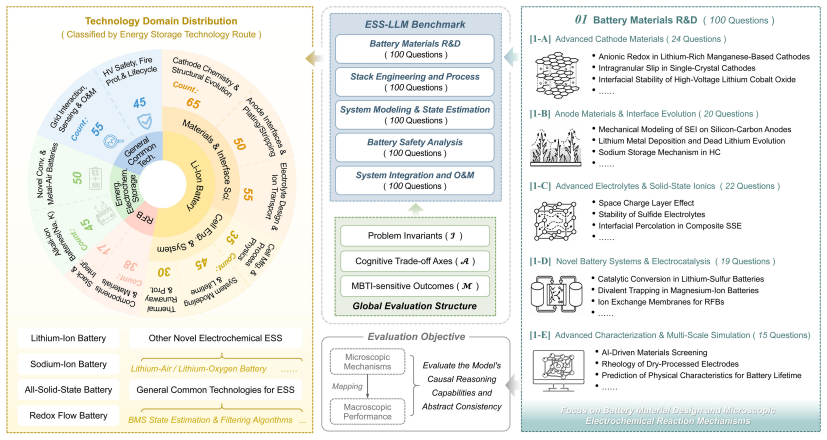
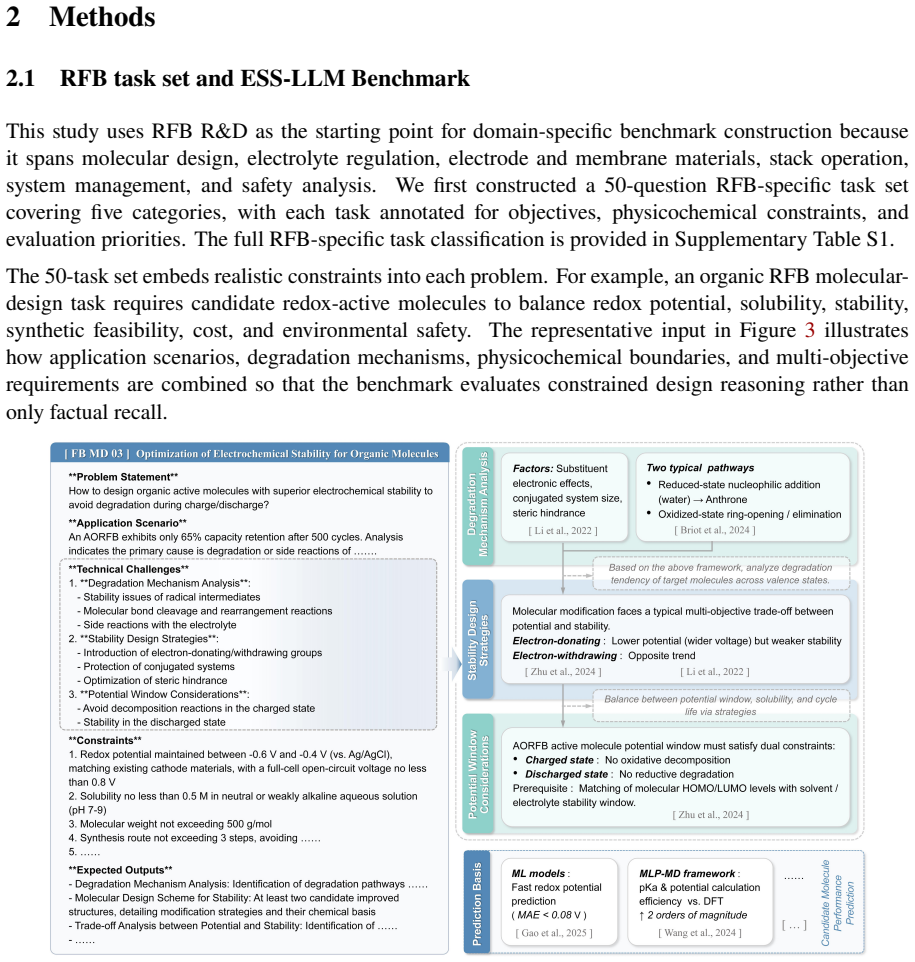
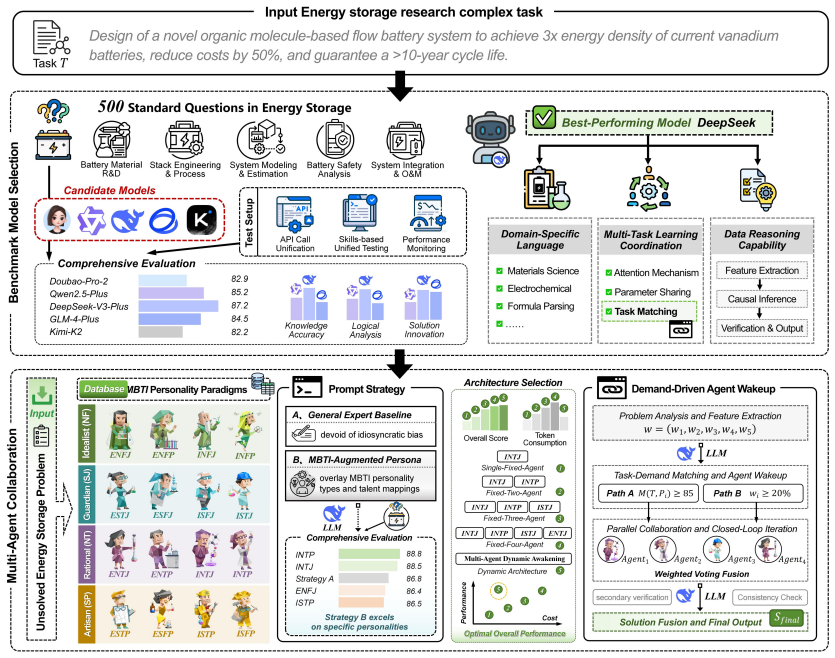
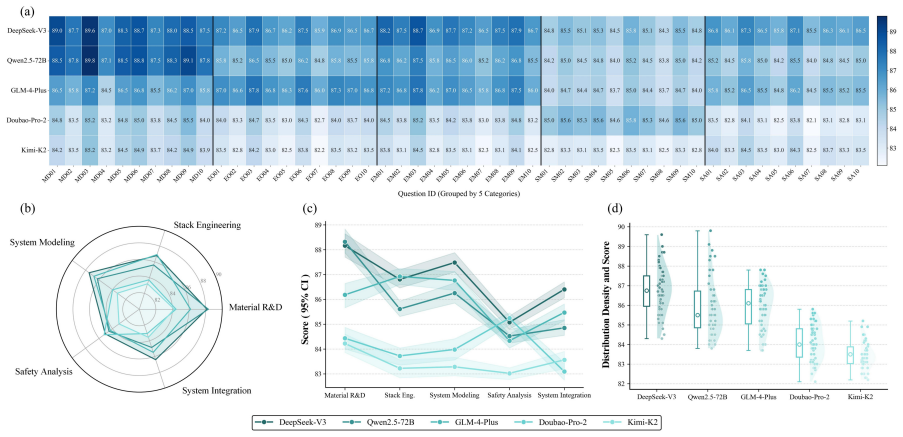
ChargeBD is a character-aware heterogeneous-agent reasoning framework that starts from a 50-question RFB-specific task set to build a 500-question ESS-LLM Benchmark. It defines 16 MBTI-inspired persona agents as structured cognitive-bias templates and uses DeepSeek-V3-Plus to evaluate them, resulting in a persona capability matrix and a cognitive advantage matrix that together overcome the insufficient adaptability of generic LLM reasoning in innovation, execution, modeling, and trade-offs.
What carries the argument
The 16 MBTI-inspired persona agents defined as structured cognitive-bias templates, evaluated on the ESS-LLM Benchmark to produce a persona capability matrix and cognitive advantage matrix.
Load-bearing premise
That MBTI-inspired persona agents defined as structured cognitive-bias templates will produce meaningfully different and useful reasoning behaviors when applied to the multi-scale, multi-objective RFB task set.
What would settle it
If the 16 persona agents generate statistically indistinguishable reasoning traces and performance scores from one another and from a single generic LLM on the 500-question ESS-LLM Benchmark.
Figures





read the original abstract
Redox-flow battery (RFB) research spans molecular design, electrolyte optimization, electrode and membrane materials, stack operation, system management, and safety analysis, making it a constrained, multi-scale, and multi-objective energy-storage R&D problem. Although large language models (LLMs) can support scientific knowledge integration and proposal generation, generic LLM reasoning remains insufficiently adaptive across innovation-oriented exploration, rule-based execution, mechanistic modeling, and system-level trade-offs. Here we introduce ChargeBD, a character-aware heterogeneous-agent reasoning framework for guided engineering in battery development. Starting from a 50-question RFB-specific task set, we construct a 500-question ESS-LLM Benchmark and define MBTI-inspired persona agents as structured cognitive-bias templates rather than psychometric instruments or representations of real personalities. DeepSeek-V3-Plus is selected as the shared base model, and 16 MBTI-inspired persona agents are evaluated to construct a persona capability matrix and a cognitive advantage matrix.
Editorial analysis
A structured set of objections, weighed in public.
Referee Report
Summary. The manuscript introduces ChargeBD, a character-aware heterogeneous-agent reasoning framework for redox-flow battery (RFB) development. It begins with a 50-question RFB-specific task set to construct a 500-question ESS-LLM Benchmark, defines 16 MBTI-inspired persona agents as structured cognitive-bias templates (rather than psychometric instruments), selects DeepSeek-V3-Plus as the shared base model, and evaluates the agents to construct a persona capability matrix and a cognitive advantage matrix.
Significance. If the evaluations establish that the MBTI-inspired personas produce meaningfully differentiated reasoning behaviors that improve outcomes across innovation-oriented exploration, rule-based execution, mechanistic modeling, and system-level trade-offs relative to generic LLM use, the framework could offer a practical method for injecting structured cognitive diversity into LLM-assisted scientific engineering workflows in constrained, multi-objective domains such as energy storage R&D.
major comments (2)
- [Abstract] Abstract: The manuscript states the construction of the benchmark and the plan to evaluate 16 persona agents in order to build the capability and advantage matrices, yet supplies no quantitative results, error analysis, baseline comparisons (e.g., against a single unconditioned DeepSeek-V3-Plus run), or statistical validation that persona differences actually improve task outcomes; this absence directly undermines the central claim that the heterogeneous framework overcomes the insufficient adaptability of generic LLM reasoning.
- [Section describing matrix construction] Section describing matrix construction: The persona capability matrix and cognitive advantage matrix are presented as derived from evaluations on the 500-question benchmark, but no data, divergence metrics, or evidence is provided that the MBTI-inspired cognitive-bias templates induce non-trivial behavioral differences or that any such differences yield collective gains on the multi-scale RFB task set; without this, the heterogeneous-agent premise reduces to unproven parallel sampling.
Simulated Author's Rebuttal
We thank the referee for the constructive and detailed feedback. The major comments correctly identify that the submitted manuscript describes the benchmark construction and matrix derivation but does not supply the supporting quantitative results or evidence. We address each point below and will incorporate the requested material in revision.
read point-by-point responses
-
Referee: [Abstract] Abstract: The manuscript states the construction of the benchmark and the plan to evaluate 16 persona agents in order to build the capability and advantage matrices, yet supplies no quantitative results, error analysis, baseline comparisons (e.g., against a single unconditioned DeepSeek-V3-Plus run), or statistical validation that persona differences actually improve task outcomes; this absence directly undermines the central claim that the heterogeneous framework overcomes the insufficient adaptability of generic LLM reasoning.
Authors: We agree that the current manuscript version presents the framework description and states that evaluations were performed, yet omits the actual quantitative results, error analysis, baseline comparisons, and statistical validation. In the revised manuscript we will add a dedicated Results section containing the persona capability matrix, cognitive advantage matrix, performance differentials versus the unconditioned DeepSeek-V3-Plus baseline, error bars, and statistical tests confirming that the observed persona differences produce measurable gains on the multi-scale RFB tasks. This addition will directly substantiate the central claim. revision: yes
-
Referee: [Section describing matrix construction] Section describing matrix construction: The persona capability matrix and cognitive advantage matrix are presented as derived from evaluations on the 500-question benchmark, but no data, divergence metrics, or evidence is provided that the MBTI-inspired cognitive-bias templates induce non-trivial behavioral differences or that any such differences yield collective gains on the multi-scale RFB task set; without this, the heterogeneous-agent premise reduces to unproven parallel sampling.
Authors: The referee is correct that the manuscript asserts the matrices are derived from the 500-question evaluations but supplies neither the underlying data nor divergence metrics demonstrating non-trivial behavioral differentiation or collective gains. We will revise the matrix-construction section to include the full evaluation dataset summary, explicit divergence metrics (response variance, task-specific performance spreads), and comparative analysis showing that the MBTI-inspired templates generate differentiated reasoning trajectories whose combination yields gains beyond parallel sampling of a single model. These additions will address the concern that the heterogeneous premise remains unproven. revision: yes
Circularity Check
No significant circularity; framework is self-contained empirical construction
full rationale
The paper presents an agent-based framework without any mathematical derivations, equations, or first-principles predictions. It explicitly defines MBTI-inspired personas as cognitive-bias templates, constructs a benchmark from an initial 50-question set, and builds capability/advantage matrices directly from evaluations on that benchmark. No steps match the enumerated circularity patterns: no self-definitional reductions, no fitted inputs renamed as predictions, no load-bearing self-citations, and no imported uniqueness theorems. The central claim rests on the empirical outcomes of the defined agents rather than reducing to its own inputs by construction. This is the normal case of a self-contained proposal whose validity can be assessed externally.
Axiom & Free-Parameter Ledger
axioms (1)
- domain assumption MBTI-inspired persona agents defined as structured cognitive-bias templates will yield distinct and advantageous reasoning behaviors on RFB tasks
Reference graph
Works this paper leans on
-
[1]
Jiang X, Wang W, Tian S, et al. Applications of natural language processing and large language modelsinmaterialsdiscovery[J].NPJComputationalMaterials,2025,11(1).DOI:10.1038/s41524- 025-01554-0
-
[2]
Zhang J, Li J, Zhao G, et al. Mining Solid-State Electrolytes from Metal–Organic Framework DatabasesthroughLargeLanguageModelsandRepresentationClustering[J].JournaloftheAmer- ican Chemical Society, 2025, 147(44): 40496-40506. 23
2025
-
[3]
The application of large language models in energy storage research
Zhong, Y.; Leng, Y.; Chen, S.; Li, P.; Zou, Z.; Liu, Y.; Wan, J. Accelerating battery research with retrieval-augmented large language models: Present and future. Energy Storage Science and Technology 2024, 13(9), 3214-3225. DOI:10.19799/j.cnki.2095-4239.2024.0604
-
[4]
The application of large language models in energy storage research
Yuan, Y.; Gao, Y.; Zhang, J.; Gao, Y.; Wang, C.; Chen, X.; Zhang, Q. The application of large language models in energy storage research. Energy Storage Science and Technology 2024, 13(9), 2907-2919. DOI:10.19799/j.cnki.2095-4239.2024.0176
-
[5]
Zuo, W.; Zheng, H.; He, T.; Vishwanath, V.; Chan, M. K. Y.; Stevens, R. L.; Amine, K.; Xu, G.-L. Large language models for batteries.Joule2025, 9, 102037. DOI:10.1016/j.joule.2025.102037
-
[6]
A generative model for inorganic materials design[J]
Zeni C, Pinsler R, Zügner D, et al. A generative model for inorganic materials design[J]. Nature, 2025, 639(8055): 624-632
2025
-
[7]
Large language models as molecu- lar design engines[J]
Bhattacharya D, Cassady H J, Hickner M A, et al. Large language models as molecu- lar design engines[J]. Journal of Chemical Information and Modeling, 2024, 64:7086-7096. DOI:10.1021/acs.jcim.4c01396
-
[8]
Theodoris, Ling Xiao, Anant Chopra, Mark D
Wang, H.; Fu, T.; Du, Y.; Gao, W.; Huang, K.; Liu, Z.; Chandak, P.; Liu, S.; et al. Scientific discovery in the age of artificial intelligence.Nature2023, 620, 47-60. DOI:10.1038/s41586-023- 06221-2
-
[9]
Boiko,D.A.;MacKnight,R.;Kline,B.;Gomes,G.Autonomouschemicalresearchwithlargelan- guagemodels.Nature2023,624,570-578.DOI:10.1038/s41586-023-06792-0;arXiv:2304.05332
work page internal anchor Pith review Pith/arXiv arXiv doi:10.1038/s41586-023-06792-0;arxiv:2304.05332
-
[10]
Automating structure–activity analysis for electrochemical nitrogen reduction catalyst design through multi-agent collaborations[J]
Hu X, Chen S, Chen L, et al. Automating structure–activity analysis for electrochemical nitrogen reduction catalyst design through multi-agent collaborations[J]. National Science Review, 2025, 12(11): nwaf372
2025
-
[11]
ChemCrow: Augmenting large-language models with chemistry tools
Bran, A. M.; Cox, S.; Schilter, O.; Baldassari, C.; White, A. D.; Schwaller, P. Augmenting large language models with chemistry tools.Nature Machine Intelligence2024, 6, 525-535. DOI:10.1038/s42256-024-00832-8; arXiv:2304.05376
work page internal anchor Pith review Pith/arXiv arXiv doi:10.1038/s42256-024-00832-8
-
[12]
Ghafarollahi, A.; Buehler, M. J. SciAgents: Automating Scientific Discovery Through Bioin- spired Multi-Agent Intelligent Graph Reasoning.Advanced Materials2025, 37(22), e2413523. DOI:10.1002/adma.202413523; arXiv:2409.05556
-
[13]
Li, X.; Huang, Z.; Quan, S.; Peng, C.; Ma, X. SLM-MATRIX: a multi-agent trajectory reason- ing and verification framework for enhancing language models in materials data extraction.npj Computational Materials2025, 11, 241. DOI:10.1038/s41524-025-01719-x
-
[14]
Agent-based multimodal information extraction for nanomaterials
Odobesku,R.;Romanova,K.;Mirzaeva,S.;Zagorulko,O.;Sim,R.;Khakimullin,R.;Razlivina,J.; Dmitrenko, A.; Vinogradov, V. Agent-based multimodal information extraction for nanomaterials. npj Computational Materials2025, 11, 194. DOI:10.1038/s41524-025-01674-7
-
[15]
Rupprecht, S.; Gao, Q.; Karia, T.; Schweidtmann, A. M. Multi-agent systems for chemical engi- neering: a review and perspective.Current Opinion in Chemical Engineering2026, 51, 101209. DOI:10.1016/j.coche.2025.101209; arXiv:2508.07880
-
[16]
Pham, T. D.; Tanikanti, A.; Keceli, M. ChemGraph as an agentic framework for computational chemistryworkflows.Communications Chemistry2026,9,33.DOI:10.1038/s42004-025-01776-9; arXiv:2506.06363
-
[17]
Beyond chemical qa: Evaluating llm’s chemical reasoning with modular chemical operations[J]
Hao L, Cao H, Feng B, et al. Beyond chemical qa: Evaluating llm’s chemical reasoning with modular chemical operations[J]. Advances in Neural Information Processing Systems, 2026, 38. 24
2026
-
[18]
Elbeheiry, María Victoria Gil, Christina Glaubitz, Maximilian Greiner, Caroline T
Mirza, A.; Alampara, N.; Kunchapu, S.; Rios-Garcia, M.; Emoekabu, B.; Krishnan, A.; Gupta, T.; Schilling-Wilhelmi, M.; et al. A framework for evaluating the chemical knowledge and reasoning abilities of large language models against the expertise of chemists.Nature Chemistry2025, 17, 1027-1034. DOI:10.1038/s41557-025-01815-x; arXiv:2404.01475
-
[19]
Zhang, J.; Gan, J.; Wang, X.; Jia, Z.; Gu, C.; Chen, J.; Zhu, Y.; Ma, M. D.; Zhou, D.; Li, L.; Wang,W.MatSciBench: Benchmarkingthereasoningabilityoflargelanguagemodelsinmaterials science. arXiv preprint arXiv:2510.12171, 2025
Pith/arXiv arXiv 2025
-
[20]
DOI:10.1038/s41560-021-00796-8
Sepulveda,N.A.;Jenkins,J.D.;Edington,A.;Mallapragada,D.S.;Lester,R.K.Thedesignspace for long-duration energy storage in decarbonized power systems.Nature Energy2021, 6, 506-516. DOI:10.1038/s41560-021-00796-8
-
[21]
DOI:10.1007/s10800-011- 0348-2
Weber,A.Z.;Mench,M.M.;Meyers,J.P.;Ross,P.N.;Gostick,J.T.;Liu,Q.Redoxflowbatteries: a review.Journal of Applied Electrochemistry2011, 41, 1137-1164. DOI:10.1007/s10800-011- 0348-2
-
[22]
Darling, R. M.; Gallagher, K. G.; Kowalski, J. A.; Ha, S.; Brushett, F. R. Pathways to low-cost electrochemical energy storage: a comparison of aqueous and nonaqueous flow batteries.Energy & Environmental Science2014, 7, 3459-3477. DOI:10.1039/C4EE02158D
-
[23]
Modelling and estimation of vanadium redox flow batteries: a review.Batteries2022, 8, 121
Puleston, T.; Clemente, A.; Costa-Castello, R.; Serra, M. Modelling and estimation of vanadium redox flow batteries: a review.Batteries2022, 8, 121. DOI:10.3390/batteries8090121
-
[24]
Improved electrochemical performance for vanadium flow battery by optimizing the concentration of the electrolyte[J]
Jing M, Wei Z, Su W, et al. Improved electrochemical performance for vanadium flow battery by optimizing the concentration of the electrolyte[J]. Journal of Power Sources, 2016, 324: 215-223
2016
-
[25]
Journal of Power Sources, 2026, 667: 239216
ShaheenI,ChiuWH,LeeYX,etal.Heterogeneousgraphitefeltelectrodesdecoratedwithnanos- tructured graphitic carbon nitride for enhanced redox kinetics in vanadium redox flow batteries[J]. Journal of Power Sources, 2026, 667: 239216
2026
-
[26]
Nafion-Based Proton Exchange Membranes for Vanadium Redox Flow Batter- ies[J]
He S, Chai S, Li H. Nafion-Based Proton Exchange Membranes for Vanadium Redox Flow Batter- ies[J]. ChemSusChem, 2025, 18(10): e202402506
2025
-
[27]
Characterization and scale-up of serpentine and interdigitated flow fields for application in commercial vanadium redox flow batteries[J]
Gundlapalli R, Bhattarai A, Ranjan R, et al. Characterization and scale-up of serpentine and interdigitated flow fields for application in commercial vanadium redox flow batteries[J]. Journal of Power Sources, 2022, 542: 231812
2022
-
[28]
Journal of Power Sources, 2021, 490: 229514
ZouT,ShiX,YuL.Studyonenergylossof35kWallvanadiumredoxflowbatteryenergystorage system under closed-loop flow strategy[J]. Journal of Power Sources, 2021, 490: 229514
2021
-
[29]
Z.; Stinis, P.; Tartakovsky, A
He, Q. Z.; Stinis, P.; Tartakovsky, A. M. Physics-constrained deep neural network method for estimating parameters in a redox flow battery.Journal of Power Sources2022, 528, 231147. DOI:10.1016/j.jpowsour.2022.231147; arXiv:2106.11451
-
[30]
Chen, W.; Fu, Y.; Stinis, P. Physics-informed machine learning of redox flow battery based on a two-dimensional unit cell model.Journal of Power Sources2023, 584, 233548. DOI:10.1016/j.jpowsour.2023.233548; arXiv:2306.01010
-
[31]
Accelerating battery innovation: AI-powered molecular discovery[J]
Gao Y C, Chen X, Yuan Y H, et al. Accelerating battery innovation: AI-powered molecular discovery[J]. Chemical Society Reviews, 2025, 54(21): 9630-9684
2025
-
[32]
Machine learning toward electrochemical energy storage materials and devices: A review[J]
Ma C, Yao C, Xu J, et al. Machine learning toward electrochemical energy storage materials and devices: A review[J]. Sustainable Materials and Technologies, 2026: e01990
2026
-
[33]
Chemagent: Self-updating library in large language models improves chemical reasoning[J]
Tang X, Hu T, Ye M, et al. Chemagent: Self-updating library in large language models improves chemical reasoning[J]. arXiv preprint arXiv:2501.06590, 2025. 25
arXiv 2025
-
[34]
BestaM,ChandranS,GerstenbergerR,etal.PsychologicallyenhancedAIagents[J].arXivpreprint arXiv:2509.04343, 2025
arXiv 2025
-
[35]
Two tales of persona in llms: A survey of role-playing andpersonalization[C]//FindingsoftheAssociationforComputationalLinguistics: EMNLP2024
Tseng Y M, Huang Y C, Hsiao T Y, et al. Two tales of persona in llms: A survey of role-playing andpersonalization[C]//FindingsoftheAssociationforComputationalLinguistics: EMNLP2024. 2024: 16612-16631
2024
-
[36]
InProceedings of ACL 2024, 1840-1873
Wang, X.; Xiao, Y.; Huang, J.; Yuan, S.; Xu, R.; Guo, H.; Tu, Q.; Fei, Y.; Leng, Z.; Wang, W.; Chen,J.;Li,C.;Xiao,Y.InCharacter: Evaluatingpersonalityfidelityinrole-playingagentsthrough psychological interviews. InProceedings of ACL 2024, 1840-1873. DOI:10.18653/v1/2024.acl- long.102
-
[37]
Machine Mindset: an MBTI exploration of large language models
Cui, J.; Lv, L.; Wen, J.; Wang, R.; Tang, J.; Tian, Y.; Yuan, L. Machine Mindset: an MBTI exploration of large language models. arXiv preprint arXiv:2312.12999, 2023
arXiv 2023
-
[38]
Palo Alto: Consulting Psychologists Press, 1985
MyersI,McCaulleyM.MBTIManual: AGuidetotheDevelopmentandUseoftheMyers-Briggs Type Indicator[M]. Palo Alto: Consulting Psychologists Press, 1985
1985
-
[39]
Psychological Types[M]
Jung C G. Psychological Types[M]. London: Routledge, 1923
1923
-
[40]
Using MBTI for the success assessment of engineering teams in project-based learning[J]
Rodríguez Montequín V, Mesa Fernández J M, Balsera J V, et al. Using MBTI for the success assessment of engineering teams in project-based learning[J]. International journal of technology and design education, 2013, 23(4): 1127-1146. 26 Supplementary Information Supplementary Note S1. Prompt templates and persona-agent definitions Theprompt-sourcearchivec...
2013
discussion (0)
Sign in with ORCID, Apple, or X to comment. Anyone can read and Pith papers without signing in.