Middle orders: all distributive lattices between weak and Bruhat
Pith reviewed 2026-06-27 09:15 UTC · model grok-4.3
The pith
In type A, binary trees index all distributive lattices between the weak and Bruhat orders.
A machine-rendered reading of the paper's core claim, the machinery that carries it, and where it could break.
Core claim
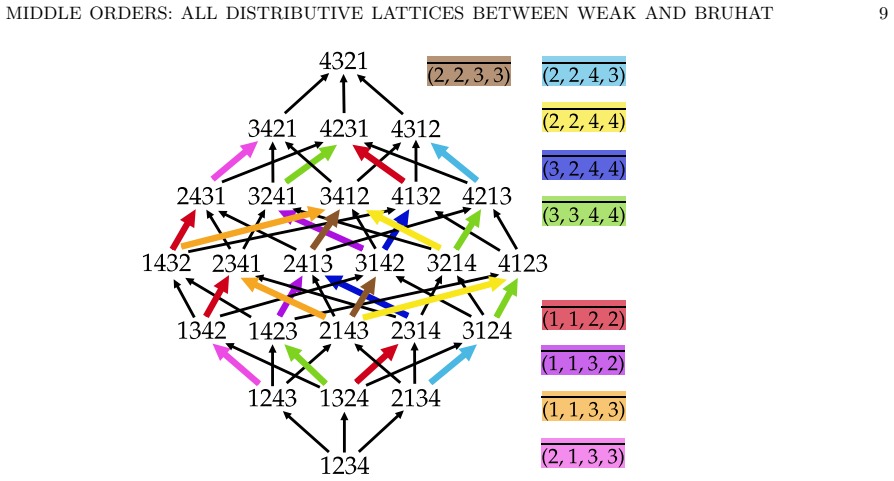
Middle orders on the symmetric group are in bijection with binary trees; each tree gives a partition of the root poset into rectangles such that the lower sets of the partition are in bijection with permutations, and the inclusion order on these lower sets is a distributive lattice refining the weak order and refined by the Bruhat order. These are the only such lattices in type A.
What carries the argument
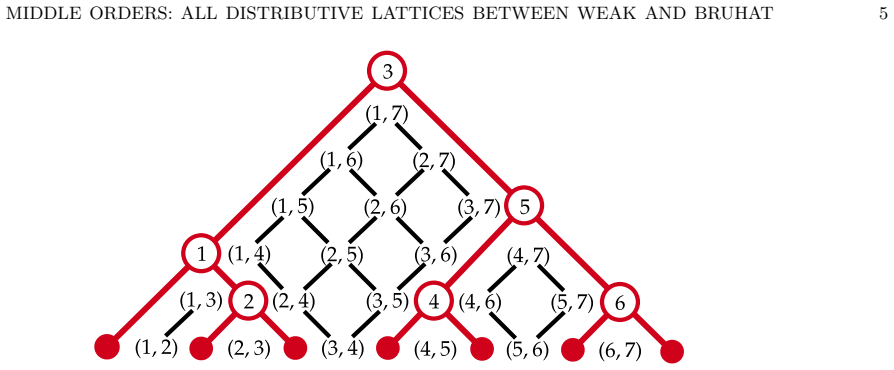
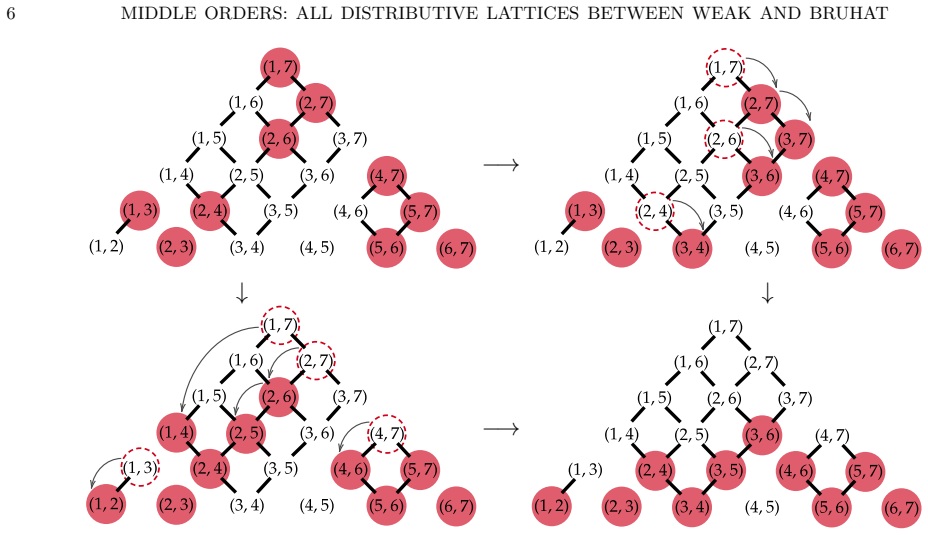
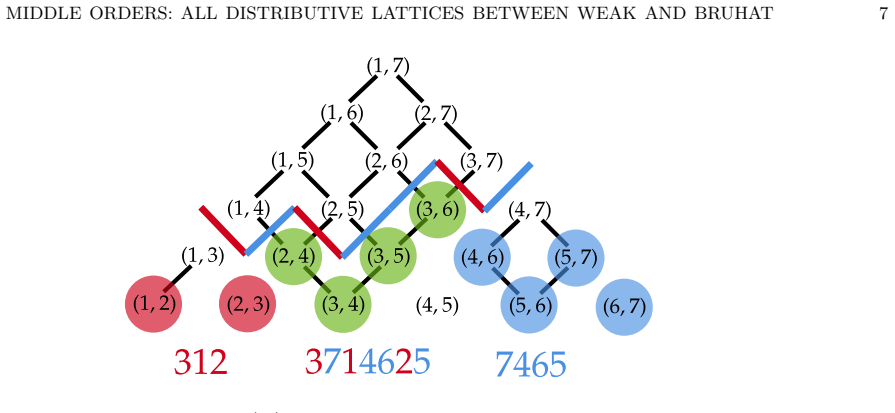
The rectangle partition of the root poset determined by a binary tree, which induces a bijection from permutations to lower sets and thereby equips them with a distributive lattice structure between the weak and Bruhat orders.
If this is right
- The left-comb binary tree recovers the middle order previously defined by Bouvel, Ferrari, and Tenner.
- All minuscule middle orders are sorting orders in the sense of Armstrong.
- The construction extends from type A to other Weyl groups using parabolic quotients.
- Conjectural descriptions are proposed for non-minuscule middle orders.
Where Pith is reading between the lines
- The rectangle-partition technique might apply to other poset families on permutations beyond Coxeter groups.
- One could check whether the number of linear extensions of these lattices admits a closed formula in terms of the binary tree.
- The uniqueness result in type A suggests that similar classification problems could be posed for other pairs of orders on the same ground set.
Load-bearing premise
The map sending each permutation to the lower set corresponding to its rectangle partition must define a distributive lattice order that sits between the weak and Bruhat orders.
What would settle it
A counterexample would be a distributive lattice on the set of permutations that properly refines the weak order, is properly refined by the Bruhat order, yet is not isomorphic to any of the lattices constructed from binary trees.
Figures





read the original abstract
For a given Coxeter group, we study distributive lattices called middle orders refining the weak order and refined by the Bruhat order. In type $A$, we construct such lattices indexed by binary trees using a direct bijection between permutations and lower sets of a certain partition of the root poset into rectangles. When the binary tree is a left-comb tree, we recover the middle order defined by Bouvel, Ferrari, and Tenner (2025). We study combinatorial properties of these lattices, and show they are the only distributive lattices between the weak and Bruhat orders in type $A$. For general Coxeter groups, we study middle orders on parabolic quotients and use these to generalize our construction in type $A$ to other Weyl groups, obtaining so-called ``minuscule middle orders''. We show that they are a subset of sorting orders defined by Armstrong (2009), and we give conjectural descriptions of all middle orders that are not minuscule.
Editorial analysis
A structured set of objections, weighed in public.
Referee Report
Summary. The paper defines middle orders as distributive lattices on Coxeter groups that refine the weak order and are refined by the Bruhat order. In type A, it constructs such lattices indexed by binary trees via an explicit bijection mapping permutations in S_n to lower sets of a partition of the root poset into rectangles (one rectangle per tree). It proves these lattices are distributive and satisfy the sandwich property, recovers the Bouvel-Ferrari-Tenner construction for left-comb trees, establishes that these are all distributive lattices between weak and Bruhat in type A, and studies their combinatorial properties. For general Coxeter groups, it defines minuscule middle orders on parabolic quotients, generalizes the construction to other Weyl groups, proves containment in Armstrong's sorting orders, and offers conjectural descriptions of non-minuscule cases.
Significance. If the constructions and uniqueness hold, the work supplies a complete classification of distributive lattices between weak and Bruhat orders in type A, with an explicit link to binary trees and root-poset geometry. The generalization to minuscule middle orders and their inclusion among sorting orders provides a concrete framework for other types. Explicit bijections, direct combinatorial arguments, and recovery of prior work are notable strengths; the results are parameter-free and rest on standard root-poset structure.
minor comments (3)
- [§3] §3 (type A construction): the bijection between permutations and lower sets of the rectangle partition should include a small explicit example (e.g., n=3 or n=4) to illustrate how the induced order refines weak order and is refined by Bruhat order.
- [§4] The uniqueness statement in type A would be strengthened by a brief remark confirming that distinct binary trees produce non-isomorphic lattices (or noting when they coincide).
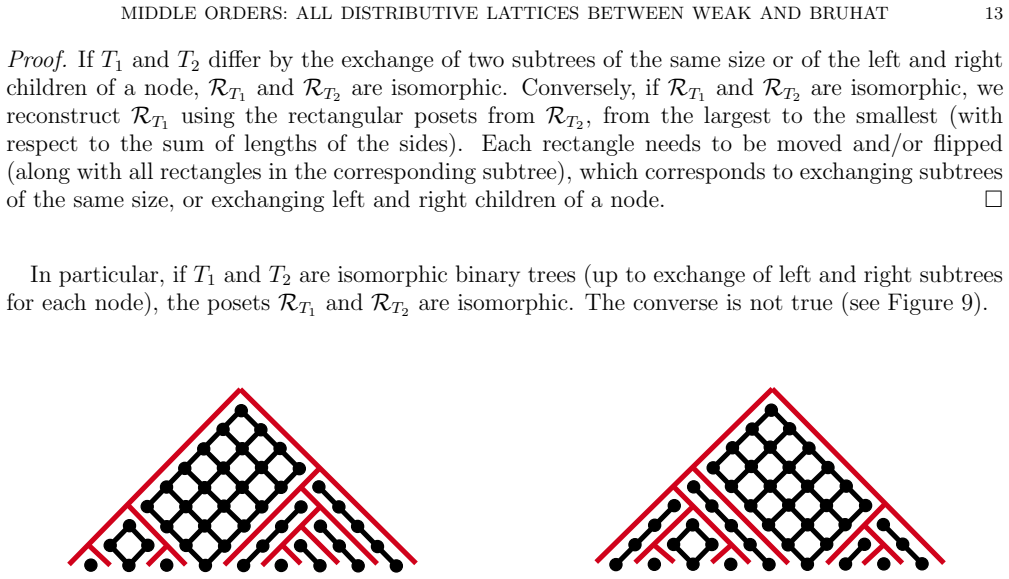
- A figure showing the rectangle partition for a non-left-comb binary tree would improve readability of the generalization to minuscule middle orders.
Simulated Author's Rebuttal
We thank the referee for their positive summary of the manuscript, recognition of its contributions, and recommendation for minor revision. No specific major comments were provided in the report.
Circularity Check
No significant circularity
full rationale
The derivation chain consists of explicit combinatorial constructions: a direct bijection from permutations to lower sets of a rectangle-partitioned root poset (indexed by binary trees), verification that the induced order refines weak and is refined by Bruhat, and a classification proof that every distributive lattice with the sandwich property arises this way. These steps rest on standard definitions of weak order, Bruhat order, root posets, and Armstrong's sorting orders (external 2009 reference). The minuscule-middle-order generalization is likewise an explicit containment argument. No equations or claims reduce by construction to fitted parameters, self-definitions, or load-bearing self-citations; the manuscript supplies the required direct arguments without circular reduction.
Axiom & Free-Parameter Ledger
axioms (2)
- domain assumption Weak order and Bruhat order are partial orders on Coxeter groups with the stated refinement relation.
- standard math A poset is a distributive lattice when meet and join distribute over each other.
Reference graph
Works this paper leans on
-
[1]
Generalized noncrossing partitions and combinatorics of coxeter groups.Mem
Drew Armstrong. Generalized noncrossing partitions and combinatorics of coxeter groups.Mem. Amer. Math. Soc., 202(949), 2009
2009
-
[2]
The sorting order on a Coxeter group.Journal of Combinatorial Theory, Series A, 116(8):1285–1305, 2009
Drew Armstrong. The sorting order on a Coxeter group.Journal of Combinatorial Theory, Series A, 116(8):1285–1305, 2009
2009
-
[3]
On the Glucose SAT solver.International Journal on Artificial Intelli- gence Tools, 27(01):1840001, February 2018
Gilles Audemard and Laurent Simon. On the Glucose SAT solver.International Journal on Artificial Intelli- gence Tools, 27(01):1840001, February 2018
2018
-
[4]
Coxeter-biCatalan combinatorics.Journal of Algebraic Combinatorics, 47(2):241–300, August 2017
Emily Barnard and Nathan Reading. Coxeter-biCatalan combinatorics.Journal of Algebraic Combinatorics, 47(2):241–300, August 2017
2017
-
[5]
Rings of sets.Duke Mathematical Journal, 3(3), 1937
Garrett Birkhoff. Rings of sets.Duke Mathematical Journal, 3(3), 1937
1937
-
[6]
Lattice Theory
Garrett Birkhoff. Lattice Theory. revised edition.Amer. Math. Soc. Colloq. Publ., 25(2), 1948
1948
-
[7]
Affine permutations of typeA.The Electronic Journal of Combinatorics, 3(2), September 1995
Anders Bj¨ orner and Francesco Brenti. Affine permutations of typeA.The Electronic Journal of Combinatorics, 3(2), September 1995
1995
-
[8]
Graduate Texts in Mathematics
Anders Bj¨ orner and Francesco Brenti.Combinatorics of Coxeter Groups. Graduate Texts in Mathematics. Springer, April 2005
2005
-
[9]
Mathilde Bouvel, Luca Ferrari, and Bridget E. Tenner. Between weak and Bruhat: The middle order on permutations.Graphs Comb., 41(2), April 2025
2025
-
[10]
Lattices of pretorsion classes
Federico Campanini, Francesca Fedele, and Emine Yıldırım. Lattices of pretorsion classes. Preprint, arXiv:2511.19223, 2025
-
[11]
Mixed dimer models for Euler and Catalan numbers
Andrew Claussen and Nicholas Ovenhouse. Mixed dimer models for Euler and Catalan numbers. Preprint, arXiv:2503.11936, 2025
-
[12]
The shape of a typical boxed plane partition
Henry Cohn, Michael Larsen, and James Propp. The shape of a typical boxed plane partition. 2002
2002
-
[13]
Sur la topologie de certains espaces homog` enes.The Annals of Mathematics, 35(2):396, April 1934
Charles Ehresmann. Sur la topologie de certains espaces homog` enes.The Annals of Mathematics, 35(2):396, April 1934
1934
-
[14]
Springer Basel, 2011
George Gr¨ atzer.Lattice Theory: Foundation. Springer Basel, 2011
2011
-
[15]
Novelli, and Jean-Yves Thibon
Florent Hivert, Jean-Christophe. Novelli, and Jean-Yves Thibon. The algebra of binary search trees.Theoretical Computer Science, 339(1):129–165, 2005. Combinatorics on Words
2005
-
[16]
Treillis et bases des groupes de Coxeter.Electron
Alain Lascoux and Marcel-Paul Sch¨ utzenberger. Treillis et bases des groupes de Coxeter.Electron. J. Combin., 3(2):Research paper 27, approx. 35, 1996
1996
-
[17]
Macdonald.Symmetric Functions and Hall Polynomials
Ian G. Macdonald.Symmetric Functions and Hall Polynomials. Oxford University Press, 1979
1979
-
[18]
The On-Line Encyclopedia of Integer Sequences
OEIS Foundation Inc. The On-Line Encyclopedia of Integer Sequences. Published electronically athttp: //oeis.org
-
[19]
Permutrees.Electronic Notes in Discrete Mathematics, 61:987–993, 2017
Vincent Pilaud and Viviane Pons. Permutrees.Electronic Notes in Discrete Mathematics, 61:987–993, 2017. The European Conference on Combinatorics, Graph Theory and Applications (EUROCOMB’17)
2017
-
[20]
Quotientopes.Bulletin of the London Mathematical Society, 51(3):406– 420, 2019
Vincent Pilaud and Francisco Santos. Quotientopes.Bulletin of the London Mathematical Society, 51(3):406– 420, 2019
2019
-
[21]
Robert A. Proctor. Bruhat lattices, plane partition generating functions, and minuscule representations.Eu- ropean Journal of Combinatorics, 5(4):331–350, 1984
1984
-
[22]
Lattice structure for orientations of graphs.The Electronic Journal of Combinatorics, 32(4):P4.26, Nov
James Propp. Lattice structure for orientations of graphs.The Electronic Journal of Combinatorics, 32(4):P4.26, Nov. 2025
2025
-
[23]
Lattice congruences, fans and Hopf algebras.Journal of Combinatorial Theory, Series A, 110(2):237–273, 2005
Nathan Reading. Lattice congruences, fans and Hopf algebras.Journal of Combinatorial Theory, Series A, 110(2):237–273, 2005
2005
-
[24]
Cambrian lattices.Advances in Mathematics, 205(2):313–353, 2006
Nathan Reading. Cambrian lattices.Advances in Mathematics, 205(2):313–353, 2006
2006
-
[25]
Rush and XiaoLin Shi
David B. Rush and XiaoLin Shi. On orbits of order ideals of minuscule posets.Journal of Algebraic Combina- torics, 37(3):545–569, June 2012
2012
-
[26]
Sage-Combinat: enhancing Sage as a toolbox for computer exploration in algebraic combinatorics, 2024.https://wiki.sagemath.org/combinat
The Sage-Combinat community. Sage-Combinat: enhancing Sage as a toolbox for computer exploration in algebraic combinatorics, 2024.https://wiki.sagemath.org/combinat
2024
-
[27]
Stembridge
John R. Stembridge. On minuscule representations, plane partitions and involutions in complex Lie groups. Duke Mathematical Journal, 73(2):469 – 490, 1994
1994
-
[28]
Stembridge
John R. Stembridge. On the fully commutative elements of Coxeter groups.Journal of Algebraic Combinatorics, 5(4):353–385, October 1996
1996
-
[29]
Sagemath, the Sage Mathematics Software System (Version 10.2), 2023
The Sage Developers. Sagemath, the Sage Mathematics Software System (Version 10.2), 2023. https://www.sagemath.org
2023
-
[30]
"" p = permutation of length n−1 w = permutation of length n Compute the ideal of R T corresponding to w, where T is the binary search tree of p
Sergei V. Tsaranov. Representation and classification of Coxeter monoids.European Journal of Combinatorics, 11(2):189–204, 1990. MIDDLE ORDERS: ALL DISTRIBUTIVE LATTICES BETWEEN WEAK AND BRUHAT 25 AppendixA. The first function creates clauses in conjunctive normal form (CNF) whose variables are strict Bruhat edges that a set of edges must satisfy in order...
1990
discussion (0)
Sign in with ORCID, Apple, or X to comment. Anyone can read and Pith papers without signing in.