On-chip measurement of the modal Stokes-Gell-Mann parameters for partially coherent three-mode light
Pith reviewed 2026-06-27 08:37 UTC · model grok-4.3
The pith
A hexagonal mesh of Mach-Zehnder interferometers on a photonic chip measures the eight Stokes-Gell-Mann parameters for partially coherent three-mode light.
A machine-rendered reading of the paper's core claim, the machinery that carries it, and where it could break.
Core claim
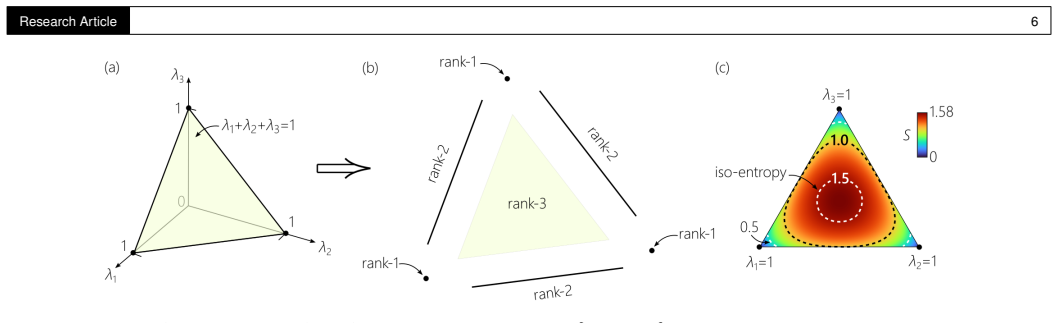
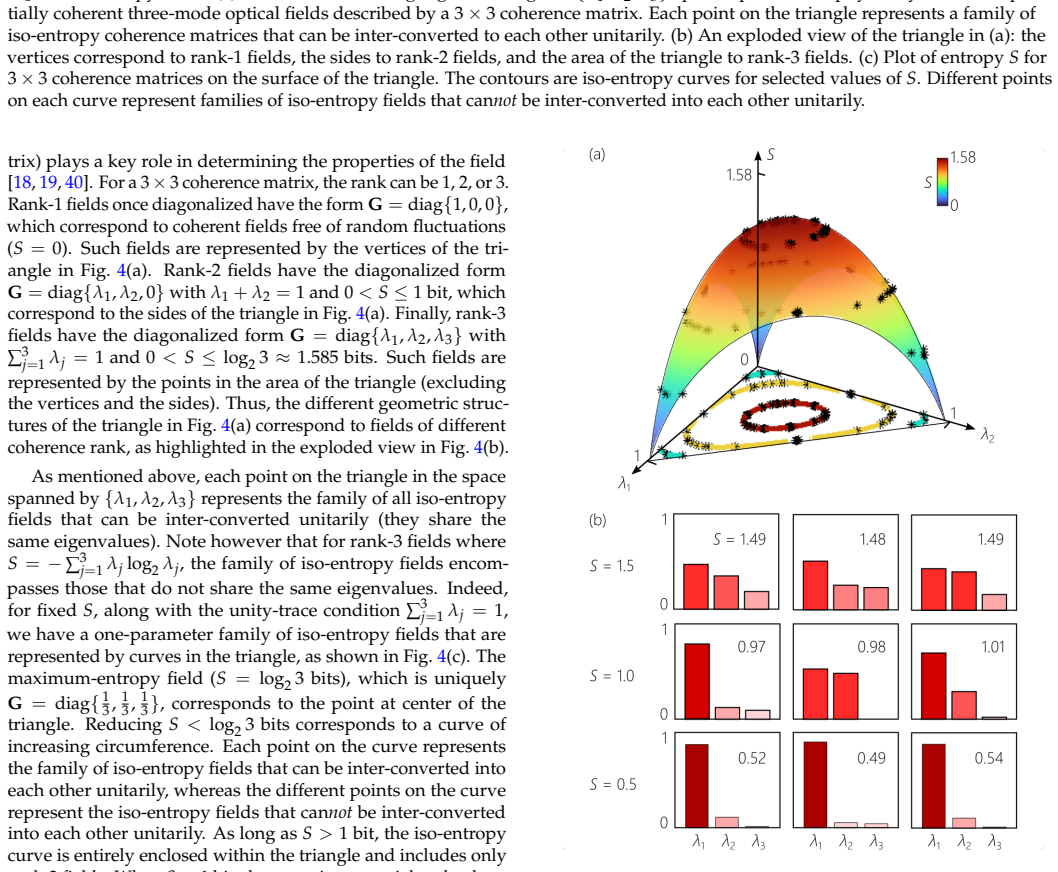
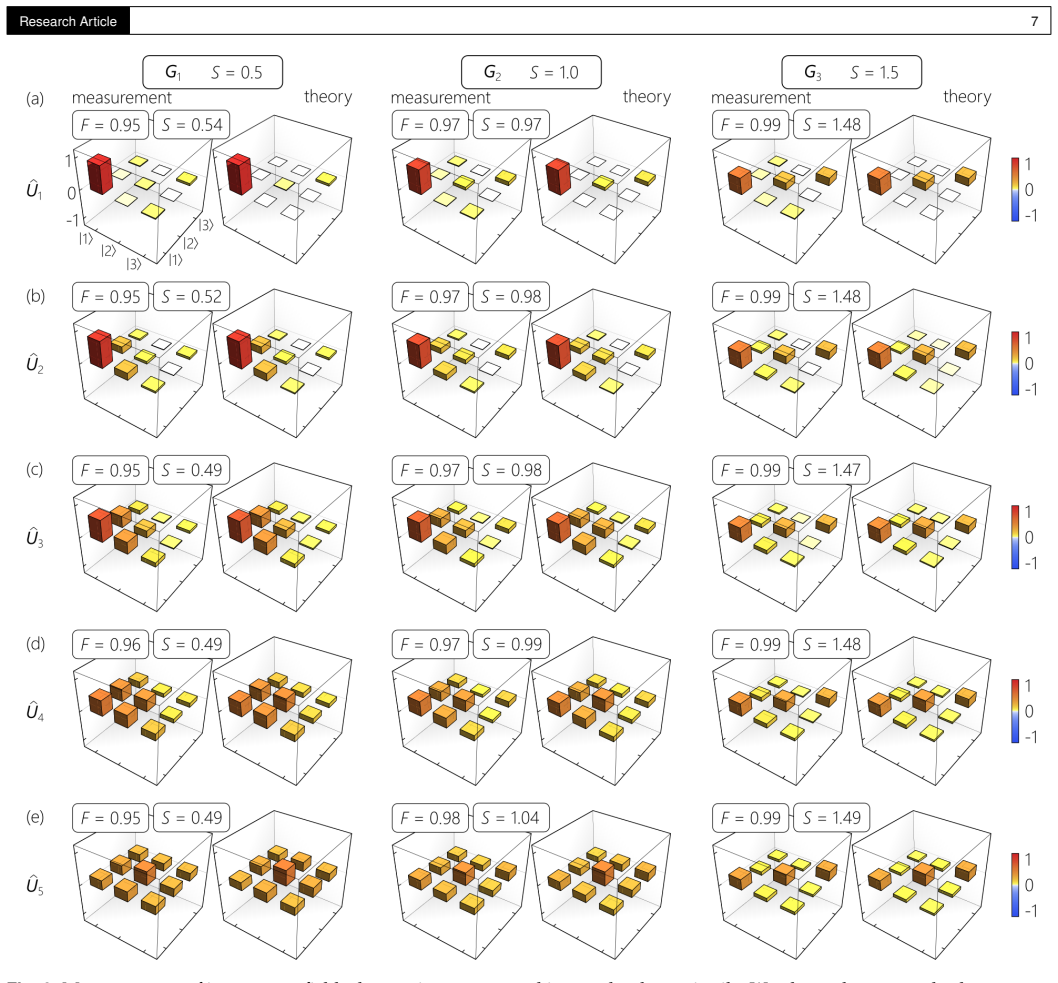
The SGM parameters are measured directly in a photonic integrated platform, from which the 3x3 coherence matrix is reconstructed. This facilitates exploring the full space of iso-entropy fields that can be inter-converted into each other unitarily, and those that share the same value of entropy and yet cannot be inter-converted unitarily.
What carries the argument
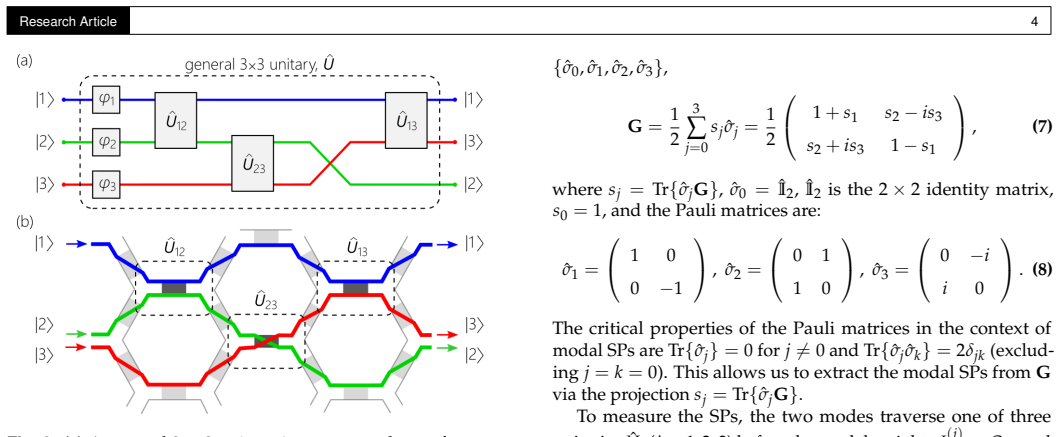
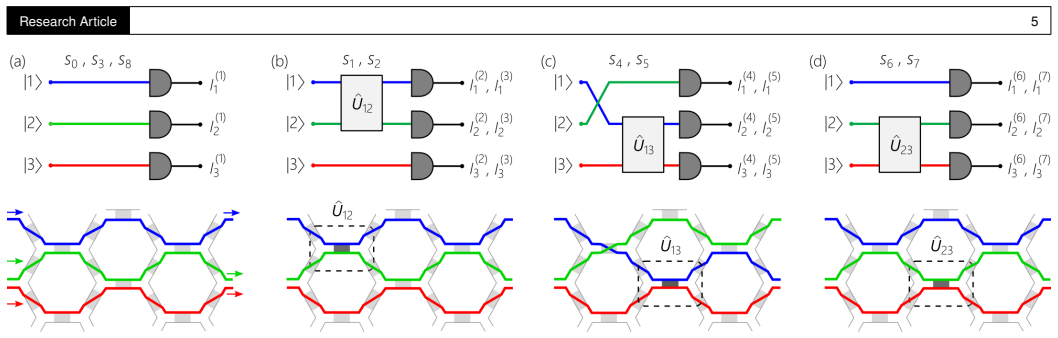
The hexagonal mesh of Mach-Zehnder interferometers, which performs the measurements needed to extract the eight SGM parameters from the three-mode field.
If this is right
- The 3x3 coherence matrix for three-mode partially coherent light can be reconstructed from the SGM parameters.
- Fields with the same entropy can be classified based on whether they are unitarily interconvertible.
- Multimode partially coherent light becomes usable in optical communications, sensing, and information processing.
Where Pith is reading between the lines
- This on-chip approach might be scaled to characterize fields with more than three modes.
- Similar meshes could enable real-time monitoring of coherence in integrated photonic systems.
- The technique opens possibilities for using SGM parameters in quantum optics protocols involving partial coherence.
Load-bearing premise
The hexagonal mesh of Mach-Zehnder interferometers can be calibrated and operated without significant systematic errors or mode crosstalk to directly extract the eight SGM parameters.
What would settle it
Independent verification of the coherence matrix elements through a different method, such as direct correlation measurements, that disagrees with the matrix reconstructed from the SGM parameters would falsify the measurement validity.
Figures

read the original abstract
The Stokes parameters are three real parameters that completely characterize partially coherent optical fields spanned by two modes -- whether a pair of polarization or spatial modes -- and their use is thus ubiquitous in optics. Because the Stokes parameters are defined through an expansion of the $2\times2$ coherence matrix in terms of the Pauli matrices, they cannot be applied to optical fields comprising three modes, which are described by a $3\times3$ coherence matrix. Examples of such fields include the polarization of non-paraxial fields (spanned by three orthogonal polarization modes), and fields comprising three spatial or temporal modes. It has long been theorized that the $3\times3$ Gell-Mann matrices -- developed in high-energy particle physics -- can serve as a basis for $3\times3$ optical coherence matrices, with 8~expansion coefficients known as the Stokes-Gell-Mann (SGM) parameters, but the measurement procedure is daunting, and the SGM parameters have not been measured directly to date in optics. Here we present the first measurements of the SGM parameters for partially coherent three-mode light in a photonic integrated platform comprising a hexagonal mesh of Mach-Zehnder interferometers. Measuring the SGM parameters on chip, from which we reconstruct the $3\times3$ coherence matrix facilitates exploring the full space of iso-entropy fields that can be inter-converted into each other unitarily, and those that share the same value of entropy and yet cannot be inter-converted unitarily. These results pave the way to utilizing multimode partially coherent light in applications involving optical communications, sensing, and information processing.
Editorial analysis
A structured set of objections, weighed in public.
Referee Report
Summary. The manuscript claims to present the first on-chip measurements of the eight Stokes-Gell-Mann (SGM) parameters for partially coherent three-mode light, obtained via intensity measurements in a photonic integrated circuit consisting of a hexagonal mesh of Mach-Zehnder interferometers. These measurements enable reconstruction of the full 3x3 coherence matrix and exploration of unitary equivalence classes among iso-entropy fields.
Significance. If the experimental results hold with adequate validation, the work provides a practical extension of the Stokes formalism to three-mode fields, which is relevant for non-paraxial polarization, multimode spatial or temporal fields. The on-chip platform could support applications in optical communications, sensing, and information processing by allowing direct access to the complete set of coherence parameters.
major comments (2)
- [Abstract] Abstract (measurement procedure): The central claim that the hexagonal MZI mesh extracts all eight SGM parameters directly rests on the assumption that the device can be calibrated to isolate each Gell-Mann component without significant systematic errors, loss imbalances, or inter-mode crosstalk. No quantitative error budget, calibration protocol, or post-calibration verification of linear independence is supplied, which is load-bearing for the accuracy of the reconstructed coherence matrix.
- [Abstract] Abstract and results: The abstract asserts the first measurements but supplies no data, error bars, or cross-checks against independent methods or known limiting cases (e.g., fully coherent or incoherent fields). Without these, the support for the experimental claim cannot be assessed.
minor comments (1)
- [Abstract] The abstract would be strengthened by a concise statement of the achieved measurement precision or representative SGM values obtained.
Simulated Author's Rebuttal
We thank the referee for their careful reading and constructive comments. We address each major comment below and indicate where revisions will be made to strengthen the manuscript.
read point-by-point responses
-
Referee: [Abstract] Abstract (measurement procedure): The central claim that the hexagonal MZI mesh extracts all eight SGM parameters directly rests on the assumption that the device can be calibrated to isolate each Gell-Mann component without significant systematic errors, loss imbalances, or inter-mode crosstalk. No quantitative error budget, calibration protocol, or post-calibration verification of linear independence is supplied, which is load-bearing for the accuracy of the reconstructed coherence matrix.
Authors: We agree that a quantitative error budget, explicit calibration protocol, and verification of linear independence are essential to support the central claim. Although the manuscript describes the device operation and measurement procedure, we acknowledge these specific elements were not provided in sufficient detail. In the revised manuscript we will add a dedicated subsection on calibration, including a quantitative error budget for loss imbalances and crosstalk together with post-calibration checks confirming linear independence of the extracted Gell-Mann components. revision: yes
-
Referee: [Abstract] Abstract and results: The abstract asserts the first measurements but supplies no data, error bars, or cross-checks against independent methods or known limiting cases (e.g., fully coherent or incoherent fields). Without these, the support for the experimental claim cannot be assessed.
Authors: Abstracts are concise summaries and do not normally contain raw data or error bars. The main text and figures present the measured SGM parameters with error bars and include explicit cross-checks against the limiting cases of fully coherent and fully incoherent three-mode fields. To better anchor the abstract claim, we will add a short clause referencing these validations while remaining within length constraints. revision: partial
Circularity Check
No circularity: experimental measurement report with no derivation chain
full rationale
This is an experimental paper reporting the first on-chip measurements of the eight Stokes-Gell-Mann parameters for three-mode partially coherent light using a hexagonal mesh of Mach-Zehnder interferometers. The central claim rests on device calibration and intensity measurements to reconstruct the 3x3 coherence matrix, not on any theoretical derivation that reduces by construction to fitted inputs, self-definitions, or self-citation chains. No equations or procedures are presented as 'predictions' that loop back to the measurement protocol itself. The paper is self-contained against external benchmarks of optical coherence matrix reconstruction and does not invoke uniqueness theorems or ansatzes from prior self-work in a load-bearing manner.
Axiom & Free-Parameter Ledger
axioms (1)
- domain assumption The coherence matrix for three-mode fields can be expanded using the eight Gell-Mann matrices to yield the SGM parameters.
Reference graph
Works this paper leans on
-
[1]
Encoding information in the mutual coherence of spatially separated light beams,
A. Nardi, S. Divitt, M. Rossi,et al., “Encoding information in the mutual coherence of spatially separated light beams,” Opt. Lett.47, 4588–4591 (2022)
2022
-
[2]
Op- tical communications through highly scattering channels using the coherence-rank,
M. Harling, C. Stevenson, K. C. Toussaint, and A. F . Abouraddy, “Op- tical communications through highly scattering channels using the coherence-rank,” APL Photonics10, 076116 (2025)
2025
-
[3]
Partial coher- ence enhances parallelized photonic computing,
B. Dong, F . Brückerhoff-Plückelmann, L. Meyer,et al., “Partial coher- ence enhances parallelized photonic computing,” Nature632, 55–62 (2024)
2024
-
[4]
Optical coherence encryption with structured random light,
D. Peng, Z. Huang, Y . Liu,et al., “Optical coherence encryption with structured random light,” PhotoniX2, 6 (2021)
2021
-
[5]
Unlocking secure optical multiplexing with spatially incoherent light,
X. Liu, X. Li, S. A. Ponomarenko,et al., “Unlocking secure optical multiplexing with spatially incoherent light,” Laser Photon. Rev.19, 2401534 (2025)
2025
-
[6]
Universal programmable and self-configuring optical filter,
D. A. B. Miller, C. Roques-Carmes, C. G. Valdez,et al., “Universal programmable and self-configuring optical filter,” Optica12, 1417–1426 (2025)
2025
-
[7]
Matrix treatment of partial coherence,
H. Gamo, “Matrix treatment of partial coherence,” Prog. Opt.3, 187– 332 (1964)
1964
-
[8]
Coherence properties of optical fields,
L. Mandel and E. Wolf, “Coherence properties of optical fields,” Rev. Mod. Phys.37, 231–287 (1965)
1965
-
[9]
Wolf,Introduction to the Theory of Coherence and Polarization of Light(Cambridge Univ
E. Wolf,Introduction to the Theory of Coherence and Polarization of Light(Cambridge Univ. Press, Cambridge, 2007)
2007
-
[10]
Phase-space measurement and coherence synthesis of optical beams,
L. Waller, G. Situ, and J. W. Fleischer, “Phase-space measurement and coherence synthesis of optical beams,” Nat. Photon.6, 474–479 (2012)
2012
-
[11]
Programmable photonic circuits,
W. Bogaerts, D. Pérez, J. Capmany,et al., “Programmable photonic circuits,” Nature586, 207–216 (2020)
2020
-
[12]
Measuring, processing, and generating partially coherent light with self-configuring optics,
C. Roques-Carmes, S. Fan, and D. Miller, “Measuring, processing, and generating partially coherent light with self-configuring optics,” Light Sci. Appl.13, 260 (2024)
2024
-
[13]
Programmable on-chip synthesis and reconstruction of partially coherent two-mode optical fields,
A. Hashemi, A. Shiri, B. E. A. Saleh,et al., “Programmable on-chip synthesis and reconstruction of partially coherent two-mode optical fields,” arXiv:2601.09802 (2026)
-
[14]
A. Hashemi, A. Shiri, B. E. A. Saleh,et al., “On-chip control of the coherence matrix of four-mode partially coherent light: rank, entropy, and modal stokes parameters,” arXiv:2601.18797 (2026)
-
[15]
Separating partially coherent light,
P .-A. Mor, A. R. Kroo, C. G. Valdez,et al., “Separating partially coherent light,” arXiv:2603.15517 (2025). Research Article 9
-
[16]
Two-point optical coherency matrix tomography,
A. F . Abouraddy, K. H. Kagalwala, and B. E. A. Saleh, “Two-point optical coherency matrix tomography,” Opt. Lett.39, 2411–2414 (2014)
2014
-
[17]
Optical coherency matrix tomography,
K. H. Kagalwala, H. E. Kondakci, A. F . Abouraddy, and B. E. A. Saleh, “Optical coherency matrix tomography,” Sci. Rep.5, 15333 (2015)
2015
-
[18]
Locked entropy in partially coherent optical fields,
M. Harling, V. A. Kelkar, K. C. Toussaint, and A. F . Abouraddy, “Locked entropy in partially coherent optical fields,” Phys. Rev. A109, L021501 (2024)
2024
-
[19]
Isoen- tropic partially coherent optical fields that cannot be interconverted unitarily,
M. Harling, V. A. Kelkar, K. C. Toussaint, and A. F . Abouraddy, “Isoen- tropic partially coherent optical fields that cannot be interconverted unitarily,” Phys. Rev. A110, 013505 (2024)
2024
-
[20]
SU(3) repre- sentation for the polarisation of light,
G. Ramachandran, M. V. N. Murthy, and K. S. Mallesh, “SU(3) repre- sentation for the polarisation of light,” Pramana15, 357–369 (1980)
1980
-
[21]
Parameters characteriz- ing electromagnetic wave polarization,
T. Carozzi, R. Karlsson, and J. Bergman, “Parameters characteriz- ing electromagnetic wave polarization,” Phys. Rev. E61, 2024–2028 (2000)
2024
-
[22]
Degree of polarization for optical near fields,
T. Setälä, A. Shevchenko, M. Kaivola, and A. T. Friberg, “Degree of polarization for optical near fields,” Phys. Rev. E66, 016615 (2002)
2002
-
[23]
Geometric interpretation of the three-dimensional co- herence matrix for nonparaxial polarization,
M. R. Dennis, “Geometric interpretation of the three-dimensional co- herence matrix for nonparaxial polarization,” J. Opt. A6, S26–S31 (2004)
2004
-
[24]
Degree of polar- ization of statistically stationary electromagnetic fields,
J. Ellis, A. Dogariu, S. Ponomarenko, and E. Wolf, “Degree of polar- ization of statistically stationary electromagnetic fields,” Opt. Commun. 248, 333–337 (2005)
2005
-
[25]
Optical polarimetry of random fields,
J. Ellis and A. Dogariu, “Optical polarimetry of random fields,” Phys. Rev. Lett.95, 203905 (2005)
2005
-
[26]
Three-dimensional polarization control in microscopy,
A. F . Abouraddy and K. C. Toussaint, “Three-dimensional polarization control in microscopy,” Phys. Rev. Lett.96, 153901 (2006)
2006
-
[27]
Invariant polarimetric contrast parameters of light with Gaussian fluctuations in three dimensions,
P . Réfrégier, M. Roche, and F . Goudail, “Invariant polarimetric contrast parameters of light with Gaussian fluctuations in three dimensions,” J. Opt. Soc. Am. A23, 124–133 (2006)
2006
-
[28]
Partial polarization in three dimensions,
C. J. R. Sheppard, “Partial polarization in three dimensions,” J. Opt. Soc. Am. A28, 2655–2659 (2011)
2011
-
[29]
Jones and Stokes parameters for polarization in three dimensions,
C. J. R. Sheppard, “Jones and Stokes parameters for polarization in three dimensions,” Phys. Rev. A90, 023809 (2014)
2014
-
[30]
Three-dimensional polarization algebra,
C. J. R. Sheppard, M. Castello, and A. Diaspro, “Three-dimensional polarization algebra,” J. Opt. Soc. Am. A33, 1938–1947 (2016)
1938
-
[31]
Structure of polari- metric purity of three-dimensional polarization states,
J. J. Gil, A. T. Friberg, T. Set älä, and I. S. José, “Structure of polari- metric purity of three-dimensional polarization states,” Phys. Rev. A95, 053856 (2017)
2017
-
[32]
Geometric descriptions for the polarization of nonparax- ial light: a tutorial,
M. A. Alonso, “Geometric descriptions for the polarization of nonparax- ial light: a tutorial,” Adv. Opt. Photon.15, 176–235 (2023)
2023
-
[33]
Brosseau,Fundamentals of Polarized Light(Wiley, New Y ork, 1998)
C. Brosseau,Fundamentals of Polarized Light(Wiley, New Y ork, 1998)
1998
-
[34]
Symmetry properties and polarization descriptors for an arbitrary electromagnetic wavefield,
C. Brosseau and A. Dogariu, “Symmetry properties and polarization descriptors for an arbitrary electromagnetic wavefield,” Prog. Opt.49, 315–380 (2006)
2006
-
[35]
Symmetries of baryons and mesons,
M. Gell-Mann, “Symmetries of baryons and mesons,” Phys. Rev.125, 1067–1084 (1962)
1962
-
[36]
3D Stokes polarimetric imaging at nanoscales,
I. Herrera, M. A. Alonso, and S. Brasselet, “3D Stokes polarimetric imaging at nanoscales,” arXiv:2511.11222 (2025)
-
[37]
Experimental realization of any discrete unitary operator,
M. Reck, A. Zeilinger, H. J. Bernstein, and P . Bertani, “Experimental realization of any discrete unitary operator,” Phys. Rev. Lett.73, 58–61 (1994)
1994
-
[38]
Comment on ‘polar- ization coherence theorem’,
A. F . Abouraddy, A. Dogariu, and B. E. A. Saleh, “Comment on ‘polar- ization coherence theorem’,” Optica6, 829–830 (2019)
2019
-
[39]
Poincaré sphere representa- tion of scalar two-beam interference under spatial unitary transforma- tions,
A. Halder, A. Norrman, and A. T. Friberg, “Poincaré sphere representa- tion of scalar two-beam interference under spatial unitary transforma- tions,” Opt. Lett.46, 5619–5622 (2021)
2021
-
[40]
Optical cross-purity,
A. F . Abouraddy and B. E. A. Saleh, “Optical cross-purity,” Opt. Lett.51, 833–836 (2026)
2026
-
[41]
Fidelity for mixed quantum states,
R. Jozsa, “Fidelity for mixed quantum states,” J. Mod. Opt.41, 2315– 2323 (1994)
1994
discussion (0)
Sign in with ORCID, Apple, or X to comment. Anyone can read and Pith papers without signing in.