Investigating the young stellar populations and hierarchies in nearby galaxies with the UVIT. II. Presenting the properties of ~25,000 UV-detected star-forming clumps
Pith reviewed 2026-06-27 09:21 UTC · model grok-4.3
The pith
A catalog of ~25,000 UV-detected star-forming clumps in 17 nearby galaxies shows age trends matching inside-out disk growth and other formation patterns.
A machine-rendered reading of the paper's core claim, the machinery that carries it, and where it could break.
Core claim
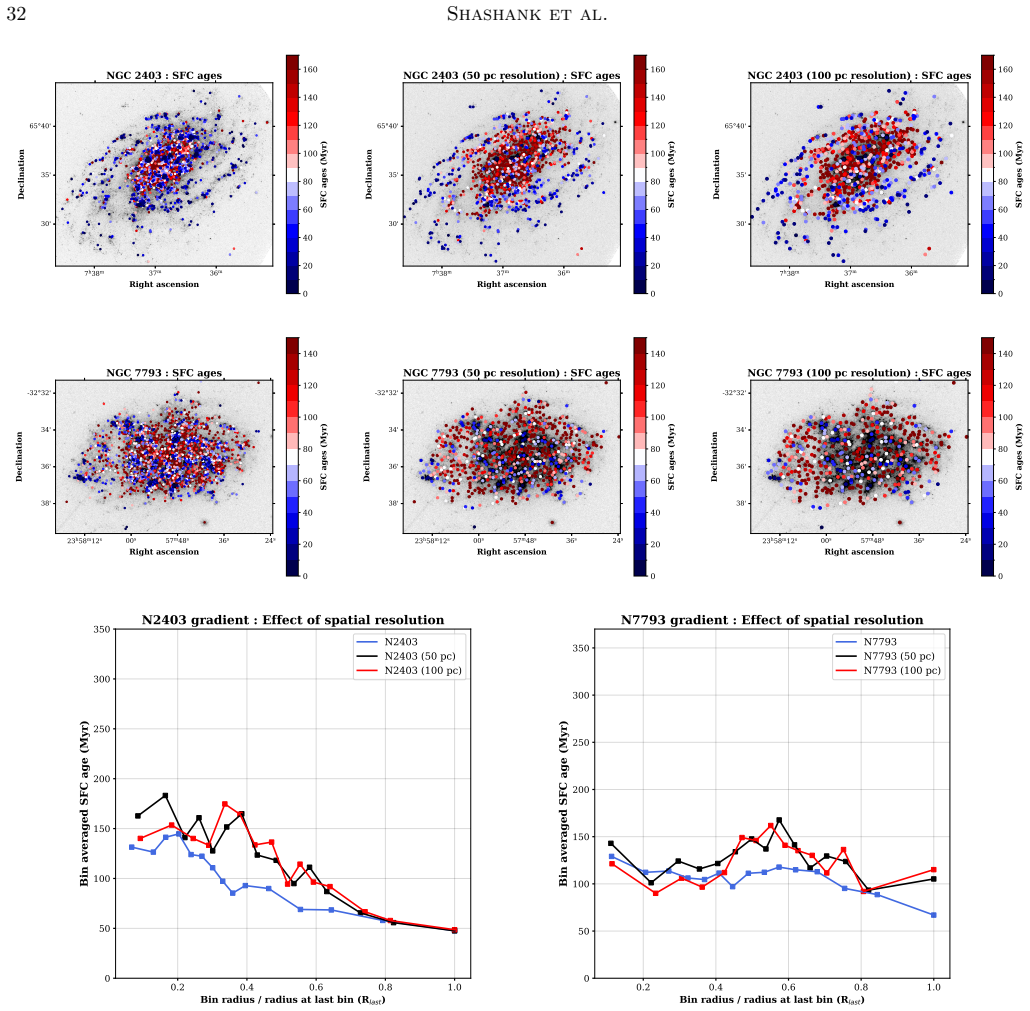
Using UVIT far- and near-UV imaging, the authors detect and characterize approximately 25,000 star-forming clumps younger than 400 Myr across 17 galaxies. After uniform detection, spatially varying dust correction, and comparison with Starburst99 models, they map clump ages and find demographic patterns consistent with inside-out disk formation in massive spirals, local gravitational instabilities in flocculent spirals, and stochastic star formation in dwarfs.
What carries the argument
The SFC catalog derived from UVIT photometry with dust attenuation maps and Starburst99 model fitting for ages.
If this is right
- The catalog supplies a uniform, galaxy-wide view of star formation on 50-parsec scales that complements existing optical cluster catalogs.
- Age trends support inside-out growth in massive disks and stochastic timing in dwarfs.
- Public release of the clump catalog and A_V maps enables direct comparison across galaxy masses and environments.
- The method demonstrates that UVIT resolution is sufficient to isolate individual clumps throughout entire nearby galaxies.
Where Pith is reading between the lines
- The same UV-selected sample could be cross-matched with molecular gas maps to test whether clump ages correlate with local gas depletion times.
- Extending the analysis to additional UVIT-observed galaxies would allow a statistical test of how clump age spreads scale with galaxy mass.
- If the observed inside-out age gradients persist when the sample is divided by environment, it would strengthen the link between clump demographics and global disk assembly.
Load-bearing premise
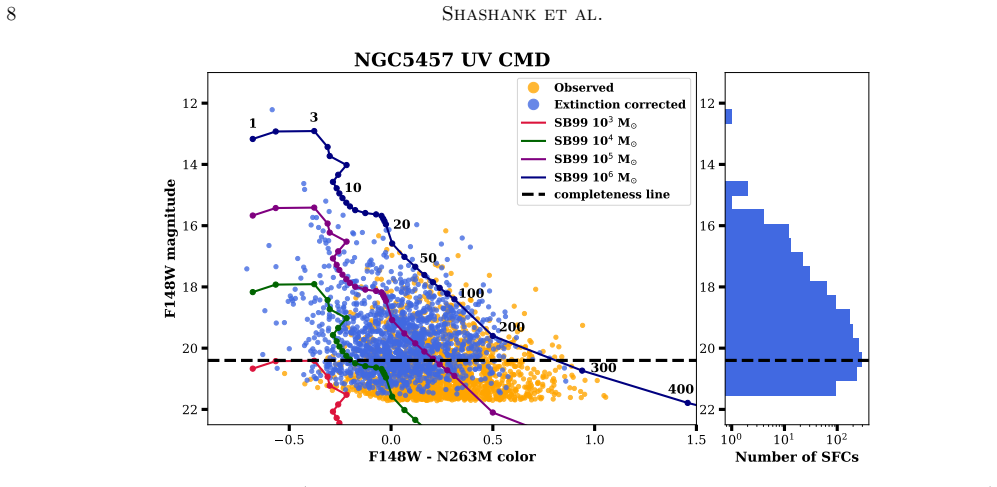
The Starburst99 simple stellar population models accurately reproduce the observed UV colors and magnitudes of the clumps without major systematic offsets from real metallicity, IMF, or contamination effects.
What would settle it
Re-deriving ages for the same clumps using independent optical or infrared photometry that yields systematically older or younger distributions would undermine the reported age demographics.
Figures





read the original abstract
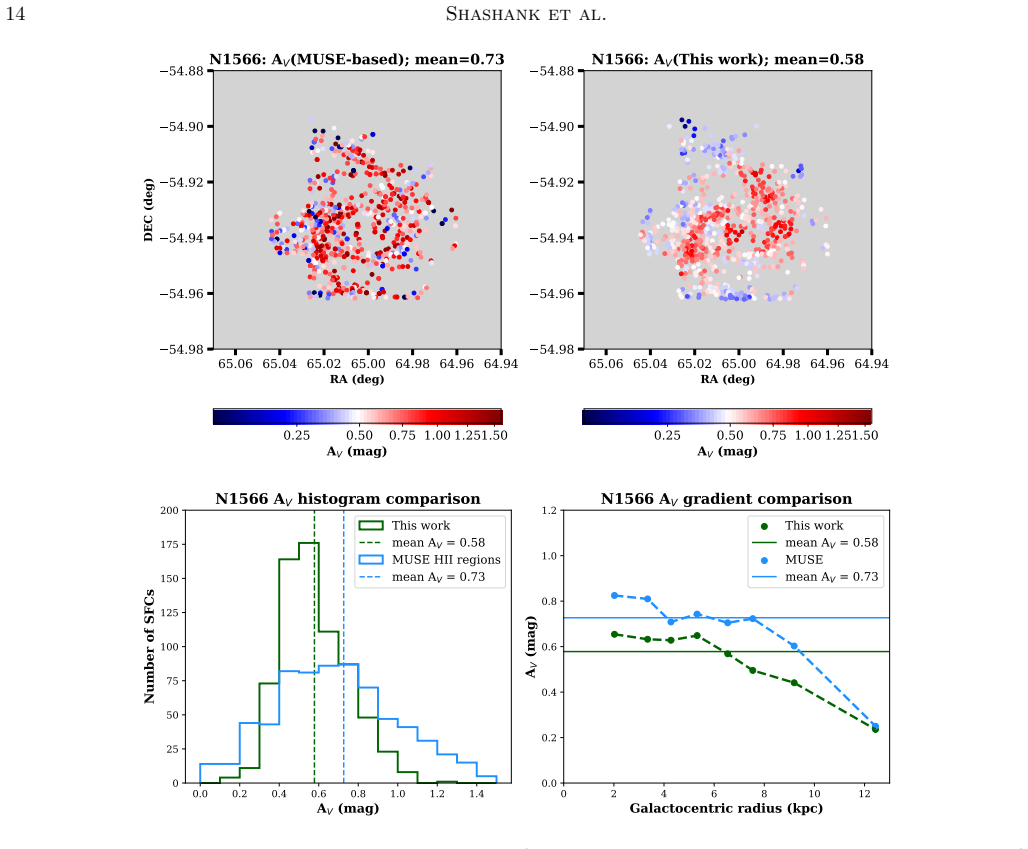
Studying young stellar populations within galaxies can help refine our understanding of recent star formation in galaxies and their evolution. With this motivation, we present a catalog of ~25,000 recently formed (within 400 Myr) star-forming clumps (SFCs) in 17 morphologically diverse nearby galaxies, including 8 massive, classic spirals, 6 intermediate-mass, flocculent spirals, and 3 dwarf irregulars. We used far- and near-UV observations from the UltraViolet Imaging Telescope (UVIT), whose ~1.5" angular resolution and 28' field-of-view allow us to probe SFCs at a mean physical scale of ~54 parsec, within the full extent of our galaxies. We adopted a homogeneous SFC detection criterion, corrected for spatially varying dust attenuation (using 6" resolution A_V maps, made by combining FUV with archival infrared observations), and estimated the SFC ages by comparing the observed UV color-magnitude diagrams with Starburst99 simple stellar population models. Using our SFC catalog, we studied the age demographic of the recently formed stellar populations across different galaxy morphologies and observed age trends consistent with several well-known phenomena, such as the inside-out formation of disc galaxies, local gravitational instabilities leading to flocculent spiral arms, and the stochastic nature of star formation in dwarf galaxies. Leveraging full galaxy coverage and FUV data, our catalog complements existing optically-identified star cluster catalogs in the literature towards improving our understanding of star formation across a wide range of galaxy morphologies, masses, and environments. We make the SFC catalog and A_V maps of our 17 galaxies publicly available with this paper.
Editorial analysis
A structured set of objections, weighed in public.
Referee Report
Summary. The manuscript presents a catalog of ~25,000 UV-detected star-forming clumps (SFCs) identified in 17 nearby galaxies (8 massive spirals, 6 flocculent spirals, 3 dwarfs) using UVIT FUV/NUV imaging at ~1.5" resolution (~54 pc physical scale). Clumps are selected with a homogeneous criterion, corrected for dust using combined FUV+IR A_V maps, and assigned ages ≤400 Myr via comparison of UV color-magnitude diagrams to Starburst99 SSP models. The work reports age demographics and trends interpreted as inside-out disk growth, flocculent arm instabilities, and stochastic SF in dwarfs, and releases the catalog and A_V maps publicly.
Significance. A homogeneous, full-galaxy-coverage catalog of young SFCs at this resolution and sample size would complement existing optical cluster catalogs and enable statistical studies of recent star formation across morphologies. The public data release is a clear positive. However, the scientific utility hinges on the robustness of the age assignments; without validation of the SSP modeling assumptions, the reported demographics and morphological trends cannot be considered secure.
major comments (2)
- [Abstract; methods (SFC age estimation)] Abstract and methods section on age estimation: The claim that SFCs are 'recently formed (within 400 Myr)' rests on direct comparison of observed FUV-NUV CMDs to Starburst99 SSP models, but the text supplies no quantitative tests of model assumptions (e.g., no metallicity grid, no IMF-variation runs, no cross-validation against optical SED ages or Hα equivalent widths). A systematic color offset of ≥0.3 mag would move a non-negligible fraction of clumps across the 400 Myr boundary and directly affect the reported age distributions and inside-out/flocculent/stochastic trends.
- [Results (age demographic analysis)] Results section on age demographics: The interpretation of trends (inside-out formation, gravitational instabilities, stochasticity) is presented as consistent with the catalog, yet the absence of any error budget or selection-function modeling for the UV detection + age cut means it is unclear whether the observed morphological differences are intrinsic or driven by completeness variations across galaxy types.
minor comments (2)
- [Abstract] The abstract states '8 massive, classic spirals, 6 intermediate-mass, flocculent spirals, and 3 dwarf irregulars' but does not list the specific galaxies or their distances; adding a table or explicit list would improve reproducibility.
- [Methods (dust correction)] Notation for the A_V maps (6" resolution) and the exact dust-correction procedure should be clarified with a short equation or reference to the precise IR data used, to allow readers to assess the impact on UV colors.
Simulated Author's Rebuttal
We thank the referee for their constructive review and for recognizing the value of the homogeneous SFC catalog and public data release. We address each major comment below and outline revisions that will strengthen the manuscript without altering its core conclusions.
read point-by-point responses
-
Referee: [Abstract; methods (SFC age estimation)] Abstract and methods section on age estimation: The claim that SFCs are 'recently formed (within 400 Myr)' rests on direct comparison of observed FUV-NUV CMDs to Starburst99 SSP models, but the text supplies no quantitative tests of model assumptions (e.g., no metallicity grid, no IMF-variation runs, no cross-validation against optical SED ages or Hα equivalent widths). A systematic color offset of ≥0.3 mag would move a non-negligible fraction of clumps across the 400 Myr boundary and directly affect the reported age distributions and inside-out/flocculent/stochastic trends.
Authors: We agree that explicit sensitivity tests would improve the robustness discussion. The current analysis adopts the standard Starburst99 solar-metallicity, Salpeter-IMF SSP tracks that are conventional for UV-based studies of young populations; our CMDs align with these tracks without requiring large zero-point shifts. In the revised manuscript we will add a dedicated subsection that (i) explores the available Starburst99 metallicity grid and shows that the 400 Myr isochrone boundary shifts by <0.15 mag for metallicities spanning the range of our sample galaxies, (ii) notes the effect of a Kroupa IMF (which produces a comparable shift), and (iii) provides a limited cross-check against published Hα equivalent-width ages for the subset of clumps in galaxies with ancillary data. We will also attach per-clump age uncertainties to the public catalog to quantify the impact of a possible 0.3 mag systematic offset. revision: partial
-
Referee: [Results (age demographic analysis)] Results section on age demographics: The interpretation of trends (inside-out formation, gravitational instabilities, stochasticity) is presented as consistent with the catalog, yet the absence of any error budget or selection-function modeling for the UV detection + age cut means it is unclear whether the observed morphological differences are intrinsic or driven by completeness variations across galaxy types.
Authors: We acknowledge that a full forward-modeling of the selection function is absent. The reported trends are presented as qualitative consistencies with well-established phenomena rather than as statistically quantified results. In revision we will (i) tabulate the UV magnitude limits and corresponding age-dependent completeness estimates for each galaxy, (ii) add a short discussion of how detection incompleteness for older, fainter clumps could differ between massive spirals and dwarfs, and (iii) rephrase the morphological interpretations as “consistent with” rather than “demonstrating” the cited processes. These additions will make the limitations explicit while preserving the scientific narrative supported by the homogeneous catalog. revision: partial
Circularity Check
No circularity: catalog from direct UVIT data and external Starburst99 models
full rationale
The paper derives its catalog of ~25,000 SFCs directly from UVIT FUV/NUV observations of 17 galaxies, applies a homogeneous detection criterion, corrects dust attenuation using combined FUV+IR A_V maps, and assigns ages by comparing observed UV CMDs to external Starburst99 SSP models. None of these steps reduce a derived quantity to a parameter fitted from the same dataset, invoke self-citation for a uniqueness theorem, or smuggle an ansatz via prior work by the same authors. The age demographic trends are presented as observational results rather than predictions forced by the fitting procedure itself. The derivation chain is therefore self-contained against external benchmarks.
Axiom & Free-Parameter Ledger
axioms (1)
- domain assumption Starburst99 simple stellar population models can be used to estimate ages from UV colors of star-forming clumps
Reference graph
Works this paper leans on
-
[1]
Realm of the Nebulae
-
[2]
Third Reference Catalogue of Bright Galaxies
-
[3]
The de Vaucouleurs Atlas of Galaxies
-
[4]
A FUV-optical approach for studying hierarchical star formation in nearby galaxies with UVIT
A FUV - optical approach for studying hierarchical star formation in nearby galaxies with UVIT. arXiv e-prints , keywords =. doi:10.48550/arXiv.2602.22860 , archivePrefix =. 2602.22860 , primaryClass =
work page internal anchor Pith review Pith/arXiv arXiv doi:10.48550/arxiv.2602.22860
-
[5]
UV Star Formation Rates in the Local Universe
UV Star Formation Rates in the Local Universe. , keywords =. doi:10.1086/519218 , archivePrefix =. 0704.3611 , primaryClass =
work page internal anchor Pith review Pith/arXiv arXiv doi:10.1086/519218
-
[6]
The Space Density of Extended Ultraviolet (XUV) Disks in the Local Universe and Implications for Gas Accretion onto Galaxies. , keywords =. doi:10.1088/0004-637X/733/2/74 , archivePrefix =. 1104.4501 , primaryClass =
work page internal anchor Pith review Pith/arXiv arXiv doi:10.1088/0004-637x/733/2/74
-
[7]
Secular Evolution and the Formation of Pseudobulges in Disk Galaxies. , keywords =. doi:10.1146/annurev.astro.42.053102.134024 , archivePrefix =. astro-ph/0407343 , primaryClass =
-
[8]
Star Clusters Across Cosmic Time. , keywords =. doi:10.1146/annurev-astro-091918-104430 , archivePrefix =. 1812.01615 , primaryClass =
-
[9]
How Gas Accretion Feeds Galactic Disks
How Gas Accretion Feeds Galactic Disks. , keywords =. doi:10.3847/1538-4357/ab0ec2 , archivePrefix =. 1903.06840 , primaryClass =
work page internal anchor Pith review Pith/arXiv arXiv doi:10.3847/1538-4357/ab0ec2 1903
-
[10]
Secular Evolution in Disk Galaxies
Secular Evolution in Disk Galaxies. Secular Evolution of Galaxies , year = 2013, editor =. doi:10.48550/arXiv.1311.2609 , adsurl =
work page internal anchor Pith review Pith/arXiv arXiv doi:10.48550/arxiv.1311.2609 2013
-
[11]
Search For Star Cluster Age Gradients Across Spiral Arms of Three LEGUS Disk Galaxies
Search for star cluster age gradients across spiral arms of three LEGUS disc galaxies. , keywords =. doi:10.1093/mnras/sty1277 , archivePrefix =. 1805.05643 , primaryClass =
work page internal anchor Pith review Pith/arXiv arXiv doi:10.1093/mnras/sty1277
-
[12]
Legacy Extragalactic UV Survey (LEGUS) With the Hubble Space Telescope. I. Survey Description. , keywords =. doi:10.1088/0004-6256/149/2/51 , archivePrefix =. 1410.7456 , primaryClass =
work page internal anchor Pith review Pith/arXiv arXiv doi:10.1088/0004-6256/149/2/51
-
[13]
PHANGS-HST Catalogs for 100,000 Star Clusters and Compact Associations in 38 Galaxies. I. Observed Properties. , keywords =. doi:10.3847/1538-4365/ad3cd3 , archivePrefix =. 2403.04901 , primaryClass =
-
[14]
Star Cluster Catalogs for the LEGUS Dwarf Galaxies
Star cluster catalogues for the LEGUS dwarf galaxies. , keywords =. doi:10.1093/mnras/stz331 , archivePrefix =. 1902.00082 , primaryClass =
work page internal anchor Pith review Pith/arXiv arXiv doi:10.1093/mnras/stz331 1902
-
[15]
PHANGS-HST Catalogs for 100,000 Star Clusters and Compact Associations in 38 Galaxies. II. Physical Properties from Decision-tree-based Spectral Energy Distribution Fitting of NUV-U-B-V-I Photometry with Categorical Priors Set by H Emission, Cluster Morphology, and Other Auxiliary Information. , keywords =. doi:10.3847/1538-4365/addabb , adsurl =
-
[16]
The PHANGS-HST Survey: Physics at High Angular Resolution in Nearby Galaxies with the Hubble Space Telescope. , keywords =. doi:10.3847/1538-4365/ac1fe5 , archivePrefix =. 2101.02855 , primaryClass =
-
[17]
Legacy ExtraGalactic UV Survey with The Hubble Space Telescope: Stellar Cluster Catalogs and First Insights Into Cluster Formation and Evolution in NGC 628. , keywords =. doi:10.3847/1538-4357/aa7132 , archivePrefix =. 1705.01588 , primaryClass =
work page internal anchor Pith review Pith/arXiv arXiv doi:10.3847/1538-4357/aa7132
-
[18]
and Roškar, Rok and Debattista, Victor P
Radburn-Smith, David J. and Roškar, Rok and Debattista, Victor P. and Dalcanton, Julianne J. and Streich, David and de Jong, Roelof S. and Vlajić, Marija and Holwerda, Benne W. and Purcell, Chris W. and Dolphin, Andrew E. and Zucker, Daniel B. , title =. The Astrophysical Journal , abstract =. 2012 , month =. doi:10.1088/0004-637X/753/2/138 , url =
-
[19]
Effect of low-mass galaxy interactions on their star formation. , keywords =. doi:10.1051/0004-6361/202346536 , archivePrefix =. 2310.02595 , primaryClass =
-
[20]
The VMC Survey. XXII. Hierarchical Star Formation in the 30 Doradus-N158-N159-N160 Star-forming Complex. , keywords =. doi:10.3847/1538-4357/835/2/171 , archivePrefix =. 1611.06508 , primaryClass =
work page internal anchor Pith review Pith/arXiv arXiv doi:10.3847/1538-4357/835/2/171
-
[21]
Hierarchical star formation in nearby galaxies. , keywords =. doi:10.1051/0004-6361/202038970 , archivePrefix =. 2010.14419 , primaryClass =
-
[22]
Star Formation Histories of the LEGUS Spiral Galaxies. I. The Flocculent Spiral NGC 7793. , keywords =. doi:10.3847/1538-4357/ab1de1 , archivePrefix =. 1905.00020 , primaryClass =
work page internal anchor Pith review Pith/arXiv arXiv doi:10.3847/1538-4357/ab1de1 1905
-
[23]
and Leitherer, Claus , title =
Levesque, Emily M. and Leitherer, Claus , title =. The Astrophysical Journal , abstract =. 2013 , month =. doi:10.1088/0004-637X/779/2/170 , url =
-
[24]
Tracing the star formation history of cluster galaxies using the Halpha/UV flux ratio
Iglesias-Paramo, Jorge and Boselli, A. and Gavazzi, G. and Zaccardo, A. Tracing the star formation history of cluster galaxies using the H-alpha / UV flux ratio. Astron. Astrophys. 2004. doi:10.1051/0004-6361:20034572. arXiv:astro-ph/0403620
work page internal anchor Pith review Pith/arXiv arXiv doi:10.1051/0004-6361:20034572 2004
-
[25]
Pasquali, A. and Leroy, A. and Rix, H.-W. and Walter, F. and Herbst, T. and Giallongo, E. and Ragazzoni, R. and Baruffolo, A. and Speziali, R. and Hill, J. and Beccari, G. and Bouché, N. and Buschkamp, P. and Kochanek, C. and Skillman, E. and Bechtold, J. , title =. The Astrophysical Journal , abstract =. 2008 , month =. doi:10.1086/591658 , url =
-
[26]
Advances in Space Research , year = 2006, month = jan, volume =
A broad spectral band Indian Astronomy satellite Astrosat. Advances in Space Research , year = 2006, month = jan, volume =. doi:10.1016/j.asr.2006.03.038 , adsurl =
-
[27]
Space Telescopes and Instrumentation 2014: Ultraviolet to Gamma Ray , year = 2014, editor =
ASTROSAT mission. Space Telescopes and Instrumentation 2014: Ultraviolet to Gamma Ray , year = 2014, editor =. doi:10.1117/12.2062667 , adsurl =
-
[28]
and Adamo, Angela and Sandstrom, Karin and Dale, Daniel A
Calzetti, Daniela and Kennicutt, Robert C. and Adamo, Angela and Sandstrom, Karin and Dale, Daniel A. and Elmegreen, Bruce and Gallagher, John S. and Gregg, Benjamin and Bajaj, Varun and Böker, Torsten and Bortolini, Giacomo and Boyer, Martha and Correnti, Matteo and De Looze, Ilse and Draine, Bruce T. and Duarte-Cabral, Ana and Faustino Vieira, Helena an...
-
[29]
Studying the ISM at 10 pc scale in NGC 7793 with MUSE. II. Constraints on the oxygen abundance and ionising radiation escape. , keywords =. doi:10.1051/0004-6361/202039402 , archivePrefix =. 2104.08088 , primaryClass =
-
[30]
PHANGS-HST: star cluster spectral energy distribution fitting with CIGALE. , keywords =. doi:10.1093/mnras/stab055 , archivePrefix =. 2101.02134 , primaryClass =
-
[31]
Linden, S. T. and Perez, G. and Calzetti, D. and Maji, S. and Messa, M. and Whitmore, B. C. and Chandar, R. and Adamo, A. and Grasha, K. and Cook, D. O. and Elmegreen, B. G. and Dale, D. A. and Sacchi, E. and Sabbi, E. and Grebel, E. K. and Smith, L. , title =. The Astrophysical Journal , abstract =. 2022 , month =. doi:10.3847/1538-4357/ac7c07 , url =
-
[32]
Recent Star Formation in the Extreme Outer Disk of M83
Recent Star Formation in the Extreme Outer Disk of M83. , keywords =. doi:10.1086/425251 , archivePrefix =. astro-ph/0411306 , primaryClass =
work page internal anchor Pith review Pith/arXiv arXiv doi:10.1086/425251
-
[33]
Panoramic GALEX FUV and NUV imaging of M31 and M33
Panoramic GALEX Far- and Near-Ultraviolet Imaging of M31 and M33. , keywords =. doi:10.1086/424816 , archivePrefix =. astro-ph/0411311 , primaryClass =
work page internal anchor Pith review Pith/arXiv arXiv doi:10.1086/424816
-
[34]
The GALEX Ultraviolet Atlas of Nearby Galaxies
The GALEX Ultraviolet Atlas of Nearby Galaxies. , keywords =. doi:10.1086/516636 , archivePrefix =. astro-ph/0606440 , primaryClass =
work page internal anchor Pith review Pith/arXiv arXiv doi:10.1086/516636
-
[35]
A Search for Extended Ultraviolet Disk (XUV-disk) Galaxies in the Local Universe
A Search for Extended Ultraviolet Disk (XUV-Disk) Galaxies in the Local Universe. , keywords =. doi:10.1086/523853 , archivePrefix =. 0712.3555 , primaryClass =
work page internal anchor Pith review Pith/arXiv arXiv doi:10.1086/523853
-
[36]
Recent star formation in nearby galaxies from GALEX imaging:M101 and M51
Recent Star Formation in Nearby Galaxies from Galaxy Evolution Explorer Imaging: M101 and M51. , keywords =. doi:10.1086/422685 , archivePrefix =. astro-ph/0411408 , primaryClass =
work page internal anchor Pith review Pith/arXiv arXiv doi:10.1086/422685
-
[37]
Specific SFR profiles in nearby spiral galaxies: quantifying the inside-out formation of disks
Specific Star Formation Rate Profiles in Nearby Spiral Galaxies: Quantifying the Inside-Out Formation of Disks. , keywords =. doi:10.1086/511812 , archivePrefix =. astro-ph/0612017 , primaryClass =
work page internal anchor Pith review Pith/arXiv arXiv doi:10.1086/511812
-
[38]
H{\alpha} to FUV ratios in resolved star forming region populations of nearby spiral galaxies
H to FUV ratios in resolved star-forming region populations of nearby spiral galaxies. , keywords =. doi:10.1093/mnras/stt665 , archivePrefix =. 1304.5242 , primaryClass =
work page internal anchor Pith review Pith/arXiv arXiv doi:10.1093/mnras/stt665
-
[39]
Comparing the Inner and Outer Star-forming Complexes in the Nearby Spiral Galaxies NGC 628, NGC 5457, and NGC 6946 Using UVIT Observations. , keywords =. doi:10.3847/1538-4357/abf8c1 , archivePrefix =. 2103.16819 , primaryClass =
-
[40]
A comparative study of star-forming dwarf galaxies using the UVIT. , keywords =. doi:10.1093/mnras/stae907 , archivePrefix =. 2404.00537 , primaryClass =
-
[41]
Dwarf-dwarf interactions and their influence on star formation: Insights from post-merger galaxies. , keywords =. doi:10.1051/0004-6361/202554437 , archivePrefix =. 2507.14695 , primaryClass =
-
[42]
Understanding the secular evolution of NGC 628 using UltraViolet Imaging Telescope. , keywords =. doi:10.1093/mnras/stac2285 , archivePrefix =. 2208.05999 , primaryClass =
-
[43]
The Astronomical Journal , abstract =
Mondal, Chayan and Subramaniam, Annapurni and George, Koshy , title =. The Astronomical Journal , abstract =. 2018 , month =. doi:10.3847/1538-3881/aad4f6 , url =
-
[44]
and Subramanian, Smitha and Barway, Sudhanshu , title =
Mondal, Chayan and Subramaniam, Annapurni and George, Koshy and Postma, Joseph E. and Subramanian, Smitha and Barway, Sudhanshu , title =. The Astrophysical Journal , abstract =. 2021 , month =. doi:10.3847/1538-4357/abe0b4 , url =
-
[45]
Star formation in interacting galaxy systems: UVIT imaging of NGC 7252 and NGC 5291. , keywords =. doi:10.1017/pasa.2025.21 , archivePrefix =. 2503.02777 , primaryClass =
-
[46]
Connecting the dots: Tracing the evolutionary pathway of polar ring galaxies in the cases of NGC 3718, NGC 2685, and NGC 4262. , keywords =. doi:10.1017/pasa.2025.24 , archivePrefix =. 2503.03709 , primaryClass =
-
[47]
AstroSat UVIT Survey of M31: Point-source Catalog. , keywords =. doi:10.3847/1538-4365/ab77a9 , adsurl =
-
[48]
UVIT Observations of the Small Magellanic Cloud: Point-source Catalog. , keywords =. doi:10.3847/1538-4357/acba9c , archivePrefix =. 2302.01515 , primaryClass =
-
[49]
UVIT Study of the MAgellanic Clouds (U-SMAC) - I. Recent star formation history and kinematics of the Shell region in the north-eastern Small Magellanic Cloud. , keywords =. doi:10.1093/mnras/stae1438 , archivePrefix =. 2406.05093 , primaryClass =
-
[50]
UVIT Study of the MAgellanic Clouds (U-SMAC). II. A Far-UV Catalog of the Small Magellanic Cloud: Morphology and Kinematics of Young Stellar Population. , keywords =. doi:10.3847/1538-3881/ad7de2 , archivePrefix =. 2409.13605 , primaryClass =
-
[51]
Galaxy UV Legacy Project: Survey Description and First Insights Into NGC 4449 Recent History of Star Formation. arXiv e-prints , keywords =. doi:10.48550/arXiv.2603.06510 , archivePrefix =. 2603.06510 , primaryClass =
-
[52]
Anatomy of the Star Formation in a Tidally Disturbed Disk Galaxy: NGC 3718. , keywords =. doi:10.3847/1538-4357/ad738b , archivePrefix =. 2408.09898 , primaryClass =
-
[53]
Hao, Cai-Na and Kennicutt, Robert C. and Johnson, Benjamin D. and Calzetti, Daniela and Dale, Daniel A. and Moustakas, John , title =. The Astrophysical Journal , abstract =. 2011 , month =. doi:10.1088/0004-637X/741/2/124 , url =
-
[54]
Towards universal hybrid star formation rate estimators
Towards universal hybrid star formation rate estimators. , keywords =. doi:10.1051/0004-6361/201527759 , archivePrefix =. 1603.09340 , primaryClass =
work page internal anchor Pith review Pith/arXiv arXiv doi:10.1051/0004-6361/201527759
-
[55]
Quantification of The Age Dependence of Mid-Infrared Star Formation Rate Indicators. arXiv e-prints , keywords =. doi:10.48550/arXiv.2508.08451 , archivePrefix =. 2508.08451 , primaryClass =
-
[56]
and Postma, Joseph and Nofech, Joseph and Corbould, Harrisen and Thilker, David and Leroy, Adam K
Hassani, Hamid and Rosolowsky, Erik and Koch, Eric W. and Postma, Joseph and Nofech, Joseph and Corbould, Harrisen and Thilker, David and Leroy, Adam K. and Schinnerer, Eva and Belfiore, Francesco and Bigiel, Frank and Boquien, Médéric and Chevance, Mélanie and Dale, Daniel A. and Egorov, Oleg V. and Emsellem, Eric and Glover, Simon C. O. and Grasha, Kath...
-
[57]
Defining an evolutionary sequence
Stellar associations powering H II regions - I. Defining an evolutionary sequence. , keywords =. doi:10.1093/mnras/stad878 , archivePrefix =. 2303.12101 , primaryClass =
-
[58]
Turbulence and star formation in molecular clouds. , keywords =. doi:10.1093/mnras/194.4.809 , adsurl =
-
[59]
A Fractal Origin for the Mass Spectrum of Interstellar Clouds. , keywords =. doi:10.1086/178009 , adsurl =
-
[60]
Disentangling the independently controllable factors of variation by interacting with the world
Embedded Clusters in Molecular Clouds. , keywords =. doi:10.1146/annurev.astro.41.011802.094844 , archivePrefix =. astro-ph/0301540 , primaryClass =
work page internal anchor Pith review Pith/arXiv arXiv doi:10.1146/annurev.astro.41.011802.094844
-
[61]
The Fractal Distribution of HII Regions in Disk Galaxies
The Fractal Distribution of H II Regions in Disk Galaxies. , keywords =. doi:10.1086/589653 , archivePrefix =. 0804.4554 , primaryClass =
work page internal anchor Pith review Pith/arXiv arXiv doi:10.1086/589653
-
[62]
Hierarchical Star Formation in Nearby LEGUS Galaxies
Hierarchical Star Formation in Nearby LEGUS Galaxies. , keywords =. doi:10.1088/2041-8205/787/1/L15 , archivePrefix =. 1404.6001 , primaryClass =
work page internal anchor Pith review Pith/arXiv arXiv doi:10.1088/2041-8205/787/1/l15 2041
-
[63]
Hierarchical Star Formation in the Spiral Galaxy NGC 628
Hierarchical Star Formation in the Spiral Galaxy NGC 628. , keywords =. doi:10.1086/503797 , archivePrefix =. astro-ph/0605523 , primaryClass =
work page internal anchor Pith review Pith/arXiv arXiv doi:10.1086/503797
-
[64]
The dependence of the hierarchical distribution of star clusters on galactic environment. , keywords =. doi:10.1093/mnras/stab2413 , archivePrefix =. 2108.04387 , primaryClass =
-
[65]
The Hierarchical Distribution of the Young Stellar Clusters in Six Local Star Forming Galaxies
The Hierarchical Distribution of the Young Stellar Clusters in Six Local Star-forming Galaxies. , keywords =. doi:10.3847/1538-4357/aa6f15 , archivePrefix =. 1704.06321 , primaryClass =
work page internal anchor Pith review Pith/arXiv arXiv doi:10.3847/1538-4357/aa6f15
-
[66]
Unbound Young Stellar Systems: Star Formation on the loose
Unbound Young Stellar Systems: Star Formation on the Loose. , keywords =. doi:10.1088/1538-3873/aac1fd , archivePrefix =. 1806.11541 , primaryClass =
work page internal anchor Pith review Pith/arXiv arXiv doi:10.1088/1538-3873/aac1fd
-
[67]
Tracing hierarchical star formation out to kiloparsec scales in nearby spiral galaxies with UVIT. , keywords =. doi:10.1051/0004-6361/202451739 , archivePrefix =. 2412.00872 , primaryClass =
-
[68]
UVIT view of ram-pressure stripping in action: star formation in the stripped gas of the GASP jellyfish galaxy JO201 in Abell 85. , keywords =. doi:10.1093/mnras/sty1452 , archivePrefix =. 1803.06193 , primaryClass =
work page internal anchor Pith review Pith/arXiv arXiv doi:10.1093/mnras/sty1452
-
[69]
Star formation history of the post-collisional Cartwheel galaxy using AstroSat/UVIT FUV images. , keywords =. doi:10.1093/mnras/stad3382 , archivePrefix =. 2311.06583 , primaryClass =
-
[70]
A Virgo Environmental Survey Tracing Ionised Gas Emission (VESTIGE). III. Star formation in the stripped gas of NGC 4254. , keywords =. doi:10.1051/0004-6361/201732410 , archivePrefix =. 1803.04177 , primaryClass =
work page internal anchor Pith review Pith/arXiv arXiv doi:10.1051/0004-6361/201732410
-
[71]
Galaxy Formation through Hierarchical Clustering. , keywords =. doi:10.1086/170483 , adsurl =
-
[72]
The formation of galactic discs. , keywords =. doi:10.1046/j.1365-8711.1998.01227.x , archivePrefix =. astro-ph/9707093 , primaryClass =
-
[73]
The Onset of Spiral Structure in the Universe
The Onset of Spiral Structure in the Universe. , keywords =. doi:10.1088/0004-637X/781/1/11 , archivePrefix =. 1312.2215 , primaryClass =
work page internal anchor Pith review Pith/arXiv arXiv doi:10.1088/0004-637x/781/1/11
-
[74]
The 2MASS Large Galaxy Atlas. , keywords =. doi:10.1086/345794 , adsurl =
-
[75]
The Spitzer Infrared Nearby Galaxies Survey: A High-Resolution Spectroscopy Anthology
The Spitzer Infrared Nearby Galaxies Survey: A High-Resolution Spectroscopy Anthology. , keywords =. doi:10.1088/0004-637X/693/2/1821 , archivePrefix =. 0811.4190 , primaryClass =
work page internal anchor Pith review Pith/arXiv arXiv doi:10.1088/0004-637x/693/2/1821
-
[76]
SINGS: The SIRTF Nearby Galaxies Survey
SINGS: The SIRTF Nearby Galaxies Survey. , keywords =. doi:10.1086/376941 , archivePrefix =. astro-ph/0305437 , primaryClass =
work page internal anchor Pith review Pith/arXiv arXiv doi:10.1086/376941
-
[77]
The Relationship between Infrared, Optical, and Ultraviolet Extinction. , keywords =. doi:10.1086/167900 , adsurl =
-
[78]
Ultra Violet Imaging Telescope (UVIT) on ASTROSAT
Ultra Violet Imaging Telescope (UVIT) on ASTROSAT. Space Telescopes and Instrumentation 2012: Ultraviolet to Gamma Ray , year = 2012, editor =. doi:10.1117/12.924507 , archivePrefix =. 1208.4670 , primaryClass =
work page internal anchor Pith review Pith/arXiv arXiv doi:10.1117/12.924507 2012
-
[79]
Tandon, S. N. and Subramaniam, Annapurni and Girish, V. and Postma, J. and Sankarasubramanian, K. and Sriram, S. and Stalin, C. S. and Mondal, C. and Sahu, S. and Joseph, P. and Hutchings, J. and Ghosh, S. K. and Barve, I. V. and George, K. and Kamath, P. U. and Kathiravan, S. and Kumar, A. and Lancelot, J. P. and Leahy, D. and Mahesh, P. K. and Mohan, R....
-
[80]
Tandon, S. N. and Postma, J. and Joseph, P. and Devaraj, A. and Subramaniam, A and Barve, I. V. and George, K. and Ghosh, S. K. and Girish, V. and Hutchings, J. B. and Kamath, P. U. and Kathiravan, S. and Kumar, A. and Lancelot, J. P. and Leahy, D. and Mahesh, P. K. and Mohan, R. and Nagabhushana, S. and Pati, A. K. and Rao, N. Kameswara and Sankarasubram...
discussion (0)
Sign in with ORCID, Apple, or X to comment. Anyone can read and Pith papers without signing in.