Jet Radius Dependence of Energy Loss in Pb+Pb Collisions: A Comparative Analysis of the Ratio of Nuclear Modification Factors and Fractional Energy Loss
Pith reviewed 2026-06-27 07:34 UTC · model grok-4.3
The pith
Fractional energy loss S_loss enables radius-differential jet quenching comparisons across experiments with reduced dependence on the proton-proton spectrum.
A machine-rendered reading of the paper's core claim, the machinery that carries it, and where it could break.
Core claim
In central Pb+Pb collisions, the radius dependence of the ratio of nuclear modification factors differs between single-jet and dijet measurements and between ATLAS calorimeter jets and ALICE charged-particle jets. The fractional energy loss S_loss allows direct radius-differential comparisons with reduced sensitivity to the pp spectral slope. Combining the ratio and S_loss methods constrains the radius dependence of jet modification while accounting for selection biases.
What carries the argument
The fractional energy loss S_loss, which quantifies the average medium-induced momentum shift of jets to reduce dependence on the pp jet spectral shape.
If this is right
- The radius dependence of jet suppression differs for inclusive single jets compared to dijets.
- ATLAS and ALICE data show better alignment when expressed via S_loss rather than R_AA ratios.
- Jet quenching models can be benchmarked with constraints that incorporate selection bias effects.
- Cross-experiment comparisons of medium-induced energy loss become feasible at the level of radius dependence.
Where Pith is reading between the lines
- This method could help isolate intrinsic jet radius effects from experimental selection differences in future measurements.
- Applying S_loss to other observables like jet substructure might reveal additional medium response details.
- Similar comparisons at lower collision energies could test the energy dependence of the radius effect.
Load-bearing premise
That the S_loss definition sufficiently removes biases from differing kinematic selections and jet constituents between ATLAS and ALICE without introducing new systematic effects.
What would settle it
A calculation or measurement showing that the extracted radius dependence of S_loss changes significantly when varying the assumed pp spectrum slope or when using fully consistent event selections.
Figures
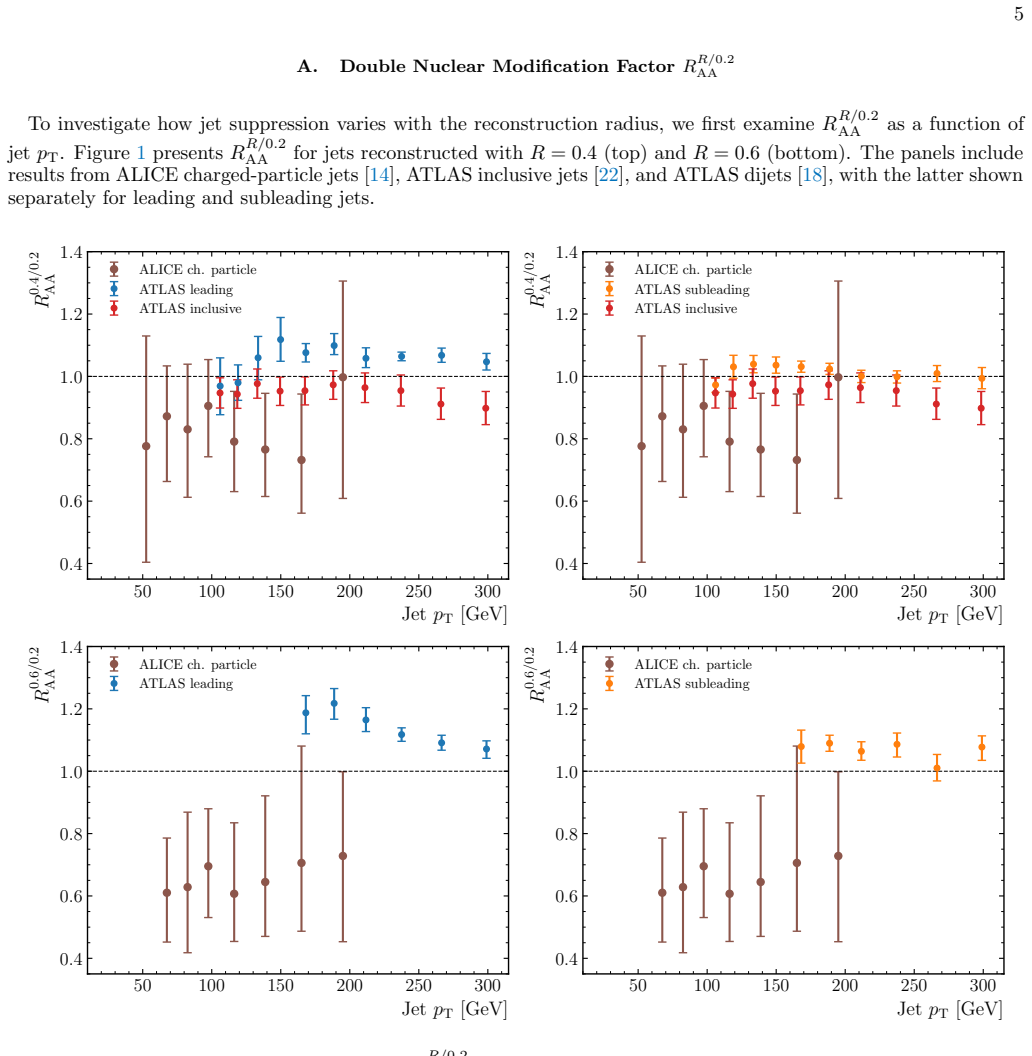
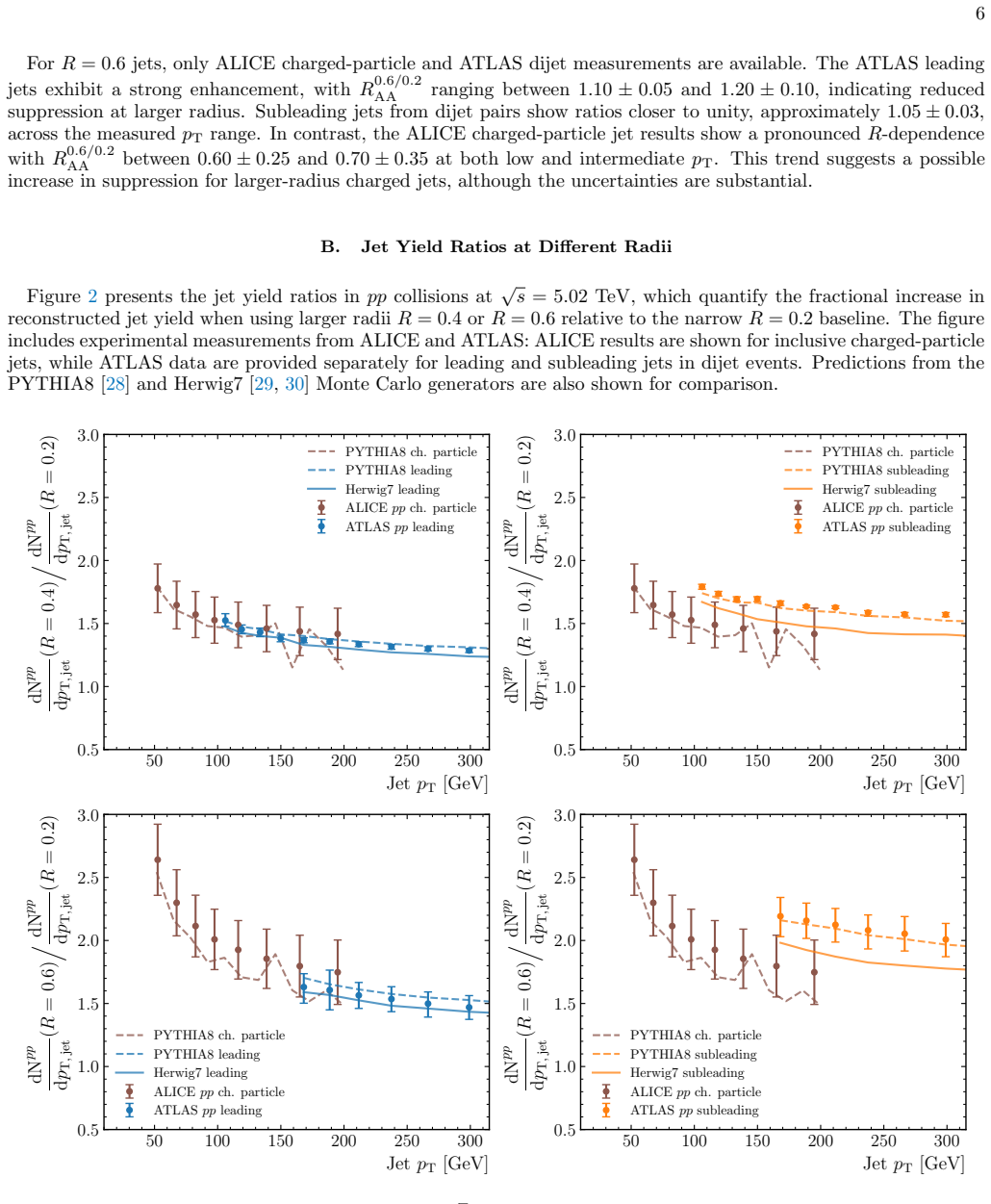
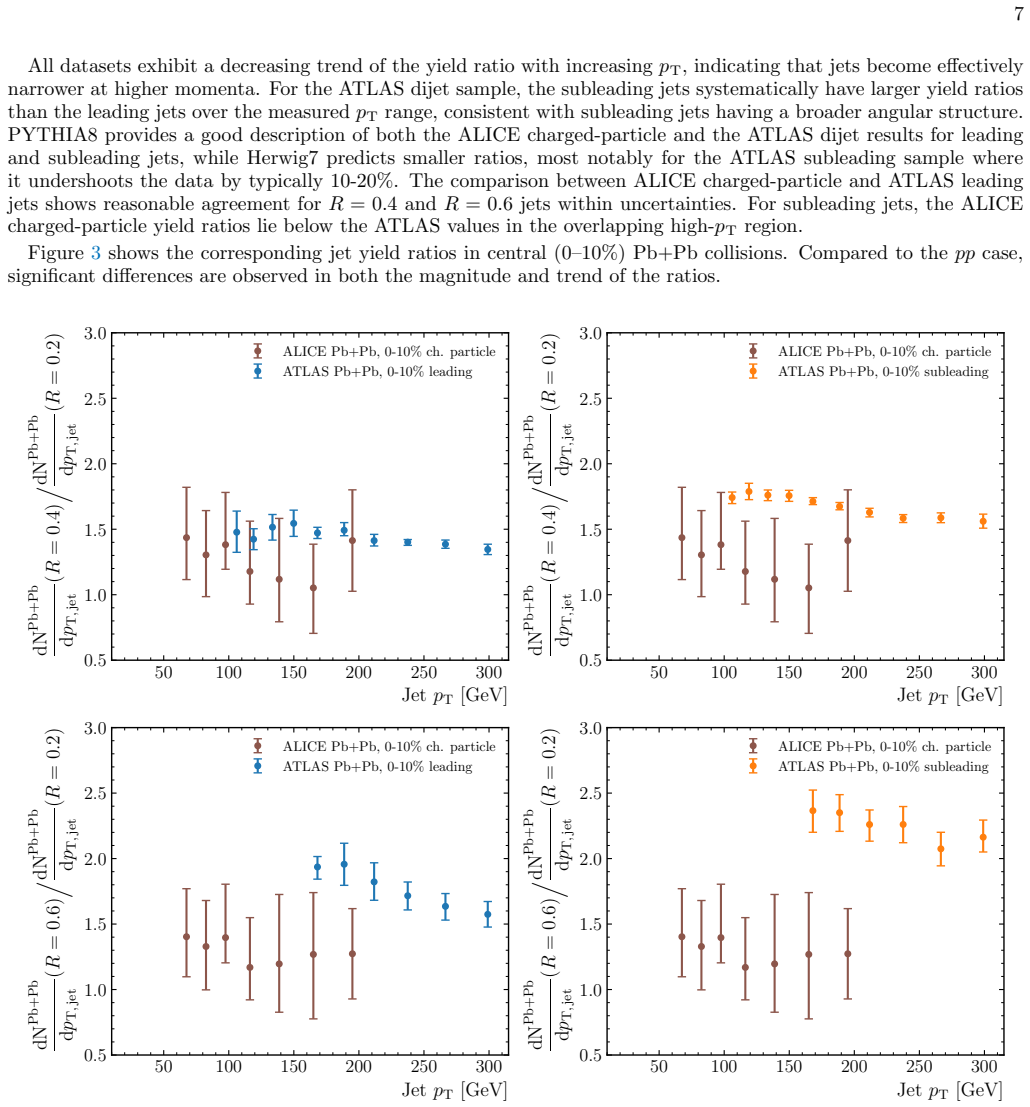

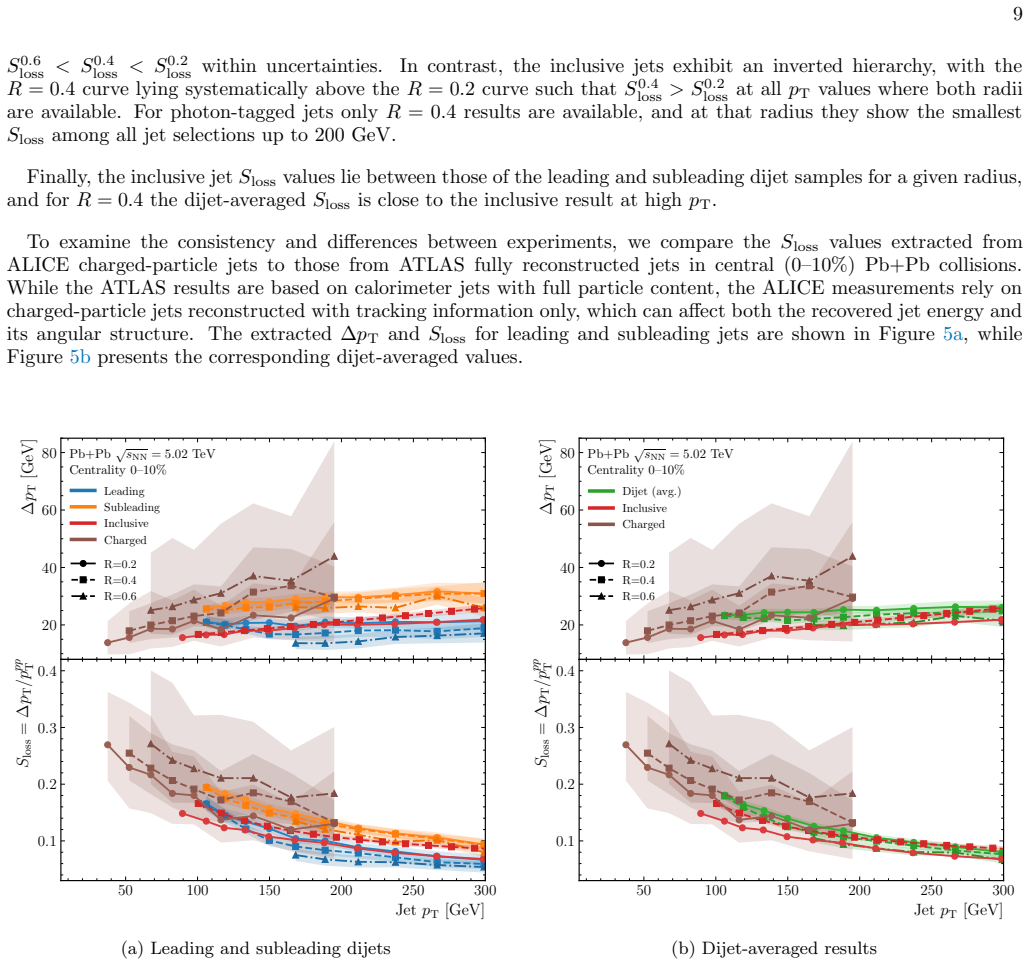
read the original abstract
The quark-gluon plasma (QGP) is a deconfined state of strongly interacting matter formed at extreme temperature and energy density in ultra-relativistic nucleus-nucleus collisions at RHIC and the LHC. High transverse momentum jets, produced in initial hard scatterings, traverse the QGP and lose energy via elastic and radiative processes, an effect known as jet quenching. The nuclear modification factor, $R_{\mathrm{AA}}$, defined as the ratio of the Pb+Pb jet yield to the $pp$ cross section scaled by the nuclear thickness function, is widely used to quantify jet quenching. However, its value depends strongly on both the $pp$ jet spectral shape and the strength of the quenching, complicating comparisons across jet selections. The fractional energy loss, $S_{\text{loss}}$, quantifying the average medium-induced momentum shift of jets, is designed to mitigate this dependence. In central Pb+Pb collisions at $\sqrt{s_{\mathrm{NN}}}=5.02~\mathrm{TeV}$, we compile and compare published ATLAS and ALICE measurements of jet suppression for inclusive single-jet and dijet selections across multiple jet radii, considering (i) the ratio of the nuclear modification factor at a given radius to that at a reference radius of 0.2, and (ii) the fractional energy loss. The radius dependence of this ratio differs between single-jet and dijet measurements, and between ATLAS calorimeter jets and ALICE charged-particle jets, reflecting differences in kinematic event selections and jet constituents. Expressing the results in terms of $S_{\text{loss}}$ allows direct, radius-differential comparisons across experiments with reduced sensitivity to the $pp$ spectral slope. Combining these approaches enables constraints on the radius dependence of jet modification that account for selection biases, and facilitates cross-experiment benchmarking of jet quenching models.
Editorial analysis
A structured set of objections, weighed in public.
Referee Report
Summary. The manuscript compiles and compares published ATLAS and ALICE measurements of jet nuclear modification factor R_AA in central Pb+Pb collisions at 5.02 TeV for inclusive single-jet and dijet selections across multiple jet radii. It examines both the ratio R_AA(R)/R_AA(0.2) and the fractional energy loss S_loss, concluding that expressing results in terms of S_loss reduces sensitivity to the pp spectral slope and enables direct, radius-differential cross-experiment comparisons that account for selection biases between calorimeter and charged-particle jets.
Significance. If the central assumption holds, the work supplies a practical framework for combining heterogeneous experimental datasets to constrain the radius dependence of jet quenching in the QGP. Credit is due for relying exclusively on published results and standard definitions of R_AA and S_loss rather than introducing new parameters or ad-hoc corrections.
major comments (1)
- [Abstract] Abstract: the claim that S_loss 'allows direct, radius-differential comparisons across experiments with reduced sensitivity to the pp spectral slope' and thereby 'enables constraints on the radius dependence of jet modification that account for selection biases' rests on the unverified premise that residual differences in jet constituents (calorimeter vs. charged-particle) and kinematic selections between ATLAS and ALICE are fully mitigated; no explicit validation, mock-spectrum test, or systematic variation study is referenced to support this load-bearing step.
minor comments (1)
- [Abstract] The abstract states that the radius dependence 'differs between single-jet and dijet measurements, and between ATLAS calorimeter jets and ALICE charged-particle jets' but does not indicate whether the subsequent S_loss comparison quantitatively reconciles these differences or merely re-expresses them.
Simulated Author's Rebuttal
We thank the referee for the careful review and the opportunity to address this important point on validation of the S_loss framework. We respond to the major comment below.
read point-by-point responses
-
Referee: [Abstract] Abstract: the claim that S_loss 'allows direct, radius-differential comparisons across experiments with reduced sensitivity to the pp spectral slope' and thereby 'enables constraints on the radius dependence of jet modification that account for selection biases' rests on the unverified premise that residual differences in jet constituents (calorimeter vs. charged-particle) and kinematic selections between ATLAS and ALICE are fully mitigated; no explicit validation, mock-spectrum test, or systematic variation study is referenced to support this load-bearing step.
Authors: We agree that the manuscript does not contain an explicit mock-spectrum test or systematic variation study quantifying residual effects from jet constituents and kinematic differences. The central claim uses the phrasing 'reduced sensitivity' (not 'fully mitigated'), and the supporting evidence is the observed convergence of S_loss values relative to the larger spread seen in R_AA ratios across the compiled published datasets. To address the concern directly, we will add a short subsection to the discussion that performs a simple sensitivity test by varying the assumed pp spectral index within published uncertainties and shows the resulting impact on both R_AA ratios and S_loss. The abstract will be revised to emphasize that the reduction is demonstrated empirically from the data compilation rather than proven to eliminate all selection effects. These changes will be presented as strengthening the interpretation without altering the core conclusions. revision: partial
Circularity Check
No circularity; analysis compiles external data using standard definitions
full rationale
The paper compiles and compares already-published ATLAS and ALICE measurements of jet suppression. It applies the standard definitions of R_AA (ratio of Pb+Pb yield to scaled pp cross section) and S_loss (average medium-induced momentum shift) taken from prior literature without introducing new equations, fits, or predictions. No load-bearing step reduces to a self-citation, fitted parameter renamed as prediction, or ansatz smuggled via citation. The central claims rest on re-expression of independent external data points, making the work self-contained against external benchmarks.
Axiom & Free-Parameter Ledger
Reference graph
Works this paper leans on
-
[1]
John C. Collins and M. J. Perry. Superdense Matter: Neutrons Or Asymptotically Free Quarks?Phys. Rev. Lett., 34:1353, 1975.doi:10.1103/PhysRevLett.34.1353
-
[2]
Edward V. Shuryak. Quantum Chromodynamics and the Theory of Superdense Matter.Phys. Rept., 61:71–158, 1980. doi:10.1016/0370-1573(80)90105-2
-
[3]
Paul Romatschke and Ulrike Romatschke.Relativistic Fluid Dynamics In and Out of Equilibrium. Cambridge Monographs on Mathematical Physics. Cambridge University Press, 5 2019.arXiv:1712.05815,doi:10.1017/9781108651998
work page internal anchor Pith review Pith/arXiv arXiv doi:10.1017/9781108651998 2019
-
[4]
Review of Jet Measurements in Heavy Ion Collisions
Megan Connors, Christine Nattrass, Rosi Reed, and Sevil Salur. Jet measurements in heavy ion physics.Rev. Mod. Phys., 90:025005, 2018.arXiv:1705.01974,doi:10.1103/RevModPhys.90.025005
work page internal anchor Pith review Pith/arXiv arXiv doi:10.1103/revmodphys.90.025005 2018
-
[5]
Looking inside jets: an introduction to jet substructure and boosted-object phenomenology
Simone Marzani, Gregory Soyez, and Michael Spannowsky.Looking inside jets: an introduction to jet substructure and boosted-object phenomenology, volume 958. Springer, 2019.arXiv:1901.10342,doi:10.1007/978-3-030-15709-8
work page internal anchor Pith review Pith/arXiv arXiv doi:10.1007/978-3-030-15709-8 2019
-
[6]
J. D. Bjorken. Energy Loss of Energetic Partons in Quark-Gluon Plasma: Possible Extinction of Highp T Jets in Hadron- Hadron Collisions. 8 1982
1982
-
[7]
Jet Quenching in Dense Matter.Phys
Miklos Gyulassy and Michael Plumer. Jet Quenching in Dense Matter.Phys. Lett. B, 243:432–438, 1990.doi:10.1016/ 0370-2693(90)91409-5
1990
-
[8]
Leticia Cunqueiro and Anne M. Sickles. Studying the QGP with Jets at the LHC and RHIC.Prog. Part. Nucl. Phys., 124:103940, 2022.arXiv:2110.14490,doi:10.1016/j.ppnp.2022.103940
-
[9]
Glauber Modeling in High Energy Nuclear Collisions
Michael L. Miller, Klaus Reygers, Stephen J. Sanders, and Peter Steinberg. Glauber modeling in high energy nuclear col- lisions.Ann. Rev. Nucl. Part. Sci., 57:205–243, 2007.arXiv:nucl-ex/0701025,doi:10.1146/annurev.nucl.57.090506. 123020
work page internal anchor Pith review Pith/arXiv arXiv doi:10.1146/annurev.nucl.57.090506 2007
-
[10]
Cone-Size Dependence of Jet Suppression in Heavy-Ion Collisions.Phys
Yacine Mehtar-Tani, Daniel Pablos, and Konrad Tywoniuk. Cone-Size Dependence of Jet Suppression in Heavy-Ion Collisions.Phys. Rev. Lett., 127(25):252301, 2021.arXiv:2101.01742,doi:10.1103/PhysRevLett.127.252301
-
[11]
Heavy quarks and jets as probes of the QGP.Prog
Liliana Apolin´ ario, Yen-Jie Lee, and Michael Winn. Heavy quarks and jets as probes of the QGP.Prog. Part. Nucl. Phys., 127:103990, 2022.arXiv:2203.16352,doi:10.1016/j.ppnp.2022.103990
-
[12]
Jet suppression and azimuthal anisotropy from RHIC to LHC
Yacine Mehtar-Tani, Daniel Pablos, and Konrad Tywoniuk. Jet suppression and azimuthal anisotropy from RHIC to LHC. Phys. Rev. D, 110(1):014009, 2024.arXiv:2402.07869,doi:10.1103/PhysRevD.110.014009
-
[13]
CMS Collaboration. First measurement of large area jet transverse momentum spectra in heavy-ion collisions.JHEP, 05:284, 2021.arXiv:2102.13080,doi:10.1007/JHEP05(2021)284. 11
-
[14]
ALICE Collaboration. Measurement of the radius dependence of charged-particle jet suppression in Pb-Pb collisions at√sNN = 5.02 TeV.Phys. Lett. B, 849:138412, 2024.arXiv:2303.00592,doi:10.1016/j.physletb.2023.138412
-
[15]
ATLAS Collaboration. Measurements of the Nuclear Modification Factor for Jets in Pb+Pb Collisions at √sNN = 2.76 TeV with the ATLAS Detector.Phys. Rev. Lett., 114(7):072302, 2015.arXiv:1411.2357,doi:10.1103/PhysRevLett. 114.072302
work page internal anchor Pith review Pith/arXiv arXiv doi:10.1103/physrevlett 2015
-
[16]
ATLAS Collaboration. Observation of a Centrality-Dependent Dijet Asymmetry in Lead-Lead Collisions at √sNN = 2.76 TeV with the ATLAS Detector at the LHC.Phys. Rev. Lett., 105:252303, 2010.arXiv:1011.6182,doi:10.1103/ PhysRevLett.105.252303
Pith/arXiv arXiv 2010
-
[17]
CMS Collaboration. Observation and studies of jet quenching in PbPb collisions at √sN N = 2.76 TeV.Phys. Rev. C, 84:024906, 2011.arXiv:1102.1957,doi:10.1103/PhysRevC.84.024906
work page internal anchor Pith review Pith/arXiv arXiv doi:10.1103/physrevc.84.024906 2011
-
[18]
ATLAS Collaboration. Jet radius dependence of dijet momentum balance and suppression in Pb+Pb collisions at 5.02 TeV with the ATLAS detector.Phys. Rev. C, 110(5):054912, 2024.arXiv:2407.18796,doi:10.1103/PhysRevC.110.054912
-
[19]
PHENIX Collaboration. Formation of dense partonic matter in relativistic nucleus-nucleus collisions at RHIC: Experimental evaluation by the PHENIX collaboration.Nucl. Phys. A, 757:184–283, 2005.arXiv:nucl-ex/0410003,doi:10.1016/j. nuclphysa.2005.03.086
work page internal anchor Pith review Pith/arXiv arXiv doi:10.1016/j 2005
-
[20]
PHENIX Collaboration. A Detailed Study of High-p T Neutral Pion Suppression and Azimuthal Anisotropy in Au+Au Collisions at √sNN = 200 GeV.Phys. Rev. C, 76:034904, 2007.arXiv:nucl-ex/0611007,doi:10.1103/PhysRevC.76. 034904
work page internal anchor Pith review Pith/arXiv arXiv doi:10.1103/physrevc.76 2007
-
[21]
ATLAS Collaboration. Comparison of inclusive and photon-tagged jet suppression in 5.02 TeV Pb+Pb collisions with ATLAS.Phys. Lett. B, 846:138154, 2023.arXiv:2303.10090,doi:10.1016/j.physletb.2023.138154
-
[22]
ATLAS Collaboration. Measurement of the nuclear modification factor for inclusive jets in Pb+Pb collisions at√sNN = 5.02 TeV with the ATLAS detector.Phys. Lett. B, 790:108–128, 2019.arXiv:1805.05635,doi:10.1016/j.physletb.2018. 10.076
work page internal anchor Pith review Pith/arXiv arXiv doi:10.1016/j.physletb.2018 2019
-
[23]
ATLAS Collaboration. Measurement of Suppression of Large-Radius Jets and Its Dependence on Substructure in Pb+Pb Collisions at √sN N = 5.02 TeV with the ATLAS Detector.Phys. Rev. Lett., 131(17):172301, 2023.arXiv:2301.05606, doi:10.1103/PhysRevLett.131.172301
-
[24]
The anti-k_t jet clustering algorithm
Matteo Cacciari, Gavin P. Salam, and Gregory Soyez. The anti-k t jet clustering algorithm.JHEP, 04:063, 2008.arXiv: 0802.1189,doi:10.1088/1126-6708/2008/04/063
work page internal anchor Pith review Pith/arXiv arXiv doi:10.1088/1126-6708/2008/04/063 2008
-
[25]
PHENIX Collaboration. Scaling properties of fractional momentum loss of high-p T hadrons in nucleus-nucleus collisions at √sN N from 62.4 GeV to 2.76 TeV.Phys. Rev. C, 93(2):024911, 2016.arXiv:1509.06735,doi:10.1103/PhysRevC.93. 024911
-
[26]
Interpreting Single Jet Measurements in Pb+Pb Collisions at the LHC
Martin Spousta and Brian Cole. Interpreting single jet measurements in Pb + Pb collisions at the LHC.Eur. Phys. J. C, 76(2):50, 2016.arXiv:1504.05169,doi:10.1140/epjc/s10052-016-3896-0
work page internal anchor Pith review Pith/arXiv arXiv doi:10.1140/epjc/s10052-016-3896-0 2016
-
[27]
ALICE Collaboration. Measurement of inclusive charged-particle jet production in pp and p-Pb collisions at √sNN = 5.02 TeV.JHEP, 05:041, 2024.arXiv:2307.10860,doi:10.1007/JHEP05(2024)041
-
[28]
Torbj¨ orn Sj¨ ostrand, Stefan Ask, Jesper R. Christiansen, Richard Corke, Nishita Desai, Philip Ilten, Stephen Mrenna, Stefan Prestel, Christine O. Rasmussen, and Peter Z. Skands. An introduction to PYTHIA 8.2.Comput. Phys. Commun., 191:159–177, 2015.arXiv:1410.3012,doi:10.1016/j.cpc.2015.01.024
work page internal anchor Pith review Pith/arXiv arXiv doi:10.1016/j.cpc.2015.01.024 2015
-
[29]
M. Bahr et al. Herwig++ Physics and Manual.Eur. Phys. J. C, 58:639–707, 2008.arXiv:0803.0883,doi:10.1140/epjc/ s10052-008-0798-9
work page internal anchor Pith review Pith/arXiv arXiv doi:10.1140/epjc/ 2008
-
[30]
Herwig 7.0 / Herwig++ 3.0 Release Note
Johannes Bellm et al. Herwig 7.0/Herwig++ 3.0 release note.Eur. Phys. J. C, 76(4):196, 2016.arXiv:1512.01178, doi:10.1140/epjc/s10052-016-4018-8
work page internal anchor Pith review Pith/arXiv arXiv doi:10.1140/epjc/s10052-016-4018-8 2016
discussion (0)
Sign in with ORCID, Apple, or X to comment. Anyone can read and Pith papers without signing in.